March 31

GUEST CURATOR:  Mary Aldrich

What was advertised in a colonial newspaper 250 years ago today?

Mar 31 - 3:31:1766 Connecticut Courant
Connecticut Courant (March 31, 1766).

“Augustus Deley, … CONTINUES to carry on the Business of manufacturing TOBACCO.”

I find it interesting that this advertisement starts by stating that the advertiser “CONTINUES to carry on the Business of manufacturing TOBACCO, in all its Branches.” This makes me wonder if something happened to cast doubt in the minds of his customers about whether they would be able to continue purchasing their tobacco from him or not. This advertisement has the air of someone reassuring his customers that he was indeed still in business.

The fact that Deley mentioned that he needed sufficient notice from those wishing to purchase large quantities of tobacco makes me think that he was not a minor tobacconist. To have customers purchase large amounts of tobacco must have occurred often enough for him to specifically ask those who wished to purchase those amounts to let him know beforehand. It must have been inconvenient for him to have a customer come in and take most of his supply because afterward he would have to potentially turn other customers away while he waited for a new shipment.

**********

ADDITIONAL COMMENTARY:  Carl Robert Keyes

Augustus Deley certainly wanted residents of Hartford and its hinterland to know that he continued to sell tobacco, that he was still in business, but his advertisement also alluded to a notice that he posted in the Connecticut Courant nearly three months earlier. Perhaps Deley had recently moved to Hartford and was settling in. After all, his earlier advertisement announced that he was a “Tobaconist (from New-York),” but he dropped that description in his updated advertisement. He may have become an increasingly familiar face in Hartford, but he likely wanted to let potential customers not yet aware of his shop or uncertain of its success that he did indeed “CONTINUE to carry on the Business of manufacturing TOBACCO.”

Among the various updates to his advertisement, Deley listed a location: “At the Sign of the Black Boy, Near the North Meeting-House in Hartford.” It was no coincidence that a tobacconist set up shop “At the Sign of the Black Boy.” After all, slaves provided the labor involved in cultivating tobacco in the Chesapeake colonies. Just as many trade cards or tobacco wrappers from the era featured images of enslaved men and women at work on plantations or interacting happily with white masters and overseers, Deley selected a shop sign that reduced a “Black Boy” to the colonial equivalent of a mascot or a brand to market his product.
March 29

GUEST CURATOR:  Mary Aldrich

What was advertised in a colonial newspaper 250 years ago this week?

Mar 29 - 3:28:1766 New-Hampshire Gazette
New-Hampshire Gazette (March 28, 1766).

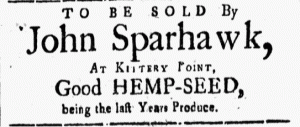
“TO BE SOLD by John Sparhawk, AT KITTERY POINT, Good HEMP-SEED.”

Hemp was a valuable commodity in eighteenth century America because it was used to make the ropes that were on every ship in this period. According to Ben Swenson at Colonial Williamsburg, all of the colonies grew hemp because of its ability to grow virtually anywhere. By the eighteenth century, the colonies of Virginia and Maryland grew the most hemp, but for farmers in New Hampshire it was still a valuable crop.

Farmers were profit driven and the best way to grow hemp to get nice long fibers to be used for ropes was to plant them close together. This limited the amount of female flowers the plants were able to produce, which is location of the greatest concentration of THC. (Colonists did know about the hallucinogenic properties of hemp.) Besides rope, hemp was used to make cloth for clothes and sacks, paper, and bed ticking, which kept the feathers or straw of the mattress from poking through. The cloth made from hemp grown in the colonies was especially valued when the colonists began to boycott goods from England. The growing and processing of hemp was already so well established that colonists were easily able to either grow more hemp or set aside a larger amount for the production of homespun.

The processing of hemp was difficult; after it was cut and rotted the waste had to be removed from the desired long fibers. The hemp needed to be rotted because it would loosen the fibers from the woody interior and the bark. The process of breaking the hemp separated the fibers from much of the waste. Afterward it needed to be beaten and scraped, then combed to remove the rest of the waste from the strands. Only then was the hemp suitable to be processed into its final product.

**********

ADDITIONAL COMMENTARY:  Carl Robert Keyes

At first glance today’s advertisement appears rather bland, but Mary’s analysis demonstrates why it is an appropriate sequel to yesterday’s featured advertisement for Barnabas Clarke’s shop “Near Liberty-Bridge” in Portsmouth. The two appeared on the same page of the New-Hampshire Gazette, Sparhawk’s about two-thirds of the way down the second column and Clarke’s filling the top half of the third and final column.

Clarke explicitly invoked many colonists’ sentiments about their relationship to Parliament when he listed the location of his shop, which would have called to mind the protests against the Stamp Act that occurred quite recently, less than three months earlier. Sparhawk, on the other hand, did not make reference to such difficulties, but, given the ubiquity of hemp in the colonial world, most colonists would have been aware that it was a resource for creating homespun. Sparhawk’s advertisement played off what colonists knew about nonconsumption and nonimportation even as it encouraged consumption of an alternate product. As the article from Colonial Williamsburg cited above explains, in the coming years newspapers increasingly encouraged growing and using hemp as a means of resistance as the imperial crisis intensified.

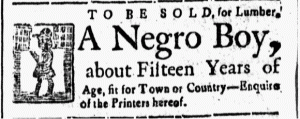
Mar 29 - Slave Ad 3:28:1766 New-Hampshire Gazette
New-Hampshire Gazette (March 28, 1766).

Given that the advertisements for yesterday and today each had connections to colonists’ understanding of liberty, it is worth noting a third advertisement that appeared on this page of the New-Hampshire Gazette, immediately to the right of Sparkhawk’s advertisement and a bit below Clarke’s. While Clarke peddled his wares “Near Liberty-Bridge” and Sparhawk offered a product that could help colonists reduce commercial ties with an oppressive England, readers of the New-Hampshire Gazette could purchase “A Negro Boy, about Fifteen Years of Age.” Once again, slavery and freedom were intertwined in the advertisements in the New-Hampshire Gazette.

March 16

Who was the subject of an advertisement in a colonial newspaper 250 years ago this week?

Mar 16 - 3:14:1766 New-Hampshire Gazette
New-Hampshire Gazette (March 14, 1766).

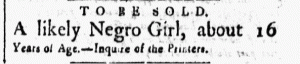
“A likely Negro Girl, about 16 Years of Age.”

I’ve previously made it clear that I wish to feature a new and different advertisement every day. This short advertisement is indeed new to the Adverts 250 Project, though it looks so similar to several others that it’s easy to understand why somebody might question whether it appeared here before.

So why choose it as today’s advertisement? How does it help us to understand early American advertising, consumer culture, or slavery better than any of the previous advertisements for enslaved men, women, and children analyzed here?

Part of the answer lies in the fact that this has become such a familiar type of advertisement. I have not disproportionately selected advertisements seeking to buy or sell enslaved Africans and African Americans. If advertisements for enslaved people have become a familiar part of this project, imagine just how commonplace they appeared to colonists in the eighteenth century. Any reader of a colonial newspaper would have seen far more advertisements for enslaved people than have appeared here, and far more regularly. An advertisement for “A likely Negro Girl” and its counterparts may startle many modern readers, but those advertisements would have been just part of the commercial and cultural landscape in early America.

Only six advertisements for consumer goods and services appeared in this issue of the New-Hampshire Gazette. Two of them offered to sell enslaved youths, “A likely Negro Girl” here and “A NEGRO BOY” (printed just below an advertisement for “BARBADOS whitest LOAF SUGAR,” as featured last week).

These are some of the reasons that I consider it important to continue to feature advertisements for enslaved people. Even in colonial New Hampshire, far removed geographically from the plantations of the Chesapeake, the Lower South, and the Caribbean, slavery was an integral part of advertising as well as commerce more generally. To overlook or ignore these advertisements because they resemble or replicate others would be to misconstrue the past.

March 8

What was advertised in a colonial newspaper 250 years ago this week?

Mar 8 - 3:7:1766 New-Hampshire Gazette
New-Hampshire Gazette (March 7, 1766).

“This masterly Performance merits the closest Attention and Consideration of every true SON OF AMERICA, the Propriety of imposing TAXES on free Subjects.”

Yesterday’s advertisements from the New-Hampshire Gazette testified to the connections between slavery and consumer culture in eighteenth-century America. Slavery was discussed elsewhere on the same page of that issue, though it was slavery of a different sort. The printers inserted several letters forwarded by the “true born Sons of Liberty” concerning the continuing controversy over the Stamp Act. The American protestors were “determined to use there utmost Efforts to prevent even the Appearance of Slavery.” Meanwhile, readers who glanced two columns to the left would have seen the advertisements for “BARBADOS whitest LOAF SUGAR” and “A NEGRO BOY.”

Today’s advertisement appeared on the previous page. It does not include the word “slavery,” but other items published in the same issue demonstrate that many readers consciously linked the Stamp Act and enslavement (even as they may have attempted to eschew associations between sugar and slavery). In American Slavery, American Freedom (1975), Edmund S. Morgan explored the paradox of the founding of the American nation: the rhetoric of freedom and equality during the Revolution and after occurred with the enslavement of black laborers as its backdrop throughout the colonial era and beyond. The liberty of white Americans was contingent in many ways on the enslavement of Africans and African Americans, a distressing contradiction.

Today’s advertisement is certainly evidence that advertising and consumer culture took on a political valence in the years of the imperial crisis, but a story of patriotic advertising would be an incomplete story. Just as yesterday’s advertisements for sugar and an enslaved boy were bound together, the stories of Americans advocating (and eventually fighting) for their liberties and simultaneously continuing to practice slavery cannot be separated from each other.

March 7

What was advertised in a colonial newspaper 250 years ago today?

Mar 7 - 3:7:1766 New-Hampshire Gazette
New-Hampshire Gazette (March 7, 1766).

“BARBADOS whitest LOAF SUGAR.”

“A NEGRO BOY.”

Today I have chosen two advertisements whose proximity on the page resonated with me. When I scanned this issue of the New-Hampshire Gazette to make my selection, particular portions of each advertisement seemed to jump off the page:

  • “BARBADOS whitest LOAF SUGAR”
  • “A NEGRO BOY”

Two separate advertisements, but each inextricably bound with the other.

Considered on its own, the first advertisement seems to hide the connection between a finished product available for purchase in an increasingly vibrant eighteenth-century marketplace and the labor of enslaved Africans on plantations in faraway Barbados – at least to twenty-first-century readers unfamiliar with the networks of production, exchange, and consumption in the early modern Atlantic world. Consumers in Portsmouth, New Hampshire, in 1766, on the other hand, would have certainly been aware of the origins of the sugar they consumed, even if advertisements and conversations politely avoided the topic.

Yet that connection could hardly be ignored here, not when an advertisement for “BARBADOS whitest LOAF SUGAR” was followed immediately by an advertisement for “A NEGRO BOY.” Slavery was not only a labor system practiced far away in other parts of the British Empire. It was not only an invisible (but not really invisible) foundation of commercial networks and consumer culture in the eighteenth century. Slavery was part of colonial culture even in the northernmost colonies in British mainland North America, even in those colonies with relatively few slaves compared to their counterparts in the Chesapeake and the Lower South.

Even for consumers who might have wished to ignore the connections between sugar and slavery, the juxtaposition of these two advertisements would have made that very difficult, if not impossible.

February 16

GUEST CURATOR:  Elizabeth Curley

Who was the subject of an advertisement in a colonial newspaper 250 years ago this week?

Feb 16 - 2:14:1766 New-Hampshire Gazette
New-Hampshire Gazette (February 14, 1766).

“TO BE SOLD … A NEGRO LAD, about Seventeen Years of Age.”

As we know from the previous week’s advertisements, even the northern colonies embraced the slave trade. This advertisement has no information about the owner, only that if interested readers should inquire of the printer for more information. We do know that the boy is being sold for lumber or on “short credit.”

At about seventeen the boy had been owned by the advertiser for four years. He could “speak good English.” However, the advertisement goes on that he was not being bought for his “BEAUTY or GOOD QUALITIES.” He would have made a good worker or “labouring Servant.” This means that he would have probably worked outside, perhaps on docks or a farm or assisting with carpentry or masonry. If he had been pretty he could have been placed as a house servant, which might have included duties such as footman, general house staff, and, if the family was wealthy enough, a coach or stable man.

The comment about his looks and beauty go beyond what type of work he would be doing though. Those comments point to the view that his owner and many others had.   They believed that African Americans were inferior and had only bad intentions. However much this makes me upset as a human being, this is an advertisement that needs to be brought up for the discussion that will follow. Many people believe that racism is not as relevant or present today, and, though African Americans thankfully are not property any more, as a nation we have a long way to go until we as a people are united in equality.

**********

ADDITIONAL COMMENTARY:  Carl Robert Keyes

As historians have worked since the era of the modern civil rights movement to better incorporate race, class, and gender into our narratives and interpretations of the American past, some critics (both within and, especially, beyond the academy) have accused us of so-called revisionism. Most historians agree that acknowledging our complicated past tells a richer and fuller story. Furthermore, it is a patriotic endeavor in that it challenges us as a nation to recognize when we have fallen short of the rhetoric of the Revolution so we can strive to do better. But in order to do better, we must be fully aware of both current events and the actions, attitudes, and ideas that have produced and shaped those current events over decades and centuries.

Yet there are other reasons to tell a story of the past that includes as many perspectives as possible. Earlier this semester, Elizabeth and her peers in our Public History course read this passage:

“Students’ lack of historical knowledge about the past results in an inability to see themselves, their families, and their communities as part of the larger process of American history. If students fail to see their own histories as important, they do not believe that they can have an impact on their environments. One of the ways in which people ‘learn to be members of society’ is to feel engaged in it. History is central to identifying, analyzing, and interpreting the values upon which civil society depends. All historians should remember that they are citizens as well as scholars and that they possess some responsibility to the larger civic community.”[1]

Many critics of so-called revisionism yearn for historical narratives they consider patriotic. They envision history as a means of inculcating civics in students. Although I disagree with the shape of the narrative many critics wish to impose, I wholeheartedly agree that civic participation is one of the most important purposes of studying the past. As the passage above argues, we need history with as much breadth and depth as possible in order to empower ALL Americans to engage in thoughtful citizenship and compassionate service to their communities.

The advertisement Elizabeth selected for today is important in its own right for what it tells us about the history of slavery in America and the depictions of Africans and African Americans in colonial New England. There is so much more to say about an advertisement that denigrates a seventeen-year-old boy for a supposed lack of both “BEAUTY or GOOD QUALITIES,” but I appreciate that Elizabeth has challenged us also to think about why it is important that we analyze this kind of advertisement and include it in our historical narrative.

**********

[1] Patricia Mooney-Melvin, “Professional Historians and the Challenge of Redefinition,” in Public History: Essays from the Field, rev. ed., ed. James B. Gardner and Peter S. LaPaglia, (Malabar, FL: Krieger Publishing Company, 2006), 17.

February 12

GUEST CURATOR:  Kathryn J. Severance

Who was the subject of an advertisement in a colonial newspaper 250 years ago this week?

Feb 12 - 2:10:1766 New-York Gazette
New-York Gazette (February 10, 1766).

“TO BE SOLD, For Want of Employ.”

This advertisement was put forth by a master looking to sell a slave due to the fact that they no longer could use their work.  Advertisements for slaves were common since slaves were commodities during the Colonial period.  In the eyes of many at the time, selling slaves was not much different than selling oxen or horses.

Feb 12 - Abolition Map
Map of Slave States and Free States in 1800.

The slave featured within this particular advertisement seems to be nineteen years old.  At twenty myself, I took a look at this advertisement and, for a second, imagine my own life.

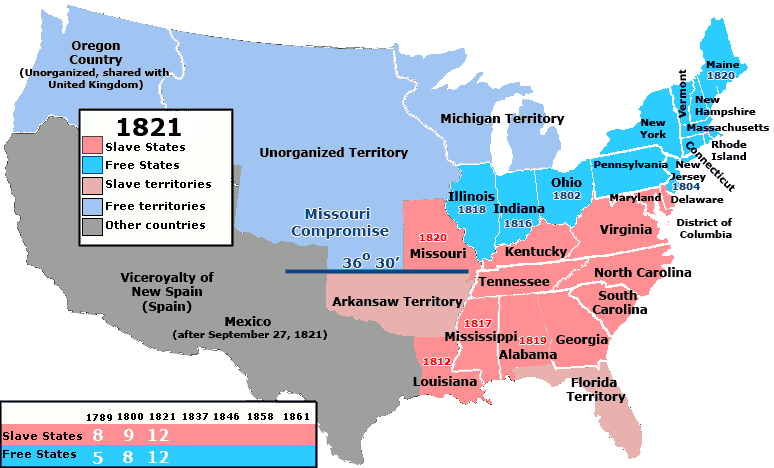
I imagine that many members of the public would be interested to know that a newspaper in what came to be known as the North, advertised slavery in the 1760s.  These types of advertisements also continued in New England’s newspapers for at least 10 years until Vermont, inspired by the Declaration of Independence, was the first to ban slavery in its 1777 state constitution.  Other New England states followed suit.  By 1800 all the states within New England’s borders abolished slavery.

**********

ADDITIONAL COMMENTARY:  Carl Robert Keyes

Today Kathryn has selected a type of advertisement that surprises many students who enroll in my courses on early America, whether the introductory survey or advanced electives on colonial and Revolutionary America or the capstone research seminar on slavery in America. As Kathryn points out, many are shocked when looking through the pages of eighteenth-century newspapers to discover just how often enslaved men, women, and children were advertised, either to be bought and sold or because they ran away from their masters.

Many students (and I would venture to guess many New Englanders as well as other Americans) imagine a strict North-South divide. Slavery as an institution was something that existed in the South, they assume, but not in the North. Such assumptions conflate nineteenth-century America and earlier periods by grafting the antebellum era over the realities of seventeenth- and eighteenth-century America.

Feb 12 - Abolition Map 1821
Map of Slave States and Free State in 1821.  Note that New Jersey and New York merit additional explanation and clarification due to gradual emancipation.

Even the history of abolition is messier than simply stating that after a certain year slavery had been abolished in Northern states. Not every state adopted immediate abolition. New York (1799) and New Jersey (1804) each enacted gradual emancipation intended to phase out slavery over time. As a result, slaves resided in New York as late as 1824 and in New Jersey until the Civil War ended in 1865.

This advertisement reminds us of a history of slavery that is all too often hidden: its widespread practice throughout all the colonies in the seventeenth and eighteenth centuries and its continuation in some Northern states well into the nineteenth century.

January 16

Who was the subject of an advertisement in a colonial newspaper 250 years ago today?

Jan 16 - 1:16:1766 Massachusetts-Gazette
Massachusetts-Gazette (January 16, 1766)

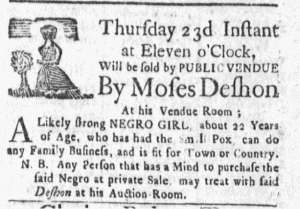
“Will be sold … A Likely strong NEGRO GIRL.”

Many, many different kinds of merchandise were bought and sold via the advertisements in eighteenth-century newspapers — certainly more than an assortment of textiles, housewares, and foodstuffs imported from London and other ports throughout the Atlantic world.  People could also be commodities in eighteenth-century America, as this advertisement demonstrates.

Advertisements for buying and selling slaves — and for runaways who sought to escape their captivity — were not uncommon in newspapers printed in New England and the Middle Atlantic and an even more familiar feature in the Chesapeake and Lower South.  This advertisement, however, is rather unique:  unlike most others peddling slaves, it includes an image, a woodcut intended to depict “A Likely strong NEGRO GIRL.”  This would have been a stock piece owned by the printer.  It could have been inserted in any number of advertisements for female slaves or even runaway wives since its features did not depict any particular woman or girl.  The “Likely strong NEGRO GIRL” remained nameless in this advertisement, just as interchangeable with other slaves, other pieces of property that could be bought and sold, as a piece of type that could be inserted in any number of advertisements.