October 22

GUEST CURATOR: Lindsay Hajjar

Who was the subject of an advertisement in a colonial American newspaper 250 years ago today?

oct-22-10221766-georgia-gazette
Georgia Gazette (October 22, 1766).

“Who is as good a cooper as any of his colour in this province.”

The word “cooper” was new to me. After doing some research I learned that it means someone who makes casks or barrels. David Waldstreicher talks about how important it was to owners that slaves had a trade because it allowed them to be more useful than just another farmhand.[1] Being a good cooper would have been a very useful skill; it would have made this ‘HEALTHY YOUNG NEGROE MAN” more valuable, to both the seller and the new owner.

In many other advertisements goods tended to be sold by the cask or barrel. For slave owners who wanted to sell things they were producing by the barrel having a slave who was able to produce the barrels would have been desirable. It would have been a way to save money, because they would not have to pay a third party. All the owner would have to do was buy the supplies and then have the slave make the casks. Waldstreicher talks about how different slaves had different value to their owners and “A HEALTHY YOUNG NEGROE MAN” who had a trade would be a slave that would have been considered profitable.

**********

ADDITIONAL COMMENTARY: Carl Robert Keyes

This advertisement, which ran for several weeks, has already been featured on the Slavery Adverts 250 Project. That project, however, limits the description and analysis of each advertisement to a single tweet. At the end of the semester, the curators will write an essay about slavery in colonial America that draws from the work they have done for the Slavery Adverts 250 Project and other course material. That means that the bulk of the analysis has been delayed. It might also have the unintended consequence of guest curators for the Adverts 250 Project choosing to examine other sorts of advertisements and not including advertisements for slaves in the rotation of commercial notices they select for research and analysis. I’ve made a commitment to including advertisements that treated slaves as commodities from the very start of this project. In selecting today’s advertisement, Lindsay has further augmented that aspect of the Adverts 250 Project.

Every time that I have encountered this advertisement I have been struck by the backhanded compliment about the enslaved young man’s skill as an artisan: “as good a cooper as any of his colour in this province.” The seller worked toward two very different purposes, creating an astounding dissonance within the advertisement. To gain the best price and make the slave as attractive as possible, the seller underscored his skill as a cooper. As Lindsay notes, this would have added value for a variety of reasons. As with other advertisements for enslaved tradesmen, it also demonstrates that slaves contributed expertise and experience to the colonial economy, in addition to labor.

Yet the seller also found it necessary to qualify the remark about the skills the enslaved cooper possessed. He was not as good as any cooper in the colony but rather as good “as any of his colour.” This diminished his skill by implying that white coopers were categorically better at their trade. No matter how skilled this “HEALTHY YOUNG NEGROE MAN” may have been, the seller perpetuated a hierarchy in which the enslaved cooper was still inferior to white artisans.

**********

[1] David Waldstreicher, “Reading the Runaways: Self-Fashioning, Print Culture, and Confidence in Slavery in the Eighteenth-Century Mid-Atlantic,” William and Mary Quarterly 56, no. 2 (April 1999): 244.

October 17

GUEST CURATOR: Lindsay Hajjar

Who was the subject of an advertisement in a colonial American newspaper 250 years ago today?

oct-17-10171766-new-london-gazette
New-London Gazette (October 17, 1766).

“ALSO, An able body’d hearty Wench 16 Years old (with a sucking Child.”

This advertisement started with the sale of a twenty-nine-year old slave, described as “strong and healthy.” The seller then indicated where he was born and that he has skills in farming. Next, he stated he was selling a “Wench” who was sixteen years old. By calling her a wench he degraded her status as a woman even further. In this case, a female slave was held at even lower regard than a male slave, perhaps because of the fact that when she had a child it took away from her ability to do work. The girl being sold was “able-bodied” and could “do all Sorts of House Work,” but was being sold because of “her breeding.” The words “breeding” and “wench” show the seller’s opinion about women, especially enslaved women, as well as an assumption that because she was a women and a slave she should be good at housework because that was what she was born to do.

In “Work, Pregnancy, and Infant Mortality among Southern Slaves,” John Campbell talks about how in the South slave owners placed value not on the gender of slaves but rather their age and physical condition. Campbell also points out that both male and female slaves were “harvesting equal proportions of cotton,” showing that in the South it did not matter to the slave owners the gender of the slave as long as they were capable of doing the work.[1] However, this advertisement was printed in the northern colony of Connecticut during an earlier period; the seller’s tone was different. It changed, becoming more aggressive and angry when going from depicting the man to the girl being sold. It is as if the seller was annoyed that she had a child that was now going to be a burden on him and he had to sell them because the child would be a distraction to her. He was not willing to make the long-term investment in the child, showing that Northern slave owners in the colonial period were not as ambivalent about their slaves’ genders as Southern slave owners were in the nineteenth century. In his advertisement the seller said the young woman came “with a sucking child.” He seemed upset with the fact that she had a child and that the child was nothing but an inconvenience, because the child was still breastfeeding. Female slaves could be looked at as beneficial because they had the ability to produce more slaves for their owners but that could also be a shortcoming because when they were pregnant and while the child was dependent mothers were not able to work to the same capacity.

**********

ADDITIONAL COMMENTARY: Carl Robert Keyes

I appreciate how Lindsay compares the sentiments expressed in today’s advertisement to the attitudes adopted by slaveholders in another region during another period, underscoring that there was not a monolithic experience of slavery in America. Instead, different people (both enslaved and free) faced very different circumstances depending on the period and place in which they lived.

oct-17-10171766-puff-piece-new-london-gazette
New-London Gazette (October 17, 1766).

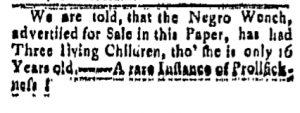
Another notice that appeared on the same page of the New-London Gazette further complicates today’s advertisement. “We are told,” an anonymous narrator (perhaps the printer) proclaimed, “that the Negro Wench advertised for Sale in this Paper, has had Three living Children, tho’ she is only 16 Years old. — A rare Instance of Prollfickness!” (Presumably the last word was supposed to be “prolificness.”) As Lindsay noted, the seller wished to be rid of this young woman solely because of her “breeding” and the inconveniences that it caused. The other notice, however, seemed to celebrate the young enslaved woman’s ability to produce children, promoting her fecundity as a selling point for potential buyers.

Who was responsible for the announcement that the sixteen-year-old “hearty Wench” already had three children? Was this an advertisement – a puff piece – placed by the current owner of the young woman in hopes of generating interest and making a sale? Or did the printer insert it of his own volition, as a point of interest he hoped would inform and entertain readers? The placement on the page makes it difficult to reach any particular conclusion. The notice appeared among the advertisements included in that issue of the New-London Gazette, but it appears at the bottom of the column immediately to the left of the column in which the advertisement for the “hearty Wench” was printed. It may have been positioned to prime readers to consider purchasing the young woman, but it also could have been intended as amusing filler when news and advertising did not completely fill the column. Either way, it now provides disheartening evidence concerning the levels of degradation one enslaved woman experienced at the hands of her captor and his community.

When Lindsay first presented this advertisement for my approval, I thought I might contemplate whether it suggested a family was being separated. When I examined it in the context of the rest of the issue, however, I discovered a much more revolting situation.

**********

[1] John Campbell, “Work, Pregnancy, and Infant Mortality among Southern Slaves,” Journal of Interdisciplinary History 14, no. 4 (Spring 1984): 797.

Introducing the Slavery Adverts 250 Project

Today is the first day of a twelve-week project being undertaken by students in my Colonial America course at Assumption College. The Slavery Adverts 250 Project seeks to identify and republish every advertisement that offered slaves for sale or reported runaways printed in colonial newspapers exactly 250 years ago. Unlike the Adverts 250 Project, which examines one advertisement each day, the Slavery Adverts 250 Project will feature multiple advertisements on most days, drawing from every colonial newspaper that has been digitized and made available to my students via Accessible Archives, Colonial Williamsburg’s Digital Library, and Readex’s America’s Historical Newspapers.

Each advertisement will appear individually via the Slavery Adverts 250 Project’s Twitter account (@SlaveAdverts250). In addition, all of the advertisements published on a given day will appear together in a single entry on the Adverts 250 Project’s blog. Individual advertisements will not be analyzed separately; instead, my students and I are creating an archive to be consulted for an essay about slavery in colonial America that will be their final exam at the end of the semester.

Each student will serve as curator of the Slavery Adverts 250 Project for one week. The curator will be responsible for identifying all relevant advertisements, posting them to the project’s Twitter account, and compiling statistics about how many advertisements were included in the project during their week. I am serving as curator during the first week, to establish the project and to troubleshoot any difficulties before turning the project over to my students.

This research project is both experimental and collaborative. I expect that I will learn just as much as my students do as we work together to gather and republish these advertisements. Throughout the project, we will ask ourselves a series of questions about what these advertisements tell us about slavery and its role in everyday life and commerce in colonial America.

  • What do these advertisements tell us about the experiences of enslaved men, women, and children?
  • What do these advertisements tell us about the experiences and attitudes of other colonists?
  • How often did advertisements featuring slaves appear in colonial newspapers?
  • Are regional differences apparent in the numbers, types, or content of advertisements featuring slaves?
  • What do these advertisements reveal that deviates from our expectations?

In the process of pursuing these questions, my students should enhance their research skills, gain experience using primary sources, and improve their information literacy. For many of them, this will also be part of a general introduction to digital humanities projects. Each student will also serve as guest curator of the Adverts 250 Project, taking on additional responsibilities that also move their coursework beyond the traditional classroom.

September 16

Who was the subject of an advertisement in a colonial American newspaper 250 years ago today?

sep-16-9161766-south-carolina-gazette-and-country-journal
South-Carolina Gazette and Country Journal (September 16, 1766).

“A LIKELY young Negro Fellow, who is a good Ship-Carpenter and Caulker.”

As this advertisement vividly demonstrates, enslaved people contributed far more than just involuntary labor to the developing economies of the American colonies. The unnamed “LIKELY young Negro Fellow” offered for this sale in this advertisement was “a good Ship-Carpenter and Caulker” who possessed very specialized skills that could be gained only through training and experience. His work required knowledge of various materials and resources as well as proficiency with an assortment of tools. This “LIKELY young Negro Fellow” was an artisan in his own right, even if his master and other colonists did not accord him that status but instead chose to think of him as a laborer.

In addition to illustrating the expertise possessed by some slaves in colonial America, this advertisement also testifies to the relationship between print and slavery in the eighteenth century. My students recently read an article by David Waldstreicher, “Reading the Runaways.”[1] Although Waldstreicher examined the Middle Colonies, advertisements like this one suggest that his arguments extend to other regions in British mainland North America. For instance, printers enjoyed financial gains thanks to slavery and the slave trade every time they included advertisements for runaways or seeking to buy and sell slaves in their newspapers. It was not necessary to own slaves or sell slaves to benefit from the enslavement of Africans.

Also note that this advertisement directs interested parties that “For farther Particulars, enquire of the Printer of this Paper.” Such maneuvers placed printers, rather than slave traders or auctioneers, at the center of some networks for buying and selling slaves. Printers often facilitated and oversaw the sales of enslaved men, women, and children. In addition, this advertisement did not name the seller or the slave. Waldstreicher points out that this allowed potential sales to remain secret from those who might be sold. Some slaves were literate and shared the contents of newspapers with their peers, but the absence of names meant that the “LIKELY young Negro Fellow” would not be tipped off about an impending sale and choose to avoid it by running away.

This short advertisement, only five lines, opens up a much broader world of colonial commerce, labor, and culture than might be readily apparent at first glance.

**********

[1] David Waldstreicher, “Reading the Runaways: Self-Fashioning, Print Culture, and Confidence in Slavery in the Eighteenth-Century Mid-Atlantic,” William and Mary Quarterly, 3rd ser., 56, no. 2 (April 1999): 243-272.

August 22

Who was the subject of an advertisement in a colonial American newspaper 250 years ago today?

Aug 22 - 8:22:1766 New-Hampshire Gazette
New-Hampshire Gazette (August 22, 1766).

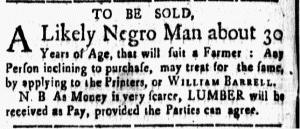
“A Likely Negro Man about 30 Years of Age.”

Yesterday’s featured advertisement announced that the sloop Ranger had arrived in Philadelphia carrying a human cargo, a “Parcel of healthy SLAVES, men, women, boys, and girls” “from the river Gambia” who were soon to be “sold upon low terms.” I argued that although the number of slaves that resided in northern colonies did not approach those in southern colonies, the advertisement demonstrated that slavery and the transatlantic slave trade were indeed part of society, culture, and commerce throughout all the colonies. Contrary to common misconceptions about the American past, slavery was not absent in the colonies that eventually became free states in the nineteenth century.

I concluded by noting that a single advertisement was one piece of evidence, suggestive but perhaps not sufficient documentation to be completely convincing. To that end, today I have selected a companion advertisement published one day later but hundred of miles further north in another colony. William Barrell wished to sell “A Likely Negro Man about 30 Years of Age.” He indicated that the unnamed enslaved man “will suit a Farmer.” These two advertisements are representative of the many similar ones inserted in newspapers published in cities in northern cities.

Advertisements for enslaved people – seeking to sell them or to buy them, warning against runaways or announcing their capture – certainly appeared in greater numbers in newspapers published in the Chesapeake and the Lower South, but that does not mean that such notices in northern newspapers may be dismissed. This advertisement for “A Likely Negro Man” inserted in the New-Hampshire Gazette, published in Portsmouth (the most northern city with a newspaper in 1766 in what became the United States*), testifies to an accepted practice and part of everyday life. (*Halifax, Nova Scotia, founded less than two decades earlier, also had a newspaper. None of the issues from 1766 in the collections of the American Antiquarian Society include advertisements for slaves, though the commodities offered for sale were certainly part of the larger networks of trade that crisscrossed the Atlantic and incorporated the slave trade.) Colonists in New England and the Middle Atlantic lived in a society that allowed for slavery. They encountered slaves regularly. Some owned or traded slaves. To assume that slavery was a southern phenomenon misconstrues the past.

August 21

Who was the subject of an advertisement in a colonial American newspaper 250 years ago today?

Aug 21 - 8:21:1766 Pennsylvania Journal
Pennsylvania Journal (August 21, 1766).

“A Parcel of healthy SLAVES, men, women, boys, and girls.”

This advertisement reveals a hidden history of slavery that has been largely forgotten in the United States, forgotten because it is both convenient and comfortable to overlook, forgotten because it disrupts familiar narratives about when and where Americans traded slaves and owned enslaved men, women, and children. In particular, the slave trade and the presence of slaves are associated with colonies in the Chesapeake and the Lower South. Most people tend to think of those colonies that became the northeastern United States as territories that never practiced slavery or profited from the slave trade.

This story has not been completely overlooked. Many historians of early America have devoted their careers to uncovering and examining the histories of both the presence of enslaved peoples in northern colonies as well as the networks of trade and commerce that inextricably tied northern colonies and their economic welfare to participation in the transatlantic slave trade. In addition to the work of these specialists, other historians have increasingly integrated slavery in the northern colonies and states into the larger narrative of American history they include in their publications for fellow scholars and in the course content they deliver to students. Many public historians have also sought to address slavery conscientiously and responsibly in their efforts to present the past to audiences beyond traditional classroom settings.

Yet it seems fair to continue to describe this as a hidden history, an intentionally overlooked history. The students who enroll in my early American history courses every year are more likely than not to assume that slavery was not a part of the New England experience. In a variety of forums, public historians report that they regularly encounter visitors either unaware of the history of slavery in northern colonies or willfully resistant to acknowledging its existence alongside the stories they want and expect to be told.

Today’s advertisement, however, makes clear that slavery and the transatlantic slave trade were indeed part of everyday life and commerce in places other than Virginia, South Carolina, and Georgia. Today’s advertisement announced that “A Parcel of healthy SLAVES, men, women, boys, and girls” were “Just imported, from the river Gambia” and would be “sold upon low terms, by James and William Harvey, merchants” in Philadelphia. Even in Pennsylvania, “The quality of the slaves from the abovementioned river, is so well known, that nothing further is necessary to recommend them.” In other words, colonists in the north had a more than passing awareness and familiarity with slaves and the transatlantic slave trade.

The advertisement does not mention that this “Parcel of healthy SLAVES” consisted of 100 men, women, and children. Nor does it mention that 120 had been loaded on the Ranger off the coast of Africa, but twenty had died during the Middle Passage across the Atlantic. Those numbers come from other sources that have been compiled at Voyages: The Trans-Atlantic Slave Trade Database. Those sources also reveal that the Ranger sailed directly from Africa; it did not make stops in other American ports. These men, women, and children were always intended for sale in one of the northern colonies, not any of the colonies in the Chesapeake or Lower South that operated on a plantation economy.

Today’s advertisement is just one piece of evidence, but it is not the only piece. Slavery was a significant part of the colonial experience throughout the colonies, not just in the southern colonies. It is part of American history that cannot be overlooked, at least not if we want to be honest and truly understand the past that has led to the present.

August 6

Who was the subject of an advertisement in a colonial American newspaper 250 years ago today?

Aug 6 - 8:6:1766 Georgia Gazette
Georgia Gazette (August 6, 1766).

“TALL SLIM LIKELY YOUNG NEGROE GIRL.”

It would have been impossible to overlook Donald Mackay’s description of Maria, an enslaved young woman: “TALL SLIM LIKELY YOUNG NEGROE GIRL.” Each of the adjectives suggested that Maria was attractive, a young woman that most masters and others would have found desirable, a young woman who most likely would have become increasingly alluring as she continued to mature.

In the absence of any sort of visual image (not even a crude woodcut), Mackay put a black body on display by asking readers to imagine Maria’s appearance and inviting them to scrutinize every black woman they encountered to determine if they might be the runaway Maria.

This advertisement also hints at the treatment that Maria may have already experienced or that she was likely to experience at some point. White men had unfettered access to enslaved women throughout early American history, from the colonial period through the antebellum era and the Civil War. Writing under the pseudonym Linda Brent nearly a century after this advertisement was published, Harriet Jacobs published a slave narrative in which she documented the constant threat of sexual absue she faced as a slave in North Carolina in the early nineteenth century. Various other sources – slave narratives, letters, ledgers, and journals, written by both black and white authors – confirm the sexual violence perpetrated against black women under slavery. Some do so explicitly.

Others, like this advertisement, raise the possibility with more subtlety, asking observers to read between the lines.

A multitude of circumstances probably influenced Maria’s decision to run away, but her vulnerability to sexual abuse was likely one of them. Donald Mackay did not elaborate on all the reasons that he wanted this “TALL SLIM LIKELY YOUNG NEGROE GIRL” captured and returned, but eighteenth-century readers would have been aware of what was unwritten. This advertisement was about more than recovering a piece of human property who could work in the fields or do domestic labor in the household.

Advertisements for enslaved men, women, and children allow us to reconstruct portions of their lives when we read against the grain and interrogate the implications of what white authors have written.

June 28

What was advertised in a colonial newspaper 250 years ago this week?

Jun 28 - 6:27:1766 Virginia Gazette
Virginia Gazette (June 27, 1766).

“JUST arrived … two hundred choice healthy Windward and Gold Coast slaves.”

Eighteenth-century advertisements for consumer goods often deployed formulaic language, especially for goods “just imported from” London or other ports in England or the Caribbean. This advertisement offers several variations on those familiar advertisements.

First of all, “the ship Apollo, Capt. Elias Glover,” carried human cargo – slaves – rather than the “bauble of Britain” so frequently advertised in newspapers throughout the colonies. Although slaves were often offered for sale in the New England and the Middle Atlantic colonies, ships loaded with two hundred Africans usually did not sail into those ports. Here we encounter a regional difference in the kinds of advertisements that appeared in local newspapers. Rather than a ship loaded with textiles, housewares, and grocery items, Captain Glover’s vessel delivered people who had been reduced to commodities to be put up for sale.

The slave traders who sold this human cargo – Thomas Tabb, William Bolden, and John Lawrence – reported that the Apollo had come from Africa, but they do not make clear whether it had made any stops along the way. Were these slaves being imported directly from Africa? Or had the Apollo stopped in the Caribbean or other ports on the North American mainland before making its way to the James River?

Not unlike advertisements for dry goods or hardware, this notice emphasized the quality of the commodities offered for sale: they were “choice” and “healthy.” Furthermore, they came from specific places in Africa, the Windward and Gold Coasts. Plantation owners often desired slaves from particular regions, associating specific skills or knowledge with those places.

All in all, even though the wording differed from advertisements for goods imported from England, this and other advertisements for slaves took a similar tone. What seems horrifying from a twenty-first-century perspective was business as usual for slaveholders and slave traders. None of that even takes into account the perspectives of the enslaved Africans themselves.

April 26

Who was the subject of an advertisement in a colonial newspaper 250 years ago this week?

Apr 26 - 4:25:1766 New-Hampshire Gazette
New-Hampshire Gazette (April 25, 1766).

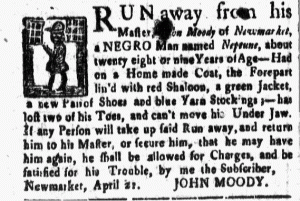
“RUN away from his Master … a NEGRO Man named Neptune.”

John Moody placed this advertisement when “a NEGRO Man named Neptune” – almost certainly not the name bestowed on him by his parents when he was born – ran away. This advertisement stands in stark contrast to the one featured yesterday, though both came from the same issue of the New-Hampshire Gazette. Yesterday’s “ADVERTISEMENT Extraordinary” encouraged readers to put on all kinds of displays upon receiving word that the Stamp Act had been repealed. This advertisement, however, asserted that black bodies should be on display and encouraged readers to take note of any “NEGRO Man” they encountered. Black bodies were figuratively on display in the crude woodcut that could have been any enslaved man. Black bodies were literally on display – scrutinized closely – any time readers attempted to assess if a black man fit the description in the advertisement. “Neptune” could change his clothing, but the fugitive could not disguise certain physical characteristics: “lost two of his Toes, and can’t move his Under Jaw.” Determining if a black man fit this description could require sustained observation; these are not attributes that would necessarily be noticed at a glance. While many colonial Americans engaged in public spectacles to celebrate the end of the Stamp Act, “Neptune” likely did all he could to avoid becoming a public spectacle, but today’s advertisement encouraged colonial Americans to think of all black bodies as some sort of public spectacle to be observed and scrutinized.

April 21

GUEST CURATOR: Trevor Delp

Who was the subject of an advertisement in a colonial newspaper 250 years ago today?

Apr 21 - 4:21:1766 Boston Evening-Post
Boston Evening-Post (April 21, 1766)

“A sprightly, active Negro Woman about 24 Years of Age.”

This advertisement offered an African American woman in her early twenties who could fulfill the duties of “House Business.” Initially this advertisement shocked me, because at the top a sloop (one-masted sailboat) was for sale, yet just beneath that a woman was for sale. The normality of this pairing seems completely unfathomable to me. To read an advertisement for a ship that then immediately jumped to selling a woman seems absurd. To dehumanize someone to the point of equating her to a ship is a hard concept for modern readers to grasp. To most readers of the time, however, this would not have been so disconcerting.

There is a common misconception in the United States that the northern colonies were free of slavery. According to the Massachusetts Historical Society, it was not until 1771 that the “Massachusetts Colonial assembly passes a resolution calling for the end of the importation of African slaves into the colony. Governor Thomas Hutchinson refuses the measure.” During the late eighteenth century in the north there were early attempts to eradicate slavery, but they were not always generally supported. According to an article written by Nicholas Boston and Jennifer Hallam, “By 1804, all Northern states had voted to abolish the institution of slavery within their borders. In most of these states, however, abolition was not immediate.” Boston and Hallam go on to explain that it took until the first half of the nineteenth century for many African Americans in the North to achieve status as free people.

In the late eighteenth century slaves began achieving their freedom in Massachusetts through judicial law. In the case of Quock Walker, Walker sued for his freedom after being beaten by a man claiming to be his master after his then-deceased master had promised him his freedom. In 1781, the court found that Walker was indeed free under the state constitution, making it evident that the Massachusetts court system now viewed slaves equal in the eyes of the law. When this advertisement was posted in 1766, slavery in Massachusetts was just starting to become scrutinized and a judicial debate. In the years following, advertisements like this one would become less and less popular up until the North’s complete abolition of slavery during the nineteenth century.

**********

ADDITIONAL COMMENTARY:  Carl Robert Keyes

I agree with Trevor. It is jarring to see a sloop and an enslaved woman offered together in the same advertisement, both of them items for sale from an eighteenth-century perspective. While I believe that Trevor tells the more important story in making and elaborating on that observation, this advertisement also offers an opportunity to examine the manner in which colonists used print and thought about the placement of advertisements in newspapers.

Today we usually expect advertisements to have a single purpose or, at the very least, for all the elements to tie together in some cohesive way. In the eighteenth century, however, advertisers bought a certain amount of space – often a “square” or multiple squares – and inserted whatever information they wished to bring to public attention. Sometimes the separate parts of a square were related; other times they were not. Earlier this week, for instance, Trevor examined an advertisement in which a shopkeeper first issued a call that he wanted to purchase “POT-ASH” before launching a lengthier promotion of the goods he sold. In today’s advertisement, the sloop and the enslaved woman were only tenuously linked: they were both “items” for sale by the same auctioneer.

Apr 21 - Entire Advert
Boston Evening-Post (April 21, 1766).

That auctioneer happened to be one of the printers of the Boston Evening-Post. It’s telling that even those who produced the newspaper did not see any need to divide up the announcements of these sales. In general, an assortment of advertisements with varying purposes appeared mixed together and undifferentiated in colonial newspapers. Neither printers nor readers expected any system of classification that placed similar advertisements together on the page.

Trevor was shocked by the advertisement as it appears above. We discussed his reaction during a meeting in my office before he wrote about it. Earlier this week he submitted a draft of today’s entry, which I approved with some minor revisions. It was not until this morning, however, when I examined the entire issue of the Boston Evening-Post in order to gain more context in preparation of writing my own commentary that I discovered that today’s advertisement was actually a portion of a longer advertisement, but the database had divided it in half. (Given the format of the advertisement, it’s understandable why that happened.) The entire advertisement also included a “Public Vendue” for seventy bolts of damaged fabric. For me, this makes the advertisement Trevor chose even more stark: an enslaved woman appeared last in an advertisement for a ship and damaged goods being sold so the insurers could recoup some of their losses.