March 29

What was advertised in a colonial American newspaper 250 years ago today?
Mar 29 - 3:29:1768 South-Carolina Gazette and Country Journal
South-Carolina Gazette and Country Journal (March 29, 1768).

“He intends to open School … she will undertake to teach the Girls their Needle.”

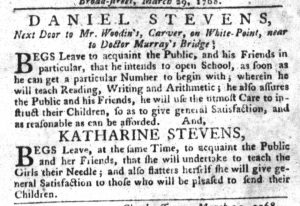
In preparation for opening a school in Charleston, Daniel Stevens placed an advertisement in the March 29, 1768, edition of the South-Carolina Gazette and Country Journal. He advised “the Public, and his Friends in particular” that he would teach reading, writing, and arithmetic, establishing a curriculum that set his school apart from the “British Academy on the Green” that Osborne Straton promoted in another advertisement in the same issue. Osborne taught English, Latin, and French as well as drawing, “Poetry, Rhetoric, [and] Logic.” Instead of “Writing” and “Arithmetic,” he taught “Writing in the Mercantile and Law Hands” and “The various useful and practical Branches of the Mathematicks.” Straton implied that he welcomed only boys as “Day Scholars,” but he tutored “Gentlemen or Ladies” in their homes on selected afternoons.

Stevens, on the other hand, invited readers to send both boys and girls to his school, where he provided a more modest and practical education. To that end, his advertisement included a short section in which Katharine Stevens announced “that she will undertake to teach the Girls their Needle.” As Straton cornered the market when it came to a genteel education, Daniel Stevens offered a different sort of enhancement to his curriculum, an enhancement that readers who could not translate the Latin quotations sprinkled throughout Straton’s advertisement may have considered much more useful and important.

That enhancement depended on the contributions of Katharine Stevens, presumably Daniel’s wife (but possibly a sister, daughter, or other female relation). The wording of the advertisement presents the school primarily as Daniel’s venture, but Katharine likely acted as more than a mere assistant in the endeavor. Even if she did not teach the academic subjects, she did participate in the instruction of the female students. In the process, she also supervised the children at the school, contributing to good order within the classroom. Some parents of prospective students may have been reassured simply by Katharine’s presence, assuming that it signaled more care and attention than Daniel could deliver by himself.

Both the copy and the format of this advertisement position Katharine as subordinate to Daniel. He sought pupils for his school; she taught a gendered skill, sewing, to only some of his students, the girls. Yet that description likely belied a more equal partnership that guided this joint venture in both planning and execution. At the very least, Daniel Stevens relied on the contributions made by Katharine Stevens when marketing his (their?) new school. She provided instruction in an area that he did not possess skill or expertise, an addition to the curriculum intended to make the school more attractive to prospective students and their parents.
March 22

What was advertised in a colonial American newspaper 250 years ago today?

Mar 22 - 3:22:1768 South-Carolina Gazette and Country Journal
South-Carolina Gazette and Country Journal (March 22, 1768.)

“MATTHIAS HUTCHINSON, CAHIR-MAKER, who served his time to Mr. HART.”

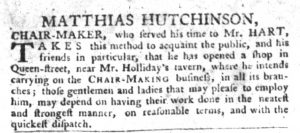
Matthias Hutchinson published an advertisement in the March 22, 1768, edition of the South-Carolina Gazette and Country Journal “to acquaint the public, and his friends in particular, that he has opened a shop in Queen-street.” Hutchinson, a “CHAIR-MAKER,” proclaimed that he would pursue his occupation “in all its branches,” signaling to prospective customers that he was prepared to undertake jobs involving any aspect of constructing chairs. He also advanced some of the most common appeals made by merchants, artisans, and shopkeepers in their advertisements for consumer goods and services during the eighteenth century. He promised fair prices (“reasonable terms”) and efficient service (“quickest dispatch”).

In addition to those marketing strategies, Hutchinson also adopted an appeal most frequently deployed by artisans: he promoted his qualifications, especially his training. He did not introduce himself to the public merely as a “CHAIR-MAKER” but instead as a “CHAIR-MAKER, who served his time to Mr. HART.” In other words, Hutchinson had completed an apprenticeship in Hart’s workshop. He assumed that readers of the South-Carolina Gazette and Country Journal were already familiar with Hart’s work and depended on his former master’s reputation as he attempted to cultivate his own professional identity among prospective customers in Charleston and beyond. Hutchinson considered this particularly imperative, opting to establish his credentials before he even mentioned his location or made appeals to price and customer service. Those credentials also enhanced his credibility when he assured potential clients that they “may depend on having their work done in the neatest and strongest manner.” His chairs were both attractive and sturdy, results produced thanks to the skills that Hutchinson developed via his training by Hart.

When he established his own workshop, Hutchinson identified his apprenticeship as an advantage that prospective customers would value when considering whether to entrust their business to the newcomer. Having labored in Hart’s workshop, he had participated in the production of chairs associated with his former master, contributing to the senior artisan’s reputation. Now Hutchinson sought to mobilize Hart’s reputation as a testament to his own qualifications and skill by noting that he had “served his time to Mr. HART.” More than any other appeal to prospective customers, Hutchinson made that the focal point of his identity as an artisan and entrepreneur.

March 15

What was advertised in a colonial American newspaper 250 years ago today?

Mar 15 - 3:15:1768 South-Carolina Gazette and Country Journal
South-Carolina Gazette and Country Journal (March 15, 1768).

“A fresh assortment of GARDEN SEEDS, pease, beans and flower-roots.”

James McCall stocked and sold a variety of imported merchandise “at his store in Tradd-street” in Charleston. Like many other merchants and shopkeepers, he attempted to incited demand for his wares by placing an advertisement that listed many of them in a dense paragraph, everything from “neat Wilton carpeting” to “shot of all sizes” to “coffee and chocolate.” His inventory included groceries, clothing, housewares, and much more.

For the most part McCall did not make special efforts to promote any particular items, with one exception. Deploying typography strategically, he did draw attention to his “fresh assortment of GARDEN SEEDS, pease, beans and flower-roots.” Very few words in his advertisement appeared in all capital letters; most of those that did were names: his own name that served as a headline, the name of the ship and captain that transported the goods, and the name of the English port of departure. In the main body of the advertisement, the list of items for sale, the first word appeared in all capitals, as was the convention for all advertisements in the South-Carolina Gazette and Country Journal. Otherwise, the words “GARDEN SEEDS” about midway through the list of goods were the only words in all capitals in the body of McCall’s notice.

Although advertisers usually wrote copy and left it to compositors to determine the graphic design elements of eighteenth-century newspaper advertisements, deviations from the standard appearance of notices within particular publications suggest that advertisers could and did sometimes request specific typography for certain aspects of their notices. Such appears to have been the case for McCall’s advertisement since the compositor would have had little reason to randomly set “GARDEN SEEDS” in all capitals. On the other hand, McCall had particular interest in drawing attention to such seasonal merchandise. In other advertisements, he developed a habit for singling out a specific item to promote to prospective customers. For instance, the previous August he included “CHOICE DOUBLE GLOSTER CHEESE” in a list-style advertisement that did not feature any other items in all capitals.

McCall could have chosen to highlight these items by listing them first or writing a separate nota bene to append to his advertisements. Instead, he opted to experiment with variations in typography to accentuate his “GARDEN SEEDS” and “CHOICE DOUBLE GLOSTER CHEESE.” Although rudimentary compared to modern understandings of graphic design, his choices indicate some level of understanding that the appearance on the page could be just as effective as the copy when it came to delivering advertising content to consumers.

March 8

What was advertised in a colonial American newspaper 250 years ago today?

Mar 8 - 3:8:1768 South-Carolina Gazette and Country Journal
Addition to the South-Carolina Gazette and Country Journal (March 8, 1768).

“They carry on the Taylors Business in all its Branches.”

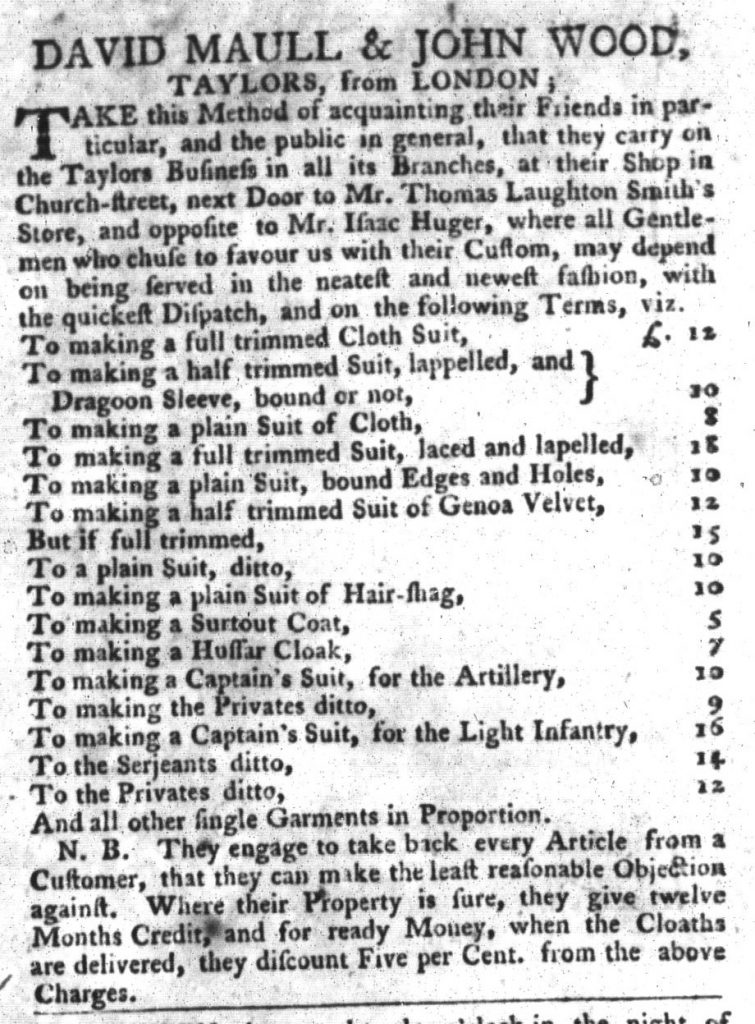
David Maull and John Wood’s advertisement was one of nearly a dozen that appeared in the two-page Addition to the South-Carolina Gazette and Country Journal published by Charles Crouch on March 8, 1768. It accompanied the regular four-page issue of that newspaper and a two-page Supplement. Crouch distributed supplements so often that many readers may have come to expect them as standard, made necessary by the number of advertisements submitted to the printing office. Indeed, the supplements usually contained advertising exclusively, even when advertisements accounted for nearly half of the space in regular issues.

The Addition, however, did not follow this pattern. Only two of the six columns (three on each side of the halfsheet) were filled with advertising. The ninth of John Dickinson’s “LETTERS from a FARMER in PENNSYLVANIA, to the Inhabitants of the BRITISH COLONIES” occupied nearly the entire first page. In it, the “FARMER” explained the necessity of local representation in firmly established assemblies. The Addition also included news from Boston and Philadelphia as well as a poem, “The Batchelor’s Reasons for taking a Wife.”

What Crouch termed an Addition his counterparts in other cities and towns usually called an Extraordinary in their efforts to distinguish such publications from the more common supplements often distributed with the standard issues of their newspapers. Whatever the nomenclature, Crouch’s Addition of March 8, 1768, further establishes a pattern. During the period of the imperial crisis between the imposition of the Stamp Act in 1765 and the outbreak of military hostilities in 1775, the colonies alternately experienced periods of intense discord with Britain and periods of relative calm. In early March 1768 the Townshend Act had been in effect for just over three months. Colonists had commenced non-importation agreements at the beginning of the year. From New England to Georgia, newspapers reported discontent and political outrage, often in supplements and extraordinary issues that proliferated during those times that the imperial crisis intensified.

At most times advertising, especially the revenue it generated for printers, facilitated the dissemination of news and editorial items. Supplements devoted to advertising made delivering the news and other content possible. During periods of conflict, however, publishing the news sometimes led to the broader or more frequent distribution of advertising. Such appears to have been the case with Crouch’s Addition from March 8, 1768. As he went about publishing Dickinson’s “LETTER IX” and news from Boston and Philadelphia, the printer needed to fill an entire halfsheet. The poem took up half a column. Two of the advertisements promoted the printer’s own wares, but the others had previously appeared as paid notices. Perhaps those who placed them paid for this insertion as well. Even if that were the case, the Addition upended the usual relationships between news and advertisements in colonial newspapers. In this case, publishing the news led to readers being exposed to more advertising rather than the usual situation of advertising bringing the news.

March 1

What was advertised in a colonial American newspaper 250 years ago today?

Mar 1 - 3:1:1768 South-Carolina Gazette and Country Journal
South-Carolina Gazette and Country Journal (March 1, 1768).

“He makes jumps and stays … in the newest fashion, either in the English or French manner.”

John Burchet presented himself to consumers in Charleston as a “STAY and MANTUA-MAKER, from LONDON and PARIS.” He established his former places of residence and employment not merely by way of introduction but also to strengthen one of the appeals he advanced in his advertisement. Burchet announced to prospective clients that he made garments “in the newest fashion, either in the English or French manner.” Although he did not elaborate on his time in the English and French capitals, he leveraged the connection to assure customers that they could rely on him to outfit them in “the newest fashion” rather than trends that already declined in popularity. He implied that he had special insight into la mode on the other side of the Atlantic.

Keeping up with the current styles in England and France was important to residents throughout the colonies, but perhaps especially to the gentry and middling sorts aspiring to join their ranks in the largest urban ports. Although the size of Charleston, Boston, New York, and Philadelphia paled in comparison to the metropolis of London, the better sorts in those cities wished to imagine themselves as cosmopolitan as their peers across the ocean. Anxious that they would be seen as backwater provincials, they adopted new fashions – both clothing and housewares – at a speed that often surprised European visitors to the colonies. Some shopkeepers and members of the garments trade emphasized their correspondence with counterparts in England as a means of keeping abreast of the newest trends. Burchet, however, suggested that he offered something even better: why settle for an American staymaker who imitated the styles popular in Europe when it was possible to hire one “from LONDON and PARIS” who had direct knowledge from his time in those cities? This marketing strategy did rely on both the staymaker and the customer suspending their disbelief to some extent. After all, having once lived and worked in London and Paris did not give Burchet immediate access to fashions there. He relied on transatlantic correspondence, just like his competitors. Yet he marshaled the cachet of his origins, prompting clients to imagine visiting his shop for measurements and fittings and ultimately wearing garments made by an artisan “from LONDON and PARIS.” Burchet’s stays and other wares might have yielded the same appearance as those made by others, but his personal narrative added value to the clothing he made.

February 23

What was advertised in a colonial American newspaper 250 years ago today?

Feb 23 - 2:23:1768 South-Carolina Gazette and Country Journal
South-Carolina Gazette and Country-Journal (February 23, 1768).

“FINE BOHEA TEA.”

William Greaves opened his advertisement by announcing that he sold “FINE BOHEA TEA, At twenty-seven shillings and six pence per pound.” The format distinguished it from other advertisements for consumer goods and services that ran in the South-Carolina Gazette and Country Journal in the late 1760s. Advertisers tended to follow certain conventions when they wrote copy, but Greaves experiments with something different. That variation likely drew greater attention to his advertisement.

Advertisements, especially list-style advertisements that enumerated an assortment of merchandise, in the South-Carolina Gazette and Country Journal and other newspapers usually opened in one of two ways. Some merchants and shopkeepers used their own names, all in capital letters, as a headline, followed by a description of their origins of their goods or their location as a distinct section of text, and then the list of goods in stock. Such was the case in an advertisement that advised readers “JAMES McCALL, HAS just imported in the London, Captain Curling, and the Mary, Captain Gordon, from London, and Indian King, Captain Baker, from Bristol, a large supply of GOODS, amongst a great variety of other articles.” McCall’s advertisement then listed scores of items. Similarly, “WILLIAM WILLIAMSON, In Broad-street, next door to Mr. Lockwood’s watchmaker, &c. hath received per consignment, for sale” several sorts of spirits. Each of these advertisements was divided into three segments, each of them familiar to reader, each of them with a purpose easily identifiable.

The same was true of the other popular method for writing copy for advertisements for consumer goods and services. That format reversed the order of the first two elements. The advertiser’s name appeared as a headline, but only after introductory remarks about the origins of the goods offered for sale. For instance, an advertisement for dry goods began with “JUST imported in the ship Bacchus, Daniel Jackson, Master, from Liverpool, and to be sold by WILLIAM HARROP.” Another advertisement more simply started with “JUST IMPORTED, and to be SOLD, By NATHANIEL RUSSELL.” In all of these, the name of the advertiser appeared in larger type than any other text in the advertisement.

Greaves included the same information in his advertisement, but he used one item from among his merchandise to draw the attention of potential customers and encourage them to peruse the rest of his list of goods. Unlike the advertisements placed by his competitors, Greaves’ notice had two headlines: “FINE BOHEA TEA” at the beginning of the advertisement, followed by his name. Both appeared in all capital letters of a larger font than the remainder of the text. Rather than rely on an implicit appeal to consumer choice through publishing an extensive list of his wares, Greaves explicitly marketed one item in order to set the tone for prospective customers to read the rest of the advertisement. He underscored the quality, price, and freshness of his “BOHEA TEA” before giving any of the other information about his business that usually appeared first in advertisements. When it came to innovation, the format of this advertisement alone made Greaves’ notice distinctive, both in a newspaper crowded with advertisements and in a port city busy with commercial exchanges.

February 16

What was advertised in a colonial American newspaper 250 years ago today?

Feb 16 - 2:16:1768 South-Carolina Gazette and Country Journal
South-Carolina Gazette and Country Journal (February 16, 1768).

“JOHN & SARAH CRANE, TAYLOR and MANTUA-MAKER, from LONDON.”

Given their participation in the colonial marketplace as the providers of goods and services, women were underrepresented among the advertisements in eighteenth-century newspapers. Some female entrepreneurs did place their own advertisements to promote businesses they operated, but others followed a different strategy when they jointly advertised with men. Such advertisements had several variations. In most, a woman advertised alongside a male relation, most often as wife and husband but sometimes as siblings or as mother and son. On occasion, women advertised with male partners who were not related to them, but such instances were much less common.

Joint advertisements also varied in terms of how prominently they featured women’s activities in the marketplace. Some focused almost exclusively on the activities of a male head of household and only mentioned in passing that a woman also worked in the shop or otherwise provided goods or services on her own. Such advertisements frequently used the man’s name as the headline and did not mention the woman until the final sentence or in a nota bene that almost seemed an afterthought. Others, such as an advertisement by John Holliday and Mrs. Holliday, devoted equal amounts of space to the separate endeavors of both parties, yet still focused primary attention on the husband by using his name as the headline and promoting his business before turning to his wife.

Sometimes, however, men and women placed advertisements that portrayed them as equal partners in their enterprises, especially when they pursued related occupations. That was the case with John and Sarah Crane, “TAYLOR and MANTUA-MAKER, from LONDON,” in an advertisement in the January 16, 1768, edition of the South-Carolina Gazette and Country Journal. The headline featured both of their names in capital letters. The body of the advertisement addressed the qualities they both contributed to the garments they made. A nota bene even promoted certain items made by “Mrs. Crane” beyond those customers might have expected from a mantuamaker, suggesting her skill and versatility. The Cranes apparently continued this egalitarianism into other aspects of their marketing. Their advertisement indicated their shop was marked “With their names in gold letters over the door.” The space there they conducted their business, just like their advertisement, was a shared domain where the Cranes acted as partners. Their story demonstrates what was possible for married women as providers of goods and services in the colonial marketplace, even if it was not the most probable arrangement.

February 9

What was advertised in a colonial American newspaper 250 years ago today?

Feb 9 - 2:9:1768 South-Carolina Gazette and Country Journal
South-Carolina Gazette and Country Journal (February 9, 1768).

“Greatful thanks for the encouragement he has had for eighteen years past in Charles-Town.”

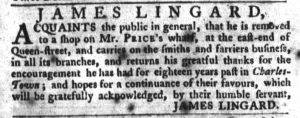
Experience matters. That was the central theme James Lingard presented in his advertisement in the February 9, 1768, edition of the South-Carolina Gazette and Country Journal. In the process of announcing that he had moved to a new location at the east end of Queen Street, Lingard expressed his appreciation to his former customers, noting that he had served the residents of Charleston for the past eighteen years. While merchants and shopkeepers occasionally referred to their years of experience in their attempts to entice customers, artisans most commonly made such appeals. Lingard, a blacksmith and farrier, continued a common practice among eighteenth-century artisans who placed newspaper advertisements.

Lingard enhanced his professional reputation by promoting his experience and expressing “his greatful thanks for the encouragement” he had received from those who had previously engaged his services. It would not have been possible for him to operate a shop in the busy port for nearly two decades had it not been for his skills in “the smiths and farriers business, in all its branches.” Still, it did not hurt to inform potential customers that he had honed those skills over the years and now possessed significant experience. For those who had resided in Charleston for quite some time, Lingard’s advertisement served as a reminder that he had been operating his shop for years. For newcomers to the city, however, Lingard seized an opportunity to inform them of his long history working with local customers.

Lingard likely attracted some of his business via word-of-mouth referrals built on his reputation. Turning to print could have been a strategy to prompt more referrals, presenting himself for consideration among members of “the public in general” who had not previously hired him but who might ask others if they had any experiences dealing with Lingard. In such situations, his appeals to skill and experience in his advertisement set the tone for conversations among customers.

February 2

What was advertised in a colonial American newspaper 250 years ago today?

Feb 2 - 2:2:1768 South-Carolina Gazette and Country Journal
South-Carolina Gazette and Country Journal (February 2, 1768).

“They engage to take back every Article from a Customer, that they can make the least reasonable Objection against.”

David Maull and John Wood, “TAYLORS, from LONDON,” incorporated a variety of marketing appeals into their advertisement in the February 2, 1768, edition of the South-Carolina Gazette and Country Journal. They included some of the most popular marketing strategies deployed in the eighteenth century, but they also devised several innovative strategies that differentiated their commercial notice from others.

Purveyors of goods and services commonly promoted quality and fashion. Maull and Wood did so when they stated that their work represented “the neatest and newest fashion.” Artisans often underscored their competence. Maull and Wood reported that “they carry on the Taylors Business in all its Branches.” Shopkeepers and artisans both proclaimed their origins or other connections to London to give their goods and services more cachet in the transatlantic marketplace. Maull and Wood announced that they had migrated “from LONDON,” where they had presumably received training and previously worked. Invoking some sort of link to London also bolstered their claim to produce garments in the “newest fashion.” Many advertisers made a nod toward customer service, as Maull and Wood did when they pledged to fulfill orders “with quickest Dispatch.” Maull and Wood used stock language in making these common appeals to customers.

Yet the tailors also attempted to entice clients with a series of other marketing strategies in a nota bene that concluded their advertisement. They provided a money-back guarantee, promising “to take back every Article from a Customer, that they can make the least reasonable Objection against.” They also offered reduced rates to customers who paid in cash, vowing to “discount Five per Cent.” On the other hand, they extended “twelve Months Credit” to other customers during a period that most advertisers either demanded cash or allowed only “short credit.” Consumers regularly made purchases on credit in eighteenth-century America, but it was not a method of payment promoted by most purveyors of goods and services in their advertisements in the late 1760s. Maull and Wood made clear that they were willing to work out payment schedules that fit the needs of their prospective clients. John Ward, another tailor who advertised in the same issue, made no mention of how he expected customers to pay. Finally, Maull and Wood doubled the length of their advertisement by publishing a roster of prices to demonstrate their reasonable prices to prospective clients. This eliminated negotiating over the bill and anxieties that a better deal might have been possible by locking in rates from the start.

Maull and Wood distinguished their advertisement from others published in Charleston’s newspapers by augmenting the most common appeals with innovative marketing strategies. They did not invent any of the methods they used, but they effectively amalgamated multiple popular and novel tactics for attracting customers into a single advertisement to an extent not achieved by most other advertisers of consumer goods and services in the 1760s.

January 26

Who was the subject of an advertisement in a colonial American newspaper 250 years ago today?

Jan 26 - 1:26:1768 South-Carolina Gazette and Country Journal
South-Carolina Gazette and Country Journal (January 26, 1768).

“She was with child when she went away.”

Every advertisement about a runaway slave tells a story of resistance and the struggle to claim the same liberty enjoyed by the slaveholder who placed the advertisement. Yet these advertisements contain much more. They often reveal family histories or suggest bonds of affection among enslaved men, women, and children. As much as slaveholders may have wished to pretend otherwise, such stories embedded in advertisements intended to reclaim their property testified to the humanity of men, women, and children held in bondage.

Consider Sampson and Miley. The two ran away from the same plantation at the same time, quite likely departing together. Alexander Kerr described both of them in an advertisement. Sampson, approximately thirty, was missing two of his front teeth. Miley, a “slender made wench,” may have been even more recognizable by her “yellow complexion” and the “country marks on her face.” In addition, she was “with child” when she ran away. Her pregnancy would only become more apparent until she delivered the baby. After that, caring for an infant would continue to distinguish her from other black women.

What was Sampson and Miley’s relationship? He may have been the father of Miley’s child. Perhaps they made a decision that as parents they needed to escape together rather than allowing their child to be born into bondage. Perhaps Sampson and Miley had been in a relationship that their master refused to recognize. Miley’s child may have been the result of sexual assault by their master or an overseer, in which case Sampson could have aided her escape as a means of providing more protection for both mother and child than he previously had been capable of providing for Miley. Perhaps Sampson and Miley were friends, siblings, or otherwise related. They may have determined that they had better chances to make good on their escape if they assisted each other.

Despite all the details included in the descriptions of Sampson and Miley, Alexander Kerr did not specify their relationship to each other. It simply may not have mattered to him. After all, the stakes were much different for him than for the fugitives. Kerr demanded the return of his property, but the pregnant Miley and her companion sought freedom for themselves and a child on its way. Unwillingly, Kerr’s advertisement for runaway slaves revealed bonds of affection that would extend to another generation upon the birth of Miley’s child. Unintentionally, he gave voice in print to the sincerest desires of slaves that he otherwise attempted to keep silent.