August 9

What was advertised in a colonial American newspaper 250 years ago today?
South-Carolina Gazette and Country Journal (August 9, 1774).

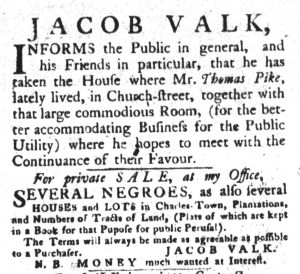
“That large commodious Room, (for the better accommodating Business for the Public Utility).”

Jacob Valk continued to do well as a broker for “Lands, Houses, and Negroes” in Charleston in the summer of 1774.  He attracted so many clients that the advertisements he placed on their behalf filled two of the three columns on the first page of the August 9, 1774, edition of the South-Carolina Gazette and Country Journal.  In addition to that publication, he regularly bought a significant amount of space in the South-Carolina Gazette and the South-Carolina and American General Gazette.  His investment in advertising testified to his belief in its effectiveness, while the number of advertisements demonstrated the extensive demand for his services.

Such success prompted him to move his brokerage office to a new location.  He announced that he “has taken the House where Mr. Thomas Pike, lately lived … together with that large commodious Room, (for the better accommodating Business for the Public Utility).”  Pike had recently departed the city after offering dancing and fencing lessons to its residents for a decade.  He hosted an annual ball for his students to display their talents, most recently in the “New-Assembly Room” where Valk now conducted business.  Even while he was still in town, Pike had rented the room for “Public Sales, of Estates, Negroes, [and] Dry Goods.”  With Valk on the scene, the space only occasionally used for the buying and selling of enslaved men, women, and children now became a site dedicated to perpetuating the slave trade.

Immediately below his note about his new location, Valk advertised “SEVERAL NEGROES” available “For private SALE, at my Office.”  In the subsequent advertisements that filled those two columns, he also sought buyers for “two very valuable Negro Shoemakers” and “TWO or three exceeding good SEAMSTRESSES, and some young Negro Fellows, capable of all Work.”  He also put out a call for a “good Negro CARPENTER,” seeking an enslaver interested in selling a skilled artisan.  Although most of these enslaved people did not need to appear in the “New-Assembly Room” for Valk to broker the sales, that “large commodious Room” did lend itself to putting enslaved people on display.  Colonizers who sought Valk’s services buying and selling enslaved people did conduct business in the space formerly used for dancing lessons.  Some of them had likely socialized there during Pike’s annual balls before buying and selling enslaved people in the same space after the dancing master’s departure from the city.  Valk seamlessly moved his brokerage office there, a testament to how slavery was so deeply enmeshed in daily life in colonial Charleston and other urban centers.
July 12

What was advertised in a colonial American newspaper 250 years ago today?

South-Carolina Gazette and Country Journal (July 13, 1774).

“The Sign of the NEGRO BOY.”

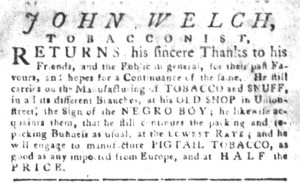
When John Welch, a tobacconist, advertised in the July 12, 1774, edition of the South-Carolina Gazette and Country Journal, he invited “his Friends, and the Public in general” to “his OLD SHOP in Union-street, the Sign of the NEGRO BOY.”  That emblem linked the commodity that Welch’s customers consumed to the enslaved men, women, and children who played such a significant role in producing it.  While Welch emphasized his role in the final stage of “the Manufacturing of TOBACCO and SNUFF, in all its different Branches” to make those items available on the market, the “Sign of the NEGRO BOY” merely hinted at the enslaved labor that raised tobacco on plantations.

South-Carolina Gazette and Country Journal (July 12, 1774).

Welch’s sign was one more instance of putting Black bodies on display in the colonies during the era of the American Revolution.  At auctions and as they went about their daily lives, the bodies of enslaved people were scrutinized by colonizers.  Advertisements that provided descriptions of enslaved people who liberated themselves by running away from their enslavers and offered rewards for their capture and return encouraged even more careful observation of Black bodies.  Other advertisements announcing enslaved people for sale incorporated images of Black bodies.  Those woodcuts, stock images supplied by printers, were nondescript and interchangeable, further dehumanizing the people they represented in a system that treated them as commodities.  An image of a Black man accompanied an advertisement about “A CARGO OF ONE HUNDRED & TWENTY PRIME NEGROES … directly from SIERRA-LEON, a Rice Country, on the Windward Coast of AFRICA” in the same column as Welch’s advertisement.

Variations of the “Sign of the NEGRO BOY” marked the locations of shops in other towns.  In March 1766, August Deley advertised tobacco “At the Sign of the Black Boy … in Hartford” in the Connecticut Courant.  Jonathan Russell peddled a “NEW and FRESH Assortment of English and India GOODS … at the Sign of the BLACK-BOY” in Providence in May 1767.  In December 1768, he gave a different description, “the Sign of the Black Boy and Butt.”  Perhaps he had a new sign that incorporated a large barrel along with the boy, though he may have added a detail that he did not mention in his previous advertisement.  Several months later, Samuel Young promoted an “Assortment of European, East and West-India GOODS” in stock at his store at “the Sign of the Black Boy” in Providence.  Four years after that, he continued business “At the Sign of the Black Boy” in May 1773.  Jonathan Williams gave his location as “the Black Boy and Butt in Cornhill” in the Massachusetts Gazette and Boston Weekly News-Letter in September 1770 and in the Boston Evening-Post in April 1771.  Advertisers in northern colonies as well as southern ones deployed images of Black bodies in marking their locations.

Colonizers appropriated the labor of enslaved men, women, and children in producing commodities for market throughout the Atlantic world and beyond, but that was not the extent of the appropriation that took place.  They also appropriated images of Black bodies to market goods, to sell Black people they treated as commodities, and to encourage surveillance of Black people to determine whether they were fugitives for freedom who liberated themselves from their enslavers.

July 5

What was advertised in a colonial American newspaper 250 years ago today?

South-Carolina Gazette and Country Journal (July 5, 1774).

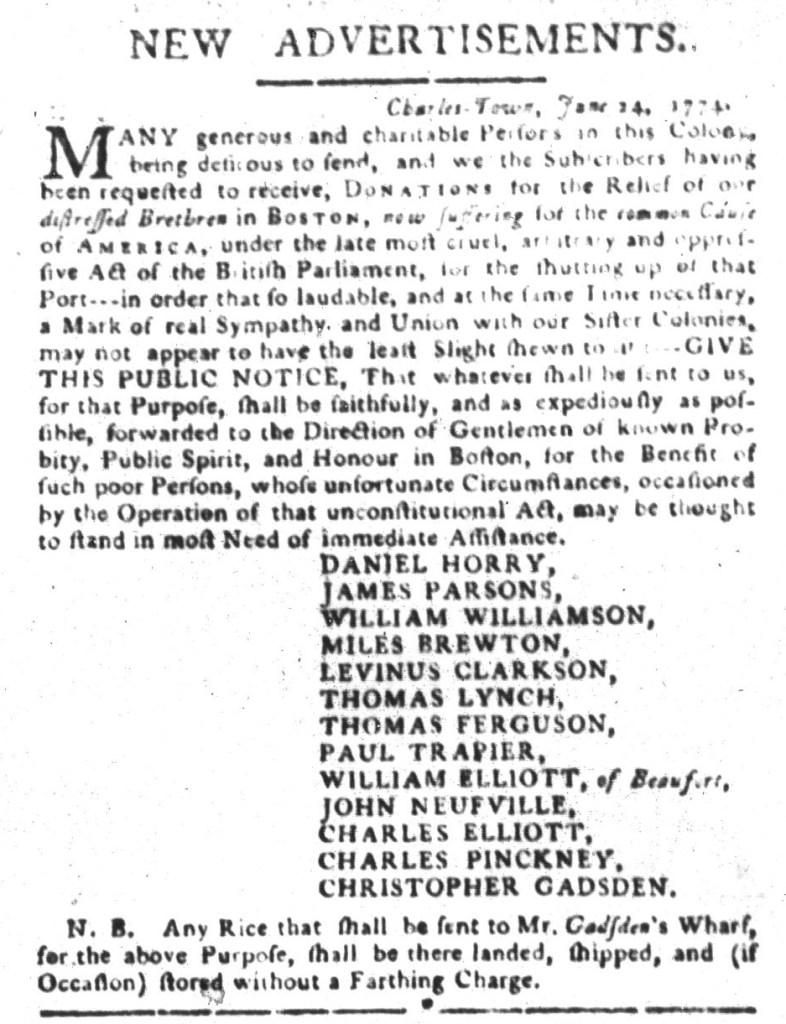
“DONATIONS for the Relief of our distressed Brethren in BOSTON, now suffering for the common Cause of AMERICA.”

Parliament intended to punish Boston when it closed and blockaded the harbor, effective June 1, 1774, as punishment for the destruction of the tea the previous December, yet colonizers from New England to Georgia protested what some described as “that unconstitutional Act.”  The Boston Port Act halted trade in what had been a bustling port city.  In early July, a dozen prominent residents of Charleston and other towns in South Carolina published an advertisement that outlined their plans to send aid to Massachusetts.  They described how “MANY generous and charitable Persons in this Colony” were “desirous to send … DONATIONS for the Relief of our distressed Brethren in BOSTON, now suffering for the common Cause of AMERICA.”  Parliament had miscalculated if it believed that other colonies would not react to the Boston Port Act and the other Coercive Acts.  As many colonizers mobilized to protest, contemplating measures that included nonimportation agreements, some directed their attention to assisting the people of Boston whose patriotic spirit put them in the position of enduring Parliament’s retribution.  Bostonians had acted in the interests of all colonizers, so they had earned the support of colonizers near and far.

The committee that collected donations in Charleston described the Boston Port Act as the “most cruel, arbitrary and oppressive Act of the British Parliament.”  As they explained in their advertisement, it prompted them to organize a “laudable” and “necessary” plan to collect donations “for the Benefit of such poor Persons, whose unfortunate Circumstances, occasioned by the Operation of that unconstitutional Act, may be through to stand in most Need of immediate Assistance.”  The committee encouraged other to participate in this endeavor as “a Mark of real Sympathy and Union with our Sister colonies.”  They made that appeal at the same time that John Holt incorporated a “JOIN OR DIE” emblem into the masthead of the New-York Journal, another testament to belief in the “common cause of AMERICA.”  The committee pledged to “faithfully, and as expediously as possible” send donations to “Gentlemen of known Probity, Public Spirit, and Honour in Boston” to distribute as they deemed appropriate.  One member of the committee, Christopher Gadsden, even offered to store and ship rice donated in support of the people of Boston, likely hoping that gesture would inspire others to similar generosity.

News coverage of reactions to the Boston Port Act appeared elsewhere in the July 5 edition of the South-Carolina Gazette ad Country Journal, though the appeal from the committee ran among “NEW ADVERTISEMENTS.”  Throughout the imperial crisis, advertisements often relayed news and opinion that supplemented articles and editorials.  In this instance, the committee collecting aid for Boston made a forceful argument about politics and attempted to shape public opinion concerning current events.  Their advertisement bolstered commentary that readers encountered throughout the newspaper, not solely in the portion for “freshest Advices, both Foreign and Domestic” selected by the printer.

June 14

What was advertised in a colonial American newspaper 250 years ago today?

South-Carolina Gazette and Country Journal (June 14, 1774).

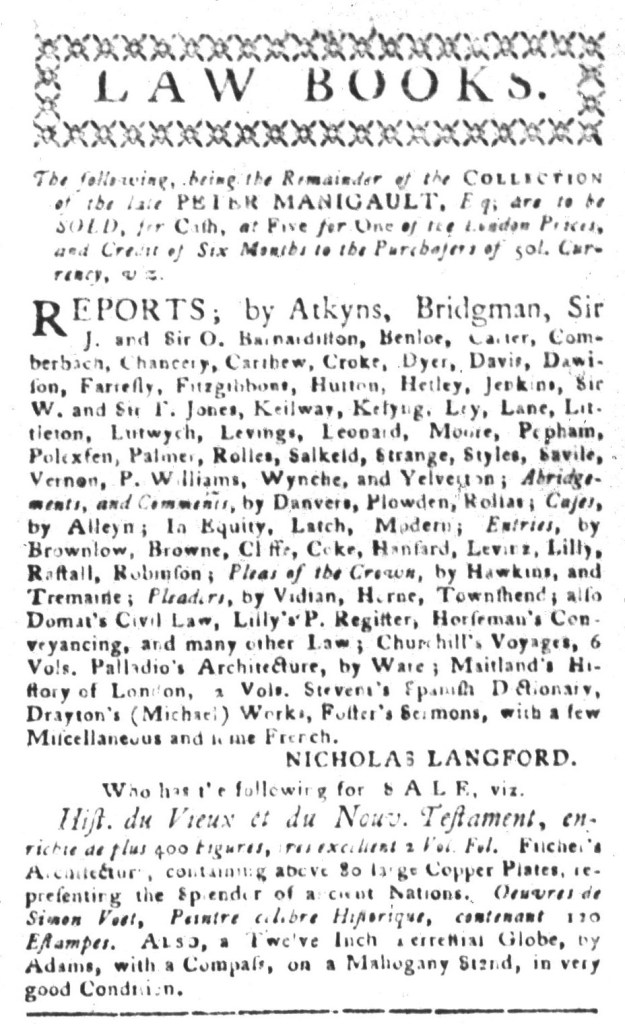
“LAW BOOKS … being the Remainder of the COLLECTION of the late PETER MANIGAULT, Esq.”

Nicholas Langford advertised dozens of law books for sale in the June 14, 1774, edition of the South-Carolina Gazette and Country Journal.  In addition to listing the authors and titles, his advertisement featured a headline, “LAW BOOKS,” enclosed within a border composed of decorative type.  It was the only notice in that issue that received such treatment.  Langford also advertised in the June 10 edition of the South-Carolina and American General Gazette, deploying the same headline with the list of books.  In that instance, the headline did not receive special treatment, suggesting that the printing office was responsible for the enhancement to the version in the South-Carolina Gazette and Country Journal instead of Langford issuing instructions or making a request.

Why might Charles Crouch, the printer of that newspaper, have decided that this advertisement merited such a headline?  Perhaps it was an act of deference.  Langford advertised “the Remainder of the COLLECTION of the late PETER MANIGAULT, Esq.”  Crouch and readers would have been familiar with the prominent lawyer, legislator, and plantation owner.  “Because of his large land and slave holdings,” Michelle Brown notes, Manigault “became one of the wealthiest men in eighteenth-century British North America.”  He owned thousands of acres and enslaved hundreds of men, women, and children.  Manigault served in the Commons House of Assembly from 1755 to 1772, elected as Speaker during the time that South Carolina and other colonies protested the Stamp Act and reelected seven times.  His political career began shortly after he returned from London, where he studied law at the Inner Temple from 1750 to 1754.  He resigned in 1772 due to ill health, returning to England in hopes of recuperating, but died there on November 12, 1773.  Brown reports that “his body was returned to Charleston for burial in the family vault of the Huguenot Church.”  His estate entrusted Langford, a bookseller, with selling his library of law books.  Given Manigault’s influence in the colony, Crouch may have decided that this advertisement deserved a more elaborate headline than others published in his newspaper.

May 6

What was advertised in a colonial American newspaper 250 years ago today?

Top to bottom: South-Carolina and American General Gazette (May 6, 1774); South-Carolina Gazette and Country Journal (May 10, 1774); Supplement to the South-Carolina Gazette (May 16, 1774).

“Whom he has had under his [illegible] these ten Years past.”

It had been a while since Mr. Pike, the dancing master, ran advertisements in any of the newspapers printed in Charleston in the 1770s.  In September 1773, he announced that he opened his “Dancing and Fencing SCHOOLS … for the Season.”  A little more than six months later, he once again took to the public prints with a final notice that he would leave “the Province some Time next Month” due to ill health.  It appeared in the May 6 edition of the South-Carolina and American General Gazette and the May 10 edition of the South-Carolina Gazette and Country Journal.  He likely placed it in the South-Carolina Gazette simultaneously, but some issues have not survived.  It ran in the Supplement to the South-Carolina Gazette on May 16, probably moved to that portion of the newspaper after appearing in the standard issue in previous weeks.  By placing his notice in all three newspapers published in the colony, Pike disseminated his farewell message widely, making his intended departure as visible as possible.

The reiteration of his advertisements across multiple newspapers eventually made it more accessible to historians and other modern readers, especially those who rely on digital surrogates.  However, Pike’s advertisement is fully legible in only one of the digital images of the issues listed above.  It is possible to make out most of the content of the advertisement from the South-Carolina and American General Gazette, but not all of it.  While it might be tempting to blame poor printing, that does not seem to be solely responsible for the quality of the image.  Robert Wells, the printer, would not have been able to keep his newspaper in business for years if the contents were not legible, especially when competing with two other newspapers.  Digital images of some, but not all, pages of the May 6 edition of the South-Carolina and American General Gazette are more legible.  Others are much less legible.  The primary problem seems to lie with the photography rather than the printing.  Technological errors that occurred during the digitization of the South-Carolina Gazette certainly made a portion of Pike’s advertisement in the May 16 supplement illegible.  A glitch of some sort cut off the bottom third of the first page of the supplement, presenting solid grey rather than an image of the advertisements on that portion of the page.  The first several lines of Pike’s advertisement are visible, but not the rest.  In contrast, the entire advertisement is legible in the digital image of the South-Carolina Gazette and Country Journal for May 10, though some combination of printing, wear over time, and modern photography has made some words more difficult to decipher than others.

These examples demonstrate that digitization is not a panacea for providing access to primary sources.  Digital images do not always offer the same access as examining the original documents.  The lower third of the page is not actually missing from the South-Carolina Gazette.  The South-Carolina and American General Gazette may be much more legible when viewed in person.  Unfortunately, the quality of the digital images undermines their accessibility.

May 3

What was advertised in a colonial American newspaper 250 years ago today?

South-Carolina Gazette and Country Journal (May 3, 1774).

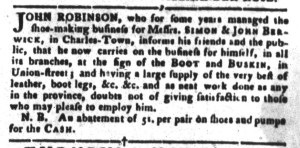
“He now carries on the business for himself … at the Sign of the BOOT and BUSKIN.”

When John Robinson launched his own business in the spring of 1774, he ran an advertisement in the South-Carolina Gazette and Country Journal.  He began by reminding prospective customers that he “for some years managed the shoe-making business for Messrs. SIMON & JOHN BERWICK.”  Now he was prepared to leverage that experience into operating his own enterprise, announcing to “his friends and the public, that he now carries on the business for himself.”  They could find him “at the sign of the BOOT and BUSKIN” on Union Street.

Robinson asserted that he pursued shoemaking “in all its branches,” deploying a familiar phrase that meant that he was capable of performing any task related to his occupation and producing any item associated with his trade.  The device that he chose to mark his location testified to that as well, depicting both a traditional boot and a buskin or a knee-high boot.  To that end, he acquired a “large supply of the very best of leather, boot legs,” and other materials, yet he also realized that the quality of the materials alone would not sell the items produced in his shop.  He declared his work “as neat … as any in the province,” simultaneously drawing on his experience managing the Berwicks’ workshop and drawing comparisons to competitors throughout Charleston and the rest of the colony.

To further entice prospective customers, Robinson concluded with a nota bene that promoted an “abatement of 5s. per pair on shoes and pumps for the CASH.”  He likely extended credit when necessary, but those who paid at the time of sale received a discount of five shillings.  The shoemaker likely hoped that bargain would attract the attention of even those not among his “friends” who knew him from his time at another workshop, convincing them to visit the “sign of the BOOT and BUSKIN” to check out the sale prices on shoes.

April 26

What was advertised in a colonial American newspaper 250 years ago today?

Supplement to the South-Carolina Gazette and Country Journal (April 26, 1774).

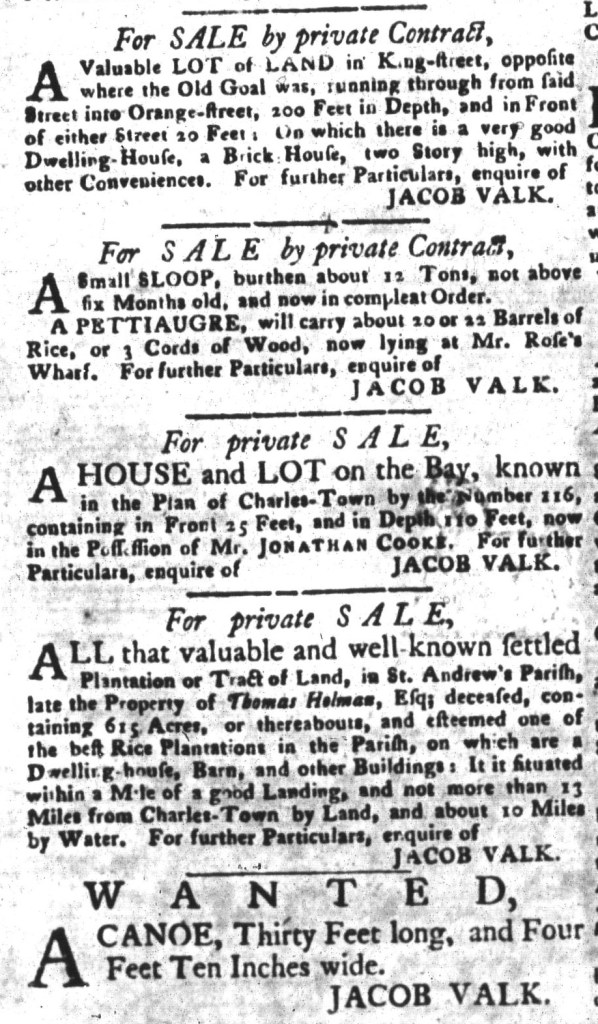
“For further particulars, enquire of JACOB VALK.”

Jacob Valk established a brokerage office in Charleston in the early 1770s.  In his newspaper advertisements, he advised, “Lands, Houses, and Negroes, Bought and sold at private Sale, upon the usual Commission.”  If the pages of the public prints provide any guidance, many colonizers availed themselves of his services, entrusting the broker to conduct business on their behalf.  His name became a familiar sight as he placed advertisement after advertisement for his clients.

Consider the supplement that accompanied the April 26 edition of the South-Carolina Gazette and Country Journal.  Valk purchased an entire column on the third page, running fourteen advertisements.  Some offered tracts of land for sale, while others included houses and other buildings along with land.  Two of them announced sales of enslaved people, one indicating “SEVERAL NEGROES” without giving further details and the other describing “two very valuable Negro Shoe-makers.”  Valk sought buyers for “A Small Sloop” and a pettiaugre (or canoe).  In each instance, he invoked a familiar refrain: “For further Particulars, enquire of JACOB VALK.”  He also assisted executors of estates in calling on those who had unfinished business to settle accounts, inviting them to his office “where the Particulars of that Estate now lay ready for their Perusal.”  Four days earlier, Valk purchased a similar amount of space to run many of the same advertisements in the South-Carolina and American General Gazette.

The broker must have factored the cost of advertising into the “usual Commission” that he received for his services, especially considering that he was one of the best customers for the printing offices in Charleston.  That he continuously placed newspaper advertisement testifies to his confidence in their general effectiveness, though not every notice may have achieved the desired results.  Running so many simultaneously allowed him to distribute the risk and rewards of advertising.  Even if some advertisements did not attract buyers, sellers, or associates seeking to settle accounts, others apparently did.  When considered collectively, Valk came out ahead on what he invested in advertising.  His individual clients, however, would not have had the same experience had they gone it alone.  If they paid Valk on commission following a transaction he facilitated, then they paid only for successful advertisements without losing money on notices that did not produce the intended results.

April 19

What was advertised in a colonial American newspaper 250 years ago today?

South-Carolina Gazette and Country Journal (April 19, 1774).

“BOHEA, GREEN, and HYSON TEA.”

Not all colonizers dispensed with advertising, selling, and drinking tea as an immediate response to the Boston Tea Party, especially if the tea in question had not been subject to import duties.  In April 1774, Pott Shaw advertised “BOHEA, GREEN, and HYSON TEA, warranted of the finest Quality,” in the South-Carolina Gazette and Country Journal.  Shaw did not reveal when the tea arrived in the colony, by what means, or its origins, leaving those details to prospective customers to ask about, if they chose to do so, when they made their purchases.  Buying and selling this particular commodity occurred in the context of conversations about the politics of tea.

The April 19 edition of the South-Carolina Gazette and Country Journal carried some of the same updates about possible reactions to the Boston Tea Party that appeared in the Connecticut Courant a week earlier.  Throughout the colonies, printers reprinted news from one newspaper to another.  In this instance, both newspapers carried an “Extract of a letter from London, January 24,” that originally ran in newspapers in Philadelphia.  It briefly stated, “Three men of war are ordered to be in readiness to sail for Boston, and exact payment for the TEA,” without providing additional information, including who had written the letter.  Readers had to decide for themselves whether the report was accurate or merely rumor.  Another news item, this one having arrived via New York, reported that the “intentions of the British administration, relative to the American duty on tea, are not yet fixed.”  Readers in Charleston and Hartford read both these dispatches from London.  They also encountered advertisements for tea in the same issues that carried that news.

Readers of the South-Carolina Gazette and Country Journal also read about commemorations of events that contributed to the imperial crisis.  From Boston, they learned that “the horrid tragedy of the 5th of March,” the Boston Massacre, “was observed with the usual solemnity” on its fourth anniversary.  That article described “a portrait of that inhuman and cruel massacre” put on display and the ringing of bells throughout the city for an entire hour.  An update from New York followed, describing dinners that celebrated the “anniversary of the repeal of the STAMP-ACT.”  Abuses perpetrated by both British soldiers and Parliament received attention alongside news about tea.

For the moment, however, that did not result in merchants, shopkeepers, and others refraining from advertising and selling tea in South Carolina or Connecticut or other colonies.  The beverage was exceptionally popular, making it difficult to curtail consumption.  Eventually, colonizers did enact boycotts, but some people still devised ways to evade them, at least according to Peter Oliver’s account.  Although some entrepreneurs opted not to sell (or at least not to advertise) tea following the Boston Tea Party, it did not immediately disappear from shelves or newspaper advertisements.

March 29

What was advertised in a colonial American newspaper 250 years ago today?

South-Carolina Gazette and Country Journal (March 29, 1774).

“He has Advice of a compleat Assortment … expected here from London every Day.”

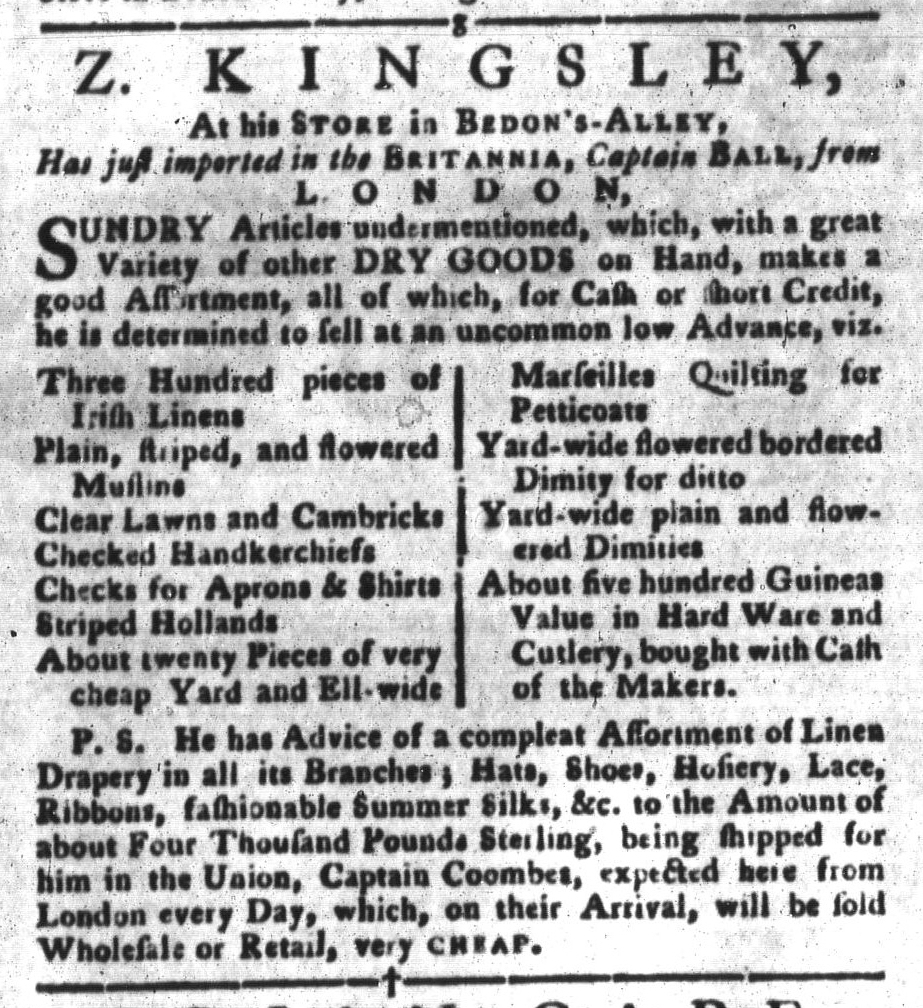
Zephaniah Kingsley trumpeted the magnitude of the inventory “At his STORE in BEDON’S-ALLEY” in an advertisement in the March 29, 1774, edition of the South-Carolina Gazette and Country Journal.  He promoted the “SUNDRY Articles undermentioned” in a list of items “just imported … from LONDON” as well as a “great Variety of other DRY GOODS on Hand” from previous shipments.  All together, they constituted a “good Assortment” that offered a vast array of choices to consumers in Charleston.  He even took the unusual step of the total worth of some of his merchandise, declaring that he stocked “About five hundred Guineas Value in Hard Ware and Cutlery.”  That certainly signaled that he had indeed acquired a “good Assortment” of those items to satisfy the desires of just about any prospective customer.

The merchant opted for a postscript (rather than the more common nota bene) to alert readers that he “has Advice of a compleat Assortment of Linen Drapery in all its Branches; Hats, Shoes, Hosiery, Lace, Ribbons, fashionable Summer Silks,” and other goods “being shipped for him in the Union, … expected here from London every Day.”  As if his current inventory was not enough, Kingsley encouraged a sense of anticipation for new items that matched the most current fashions in London, the most cosmopolitan city in the empire.  In so doing, he once again deployed a marketing strategy that he used a couple of months earlier.  In early February, he proclaimed that he “intends having ready to open as soon as possible in the spring, an elegant assortment of Linen Drapery … with a quantity of the most fashionable summer Silks.”  The new advertisement served as an update for customers whose attention Kingsley caught with that preview.  In his effort to sell all his merchandise, including goods already “on Hand,” the merchant emphasized new items and even those that had not yet arrived but that he would make available to consumer imminently.  Curiosity about those goods, he likely reasoned, could help in moving older inventory out of his store once he got customers through the doors.

March 15

What was advertised in a colonial American newspaper 250 years ago today?

South-Carolina Gazette and Country Journal (March 15, 1774).

“All Persons whatever, who may be inclinable to favour him with their Advertisements, may rely on its answering their End.”

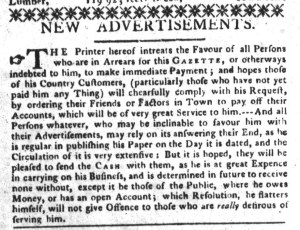
The “NEW ADVERTISEMENTS” in the March 15, 1774, edition of the South-Carolina Gazette and Country Journalbegan with a notice from the printer, Charles Crouch.  Like his counterparts throughout the colonies, Crouch occasionally issued a call for “all Persons who are in Arrear for this GAZETTE, or otherways indebted to him, to make immediate Payment.”  Recognizing that many of his subscribers lived outside Charleston, he requested that “his Country Customers … will cheerfully comply” by directing “their Friends or Factors in Town to pay off their Accounts.”  In particular, he pointedly suggested that “those who have not yet paid him any Thing” would tend to what they owed.  When they ran notices for similar purposes, some printers asserted that certain customers had not made payments for years, taking advantage of credit extended to them.

How did Crouch and other printers manage to stay in business under such circumstances.  Many, but not all, required advertisers to pay in advance, figuring that advertising generated enough revenue to offset shortfalls from subscriptions.  That was the case for Crouch and the South-Carolina Gazette and Country Journal.  He instructed advertisers “send the CASH” when they submitted copy to the printing office.  After all, “he is at great Expence in carrying on his Business.” Accordingly, Crouch was “determined in future to receive none without,” suggesting that perhaps he had accepted advertisements without “the CASH” in the past.  The printer made an exception for those he “owes Money, or has an open Account,” presumably counting new advertisements against his own debts.

In hopes of attracting new advertisers, Crouch commented on the effectiveness of inserting notices in his newspaper.  Advertisers could “rely on its answering their End” or serving their purpose, whether disseminating information or enticing customers or whatever other reason they had for advertising.  He competed against two other newspapers published in Charleston, the South-Carolina Gazette and the South-Carolina and American General Gazette.  Prospective advertisers should choose the South-Carolina Gazette and Country Journal, Crouch stated, because “the Circulation of it is very extensive.”  In other words, the newspaper reached many readers.  In addition, Crouch bragged that he was “regular in publishing his Paper on the Day it is dated,” taking a swipe at other competitors who sometimes delayed printing and distributing their weekly newspapers.  Advertisers could depend on their notices in the South-Carolina Gazette and Country Journal reaching readers in a timely manner.  At the same time, he tended to settling accounts with existing customers, Crouch sought additional customers who had reason to advertise.