February 1

What was advertised in a colonial American newspaper 250 years ago today?

South-Carolina Gazette and Country Journal (February 1, 1774).

“He intends having ready to open as soon as possible in the spring, an elegant assortment of Linen Drapery in all its branches, with a quantity of the most fashionable summer Silks.”

Z. Kinsley inserted a lengthy advertisement promoting the “large STOCK of DRY GOODS” available at his store in Charleston in the South-Carolina Gazette and Country Journal several times in the winter of 1773 and 1774. Unlike most advertisements that ran for several consecutive weeks before being discontinued, this one appeared sporadically in December and January. Kingsley even placed it once again on February 1, perhaps in a final effort to move his current inventory before making a trip to London.  He made it known throughout his advertising campaign that “he intends going for London the beginning of February.”  With that departure in mind, he sold his wares for cash (or “ready Money”) or “short Credit.”  He set attractive prices, marking up his costs only slightly (or what he and other advertisers called “a very low Advance”).  As much as possible, he hoped to clear out his store to make room for new goods that he would acquire on his trip.

The merchant apparently did not envision staying in London for too long.  In a nota bene, he declared that he “intends having ready as soon as possible in the spring, an elegant assortment of Linen Drapery in all its branches, with a quantity of the most fashionable summer Silks” and other items.  In addition to marketing an assortment of textiles, hardware, cutlery, and ironmongery already in stock, Kingsley encouraged consumers to anticipate his summer selections well before they arrived.  Like so many other advertisers, he declared that he imported his merchandise “in the very last Ships from England,” but he devised an innovation on that popular appeal by prompting prospective customers to imagine what he would carry in his store after his trip.  Months in advance, he attempted to persuade consumers to think of his store as the place to purchase “fashionable summer Silks” and other goods appropriate for the season before his competitors began a chorus of claims about importing the newest and most fashionable items via the vessels that most recently arrived in port.  In addition, readers realized that making a trip to London meant that Kinsley could eliminate the middlemen who drove up prices.  That meant another “very low Advance” when he presented that “elegant assortment of Linen Drapery” for sale in the spring.

Most merchants and shopkeepers focused on selling the wares they already had in stock.  Kinsley devoted significant space in his advertisement to doing so, but he did not stop there.  At various points throughout the winter, he urged consumers in Charleston to anticipate the merchandise that he would select during his trip to the cosmopolitan center of the empire where he would observe the latest fashions himself.  His marketing efforts incorporated both shopping in the present and shopping in the future, priming customers to visit his store when they needed or desired to purchase from among his spring and summer selections.

January 25

What was advertised in a colonial American newspaper 250 years ago today?

South-Carolina Gazette and Country Journal (January 25, 1774).

“Lists of Public Officers; Members of the Commons House of Assembly; Days for holding Courts in South-Carolina and Georgia.”

Charles Crouch, the printer of the South-Carolina Gazette and Country Journal, also published almanacs.  Most newspaper printers did so.  Almanacs, those popular pamphlets, represented an important revenue stream for any printing office, yet publishing them could be a tricky business.  Printers aimed to produce enough copies to meet demand, but not so many that they had a significant number of leftovers that cut into their profits.

As January 1774 neared its end, Crouch seemed to have a surplus of “THOMAS MORE’s ALMANACK, for the Year 1774” that he needed to move out of his printing office on Elliott Street in Charleston.  On January 25, he ran an advertisement that offered the almanacs for sale “Wholesale and Retail, with good Allowance to those who take a Quantity.”  In other words, he offered a discount to shopkeepers, peddlers, and others who bought in volume.  He placed the notice at the top of the center column on the first page, enhancing its visibility in that issue of the South-Carolina Gazette and Country Journal.  The introduction to the advertisement proclaimed, “Just published,” but that probably was not the case.  Crouch previously inserted the same advertisement as the new year approached.  As was common practice, he likely inserted the notice once again, type already set, without making revisions.

With each passing day, some of the contents became obsolete, including “the Sun and Moon’s Rising and Setting,” “Length of Days and Nights,” and “Judgment of the Weather.”  Other items, however, remained relevant.  Crouch relied on these “useful Particulars” in marketing the almanac.  Its pages contained “Lists of Public Officers; Members of the Commons House of Assembly; [and] Days for holding Courts in South-Carolina and Georgia.”  For those who might have occasion to travel to other colonies by land rather than by ship, the almanac included “Descriptions of the Roads throughout the Continent.”  Throughout their advertising campaigns, printers highlighted the various contents of the almanacs they published and sold.  Each year, the “useful Particulars” beyond what many described as the “usual Astronomical Calculations” (though Crouch did not happen to use that phrase) became increasingly important in marketing almanacs in January, February, and March.

January 11

What was advertised in a colonial American newspaper 250 years ago today?

South-Carolina Gazette and Country Journal (January 11, 1774).

“Their assortment is as compleat as most in the province.”

In an advertisement in the January 11, 1774, edition of the South-Carolina Gazette and Country Journal, George Cooke and Company informed prospective customers that they recently imported a “fresh SUPPLY of GOODS” from London on the Portland.  Their merchandise included “very fashionable brocades” and other textiles, “men and boys fine beaver hats,” “womens black and coloured satin hats,” “all sorts of gloves and mitts,” “hosiery of all kinds,” and “a great variety of other goods.”

Cooke and Company competed in Charleston’s bustling marketplace.  John Webb advertised a similar inventory, as did Z. Kingsley and Samuel Gordon.  Other merchants and shopkeepers placed advertisements in the city’s other newspapers, the South-Carolina Gazette and the South-Carolina and American General Gazette.  Many did not advertise in the public prints, relying instead on other means of attracting customers to their stores and shops.  Consumers had many choices for acquiring goods in the busy port.

Realizing that was the case, Cooke and Company strove to convince readers that they offered a selection as extensive as those they would find just about anywhere else in Charleston or the rest of the colony.  The items they just received from the Portland supplemented previous shipments.  Those “several late importations from London and Bristol” made their assortment of goods “as compleat as most in the province.”  Customers did not need to go from shop to shop, looking for wares that appealed to them, when Cooke and Company stocked just about anything they could imagine.

Webb, Kingsley, and Gordon all demonstrated some of the choices they offered to consumers by listing dozens of items in their advertisements, each of them indicating that they carried much more than they could include in newspaper advertisements, yet Cooke and Company alone in that issue of the South-Carolina Gazette and Country Journal provided assurances that few if any of their competitors surpassed the selection at their shop.  Whether or not that swayed any prospective customers, Cooke and Company attempted to give their enterprise an advantage over the marketing undertaken by other merchants and shopkeepers.

December 7

What was advertised in a colonial American newspaper 250 years ago today?

South-Carolina Gazette and Country Journal (December 7, 1773).

“As compleat a Stock of various Liquors … as any other Tavern or House of Entertainment whatsoever in this Province.”

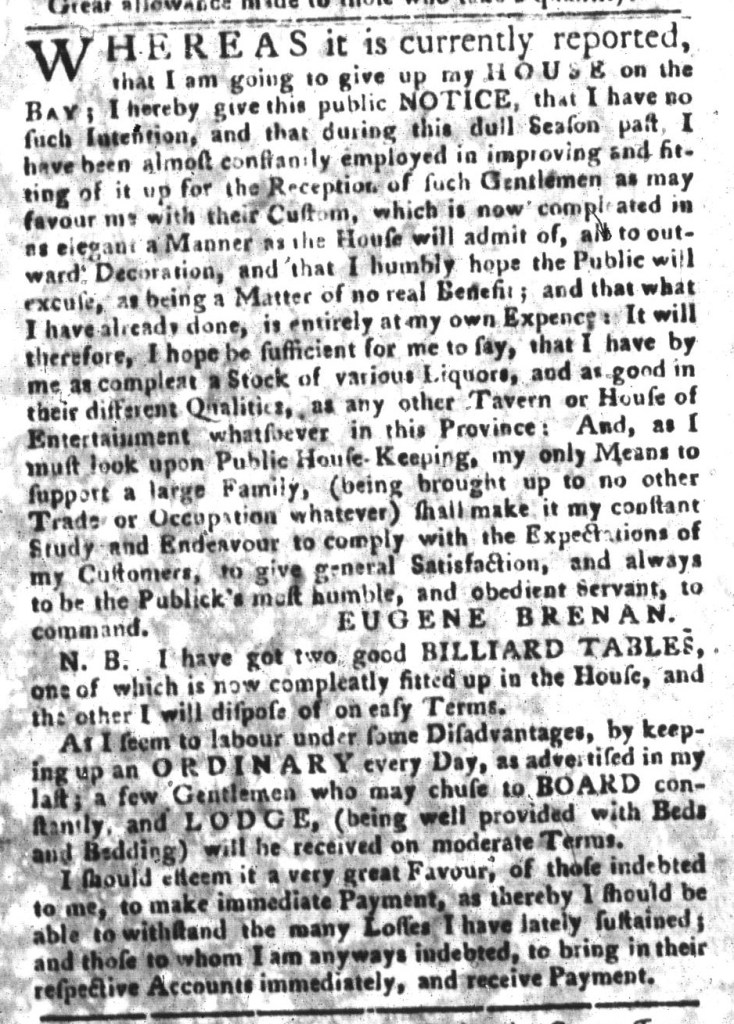
Eugene Brenan worried that rumors purporting that he planned to “give up my HOUSE on the BAY” would damage business at his public house in Charleston.  To dispel whatever gossip circulated about the fate of his establishment, he ran an advertisement in the December 7, 1773, edition of the South-Carolina Gazette and Country Journal.  Though he acknowledged “many Losses …lately sustained,” he underscored his determination to run a public house that rivaled all others.   Quite the opposite of what some reported about Brenan closing his doors, he had been “constantly employed in improving” and furnishing his public house “for the Reception of such Gentlemen as may favour [him] with their Custom.”  His guests would convene in a gathering space “as elegant … as the House will admit of.”  The “outward Decoration,” however, did not matter as much as other amenities that Brenan provided.

He attempted to entice customers with promises of “as compleat a Stock of various Liquors, and as good in their different Qualities, as any other Tavern or House of Entertainment whatsoever in this Province.”  Whatever their tastes, gentlemen could order their favorite spirits at Brenan’s public house.  He also equipped the establishment with a billiard table for the enjoyment of his patrons, allowing for some friendly competition as they socialized and sampled the “various Liquors.”  Brenan encouraged readers to think of spending time at his public house as an experience, one that he “shall make it [his] constant Study and Endeavour to comply with the Expectations of [his] Customers.”  He was especially motivated “to give general Satisfaction” because he had been “brought up to no other Trade or Occupation whatever.”  Brenan put all of his energy into “Public House-Keeping” and tending to his patrons.  Whatever the gentlemen of Charleston thought they knew about Brenan’s alleged plans to close his public house, he hoped that an advertisement setting the record straight would convince them to visit and see for themselves the improvements he made, sample the liquors he stocked, play billiards, and socialize with friends and acquaintances.  Through his endeavors to serve them, Brenan suggested, his customers would discover a public house as comfortable and inviting as any in the bustling port of Charleston.

November 23

What was advertised in a colonial American newspaper 250 years ago today?

South-Carolina Gazette and Country Journal (November 23, 1773).

“Wedding-Cakes.”

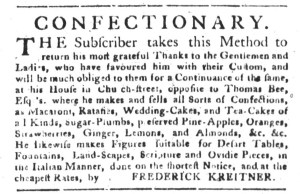
Frederick Kreitner made and sold sweet treats at his “CONFECTIONARY” in Charleston in the early 1770s.  In an advertisement in the November 23, 1773, edition of the South-Carolina Gazette and Country Journal, he expressed “his most grateful Thanks to the Gentlemen and Ladies, who have favoured him with their Custom” and solicited the patronage of new and returning customers.  The confectioner listed several of the items he made and sold, including macaroons, “Tea-Cakes of all Kinds, Sugar-Plumbs, [and] preserved Pine-Apples, Oranges, Strawberries, Ginger, Lemons, and Almonds.”  Kreitner also advertised that he sold “Wedding-Cakes.”

What distinguished a wedding cake from other cakes in colonial Charleston?  In “Wedding Cake: A Slice of History,” Carol Wilson examines a variety of traditions, including English traditions that colonizers brought with them to North America.  According to Wilson, “bride cake, the predecessor of the modern wedding cake,” replaced bride pie in the seventeenth century.  “Fruited cakes, as symbols of fertility and prosperity, gradually became the centerpieces for weddings.”  However, a “much less costly bride cake took the simpler form of two large rounds of shortcrust pastry sandwiched together with currants and sprinkled with sugar on the top.”  This simple type of cake “could easily be cooked on a bakestone on the hearth.”  Wilson also reports, “Bride cake covered with white icing first appeared sometime in the seventeenth century.”  In 1769, Elizabeth Raffald, known for the recipes and other household hints she published in England, “was the first to offer the combination of bride cake, almond cake, and royal icing.”  In 1773, Raffald published the third edition of The Experienced English Housekeeper, for the Use and Ease of Ladies, Housekeepers, Cooks.  It contained nearly nine-hundred recipes, including instructions “To make a BRIDE CAKE,” “To make ALMOND-ICEING for the BRIDE CAKE,” and “To make SUGAR ICEING for the BRIDE CAKE.”  Raffald considered these recipes so important that she placed them first in chapter 11, following and introduction that offered “Observations upon CAKES.”

Prospective customers in Charleston had expectations about what distinguished wedding cakes from “Tea-Cakes” and other cakes that Kreitner made and sold.  By including wedding cakes among the confections in his advertisement, Kreitner aided in further diffusing traditions associated with new marriages and presented himself as an authority who could assist customers who wished to adhere to contemporary fashions and rituals.

November 2

What was advertised in a colonial American newspaper 250 years ago today?

South-Carolina Gazette and Country Journal (November 2, 1773).

A COMPLEAT and CORRECT MAP of SOUTH-CAROLINA.”

In the fall of 1773, James Cook, a surveyor, advertised a “COMPLEAT and CORRECT MAP of SOUTH-CAROLINA” to readers of the South-Carolina Gazette and Country Journal.  He underscored that he went to “great Expence in surveying” the colony, “informing himself of the District Lines, Sea-Coast, &c. with many other Particulars of general Utility.”  Furthermore, he made arrangements for “the Engraving and Colouring [to be] executed by the best Hands in London.”  The surveyor asserted that his map was “as useful a Piece of Geography as any extant.  According to William P. Cumming in British Maps of Colonial America, as quoted in the overview presented by David Rumsey Map Collection, Cook’s map was “the most detailed and accurate printed map of South Carolina, especially for the interior, yet to appear.”  You may examine a high-resolution image of Cook’s “Map of the PROVINCE of SOUTH CAROLINA” at the David Rumsey Map Collection.

Inset from James Cook, Map of the Province of South Carolina, engraved by Thomas Brown (London: 1773).  Courtesy David Ramsey Map Collection.

In his advertisement, Cook declared that map provided “a clear Idea, not only of this Province, but of the Catabaw Nation, Part of North-Carolina, and as far back as the Blue Mountains, … together with the established Dividing Line of the two Provinces.”  A small amount of territory denoted “CATABAW NATION” appeared in the northern region, but the depiction of “Catabaw Town” consisted of six squares, presumably representing houses.  The insets provided more detail of English settlements and outposts: “A PLAN of CHARLESTOWN,” “A PLAN of GEORGETOWN,” “A PLAN of CAMDEN,” “A PLAN OF BEAUFORT ON PORT ROYAL ISLAND,” and “A DRAUGHT of PORT ROYAL HARBOUR in SOUTH CAROLINA with the Marks for going in.”  Mapping the colony from the coast into the interior was an act of taking possession of the land (including, as the title of the map stated, “Roads, Marshes, Ferrys, Bridges, Swamps, Parishes Churches, Towns, Townships; COUNTY PARISH DISTRICT and PROVINCIAL LINES) and waterways (including Rivers, Creeks, Bays, Inletts, Islands [to facilitate] INLAND NAVIGATION”).  That simultaneously dispossessed indigenous inhabitants or, in the case of the Catawba, confined them to small districts.  One more inset depicted a scene with two well-dressed English gentlemen, either merchants or planters, conversing next to the cargo of a ship with several buildings visible on the other side of a harbor or river.  An enslaved African, shirtless in contrast to the finery of the gentlemen, carries a parcel on his back.  An indigenous man observes, sitting on the other side of a tree and an alligator, removed from the English settlement and the commerce undertaken by the English gentlemen and the enslaved African.  He holds a bow in one hand and an arrow in the other, representing, from the perspective of the producers and consumers of the map, the dangers that colonizers continued to face from the indigenous population.

Cook hoped that the map “will merit the Approbation of the Public” and sell many copies “at the low Price of TWO DOLLARS and a HALF.”  Whatever the sales may have been in the 1770s, only six copies survive, five in institutions in the United States and a sixth at the British Museum.  Perhaps so few survive in part because consumers did not purchase the maps solely to decorate homes or merchants’ offices but instead used them to traverse the land and waterways of the colony.

October 26

What was advertised in a colonial American newspaper 250 years ago today?

South-Carolina Gazette and Country Journal (October 26, 1773).

“A GENTEEL ORDINARY [and] a COFFEE-ROOM.”

Just six months after advertising that he moved to a new location, Francisco Morrelli (sometimes Francis Morelli), “PASTRY-COOK,” took to the public prints once again to alert “those Gentlemen who were so kind to favour him with their Custom,” along with prospective new customers, that he had moved to a “large and commodious HOUSE” at the corner of Church and Elliott Streets in Charleston.  He invited “Gentlemen only” to enjoy “the best Entertainment this Province can possibly afford.”  With that invitation, Morelli established his “GENTEEL ORDINARY” as a homosocial space, like many taverns and coffeehouses, for men to gather to eat, drink, conduct business, socialize, discuss politics, conduct business, and gossip.  In asserting that “Gentlemen only may be accommodated” at his ordinary, may have also signaled that he welcomed only the better sorts.  Others should congregate elsewhere.

Morelli also promoted new services.  In his previous advertisement, he invited patrons to imbibe “Wine, Punch, [and] Beer” at his ordinary, while this “large and commodious HOUSE” had space for a “COFFEE-ROOM for the Reception of those Gentlemen who may chuse to drink Tea or Coffee” and “read Papers.”  He reported that he “intends to be furnished with every News Paper that can be procured.”  That meant local publications, perhaps all three of the newspapers printed in Charleston at the time, as well as newspapers from other cities and towns, especially major ports like Boston, New York, and Philadelphia.  Eighteenth-century coffeehouses often subscribed to newspapers as a service to a clientele that perused them to keep informed about both politics and commerce.  The shipping news and prices current from places near and far, for instance, aided merchants in transacting business.

The pastry cook also delivered takeout meals to prospective customers, a service not limited to “Gentlemen only.”  Morelli declared that “any Family wanting Dinners or Suppers drest [or prepared] and sent Home to their Houses, may be genteelly served on the shortest Notice.”  Other entrepreneurs provided similar services in early America.  For instance, when Edward Bardin opened a “compleat Victualing-House” in New York in June 1770, he offered meals “ready dressed, sold out in any Quantity, to such Persons who may find it convenient to send for it.”  Meal delivery in American cities dates back at least as far as the eighteenth century.

Morelli concluded his advertisement with a short note about “PASTRY and DESERTS as usual,” hawking the “Pies, Tarts, Cakes, Jellies,” and other treats that he mentioned in an earlier advertisement.  They accounted for only a portion of the services and amenities that he presented to current and prospective customers.  In addition to selling and delivering meals and pastries, Morelli hoped to make his “GENTEEL ORDINARY” and “COFFEE-ROOM” a destination for merchants, planters, and other local gentry.

October 12

What was advertised in a colonial American newspaper 250 years ago today?

South Carolina Gazette and Country Journal (October 12, 1773).

“A great variety of articles in the highest taste.”

In his efforts to sell his merchandise to prospective customers in Charleston and nearby town in the fall of 1773, James McCall emphasized the array of choices available at his shop.  Like many other purveyors of consumer goods, he listed many of his wares in a newspaper advertisement.  His merchandise included everything from “superfine bright scarlet broad-cloth” and “rich black Genoa velvet” to “elegant china” and “neat portmantua and other trunks” to “handsome tall candlesticks” and chamber and street lamps.”  He stocked “Morocco slippers” in a range of colors, including “red, blue, green, and yellow.”  Similarly, customers could choose “mens velvet caps, with and without tassels,” to suit their tastes.

McCall introduced consumers to his catalog of goods by describing his inventory as a “very large ASSORTMENT” and explaining that he included only certain items in his advertisement.  The list commenced with “AMONG OTHER ARTICLES” and concluded with a promise of “a great variety of articles in the highest taste.”  The word “variety” also appeared elsewhere in the advertisement, “a variety of pewter, copper, tin, and iron ware” and “writing, printing, and [a] variety of paper,” to encourage prospective customers to imagine the items on his shelves and visit his shop to see for themselves.  In addition, “&c.” (an abbreviation for et cetera), deployed more than once in the advertisement, suggested even more choices.  In case that did not lure readers, the shopkeeper expected “Further supplies in the next vessels” to arrive in port.

The competition for customers sometimes manifested itself in competitions for placing the longest newspaper advertisements.  Listing dozens of items and occupying approximately one-third of a column, McCall’s advertisement matched others that ran in the October 11 edition of the South-Carolina Gazette and the October 12 edition of the South-Carolina Gazette and Country Journal.  On other occasions, however, that advertisement would have seemed brief in comparison to those placed by other merchants and shopkeepers.  In listing so many choices, McCall and others may not have merely attempted to meet consumer demand.  Instead, they may have intended for their catalogs of goods to incite greater demand by demonstrating many of the available choices and prompting prospective customers to envision selecting among them.

September 21

What was advertised in a colonial American newspaper 250 years ago today?

South-Carolina Gazette and Country Journal (September 21, 1773).

“MR. PIKE’s Dancing and Fencing SCHOOLS.”

Mr. Pike may have remained in Charleston longer than he intended … and longer than he previously announced to the public.  In an advertisement in the March 30, 1773, edition of the South-Carolina Gazette and Country Journal, the dancing master advised readers that the “BALL, for the young Ladies and Gentlemen under his Tuition” to be held on April 2 would be the “last Ball he proposes to make in Charles-Town.”  In addition to current students, he invited “former Scholars” to visit his school to brush up on their skills and then participate in an exhibition at that final ball.  This gave the impression that Pike intended to leave the city soon after the ball.

Yet six months later, he placed new advertisements in the South-Carolina Gazette and the South-Carolina Gazette and Country Journal.  In one, he announced that “MR. PIKE’s Dancing and Fencing SCHOOLS, commenced on Monday the 20th of September, as usual for the Season,” as though there had been no disruption in the schedule.  He did not, however, mention that the term would culminate in a ball, a strategy that he sometimes deployed as a means of inciting anxiety among prospective students and their parents.  In previous advertisements, Pike lectured that students needed to attend his school regularly in order to master the steps and avoid embarrassing themselves at the ball he hosted when their lessons concluded.  Perhaps Pike knew all along that he was not leaving Charleston immediately but rather had chosen not to sponsor any more balls as part of his curriculum.  However closely he followed his original plans, Pike moved to Philadelphia in 1774.  He advertised dancing and fencing lessons in the Pennsylvania Packet on October 17 and in the Pennsylvania Gazette on October 19.  He did not mention his students dancing at a ball, but he did attempt to incite anxiety among “such persons as may have forgot or had not an opportunity of learning to dance very young.”  His instruction tended to comportment more generally, including “genteel address with a proper carriage.”

South-Carolina Gazette and Country Journal (September 21, 1773).

During the time that her remained in Charleston, Pike leased or “hired the New-Assembly Room in Church-street” and sought to rent the venue for a variety of events, including “Public Sales of Estates, Negroes, [and] Dry Goods.”  The dancing master aimed to supplement the revenues he earned from giving lessons by facilitating auctions, including auctions of enslaved men, women, and children.  He also leased the space for “private Balls” on Monday and Friday evenings and meetings for “Societies” or clubs such as the Charles Town Library Society, the Saint George’s Society, and the Fellowship Society.  Pike underscored that the venue was “very airy, private, and more commodious than any one of the Kind ever built in this Province,” making it an ideal place for dancing lessons, auctions, balls, meetings, and other events.  Pike invited anyone interested in leasing the space to visit him there for “further Particulars.”

Even without promoting any balls that would take place at the end of the current season of dancing lessons, Pike maintained his status in Charleston during the time that he stayed in the city.  In addition to giving dancing and fencing lessons at the New Assembly Room, he also provided instruction at boarding schools “Four Days in the Week.”  Beyond that, he worked with local elites to schedule balls and club meetings in the venue that became synonymous with his “Dancing and Fencing SCHOOLS.”  Although not a member of the gentry, Pike positioned himself as a cultural broker whose assistance genteel Charlestonians needed to maintain their own status.

September 14

What was advertised in a colonial American newspaper 250 years ago today?

South-Carolina Gazette and Country Journal (September 14, 1773).

“The Delaware Lottery, For raising … 15,000 Dollars for the Use of the COLLEGE OF NEW-JERSEY.”

Advertisements for lotteries to fund a variety of projects, including roads, bridges, and buildings, regularly appeared in colonial newspapers.  Usually they promoted local projects, but that was not the case in an advertisement for the Delaware Lottery that ran in the September 14, 1773, edition of the South-Carolina Gazette and Country Journal. Sponsored by the “Presbyterian Congregation at Prince-Town, AND THE United Presbyterian Congregations OF NEWCASTLE and CHRISTIANA-BRIDGE,” this lottery benefited the College of New Jersey (now Princeton University).

This was not the first time that a college in colony to the north looked to benefactors from the south.  Three years earlier, Hezekiah Smith visited Georgia and South Carolina to raise funds on behalf of Rhode Island College (now Brown University).  Rather than a lottery, he advertised a subscription list.  In recognition of their donations, benefactors would have their names listed alongside others who supported that worthy enterprise.  Smith also left instructions for stragglers to submit donations (and receive recognition for their benevolence) after his departure from the towns he visited.

The sponsors of the Delaware Lottery asserted that the “growing Importance of the College of NEW-JERSEY … is now generally known through every Province in America,” making it a worthwhile endeavor for colonizers near and far to support.  Located “[i]n the Centre of North-America” (by which the sponsors meant midway along the string of settlements along the Atlantic coast), the College of New Jersey “is well fitted for the most extensive Usefulness” to all of the colonies.  The school provided “a complete and finished Education, to all who are sent to it.”  The sponsors also declared that the college “has hitherto subsisted, and been raised to its present Situation, entirely by the Favour of the Public.”  In other words, no prominent benefactor or institution funded the college; instead, it depended on the generosity of individuals who chose to make donations … or purchase lottery tickets.

According to the “SCHEME” of the lottery, the sponsors sought to sell twenty-thousand tickets for five dollars each.  They planned to pay out most of what they collected, reserving “15,000 Dollars” or “Fifteen per Cent” of each prize for the college.  The sponsors reported that “a Number of Tickets are already engaged, and many Gentlemen of extensive Acquaintance have interested themselves in this Measure,” so anyone interested in participating needed to purchase their tickets soon to get them while they lasted.  Local agents in several towns in Delaware, New Jersey, New York, Pennsylvania, Maryland, and Virginia sold tickets.  A note at the end of the lengthy advertisement advised colonizers in South Carolina to submit letters to Charles Crouch, the printer of the newspaper that carried the notice, to forward to William Bradford and Thomas Bradford in Philadelphia.  Such letters “will be safely forwarded and answered by the first Opportunity that offers after the Receipt of them.”

With the drawing fast approaching in the first week of October, readers had little time remaining to indicate their desire to enter the lottery, win prizes, and support the College of New Jersey.  That support, the “Favour of the Public,” may have provided a lot less motivation than the prospects of significant payouts for many of those who purchased tickets, but none of them had to admit that was the case.  By holding a lottery rather than circulating a subscription list, the sponsors encouraged benefactors with the prospects of reaping benefits for themselves as an incentive for their philanthropy.