September 7

What was advertised in a colonial American newspaper 250 years ago today?

South-Carolina Gazette and Country Journal (September 7, 1773).

“She expects a large and neat Assortment of Millinary from London soon.”

Jane Thomson, “SOLE-DEALER AND SEPARATE TRADER,” ran her own business in Charleston in the 1770s.  The milliner took to the pages of the South-Carolina Gazette and Country Journal to inform current and prospective clients that she “has removed from Tradd-Street to Old Church-Street, next Door to Mr. Sarazin, Silversmith,” and invited them to visit her at her new location.  She wished to maintain her clientele, expressing “grateful Thanks to her Friends and Customers for their past Favours” and stating that she “will be much obliged to her former Customers for the Continuance of their Commands.”  The milliner also hoped to expand her share of the market, promising “steady Attention” to all orders that would “give Satisfaction to all who are pleased to employ her.”

In addition to exemplary customer service, Thomson emphasized the hats as well as fabrics, ribbons, laces, other adornments, and supplies she stocked for making hats.  She declared that she “has a neat Assortment of Goods suitable for her Business.”  To further entice current and prospective clients, the milliner did not rely on her current inventory alone.  Rather than settle for leftovers that she moved from one shop to another, her customers would soon have access to a “large and neat Assortment of Millinary from London.”  Thomson expected a delivery that would replenish her supplies and keep her current with the latest fashions in the most cosmopolitan city in the empire.  On occasion, merchants, shopkeepers, tailors, milliners, and other advertisers previewed new merchandise as a means of generating excitement among prospective customers.  They leveraged anticipation to market goods not yet available, encouraging consumers to watch for subsequent advertisements or visit their shops frequently to find out what kinds of new goods recently arrived.  On another occasion, Thomson promoted “A fresh Supply of MILLINARY GOODS” that she imported from London, naming the ship and captain that delivered them to demonstrate that she did indeed carry goods recently arrived in the colony.  Like many other advertisers, she recognized that consumers placed a premium on the newest arrivals … and might even find promises of imminent arrivals even more alluring.

August 31

What was advertised in a colonial American newspaper 250 years ago today?

South-Carolina Gazette and Country Journal (August 31, 1773).

“The most minute and trifling article, INDISPUTABLY CHEAPER than they could possibly do in London.”

Working on behalf of the beneficiary of George Thomson’s estate at the end of August 1773, Benjamin Villepontoux attempted to liquidate the remaining inventory in the store “lately occupied” by Thomson on Tradd Street in Charleston.  The merchandise included a “Large and valuable assortment of DRY GOODS,” most of them imported by Thomson “in the month of October last.”  Although nearly a year had passed, Villepontoux insisted that the goods were still in style, reiterating the word “fashionable” in the list of goods in the advertisement: “SUPERFINE fashionable broad cloths, with trimming,” Fashionable beaver hats, with gold and silver bands,” “fashionable cloaks,” and “the most fashionable ribbons.”  Similarly, he promoted a “variety of genteel articles in the millinary branch” and “very elegant embroidered brocade for waistcoats.”

Villepontoux hoped that such descriptions would attract both consumers and, especially, retailers.  To encourage prospective buyers to take a significant portion of the inventory, he allowed credit until January 1774 to anyone who made a purchase “of 50l. sterling, at one time.”  Otherwise, “immediate payment will be expected” for smaller sales.  This was an opportunity for “planters, shopkeepers, and others” to acquire even “the most minute and trifling article, INDISPUTABLY CHEAPER than they could possibly do in London.”  How could Villepontoux make such a promise about these fashionable wares?  How could the prices in Charleston beat the prices in London?  He asserted that the goods “were purchased, in large parcels, of the original manufacturers, with the utmost care and pains.”  He rehearsed a narrative often delivered by merchants who sought to convince shopkeepers and consumers that they offered the best deals.  Rather than dealing with English merchants, middlemen responsible for inflating prices, Thomson contracted with the producers directly.  That lowered his costs, as did purchasing in volume.  That meant that Thomson (and now Villepontoux) could give bargains to colonizers in South Carolina by passing along the discounts.

In his effort to clear out the merchandise at Thomson’s store, Villepontoux combined a variety of popular marketing appeals.  He invoked choice, fashion, price, and connections to the most cosmopolitan city in the empire.  To persuade prospective buyers that they did not want to pass on the deals now available, he presented an explanation about how he managed to set low prices.  Those circumstances suggested the possibility of negotiating favorable transactions with an already motivated seller.

August 10

Who were the subjects of advertisements in a colonial American newspaper 250 years ago today?

South-Carolina Gazette and Country Journal (August 10, 1773).

“NEW ADVERTISEMENTS … about One Hundred choice Gambia SLAVES.”

Advertising underwrote the dissemination of the news in eighteenth-century America.  Among the advertisements for consumer goods and services, legal notices, and real estate advertisements that usually filled at least half of any issue of any newspaper printed in the colonies in the 1760s and 1770s, advertisements about enslaved people described men, women, and children for sale and offered rewards for the capture and return of “runaways” who liberated themselves from their enslavers.  No printer rejected such advertisements on principle.  Indeed, when James Rivington launched a new newspaper in the spring of 1773, it took only three issues for him not only to publish an advertisement about a “Very fine Negro Boy” for sale but also to serve as a broker by instructing interested buyers to “Enquire of the Printer.”

From New England to Georgia, printers generate revenues by publishing advertisements about enslaved people, though such advertisements accounted for a greater proportion of all notices in newspapers in southern colonies.  The August 10, 1773, edition of the South-Carolina Gazette and Country Journal, for instance, carried forty-four advertisements.  Fifteen of them concerned enslaved people.  Ten of those offered enslaved men, women, and children for sale, either individually “by private Contract” or at auctions for a “CARGO OF … SLAVES” recently arrived in Charleston after surviving the Middle Passage from Africa.  One offered a reward for a “new negro fellow named TOM” who liberated himself while another described five Black men and youths “Brought to the WORK-HOUSE” and held there until their enslavers claimed them and paid charges for holding them.  Yet another advertisement sought an overseer for a “Rice Swamp Plantation,” stating that it would be more agreeable if an applicant “has a Wife, who is used to the Management of, and will pay due Attention to sick Negroes and children.”  One more gave notice to “Residents and Non-Residents of the Parish of St. Thomas and St. Dennis” that they needed to submit a “Return upon Oath, of all their Male Slaves, liable to work in the High Roads … in Order that an Assessment may be made for defraying the Expences or Repairs.”  In addition to advertisements about enslaved people for sale and rewards for returning fugitives from enslavement, newspaper notices seeking employees and preparing for public works projects sometimes incorporated enslaved people as critical components.

South-Carolina Gazette and Country Journal (August 10, 1773).

Advertisements about enslaved people were so ubiquitous in the August 10 edition that they appeared as the first and last notices that readers encountered.  After the list of ships that entered and cleared the customs house in Charleston, a header marked “NEW ADVERTISEMENTS.”  That header appeared immediately above the first of those advertisements, a notice about the upcoming sale of “about One Hundred choice Gambia SLAVES” currently in quarantine.  It included a brief overview of a boy who had smallpox during the voyage but recovered more than four weeks earlier.  In addition, the notice provided assurances that “not the smallest Symptom hath ever appeared on any of the other Slaves, who are now all in perfect Health.”  The issue concluded with two advertisements offering enslaved people for sale by a local broker, one for “FOUR valuable and seasoned Negroes” and the other for a “Likely young NEGRO FELLOW, … a good Bricklayer.”  The broker, Jacob Valk, also placed the advertisement for the four enslaved people in the South-Carolina Gazette the previous day, one of the sixteen notices about enslaved men, women, and children in that newspaper.  Those last two advertisements ran immediately above the colophon that provided publication information: “CHARLES-TOWN: Printed by CHARLES CROUCH, in Elliott-Street.”  Advertisements about enslaved people, so lucrative for printers, bookended the paid notices in that issue of the South-Carolina Gazette and Country Journal.

July 27

What was advertised in a colonial American newspaper 250 years ago today?

South-Carolina Gazette and Country Journal (July 27, 1773).

“ITS USES are so well known as to need no Recommendation.”

Zepheniah Kingsley marketed “BOWEN’s patent SAGO” and “BOWEN’s patent SOY” in advertisements in the South-Carolina Gazette and the South-Carolina Gazette and Country Journal in July 1773.  In an advertisement placed in the Georgia Gazette five years earlier, Samuel Bowen explained that just one pound of his sago powder “will make a mess of wholesome nourishing food for 20 men.  It is of a light and nourishing substance, proper for fluxes and other disorders in the bowels, also in consumptive and ma[n]y other cases.”  At the time Kingsley placed his advertisement, he declared that the uses of sago powder “are so well known as to need no Recommendation.”  All the same, he trumpeted that the product was “So much esteemed in the ROYAL NAVY, and in the AFRICAN TRADE, as an ANTISCORBUTIC and the only CURE for the FLUX.”  In other words, captains fed it to sailors and captive Africans to prevent scurvy and treat dysentery.

Kingsley also noted that “the ROYAL SOCIETY, the ROYAL COLLEGE of PHYSICIANS, and the SOCIETY for the Encouragement of ARTS, MAUFACTURES and COMMERCE” all “approved” of sago powder, echoing endorsements that Bowen previously listed in his advertisement.  Furthermore, Kingsley made reference to testimonials from the captain and scientists aboard the Endeavour following that vessel’s famous “Voyage round the World” from 1768 to 1771, stating that sago powder’s “good Effects are likewise vouched by Captain COOKE, … Mr. BANKES and Dr. SOLANDER, … as appears by their Report since their Return.”  English botanist Joseph Banks and Swedish naturalist Daniel Solander were among the representatives of the Royal Society on that voyage.  To underscore the acclaim earned by “BOWEN’s patent SAGO,” the royal coat of arms of the United Kingdom adorned Kingsley’s advertisement in the South-Carolina Gazette and Country Journal.  Kingsley apparently did not consider it necessary to provide more details about the uses and effectiveness of Bowen’s sago powder.  The various endorsements of the product spoke for themselves.

June 8

What was advertised in a colonial American newspaper 250 years ago today?

South-Carolina Gazette and Country Journal (June 8, 1773).

“THE Printer of this Paper … will undertake any Kind of Printing-Work.”

Charles Crouch, the printer of the South-Carolina Gazette and Country Journal, included a brief note in the June 8, 1773, to alert readers and, especially, advertisers that “Advertisements omitted this Week, for want of Room, shall be in our next.”  Despite that “want of Room,” Crouch found space to run six of his own notices.  Some of them concerned the business of running the newspaper, while others advertised goods and services available at the printing office.

In tending to the operations of the newspaper, Crouch requested that “ALL Persons who may favour the Printer of this Gazette with their Advertisements … send the CASH with them, except where he owes Money, or has a running Account.”  Crouch suggested that “will prevent disagreeable Circumstances, as well as Trouble.”  He also prepared to address some of those “disagreeable Circumstances” with recalcitrant subscribers.  In another notice, he informed “ALL Persons in Charles-Town, who are in Arrears for this GAZETTE, to the first of January last, HAVE THIS PUBLIC NOTICE given them, that in the Course of this Month, they will be waited upon by my Apprentice, for Payment.”  Printers throughout the colonies often ran notices calling on delinquent subscribers to settle accounts, sometimes threatening legal action.  Few mentioned having their apprentices attempt to collect payment, but many likely tried that strategy as well.

In other advertisements, Crouch attempted to generate business at the printing office.  He advised that the “Printer of this Paper, being supplied with plenty of Hands, will undertake any Kind of Printing-Work, let it be ever so large.”  Prospective customers could depend on job printing orders “be[ing] correctly and expeditiously executed, and on reasonable terms.”  In another advertisement, the printer hawked “Shop and Waste PAPER, to be sold at Crouch’s Printing-Office, in Elliott-street.”  He also tried to generate interest in surplus copies of “THOMAS MORE’s ALMANACK, for the Year 1773.”  Though nearly half the year had passed, Crouch emphasized contents that readers could reference throughout the year, including “a List of Public Officers in this Province; a List of Justices for Charles-Town District; excellent Notes of Husbandry and Gardening, for each Month in the Year; [and] Descriptions of Roads throughout the Continent.”  At the end of that advertisement, Crouch appended a note that he also stocked copies of “BUCHAN’s Family Physician.”  In a final advertisement, the printer tended to the health of readers with products unrelated to the printing trade.  He announced that he just imported a variety of popular patent medicines, including a “Fresh Parcel of Dr. KEYSER’s genuine Pills,” “Dr. RYAN’s Incomparable Worm Destroying Sugar Plumbs,” and “Dr. JAMES’s Fever Powders.”  Like many other printers, Crouch sold patent medicines as an additional revenue stream.

An item that could be considered a seventh advertisement from the printer even found its way into the local news.  Immediately above the entries of vessels arriving and departing the busy port provided by the customs house, a short note stated, “Those GENTLEMEN who subscribed with the Printer hereof, for the AMERICAN EDITION of BLACKSTONE’s COMMENTARIES on the LAWS of ENGLAND, are requested to apply for the Fourth Volume, and the Appendix.”  Crouch served as a local agent on behalf of the publisher, Robert Bell in Philadelphia.

Crouch claimed that a “want of Room” prevented him from publishing all of the advertisements received in his printing office, yet he managed to include many of his own notices in the June 8, 1773, edition of the South-Carolina Gazette and Country Journal.  He exercised his prerogative as printer in shaping the contents of that issue, an act that potentially frustrated some advertisers who expected to see their notices in the public prints.  Given that just a few months earlier Crouch emphasized his “REAL Want of his Money,” he may have considered that a necessary gamble in his efforts to continue operations at his printing office on Elliott Street in Charleston.

June 6

Who were the subjects of advertisements in a colonial American newspaper 250 years ago this week?

South-Carolina Gazette and Country Journal (June 1, 1773).

“A CARGO OF ONE HUNDRED and FIFTY-FIVE Sierra-Leon NEGROES.”

When it came to advertising, Charles Crouch, the printer of the South-Carolina Gazette and Country Journal, did good business in terms of notices about enslaved people.  Such advertisements, whether offering enslaved people for sale or offering rewards for the capture and return of those who liberated themselves by running away, generated significant revenue for Crouch and other printers.  Consider the June 1, 1773, edition of the South-Carolina Gazette and Country Journal.  It carried sixty-one advertisements.  Among those that hawked a variety of consumer goods and services appeared two notices from the printer, seven legal notices from courts held in various towns throughout the colony, and sixteen about enslaved people.  Thirteen concerned upcoming sales, while the others the described enslaved people, including Flora, a “Washer and Ironer,” who escaped from their enslavers.

Visual images made the preponderance of advertisements about enslaved people all the more striking.  Enslaved people populated the page just as they populated the busy port of Charleston as well as towns and plantations in the countryside throughout the colony.  Images adorned fourteen of the advertisements in the June 1 edition, four of them depicting vessels at sea for advertisements seeking cargo and passengers and ten of them depicting one or more enslaved people.  Nine of those woodcuts of enslaved people appeared in a single column on the third page, the repetition and proximity making them all the more difficult to overlook.

Those advertisements described captives who arrived in Charleston “after a short Passage from AFRICA,” “from the Gold Coast,” “directly from GAMBIA,” “directly from the Coast,” “from GAMBIA,” “From CAPE-MOUNT, (A RICE COUNTRY),” “from Angola,” “directly from the Coast of Africa,” and “from the Gold-Coast.”  The images not only represented the presence of enslaved people in Charleston and throughout the colony; they also testified to the scenes in the ships that transported enslaved people across the Atlantic and the scenes at auction sites that put Black bodies on display for examination and scrutiny by prospective buyers, though sanitized for consumption in the public prints.  Printers, like Crouch, helped perpetuate slavery and the slave trade via the words and images that they allowed (and encouraged) advertisers to publish in their newspapers.

June 1

What was advertised in a colonial American newspaper 250 years ago today?

South-Carolina Gazette and Country Journal (June 1, 1773).

“ALL Persons who may favour the Printer of this Gazette with their Advertisements, are requested to send the CASH with them.”

Charles Crouch, the printer of the South-Carolina Gazette and Country Journal, seemed to do good business when it came to advertising.  Dozens of advertisements, including sixteen about enslaved people, filled seven of the twelve columns in the June 1, 1773, edition of his newspaper.  Yet the advertising revenues may not have been as robust as they appeared from merely looking at the contents on the page.

The printer commenced the portion of the issue devoted to advertising with his own notice.  “ALL Persons who may favour the Printer of this Gazette with their Advertisements,” he declared, “are requested to send the CASH with them, except where he owes Money, or has a running Account.”  Crouch suggested that this arrangement “will prevent disagreeable Circumstances, as well as Trouble.”  He apparently experienced some “disagreeable Circumstances” a few months earlier when he ran a notice that called on “ALL Persons indebted to the Printer hereof, for News-Papers, Advertisements, &c. … to make immediate Payment, as he is in REAL Want of his Money.”

Historians have often asserted that colonial printers maintained a balance in their accounts by extending credit to subscribers while requiring advertisers to pay in advance.  Accordingly, advertising became the more important revenue stream.  Notices like those placed by Crouch, however, suggest more complex arrangements, at least in some printing offices.  Both of the notices that Crouch placed in 1773 indicate that he sometimes published advertisements submitted to his office without payment, though he revised that practice as a result of some advertisers becoming as notoriously delinquent in settling accounts as many subscribers.

Crouch and other printers sometimes described such situations in the notices they placed in their own newspapers, though not as frequently as printers placed notices calling on subscribers to make payments.  These instances refine our understanding of the significance of advertising revenue to colonial printers without upending the common narrative.  It appears that some printers exercised a degree of flexibility, even if they eventually adjusted their practices, when it came to submitting the fees along with the advertising copy.

May 25

What was advertised in a colonial American newspaper 250 years ago today?

South-Carolina Gazette and Country Journal (May 25, 1773).

“Other curious Tracts worthy of high Rank in every Gentleman’s Literary Repository.”

Robert Bell, one of the most influential booksellers and publishers in eighteenth-century America, had a memorably flamboyant style.  He often packed his newspaper advertisements and book catalogs with florid prose to attract the attention of prospective customers.  Such was the case in an advertisement that ran in several newspapers in May 1773, commencing in the Pennsylvania Chronicle and the Pennsylvania Packet at the beginning of the month and appearing in the South-Carolina Gazette and Country Journal by the end of the month.

Bell often opened his advertisements with an extravagant salutation.  In this instance, he addressed “THE SONS OF SCIENCE IN AMERICA,” advising them that they played an important role in the publication of “a decent American Edition of the splendid Judge BLACKSTONE’S COMMENTARIES on the LAWS of ENGLAND, in four Volumes.”  For nearly two years, Bell had been promoting the project throughout the colonies, including in an advertisement in the Providence Gazette that addressed the “Gentlemen of Rhode-Island, and all those who are animated by the Wish of seeing NATIVE FABRICATIONS flourish in AMERICA.”  The bookseller now reported that under the “auspicious Influence” of his supporters, those “SONS OF SCIENCE” and gentlemen who supported an American publishing industry, the fourth and final volume of Blackstone’s Commentaries went to press and “is now ready to be delivered to the Subscribers.”  Those who placed advance orders could expect to receive their books soon.

The “humble Providore to the Sentimentalists, and Hand Servant to the Friends of Literature” took the opportunity to promote another book that he marketed as “a fifth Volume to range uniformly with said Commentaries.”  That “New Edition” included “much esteemed Letters of the very respectable dissenting Divine Dr. FURNEAUX to Judge BLACKSTONE, with PRIESTLEY’S Remarks on the Commentaries, and some other curious Tracts worthy of high Rank in every Gentleman’s Literary Repository.”  Yet Bell did not confine sales of that book solely to gentlemen who purchased all four volumes of Blackstone’s Commentaries and had extensive libraries.  He presented a single volume with so many entries as an “Accommodation [for] the un-opulent, among whom are many firm Friends to the Exploration and Investigation of every Truth, in which Humanity or Christianity are inserted, who ardently wish to see the Foundation of civil and religious Liberty fully displayed, asserted and established, above and beyond the Reach of all Human Tyranny.”  A prospective buyer’s ideals, not his status, justified acquiring so many essays “in one Volume.”  Bell encouraged readers to think of themselves as part of community devoted to the highest ideals, a community that extended from New England to South Carolina.

April 20

What was advertised in a colonial American newspaper 250 years ago today?

South-Carolina Gazette and Country Journal (April 20, 1773).

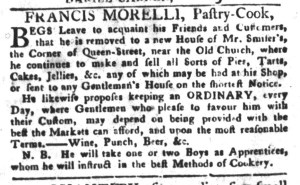
“He likewise proposes keeping an ORDINARY, every Day.”

When Francis Morelli, a pastry cook, moved to a new location in the spring of 1773, he informed “his Friends and Customers” in Charleston with an advertisement in the South-Carolina. Gazette and Country Journal.  He assured them that he continued to offer the same services, baking “all Sorts of Pies, Tarts, Cakes, Jellies,” and other pastries that customers could purchase at his shop or have “sent to any Gentleman’s House on the shortest Notice.”

Morelli also took the opportunity to announce that he “proposes keeping an ORDINARY, every Day, where Gentlemen who please to favour him with their Custom, may depend on being provided with the best the Markets can afford.”  He also served “Wine, Punch, Beer,” and other beverages.  The context makes clear to modern readers that Morelli served food.  The Oxford English Dictionary gives additional information about how the term “ordinary” was used in the British Atlantic world in the eighteenth century.

Three related definitions concern foods, including “customary fare; a regular daily meal or allowance of food; (hence, by extension) a fixed portion, an allowance of anything,” and “a meal regularly available at a fixed price in a restaurant, public house, tavern, etc. Formerly also: the company frequenting such a meal, the ‘table.’”  The OED describes the former as “Obsolete” and the latter as “Now chiefly historical.”

The third definition captures the term “ordinary” as used by Morelli in his advertisement: “an inn, public house, tavern, etc., where meals are provided at a fixed price; the room in such a building where this type of meal is provided.”  Similar to the other entries associated with foods and serving meals, this definition is “Now historical and archaic.”  The entry includes more than a dozen examples of the word in use, the earliest dating from 1590, as well as additional notes about its usage.  “In Britain in the 17th-18th centuries,” the entry explains, “the more expensive ordinaries were frequented by men of fashion, and the dinner was usually followed by gambling; hence the term was often used as synonymous with ‘gambling-house.’”  Another note addresses the use of the word in America: “In the U.S., the southern states, esp. Virginia, continued to use ordinary in this sense into the 19th cent., while other states used tavern.”

I plan to file away this advertisement for teaching purposes because it is such a great example of the English language as spoken and written in the eighteenth century sometimes requires “translation” when twenty-first century readers encounter “historical and archaic” terms, even when the words look familiar.  In addition, it presents an opportunity for teaching students how to use the Oxford English Dictionary as a “translation tool.”  I envision an in-class exercise in which I direct students to the entry for “ordinary” but allow them to seek out the relevant definitions (in this case 12a, 12b, and, especially, 12c) on their own before having a discussion about what we all learn from examining the various elements of those definitions provided by the OED.

March 30

What was advertised in a colonial American newspaper 250 years ago today?

South-Carolina Gazette and Country Journal (March 30, 1773).

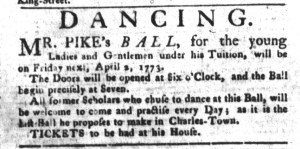
“It is the last Ball he proposes to make in Charles-Town.”

Mr. Pike, a dancing master who enhanced his image and authority by never including his first name in his advertisements, offered lessons in Charleston for many years.  (His earliest advertisement examined by the Adverts 250 Project appeared in the September 2, 1766, edition of the South-Carolina Gazette and Country Journal.)  In addition to advertising lessons, he also promoted the balls that he hosted, opportunities for his students to demonstrate the skills they developed and refined under his guidance.  Pike encouraged prospective students and their parents to consider those gatherings rites of passage within polite company, provided that they comported themselves well.  Accordingly, his marketing efforts sometimes leveraged a sense of anxiety.  For instance, when he announced a ball scheduled for December 1772, he advised parents to send their children for lessons “as soon as possible, that he may be enabled to complete his Figures in a proper Manner.”  In other words, if they did grant Pike sufficient time for instruction then they risked their children embarrassing themselves at the ball.

Pike did not take that approach when he announced that his “BALL, for the young Ladies and Gentlemen under his Tuition” would take place on the first Friday in April 1773.  That may have been because the dancing master had plans to depart the city.  (He began placing newspaper advertisements for dancing and fencing lessons in Philadelphia the following year.)  Pike proclaimed that this one was “the last Ball he proposes to make in Charles-Town.”  That being the case, he no longer needed to resort to the same tactics for attracting pupils.  Instead, he attempted to incite demand for tickets by presenting his final ball as a reunion for his students and a farewell fête.  Pike invited “former Scholars who chuse to dance at this Ball … to come and practise every Day” to prepare for it.  That allowed them to brush up on their skills and perhaps receive some pointers, free of charge, from their former instructor as a gift prior to his departure.  Anticipating both “the young Ladies and Gentlemen under his Tuition” and “former Scholars” in attendance, Pike arranged for a retrospective of his instruction and influence in cultivating a genteel pastime in one of the largest and most cosmopolitan cities in the colonies.  He hoped that would sell tickets.  After all, it was not merely the “ANNUAL BALL” for current students that he sometimes promoted in the public prints but instead his “last Ball” and final chance to partake in one of the gatherings he hosted.