December 12

What was advertised in a revolutionary American newspaper 250 years ago today?
Pennsylvania Evening Post (December 12, 1775).

“HARE’s and Co. best DRAUGHT and BOTTLED AMERICAN PORTER.”

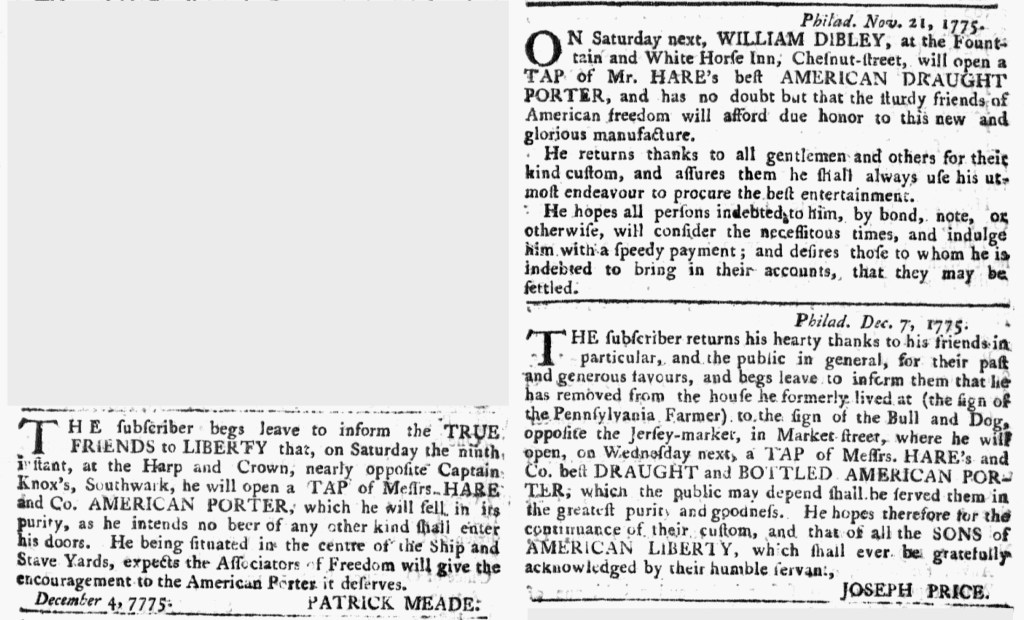
In December 1775, Philadelphia tavernkeeper Joseph Price ran an advertisement to express his gratitude to “his friends in particular, and the public in general,” while simultaneously alerting them that he had moved to a new location.  They could now find him at “the sign of the Bull and Dog” on Market Street rather than at “the sign of the Pennsylvania Farmer.”  To entice readers to visit his new location, he announced that “he will open … a TAP of Messrs. HARE’s and Co. best DRAUGHT and BOTTLED AMERICAN PORTER, which the public may depend shall be served them in the greatest purity and goodness.”

Price was not the only tavernkeeper promoting Hare and Company’s American porter, nor was he the only one associating that beer with support for the American cause.  He proclaimed that he “hopes … all the SONS of AMERICAN LIBERTY” would affirm their commitment by choosing Hare and Company’s American porter.  Price joined two other tavernkeepers who already promoted that brew.  All three of them placed advertisements in the December 12, 1775, edition of the Pennsylvania Evening Post.  William Dibley’s advertisement ran immediately above Price’s notice.  He confidently declared that he “has no doubt but that the sturdy friends of American freedom will afford due honor to this new and glorious manufacture.”  Immediately to the left of Price’s advertisement, Patrick Meade stated that he “expects the Associators of Freedom will give the encouragement to the American Porter it deserves.”  Readers who did not know much about Hare and Company’s American porter encountered endorsement after endorsement, encouraging them to take note of a beer that local tavernkeepers promoted over any others.  Tavernkeepers usually did not mention which brewers supplied their beer, making these advertisements even more noteworthy.  For their part, Hare and Company did not need to do any advertising of their own when they had such eager advocates for their American porter encouraging the public to demonstrate their political principles through the choices they made when they placed their orders at taverns in Philadelphia and nearby Southwark.

December 9

What was advertised in a revolutionary American newspaper 250 years ago today?

Pennsylvania Evening Post (December 9, 1775).

“He will open a TAP of Messrs. HARE’s and Co. AMERICAN PORTER.”

Patrick Meade aimed to create some anticipation among prospective patrons who might visit his tavern, the Harp and Crown, in Southwark on the outskirts of Philadelphia.  In an advertisement that first appeared in the Pennsylvania Evening Post on December 5, 1775, he announced that “on Saturday the ninth … he will open a TAP of Messrs. HARE and Co. AMERICAN PORTER.”  Hare and Company had been building a reputation for their brew.  Two weeks earlier, William Dibley, the proprietor of the Fountain and White Horse Inn in Philadelphia, advertised that he “will open a TAP of Mr. HARE’s best AMERICAN DRAUGHT PORTER.”  Meade’s advertisement ran again on December 9, the day he tapped the celebrated porter.

Meade and Dibley deployed similar marketing strategies to entice “gentlemen and others” to visit their establishments and drink Hare and Company’s porter.  Dibley proclaimed that he “has no doubt but that the sturdy friends of American freedom will afford due honor to this new and glorious manufacture.”  Meade addressed “the TRUE FRIENDS to LIBERTY” and emphasized his location, “situated in the center of the Ship and Stave Yards,” and declared that he “expects the Associators of Freedom will give the encouragement to the American Porter it deserves.”  Meade went all in on promoting Hare and Company’s porter, asserting that “he intends no beer of any other kind shall enter his doors,” especially not porters and other beers imported from England.  The tavernkeeper made a porter brewed in America the exclusive choice for his patron, likely expecting that the lack of other options mattered less to prospective patrons when they gather to drink, socialize, and discuss politics and current events than demonstrating their patriotism by consuming a porter brewed in America.  Meade stated that he would sell Hare and Company’s “AMERICAN PORTER … in its purity,” signaling the quality of the beverage.  Meade issued both an invitation and a challenge: who could desire any beer other than one brewed in America in support of the American cause?

November 25

What was advertised in a revolutionary American newspaper 250 years ago today?

Pennsylvania Evening Post (November 25, 1775).

“WILLIAM DIBLEY … will open a TAP of Mr. HARE’s best AMERICAN DRAUGHT PORTER.”

William Dibley was no stranger to advertising his tavern in the public prints.  In February 1775, he announced that he “removed from the Cross Keys … to the Fountain and Three Tuns.”  Both were located on “Chesnut-street” in Philadelphia, so his regular patrons did not have to go far to continue enjoying Dibley’s hospitality, yet he made sure that both “his Friends in particular and the public in general” knew about the “considerably improved” amenities available at his new location.

Nine months later, Dibley ran an advertisement in which he “returns thanks to all gentlemen and others for their kind custom, and assures them he shall always use his utmost endeavour to procure the best entertainment.”  By that time, he updated the name of his establishment to the Fountain and White Horse Inn, perhaps an effort to retain some continuity with a device, the Fountain, that had marked the location while simultaneously distinguishing his business from the one that Anthony Fortune previously operated at the same location, exchanging the Three Tuns for the White Horse.  Dibley’s expression of gratitude suggested that patrons continued gathering at his tavern when he rebranded it.

He aimed to give them more reasons to gather at the Fountain beyond the amenities he highlighted in his earlier advertisement, proclaiming that on Saturday, November 25, he would “open a TAP of Mr. HARE’s best AMERICAN DRAUGHT PORTER.”  This porter was for patriots!  Dibley declared that he “has no doubt but that the sturdy friends of American freedom will afford due honor to this new and glorious manufacture.”  As George Washington and the American army continued the siege of Boston and the Second Continental Congress continued meeting in Philadelphia, Dibley offered an opportunity for supporters of the American cause to drink a porter brewed in the colonies as they gathered to socialize and discuss politics at his tavern.  The tavernkeeper made the porter, a new product, the highlight of a visit to the Fountain, announcing when he would “open a TAP” to create anticipation among prospective patrons.  They may have expected an informal ceremony and a round of toasts to mark the occasion, another enticing reason to visit the Fountain on that day.  Consumption certainly had political overtones at the time.  Dibley tapped into the discourses about purchasing American goods when he marketed a visit to his tavern,

October 1

What was advertised in a revolutionary American newspaper 250 years ago this week?

Pennsylvania Ledger (September 30, 1775).

“Genteel Riding-Chairs … ready for Gentlemen as will give them good usage, on the shortest notice.”

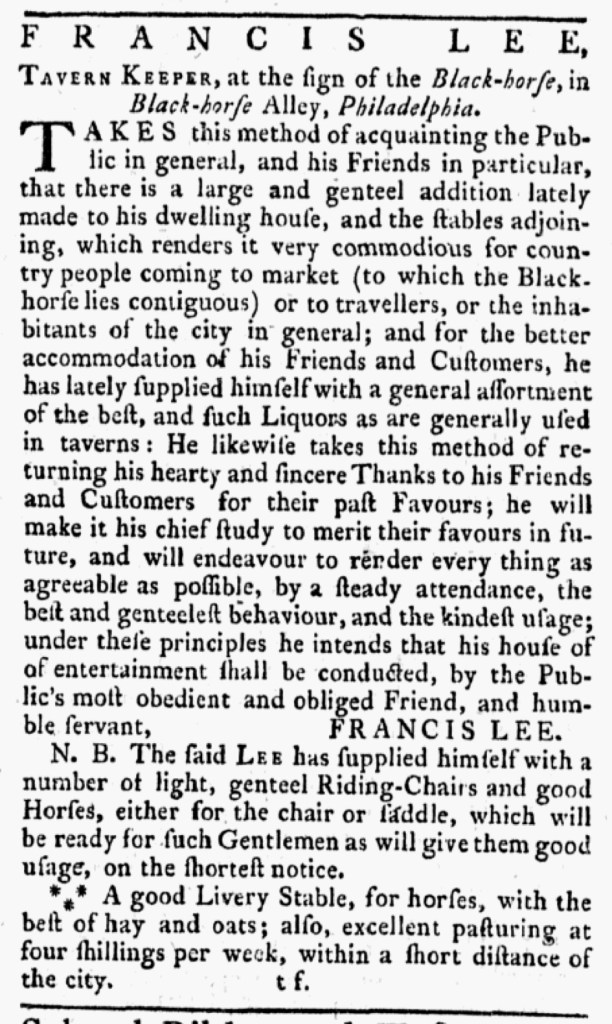
In the fall of 1775, Francis Lee operated a tavern “at the sign of the Black-horse, in Black-horse Alley, Philadelphia.”  In an advertisement in the September 30 edition of the Pennsylvania Ledger, he advised readers about a “large and genteel addition lately made to his dwelling house, and the stables adjoining, which renders it very commodious for country people coming to market.”  His tavern was conveniently located “contiguous” to the market.  In addition to those prospective patrons, Lee also wanted travelers and “the inhabitants of this city in general” to know about the improvements he made at his tavern.  He also promoted his “general assortment of the best, and such Liquors as are generally used in taverns.”  That was all part of providing a pleasant and enjoyable experience for his guests.

Lee also provided other services for the convenience of his “Friends and Customers.”  They included a “good Livery Stable, for horses, with the best of hay and oats” or pasturing by the week, just outside the city, for those staying for a length of time.  He also made a point of highlighting the “genteel Riding-Chairs and good Horses, either for the chair or saddle” that he made available “on the shortest notice.”  In other words, Lee offered an eighteenth-century version of car rentals.  His customers could borrow a horse to ride (the reference to “saddle”) or a horse and fashionable carriage (the “genteel Riding-Chairs”) to transport them to their destination.  Travelers who arrived in Philadelphia on foot, via stagecoach, or on a ship could avail themselves of this service for getting around the city.

The tavernkeeper may have been especially interested in attracting the attention of visitors in the city to attend the Second Continental Congress.  With delegates from throughout the colonies converging on Philadelphia, Lee likely hoped that some of them would visit his “house of entertainment” to enjoy the “best and genteelest behaviour, and the kindest usage” from their host while they enjoyed the amenities of the establishment.  Lee pledged “to render every thing as agreeable as possible” for his customers.  Why not continue discussions or just relax at Lee’s “commodious” tavern after a busy day of meetings to discuss the imperial crisis that had become a war?

February 18

What was advertised in a colonial American newspaper 250 years ago today?

Pennsylvania Ledger (February 18, 1775).

“The Fountain and Three Tuns, … [an] old accustomed and commodious tavern.”

When William Dibley, an experienced tavernkeeper, became the proprietor of the Fountain and Three Tuns in Philadelphia in February 1775, he placed an advertisement in the Pennsylvania Ledger to promote some of the amenities available at his new location.  He hoped that a variety of conveniences would encourage prospective patrons to visit the Fountain and Three Tuns.

Dibley made some of the most common appeals that appeared in advertisements for inns and taverns during the era of the American Revolution.  He highlighted the hospitality that he offered to guests, pledging that they would receive “the most civil treatment.”  He served “the best of liquors and provisions” in a “commodious tavern” that he had “considerably improved” or renovated for the comfort of his patrons.

Those improvements included updating the stables to accommodate sixty horses.  Travelers who visited Philadelphia could expect to find space for their horses in Dibley’s stables while they enjoyed their time at the Fountain and Three Tuns.  Those stables had easy access to the streets of Philadelphia via a “convenient passage either from Market or Chesnut streets.”  For affluent patrons, the tavernkeeper also had a “house for carriages.”

The tavernkeeper provided other services to entice merchants and others to visit the Fountain and Three Tuns, including messengers dispatched to other towns every Wednesday.  One “goes through Newark [in Delaware] to Nottingham [in Maryland],” carrying “packages and orders” to colonies to the south.  The other headed to the west, going “through Goshen to Strasburg, in Lancaster County.”  In addition, the “Virginia and Baltimore posts also call at the said inn every week.”  Dibley positioned the Fountain and Three Tuns at the center of networks for conducting commerce.

Dibley certainly hoped that his reputation would attract former customers and “his Friends in particular” who knew him from the Cross Keys on Chestnut Street.  His advertisement advised them that they could expect the same level of service at his new location.  Yet the tavernkeeper did not merely wish to transfer his current clientele from one establishment to another.  His extensive advertisement notified both locals and travelers of the many reasons they should choose the Fountain and Three Tuns over other inns and taverns in Philadelphia.

May 8

What was advertised in a colonial American newspaper 250 years ago this week?

Supplement to the Massachusetts Gazette and Boston Weekly News-Letter (May 5, 1774).

“City Tavern, Philadelphia.”

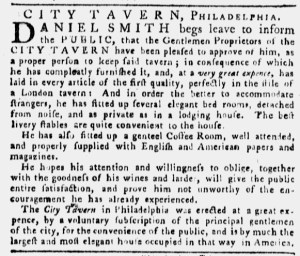
When the City Tavern opened in Philadelphia, Daniel Smith inserted advertisements in the Pennsylvania Gazette and the Pennsylvania Packet in February 1774.  The opening had been much anticipated in that city, following the efforts of some of the most prominent residents to erect the building via subscription.  In 1772, Samuel Powel entrusted the land to seven wealthy colonizers.  In turn, those “Gentlemen Proprietors” oversaw a “voluntary subscription of the principal gentlemen of the city” to raise funds to build the tavern and then selected Smith to lease and operate the City Tavern.

About three months after his advertisement ran in Philadelphia’s newspaper, it appeared in the Supplement to the Massachusetts Gazette and Boston Weekly News-Letter on May 5.  It featured identical copy and, except for the headline, identical format in terms of capitalization and italics.  Smith may have written it out exactly, but just as likely he clipped the advertisement from his local newspaper and sent it to Richard Draper’s printing office in Boston.  Alternately, he could have sent instructions to reprint the notice from a newspaper that Draper received via his exchange networks with other printers, but Smith would not have been certain that Draper received the issues that originally carried his advertisement.  Given that the tavernkeeper proclaimed that he “fitted up a genteel Coffee Room, … properly supplied with English and American papers and magazines,” he likely corresponded directly with Draper, ordering a newspaper subscription and arranging to run his advertisement in the public prints in Boston.

That advertisement provided a brief history of the City Tavern that would have been familiar to many residents of Philadelphia yet new to readers in Boston.  Smith hoped to impress prospective visitors to his city with the “largest and most elegant house occupied in that way [as a tavern, coffeehouse, and inn], in America.”  He emphasized his own “very great expence” in furnishing it with “every article of the first quality, in the stile of a London tavern.”  Indeed, when John Adams traveled to Philadelphia to attend the First Continental Congress several months later, he described it as “the most genteel [tavern] in America.”[1]  That was the reputation Smith hoped to cultivate, not only in his city but throughout the colonies.  He positioned the City Tavern as a destination itself, not just a place to eat, drink, and lodge while visiting Philadelphia.

**********

[1] See entry for August 29, 1774, in John Adams diary 21, 15 August – 3 September 1774 [electronic edition]. Adams Family Papers: An Electronic Archive. Massachusetts Historical Society. http://www.masshist.org/digitaladams/

February 16

What was advertised in a colonial American newspaper 250 years ago today?

Pennsylvania Gazette (February 16, 1774).

“Perfectly in the stile of a London tavern.”

In February 1774, Daniel Smith took to the pages of the Pennsylvania Gazette and the Pennsylvania Packet to promote his latest enterprise, the City Tavern in Philadelphia.  Residents of the urban port had witnessed the building and marketing of the tavern.  As Smith explained, the building “was erected at a great expence, by a voluntary subscription of the principal gentlemen of the city.”  He billed it as “the largest and most elegant house in that way,” meaning a tavern and inn, “in America.”  The previous summer, the proprietors ran an advertisement seeking a tavernkeeper with “an active, obliging disposition” to rent the building, still under construction with completion expected by September, and operate it “for the convenience and credit of the city.”  Those “Gentlemen Proprietors” wanted the largest and most cosmopolitan city in the colonies to have a tavern that rivaled any found in London.

Smith asserted that he achieved that goal, doing so “at a very great expence.”  He proclaimed that he furnished the building and stocked the storerooms with every necessity.  He “laid in every article of the first quality, perfectly in the stile of a London tavern,” just as envisioned by the affluent subscribers who made the City Tavern one of their projects for improving the bustling urban port and enhancing the city’s reputation throughout the British Atlantic world.  The amenities included a “genteel Coffee Room” where merchants and others could socialize and conduct business.  He “supplied English and American papers and magazines” for their entertainment, but also so they could track the shipping news, prices current, and current events that had an impact on their businesses.  Perhaps his subscriptions included the new Royal American Magazine, the only magazine published in the colonies at the time, demonstrating to his patrons the efforts he made to provide the latest and most interesting publications.  For “strangers” or visitors to the city, Smith “fitted up several elegant bed rooms, detached from noise,” and the “best livery stables,” located “quite convenient to the house.”  Smith expected that all those features, along with “the goodness of his wines and larder,” would “give the public entire satisfaction.”

The City Tavern quickly became a popular meeting place, especially as the imperial crisis intensified.  In addition to merchants and the local gentry frequenting the establishment as part of their everyday routines, concerned citizens met there to debate and discuss politics.  In May 1774, just three months after Smith ran his advertisement, more than two hundred of them gathered at the City Tavern to determine how to respond to messages from Boston in the wake of the Boston Port Act that closed the port until the colonizers paid for the tea destroyed during the Boston Tea Party.  When the First Continental Congress met in Philadelphia in September and October 1774, many influential leaders from throughout the colonies dined and drank at the City Tavern.  John Adams praised it as “the most genteel [tavern] in America.”[1]

**********

[1] See entry for August 29, 1774, in John Adams diary 21, 15 August – 3 September 1774 [electronic edition]. Adams Family Papers: An Electronic Archive. Massachusetts Historical Society. http://www.masshist.org/digitaladams/

September 16

What was advertised in a colonial American newspaper 250 years ago this week?

New-York Journal (September 13, 1770).

“The best Clubs, and the greatest Entertainments in this City, were at the above Tavern.”

Samuel Fraunces was one of the most illustrious tavernkeepers of his day.  His fame continues into the twenty-first century, due in part to the quality of the services he provided to guests in eighteenth-century America and in part to the continued operation of Fraunces Tavern as a restaurant and museum at the corner of Pearl Street and Broad Street in New York.  Fraunces advertised the various taverns he operated in the late 1760s and early 1770s.  More than a decade later, he hosted George Washington’s farewell to his officers at the conclusion of the Revolutionary War.

Fraunces ran an advertisement in the September 13, 1770, edition of the New-York Journal to announce the opening of his newest venture, the “QUEEN’s-HEAD TAVERN, Near the Exchange.”  He attempted to downplay the necessity of placing an advertisement even as he promoted the various services and amenities available at his tavern.  He emphasized that during his “many Years” of operating a tavern “the best Clubs” met at his establishment and experienced “the greatest Entertainments.”  Given the reputation he had built, Fraunces “flatters himself the Public are so well satisfied of his Ability to serve them, as to render the swelling of an Advertisement useless.”  Its only purpose, he declared, was to “assure his former Friends and the Public in general, that every Endeavour will be used to give them the highest Satisfaction.”

Yet other “swelling” embellished Fraunces’s advertisement as he attempted to attract patrons.  He noted renovations taking place; the tavern was “now fitting up in the most genteel and convenient Manner.”  He also inserted a nota bene to inform prospective customers that he provided take-out and delivery options for those “who live at a convenient Distance.”  Fraunces concluded with a manicule directing attention to a short note explaining that the “House at the Gardens will be duly attended as usual.”  He referred to another venture that he operated simultaneously, Vauxhall Garden, a restaurant, tavern, and pleasure garden named after the popular site in London.

Fraunces had indeed established his reputation as restaurateur and tavernkeeper before opening the Queen’s Head Tavern in the fall of 1770, yet he did not consider his past success sufficient for attracting patrons to his new enterprise.  Instead, he inserted an advertisement to spread the word about his newest venture, amplifying his reputation in the process.

June 11

What was advertised in a colonial newspaper 250 years ago today?

Jun 11 - 6:11:1766 Georgia Gazette
Georgia Gazette (June 11, 1766).

“A house of entertainment … good assortment of liquors … food for men and horses.”

Daniel Ocain used an advertisement to announce that he had opened a tavern and inn in Savannah in 1766. In just a few lines he let potential customers know about the variety of services available ay his “house of entertainment.” He offered “to board or lodge any person that please to favour him with their custom.” Although he did not say so explicitly, Ocain stabled horses for his guests, as his promise of “food for men and horses” suggested. To entice potential visitors to choose his establishment over others, he also promoted his “large and good assortment of liquors.”

Ocain resorted to two methods in listing his location. For the headline for his advertisement he used “DANIEL OCAIN in Savannah.” At the conclusion of the advertisement he indicated that he operated his business “at his house near the Hon. James Habersham, Esq.’s in Johnson-Square.” That would have been sufficient for local residents familiar with the area to find their way to his tavern, even if they didn’t already know Ocain or where he lived and worked. His initial announcement that he operated a tavern and inn “in Savannah” was for the benefit of readers outside the port. The Georgia Gazette was the only newspaper printed in the colony in 1766. As a result, it served readers far beyond Savannah. Copies circulated throughout the colony and throughout the Lower South and beyond. Ocain opened his advertisement by noting that his “house of entertainment” was in Savannah to attract the attention of distant readers who might have business or other reasons to visit the city and would need a place to lodge. Ocain knew that in the 1760s “local” newspapers usually had distant readers.