December 23

What was advertised in a colonial American newspaper 250 years ago today?
New-York Journal (December 23, 1773).

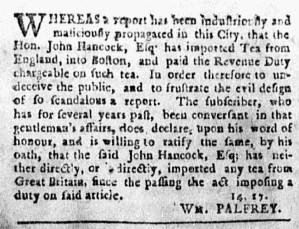
“John Hancock, Esq; has neither directly, or indirectly, imported any tea from Great Britain.”

As news of the Boston Tea Party reached New York and appeared in the December 23, 1773, edition of the New-York Journal, an advertisement in that newspaper took on new significance.  Starting on December 9 and continuing for four weeks, William Palfrey inserted an advertisement that addressed a “report [that] has been industriously and maliciously propagated in this City, that the Hon. John Hancock, Esq. has imported Tea from England, into Boston, and paid the Revenue Duty chargeable on such tea.”  Such rumors had the potential to tarnish the reputation of one of the merchants who had been most vocal in opposition to the provisions of the Tea Act, decrying Parliament’s attempts to meddle in affairs that he believed rightly belonged to colonial legislatures.

Palfrey, one Hancock’s clerks, took to the public prints to “undeceive the public, and to frustrate the evil design of so scandalous a report.”  He noted that he had “been conversant in that gentleman’s affairs” for “several years past” and, as a result, could vouch for Hancock.  In late 1773, many readers of the New-York Journal may not have been as familiar with the merchant as residents of Boston, though Hancock regularly appeared in articles reprinted from newspapers published in Massachusetts.  Five months before Palfrey’s advertisement appeared, the New-York Journal printed one of Governor Thomas Hutchinson’s letters from June 1768 that described the seizure of the Liberty, “a sloop belonging to Mr. Hancock, a wealthy merchant, of great influence over the populace,” for “a very notorious breach of the acts of trade.”  (The July 8, 1773, edition of the New-York Journal carried the entire letter and other private correspondence by the governor.)  Contrary to abiding by Parliament’s attempts to regulate colonial commerce and tax imported goods, Hancock had a history of smuggling tea and other items to avoid paying duties.  According to Palfrey, neither Hancock’s public position nor his private actions had changed.  The clerk declared “upon his word of honour” (and expressed his willingness to “ratify the dame, by his oath”) that Hancock had “neither directly, or indirectly, imported any tea from Great Britain, since the passing the act imposing a duty on said article” and most certainly had not paid import duties on tea.  As Jordan E. Taylor has recently demonstrated in Misinformation Nation: Foreign News and the Politics of Truth in Revolutionary America (2022), Patriots and Loyalists vied to establish narratives that fit their politics and their purposes, whether in newspapers, other printed materials, letters, or conversation.  That contest over the truth extended to advertisements, including Palfrey’s notice in the New-York Journal.

December 20

What was advertised in a colonial American newspaper 250 years ago today?

Boston Evening-Post (December 20, 1773).

“The above Teas were imported before any of the East-India Company’s Tea arrived, or it was known they would send any on their own Account.”

Cyrus Baldwin hoped to sell the “Choice Bohea and Souchong Teas” that he stocked at his shop in Boston while he still had a chance.  Tea had become a lightning rod for political discourse throughout the fall of 1773, thanks to the Tea Act and the arrival of ships carrying tea on behalf of the East India Company.  That discourse erupted into a protest that involved the destruction of the tea on those ships when colonizers disguised as Indians tossed the tea into the harbor, an event now known as the Boston Tea Party.  That put Baldwin in a difficult position, especially as discussions about boycotting tea occurred at the town meeting.  When he advertised bohea, souchong, and hyson tea in the December 20 edition of the Boston Evening-Post, just four days after the East India Company’s tea went into the harbor, Baldwin appended a nota bene to inform prospective customers and the general public that “[t]he above Teas were imported before any of the East-India Company’s Tea arrived, or it was known they would send any on their own Account.”  Baldwin justified selling the tea he already stocked.  He also sought to give consumers a reasonable justification for purchasing his tea before the situation became any more volatile and they faced condemnation from the community.

Massachusetts Gazette and Boston Post-Boy (December 20, 1773).

Baldwin’s advertisement ran immediately below a “NOTIFICATION” that summarized a meeting “of some of the principal Venders of TEAS in Boston” that took place on Friday, December 17, the day after the protest on the docks.  The same notification ran in all three newspapers published in Boston on Mondays, the Boston Evening-Post, the Boston-Gazette, and the Massachusetts Gazette and Boston Post-Boy.  It reported that “Venders of TEAS” met for the purpose of “consulting and determining in suitable Measures to be adopted, and to cooperate with a great number of respectable Inhabitants of this Province, express’d by a Vote of their late Assembly to suppress the Use of that detested Article.”  They did not, however, reach any conclusions.  Instead, they “agreed that a general and full Meeting should be convened” on December 20 “where it is desired and expected that all the Dealers in, and Venders of Teas will punctually attend.”  That included Baldwin as well as Archibald Cunningham, William Jackson, Samuel Allyne Otis, and Elizabeth Perkins, all of whom advertised tea in the December 20 edition of the Boston Evening-Post, though none of the others included the same sort of disclaimer that Baldwin carefully inserted in his advertisement.  A nota bene warned, “It is earnestly desired, that those concerned would not fail of giving attendance at the Time fix’d.”

The notice in the Massachusetts Gazette and Boston Post-Boy included an additional note: “A common Cause is best supported by a common Association.—The Defence and Maintenance of our Rights and Liberties is the common Cause of every American; and therefore all should unite, Hand in Hand, in one common Association in order to support it.”  Answering the abuses perpetrated by Parliament, this note suggested, did not depend on a uniform response by “Venders of TEAS” alone but rather the support and concerted efforts of consumers to abide by whatever measures colonizers in Boston adopted when they voted at town meetings.  Everyone had a duty to defend American liberties via the choices they made about how they participated in the marketplace.  For the moment, however, Cyrus Baldwin just wanted to sell the tea that he claimed he imported before the crisis commenced.

December 18

What was advertised in a colonial American newspaper 250 years ago today?

Maryland Journal (December 18, 1773).

“Fine hyson and bohea tea.”

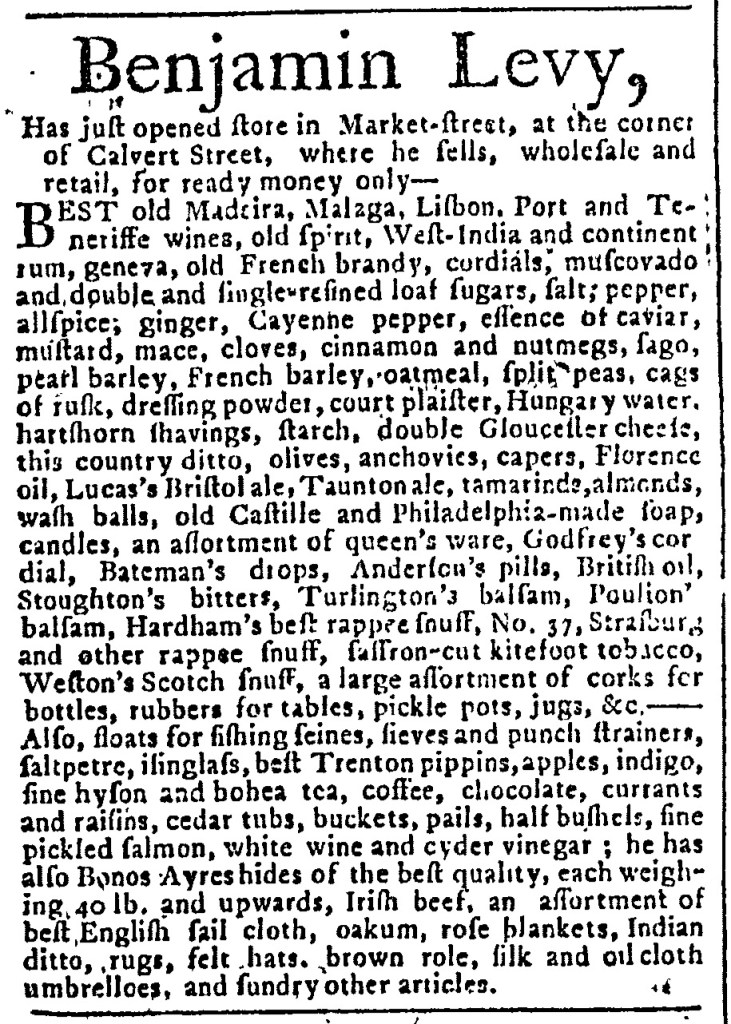
Benjamin Levy advertised a variety of groceries, including “fine hyson and bohea tea,” available at his store on Market Street in Baltimore in the December 18, 1773, edition of the Maryland Journal.  Two nights earlier, colonizers disguised as Indians boarded ships in Boston and tossed tea shipped by the East India Company into the harbor to protest the Tea Act.  While it would take a little time for that news to reach Baltimore, the newspaper carried other news about the escalating crisis.

The first page featured news from Boston, dated November 29: “Yesterday morning arrived here the ship Dartmouth, Capt. Hall, in 8 weeks from London, with 114 chests of the long expected and much talked of TEA.”  The following morning, a handbill posted around town proclaimed, “FRIENDS!  BRETHREN!  COUNTRYMEN!  THAT worst of plagues, the detested TEA, shipped for this port by the East-India Company, is now arrived in this harbour; the hour of destruction or manly opposition to the machinations of tyranny stares you in the face.”  In the face of this threat, “every friend to his country, to himself and posterity, is now called upon to meet at Faneuil Hall … to make a united and successful resistance to this last, worst and most destructive measure of administration.”  The remainder of the page and two columns on the second page provided an overview of the meeting, a response from the governor and Loyalist merchants, and a resolution from the town meeting stating that “if any person or persons shall hereafter import Tea from Great-Britain … until the said unrighteous Act shall be repealed, he or they shall be deemed by this body, an enemy of his country.”  In addition, “we will prevent the landing and sale of the same, and the payment of any duty thereon.  And we will effect the return thereof to the place from whence it shall come.”  Another resolution called for “the foregoing vote to be printed and sent to England, and all the sea-ports in this province.”  That news made it far beyond other ports in Massachusetts.

A much shorter piece followed the accounts from Boston.  A condescending note to women suggested that their enjoyment of tea played a significant role in precipitating the crisis, ignoring the fact that both men and women, poor, middling, and wealthy, all consumed tea.  “LADIES,” it declared, “HOWEVER coolly some of you may now esteem your husband, it might be worth your while to consider, whether by abandoning the accursed TEA, you will preserve your country and posterity in peace and good order, or expose twenty-five thousand of them to spill their blood, in defence of their undoubted birth-right.”  The anonymous correspondent anticipated an armed conflict over the English liberties that colonizers were supposed to possess, arguing that if that did indeed come to pass then women would be at fault for not abstaining from tea.  This echoed a sentiment so often expressed among the editorials in newspapers during the imperial crisis:  women presented dangers both political and cultural through their consumption of tea and other goods.

The Maryland Journal even included an inaccurate account of what occurred in Massachusetts: “A Gentleman just come to Town from Boston assures us, That the East India Company’s TEA, lately arrived at that Place, in several Ships, from London, for the Purpose of enslaving and impoverishing, if not poisoning, the People, was all sent back to the Proprietors, conformable to the noble and Spirited Resolves of the brave Inhabitants of the Town of Boston.”  That was not what happened at all, as colonizers in Baltimore would soon learn.  Even as Benjamin Levy advertised “fine hyson and bohea tea” for sale at his store in Baltimore, tea shipped by the East India Company floated in Boston Harbor.  A new stage of the imperial crisis was brewing as colonizers faced repercussions from Parliament for that act of protest.

March 13

What was advertised in a colonial American newspaper 250 years ago today?

Providence Gazette (March 13, 1773).

“EXcellent Bohea Tea, which for Smell and Flavour exceeds almost any ever imported.”

Joseph Russell and William Russell ranked among the most prominent merchants in Providence in the early 1770s.  Their mercantile success allowed them to construct an impressive Georgian house in 1772, a landmark still standing in the city and the contents on display in museums.  The size of the house testified to the Russells’ wealth, while the style, including “an original principal entrance taken from the English architectural pattern book Builder’s Compleat Assistant (1750) by Battey Langley,” communicated their genteel tastes.  The massive house enhanced their visibility within the cityscape of the growing town, while their frequent advertisements in the Providence Gazette enhanced their visibility among readers of the public prints in town and beyond.  On occasion, they published full-page advertisements that accounted for one-quarter of the space in a standard four-page newspaper of the period.

Most of their advertisements were not that elaborate, yet the Russells still attempted to entice prospective customers with promises of some of the luxuries that they enjoyed.  Consider a notice from the March 13, 1773, edition of the Providence Gazette.  The merchants listed a variety of items available at the Sign of the Golden Eagle, a store so well known that the Russells did not consider necessary to name it in every advertisement.  Their inventory included “a few Quarter Casks of best Lisbon Wine,” coffee, chocolate, and imported “English and Hard Ware Goods.”  They did not provide additional details about those items, but they did open their advertisement by promoting “EXcellent Bohea Tea, which for Smell and Flavour exceeds almost any ever imported.”  The Russells did more than encourage prospective customers to imagine purchasing the tea; they encouraged them to imagine consuming the tea, to take into account the sensual pleasures of the smell and the taste.  The merchants presented an opportunity for consumers to treat themselves to a small luxury, one that was not reserved solely for the better sorts, hoping that would help to sell their tea.

May 29

GUEST CURATOR: Julia Tardugno

What was advertised in a colonial American newspaper 250 years ago today?

New-Hampshire Gazette (May 29, 1772).

“The very best of BOHEA TEA.”

This advertisement immediately struck me because tea was such an important symbol during the time of the American Revolution. Parliament’s taxed tea was through the Indemnity Act of 1767, one of the notorious Townshend Acts. When the Townshend Acts went into place, the colonists were so furious that they resorted to nonimportation agreements in which they no longer purchased goods from Britain. On October 28, 1767, a town meeting took place at Faneuil Hall in Boston to discuss the Townshend Acts and their negative impact on the colonies. A broadside distributed after the meeting said that colonists decided to meet “That some effectual Measures might be agreed upon to promote Industry, Economy, and Manufacturers; thereby to prevent the unnecessary Importation of European Commodities, which threaten the Country with Poverty and Ruin.” This petition to start the nonimportation agreements was voted on unanimously and the residents of Boston listed the items that they vowed not to purchase imported goods. Instead, they would encourage “Manufacturers” in the colonies. That included “Labrador tea.” The colonists felt strongly about implementing the nonimportation agreements at first, but they put an end to the boycotts in 1770 after Parliament repealed most of the taxes on imports. The tax on tea remained. The colonists canceled the nonimportation agreements two years prior to William Elliot’s advertisement about Bohea tea, a popular consumer good. That did not mean that colonists stopped worrying about the taxes on tea. In 1773, they participated in the Boston Tea Party. Tea became an even more important symbol of the American Revolution as a result of the Boston Tea Party, but that is not the whole story.

**********

ADDITIONAL COMMENTARY: Carl Robert Keyes

William Elliot was not alone in marketing tea to readers of the New-Hampshire Gazette in the spring of 1772.  Jeremiah Libbey listed tea alongside two other beverages, coffee and chocolate, in an advertisement that also promoted an “Assortment of ENGLISH GOODS.”  In another advertisement, David Cutler and J. Cutler provided an extensive list of their “General Assortment of GOODS that came in the last Ships from London.”  The groceries they stocked included “Bohea Tea, Coffee, [and] Chocolate.”  John Penhallow published an even more extensive catalog of “GOODS … Just Imported from LONDON.”  Like his competitors, he sold “choice Bohea Tea.”  Colonizers in Portsmouth and other towns had plenty of options when it came to purchasing tea.  Throughout the colonies, merchants and shopkeepers supplemented their other inventory with tea.

The ubiquity of tea makes it an ideal commodity for examining a variety of interlocking topics in my Revolutionary America class.  We discuss trade and commerce; consumer culture and rituals that helped build a sense of community; and boycotts, politics, and protests.  I introduce students to the traditional narrative about tea and taxes, but we also take into consideration details that complicate that narrative.  As Julia notes, colonizers rescinded the nonimportation agreements when Parliament repealed the duties on most imported goods even though the tax on tea remained in place.  Some colonizers advocated for holding firm until they achieved all of their goals, but most merchants wanted to resume trade and bring an end to the disruption in transatlantic commerce.  We examine how women participated in politics as consumers, especially as consumers of tea, when they made decisions about whether they would purchase imported goods.  In October 1774, women in Edenton, North Carolina, formalized their position by signing a petition in which they resolved to boycott tea and other imported goods.  In response, engraver Philip Dawe created a print that critiqued those women who did not seem to know their place … and, by extension, their male relations incapable of exercising proper authority within their households.  We also read Peter Oliver’s account of the “Origins & Progress” of the American Revolution, including his accusation that women devised various strategies for gathering together to drink tea and cheating on the boycott.  In addition, we discuss T.H. Breen’s descriptions of colonizers destroying tea at public gatherings and enforcing compliance with boycotts.  Many students initially view tea as a quaint vestige of the eighteenth century, associating it primarily with the Boston Tea Party.  Throughout the semester, we repeatedly return to tea so they gain a better understanding of the intersection of colonial culture and politics during the era of the American Revolution.

March 13

What was advertised in a colonial American newspaper 250 years ago today?

New-Hampshire Gazette (March 13, 1772).

Choice Bohea TEA.”

When Stephen Hardy, a tailor, placed an advertisement in the March 13, 1772, edition of the New-Hampshire Gazette, his name served as the headline.  Such was the case in many advertisements for consumer goods and services in newspapers published throughout the colonies.  The names of the purveyors appeared first or appeared in larger font than the goods and services offered for sale or both.  As a result, colonizers skimming advertisements encountered a litany of names of merchants, shopkeepers, and artisans rather than products.

On occasion, however, headlines for advertisements did identify products.  In that same issue of the New-Hampshire Gazette, one advertisement promoted “Choice Bohea TEA TO BE SOLD BY DANIEL PEIRCE, junr.”  The body of the advertisement listed other items for sale as well, but the headline, “Choice Bohea TEA,” appeared in the same size font as “Stephen Hardy” elsewhere on the page, making those two headlines the most noticeable content on the page.  Although Peirce’s name ran in all capital letters, the font size did not distinguish it from the rest of the content of his advertisement.  Indeed, the decision to also print “ENGLISH, & WEST INDIA GOODS,” “GROCERIES, NAILS, GLASS,” “PEPPER,” “GINGER,” and “SHOES” in all capital letters of the same size as “DANIEL PEIRCE” made it harder to spot the name of the advertiser.  “Choice Bohea TEA” was the focal point of Peirce’s advertisement, just as “Stephen Hardy” was the focal point of the tailor’s advertisement.

Other advertisements deployed a similar strategy.  Gilliam Butler’s advertisement for “ENGLISH and WEST INDIA GOODS” also used “Choice Bohea TEA” in a larger font as its headline.  Peter Pearse’s advertisement promoted “Shushong, Hyson, Congo, and Bohea TEA,” with “Sushong, Hyson” in a larger font, occupying the first line, and operating as an abbreviated headline.  Neal McIntire’s advertisement had a similar structure: “Tar, Pitch” led a list of commodities for sale, appeared in a larger font on the first line, and displaced the seller’s name as a headline.  In an advertisement for textiles, “Russia Duck” instead of “THOMAS MARTIN” served as the headline.

Why did so many advertisements in that issue deviate from using the name of the advertiser as the headline?  Did purveyors of goods and services who placed notices in the New-Hampshire Gazette adopt different standards for writing copy than advertisers in other towns?  That may have been the case, especially if they consulted advertisements that previously ran in the New-Hampshire Gazette when writing their own notices.  The printers, Daniel Fowle and Robert Fowle, may have also played a role.  On occasion, printers noted that they aided in composing advertisements.  Perhaps Peirce, Butler, Pearse, McIntire, and Martin received advice from the Fowles, encouragement to place their products first and their names later in their advertisements.  Whatever the explanation, the advertising pages of the New-Hampshire Gazette often had a distinctive look in the early 1770s because the headlines name products instead of purveyors.

February 15

What was advertised in a colonial American newspaper 250 years ago today?

Providence Gazette (February 15, 1772).

“Choice Bohea Tea, which for Smell and Flavour exceeds almost any ever imported.”

Joseph Russell and William Russell were among the most prominent merchants in Providence in the era of the American Revolution.  The brothers were so successful that in 1772 they built what is now the “earliest extant and most impressive of the cubical, three-story houses that symbolized wealth and social standing in Providence for several generation beginning at the eve of the Revolution,” according to the Providence Preservation Society’s Guide to Providence Architecture.  The building stands at 118 North Main Street (formerly King Street), though its original interiors were removed and installed in several museums a century ago.  In addition, the building “was raised to insert a storefront” in the middle of the nineteenth century, resulting in the original entrance, “taken from the English architectural pattern book Builder’s Compleat Assistant (1750) by Battey Langley,” appearing to adorn the second floor rather than opening onto the street.

The Russells frequently advertised in the Providence Gazette in the 1760s and 1770s.  Perhaps their marketing efforts contributed, at least in part, to their mercantile success.  As they embarked on building their new house in 1772, the brothers advertised a variety of commodities on February 15.  They focused primarily on grocery items in that notice, though in others they promoted a vast array of textile, housewares, hardware, and other goods imported from England.  Among the groceries they offered to consumers, the Russells listed “Nutmegs, Cinnamon, Mace, and Cloves” as well as “Pepper by the Bag” and “Chocolate by the Box.”  They concluded their advertisement with “Choice Bohea Tea.”  Most advertisers did not offer much commentary about that popular commodity, but in this instance the Russells elaborated on what made their tea “Choice” for consumers.  They proclaimed that the “Smell and Flavour exceeds almost any ever imported.”  In conjuring such associations with their tea at the conclusion of their advertisement, the Russells may have incited greater interest in all of the groceries they sold.  Sales of “Choice Bohea Tea” and so many other goods helped finance the house they built in 1772.  The Russells almost certainly enjoyed “Choice Bohea Tea” in the parlor of their new home, partaking in popular social rituals with family and guests.

December 11

What was advertised in a colonial American newspaper 250 years ago this week?

Boston Evening-Post (December 9, 1771).

“[I]f the Teas should not please those that have not yet made trial, they will be received back and the Money returned.”

Archibald Cunningham took to the pages of the Boston Evening-Post to advertise a variety of groceries and housewares in December 1771.  His inventory included sugar, rice, nutmegs, and an assortment of spices as well as “Blue and white China Cups and Saucers” and “Delph & Glass Ware” in several colors.  Cunningham listed each of these items, some with short descriptions, but devoted an entire paragraph to promoting tea.

He informed prospective customers that he carried “Bohea Tea very good” and “excellent Souchong and Hyson Tea.”  According to Cunningham, his tea “has been approved of by good Judges to be of a superior Quality in Flavor and Color to that commonly imported.”  He did not name those “good Judges,” but he also did not expect consumers to accept such testimonials without question.  Instead, Cunningham promised satisfaction by offering a money back guarantee.  [I]f the Teas should not please those that have not yet made trial,” the shopkeeper declared, “they will be received back and the Money returned.”  That likely attracted the attention of some readers as they encountered advertisements placed by several shopkeepers who included tea among their merchandise.

On occasion, purveyors of goods and services experimented with money back guarantees in the eighteenth century, but not so often that such offers regularly appeared in advertisements.  Cunningham provided his customers with an additional benefit that distinguished how he marketed tea from others who advertised the same varieties.  Lewis Deblois and George Deblois listed “Bohea Tea per Chest or Dozen” in their advertisement, giving customer options when it came to quantity.  John Adams and Company commented on the quality of their “Best Hyson and Bohea Tea,” but did not encourage customers to take it home, try it, and then return it for a refund if it did not meet with satisfaction.

In offering a money back guarantee, Cunningham further testified to the quality of his tea.  He would not have made such an offer unless he was confident consumers would rarely invoke the option of returning what they purchased.  The guarantee provided security at the same time that it reassured prospective customers about the quality “in Flavor and Color” of Cunningham’s “Bohea Tea very good” and “excellent Souchong and Hyson Tea.”

May 30

What was advertised in a colonial American newspaper 250 years ago today?

South-Carolina Gazette (May 30, 1771).

“A Complete Assortment of GOODS (TEA excepted).”

John Edwards and Company moved quickly to place an advertisement for new merchandise in the South-Carolina Gazette.  According to the shipping news in the May 30, 1771, edition, the Heart-of-Oak arrived in port on May 27.  That gave Edwards and Company sufficient time to submit a brief advertisement to the printing office.  Their notice specified that they had “just imported” a variety of items “in the ship HEART-OF-OAK, Captain HENRY GUNN, from LONDON.”  The partners did not provide a list of their “Complete Assortment of GOODS” as a means of demonstrating the many choices available to consumers.  Perhaps they did not have enough time to unpack the merchandise before the weekly edition of the South-Carolina Gazette went to press so instead opted to entice prospective customers with promises of new inventory that just arrived in port.  Webb and Doughty took a similar approach in their advertisement on the same page as both the shipping news and Edwards and Company’s notice.

Rather than elaborating on their “Complete Assortment of GOODS,” Edwards and Company instead specified a particular item not part of their new inventory.  “TEA excepted,” they proclaimed.  They did not need to provide more detail for colonial consumers to understand their point.  Parliament had repealed most of the duties on imported goods imposed by the Townshend Acts, but the tax on tea remained.  Colonists protested the duties through a variety of means, including nonimportation agreements, but most relented and resumed trade with Britain when they achieved most of their goals.  Some continued to advocate for keeping the boycotts in place until Parliament repealed all of the offensive duties, but most merchants, shopkeepers, and consumers did not share that view.  Edwards and Company sought to have it both ways, importing and selling a variety of merchandise but underscoring that they did not carry the one item still taxed by Parliament.  This allowed them to compete with other merchants and shopkeepers to satisfy most of the needs and desires of prospective customers while still signaling that they refused to go back to business as usual without acknowledging the political significance of tea and the duty that remained in place.  Edwards and Company offered an alternative to consumers who wanted to support the American cause, at least to some extent, but also wanted to participate in the marketplace once so many options were available once again.  This strategy likely enhanced Edwards and Company’s reputation among supporters of the American cause (with the exception of the most adamant) while easing the consciences of their customers, even if it did not achieve complete ideological consistency.

It may not have mattered much to Edwards and Company that they did not publish a lengthy litany of goods that just arrived via the Heart-of-Oak in their advertisement.  Singling out tea as an item they intentionally excluded from their inventory, in an advertisement brief enough to make such a notation very visible, likely garnered far more attention and interest in their business.

November 17

What was advertised in a colonial American newspaper 250 years ago today?

Nov 17 - 11:17:1769 Massachusetts Gazette Extraordinary
Massachusetts Gazette Extraordinary (November 17, 1769).

“TEA, that was imported before the Agreement of Non-importation.”

On November 17, 1769, Herman Brimmer inserted an advertisement for “Two or three Chests of BOHEA TEA, that was imported before the Agreement of Non-importation took place” in the Massachusetts Gazette and Boston Weekly News-Letter. Without enough space to include the advertisement in the standard four-page issue for that week, Richard Draper, the printer, placed Brimmer’s advertisement on the first page of a two-page extraordinary edition that accompanied the regular issue.

Brimmer made a point to advise prospective customers and the entire community that he sold tea that did not violate the resolutions adopted by “the Merchants and Traders in the Town of Boston” more than a year earlier on August 1, 1768.   It was just as well that he did so for his advertisement appeared immediately to the right of news about the nonimportation pact. Boston’s merchants and traders had recently updated their agreement on October 17, asserting that they “will not import any Kind of Goods or Merchandize from Great-Britain … until the Acts imposing Duties in America for raising a Revenue be totally repealed.” The third of the new resolutions explicitly mentioned tea: “we will not import … or purchase of any who may import from any other Colony in America, any Tea, Paper, Glass, or any other Goods commonly imported from Great Britain, until the Revenue Acts are totally repealed.” To give more teeth to these resolutions, those attending “a Meeting of the Merchants” just ten days earlier “VOTED, That the Names of all Such Persons as may hereafter import any Goods from Great-Britain contrary to the Agreement … be inserted in the News-Papers, and that they be held up to the Public as Persons counteracting the salutary Measures the Merchants are pursuing for the obtaining the Redress of their Grievances.” The merchants who devised the nonimportation agreement meant business!

Brimmer’s advertisement for “BOHEA TEA” did not merely promote a popular product. It was part of a larger public discourse about the meanings of goods, in this case not just the cultural meanings associated with drinking tea but also the political meanings of purchasing tea during a time of crisis. Other advertisers in the late 1760s underscored that they did not violate the nonimportation agreements, but their advertisements in colonial newspapers rarely appeared immediately next to copies of those agreements. That made neither advertisers nor readers any less cognizant of the fact that news items and advertisements operated in conversation with each other. Elsewhere in the same issue, William Greenleaf assured readers that he imported his merchandise “before the Non-importation Agreement took Place” and Henry Bass called on colonists to purchase grindstone manufactured in the colonies. They participated in the same conversation about using commerce as a means of resistance to the Townshend Acts and, in doing so, preserving “Liberties and Privileges” for themselves and posterity. That the nonimportation resolutions and Brimmer’s advertisement ran next to each other provides stark visual evidence of that conversation that took place in advertisements throughout the newspaper.