December 1

What was advertised in a revolutionary American newspaper 250 years ago today?
Connecticut Gazette (December 1, 1775).

“Sold by the several Post-Riders, and by the Shop-keepers in Town and Country.”

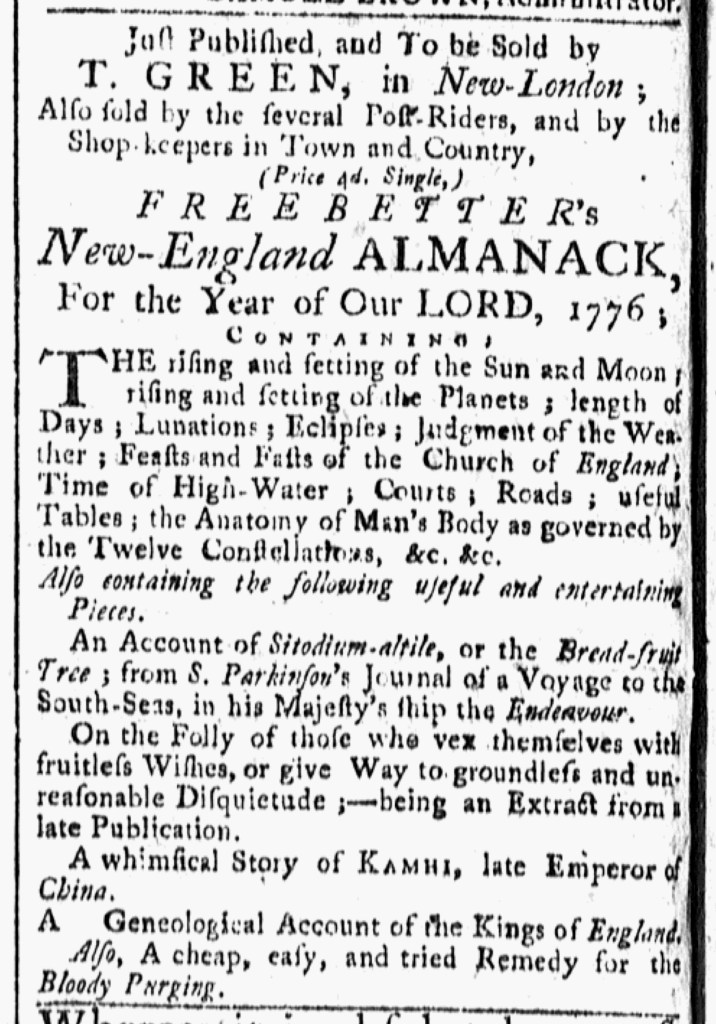
With only a month until the new year began, Timothy Green, the printer of the Connecticut Gazette, advertised “FREEBETTER’s New-England ALMANACK, For the Year of Our LORD, 1776.”  He emphasized items that usually appeared in almanacs and called attention to special features.  The former included the “rising and setting of the Sun and Moon; rising and setting of the Planets; length of Days; Lunations; Eclipses; Judgment of the Weather; Feasts and Fasts of the Chrich of England; Times of High-Water; Courts; Roads; useful Tables; [and] the Anatomy of Man’s Body as governed by the Twelve Constellations.”  The special features included a “whimsical Story of KAHM, late Emperor of China,” and a “Geneological Account of the Kings of England.”  They also included an “Account of Sitodium-altile, or the Bread-fruit Tree; from S. Parkinson’s Journal of a Voyage to the South-Seas, in his Majesty’s ship the Endeavour” and an essay on “the Folly of those who vex themselves with fruitless Wishes, or give Way to groundless and unreasonable Disquietude; –being an Extract from a late Publication.”  Green may have intended those excerpts as teasers to encourage readers to purchase the original works at his printing office in New London.

To acquire the almanac, however, customers did not have to visit Green or send an order to him.  Instead, he advised that “the several Post-Riders” with routes in the region and “the Shop-keepers in Town and Country” also sold “FREEBETTER’s New-England ALMANACK, For … 1776.”  The printer established a distribution network for the useful reference manual.  Shopkeepers often stocked a variety of almanacs so their customers could choose among popular titles.  Printers sometimes offered discount prices for purchasing multiple copies, usually by the dozen or by the hundred.  That allowed retailers to charge competitive prices to generate revenue with small markups over what they paid.  In this instance, Green did not indicate how much shopkeepers paid for the almanac, only that it sold for “4d. Single” or four pence for one copy.  That constrained shopkeepers when it came to marking up prices.  In addition to shopkeepers, “several Post-Riders” sold the almanac.  That arrangement meant greater convenience for customers and, printers hoped, increased sales and circulation.  In the 1770s, printers in New England began mentioning postriders in their advertisements for almanacs and other printed materials, perhaps acknowledging an existing practice or perhaps establishing a new means of engaging with customers.  The price that Green listed in his advertisement also kept customers aware of reasonable prices charged by post riders.

October 27

What was advertised in a revolutionary American newspaper 250 years ago today?

Connecticut Gazette (October 27, 1775).

“AN AMERICAN EDITION.”

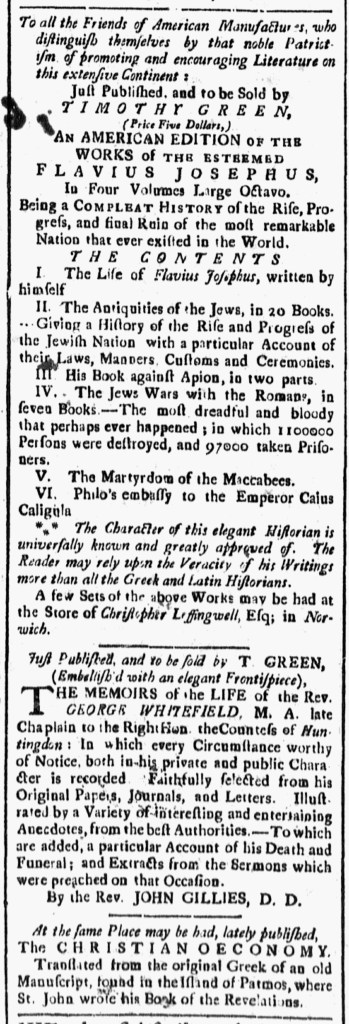
Calls to “Buy American” during the imperial crisis and the Revolutionary War extended to advertisements for books.  In the October 27, 1775, edition of the Connecticut Gazette, Timothy Green, the printer, promoted three works published in the colonies and available at his printing office in New London.  He addressed the advertisement to “all the Friends of American Manufactures, who distinguish themselves by that noble Patriotism of promoting and encouraging Literature on this extensive Continent.”

Those books included the “MEMOIRS of the LIFE of the Rev. GEORGE WHITEFIELD,” one of the most famous ministers of the era.  When he died in Newburyport, Massachusetts, on September 30, 1770, news spread throughout the colonies as widely and as quickly as news about the Boston Massacre earlier that year.  John Gillies compiled the memoir from Whitefield’s “Original Papers, Journals, and Letters” and added “a particular Account of his Death and Funeral; and Extracts from the Sermons which were preached on that Occasion.”  They originally appeared in a London edition published in 1772, but Green most likely sold an American edition printed by Robert Hodge and Frederick Shober in New York in 1774.

For another of the books, The Works of Flavius Josephus in four volumes, Green triumphantly proclaimed that it was an “AMERICAN EDITION.”  Earlier in the eighteenth century, American printers sometimes put a London imprint on the title page of books they printed in the colonies, believing that customers preferred imported works.  Mitch Fraas, curator at the Kislak Center for Special Collections, Rare Books, and Manuscripts at the University of Pennsylvania, notes the prevalence of “books printed in America … bearing the false imprint of European cities.”  That seems to have been the case with two 1773 editions of The Works of Flavius Josephus with a New York imprint yet “Probably printed in Glasgow,” according to the entries in the American Antiquarian Society’s catalog.  Yet colonizers had access to an authentic American edition … and Hodge and Shober had been involved in the production, just as they had printed an edition of The Christian Oeconomy, the final book in Green’s advertisement, in 1773.

Rather than looking to London to provide them with books, some printers and booksellers embraced American editions and encouraged prospective customers to do the same.  Green framed doing so as the patriotic duty of “Friends of American Manufactures” who supported the American cause and participated in the Continental Association, a nonimportation agreement enacted throughout the colonies in response to the Coercive Acts.  Readers could do their part to defend American liberties through the choices they made in the marketplace, including purchasing an “AMERICAN EDITION” when they went to the bookstore.

December 16

What was advertised in a colonial American newspaper 250 years ago today?

Connecticut Gazette (December 16, 1774).

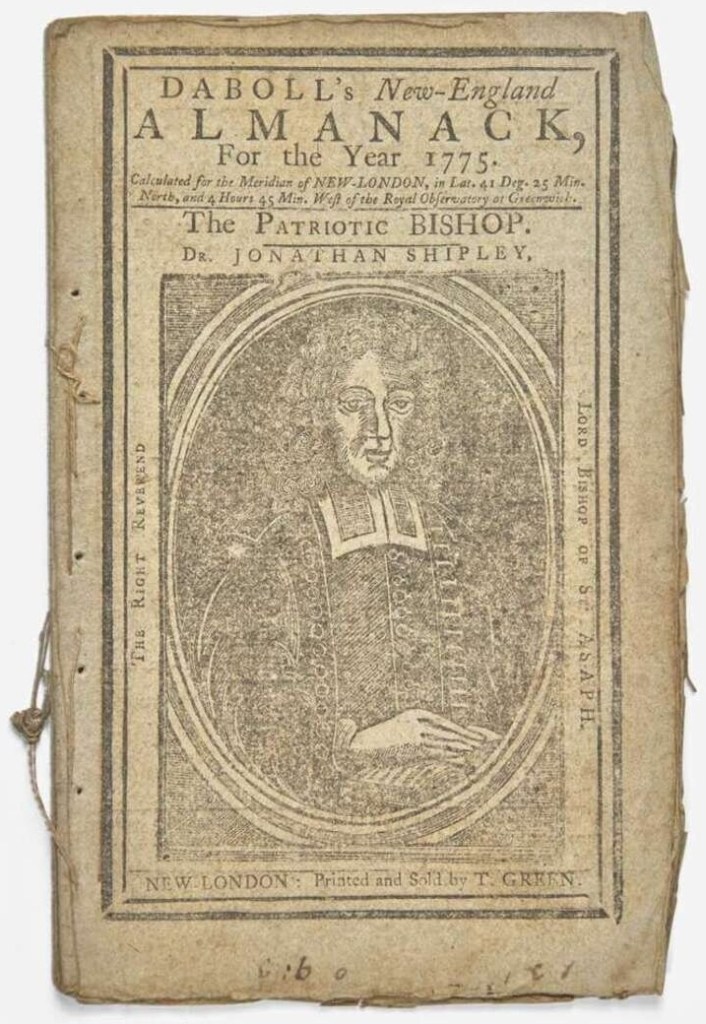
“Embellish’d with an Engraving of the patriotic Bishop of ST. ASAPH.”

With a new year only weeks away, advertisements for almanacs appeared in newspapers throughout the colonies in December 1774.  Most printers who published newspapers also produced almanacs as an alternate revenue stream, joined by other printers who supported themselves by performing job printing.  Consumers had an array of choices when they selected their almanacs for the coming year.

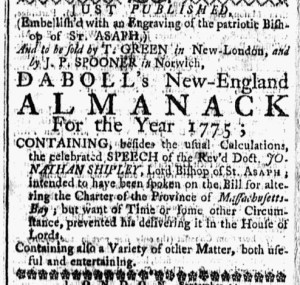
As a result, printers often marketed the contents of their almanacs, emphasizing anything that made them distinctive.  When Timothy Green, the printer of the Connecticut Gazette, advertised “DABOLL’s New-England ALMANACK For the Year 1775,” he indicated that it included the “usual Calculations” as a well as a “Variety of other Matter, both useful and entertaining.”  He emphasized a particular item: “the celebrated SPEECH of the Rev’d Doct. JONATHAN SHIPLEY, Lord Bishop of St. ASAPH; intended to have been spoken on the Bill for altering the Charter of the Province of Massachusetts-Bay; but want of Time or some other Circumstance, prevented his delivering it in the House of Lords.”  Shipley had gained acclaim in the colonies because he had been the only bishop in the Church of England who expressed opposition to the Massachusetts Government Act when Parliament considered how to respond to the Boston Tea Party.  When he did not have a chance to deliver the speech, he opted to publish it instead.

Though Shipley’s speech had little impact in England, the colonizers greeted it warmly.  Several newspapers published the speech, printers advertised pamphlets containing the speech, and Green devoted twelve of the thirty-two pages of Daboll’s New-England Almanack to the speech, anticipating that doing so would entice customers.  Furthermore, he “Embellished [the almanac] with an Engraving of the patriotic Bishop of ST. ASAPH” on the front cover.  Each time readers consulted any of the contents, they glimpsed the bishop whether or not they also read any portion of his speech.  Green advertised Daboll’s New-England Almanack at the same time he promoted his own edition of “The PROCEEDINGS and RESOLUTIONS of The Continental Congress,” joining other printers in producing and disseminating an array of items related to current events and, especially, making a case against the abuses perpetrated by Parliament.

Daboll’s New-England Almanack, For the Year 1775 (New London: Timothy Green, 1774). Courtesy Freeman’s | Hindman.

December 2

What was advertised in a colonial American newspaper 250 years ago today?

Connecticut Gazette (December 2, 1774).

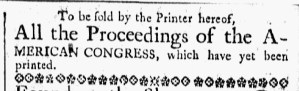
“All the Proceedings of the AMERICAN CONGRESS.”

Among the several advertisements that ran in the December 2, 1774, edition of the Connecticut Gazette, a brief notice announced that “All the Proceedings of the AMERICAN CONGRESS, which have yet been printed” were “sold by the Printer hereof.”  That expanded the options that readers had for learning more about the meetings held by the First Continental Congress in Philadelphia from September 5 through October 26.  The Connecticut Gazette and other newspapers provided coverage.  In addition, printers throughout the colonies began publishing, advertising, and selling Extracts from the Votes and Proceedings of the American Continental Congress shortly after delegates concluded their business.  Within a month, William Bradford and Thomas Bradford advertised a “JOURNAL OF THE PROCEEDINGS OF THE CONGRESS,” an even more complete account to keep colonizers informed about current events.

Timothy Green, the printer of the Connecticut Gazette, was among the printers who produced a local edition of the Extracts, yet when he advertised “All the Proceedings … which have yet been printed” he did not refer to a volume from his own press.  Although printers far and wide quickly created and marketed local editions of the Extracts, only a couple opted to print the more extensive Journal.  The Bradfords advertised their Philadelphia edition.  Hugh Gaine, the printer of the New-York Gazette and Weekly Mercury, printed the only other edition.  Green likely sold Gaine’s edition at his printing office in New Haven, given the proximity of that town to New York, though the Bradfords could have dispatched copies via a ship bound from Philadelphia to New England.  No matter which printer supplied Green with copies of the Proceedings, he advertised the journal of the meetings of the First Continental Congress to readers in Connecticut a little over a week after the Bradfords first promoted their edition in the Pennsylvania Journal.  He did so the day after the Continental Association, a nonimportation pact intended to unite the colonies in resisting the Coercive Acts, went into effect.  As readers made decisions about what they would buy and sell, Green presented them with another option for learning about the political principles behind the Continental Association and the other actions taken by the First Continental Congress.

September 9

What was advertised in a colonial American newspaper 250 years ago today?

Connecticut Gazette (September 9, 1774).

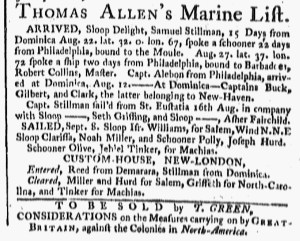
“CONSIDERATIONS on the Measures carrying on by GREAT BRITAIN, against the Colonies in North-America.”

As the number of American editions of Considerations on the Measures Carrying On with Respect to the British Colonies in North-America increased in 1774, so did the number of newspapers that carried advertisements for the political tract.  John Holt, the printer of the New-York Journal, advertised his edition.  Benjamin Edes and John Gill, the printers of the Boston-Gazette, did so as well for their edition.  Ebenezer Watson, printer of the Connecticut Courant, ran his own advertisement when he published a Hartford edition.  Yet it was not solely the printers of the various American editions who advertised or sold the popular pamphlet.  Watson listed local agents in eight towns and two post riders who sold his edition.  David Atwater advertised the New York edition for sale in New Haven in the Connecticut Journal.

Timothy Green, printer of the Connecticut Gazette, joined their ranks with an advertisement in the September 9, 1774, edition of his newspaper.  That made the pamphlet available for purchase in New London in addition to other towns in New England and New York.  Compared to the other advertisements, however, Green’s notice was quite brief, just three lines that completed the column following “THOMAS ALLEN’S Marine List,” a regular feature, on the third page.  “TO BE SOLD by T. GREEN, CONSIDERATIONS on the Measures carrying on by GREAT BRITAIN, against the Colonies in North-America.”  Green did not provide any of the elaborate description about how well the pamphlet had been received in London and how it had influenced residents there to support the American colonies against the abuses perpetrated by Parliament, nor did he encourage readers to review it for themselves so they could be better informed.  Perhaps he expected that the news he printed throughout the rest of his newspaper and the conversations about current events taking place everywhere anyone went those days provided enough reason for colonizers to acquire the pamphlet.  He also did not state which edition he sold, though the variant title in his advertisement suggests that he carried Watson’s Hartford edition.  In stocking and promoting the pamphlet, Green joined printers, post riders, and others in disseminating a political tract intended to influence colonizers and help them in articulating their grievances against Parliament.

August 7

What was advertised in a colonial American newspaper 250 years ago this week?

Connecticut Gazette (August 5, 1774).

“All Persons indebted to T. GREEN, either for News-Papers, Advertisements, or otherwise are requested to make immediate Payment.”

Among the many advertisements that appeared on the final page of the August 5, 1774, edition of the Connecticut Gazette, Timothy Green, the printer, inserted a brief notice calling on readers to settle accounts in his printing office in New London.  “All Persons indebted to T. GREEN, either for News-Papers, Advertisements, or otherwise,” it read, “are requested to make immediate Payment.”  The “otherwise” included books and pamphlets.  Green simultaneously advertised several including “POEMS on various SUBJECTS, RELIGIOUS AND MORAL, By PHILLIS WHEATLEY,” “A PLEA, In Vindication of the Connecticut Title to the contested Lands, lying West of the Province of New-York … By BENJAMIN TRUMBULL,” and “The JUDGMENT of whole Kingdoms and Nations … By Lord Somers.”  Green likely stocked stationery and writing supplies as well.  Many printers even peddled patent medicines for supplementary revenue.

Printers also did job printing, such as blanks (printed forms), broadsides, and handbills.  When Green called on those indebted to him for advertisements to submit payment, he may have meant customers who ordered broadsides, handbills, and other advertising ephemera.  That was sometimes what printers meant when they solicited advertisements.  Such was the case when Joseph Crukshank announced that he opened a printing office in Philadelphia in 1769.  “Particular care will be taken,” he pledged, “to do Advertisements, Blanks, &c. on very short notice.”  Isaiah Thomas was more specific in the colophon that regularly ran at the bottom of the final page of the Massachusetts Spy in the early 1770s: “Small HAND-BILLS at an Hour’s Notice.”  That may have been the kind of work that Green meant, but he may have also intended to include paid notices that appeared in the Connecticut Gazette.  If so, extending credit to newspaper advertisers did not align with the business practice traditionally identified by historians of the early American press: printers supposedly allowed credit for subscriptions yet demanded payment in advance for newspaper advertisements.  The revenue from advertising underwrote whatever subscribers neglected to pay.  Yet printers sometimes inserted notices that indicated they had published newspaper advertisements on credit.  Ebenezer Watson, printer of the Connecticut Courant, reconsidered that policy when he announced that “No Advertisements will for the future be published in this paper, without the money is first paid.”  Green may have allowed credit for advertisements in the Connecticut Gazette.  The wording in his notice does not definitively eliminate that possibility.

February 11

What was advertised in a colonial American newspaper 250 years ago today?

Connecticut Gazette (February 11, 1774).

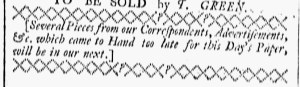
Several Pieces from our Correspondents, Advertisements, &c. which came to Hand too late for this Day’s Paper, will be in out next.”

Timothy Green, the printer of the Connecticut Gazette, inserted a brief notice in the February 11, 1774, edition to advise that “Several Pieces from our Correspondents, Advertisements, &c. which came to Hand too late for this Day’s Paper, will be in out next.”  In a few short lines, the printer aimed to manage his relationships with subscribers, advertisers, and anyone who submitted news, editorials, essays, or any other content for the newspaper.  He suggested to readers that he worked until the last possible moment to include the latest news.  He assured advertisers that their notices would indeed appear in print in the next issue.  He let those who provided content know that practical matters, not a lack of appreciation for their efforts, played the deciding role in why their submissions did not appear alongside a proclamation from the governor, resolutions from a “Town-Meeting of the Town of Providence” concerning a “Duty upon Tea” enacted by Parliament, and an account of events that resulted in the tarring and feathering of John Malcom, a customs officer, in Boston.

Green’s notice appeared at the bottom of the final column on the third page.  While that may seem like a curious place to modern readers, it made absolute sense to eighteenth-century readers, especially anyone familiar with the process for printing newspapers.  The Connecticut Gazette, like other newspapers of the era, consisted of four pages, created by printing two pages on each side of a broadside and folding it in half.  Workers in a printing office set the type for the first and fourth pages, printed the side of the broadsheet that featured those pages, and let the ink dry before printing the second and third pages on the other side.  That meant that type for the interior pages was set last, so news received most recently, regardless of its magnitude, appeared there rather than on the front page.  Whatever appeared at the end of the last column on the third page was the final bit of content that printers managed to fit in that issue.  That Green’s notice appeared there testified to his efforts to publish everything received in his printing office in New London up to the moment he had to take that issue to press and distribute the February 11 edition on schedule.

November 12

What was advertised in a colonial American newspaper 250 years ago today?

New-London Gazette (November 12, 1773).

“A COMPLEAT and ENTIRELY NEW Assortment Of the best PRINTING MATERIALS.”

Timothy Green, the printer of the New-London Gazette, made an important announcement about his business in the November 12, 1773, edition of his newspaper.  He proclaimed that he “Has just IMPORTED from LONDON, A COMPLEAT and ENTIRELY NEW Assortment Of the best PRINTING MATERIALS.”  New type and other equipment would enhance not only the newspaper, making it more attractive for both subscribers and advertisers, but also books, pamphlets, almanacs, and blanks produced in his printing office.  In addition, he sought orders for broadsides, handbills, and other job printing.  With the arrival of these “best PRINTING MATERIALS,” Green “hopes that the kind of Encouragement of the PUBLIC will not be wanting.”  He was ready to serve clients, giving “his constant Attention to please them.”

The savvy printer just happened to place the most ornate of all the advertisements in that issue of the New-London Gazetteimmediately below his own notice.  A border made of decorative type enclosed an advertisement in which David Gardiner, Jr., offered cash for “Small Furrs, Bees-Wax, old Brass, Copper, and Pewter” and hawked a “good ASSORTMENT of Ship-Chandlery Ware, Groceries of all Kinds, an Assortment of Glass and Stone Ware,” and other merchandise.  The distinctive advertisement demonstrated to prospective clients that they could place their own notices that featured visual elements designed to attract attention.  It also presented possibilities for broadsides, handbills, catalogs, billheads, blanks, and other job printing orders.

New-London Gazette (November 19, 1773).

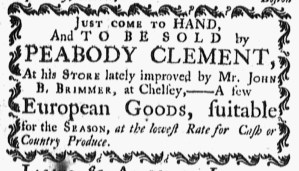
Gardiner’s advertisement ran in the next issue of the New-London Gazette, but it was no longer the only one with a decorative border.  In a new advertisement, Peabody Clement promoted imported goods “JUST COME TO HAND.” Green or one of the compositors in his shop selected different printing ornaments for Clement’s advertisement than those in Gardiner’s notice.  That distinguished the notices from each other, while also displaying some of the range of new types in Green’s printing office.  Perhaps Clement saw the printer’s announcement and Gardiner’s advertisement in the November 12 edition and that helped convince him to place his own notice and influenced his decision about the format.

July 2

What was advertised in a colonial American newspaper 250 years ago today?

New-London Gazette (July 2, 1773).

Also at the Printing-Office in Norwich, and by Nathan Bushnell, jun. and Joseph Knight, Post Riders.”

In early July 1773, Timothy Green, the printer of the New-London Gazette, ran an advertisement for a pamphlet that he “Just Publish’d” and sold at the printing office.  He noted that it was the “Third EDITION corrected.”  The Adverts 250 Project has traced the marketing of earlier editions of that pamphlet, John Allen’s “ORATION, Upon the BEAUTIES of LIBERTY, Or the essential Rights of the AMERICANS,” a publication that John M. Bumsted and Charles E. Clark have described as “one of the best-selling pamphlets of the pre-Revolutionary crisis, passing through seven editions in four cities between 1773 and 1775.”[1]

In advertisements in the Massachusetts Gazette and Boston Weekly News-Letter and the Massachusetts Spy on January 14, 1773, Benjamin Kneeland and Nathaniel Davis announced that the pamphlet was “Now in the press, and will be published in a few days.”  A week later, the printers announced “This Day was published” the “SECOND EDITION.”  Newspaper advertisements did not account for the first edition.  It did not take long for Samuel Hall and Ebenezer Hall, the printers of the Essex Gazette, to advertise that they sold the pamphlet at their printing office in Salem.  Copies of the Oration circulated beyond Boston.

Green … or Joseph Knight, a post rider … apparently acquired the pamphlet and determined that the conditions were right to market a third edition in Connecticut.  The imprint on the title page stated, “Printed by T. Green, for Joseph Knight, post-rider.”  The efforts of the printer and the post rider to disseminate Allen’s Oration extended beyond the printing office in New London to include the printing office in Norwich, Knight, and another post rider, Nathan Bushnell, Jr.  Printer-booksellers frequently stocked books and pamphlets published by their fellow printer-booksellers.  They also served as local agents who collected subscriptions for proposed publications.  Newspaper advertisements, however, rarely mentioned post riders as publishers or even as local agents responsible for selling and distributing books and pamphlets.  Green and Knight devised an innovative method for marketing and disseminating this pamphlet, perhaps increasing its circulation and contributing to the popularity that led to four other editions appearing in the next two years.

**********

[1] John M. Bumstred and Charles E. Clark, “New England’s Tom Paine: John Allen and the Spirit of Liberty,” William and Mary Quarterly, 3rd ser., 21, no. 4 (October 1964): 562.

April 23

Who was the subject of advertisements in colonial American newspapers 250 years ago today?

Connecticut Journal (April 23, 1773).

“TO BE SOLD … A likely Negro Man … Enquire of the Printers.”

TO BE SOLD, A Negro Boy … Enquire of the Printers.”

Timothy Green ran a busy printing office in the early 1770s.  In addition to publishing the New-London Gazette, he sold books, some that he printed but most of them imported.  In the April 23, 1773, edition of his newspaper, Green advertised one of his own imprints, informing readers that “A Faithful HISTORY OF REMARKABLE OCCURRENCES, IN THE Captivity and Deliverances OF Mr. JOHN WILLIAMS, Minister of the Gospel in DEEERFIELD” was “Just Published, and to be Sold.”  Green also did job printing, including broadsides, handbills, and blanks (or forms).  Similarly, Thomas Green and Samuel Green oversaw a bustling printing office where they published the Connecticut Journal and New-Haven Post-Boy.  In the spring of 1773, they distributed subscription proposals for a new edition of “A Discourse on Justification by Faith alone. BY THE REVEREND JONATHAN EDWARDS.”  Those proposals also appeared in the April 23 edition of the New-London Gazette, part of a network of printers and others who cooperated in collecting the names of subscribers who reserved copies.

New-London Gazette (April 23, 1773).

Among their many other responsibilities, all three printers also served as slave brokers.  The same day that they promoted important historical and theological works, they also advised readers to “Enquire of the Printers” to learn more about enslaved people advertised for sale in their newspapers.  In the Connecticut Journal, a brief advertisement announced, “TO BE SOLD, (for no Fault, but for want of Employ,) A likely Negro Man, about 26 Years old, fit for Town or Country. Enquire of the Printers.”  An even shorter, but equally insidious, advertisement in the New-London Gazette stated, “TO BE SOLD, A Negro Boy, about 13 Years old, lately brought into the Country.  Enquire of the Printer.”  In both cases, the advertisers declined to identify themselves, instead instructing interested parties to contact the printers for more information.  In turn, the printers facilitated the sales of enslaved people twice over and generated revenue from the advertisements in the process.  First, they disseminated the notices, undertaking the labor required to print and distribute the advertisements and the rest of the newspapers.  Then, they actively participated in the sale of the “likely Negro Man” and the “Negro Boy, about 13 Years old,” responding to messages they received in the printing office and colonizers who visited to learn more.  As these advertisements demonstrate, printers in New England participated in perpetuating slavery during the era of the American Revolution, alongside their counterparts in Maryland, Virginia, South Carolina, and other colonies with greater numbers of enslaved people.  Such advertisements underwrote the production and dissemination of the news, while those that required readers to “Enquire of the Printers” further enmeshed printers in the slave trade as brokers for sales.

For an extended consideration of such advertisements, see Jordan E. Taylor, “Enquire of the Printer: Newspaper Advertising and the Moral Economy of the North American Slave Trade, 1704-1807,” Early American Studies 18, no. 3 (Summer 2020): 287-323, and the companion website.