December 19

What was advertised in a revolutionary American newspaper 250 years ago today?
Dunlap’s Maryland Gazette (December 19, 1775).

“He carries on the Spinning-Wheel business in its various branches.”

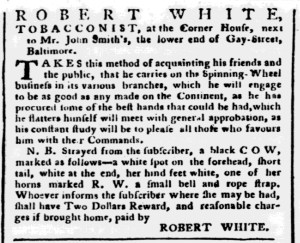
In the final weeks of 1775, Robert White, a tobacconist in Baltimore, diversified his business.  He inserted an advertisement in the December 19 edition of Dunlap’s Maryland Gazette that announced that “he carries on the Spinning-Wheel business in its various branches.”  Why would a tobacconist decide to go into that line of business?  The Continental Association, a nonimportation and nonconsumption agreement devised by the Furst Continental Congress, remained in effect.  It called on colonizers to replace imported goods, including textiles, with alternatives produced in the colonies.  That meant more time spent spinning, a domestic chore that gained political significance.  Women styled Daughters of Liberty in newspaper accounts participated in public spinning bees to demonstrate their patriotism and inspire others to follow their example in their own homes.  To do so, they needed the right equipment.  White saw an expanding market for spinning wheels.

He was not alone in marketing equipment for producing homespun cloth.  His advertisement happened to appear immediately above Fergus McIllroy’s notice promoting “LOOMS made properly, for carrying on the Linen and Woolen Weaving-business.”  McIllroy, a “House Joiner,” also pursued a new line of work, though in his case doing so did not depart nearly as much from his primary occupation.  In addition, he reported that he had previously constructed more than two hundred looms in Ireland before migrating to the colonies.  White, the tobacconist, did not invoke such experience when it came to spinning wheels, yet he confidently proclaimed that he “will engage” his spinning wheels “to be as good as any made on the Continent” because “he has procured some of the best hands that could be had.”  In turn, White “flatters himself” that his workers and the spinning wheels they produced “will meet with general approbation” or approval from customers.  The tobacconist apparently served as a supervisor, an entrepreneur who established a business when he identified need for it during difficult time yet did not participate in making the spinning wheels.  Instead, in overseeing his new business, he pledged that “his constant study will be to please all those who favours him with their Commands.”  With no resolution in sight for the imperial crisis that became a war the previous April, White’s advertisement likely resonated with readers who understand the political implications of a tobacconist deciding to produce spinning wheels.

April 11

What was advertised in a colonial American newspaper 250 years ago today?

South-Carolina Gazette and Country Journal (April 11, 1775).

“The Sign of the NEGRO BOY.”

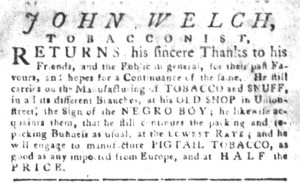
The April 11, 1775, edition of the South-Carolina Gazette and Country Journal carried seventeen advertisements about enslaved people.  Several offered enslaved people for sale.  Jacob Valk, a broker who regularly advertised, noted that “NEGROES of different Qualifications” were “daily for SALE” at his office.  Valentine Lynn sought to sell “Seven healthy, stout NEGROES,” including “a good boatman,” a “handy” domestic servant, and five “field slaves.”  Robert Goudey announced that he “will dispose of, by private contract,” nearly three dozen enslaved people, “among whom are carpenters, coopers, wagon drivers, plough men, and house” maids.  Prospective purchasers could presumably examine those enslaved people, just as they could examine any of the eleven Black men and women “Brought to the Workhouse” and imprisoned there until their enslavers claimed them.

Other advertisements certainly enlisted readers in examining Black bodies closely to determine if they matched the descriptions of enslaved people who liberated themselves by running away from their enslavers.  William Stitt, for instance, asked readers to take note of any Black women they encountered who might be Lydia, “about 40 years of age, of a yellowish complexion.”  William Roberts described Tena, who “had on when she went away, a blue negro cloth gown, and osnaburgs apron.”

Yet these were not the only instances of Black bodies on display in Charleston.  In a notice asking others to settle accounts before he left the city for a while, John Welch, a tobacconist, advised his “Friends and Customers” that associates would conduct business “as usual” at his “SHOP in Union-street, the Sign of the NEGRO BOY.”  He may have chosen that emblem to represent the laborers who cultivated the tobacco he sold.  By the time Welch ran his advertisement in the spring of 1775 the sign that marked his shop was a familiar sight to those who traversed the streets of Charleston.  He referenced it in an advertisement the previous summer, so it had been in place for the better part of a year and probably longer, especially considering that he also referred to that location as his “old SHOP.”  Welch’s commercial enterprise appropriated the labor the enslaved men and women who raised the tobacco he sold, but that was not the extent of his use of Black bodies in earning his livelihood.  He also deployed an image of a Black boy as the emblem of his business and the device that confirmed customers arrived at the right location to purchase tobacco and snuff.

July 12

What was advertised in a colonial American newspaper 250 years ago today?

South-Carolina Gazette and Country Journal (July 13, 1774).

“The Sign of the NEGRO BOY.”

When John Welch, a tobacconist, advertised in the July 12, 1774, edition of the South-Carolina Gazette and Country Journal, he invited “his Friends, and the Public in general” to “his OLD SHOP in Union-street, the Sign of the NEGRO BOY.”  That emblem linked the commodity that Welch’s customers consumed to the enslaved men, women, and children who played such a significant role in producing it.  While Welch emphasized his role in the final stage of “the Manufacturing of TOBACCO and SNUFF, in all its different Branches” to make those items available on the market, the “Sign of the NEGRO BOY” merely hinted at the enslaved labor that raised tobacco on plantations.

South-Carolina Gazette and Country Journal (July 12, 1774).

Welch’s sign was one more instance of putting Black bodies on display in the colonies during the era of the American Revolution.  At auctions and as they went about their daily lives, the bodies of enslaved people were scrutinized by colonizers.  Advertisements that provided descriptions of enslaved people who liberated themselves by running away from their enslavers and offered rewards for their capture and return encouraged even more careful observation of Black bodies.  Other advertisements announcing enslaved people for sale incorporated images of Black bodies.  Those woodcuts, stock images supplied by printers, were nondescript and interchangeable, further dehumanizing the people they represented in a system that treated them as commodities.  An image of a Black man accompanied an advertisement about “A CARGO OF ONE HUNDRED & TWENTY PRIME NEGROES … directly from SIERRA-LEON, a Rice Country, on the Windward Coast of AFRICA” in the same column as Welch’s advertisement.

Variations of the “Sign of the NEGRO BOY” marked the locations of shops in other towns.  In March 1766, August Deley advertised tobacco “At the Sign of the Black Boy … in Hartford” in the Connecticut Courant.  Jonathan Russell peddled a “NEW and FRESH Assortment of English and India GOODS … at the Sign of the BLACK-BOY” in Providence in May 1767.  In December 1768, he gave a different description, “the Sign of the Black Boy and Butt.”  Perhaps he had a new sign that incorporated a large barrel along with the boy, though he may have added a detail that he did not mention in his previous advertisement.  Several months later, Samuel Young promoted an “Assortment of European, East and West-India GOODS” in stock at his store at “the Sign of the Black Boy” in Providence.  Four years after that, he continued business “At the Sign of the Black Boy” in May 1773.  Jonathan Williams gave his location as “the Black Boy and Butt in Cornhill” in the Massachusetts Gazette and Boston Weekly News-Letter in September 1770 and in the Boston Evening-Post in April 1771.  Advertisers in northern colonies as well as southern ones deployed images of Black bodies in marking their locations.

Colonizers appropriated the labor of enslaved men, women, and children in producing commodities for market throughout the Atlantic world and beyond, but that was not the extent of the appropriation that took place.  They also appropriated images of Black bodies to market goods, to sell Black people they treated as commodities, and to encourage surveillance of Black people to determine whether they were fugitives for freedom who liberated themselves from their enslavers.

March 28

What was advertised in a colonial American newspaper 250 years ago this week?

New-York Journal (March 25, 1773).

“The Public will find upon trial, the SNUFF manufactured by them to be equal in Quality, and Flavour, to any imported from Great-Britain.”

In the spring of 1773, the firm of Maxwell and Williams announced that they processed and sold tobacco and snuff to customers in New York.  According to their advertisement in the March 25, 1773, edition of the New-York Journal, the partners formerly “carried on a large and extensive trade in the SNUFF and TOBACCO Manufactories” in Bristol.  Upon relocating their business in the colonies, they supplied the public with “all sorts of best Scotch and Rappee SNUFF, [and] Pugtail, Rag, and fine mild smoaking TOBACCO.”

Although relative newcomers to New York, Maxwell and Williams enthusiastically joined calls to encourage “domestic manufactures” through purchasing goods produced in the colonies rather than imported from England.  Like other artisans who made such appeals, the tobacconists declared that consumers did not have to sacrifice quality when they chose to acquire local goods rather than imported alternatives.  “The Public will find upon trial,” Maxwell and Williams confidently asserted, “the SNUFF manufactured by them to be equal in Quality, and Flavour, to any imported from Great-Britain.”  They invited consumers to make that determination for themselves.

Maxwell and Williams also sought to distinguish their product from any others produced in New York or other colonies.  They not only wished for consumers to support domestic manufactures; they also wanted consumers to support their domestic manufactures in particular.  To that end, Maxwell and Williams stated that they “erected … a complete apparatus for carrying on the said business in all its branches.”  In addition, their snuff was “made of the best materials, and in a manner superior to any thing of the kind yet attempted in this country.”  Only after making all of those pitches did the partners most explicitly call on consumers to purchase goods produced in the colonies rather than imported alternatives, offering competitive prices to make doing so even more attractive.  “[A]s an encouragement to those who are inclined to countenance Manufactories set on foot in AMERICA,” Maxwell and Williams trumpeted, they would sell “their SNUFF on lower terms than any can be imported.”

Many entrepreneurs, including tobacconists, launched “Buy American” campaigns prior to the Revolutionary War.  Some sought to address a trade imbalance between the colonies and Britain.  Others recognized the political dimensions of both production and consumption, leveraging commerce and industry as a means of participating in politics.  All of them wished to create new opportunities for the success of their own endeavors by adding support for domestic manufactures to the array of marketing strategies commonly deployed by advertisers.

September 16

What was advertised in a colonial American newspaper 250 years ago today?

Pennsylvania Journal (September 16, 1772).

“A sample of the TOBACCO may be seen at the Bar of the London Coffee-House.”

In a series of newspaper advertisements, Hamilton and Leiper informed readers that they sold “the various kinds of manufactured TOBACCO and SNUFF (of the best quality)” at their store on Second Street in Philadelphia.  In addition, they “established a MANUFACTORY” in Baltimore “for the conveniency of their customers in Maryland.”  Over time, the partners became the most successful tobacconists in the region.  Their advertisements and other marketing efforts likely played a role in their success.

As fall approached in 1772, the partners promoted their “KITE-FOOT TOBACCO” in an advertisement in the September 16 edition of the Pennsylvania Gazette.  As usual, they lauded their tobacco’s “excellent quality.”  Like other entrepreneurs who hawked “domestic manufactures,” goods produced in the colonies, Hamilton and Leiper proclaimed their product “equal to any imported from Europe.”  Consumers were familiar with tobacco exported to England and Scotland as raw materials, processed in those places, and then imported into the colonies.  Hamilton and Leiper, however, asserted that quality tobacco did not need to cross the Atlantic twice.

Prospective customers could decide for themselves.  In addition to visiting Hamilton and Leiper’s shop, consumers had the option of examining a sample “at the Bar of the London Coffee-House.”  That almost certainly enhanced the visibility of Hamilton and Leiper’s product, exposing patrons of an establishment already popular with merchants and other colonizers to their brand of tobacco.  Patrons did not need to enter the London Coffee House with the intention of scrutinizing Hamilton and Leiper’s “KITE-FOOT TOBACCO” to determine if they wished to make a purchase.  Instead, they could be incidentally exposed to the product as others examined and discussed it.  Making samples available had the potential to incite interest and enthusiasm among multiple prospective customers engaging with each other and the product simultaneously.  That marketing strategy had the potential to create a very different kind of experience among consumers than reading newspaper notices.

July 9

What was advertised in a colonial American newspaper 250 years ago today?

Connecticut Courant (July 9, 1771).

“As cheap, and equal in goodness to any sold in New York.”

Purveyors of goods in Hartford and nearby towns frequently assured prospective customers that they had the same opportunities to participate in the marketplace as if they lived in bustling urban ports like Boston and New York.  Such was the case in two advertisements that ran in the July 9, 1771, edition of the Connecticut Courant.  In the first, Barzillai Hudson, a tobacconist, announced that he sold the “best pig tail and paper tobacco in small or large quantities as cheap, and equal in goodness to any sold in New York.”  Like other advertisers in smaller towns, Hudson asserted that he offered the same bargains and the same quality that consumers enjoyed in colonial cities.

In another advertisement, Peter Verstille of Weathersfield demonstrated the vast array of choices he made available to consumers.  Divided into two parts, that advertisement extended an entire column.  The first portion listed a “fine assortment of GOODS” imported from London and Bristol and received via Boston and New London.  Verstille enumerated various kinds of textiles, tableware, and housewares before concluding that portion of his notice with “&c. &c. &c.”  Invoking the eighteenth-century abbreviation for et cetera three times underscored consumers could expect to discover many more choices when they visited his shop.  That portion of the advertisement initially ran on its own, but Verstille later updated it with another litany of imported goods that arrived via Boston.  In particular, he listed hardware items that did not appear in the original.  That addition meant that his customers enjoyed one-stop-shopping for their various needs and desires.  Verstille also promoted prices that matched those in Boston and New York.

The pages of the Connecticut Courant did not overflow with advertising for consumer goods and services like newspapers published in Boston, Charleston, New York, and Philadelphia.  Ebenezer Watson did not need to publish advertising supplements.  That did not mean, however, that readers of the Connecticut Courant in the countryside did not participate in the vibrant consumer culture taking place in urban ports.  Entrepreneurs like Hudson and Verstille invited and made it possible for even colonists who resided in remote places to participate in the consumer revolution.

May 5

What was advertised in a colonial American newspaper 250 years ago this week?

Pennsylvania Gazette (May 2, 1771).

“They manufacture and sell as usual at Frederick-Town.”

According to their advertisement in the Pennsylvania Gazette, Hamilton and Leiper sold tobacco and snuff at several locations.  For consumers in Philadelphia, they listed their location as “Second-street, between Market and Arch-streets.”  The primary purpose of their advertisement in the May 2, 1771, edition of the Pennsylvania Gazette, however, was to inform customers in Maryland that they had “established a MANUFACTORY in Market-street, Baltimore.”  At that location, they sold “the various kinds of manufactured TOBACCO and SNUFF (of the best quality) on the most reasonable terms.”  In addition, the tobacconists declared that they “manufacture and sell as usual at Frederick-Town” in western Maryland.  Altogether, Hamilton and Leiper sold tobacco and snuff in three towns in two colonies, their multiple locations providing for “the conveniency of their customers.”

Their advertisement in the Pennsylvania Gazette also testified to the reach of that newspaper in the early 1770s.  Baltimore would not have its own newspaper until August 1773.  Fredericktown (now Frederick) did not have a newspaper until after the American Revolution.  For half a century, the Pennsylvania Gazette served as a regional newspaper for readers in Pennsylvania, Delaware, Maryland, and New Jersey.  Although most of the advertisers who promoted consumers goods and services in its pages were located in Philadelphia, the Pennsylvania Gazette also carried notices from Lancaster, Pennsylvania; Wilmington, Delaware; Baltimore and Frederick, Maryland; Burlington and Trenton, New Jersey; and several other towns in those colonies.  Similarly, the Pennsylvania Gazette carried legal notices and advertisements about runaway apprentices and indentured servants and enslaved people who liberated themselves submitted by colonists throughout the region.  In the same column as Hamilton and Leiper’s advertisement, Henry Wells, a jailer, described a runaway servant who made his escape from William Anders or Andrews in Joppa, Maryland, but had been taken into custody and confined in Dover, Delaware.

Several colonies constituted a single media market for the Pennsylvania Gazette and other newspapers published in Philadelphia before the revolution.  Enterprising entrepreneurs like Hamilton and Leiper also recognized the potential to create larger markets for their wares rather than serve only a single town and its hinterlands.  In the early 1770s, they branched out from locations in Philadelphia and Frederick to a third location in Baltimore.  Advertisements in the Pennsylvania Gazette alerted consumers in and near all three places about the tobacco and snuff that Hamilton and Leiper sold at their several convenient locations.

August 6

What was advertised in a colonial American newspaper 250 years ago today?

Aug 6 - 8:6:1770 New-York Gazette and Weekly Mercury
New-York Gazette and Weekly Mercury (August 6, 1770).

“He hopes this will be an additional recommendation to every sincere lover of AMERICA.”

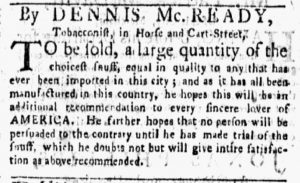
In the summer of 1770, Dennis McReady, a tobacconist on Horse and Cart Street in New York, advertised that he had for sale “a large quantity of the choicest snuff.”  To convince prospective customers to buy his product, he made a “Buy American” argument and proclaimed that his snuff was “equal in quality to any that has ever been imported in this city.”  The city’s merchants had withdrawn from their nonimportation agreement a few months earlier, shortly after receiving word that most of the duties imposed on imported goods in the Townshend Acts had been repealed.  With only the tax on tea remaining, New York’s merchants chose to resume trade with their counterparts in Britain.

Not all New Yorkers universally approved of that decision.  For those who had pursued “domestic manufactures” or local production of alternatives to imported goods, the boycott enhanced their ability to market their wares as symbols of patriotism and support for the American cause.  McReady cautioned prospective customers against turning back to imported goods too hastily, challenging them to try his snuff “manufactured in this country.”  In addition to declaring that his product was equal to snuff that had been processed from tobacco on the other side of the Atlantic, he issued a political challenge to “every sincere lover of AMERICA.”  That “AMERICA” was the only word in all capitals in the body of his advertisement made it easy for readers to spot and underscored the emphasis McReady placed on this particular appeal to consumers.  The tobacconist doubled down on his claims about the quality of his snuff and his challenge to choose it over imported snuff; he expressed his “hopes that no person will be persuaded to the contrary until he has made trial of [McReady’s] snuff.”  At least try this product once to test its quality, McReady demanded, rather than assume that “imported” meant “better quality.”  Instead of purchasing imported snuff just because they could, McReady sought to persuade consumers to support domestic manufactures and the patriotic ideals associated with them.

March 31

GUEST CURATOR:  Mary Aldrich

What was advertised in a colonial newspaper 250 years ago today?

Mar 31 - 3:31:1766 Connecticut Courant
Connecticut Courant (March 31, 1766).

“Augustus Deley, … CONTINUES to carry on the Business of manufacturing TOBACCO.”

I find it interesting that this advertisement starts by stating that the advertiser “CONTINUES to carry on the Business of manufacturing TOBACCO, in all its Branches.” This makes me wonder if something happened to cast doubt in the minds of his customers about whether they would be able to continue purchasing their tobacco from him or not. This advertisement has the air of someone reassuring his customers that he was indeed still in business.

The fact that Deley mentioned that he needed sufficient notice from those wishing to purchase large quantities of tobacco makes me think that he was not a minor tobacconist. To have customers purchase large amounts of tobacco must have occurred often enough for him to specifically ask those who wished to purchase those amounts to let him know beforehand. It must have been inconvenient for him to have a customer come in and take most of his supply because afterward he would have to potentially turn other customers away while he waited for a new shipment.

**********

ADDITIONAL COMMENTARY:  Carl Robert Keyes

Augustus Deley certainly wanted residents of Hartford and its hinterland to know that he continued to sell tobacco, that he was still in business, but his advertisement also alluded to a notice that he posted in the Connecticut Courant nearly three months earlier. Perhaps Deley had recently moved to Hartford and was settling in. After all, his earlier advertisement announced that he was a “Tobaconist (from New-York),” but he dropped that description in his updated advertisement. He may have become an increasingly familiar face in Hartford, but he likely wanted to let potential customers not yet aware of his shop or uncertain of its success that he did indeed “CONTINUE to carry on the Business of manufacturing TOBACCO.”

Among the various updates to his advertisement, Deley listed a location: “At the Sign of the Black Boy, Near the North Meeting-House in Hartford.” It was no coincidence that a tobacconist set up shop “At the Sign of the Black Boy.” After all, slaves provided the labor involved in cultivating tobacco in the Chesapeake colonies. Just as many trade cards or tobacco wrappers from the era featured images of enslaved men and women at work on plantations or interacting happily with white masters and overseers, Deley selected a shop sign that reduced a “Black Boy” to the colonial equivalent of a mascot or a brand to market his product.

January 31

GUEST CURATOR:  Maia Campbell

What was advertised in a colonial newspaper 250 years ago this week?

Jan 31 - 1:30:1766 Pennsylvania Gazette
Pennsylvania Gazette (January 30, 1766)

“Which has been proved by many Trials to be equal to the best snuff imported from Great-Britain.”

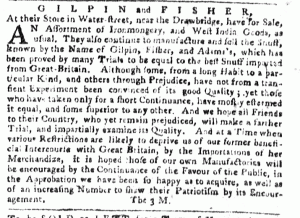
Advertisements for goods, such as the one depicted above, were commonplace in colonial newspapers. Advertising snuff, also known as sniffing tobacco, would not have been a shocking advertisement for the time as tobacco was a popular product. What is striking about the notice is what the tobacco was compared to:  tobacco imported from Great Britain.

I also find it interesting that Gilpin and Fisher would make a comparison to tobacco from Great Britain at a time when several of the colonies were prone to unrest. Britain had just passed the Stamp Act tax in 1765; some British products were currently being boycotted. Perhaps since the people of the colonies still considered themselves British citizens, they would have wanted to be loyal to British products. On the other hand, the advertisement would give colonists a sense of security in local products since the colonists had been so used to British goods.

**********

ADDITIONAL COMMENTARY:  Carl Robert Keyes

I was excited when Maia chose this advertisement, for a variety of reasons. She did not know that I had already selected an advertisement from the Massachusetts Gazette for yesterday that was also shaped by the Stamp Act, making this a wonderful transition into her responsibilities as guest curator for this week. I also appreciated the appeal to locally produced good, which Maia highlights in the quotation she selected from this advertisement: “Which has been proved by many Trials to be equal to the best snuff imported from Great-Britain.”

When I have featured advertisements that make similar appeals, I have emphasized their political valence and their rhetoric of resistance. Maia offers a perspective that I have not given as much attention: assuring colonists that domestic products were as good as any imported from Great Britain was not just an assurance of quality. This was also a means of offering reassurance to potential customers who faced an increasingly disorienting world of consumption disrupted by transatlantic politics.

Also, in questioning to what extent colonists might have wanted, on some level, to remain loyal to British goods Maia also reminds us that this was indeed a period of resistance – not yet revolution – and colonists continued to embrace their identity as members of the British empire even as they sought redress of grievances within the British system of law and politics.