July 26

What was advertised in a revolutionary American newspaper 250 years ago today?

Pennsylvania Gazette (July 26, 1775).

“A SERMON, on the present Situation of American Affairs … to distribute … among the Military Associators.”

A few days ago, I examined an advertisement for “A sermon on the present Situation of American Affairs” by William Smith that ran in the July 21, 1775, edition of the South-Carolina and American General Gazette.  I concluded that Wells likely sold copies of the pamphlet printed by James Humphreys, Jr., in Philadelphia and shipped to his “GREAT STATIONARY & BOOK STORE” in Charleston.  An advertisement in the July 26, 1775, edition of the Pennsylvania Gazette suggests that was indeed the case.

That notice listed several printers who stocked the sermon.  It gave top billing to James Humphreys, Jr., and noted that “the other Printers in Philadelphia” also sold the sermon.  Radiating outward from the city, the list next named Matthias Slough and Francis Bailey in Lancaster and then Hugh Gaine, the printer of the New-York Gazette and Weekly Mercury, in New York.  The list concluded with “Mr. ROBERT WELLS, in Charlestown, South-Carolina.”  Humphreys apparently dispatched copies to associates both in his own city and in other towns and colonies.

Another aspect of that advertisement indicates that Wells most likely sold copies of the sermon printed by Humphreys in Philadelphia.  Wells did not mention the price in his advertisement, but Humphreys gave prices for a single copy and multiple copies: nine pence for one copy, six shillings for a dozen, and six dollars for one hundred copies.  That pricing structure concluded with a note that Humphreys intended the discount for purchasing in volume as a benefit “for such Persons as may desire to distribute them among the Military Associators.”  He encouraged officers and other Patriots to disseminate the sermon widely by making a gift of it to those who volunteered to defend American liberties.  Humphreys was not alone in envisioning that officers would give books and pamphlets about current affairs as gifts.  George Washington had recently ordered eight copies of Thomas Hanson’s Prussian Evolutions in Actual Engagements to distribute among his subordinates.

The details in Humphreys’s advertisement strengthen the case that Wells did not publish his own edition of Smith’s sermon but instead advertised and sold copies that Humphreys printed in Philadelphia and distributed to printers and booksellers in several cities and towns.  Doing so contributed to the creation of what Benedict Anderson terms an “imagined community” grounded in print.  Newspapers played an important role as printers reprinted news and editorials from one to another, yet colonizers also had access to pamphlets, tracts, and sermons that circulated widely.  They did not have to be present when Smith delivered his sermon to engage with the ideas and arguments that the minister offered for consideration.

July 23

What was advertised in a revolutionary American newspaper 250 years ago this week?

South-Carolina and American General Gazette (July 21, 1775).

“A SERMON on the present Situation of American Affairs.”

Robert Wells, the printer of the South-Carolina and American General Gazette, often inserted advertisements that promoted the merchandise available at his “GREAT STATIONARY & BOOK STORE” in Charleston.  On July 21, 1775, he devoted a notice to “A SERMON on the present Situation of American Affairs.  Preached in Christ Church, Philadelphia, June 23, 1775, at the Request of the Officers of the Third Battalion of the City of Philadelphia and District of Southwark.  By WILLIAM SMITH, D.D. Provost of the College in that City.”  Like many other advertisements for books, the copy replicated the title page.  Wells added the verse from the Book of Joshua that Smith cited as inspiration for the sermon.

The headline for the advertisement declared, “Just published, and to be sold BY ROBERT WELLS.”  Did “Just published” and “to be sold” both describe Wells’s role in disseminating Smith’s sermon?  When printers and booksellers linked those phrases together, they often meant that a work had been “Just published” by someone else and made available “to be sold” by other printers and booksellers.  Wells may have acquired copies of the sermon printed by James Humphreys, Jr., in Philadelphia and retailed them at his own shop.  Another advertisement in the same issue used the headline, “This Day are Published, BY ROBERT WELLS,” to introduce two books, “OBSERVATIONS on the RAISING and TRAINING of RECRUITS. By CAMPBELL DALRYMPLE, Esq; Lieutenant Colonel to the King’s Own Regiment of Dragoons,” and “THE MANUAL EXERCISE, with EXPLANATIONS, as now practised by The CHARLESTOWN ARTILLERY COMPANY.”  In contrast to “This Day are Published,” other items certainly not printed by Wells appeared beneath a header that stated, “At the same STORE may be had.”  On the other hand, Wells could have published a local edition of Smith’s sermon.  James Adams printed and sold a local edition in Wilmington, Delaware.

Christopher Gould includes Smith’s Sermon on the Present Situation of American Affairs (entry 103) in his roster of imprints from Wells’s printing office, along with The Manual Exercise (entry 92) and Observations on the Raising and Training of Recruits (entry 93).  For each of them, he indicates that he did not examine an extant copy but instead drew the information from newspaper advertisements.  Gould explains that “many of the entries for 1774 and 1775 must be regarded as suspect.  Wells advertises them as his publications, but in the absence of extant copies bearing his imprint, the likelihood is strong that they are in fact London editions of popular works bound in Charleston by Wells.”[1]  As I have noted, Wells used a headline to introduce Smith’s Sermon that both contemporary printers and readers understood did not necessarily attribute publication to the advertiser.  Even if he sold copies of the sermon printed elsewhere, they did not come from London.  Smith delivered the sermon on June 23 and Wells advertised it just four weeks later, not nearly enough time for London printers to be involved.  Wells advertised an American edition, even if he did not publish it.

Whatever the case, the sermon supplemented the news.  Readers of the South-Carolina and American General Gazettefollowed all sorts of “AMERICAN INTELLIGENCE” from New England to Georgia, but the pages of any newspaper could present only so much content.  Wells presented readers an opportunity to learn more about the discussions about current events taking place in Philadelphia by experiencing Smith’s sermon themselves.  As consumers, they could become better informed and join with others who heard or read the sermon.

**********

[1] Chrisopher Gould, “Robert Wells, Colonial Charleston Printer,” South Carolina Historical Magazine 79, no. 1 (January 1978): 42.

October 21

What was advertised in a colonial American newspaper 250 years ago today?

Massachusetts Spy (October 21, 1773).

“He has improved on the late patent Windlass.”

William Smith, a shipwright, advertised windlasses, mechanisms for moving heavy weights, in the October 21, 1773, edition of the Massachusetts Spy.  In his efforts to convince “Merchants or Captains” to purchase his windlasses, Smith emphasized innovations that made them superior to “the late patent Windlass.”  According to the shipwright, he “has contrived a new plan by which two men will have a strain equal to seven in less time.”  That significantly reduced the effort necessary to raise an anchor.  In addition, Smith noted that he “fixed the palls” or pawls “to catch twenty-four times in once going round.”  The “Merchants or Captains” that the shipwright addressed knew that pawls used on anchor windlasses prevented free-spooling chains by grabbing and securing individual links.

Innovation did not result in higher prices for Smith’s windlasses.  To the contrary, he asserted that his windlass “will not cost as much money as the late patent windlass, by at least one fourth.”  Those “Merchants or Captains” could acquire a superior piece of equipment at lower prices.  Furthermore, Smith advised that “the improvement may be fixed to any common windlass, with a power far greater then the late patent windlass.”  The shipwright encouraged prospective customers to consult with him about making the modifications.

When advertisers promoted new technologies, they sometimes included testimonials to demonstrate the accuracy of the claims they made.  Even more commonly, they reported that others examined and endorsed their products, neglecting to provide any names or commentary.  Still, they aimed to convince prospective customers that they did not have to rely on an advertiser’s word alone.  For his part, Smith confided that his “model has been surveyed by several gentlemen, who unanimously agree that it is the greatest improvement yet made.”  That suggested to “Merchants or Captains” that they would be satisfied with the performance of Smith’s windlass once they gave it a chance.  Today, many advertisers emphasize innovation and new technologies in their marketing campaigns.  When they do so, they draw on a long history.  Such advertising strategies had precursors in the eighteenth century.

March 10

What was advertised in a colonial American newspaper 250 years ago today?

Pennsylvania Journal (March 10, 1773).

“Made it their particular study to encourage their own manufactures.”

Today, collectors consider precious glassware produced in the eighteenth century by Henry William Stiegel at his American Flint Glass Manufactory, but during his own lifetime the German-American glassmaker did not achieve the same renown.  Like many other artisans, he published newspaper advertisements in an effort to entice consumers and improve his prospects.

In many of those advertisements, Stiegel attempted to convince prospective customers to support “domestic manufactures” by purchasing goods produced in the colonies, especially glassware he made at his manufactory in Manheim in Lancaster County, Pennsylvania, rather than imported alternatives.  Artisans and others launched “Buy American” campaigns during the imperial crisis, suggesting to colonizers that they had a civic responsibility to practice politics through the decisions they made in the marketplace.  In an advertisement in the March 10, 1773, edition of the Pennsylvania Journal, Stiegel and his broker in Philadelphia, William Smith, made the case that the “friends and well-wishers to America have, on all laudable occasions, shewed a spirit of patriotism worthy of themselves, and made it their particular study to encourage their own manufactures in preference to all others.”  Stiegel and Smith reiterated an appeal that Stiegel made in another advertisement in November 1771.

The glassmaker and his broker challenged consumers to take part in “so noble a resolution” to purchase “their own manufactures,” yet that was not the extent of their sales pitch.  They also emphasized price, stating that they sold glassware “on as good terms” as imported goods, and quality, asserting that the “ELEGANT ASSORTMENT” of items was “as neat in their kinds” as “any imported from Europe.”  Prospective customers did not have to take their word for it.  Instead, Stiegel and Smith confidently asserted that if “impartial judges” inspected works from the American Flint Glass Manufactory that they would reach the same conclusion.

Stiegel and Smith presented decisions about consumption as political acts, yet they recognized that politics alone would not motivate some consumers, especially during a lull in tensions between colonizers and Parliament.  That being the case, they assured prospective customers that when they purchased glassware produced by Stiegel that they acquired merchandise equal in quality to items imported from Europe and at the same prices.  They hoped that the combination of appeals would convince consumers to support “their own manufactories” in the colonies.

September 30

What was advertised in a colonial American newspaper 250 years ago today?

Pennsylvania Journal (September 30, 1772).

“WILLIAM SMITH, HAS removed his Medicinal Store from Front-street.”

In the fall of 1772, William Smith placed newspaper advertisements to inform the public that he recently moved yet “continues to carry on the Drug Business.”  He invited customers to visit his “Medicinal Store” at his new location, the Rising Sun on Second Street in Philadelphia.  He pledged that he was “determined always to pay particular attention to the quality of his medicines, and hopes by his care and fidelity to render full satisfaction to Practitioners in Physic, and others, who may please to favour him with their custom.”

In an effort to enlarge his share of the market, Smith placed the same advertisement in multiple newspapers.  On Wednesday, September 30, it ran in both the Pennsylvania Gazette and the Pennsylvania Journal.  Later in the week, it also appeared in the Pennsylvania Chronicle on Saturday, October 3.  The advertisements in the three newspapers featured identical copy, though the compositors made different decisions about format, including font sizes and capitalization.

Smith did not choose to place his advertisement in the city’s remaining English-language newspaper, the Pennsylvania Packet, on Monday, October 5, nor did he insert it in the Wochentliche Pennsylvanische Staatsbote for the benefit of German-speaking residents in and near Philadelphia.  The printer, had a standing offer in the masthead that “All ADVERTISEMENTS to be inserted in this Paper, or printed single, by HENRY MILLER, Publisher hereof, are by him translated gratis,” but Smith did not avail himself of that service.  Perhaps the apothecary felt that advertising in three newspapers was sufficient.  Perhaps he spent as much as he considered prudent on marketing so opted to forego the other two newspapers.

Whatever the reason, Smith aimed for a greater level of market saturation than advertising in just one publication allowed.  That may have been especially important to him considering that he ran his shop from a new location.  He did not want customers to experience any frustration upon visiting his former location and then decide to visit competitors who continued to do business in familiar locations.  After all, Robert Bass and Townsend Speakman, both prolific advertisers, continued operating their own apothecary shops on Market Street.  Smith did not wish to lose customers to either of them, making his advertisements in three newspapers a sound investment.

December 17

What was advertised in a colonial American newspaper 250 years ago today?

dec-17-12171766-georgia-gazette
Georgia Gazette (December 17, 1766).

“The advertisement concerning the sale of negroes … was printed in the last page of this paper by mistake.”

James Johnston, the printer of the Georgia Gazette, issued a retraction of one of the advertisements that appeared in the December 17 issue: “The advertisement concerning the sale of negroes, &c. belonging to the estate of Mr. William Smith, deceased, was printed in the last page of this paper by mistake.”

That advertisement by Matthew Roche, the Provost Marshal, would have looked familiar to readers of the Georgia Gazette. Dated “12 Nov. 1766,” it had appeared in previous issues in order to give interested parties sufficient advance notice that slaves, cattle, horses, and fifty acres of land that included a “handsome dwelling house, garden, tan-yard, and several other convenient buildings” would be auctioned “on Tuesday the 16th day of December, 1766.”

That’s right: December 16, the day before the issue was dated and distributed for public consumption. Johnston did not publish the retraction because the sale had been canceled but instead because it truly had been printed “by mistake,” a mistake made in the office of the printer.

That Johnston overlooked this advertisement, not noticing that the new issue included an outdated advertisement until after the broadsheet had already been printed on one side, raises some interesting questions about advertisements that ran for more than a few weeks. Did advertisers contract and pay to have those advertisements repeatedly inserted? Or, did some advertisements serve as filler, published gratis, when printers lacked other content?

Johnston may have been distracted with filling the final page with advertisements already set in type; that would explain how he overlooked the date of the auction of William Smith’s estate. The same issue included other advertisements that ran for months (not just for weeks): Donald Mackay’s advertisement for a runaway slave (dated “5th August, 1766”) and the sale of Baillie’s Island by the executors of Colonel Kenneth Baillie (first published in November 1766 and repeated well into 1767). Mackay and Baillie’s executors may very well have arranged for their advertisements to appear so many times.

If they did not, however, that suggests that printers sometimes used advertisements for their own purposes in constructing complete issues of their newspapers. While it may be tempting to argue that some advertisers repeated their notices frequently because they believed in the power of advertising (or, in the case of Mackay, because he really wanted to retrieve Maria, “a TALL SLIM LIKELY NEGROE GIRL”), it is also important to question whether the advertisers themselves were indeed responsible for how frequently their notices appeared.

October 29

GUEST CURATOR: Megan Watts

What was advertised in a colonial American newspaper 250 years ago today?

oct-29-10291766-georgia-gazette
Georgia Gazette (October 29, 1766).

“A PARCEL of TANNED SOLE LEATHER.”

I chose this advertisement because it dealt with a material whose impact on society I did not know a lot about overall: leather. This short advertisement attempted to sell “A PARCEL of TANNED SOLE LEATHER.” I did realize that throughout history leather played a role, but did not fully understand its importance in the colonial world. Obviously there was demand for it. But why was leather in demand? I engaged in some research to find out more about it. According to Colonial Williamsburg, leather was used for myriad of items: equestrian equipment, fashion items and storage products. It even was used for luxury items like “ fur and leather hand muffs” and “razor cases.”

The importance of equipment used in harnessing horses cannot be overstated. During the colonial period the primary mode of travel, other than walking, was horseback or a horse drawn vehicle. There would have been thousands of colonists using horses to travel across towns or colonies. None of that travel would have been possible without bridles, saddles, harnesses, and other leather goods. That is one of the main reasons leather was a commodity that was worth selling. It was a necessary component of colonial travel, as well as a resource used in fashion. A colonist reading this advertisement would have recognized the value of leather goods.

**********

ADDITIONAL COMMENTARY: Carl Robert Keyes

Megan has selected an advertisement that differs from many other advertisements for consumer goods and services in one significant aspect: “MATT. ROCHE, Prov. Mar.” signed this notice. Roche was not a producer, supplier, or retailer. Instead, he was a local official, a provost marshal (a law enforcement officer roughly equivalent to a sheriff). As part of their own institutional history, the U.S. Marshals Service states that “as soon as the colony of Georgia was founded in 1733, the office of provost marshal was established.” Other colonies, including Virginia, also had provost marshals. Their duties included collecting fines, apprehending and transporting criminals, and, most significantly for the purposes of understanding this advertisement, “taking inventory of a deceased person’s estate.”

Roche did not seek to sell his own goods or make a profit from transactions with customers. That was not his way of earning a living. Instead, in his official capacity he participated in settling the estate of “the late Mr. William Smith.” Note that Roche did not have his own shop, auction house, or warehouse for dispersing the “PARCEL of TANNED SOLE LEATHER.” Instead, those interested in purchasing this commodity needed to seek it out at “Joseph Pruniere’s store adjoining his house.” Notice as well that Roche did not announce an ongoing sale. The “PARCEL” had been divided into lots that were to be sold on a specific date (“Tuesday the 4th of November, 1766”) at a specific place. This was an auction intended to quickly and efficiently liquidate the deceased Smith’s inventory of sole leather in order to move forward with settling his estate. Roche inserted an announcement of the sale in the Georgia Gazette, but he did not attempt to incite demand by resorting to any particular appeals to entice buyers, unlike shopkeepers whose livelihoods depended on attracting customers.

Most likely many colonists eventually wore shoes constructed from this “PARCEL of TANNED SOLE LEATHER,” but the path from producer to consumer took unanticipated turns along the way.

July 31

What was advertised in a colonial newspaper 250 years ago today?

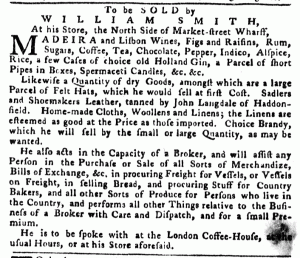
Jul 31 - 7:31:1766 Pennsylvania Gazette
Pennsylvania Gazette (July 31, 1766).

“He is to be spoke with at the London, Coffee-House, at the usual Hours.”

William Smith was a busy businessman. He sold an assortment of goods at his star on the “North Side of Market-street Wharff” and also “acts in the Capacity of a Broker, and will assist any Person in the Purchase or Sale of all Sorts of Merchandise” as well as a variety of other services.

Smith concluded his advertisement by informing potential customers and clients that “He is to be spoke with at the London Coffee-House, at the usual Hours, or at his Store aforesaid.” Rather than conduct business exclusively at his store, Smith spent time at the London Coffee House, an establishment where merchants and others gathered to make deals and settle accounts. Auctions of all kinds of merchandise (including slaves) took place just outside the coffeehouse. The proprietors provided newspapers printed in Philadelphia and other cities for patrons to keep up on political events and follow the shipping news. Men gathered at the London Coffee House to do business, talk politics, and gossip. It was Philadelphia’s exchange.

Philadelphia’s entrepreneurs so regularly gathered at the London Coffee House that Smith did not need to specify when he would be present beyond stating “at the usual Hours.” A dozen years after William Bradford first opened it in 1754, the London Coffee House was an integral part of the commercial landscape in colonial Philadelphia. More than two hundred merchants had contributed funds toward its construction, but an even greater number of people gathered there regularly over the next several decades. Smith did not need to specify that the London Coffee House was the corner of Front and High (present-day Market) Streets. Everybody in Philadelphia knew where it was, and visitors to the city could easily locate it by asking any local they encountered.

Jul 31 - London Coffee House
London Coffee House (lithograph by W.L. Breton:  Philadelphia, 1830).  Library Company of Philadelphia.