What was advertised in a colonial newspaper 250 years ago today?
New-Hampshire Gazette (March 7, 1766).
“BARBADOS whitest LOAF SUGAR.”
“A NEGRO BOY.”
Today I have chosen two advertisements whose proximity on the page resonated with me. When I scanned this issue of the New-Hampshire Gazette to make my selection, particular portions of each advertisement seemed to jump off the page:
“BARBADOS whitest LOAF SUGAR”
“A NEGRO BOY”
Two separate advertisements, but each inextricably bound with the other.
Considered on its own, the first advertisement seems to hide the connection between a finished product available for purchase in an increasingly vibrant eighteenth-century marketplace and the labor of enslaved Africans on plantations in faraway Barbados – at least to twenty-first-century readers unfamiliar with the networks of production, exchange, and consumption in the early modern Atlantic world. Consumers in Portsmouth, New Hampshire, in 1766, on the other hand, would have certainly been aware of the origins of the sugar they consumed, even if advertisements and conversations politely avoided the topic.
Yet that connection could hardly be ignored here, not when an advertisement for “BARBADOS whitest LOAF SUGAR” was followed immediately by an advertisement for “A NEGRO BOY.” Slavery was not only a labor system practiced far away in other parts of the British Empire. It was not only an invisible (but not really invisible) foundation of commercial networks and consumer culture in the eighteenth century. Slavery was part of colonial culture even in the northernmost colonies in British mainland North America, even in those colonies with relatively few slaves compared to their counterparts in the Chesapeake and the Lower South.
Even for consumers who might have wished to ignore the connections between sugar and slavery, the juxtaposition of these two advertisements would have made that very difficult, if not impossible.
What was advertised in a colonial newspaper 250 years ago today?
Pennsylvania Gazette (March 6, 1766).
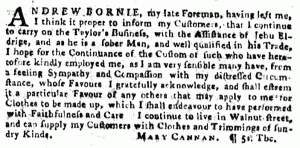
“My late Foreman, having left me, … I continue to carry on the Taylor’s Business.”
On several occasions I have noted that advertisements by female shopkeepers and artisans did not appear in the public prints in proportion to the numbers of women who kept shop or plied a trade in eighteenth-century America. When they did appear they could be interpreted as assertions of independence by women publicly proclaiming that they participated in the marketplace as retailers, producers, and suppliers – rather than exclusively as consumers – alongside their male counterparts.
Mary Cannan’s advertisement, however, merits different consideration. The first three lines name two men affiliated with Cannan’s “Taylor’s Business.” Indeed, she opens her advertisement naming “ANDREW BORNIE, my late Foreman,” a male colleague who presumably oversaw her business operations. In his absence, Cannan made it clear that another man, Jehu Elridge (“a sober man, and well qualified in his Trade”), continued his association with her “Taylor’s Business.”
On the other hand, it may be worth noting that even though we now use the word “tailor” to describe both men and women, in the eighteenth century men were more likely to describe themselves as tailors and women to describe themselves as seamstresses. In addition, the word – then and now – conjured connotations of working on men’s clothing.
I suspect that Cannan may have been unmarried, given her request for “a feeling of Sympathy and Compassion with my distressed Circumstance,” in which case making sure potential customers and the public more broadly knew men worked in her shop was a savvy business move and necessary to protect her reputation. After all, making and measuring clothes involved close and sometimes awkward contact with another person’s body. Putting men front and center in her advertisement may have been a strategy to ward off unsavory assumptions and accusations.
Even taking all of this into consideration, Cannan still crafted an advertisement that was different, based on her gender, than those placed by her male counterparts in the “Taylor’s Business.”
**********
Note: This is Spring Break week at Assumption College. I am resuming my regular duties while the students in my Public History class are away. They will return as guest curators two weeks from today.
During my time guest curating on the Adverts 250 Project I learned a tremendous amount about the value of culture in relation to history. At first this seemed like common sense to me, but as I worked through many different advertisements I realized that they gave me a personal look into everyday life and the values found in the colonies. Today there are so many different forms of advertisements that many go overlooked, but this project gave me a new perspective. I found that although things may seem insignificant now, in the future that may all change.
Prior to working on the Adverts 250 Project I had very little understanding of the process of professional history. As a history major I had written many research essays and analytical essays, but never had I worked on something that would be published for the public eye. This gave a new sense of importance to my work, and one that really motivated me.
My work on the Adverts250 project was at times stressful but ultimately very rewarding. I was very nervous that I was underprepared for a project of this magnitude. I was able to fight through the tougher moments and in return was able to truly enjoy the work I was doing. When I began as guest curator I did not know where to begin. At first, I struggled to find insight into some of the more basic advertisements but over time my way of thinking evolved. I was able to look past the basic sentences and find meaning in the actual words used. This was a huge step for me while not only working on my project but also as an historian. I learned to ask intuitive questions of the advertisements that enhanced my understanding of the time. I have always been interested in history and the value of it, but I never saw the meaning of it. I was just interested in things of the past, not what they told of the past. The Adverts 250 Project changed all of that for me and since completing the project I can only describe the experience as invaluable.
One of the most daunting aspects of the project for me was that my work was going to be presented to a public audience. This was the first time that any of my work as a student would be publicly seen and that was intimidating to me. As I worked more and more on the project it gave me a sense of motivation. For me, it is easy to get caught up in the monotonous routine of writing essays strictly to been seen by professors. I really grew to love this project because it felt as if I had a reason for writing. That perspective was something that I wish I could have been exposed to earlier because it really intensified my appreciation and love for working with historical texts.
To judge the difficulty of this project is tough for me. At times it was incredibly difficult, but at the same time I enjoyed my work so much I did not focus on the difficulty of it. On some advertisements it took me an tremendously long time to figure out what I wanted to say, but I still found the process very intriguing. Additionally, once I found something that interested me within the texts I became completely absorbed in trying to decipher how it related to the late eighteenth century. In other words, the process was challenging for me, but one that I looked forward to.
To conclude, I am excited to have completed my first week as guest curator and have great anticipation for my second week. One of favorite quotes by Albert Einstein goes, “Intellectual growth should commence at birth and cease only at death.” I hope that those who read my posts were intrigued and ultimately learned something new. As a passionate historian I hope to never stop learning from the worlds before us and the ones to come.
**********
ADDITIONAL THOUGHTS: Carl Robert Keyes
Thank you, Trevor, for an interesting and thoughtful slate of advertisements for the past week. Many of your selections reminded us of the many ways that advertisements can be read: on their own, in relationship to other advertisements, and in relationship to broader cultural, political, and economic trends in eighteenth-century America. Trevor will be returning for a second week as guest curator at the end of the semester.
What was advertised in a colonial newspaper 250 years ago this week?
Boston-Gazette (March 3, 1766).
“A Handsome Brick House.”
Today’s advertisement is different from others that I have analyzed because it offers no specified author. This was something I found interesting because it is unclear who is selling the house and why. Furthermore, at the end of the advertisement it requests that interested buyers “Inquire of the Printers.” This then leads me to question if the printer is the one selling the house?
One modern real estate brokerage reports that realtors did not become popular until the late nineteenth century so it is unlikely that a professional was helping to sell the house. The information surrounding the house provided in the advertisement is very basic and only gives a simplistic description of where the house is located. Also, the advertisement does not provide the price of the house for potential buyers. Overall, this advertisement seems a little out of place to me. I wonder if the advertisement was rushed or if the author did not have the financial means to support something larger.
**********
ADDITIONAL COMMENTARY: Carl Robert Keyes
Trevor suggests that this advertisement raises more questions than it answers, especially for modern readers accustomed to a very different real estate industry and its marketing methods. Because it does not meet our expectations of what belongs in an advertisement offering a house for sale, today’s advertisement demonstrates how much advertising for real estate has changed over the past 250 years. Even the brief history of realtors Trevor consulted came from a website advertising a modern real estate company! How awesome is that?
Even for the 1760s, however, this advertisement was rather bare bones. Others from the period provided much more detail. Many advertisements to sell or rent houses also included woodcuts. On the whole, eighteenth-century real estate advertisements were more likely to feature an image than advertisements for consumer goods and services. Printers had a several types of stock woodcuts (including houses, ships, and runaway slaves) that could be inserted when appropriate. (On the other hand, shopkeepers and artisans, if they wanted a visual image as part of their advertisement, were responsible for commissioning it themselves.) Although these woodcuts did not provide an image of the actual house for sale, they did help to draw the eye to real estate advertisements, proving a form of organization on pages that largely were not organized or “classified,” as we think of today’s print advertising.
While this advertisement lacks many of the bells and whistles we expect today (it’s certainly not a refrigerator magnet with a calendar of all the New England Patriots games my realtor sends me every year), it does offer some appeals that seem familiar. Readers learned that the house was “Handsome” and included a garden and “Many Accommodations, fit for a Gentleman.” As Trevor notes, the price was not listed, but the advertiser did mention financing: “Only one fourth Part is required to be paid down.” I suspect that mentioning that the house was “near the North Latin School” was offered merely to suggest the location, unlike modern real estate websites that promote a home’s school district.
Boston Evening-Post (March 3, 1766).
I recently discussed some of the reasons that so many advertisements instructed those interested to “Inquire of the Printers,” a part of the process that seems rather unusual to us today. That was such a common way of doing business in the 1760s that the version of this advertisement that ran the same day in the Boston Evening-Post did not even include that final sentence. Even without such instructions, colonial readers would have known that was what they needed to do to get more information.
What was advertised in a colonial newspaper 250 years ago this week?
New-York Mercury (March 3, 1766).
“Making or mending any Kind of Diamond or enameled Work.”
Charles Oliver Bruff’s advertisement offers a wide variety of popular jewelry to be made and mended. Jewelry made between 1714 and 1847 comes from the Georgian Era. It is important to note that jewelry was not made the same way it is today. According to the International Gem Society, the process was far more labor-intensive. Gold and metal ingots needed to be rolled into thin sheets before they could be formed into the popular styles of the time.
Bruff chose to market a variety of popular merchandise, but one that is specifically interesting is pinchbeck buckles. Pinchbeck was a material commonly used that looks like gold but is much more affordable. Oliver’s choice to advertise this along with more expensive jewelry is interesting because it shows that he was trying to appeal to people of many different economic backgrounds. Jewelry was primarily a luxury of the elite society, but Oliver’s advertisement alludes to the inclusion of customers from other economic statuses.
**********
ADDITIONAL COMMENTARY: Carl Robert Keyes
Of all the possible items in Bruff’s advertisement that Trevor chose to investigate, he selected pinchbeck buckles. That, in turn, led me to a fascinating discovery when I clicked the hyperlink to a dictionary definition of “pinchbeck” that he included to accompany his commentary for today. The first entry refers explicitly to “the Jewellery Way” (as Bruff put it): “an alloy of copper and zinc used especially to imitate gold in jewelry.”
A second entry, however, indicates that “pinchbeck” could also mean “something counterfeit or spurious.” It seems unlikely that Bruff intended to suggest that his buckles should be considered inferior in any way, but colonial consumers would have known that pinchbeck buckles were made of something other than gold (especially since Bruff promised to sell them “cheap by the dozen”).
A variety of scholars – including those who study consumer culture, material culture, manners, and reputation – have argued that assessing the dress and comportment of others became a cultural preoccupation in the eighteenth century. Especially as greater numbers of people of diverse statuses possessed an increasing array of goods as the consumer revolution progressed, colonists attempted to distinguish the truly genteel from those who merely simulated gentility. Colonists carefully observed each other to see if inner character matched an individual’s outward appearance.
In that context, pinchbeck buckles potentially presented a bit of a conundrum. What did it say about someone who wore accoutrements that looked like gold all while knowing that the appearance of the more costly metal misrepresented the true nature of the alloy that was actually used? Could that be interpreted as a reflection on one’s own character? Social mobility was fraught with such dilemmas in the eighteenth century.
In recent weeks I have questioned some of the decisions made by the printers of the New-Hampshire Gazette in the early months of 1766. Several of the advertisements the guest curators have selected featured rather unconventional formats, sometimes as a line or two running across the bottom of a page and other times entire advertisements tilted counterclockwise ninety degrees. I discovered other irregularities as I consulted Early American Newspapers to see these advertisements in the context of the entire printed page. What were the printers thinking?!
I’ve suggested a couple of theories. For instance, I hypothesized that some of the unusual layout might have been the result of the printers attempting to create front and back pages with equal coverage of text. I also questioned whether some of the decisions about the layout might have been innovative experiments to draw readers’ attention to the advertising. In both instances, I promised to consult the originals, rather than the digital surrogates, to see if that would answer any questions.
It turns out that examining original issues of the New-Hampshire Gazette helped me to solve the mystery! This is an instance that demonstrates that digital surrogates cannot replace original sources. Instead, the two complement each other, allowing scholars to ask new questions and find answers that would not have been possible (or, at the very least, much less likely) when relying on only one or the other.
Here’s what was happening with the New-Hampshire Gazette in 1766. Like other newspapers of the era, this one was published on a broadsheet that was folded in half to create an issue with four pages. In this case, each page measured 9½ inches wide by 14¾ inches high. Each page featured three columns whose width each measured 2¾ inches. Let’s call that a “standard” format for the purposes of this examination.
For the February 7 issue, however, the printers switched to smaller broadsheets. I imagine that the larger ones were in short supply or not available. That issue, as well as the next two (February 14 and 21) still included four pages, but each page was 8 inches wide by 13 inches high rather than 9½ inches x 14¾ inches. Instead of three columns measuring 2¾ inches wide each, the new size accommodated two columns that were 3½ inches wide (in most cases, but I will soon describe some of the very interesting exceptions). Let’s consider these new parameters a “temporary” format for the purposes of this examination.
Starting with the February 28 issue, the newspaper returned to the larger size broadsheet, but not to any sort of “standard” format. That and the following issue, March 7, featured advertising layouts that were even more visually jolting. With the March 14 issue the New-Hampshire Gazette returned to publishing “standard” format issues of four pages with three columns measuring 2¾ inches wide each.
Although Early American Newspapers revealed to me the difference in the number of columns, it did not offer any metadata explaining the transition. The difference was immediately apparent, however, when I viewed the originals at the American Antiquarian Society. I spent quite a bit of time with a ruler measuring the pages and the columns for each issue from January 31 through March 14.
This particular kind of metadata is currently lacking in Early American Newspapers. That is an observation rather than a complaint. I realize that it would be prohibitively expensive to develop this particular metadata: all the measuring, recording, coding, and other tasks required to link this data to the digitized images that substitute for the original newspapers. As somebody who regularly uses digitized newspapers I would much prefer that the partnership of the American Antiquarian Society and Readex continue to produce digital images of as many newspapers as possible, allowing for even more expansive research by scholars working on a variety of projects and members of the general public asking a variety of questions. I understand that the trade off for access to a greater number of sources will often be less metadata for most of them. Still, I feel that the strategy that has been pursued here has been appropriate, as long as those using the digital surrogates are aware that the digital images cannot reveal everything that the original sources do.
This raises important questions about what we miss when we rely exclusively on digital sources. I first began thinking about this issue as a result of Leon Jackson’s presentation at the Digital Antiquarian Conference last summer: “Historical Haptics: Digital and Print Cultures in the Nineteenth Century.” (Check out the slides from his presentation.) He pointed out that every issue of a newspaper appears to “be” the same size when consulting digital sources: the size of the screen. That was certainly my experience with the New-Hampshire Gazette. The digital surrogates hid some important information – the size of the page – from me.
**********
Let’s have a look at some of the unusual layout decisions the printers made when they temporarily used smaller sheets for their newspaper.
Third page of the New-Hampshire Gazette (February 7, 1766).
Consider the third page of the February 7 issue. The first two pages featured the “temporary” format: two columns that were each 3½ inches wide. The third page, however, had two columns supplemented by a third column of four advertisements each rotated ninety degrees counterclockwise. It turns out that each column measures 2¾ inches wide, as do each of the four advertisements in the extra column with perpendicular text. Each of those advertisements previously ran in earlier issues. The printers likely still had the advertisements in the forms. Rather than reset the type for the new format of the newspaper they saved time by reusing the work they had already done (and keep in mind that they would have reused it all the same if they had access to the larger broadsheets that week).
This issue also included advertisements featured here previously, both from Jonathan Moulton. On the first and fourth pages they ran for two lines across both columns at the bottom of the page. Why? Perhaps this was a means of squeezing in a little more advertising. Perhaps it was because Moulton offered a March 1 deadline for purchasing cows, making his notice time sensitive, prompting the printers to insert it even after the rest of the issue had been set for printing.
Second page of the New-Hampshire Gazette (February 14, 1766).
The second page of the February 14 issue included other curious decisions about the layout. At first glance it appears that the printers followed the same course as they did for the third page for February 7. On closer examination, however, it turns out that the first column measure 3½ inches wide while the second is only 2¾ inches wide. The four advertisements rotated to form the third column all measure 2¾ inches wide.
With one exception, the first column features either new items or advertisements repeated from the previous issue and set with a 3½-inch width at that time. The exception is a “new” advertisement from Moulton which combines the two that appeared on the first and last pages of the previous issue into a single advertisement (which was then repeated in subsequent weeks).
All of the advertisements in the second column, measuring 2¾ inches wide, were repeated from issues printed on larger broadsheets on January 31 or earlier. Again, the printers reused type already set in the forms.
Careful attention to the perpendicular column reveals that all four advertisements measure 2¾ inches wide. Each was repeated from type set for the “standard” format. However, one of them underwent minor alterations to make it fit into the space available. The font size for “EDWARD EMERSON” (formerly “Edward Emerson”) was reduced and the advertisement was truncated, removing “at the lowest Rates” and shaving off a line of text as a result.
The February 21 issue, the final one printed on smaller broadsheets and featuring the “temporary” format, had a very regular appearance compared to the previous two. All four pages had two columns that measured 3½ inches wide each, giving the issue a rather clean appearance compared to those that came immediately before it (and, as we will see, those that came after). The only exception was a one-line advertisement that ran across both columns at the bottom of the second page.
Third Page of New-Hampshire Gazette (February 28, 1766).
Printed once again on the larger broadsheets, the February 28 issue returned to the “standard” format of three columns, each measuring 2¾ inches wide, on every page except the third one. That page had what was becoming a familiar layout: two columns accompanied by a narrow column of advertisements rotated ninety degrees counterclockwise. Unlike either of the previous examples, however, the first and second columns measured 3½ inches wide each. All of the content was either new or repeated from issues for which type had been set to accommodate the smaller broadsheets. Again, the printers efficiently used type already in forms.
That final rotated column is definitely the most curious. The printers certainly attempted to maximize content. It featured three items that measured 2¾ inches wide: a news item from London, a new probate notice, and Edward Emerson’s advertisement (restored to its original format). The printers also inserted an advertisement that was 3½ inches in width that had originally appeared in the February 14 issue. It was too long to be wedged in along the right edge of the broadsheet so the printers removed the final four lines and inserted them as a narrow (1 inch wide) addendum next to the rest of the advertisement, giving the upper right corner of the page a rather strange appearance.
Third page of the New-Hampshire Gazette (March 7, 1766).
The printers got even more creative/efficient with the layout of the third page of the March 7 issue. (All the other pages of that issue returned to the “standard” layout.) The upper quarter of the page featured two columns measuring 3½ inches wide each and a now-familiar third column with the text rotated. All of the material in the first two columns was either new or repeated from an issue that had been set intentionally with column widths of 3½ inches.
In order to maximize the number of advertisements they could squeeze into that rotated column, the printers chose two that were 3½ inches wide and a third that was 2¾ inches wide. This allowed them to fill the page in the upper right corner. As with Edward Emerson’s advertisement previously, the font size for the first line of John Wheitfield’s advertisement was reduced in order to make it fit on the page. Similarly, the first line of George Jaffrey’s notice about excise taxes on liquor (“PROVINCE OF NEW HAMPSHIRE”) was removed in the interest of space. The probate notice was left intact from the previous issue.
The lower portion of the page included three columns, each 2¾ inches wide. The printers were continuing to transition back to the “standard” format and setting new type accordingly now that they had access to the larger broadsheets once again. The first two columns included a fresh news item from London and a new advertisement for a “Milch COW.” The third column included slightly updated advertisement by shopkeeper Joseph Bass. To save space, the first line (“Just imported from LONDON”) and a nota bene at the end were removed.
All told, the third page of the March 7 issue is the most visually striking. It also most effectively demonstrates the printers’ creativity and efficiency in printing on the paper that was available to them and conserving their energy and efforts by not completely resetting type for all the advertisements as their paper supply changed and then changed again.
As noted above, the March 14 issue returned to the “standard” format. None of the layout merits further mention, except perhaps acknowledging that the missing lines from Joseph Bass’s advertisement returned now that more space was available. This and other examples in these issues suggest that printers played the primary role in decisions about format even if advertisers called the shots when it came to content.
**********
In the end, I am not able to make the argument that I initially hoped to make about some of the innovative layouts for advertisements in the New-Hampshire Gazette in the early months of 1766. I wish I could argue that the printers were experimenting with the layout as a means of drawing readers’ (and potential customers’) attention to the advertisements, but after consulting the original issues I realize that the evidence just does not bear out that interpretation. What I took for innovation in advertising turned out to be an innovation of necessity and practicality as the printers creatively and efficiently inserted as many advertisements as possible in the wake of printing on smaller broadsheets.
I would not have been able to reach this conclusion had I relied on digitized images of the newspapers alone since that format obscures the size of the newspapers and the changes in the paper supply. As much as possible, original sources and digital surrogates really must be consulted in combination as complements to each other.
What was advertised in a colonial newspaper 250 years ago today?
Boston Evening Post (March 3, 1766).
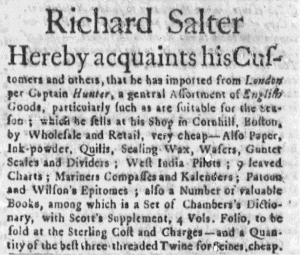
“West India Pilots; 9 leaved Charts; Mariners Compasses and Kalenders.”
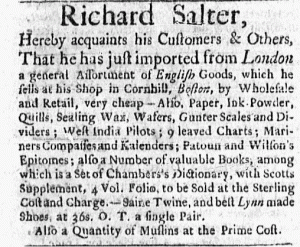
Richard Salter’s advertisement in the Supplement to the Boston-Gazette gives a look into what was being sold in Boston during 1766. The goods advertised were “just imported from London” and to be sold at Salter’s shop in Boston “by Wholesale and Retail.” There was a great variety of goods being sold, from books to maritime instruments and even shoes.
Many of the items listed show the development of Boston’s economy and its successful port. One specific item in Salter’s advertisement I find interesting is the “West India Pilots.” This was a book published by Joseph Smith Speer an English mariner who spent many years in Central America and the Caribbean. The book contained thirteen maps and detailed instructions on how to navigate between Caribbean ports. A book like this would have been invaluable to merchants interested in trading in the Caribbean.
Items being sold this one, as well as paper, quills, and “Chambers Dictionary, with Scotts Supplement,” all allude to the growing literacy rate in Boston. An article published by Colonial Williamsburg explains how cities like Boston, by the end of the eighteenth century were approaching one hundred percent literacy rates. Advertisements like Salter’s helped push the colonies into the educational boom that transpired in the late eighteenth century and early nineteenth century.
**********
ADDITIONAL COMMENTARY: Carl Robert Keyes
Supplement to the Boston-Gazette (March 3, 1766).
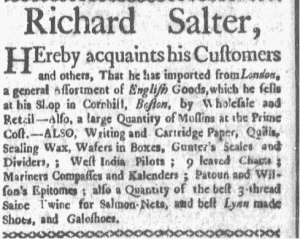
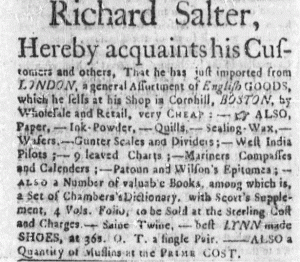
Richard Salter wanted to make sure that potential customers in Boston and its hinterland saw his advertisement. While many advertisers were content with publishing their notices in just one of the four newspapers printed in Boston in 1766, Salter arranged to have his advertisement inserted in three of them, presumably at some cost. In addition to the advertisement Trevor chose from the Monday, March 3, 1766 issue of the Boston Evening-Post, a similar advertisement appeared in the Supplement to the Boston-Gazette on the same day. In addition, a nearly identical advertisement was also featured the previous Friday in the February 27 issue of the Supplement to the Massachusetts Gazette.
Supplement to the Massachusetts Gazette (February 27, 1766).
Only the Boston Post-Boy, also published on Mondays, neglected to print an advertisement from Salter during that week. Perhaps Salter could not afford to pay to advertise in yet another newspaper. Or, perhaps he figured that placing his advertisement in two of the three newspapers published on Monday gave him sufficient coverage of the market at the beginning of the week.
I am often asked if advertising actually worked in eighteenth-century America. Unfortunately, that is an extremely difficult question to answer. Early American consumers did not leave behind documents in which they explicitly stated that they did (or did not) make purchases based on advertising. Those who placed advertisements were more likely to comment that they believed in the effectiveness of their methods.
Massachusetts Gazette (December 6, 1765).
Salter’s multiple advertisements could be interpreted several ways. He may have placed them because they were indeed effective. Alternately, he may have placed so many of them out of sheer desperation, a last resort to move his merchandise out the door. I featured a nearly identical advertisement by Salter last December when this project existed exclusively on Twitter. Would Salter have placed this advertisement three months later (and in three newspapers!) if he did not believe it would garner new business? Although I believe that advertising incited consumer demand in the eighteenth century, examples like this one force me to consider the possible limits of marketing during the period.
What was advertised in a colonial newspaper 250 years ago this week?
New-Hampshire Gazette (February 28, 1766).
“AS many Persons Licenced to sell Spirituous LIQUORS … have neglected to render their Accounts of Sale of such Liquors.”
During the eighteenth century in North America the production and distribution of rum was becoming increasingly popular. In 1733, Great Britain enacted the Molasses Act as apart of the Navigation Acts. The Molasses Act imposed a tax on molasses, sugar, and rum imported to the colonies. This act was largely ignored by the colonists and loosely enforced by the British. Several years later it was replaced by the Sugar Act of 1764. This act was designed to impose taxes at half of the rate that the Molasses Act did, but be strictly enforced. Many of these acts were put into place to rescue Britain from the enormous debt it had allotted during the Seven Years War, although the colonists did not respond well to Britain’s acts. Many of the colonists felt that they were not responsible for the debt Britain had acquired over the Seven Years War and were reluctant to give in.
In addition, colonists were used to taxing themselves, such as through the local excise tax George Jaffrey mentions in this advertisement threatening prosecution against colonists who had been cheating the taxes. Advertisements like the one here are interesting because they were a broad way for officials to address the public without physical confrontation that could result in further uproar and unrest. As the local receiver of the colony’s excise taxes, Jaffrey made it known to colonists that they were no longer to break the law and go unnoticed and that they must now reconcile their actions or face prosecution. He took this action at the same time Parliament cracked down on colonists with the Sugar Act.
**********
ADDITIONAL COMMENTARY: Carl Robert Keyes
New-Hampshire Gazette (February 28, 1766).
Colonists were indeed accustomed to raising revenues through taxes they assessed internally via their colonial legislatures, which helps to explain why they bristled so much when Parliament stepped in and attempted to enact and better enforce new methods of raising revenues through collecting taxes throughout the empire.
Edward J. Perkins compiled a list of the “Types of Domestic Taxes, 1763-1775” enacted locally by colonial assemblies in the period between the Seven Years War and the Revolution.[1] Examining the many kinds of taxes colonists already paid (or were expected to pay but often avoided, as Jaffrey’s notice indicated) offers additional context for understanding why they reacted so vehemently to Parliament’s new efforts to tax and regulate the colonial economy in the 1760s and 1770s.
Land – unimproved: Rhode Island, Pennsylvania
Land – assed value: Massachusetts, Rhode Island, Connecticut, Pennsylvania, New Jersey
Land – per acre: Virginia, Maryland, South Carolina, Georgia
Other property – assessed: Massachusetts, New Jersey, South Carolina
Excise – liquor, etc. – New Hampshire, New York, Maryland, Virginia, North Carolina
Merchant profits – Massachusetts, New Hampshire, Pennsylvania, Connecticut, Rhode Island, South Carolina
Import – finished goods: Pennsylvania, New York, Georgia
Import – slaves: New York, Maryland, South Carolina
Export – tobacco: Maryland, Virginia
Poll – flat: Maryland, Virginia, North Carolina
Poll – linked to wealth: Connecticut, Massachusetts, Rhode Island
Poll – discriminatory toward free blacks: South Carolina, Georgia
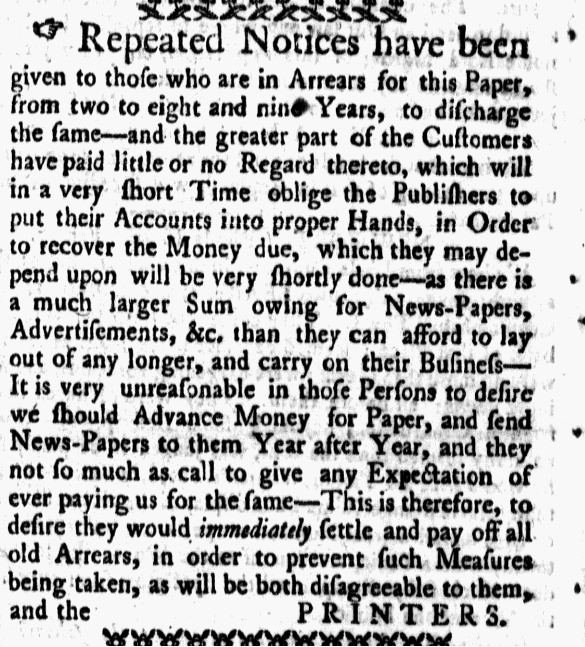
The advertisements in this particular issue of the New-Hampshire Gazette indicate that “Persons Licenced to sell Spirituous LIQUORS” were not the only people who neglected to settle up their accounts. The printers inserted this notice, stating that “there is a much larger Sum owing for News-Papers, Advertisement, &c., than they can afford to lay out any longer.” They called on debtors to “immediately settle and pay off old Arrears” and, not unlike Jaffrey, the printers threatened “such Measures being taken, as will be … disagreeable” to those who did not pay.
**********
[1] Edward J. Perkins, The Economy of Colonial America, 2nd ed. (New York: Columbia University Press, 1988), 191.
What was advertised in a colonial newspaper 250 years ago this week?
New-Hampshire Gazette (February 28, 1766).
“Will give Cash for Forty HEIFERS or young COWS.”
Jonathan Moulton’s advertisement in the New-Hampshire Gazette gives insight into a society where bartering was accepted in lieu of cash or credit at times. Although Moulton’s advertisement does state he will give cash payment in exchange for cows, he initially asks for “ABOUT Eighty Tons of good Salt and English HAY, for Boards or Staves.” The decision to offer a trade in replacement of cash allowed Moulton to target a wide range of people that may not have had consistent access to cash.
In order to be successful in the colonies, entrepreneurs needed to be flexible and work with their fellow colonists in the developing economy. Moulton’s decision to accept boards or staves instead of cash and then later to pay cash for young cows likely made his advertisement applicable and appealing to more people.
The second half of Moulton’s advertisement is directed towards people with livestock, giving him a targeted audience, one that did not always have large sums of cash readily available. The opportunity for people to choose either to trade or to use local currency was appealing to many colonists.
**********
ADDITIONAL COMMENTARY: Carl Robert Keyes
In the wake of Currency Acts passed by Parliament in 1751 and 1764, colonists feared “the likelihood of a diminished supply of local currency and a return to a heavier reliance on the more burdensome, less flexible alternatives: barter, commodity money (e.g., tobacco or sugar), and foreign gold or silver coin.”[1] Trevor has chosen an advertisement that suggests how some colonists incorporated both currency and barter into their business practices, resorting to one or the other depending on the circumstances. Given the relatively short supply of currency, Moulton’s offer to pay cash for heifers and young cows may indeed have been all the more attractive to colonists looking to sell some of their livestock.
New-Hampshire Gazette (February 7, 1766).
Does this advertisement sound familiar? It should, even if it does not visually look familiar, because a portion of it was previously featured on the Adverts 250 Project. This advertisement was printed in two separate pieces in the February 7, 1766, issue of the New-Hampshire Gazette. The first half appeared at the bottom of the first page, running across both columns. The second half appeared at the bottom of the final page, also running across both columns.
New-Hampshire Gazette (February 7, 1766).
When Trevor and I discussed the advertisements he wished to feature this week, I approved this one because, technically, it is a different advertisement than the previous one. It includes new material and the type for the entire advertisement was reset for this variant. Besides, as I have previously explained, our methodology (requiring us to consult the most recently published newspaper in the colonies) disproportionately privileges the New-Hampshire Gazette. The paucity of advertisements for consumer goods and services in that publication, compared to others from the period, can be frustrating. The guest curators and I have learned to make do with the slim pickings in the New-Hampshire Gazette.
Why did the printer reset the type and combine two advertisements into one? Friday’s extended commentary will explain how I solved that mystery when I examined the original copies at the American Antiquarian Society.
**********
[1] John J, McCusker and Russell L. Menard, The Economy of British America, 1607-1789 (Chapel Hill: University of North Carolina Press for the Institute of Early American History and Culture, 1985), 337.