March 15

What was advertised in a colonial newspaper 250 years ago this week?

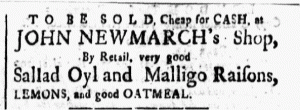
Mar 15 - 3:14:1766 New-Hampshire Gazette
New-Hampshire Gazette (March 14, 1766).

“Sallad Oyl and Malligo Raisons.”

John Newmarch listed only four items in his advertisement: “Sallad Oyl and Malligo Raisons, LEMONS, and good OATMEAL.” While modern readers probably recognize the lemons and oatmeal, I suspect that “Sallad Oyl and Malligo Raisons” may be a bit less familiar (even putting aside eighteenth-century spellings that had not yet been standardized).

What were “Malligo Raisons”?! Most likely they were raisins (produced by drying muscat grapes) from the Malaga region along the Mediterranean coast in southern Spain. Over the centuries Malaga raisins have gained a reputation as the black pearls of Andalusia, a description that testifies to both their taste and economic value. Today Malaga raisins have been incorporated into marketing campaigns as part of the region’s tourism industry, as in this article that promotes them as part of “the most traditional vintage in Europe” and details harvesting the grapes, one by one, and transporting them over difficult terrain on the backs of mules.

Mar 15 - Malaga Raisins
Malaga Raisins.

Given that “Sallad Oyl and Malligo Raisons” were grouped together in the advertisement, I imagine that “Sallad Oyl” refers to olive oil that also originated in Spain. Today, “salad oil” refers to any edible oil used in salad dressing, but the context here suggests Newmarch stocked olive oil in particular.

These grocery items – “Sallad Oyl and Malligo Raisons, LEMONS” – bring to mind the transatlantic networks of trade in the eighteenth century, but this is not a story exclusively about commercial exchange. These items also reveal transformations in taste as residents throughout the Atlantic world incorporated new foods into their diets as part of an ongoing Columbian Exchange.

March 14

What was advertised in a colonial newspaper 250 years ago today?

Mar 14 - 3:14:1766 New-Hampshire Gazette
New-Hampshire Gazette (March 13, 1766).

“Pink Lutestrings, blue Taffity, white Tabby, Velvets, purple Satten.”

I chose yesterday’s advertisement because it included a visual image, a woodcut of the Sign of the Blue Hand, that helps us to imagine what we might have seen on the streets of a colonial city. Today’s advertisement does not include an image, but it is so descriptive that we can envision the fabrics on display at “the Vendue-House, lower Room, near the Parade,” in Portsmouth, New Hampshire. We can also imagine the garments that many of these textiles eventually became.

Although the list of items for sale seems relatively short compared to other advertisements, it was packed with details that helped potential customers assess the fabrics and distinguish among them. Eighteenth-century readers would have instantly recognized lutestrings and taffity (taffeta) as types of silks, whether they happened to be pink, blue, or striped. Similarly, they would have known the difference in the texture and appearance of tabby weave (also known as plain weave) and satin weave (with a glossy surface and a dull back).

We continue to “speak” a language of textiles (and associate images with them) in the twenty-first century, but not nearly to the same extent as the average colonist did 250 years ago.

**********

In preparing this entry, I was delighted to come across Burnley & Trowbridge Co., a modern enterprise that “specializes in historically accurate fabrics, notions, patterns, research materials, and related items.” They work with historic sites, museums, and re-enactors. Not surprisingly, they’re located in Williamsburg, Virginia.

I enjoyed exploring their website, where I was able to browse images of reproduction textiles similar to those described in today’s advertisement and view a variety of patterns for making historically accurate garments. I was also interested in one of their education endeavors, the Historic Fashion Workshop Series,” which includes hands-on workshops for “Short Cloak, Pelisse, Mantle or Mantelet” and “The Belted Waistcoat.”

March 13

What was advertised in a colonial newspaper 250 years ago today?

Mar 13 - 3:13:1766 Pennsylvania Gazette
Pennsylvania Gazette (March 13, 1766).

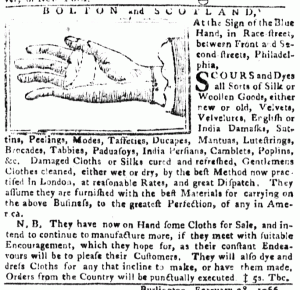
“BOLTON and SCOTLAND, At the Sign of the Blue Hand.”

As soon as I saw this advertisement I knew that I had to select it. It didn’t matter what it said, only that it included a visual image, a woodcut of a (presumably blue) hand that likely replicated the “Sign of the Blue Hand” where Bolton and Scotland operated their business “in Race-street, between Front and Second-streets, Philadelphia.”

Most newspaper advertisements for goods and services did not include images of any sort during the eighteenth century. Unlike type that could be used repeatedly and for any purpose (set, broken up, and reset for a new job), images were often very specific to a particular advertiser’s business. This image of a hand would not have worked for any advertiser who did not happen to run a business “At the Sign of the Blue Hand.”

This is not to say that other kinds of advertisements were devoid of images. Printers usually had a small selection of woodcuts, especially ships, houses, and runaway slaves, that could be used interchangeably and generically in advertisements for vessels preparing to leave port, real estate, or seeking the return of runaways.

Shopkeepers, artisans, and merchants who wanted to spruce up their advertisements, however, had to commission their own woodcuts, but then those woodcuts belonged exclusively to them and did not appear in other advertisements. This may be obvious when looking at the Blue Hand, but it is worth keeping in mind that it applied to other sorts of woodcuts associated with particular shops. For instance, a woodcut of a spinning wheel that accompanied John Kean’s advertisements was used exclusively in his advertisements – as a brand of sorts – and was not inserted in other advertisements for textiles.

Today we are accustomed to advertisements that include stimulating visual images. In the eighteenth century, however, advertisements were typically comprised mostly of text. Images were an exception rather than the rule.

March 12

What was advertised in a colonial newspaper 250 years ago today?

Mar 12 - 3:12:1766 Providence Gazette Extraordinary Supplement
Supplement to A Providence Gazette, Extraordinary (March 12, 1766).

Given the publication history of the Providence Gazette, it is interesting that this advertisement appeared at all.

On March 12, 1766, William Goddard published “A Providence Gazette, Extraordinary.” Note that it was “A Providence Gazette” rather than “The Providence Gazette.” (The most recent issue had featured a masthead proclaiming “Vox Populi, Vox Dei. A PROVIDENCE GAZETTE Extraordinary” nearly seven months earlier on August 24, 1765. Not surprisingly, its contents focused on the then-impending Stamp Act. Regular publication on a weekly schedule had ceased with the issue of May 11, 1765. The newspaper finally resumed weekly publication in August 1766.) The four-page issue included “PROPOSALS for reviving the PROVIDENCE GAZETTE,” assorted news items from throughout the colonies, and testimonials from former and potential customers interested in Goddard resuming publication of the newspaper.

A half dozen or so advertisements appeared in a two-page “SUPPLEMENT to ‘A PROVIDENCE GAZETTE, Extraordinary,’ of Wednesday March 12, 1766.” (Did this supplement accompany the extraordinary issue? Or was it published later? The masthead does not make this clear.)

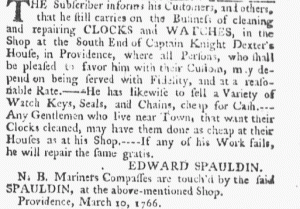
Edward Spauldin and a handful of other local shopkeepers, artisans, and merchants chose to insert advertisements in a newspaper that was not published on a regular schedule and did not have a slate of subscribers. They may have envisioned that the Extraordinary issue and its SUPPLEMENT would garner a fair amount of attention, allowing them an opportunity to present their goods and services for the consideration of potential customers in the area.

Spauldin’s advertisement was dated “PROVIDENCE, March 10, 1766.” (I checked the previous five issues to confirm that this was a new advertisement rather than one repeated from earlier but with an updated date.) Goddard may have approached him about inserting a commercial notice, but Spauldin ultimately made the decision about advertising in A Providence Gazette. This suggests that he believed in the effectiveness of advertising to incite business in the 1760s. He did not operate his business in an environment of pent-up demand but instead used advertising to create that demand with appeals to price and quality. In addition, he also included a money-back guarantee to get customers through the door: “If any of his Work fails, he will repair the same gratis.”

When “Sarah Goddard, and Company” resumed publication of the Providence Gazette on August 9, 1766, Edward Spaulding placed the same advertisement, except the nota bene had been eliminated and the date was revised to “Providence, August 8, 1766.” Perhaps he attributed new business in March to the original advertisement and decided to give it another try.

March 11

What was advertised in a colonial newspaper 250 years ago this week?

Mar 11 - 3:10:1766 Connecticut Courant
Connecticut Courant (March 10, 1766).

“Just Published … The Necessity of Repealing the American STAMP-ACT.”

Protesting the Stamp Act continued to occupy many American colonists in March 1766. It was certainly a primary concern of the printer of the Connecticut Courant and many of that newspaper’s readers. The Connecticut Courant was a more modest publication than some of its counterparts in larger cities – its four pages featured only two columns rather than three – but it opposed the Stamp Act with the same vigor as many more robust publications.

The first two (of four total) pages of the March 10, 1766, issue were devoted to coverage of the Stamp Act, including a letter from London (dated November 1 and reprinted from the Public Ledger), an extract of another letter from London (dated December 14 and reprinted from a Boston newspaper published February 27), and several shorter reports about the reactions of colonial officials near and far.

Advertisements of any sort did not appear until the third page. Today’s featured advertisement demonstrates that the commercial notices took on a political valence during the Stamp Act crisis. Printers, authors, and other members of the book trades marketed books and pamphlets about “The Necessity of Repealing the American STAMP-ACT.” And this particular advertisement should not be considered an isolated example. It appeared immediately above a similar advertisement for a pamphlet about “THE RIGHTS of the COLONIES TO THE PRIVILEGES Of British SUBJECTS.” The former was published in Boston and the latter in New York.

Mar 11 - Connecticut Courant Third Page 3:10:1766
Third page of the Connecticut Courant (March 10, 1766).

Both appeared in a column headed with an announcement that “THE last Tuesday of this Month (being the 25th Day) there is to be a General Congress of the SONS OF LIBERTY, in this Colony, to meet in Hartford, by their Representatives chosen for that Purpose.” (Was this an advertisement? It appeared alongside other advertisements, but given the printer’s political proclivities it is quire possible he inserted this notice gratis.) News coverage of the Stamp Act continued in the column to the left.

The content of the newspaper provides important context for understanding today’s advertisement. The other items formed a narrative that may have influenced potential customers to purchase one or both of the pamphlets offered for sale.

Boycotts of imported goods certainly gave decisions about which goods to purchase (or not) political valence in the 1760s and 1770s, but advertisements for books and pamphlets defending the “RIGHTS of the COLONIES” encouraged colonists to become readers who were better informed and who could better articulate why the actions of Parliament were so dangerous.

Adverts 250 Featured by Media Life Magazine

I recently had a chance to discuss the Adverts 250 Project with Diego Vasquez from Media Life Magazine.  Yesterday Media Life featured our conversation as “How Advertising Has Changed Over 250 Years.”  If you head over there to read it (and I hope you do!), you’ll find it in the Research section.

Media Life Magazine is an online daily newspaper/magazine founded in 1999.  It covers all aspects of the media.

I greatly appreciate Media Life‘s interest in the Adverts 250 Project.  I’m excited that the project has been included among their coverage of media, past and present.  Also, many thanks to Kimberly Dunbar, the Director of Public Affairs at Assumption College, for making the introduction.

Reflections on Working with Guest Curators

Those who visit regularly are aware that I have incorporated the Adverts 250 Project into the Public History course that I am teaching this semester.

Each of the students has taken a turn serving as guest curator for a week, taking on a variety of responsibilities: creating a census of newspapers published in colonial America during the same week 250 years earlier, selecting seven advertisements to feature according to the methodology I have designed for featuring the most current advertisements, conducting independent research to gain a better understanding of each advertisement, writing a short analysis of each advertisement (at least 150 words but often much more), submitting appropriate links and images to supplement and corroborate what they have written, and consulting with me as necessary throughout the process.

I continued as editor and permanent curator. In addition to providing guidance behind the scenes, I also contributed additional commentary about some aspect of each advertisement, sometimes building on the story the guest curator told and other times examining another aspect of an advertisement. So many of the advertisements are so rich that it would be impossible for anybody – student or professor – to comment on every detail exhaustively, but working as a team the guest curators and I have explored some of the most important attributes of a variety of eighteenth-century newspaper advertisements over the course of the past several weeks.

In addition to the duties listed above, each student wrote a brief reflection (at least 500 words) at the end of his or her week as guest curator. Given that my work has paralleled theirs, today I am offering my own reflection on working with the guest curators on this project.

First, I knew that this was going to be a collaborative process, but I did not anticipate just how truly collaborative it would be. I tell all of my students – whether they are enrolled in an introductory survey, an upper-level elective, or a capstone research seminar – that I expect them to be junior colleagues in the endeavor of historical enquiry. More than in any class I have taught, Public History students working on the Adverts 250 Project have comported themselves as junior colleagues who have worked collaboratively with me (though I must also tip my hat to students who have conducted original research in capstone research seminars who have also consulted with me closely to produce impressive final projects).

The manner in which we worked together very quickly took a different form than I originally envisioned. When we first decided which student would serve as guest curator for each week, I instructed them that they should submit a draft of all seven of their commentaries by the end of the day on the Wednesday before their first advertisement would be featured on the Sunday of their week. That would give me a chance to read through them and schedule a one-on-one meeting with the guest curator during office hours to go through all of them together.

That plan turned out to be too idealistic. It did not conform to the way that most undergraduates work and, quite honestly, it would have been too restrictive for me as well. The guest curators and I soon worked out a system: anything that was to be published on the Adverts 250 Project had to be submitted to me at least twenty-four hours in advance. That would give me time to review it and, if necessary, suggest revisions.

As a result, it turned out that we did not have as many face-to-face conversations about content and analysis as I expected. Instead, extended conversation in my office that I originally anticipated turned into daily email exchanges: messages shuttling back and forth. Often I was not teaching students by speaking directly to them in person. Instead, I was reading what they wrote and then they were reading my responses. Information was exchanged, context was elaborated, and details were clarified, but via email and attached documents rather than via spoken words. For me, this transformed the instructor-student relationship by incorporating some of the practices of professional communication with colleagues.

In their reflections, some of the guest curators commented explicitly that working on this project made them feel like professional historians rather than students in a generic history course (and my conversations with others revealed that all of them felt this way to one extent or another, whether they mentioned it in their reflection or not). From my perspective, this was in part due to addressing the so-called “audience of one” problem. Many assignments for history courses (and courses in just about every other discipline) have an audience of only one person who will ever see it, read it, or assess it in any way: the professor. Since those assignments feel artificial to students (a hoop to jump through to complete a college course) they often do not recognize the value of the skills the assignments were designed to develop (critical thinking, analytical writing, research methods, to name a few). Sometimes they submit work that does not correspond to their abilities, shrugging off assignments that only a professor will see.

For the Adverts 250 Project, however, students were aware from the start that I would not be the only person reading their work. They knew that the material they produced would be available on the Internet for anybody who wanted to read it. I underscored that my own reputation was on the line; while the students certainly respected that and strove to do well so they would not let me down, I believe that they also submitted their best possible work so they could be proud of their own contributions to the project. Whether they realized it or not at the time, they were also further developing the same kinds of skills that would have been emphasized in more traditional assignments.

Each student will return for a second week as guest curator after spring break. Now that each has learned more about what is involved in the project I anticipate that their experiences will be a bit different the next time around. I know that I certainly have different (and probably more realistic) expectations. Each student will offer another reflection at the end of his or her second week as guest curator.

Similarly, I will offer my own reflection once again at the end of the semester. For now, I will conclude by echoing a sentiment that many of the guest curators voiced. The Adverts 250 Project has been a lot of work, but it has also been a lot of fun. The students have reported (with sufficient enthusiasm and sincerity to dispel suspicions they were only angling for good grades) that they enjoyed working on the Adverts 250 Project. I have also very much enjoyed working with them. So far, our collaborative efforts have been fun as well as intellectually and professionally rewarding.

March 10

What was advertised in a colonial newspaper 250 years ago today?

Mar 10 - 3:10:1766 New-York Gazette
New-York Gazette (March 10, 1766).

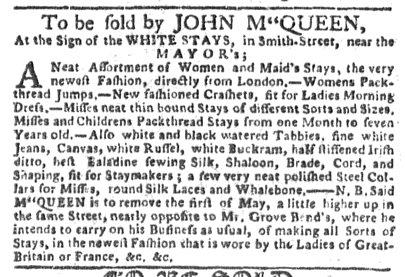
“To be sold by JOHN M”QUEEN, At the Sign of the WHITE STAYS.”

Staymaker John M”Queen was concerned with fashion – and from start to finish his advertisement suggested that his potential customers should be as well. He opened with a summary of his wares (“A Neat Assortment of Women and Maid’s Stays, the very newest Fashion, directly from London”) and concluded with a reassurance (“all sorts of Stays, in the newest Fashion that is wore by the Ladies of Great-Britain or France”). What is a stay? Colonial Williamsburg offers “A Glossary of Terms” describing women’s clothing in the colonial era: stays were the eighteenth-century version of what became corsets in the nineteenth century, but visit the glossary for a much more complete examination.

New York was one of the largest cities in the colonies in the 1760s, but it was a provincial outpost. M”Queen incited anxieties that residents did not want to be seen as inhabitants of some backwater village. Instead, his advertisement suggests, they wanted full membership in British (and European) fashion and culture. His stays were not merely of the “newest Fashion” in the colonies. Instead, they had arrived “directly from London” and were the same style as those “wore by the Ladies of Great-Britain or France.” Not just an importer, M”Queen was a staymaker himself, but as he produced stays locally he kept his eyes on changing fashions in London.

As an aside, it is worth mentioning that this advertisement linking consumption and fashion was aimed at female customers, but that should not be misinterpreted as evidence that eighteenth-century women placed more emphasis on fashion than men. Given the nature of the product he marketed, M”Queen addressed women, but advertisements for men’s garments during the period were just as likely to invoke a language of fashion and cosmopolitan connections to European metropolitan centers.

March 9

What was advertised in a colonial newspaper 250 years ago this week?

Mar 9 - 3:7:1766 New-Hampshire Gazette
New-Hampshire Gazette (March 7, 1766).

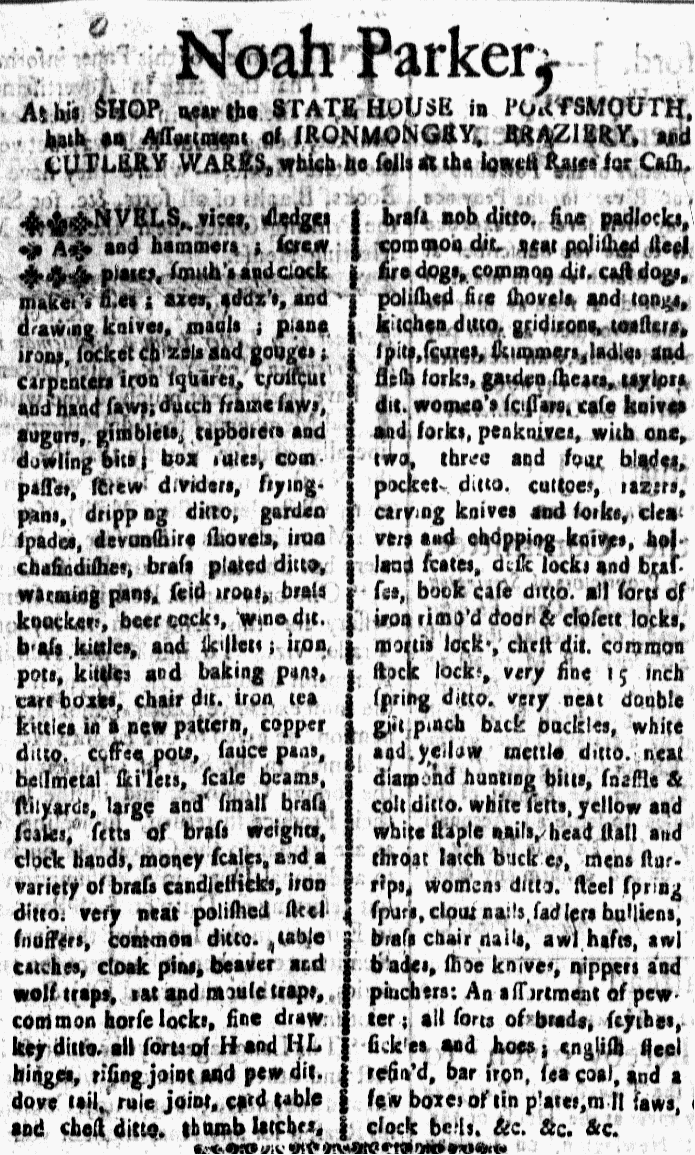
“Very neat double gilt pinch back buckles, white and yellow mettle ditto.”

Sometimes it can be a bit disorienting to read eighteenth-century advertisements. Some of the goods on offer seem unfamiliar to twenty-first-century readers (as is certainly the case in today’s advertisement), but the frequent use of the word “ditto” can also cause confusion.

  • “steel snuffers, common ditto”
  • “polished fire shovels and tongs, kitchen ditto”
  • “desk locks and brasses, book case ditto”
  • “common stock locks, very fine 15 inch spring ditto”
  • “mens sturrips, womens ditto”

In the eighteenth century, “ditto” had the same meaning as it does today: the aforesaid, the above, the same. Accordingly, the examples above should be read as:

  • “steel snuffers, common snuffers”
  • “polished fire shovels and tongs, kitchen fire shovels and tongs”
  • “desk locks and brasses, book case locks and brasses”
  • “common stock locks, very fine 15 inch spring locks”
  • “mens sturrips, womens sturrips”

Eighteenth-century readers would have made the transition easily, but (if students in any early American course I have ever taught are representative of modern Americans) today’s readers do not speak the language of the eighteenth century, nor do they recognize all of its conventions for writing. This sometimes leads to confusion about what advertisements, as well as manuscripts and other kinds of printed documents, meant to communicate.

“Ditto.” Is that just a quaint way that Americans expressed themselves in the eighteenth century? It actually had a very practical use. Imagine Noah Parker writing out this advertisement before dropping it off at the printing office. Paper may have been in short supply, but his time and efforts were both precious to him as well. When writing with a quill pen, inserting “ditto” to replace longer words and phrases reduced the amount of writing that needed to be done.

It’s impossible to know how Parker originally composed this particular advertisement, but I wouldn’t be at all surprised if he had used “do.” (itself an abbreviation for “ditto”) repeatedly, reducing the amount of writing he had to do with a quill pen significantly. (I’ve looked through enough account books to know that “do.” appeared repeatedly, sometimes as the most frequent word on a page.) The printer may have expanded “do.” to “ditto” at various places in the advertisement, though there are several examples of the much less common “dit.” standing in for “ditto.” It’s likely that both the printer and the advertiser made decisions about how to save time and space in the process of creating this advertisement.

BONUS: “&c. &c. &c.”

The advertisement ends with what appears to be a nonsensical collection of letters and symbols, at least to twenty-first-century readers. In the eighteenth century, however, writers and printers also had methods for abbreviating “et cetera, et cetera, et cetera” (and others, and so forth, and so on). Instead of “etc.” they used the more economical “&c.” (I’m not certain when the transition from “&c.” to “etc.” took place, but I suspect it may have had something to do with the relative ease of typing the latter compared to the former on a QWERTY keyboard.)

March 8

What was advertised in a colonial newspaper 250 years ago this week?

Mar 8 - 3:7:1766 New-Hampshire Gazette
New-Hampshire Gazette (March 7, 1766).

“This masterly Performance merits the closest Attention and Consideration of every true SON OF AMERICA, the Propriety of imposing TAXES on free Subjects.”

Yesterday’s advertisements from the New-Hampshire Gazette testified to the connections between slavery and consumer culture in eighteenth-century America. Slavery was discussed elsewhere on the same page of that issue, though it was slavery of a different sort. The printers inserted several letters forwarded by the “true born Sons of Liberty” concerning the continuing controversy over the Stamp Act. The American protestors were “determined to use there utmost Efforts to prevent even the Appearance of Slavery.” Meanwhile, readers who glanced two columns to the left would have seen the advertisements for “BARBADOS whitest LOAF SUGAR” and “A NEGRO BOY.”

Today’s advertisement appeared on the previous page. It does not include the word “slavery,” but other items published in the same issue demonstrate that many readers consciously linked the Stamp Act and enslavement (even as they may have attempted to eschew associations between sugar and slavery). In American Slavery, American Freedom (1975), Edmund S. Morgan explored the paradox of the founding of the American nation: the rhetoric of freedom and equality during the Revolution and after occurred with the enslavement of black laborers as its backdrop throughout the colonial era and beyond. The liberty of white Americans was contingent in many ways on the enslavement of Africans and African Americans, a distressing contradiction.

Today’s advertisement is certainly evidence that advertising and consumer culture took on a political valence in the years of the imperial crisis, but a story of patriotic advertising would be an incomplete story. Just as yesterday’s advertisements for sugar and an enslaved boy were bound together, the stories of Americans advocating (and eventually fighting) for their liberties and simultaneously continuing to practice slavery cannot be separated from each other.