The Slavery Adverts 250 Project chronicles the role of newspaper advertising in perpetuating slavery in the era of the American Revolution. The project seeks to reveal the ubiquity of slavery in eighteenth-century life from New England to Georgia by republishing advertisements about enslaved people – for sale as individuals or in groups, wanted to purchase or for hire for short periods, runaways who liberated themselves, and those who were subsequently captured and confined in jails and workhouses – in daily digests on this site as well as in real time via the @SlaveAdverts250 Twitter feed, utilizing twenty-first-century media to stand in for the print media of the eighteenth century.
The project aims to provide modern audiences with a sense of just how often colonizers encountered these advertisements in their daily lives. Enslaved men, women, and children appeared in print somewhere in the colonies almost every single day. Those advertisements served as a constant backdrop for social, cultural, economic, and political life in colonial and revolutionary America. Colonizers who did not purport to own enslaved people were still confronted with slavery as well as invited to maintain the system by purchasing enslaved men, women, and children or assisting in the capture of so-called “runaways” who sought to free themselves from bondage. The frequency of these newspaper advertisements suggests just how embedded slavery was in colonial and revolutionary American culture in everyday interactions beyond the printed page.
These advertisements also testify to the experiences of enslaved men, women, and children, though readers must consider that those experiences have been remediated through descriptions offered by enslavers rather than enslaved people themselves. Often unnamed in the advertisements, enslaved men, women, and children were not invisible or unimportant in early America.
These advertisements appeared in colonial American newspapers 250 years ago today.
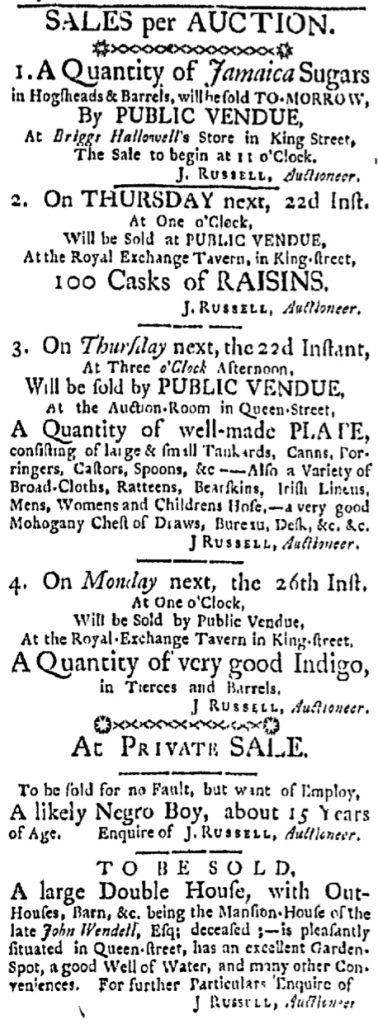
Boston Evening-Post (October 19, 1767).
**********
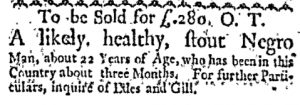
Boston Post-Boy (October 19, 1767).
**********
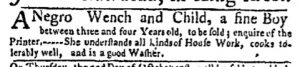
Boston Post-Boy (October 19, 1767).
**********
Supplement to the Boston Post-Boy (October 19, 1767).
**********
Boston-Gazette (October 19, 1767).
**********
Boston-Gazette (October 19, 1767).
**********
Boston-Gazette (October 19, 1767).
**********
Boston-Gazette (October 19, 1767).
**********
Boston-Gazette (October 19, 1767).
**********
Supplement to the New-York Mercury (October 19, 1767).
**********
Supplement to the New-York Mercury (October 19, 1767).
**********
Supplement to the New-York Mercury (October 19, 1767).
**********
Supplement to the New-York Mercury (October 19, 1767).
What was advertised in a colonial American newspaper 250 years ago this week?
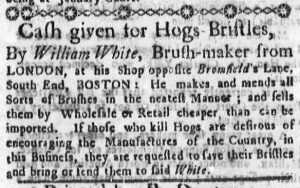
Massachusetts Gazette (October 15, 1767).
“Desirous of encouraging the Manufactures of the Country.”
During the imperial crisis that led to the American Revolution colonists resisted Parliamentary overreach with several non-importation and non-consumption agreements, each coinciding with particular legislative acts. The first round occurred in response to the Stamp Act, ceasing with the repeal of that hated measure. Colonists once again resorted to non-importation and non-consumption of British goods in response to the Townshend Acts, scheduled to take effect on November 20, 1767.
Throughout the last third of the eighteenth century, as colonists moved from resistance to revolution to independence, American advertisers developed marketing appeals that encouraged consumers to “Buy American.” Over time advertisers became much more explicit in their efforts linking consumption to political participation. A notice that appeared in the Massachusetts Gazette five weeks before the Townshend Acts took effect shows an early attempt. William White, a “Brush-maker from LONDON,” did not mention Parliament or the impending legislation, but readers would have made the connection on their own thanks to news items and opinion pieces elsewhere in Boston’s newspapers as well as conversations taking place throughout the city and beyond.
White encouraged potential customers to support domestic production rather than purchase imported wares. He noted that he made and sold brushes “Wholesale or Retail cheaper than can be imported,” prompting consumers to think about the origins of all the goods they acquired, not just the brushes they purchased from him. He also implicitly issued a challenge to retailers to acquire and distribute locally produced goods: presumably those who purchased brushes “Wholesale” did so with the intention of selling them in their own shops.
White framed his comments about the cost of his brushes with a statement even more overtly political. He made an appeal to colonists who were “desirous of encouraging the Manufactures of the Country” rather than continued importation of goods from England. Here he addressed colonists who could supply him with the bristles he needed to make “all Sorts of Brushes.” Not just consumers but producers as well had a duty to support local production over importation. In addition, even though White described his potential suppliers as “desirous of encouraging the Manufacturers of the Country” he implied that consumers should adopt the same attitude and opt to purchase their brushes from him.
William White did not invoke Parliament or the Townshend Acts by name in his advertisement, but contemporary politics still influenced how he structured his appeal to potential customers and how colonists interpreted his advertisement. He did not need to make his case any more explicitly because his advertisement was part of an ongoing conversation – in print and in person – among residents of Boston and throughout the colonies.
What was advertised in a colonial American newspaper 250 years ago today?
Providence Gazette (October 17, 1767).
“NOW IN THE PRESS, … THE NEW-ENGLAND ALMANACK.”
As surely as leaves turned colors and then fell from trees in the fall, colonists had another reminder of the changing seasons and the approach of a new year: advertisements for almanacs published in newspapers throughout the colonies. Some printers and booksellers placed notices as early as September, prompting potential customers to anticipate the impending publication of the most accurate and most fashionable almanacs. Others began promoting their almanacs in October, but the advertisements became more frequent and more extensive in November and December. Although printers and booksellers attempted to gauge demand, some always ended up with surplus almanacs that they then advertised well into the new year.
Sarah Goddard and John Carter, printers of the Providence Gazette, made an early start on printing and advertising the New-England Almanack, or, Lady’s and Gentleman’s Diary, for the Year of Our Lord 1768. Potential customers still had nearly eleven weeks to acquire their almanacs, but Goddard and Carter knew that their printing office would face competition from the many printers and booksellers in Boston who marketed competing volumes. Advertising early raised the visibility of their almanac, perhaps giving it a privileged place in the minds of potential customers who would eventually encounter other options. Using advertisements to make their almanac familiar to readers could have instilled a sense of loyalty even before they were available for purchase.
Goddard and Carter’s advertisement for the New-England Almanack, relatively sparse in terms of words and space, served as an initial announcement. Upon publication, the printers introduced more extensive advertisements that included the table of contents and listed the price (both by the dozen and singles). In that manner, some advertisements for almanacs offered yet another visual marker of the passing seasons. As the new year drew closer, advertisements for almanacs became lengthier. Just as modern Americans have grown accustomed to certain advertising practices timed to the holiday season, early American readers experienced annual rhythms of marketing for almanacs as the newspaper advertisements became more frequent and more prominent before fading after the new year.
The Slavery Adverts 250 Project chronicles the role of newspaper advertising in perpetuating slavery in the era of the American Revolution. The project seeks to reveal the ubiquity of slavery in eighteenth-century life from New England to Georgia by republishing advertisements about enslaved people – for sale as individuals or in groups, wanted to purchase or for hire for short periods, runaways who liberated themselves, and those who were subsequently captured and confined in jails and workhouses – in daily digests on this site as well as in real time via the @SlaveAdverts250 Twitter feed, utilizing twenty-first-century media to stand in for the print media of the eighteenth century.
The project aims to provide modern audiences with a sense of just how often colonizers encountered these advertisements in their daily lives. Enslaved men, women, and children appeared in print somewhere in the colonies almost every single day. Those advertisements served as a constant backdrop for social, cultural, economic, and political life in colonial and revolutionary America. Colonizers who did not purport to own enslaved people were still confronted with slavery as well as invited to maintain the system by purchasing enslaved men, women, and children or assisting in the capture of so-called “runaways” who sought to free themselves from bondage. The frequency of these newspaper advertisements suggests just how embedded slavery was in colonial and revolutionary American culture in everyday interactions beyond the printed page.
These advertisements also testify to the experiences of enslaved men, women, and children, though readers must consider that those experiences have been remediated through descriptions offered by enslavers rather than enslaved people themselves. Often unnamed in the advertisements, enslaved men, women, and children were not invisible or unimportant in early America.
These advertisements appeared in colonial American newspapers 250 years ago today.
What was advertised in a colonial American newspaper 250 years ago today?
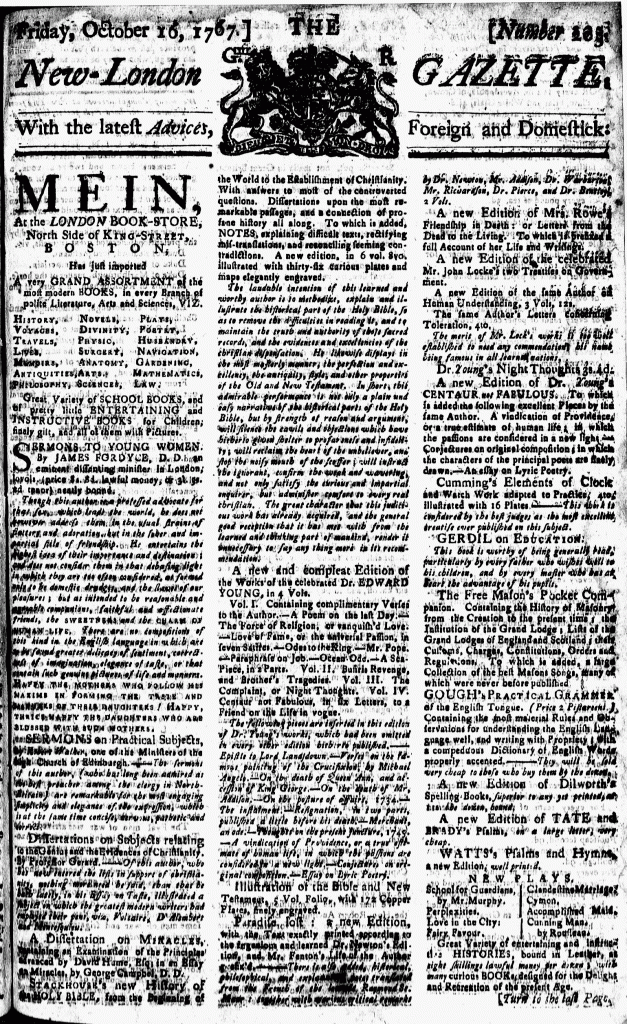
First Page of the New-London Gazette (October 16, 1767).
“MEIN, At the LONDON BOOK-STORE, North Side of KING-STREET, BOSTON.”
The Adverts 250 Project previously featured an extraordinary advertisement that John Mein placed in the New-London Gazette in the fall of 1767. Not only did Mein, a Boston bookseller, advertise in a distant newspaper, his advertisement occupied nearly two entire pages. That was a bold and innovative marketing strategy.
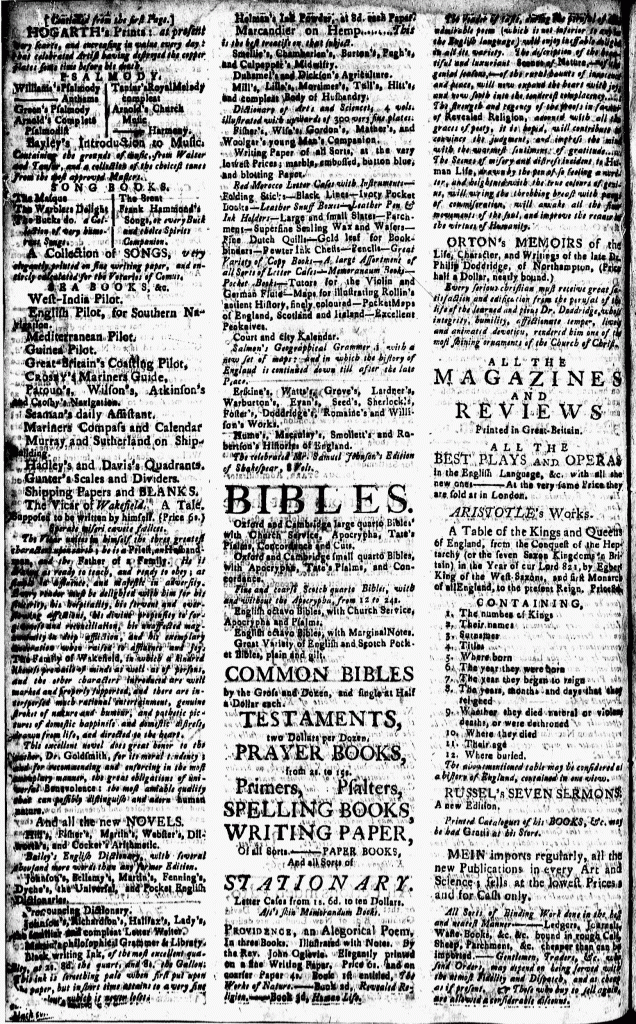
It was not a one-time gimmick. Mein placed a similar advertisement in the October 16, 1767, edition of the New-London Gazette, an advertisement that was even more elaborate than the previous one. The new version extended over six columns, two entire pages (with the exception of the masthead on the first page). Mein’s advertisement accounted for half of that issue of the newspaper, limiting the amount of space for news items and prompting the printer to insert a notice that “Advertisements omitted will be in our next.”
This new advertisement had another feature that distinguished it from the previous version. It appeared on the first and fourth pages of the four-page newspaper (rather than the final two pages). This meant that it was both the first and last item readers encountered when they read that issue of the New-London Gazette. In addition, if a reader held the open newspaper aloft to read the second and third pages, observers would glimpse only the first and last pages. From their perspective it would appear that the New-London Gazette contained nothing except Mein’s advertisement. Similarly, a closed copy of the newspaper sitting on a desk or table assumed the appearance of a broadsheet book catalogue since no other advertisements or news items would have been visible.
Final Page of New-London Gazette (October 16, 1767).
These visual aspects that depend on the material qualities of the newspaper might be overlooked when working with a copy bound into a volume with other issues of the New-London Gazette, a common practice for preserving and archiving eighteenth-century newspapers. Deprived of the ability to exist as a separate issue but instead reduced to four consecutive pages in a larger book, the transformed newspaper does not immediately suggest all of the visual characteristics that early American readers would have experienced. The same could also be said of digitized versions of the advertisement, each page completely disembodied from the others. The greater significance of Mein’s advertisement becomes apparent only upon contemplating how the form in which the New-London Gazette was originally delivered to readers, not just the format the issue happens to occupy in the twenty-first century.
The Slavery Adverts 250 Project chronicles the role of newspaper advertising in perpetuating slavery in the era of the American Revolution. The project seeks to reveal the ubiquity of slavery in eighteenth-century life from New England to Georgia by republishing advertisements about enslaved people – for sale as individuals or in groups, wanted to purchase or for hire for short periods, runaways who liberated themselves, and those who were subsequently captured and confined in jails and workhouses – in daily digests on this site as well as in real time via the @SlaveAdverts250 Twitter feed, utilizing twenty-first-century media to stand in for the print media of the eighteenth century.
The project aims to provide modern audiences with a sense of just how often colonizers encountered these advertisements in their daily lives. Enslaved men, women, and children appeared in print somewhere in the colonies almost every single day. Those advertisements served as a constant backdrop for social, cultural, economic, and political life in colonial and revolutionary America. Colonizers who did not purport to own enslaved people were still confronted with slavery as well as invited to maintain the system by purchasing enslaved men, women, and children or assisting in the capture of so-called “runaways” who sought to free themselves from bondage. The frequency of these newspaper advertisements suggests just how embedded slavery was in colonial and revolutionary American culture in everyday interactions beyond the printed page.
These advertisements also testify to the experiences of enslaved men, women, and children, though readers must consider that those experiences have been remediated through descriptions offered by enslavers rather than enslaved people themselves. Often unnamed in the advertisements, enslaved men, women, and children were not invisible or unimportant in early America.
These advertisements appeared in colonial American newspapers 250 years ago today.
South-Carolina and American General Gazette (October 16, 1767).
**********
South-Carolina and American General Gazette (October 16, 1767).
**********
South-Carolina and American General Gazette (October 16, 1767).
**********
South-Carolina and American General Gazette (October 16, 1767).
**********
South-Carolina and American General Gazette (October 16, 1767).
**********
South-Carolina and American General Gazette (October 16, 1767).
“MILLINERY … supplied on the shortest notices, by … M. and J. HUNTER.”
At a glance, this advertisement for a “GENTEEL ASSORTMENT of MILLINERY” placed by M. and J. Hunter in the October 15, 1767, issue of the Virginia Gazette seems to obscure the participation of women in the marketplace – and in the public prints – as retailers and producers, at least to modern readers who do not possess the same familiarity with Williamsburg in the 1760s as residents of the period.
Only upon close reading of the second paragraph does it become clear that M. and J. Hunter, the “humble servants” who imported and sold “all the materials for making hats and bonnets,” were women. Since milliners often tended to be women, some readers might have made this assumption as soon as they spotted the word “MILLINERY” in large, bold letters. Yet male shopkeepers and merchants, even if they did not work as milliners themselves, also imported, advertised, and sold millinery supplies to milliners and the general public. That the Hunters who placed the advertisement were women becomes clear when once states, “The subscriber having a sister just arrived from LONDON, who understands the millinery business, she hopes to carry it on to the satisfaction of those who shall favour them with their commands.” Here it becomes clear that the “subscriber,” the person who placed the notice, was a woman who went into business with a sister recently arrived in the colony: “The subscriber” referenced herself as “she.”
While it requires some special attention for the modern reader to identify M. and J. Hunter as female entrepreneurs, it would not have been as difficult for eighteenth-century readers who resided in Williamsburg. Note the careful attention to detail in the advertisement. The Hunters described their merchandise in detail, providing a long list of items as a means of signaling the wide array of choices available to consumers. They made appeals to gentility, fashion, and price. Yet they did not indicate where they operated their millinery shop. This suggests that the Hunters, especially the sister who already resided in Williamsburg for some time, believed that local readers of the Virginia Gazette already knew who they were and where to find them. The signature “M. and J. Hunter” alone does not reveal to modern readers that these milliners were women, but it would have been sufficient for contemporary residents of Williamsburg to immediately associate the advertisement with female entrepreneurs.
The Slavery Adverts 250 Project chronicles the role of newspaper advertising in perpetuating slavery in the era of the American Revolution. The project seeks to reveal the ubiquity of slavery in eighteenth-century life from New England to Georgia by republishing advertisements about enslaved people – for sale as individuals or in groups, wanted to purchase or for hire for short periods, runaways who liberated themselves, and those who were subsequently captured and confined in jails and workhouses – in daily digests on this site as well as in real time via the @SlaveAdverts250 Twitter feed, utilizing twenty-first-century media to stand in for the print media of the eighteenth century.
The project aims to provide modern audiences with a sense of just how often colonizers encountered these advertisements in their daily lives. Enslaved men, women, and children appeared in print somewhere in the colonies almost every single day. Those advertisements served as a constant backdrop for social, cultural, economic, and political life in colonial and revolutionary America. Colonizers who did not purport to own enslaved people were still confronted with slavery as well as invited to maintain the system by purchasing enslaved men, women, and children or assisting in the capture of so-called “runaways” who sought to free themselves from bondage. The frequency of these newspaper advertisements suggests just how embedded slavery was in colonial and revolutionary American culture in everyday interactions beyond the printed page.
These advertisements also testify to the experiences of enslaved men, women, and children, though readers must consider that those experiences have been remediated through descriptions offered by enslavers rather than enslaved people themselves. Often unnamed in the advertisements, enslaved men, women, and children were not invisible or unimportant in early America.
These advertisements appeared in colonial American newspapers 250 years ago today.
Massachusetts Gazette (October 15, 1767).
**********
New-York Gazette: Or, the Weekly Post-Boy (October 15, 1767).
**********
New-York Journal (October 15, 1767).
**********
New-York Journal (October 15, 1767).
**********
New-York Journal (October 15, 1767).
**********
New-York Journal (October 15, 1767).
**********
New-York Journal (October 15, 1767).
**********
Supplement to the New-York Journal (October 15, 1767).
**********
Pennsylvania Gazette (October 15, 1767).
**********
Pennsylvania Gazette (October 15, 1767).
**********
Pennsylvania Gazette (October 15, 1767).
**********
Supplement to the Pennsylvania Gazette (October 15, 1767).
What was advertised in a colonial American newspaper 250 years ago today?
Georgia Gazette (October 14, 1767).
“Henry Steerman and Jonathan Remington, TAYLORS and PARTNERS.”
The advertisement placed by Henry Steerman and Jonathan Remington, as well as all of the other advertisements on the same page of the October 14, 1767, edition of the Georgia Gazette, creates a bit of a mystery for modern historian who consult databases of digitized newspapers to conduct their research. These advertisements appeared on the fifth page of that issue.
Why would this be a mystery? Most newspapers published in 1767 followed a standard format: four pages created by printing two pages on each side of a broadsheet and folding it in half. Occasionally printers issued a supplement, either two (using half a broadsheet) or four pages (using an entire additional broadsheet). Usually these supplements had their own masthead that identified them as supplements, though sometimes they were inserted in the center of the newspaper without additional identification. Due to the scarcity of paper, printers carefully filled both sides of any supplement with news items, advertisements, or both, leaving no empty space. If they did not have enough material to issue an even number of pages – four, six, or eight – they inserted notes indicating that news items would be continued in the next issue or advertisements omitted would be in the next.
The Georgia Gazette rarely issued a supplement. The layout sometimes suggested that the printer had difficulty even filling four pages. On such occasions the advertisements featured generous amounts of white space in order to occupy as much space on the page as possible. That Steerman and Remington’s advertisement, along with twenty others, appeared on the fifth page of the Georgia Gazette was out of the ordinary. What was perplexing to this historian, however, was the absence of a sixth page in the database of digitized newspapers. It would have been extraordinary for the printer not to print on both sides of the sheet, yet the sixth page seemed to be missing. Even more curious, the fifth page did not have a masthead that identified it as a supplement. Had Steerman and Remington’s advertisement actually appeared on the fifth page? Or was it on the sixth page and the fifth page, for whatever reason, was missing from the database?
These questions could not be answered merely by examining the digital surrogates. I found definitive confirmation only when I visited the American Antiquarian Society to examine the original issue of the Georgia Gazette that had been photographed and later digitized by Readex. To my surprise, the October 14, 1767, edition of the Georgia Gazette did indeed consist of only five pages. More accurately, it consisted of five printed pages and a blank sixth page, but this was not at all evident from the database. It did not include a photograph of the blank sixth page to provide context and a complete record for researchers.
This points to two lessons when it comes to the creation and use of digital surrogates in historical research. First, digital surrogates should be used in addition to, rather than instead of, original sources. Digital surrogates are valuable resources that have made original documents much more accessible to historians, other scholars, and the general public, but sometimes they hide elements of the past rather than reveal them. They must be consulted with caution and with knowledge of what kinds of questions to also ask about original documents in order not to be misled by digitized ones.
Second, the example of the October 14, 1767, issue of the Georgia Gazette underscores the necessity of content providers, like Readex, consulting with librarians, archivists, historians, and other scholars who are familiar with the original sources and the most likely users of digital surrogates when designing and implementing databases. To a layperson unfamiliar with eighteenth-century newspapers it seemed unnecessary, wasteful, and perhaps even confusing to include a photo of a blank page of a newspaper. To someone who works with eighteenth-century newspapers, both original and digital surrogates, every day, the absence of a blank page in the database actually created confusion that could have been avoided.
Consulting the original issue of the October 14, 1767, edition of the Georgia Gazette cleared up the mystery about its original format, yet another mystery remains, one that will be much harder to solve. Given the scarcity of paper, why did the printer issue an additional halfsheet printed on only one side?
These tables indicate how many advertisements for slaves appeared in colonial American newspapers during the week of October 8-14, 1767.
Note: These tables are as comprehensive as currently digitized sources permit, but they may not be an exhaustive account. They includes all newspapers that have been digitized and made available via Accessible Archives, Colonial Williamsburg’s Digital Library, and Readex’s America’s Historical Newspapers. There are several reasons some newspapers may not have been consulted:
Issues that are no longer extant;
Issues that are extant but have not yet been digitized (including the Pennsylvania Journal); and
Newspapers published in a language other than English (including the Wochentliche Philadelphische Staatsbote).
**********
Slavery Advertisements Published October 8-14, 1767: By Date
**********
Slavery Advertisements Published October 8-14, 1767: By Region