August 14

What was advertised in a colonial American newspaper 250 years ago this week?

Aug 14 - 8:11:1768 Pennsylvania Gazette
Postscript to the Pennsylvania Gazette (August 11, 1768).

“He has of late stamped his name on his brushes.”

John Hanna made and sold all sorts of brushes “At the corner of Chestnut and Second-streets” in Philadelphia in the late 1760s. He produced brushes intended for every sort of purpose, from “sweeping, scrubbing, hearth and white-wash brushes” to “weavers, tanners, hatters, painters and furniture brushes of all kinds.” In his advertisements in the Pennsylvania Gazette he emphasized price and, especially, customer satisfaction. In making an appeal to price, the brushmaker proclaimed that he “sells by wholesale or retail, as low, if not lower, than any in this city.”

He expended much more effort on convincing potential customers that they would be satisfied if they purchased their brushes from him. He began with standardized language about quality, noting that he made brushes “in the neatest and best manner.” Hanna then backed up this pronouncement by offering a return policy should any of his brushes not meet the expectations of his customers. To that end, he asserted “that if the bristles come out in any reasonable time, with fair usage, he will give new ones for nothing.” This guarantee depended in part on the honesty of customers, but it did offer some sort of recourse should any of Hanna’s brushes fall short of the quality he promised.

The return policy likely extended to consumers who obtained Hanna’s brushes from other retailers. In a nota bene he explained that he “has of late stamped his name on his brushes, so that if they should fail, people may know where to bring them to be exchanged.” This removed retailers from having to address potential complaints about customer satisfaction. Instead, they could point out Hanna’s name on the brushes at the time of sale and instruct their own customers to contact the manufacturer directly with any concerns, anticipating a policy widely adopted in the twenty-first century.

Like many other artisans and shopkeepers, Hanna pledged that “Those who are pleased to favour him with their custom, may depend on being supplied to their satisfaction.” He enhanced his advertisement, however, with a mechanism for following through on those assurances. Stamping his name on his brushes not only branded them to encourage additional sales; it also marked them as eligible for the return policy he devised to cultivate customer satisfaction.
August 13

What was advertised in a colonial American newspaper 250 years ago today?

Aug 13 - 8:13:1768 Providence Gazette
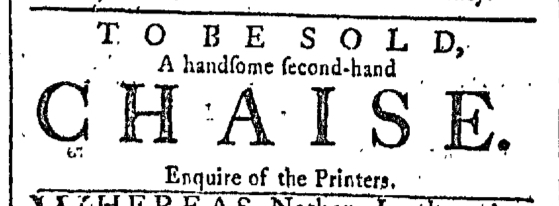
Providence Gazette (August 13, 1768).

“A handsome second-hand CHAISE.”

Colonists devised multiple ways to participate in the consumer revolution of the eighteenth century. Many purchased new good directly from merchants and shopkeepers, but others stole the items they desired or bought stolen goods at lower prices through an informal economy that made goods more accessible. Some also acquired secondhand goods at discounted prices that made them affordable. Advertisements for auctions, especially estate sales, frequently appeared in newspapers published throughout the colonies, presenting an array of goods to consumers looking for bargains. Other advertisements, however, announced the sale of particular used items, such as notice in the August 12, 1768, edition of the Providence Gazette that informed readers of a “handsome second-hand CHAISE” for sale. Interested parties were instructed to “Enquire of the Printers” for more information.

The chaise was one of the many sorts of wheeled carriages familiar to colonists. The Oxford English Dictionary indicates that the “exact application … varied from time to time,” but offers this general definition: “A light open carriage for one or two persons, often having a top or calash; those with four wheels resembling the phaeton, those with two the curricle; also loosely used for pleasure carts and light carriages generally.” In the absence of a more complete description in the advertisement, the flexibility of the term “chaise” encouraged prospective buyers to contact the printers for additional information.

Carriages of all sorts were markers of status, expensive to acquire and maintain. Opportunities to purchase secondhand carriages made them more affordable, but those with the means to purchase used carriages did not have to wait for private individuals to sell them. Some coachmakers, including Adino Paddock in Boston, incorporated sales of secondhand carriages into their marketing, selling those they received as trade-ins from customers who purchased new carriages. Regardless of who sold secondhand chaises and other sorts of carriages, their availability in the colonial marketplace indicates that they retained resale value after the initial sale. Colonists bought and sold used carriages long before the practice became a common aspect of the modern automobile industry.

August 12

What was advertised in a colonial American newspaper 250 years ago today?

Aug 12 - 8:12:1768 New-London Gazette
New-London Gazette (August 12, 1768).

“Last Night the shops of the subscribers in said Middletown was broke open.”

Many advertisements in eighteenth-century newspapers listed all sorts of consumer goods as a means of encouraging readers to visit shops, examine the merchandise, and make purchases. Other advertisements, however, demonstrate that not all colonists acquired goods through those means. Some colonists instead resorted to theft.

Such was the case in Middletown, Connecticut, at the end of July in 1768. On the morning of the final day of the month, George Philips, Asal Johnson, and Francis Whitmore all awoke to discover that their shops had been “broke open” during the night and several items stolen. The thief or thieves grabbed “about 6 dozen barcelona handkerchiefs, of which 2 dozen were black, the rest shaded various colours; 1 dozen black cravats, 3 or 4 pieces of black ribbons, 1 paper of white metal buckles, 1 castor hat a little moth eaten, 2 or 3 penknives,” and currency in several denominations from Philips. Similar items went missing from the shops of Johnson and Whitmore. The volume of stolen goods suggests that the thieves may not have intended these items solely for their own use. Instead, they may have attempted to fence them or otherwise distribute them through what Serena Zabin has termed an informal economy that allowed greater numbers of colonists to participate in the consumer revolution.
Philips and Johnson offered a reward to “Any person who will seize the thief or thieves with any or all of said articles, and secure them so that they shall be brought to justice.” The penalties could be quite severe for those convicted. Two years earlier in Rhode Island, for instance, Joseph Hart became a convict servant, sold into servitude “for the term of three years to satisfy the damages and costs of his prosecution and conviction, for stealing sundry goods.” Colonists who chose to gain access to the consumer revolution via extralegal means weighed the risks and rewards of acquiring goods that might otherwise have remained beyond their reach.

Slavery Advertisements Published August 12, 1768

The Slavery Adverts 250 Project chronicles the role of newspaper advertising in perpetuating slavery in the era of the American Revolution. The project seeks to reveal the ubiquity of slavery in eighteenth-century life from New England to Georgia by republishing advertisements for slaves – for sale, wanted to purchase, runaways, captured fugitives – in daily digests on this site as well as in real time via the @SlaveAdverts250 Twitter feed, utilizing twenty-first-century media to stand in for the print media of the eighteenth century.

The project aims to provide modern audiences with a sense of just how often colonists encountered these advertisements in their daily lives. Enslaved men, women, and children appeared in print somewhere in the colonies almost every single day. Those advertisements served as a constant backdrop for social, cultural, economic, and political life in colonial and revolutionary America. Colonists who did not own slaves were still confronted with slavery as well as invited to maintain the system by purchasing slaves or assisting in the capture of runaways. The frequency of these newspaper advertisements suggests just how embedded slavery was in colonial and revolutionary American culture in everyday interactions beyond the printed page.

These advertisements also testify to the experiences of enslaved men, women, and children, though readers must consider that those experiences have been remediated through descriptions offered by slaveholders rather than the slaves themselves. Often unnamed in the advertisements, enslaved men, women, and children were not invisible or unimportant in early America.

These advertisements appeared in colonial American newspapers 250 years ago today.

Aug 12 - New-Hampshire Gazette Slavery 1
New-Hampshire Gazette (August 12, 1768).

**********

Aug 12 - New-London Gazette Slavery 1
New-London Gazette (August 12, 1768).

**********

Aug 12 - South-Carolina and American General Gazette Slavery 1
South-Carolina and American General Gazette (August 12, 1768).

**********

Aug 12 - South-Carolina and American General Gazette Slavery 2
South-Carolina and American General Gazette (August 12, 1768).

**********

Aug 12 - South-Carolina and American General Gazette Slavery 3
South-Carolina and American General Gazette (August 12, 1768).

**********

Aug 12 - South-Carolina and American General Gazette Slavery 4
South-Carolina and American General Gazette (August 12, 1768).

**********

Aug 12 - South-Carolina and American General Gazette Slavery 5
South-Carolina and American General Gazette (August 12, 1768).

**********

Aug 12 - South-Carolina and American General Gazette Slavery 6
South-Carolina and American General Gazette (August 12, 1768).

**********

Aug 12 - South-Carolina and American General Gazette Slavery 7
South-Carolina and American General Gazette (August 12, 1768).

**********

Aug 12 - South-Carolina and American General Gazette Slavery 8
South-Carolina and American General Gazette (August 12, 1768).

**********

Aug 12 - South-Carolina and American General Gazette Slavery 9
South-Carolina and American General Gazette (August 12, 1768).

**********

Aug 12 - South-Carolina and American General Gazette Slavery 10
South-Carolina and American General Gazette (August 12, 1768).

**********

Aug 12 - South-Carolina and American General Gazette Slavery 11
South-Carolina and American General Gazette (August 12, 1768).

**********

Aug 12 - South-Carolina and American General Gazette Slavery 12
South-Carolina and American General Gazette (August 12, 1768).

August 11

What was advertised in a colonial American newspaper 250 years ago today?

Aug 11 - 8:11:1768 New-York Journal
New-York Journal (August 11, 1768).

“John Sloan, my Apprentice, has lately misbehaved.”

Advertisements for unfree laborers who ran away – indentured servants, slaves, apprentices – comprised one of the most common genres of paid notices inserted in eighteenth-century newspapers. Such advertisements appeared in newspapers printed and distributed throughout the colonies on August 11, 1768. Richard Draper’s Massachusetts Gazette, for instance, included two advertisements for runaway slaves, one concerning “a Negro Man partly Molatto named Primus” and the other “a Negro Man named Caesar.” Both advertisements offered rewards for the capture and return of the fugitive slaves. Fifteen advertisements for runaways – two for indentured servants, two for slaves, and eleven for indentured servants – appeared on the pages of the Pennsylvania Gazette, its supplement, and a one-page postscript. Purdie and Dixon’s Virginia Gazette carried four advertisements for runaway slaves. The main competitor, Rind’s Virginia Gazette, had twice as many advertisement, seven for slaves and another for am “English convict servant.” The New-York Journal continued publishing an advertisement for “a Welch servant man named William Walters” and another for “an Apprentice Lad, named Jacob Horsen, by Trade a Blacksmith.”

The New-York Journal carried another advertisement about an unruly apprentice, an advertisement preemptively placed in anticipation that he would attempt to run away from his master. James Sloan explained that his apprentice, John Sloan, “has lately misbehaved” and “threatened to leave.” Expecting that apprentice Sloan would attempt to make his escape imminently, master Sloan warned that “no Person will entertain, harbour, conceal, or carry off the said Apprentice, as they will answer it at their Peril.” Aggrieved masters frequently threatened legal action against anyone who aided runaways. The master also offered a reward for his apprentice’s capture and return even before he run away. James Sloan was sufficiently certain that his apprentice would make the attempt that he paid five shillings to have a notice inserted in the New-York Journal for four weeks. He may have considered this a less expensive option than waiting for apprentice Sloan to depart, especially if brought the advertisement to the apprentice’s attention. Knowledge of the advertisement and the increased surveillance directed at the apprentice may have been a preventative measure that forestalled flight from his master.

Throughout the colonies printers generated revenues by selling advertisements for unfree laborers who ran away from their masters. In this case, James Sloan adapted those familiar advertisements, devising a notice that warned of the possibility that his apprentice might attempt to flee. As the apprentice asserted his own agency by misbehaving and threatening to run away, the master sought to harness the power of the press in his efforts to manage and control a disorderly apprentice.

Slavery Advertisements Published August 11, 1768

The Slavery Adverts 250 Project chronicles the role of newspaper advertising in perpetuating slavery in the era of the American Revolution. The project seeks to reveal the ubiquity of slavery in eighteenth-century life from New England to Georgia by republishing advertisements for slaves – for sale, wanted to purchase, runaways, captured fugitives – in daily digests on this site as well as in real time via the @SlaveAdverts250 Twitter feed, utilizing twenty-first-century media to stand in for the print media of the eighteenth century.

The project aims to provide modern audiences with a sense of just how often colonists encountered these advertisements in their daily lives. Enslaved men, women, and children appeared in print somewhere in the colonies almost every single day. Those advertisements served as a constant backdrop for social, cultural, economic, and political life in colonial and revolutionary America. Colonists who did not own slaves were still confronted with slavery as well as invited to maintain the system by purchasing slaves or assisting in the capture of runaways. The frequency of these newspaper advertisements suggests just how embedded slavery was in colonial and revolutionary American culture in everyday interactions beyond the printed page.

These advertisements also testify to the experiences of enslaved men, women, and children, though readers must consider that those experiences have been remediated through descriptions offered by slaveholders rather than the slaves themselves. Often unnamed in the advertisements, enslaved men, women, and children were not invisible or unimportant in early America.

These advertisements appeared in colonial American newspapers 250 years ago today.

Aug 11 - Massachusetts Gazette Draper Slavery 1
Massachusetts Gazette [Draper] (August 11, 1768).

**********

Aug 11 - Massachusetts Gazette Draper Slavery 2
Massachusetts Gazette [Draper] (August 11, 1768).

**********

Aug 11 - Massachusetts Gazette Draper Slavery 3
Massachusetts Gazette [Draper] (August 11, 1768).

**********

Aug 11 - New-York Journal Slavery 1
New-York Journal (August 11, 1768).

**********

Aug 11 - New-York Journal Supplment Slavery 1
Supplement to the New-York Journal (August 11, 1768).

**********

Aug 11 - Pennsylvania Gazette Slavery 1
Pennsylvania Gazette (August 11, 1768).

**********

Aug 11 - Pennsylvania Gazette Supplement Slavery 1
Supplement to the Pennsylvania Gazette (August 11, 1768).

**********

Aug 11 - Pennsylvania Gazette Supplement Slavery 2
Supplement to the Pennsylvania Gazette (August 11, 1768).

**********

Aug 11 - Pennsylvania Gazette Supplement Slavery 3
Supplement to the Pennsylvania Gazette (August 11, 1768).

**********

Aug 11 - Virginia Gazette Purdie and Dixon Slavery 1
Virginia Gazette [Purdie & Dixon] (August 11, 1768).

**********

Aug 11 - Virginia Gazette Purdie and Dixon Slavery 2
Virginia Gazette [Purdie & Dixon] (August 11, 1768).

**********

Aug 11 - Virginia Gazette Purdie and Dixon Slavery 3
Virginia Gazette [Purdie & Dixon] (August 11, 1768).

**********

Aug 11 - Virginia Gazette Purdie and Dixon Slavery 4
Virginia Gazette [Purdie & Dixon] (August 11, 1768).

**********

Aug 11 - Virginia Gazette Purdie and Dixon Slavery 5
Virginia Gazette [Purdie & Dixon] (August 11, 1768).

**********

Aug 11 - Virginia Gazette Purdie and Dixon Slavery 6
Virginia Gazette [Purdie & Dixon] (August 11, 1768).

**********

Aug 11 - Virginia Gazette Purdie and Dixon Slavery 7
Virginia Gazette [Purdie & Dixon] (August 11, 1768).

**********

Aug 11 - Virginia Gazette Purdie and Dixon Slavery 8
Virginia Gazette [Purdie & Dixon] (August 11, 1768).

**********

Aug 11 - Virginia Gazette Purdie and Dixon Slavery 9
Virginia Gazette [Purdie & Dixon] (August 11, 1768).

**********

Aug 11 - Virginia Gazette Purdie and Dixon Slavery 10
Virginia Gazette [Purdie & Dixon] (August 11, 1768).

**********

Aug 11 - Virginia Gazette Rind Slavery 1
Virginia Gazette [Rind] (August 11, 1768).

**********

Aug 11 - Virginia Gazette Rind Slavery 2
Virginia Gazette [Rind] (August 11, 1768).

**********

Aug 11 - Virginia Gazette Rind Slavery 3
Virginia Gazette [Rind] (August 11, 1768).

**********

Aug 11 - Virginia Gazette Rind Slavery 4
Virginia Gazette [Rind] (August 11, 1768).

**********

Aug 11 - Virginia Gazette Rind Slavery 5
Virginia Gazette [Rind] (August 11, 1768).

**********

Aug 11 - Virginia Gazette Rind Slavery 6
Virginia Gazette [Rind] (August 11, 1768).

**********

Aug 11 - Virginia Gazette Rind Slavery 7
Virginia Gazette [Rind] (August 11, 1768).

**********

Aug 11 - Virginia Gazette Rind Slavery 8
Virginia Gazette [Rind] (August 11, 1768).

**********

Aug 11 - Virginia Gazette Rind Slavery 9
Virginia Gazette [Rind] (August 11, 1768).

**********

Aug 11 - Virginia Gazette Rind Slavery 10
Virginia Gazette [Rind] (August 11, 1768).

**********

Aug 11 - Virginia Gazette Rind Slavery 11
Virginia Gazette [Rind] (August 11, 1768).

**********

Aug 11 - Virginia Gazette Rind Slavery 12
Virginia Gazette [Rind] (August 11, 1768).

August 10

Who was the subject of an advertisement in a colonial American newspaper 250 years ago today?

Aug 10 - 8:10:1768 Georgia Gazette
Georgia Gazette (August 10, 1768).

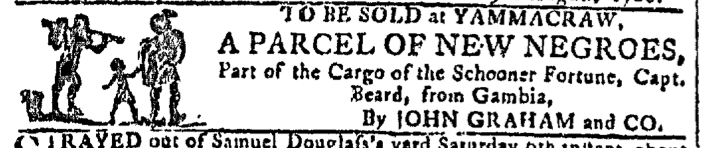
“TO BE SOLD at YAMMACRAW, A PARCEL OF NEW NEGROES.”

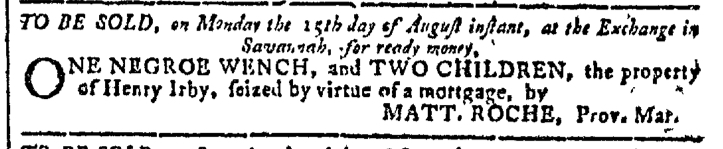
Several advertisements in the August 10, 1768, edition of the Georgia Gazette offered slaves for sale. Some concerned individual slaves (“A VERY HANDY YOUNG COUNTRY BORN WENCH”) or small groups of slaves (“Four Prime Negroes” and “ONE NEGROE WENCH, and TWO CHILDREN”) to be sold by their owners, but colonists who made their livelihood from trading in human property placed other advertisements for larger quantities of enslaved men, women, and children. The latter included a brief notice inserted by John Graham and Company announcing the sale of “A PARCEL OF NEW NEGROES” slated for sale at Yamacraw Bluff, the site where James Oglethorpe landed when he founded the Georgia colony in 1733. The place named for and formerly inhabited by the Yamacraw, a group of Creek Indians, became the point of arrival in North America for Africans involuntarily transported across the Atlantic.

Yet Georgia was not the first colony where these captives from Africa entered port on the western side of the Atlantic. Graham and Company’s advertisement indicated that these “NEW NEGROES” from Gambia were “Part of the Cargo of the Schooner Fortune.” Voyages: The Trans-Atlantic Slave Trade Database provides more information about the experiences of the human cargo aboard the Fortune. After acquiring 121 Africans in Gambia, James Baird and his crew set sail for Barbados. Only 109 of the captives survived the Middle Passage to disembark at some point after the Fortune arrived at an unspecified port in Barbados on June 25, 1768. The Fortune returned directly to Africa to trade for more slaves.

Some of the slaves who disembarked in Barbados then experienced what Gregory E. O’Malley has termed transshipment. Surviving the Middle Passage was not the end of their journey. Instead, lacking sufficient buyers at their original port of arrival in the Americas, they were loaded aboard other vessels and shipped between colonies to other markets for purchase. Graham and Company’s advertisement does not indicate how many of the 109 “NEW NEGROES” who disembarked in Barbados then made another journey to Georgia, nor does it indicate how many friends and relatives who survived the Middle Passage to the island colony only then found themselves separated from each other by slave traders who dispersed them to even more distant places in hopes of finding buyers.

Slavery Advertisements Published August 10, 1768

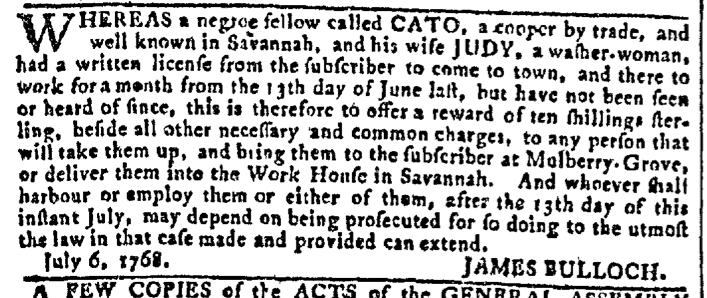
The Slavery Adverts 250 Project chronicles the role of newspaper advertising in perpetuating slavery in the era of the American Revolution. The project seeks to reveal the ubiquity of slavery in eighteenth-century life from New England to Georgia by republishing advertisements for slaves – for sale, wanted to purchase, runaways, captured fugitives – in daily digests on this site as well as in real time via the @SlaveAdverts250 Twitter feed, utilizing twenty-first-century media to stand in for the print media of the eighteenth century.

The project aims to provide modern audiences with a sense of just how often colonists encountered these advertisements in their daily lives. Enslaved men, women, and children appeared in print somewhere in the colonies almost every single day. Those advertisements served as a constant backdrop for social, cultural, economic, and political life in colonial and revolutionary America. Colonists who did not own slaves were still confronted with slavery as well as invited to maintain the system by purchasing slaves or assisting in the capture of runaways. The frequency of these newspaper advertisements suggests just how embedded slavery was in colonial and revolutionary American culture in everyday interactions beyond the printed page.

These advertisements also testify to the experiences of enslaved men, women, and children, though readers must consider that those experiences have been remediated through descriptions offered by slaveholders rather than the slaves themselves. Often unnamed in the advertisements, enslaved men, women, and children were not invisible or unimportant in early America.

These advertisements appeared in colonial American newspapers 250 years ago today.

Aug 10 - Georgia Gazette Slavery 1
Georgia Gazette (August 10, 1768).

**********

Aug 10 - Georgia Gazette Slavery 2
Georgia Gazette (August 10, 1768).

**********

Aug 10 - Georgia Gazette Slavery 3
Georgia Gazette (August 10, 1768).

**********

Aug 10 - Georgia Gazette Slavery 4
Georgia Gazette (August 10, 1768).

**********

Aug 10 - Georgia Gazette Slavery 5
Georgia Gazette (August 10, 1768).

**********

Aug 10 - Georgia Gazette Slavery 6
Georgia Gazette (August 10, 1768).

**********

Aug 10 - Georgia Gazette Slavery 7
Georgia Gazette (August 10, 1768).

**********

Aug 10 - Georgia Gazette Slavery 8
Georgia Gazette (August 10, 1768).

**********

Aug 10 - Georgia Gazette Slavery 9
Georgia Gazette (August 10, 1768).

**********

Aug 10 - Georgia Gazette Slavery 10
Georgia Gazette (August 10, 1768).

**********

Aug 10 - Georgia Gazette Slavery 11
Georgia Gazette (August 10, 1768).

**********

Aug 10 - Georgia Gazette Slavery 12
Georgia Gazette (August 10, 1768).

**********

Aug 10 - Georgia Gazette Slavery 13
Georgia Gazette (August 10, 1768).

**********

Aug 10 - Georgia Gazette Slavery 14
Georgia Gazette (August 10, 1768).

**********

Aug 10 - Georgia Gazette Slavery 15
Georgia Gazette (August 10, 1768).

August 9

What was advertised in a colonial American newspaper 250 years ago today?

Aug 9 - 8:9:1768 South-Carolina Gazette and Country Journal
South-Carolina Gazette and Country Journal (August 9, 1768).

“For the inspection of the CURIOUS … one of Mr. Benjamin Martin’s ROYAL PATENT PUMPS.”

Like many other colonial booksellers, Nicholas Langford stocked an array of other sorts of goods at his “BOOK and PRINT STORE” in Charleston. In an advertisement in the August 9, 1768 edition of the South-Carolina Gazette and Country Journal, Langford listed several titles from among the “Very neat and choice collection of BOOKS in polite literature, approved history and useful sciences” that he had recently imported, but he supplemented those wares with other sorts of merchandise, including “Woodstock wash leather gloves” and “neatest London made gentlemens shoes.” Langford’s inventory of clothing and housewares was not particularly extensive when compared to the items listed by many shopkeepers. However, the bookseller did stock sufficient additional goods to garner attention from prospective customers interested in more than just books, stationery, and prints.

That part of Langford’s advertisement was not all that unusual. Eighteenth-century booksellers frequently attempted to supplement the revenues generated by their primary occupation by selling other items on the side. A lengthy paragraph about “Mr. Benjamin Martin’s ROYAL PATENT PUMPS,” however, did distinguish Langford’s advertisement from others placed by booksellers. Langford announced that he displayed one of the pumps, which had never before been seen in South Carolina, “For the inspection of the CURIOUS.” He invited readers to examine the display model for themselves to see “its much superior effect produced by a continual stream” and observe how it “work[ed] without friction,” eliminating the “wear” and “choak” commonly associated with other pumps. Langford promoted several uses for this new brand of pumps, asserting that “they will be found to be extremely useful to this province, particularly for the draining of swamps, and filling the indico vats.” Interested parties could place their orders at the “BOOK and PRINT STORE” for Langford to transmit “to the manufactory in London.”

The final paragraph of Langford’s advertisement deviated significantly from the standard marketing efforts deployed by eighteenth-century booksellers. He offered readers a curiosity that they were invited to contemplate in the moment as well as examine on their own during a visit to his shop. In making “Mr. Benjamin Martin’s ROYAL PATENT PUMPS” available for purchase, he enhanced his reputation as an entrepreneur who tended to the improvement of the entire colony rather than merely advancing his own business. Yet he did stand to reap benefits of his own if displaying the pump and taking orders also happened to create additional foot traffic in his shop and if curious onlookers also happened to buy books or other wares. Langford hoped to transform the “CURIOUS” into consumers.

Slavery Advertisements Published August 9, 1768

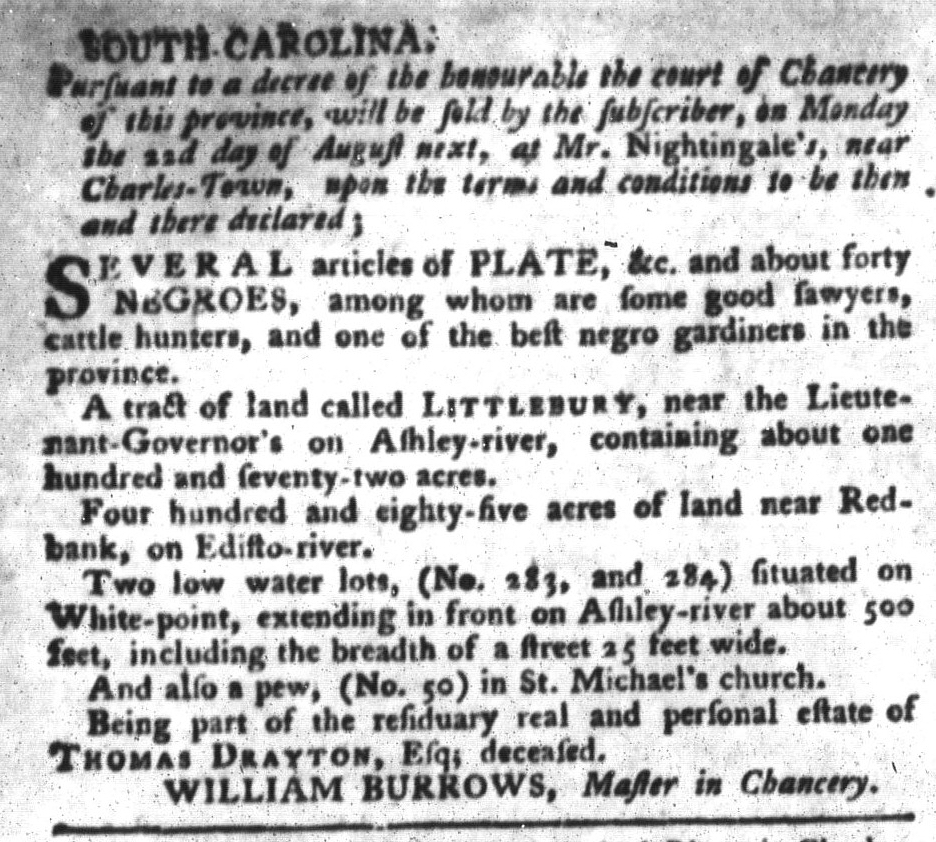
The Slavery Adverts 250 Project chronicles the role of newspaper advertising in perpetuating slavery in the era of the American Revolution. The project seeks to reveal the ubiquity of slavery in eighteenth-century life from New England to Georgia by republishing advertisements for slaves – for sale, wanted to purchase, runaways, captured fugitives – in daily digests on this site as well as in real time via the @SlaveAdverts250 Twitter feed, utilizing twenty-first-century media to stand in for the print media of the eighteenth century.

The project aims to provide modern audiences with a sense of just how often colonists encountered these advertisements in their daily lives. Enslaved men, women, and children appeared in print somewhere in the colonies almost every single day. Those advertisements served as a constant backdrop for social, cultural, economic, and political life in colonial and revolutionary America. Colonists who did not own slaves were still confronted with slavery as well as invited to maintain the system by purchasing slaves or assisting in the capture of runaways. The frequency of these newspaper advertisements suggests just how embedded slavery was in colonial and revolutionary American culture in everyday interactions beyond the printed page.

These advertisements also testify to the experiences of enslaved men, women, and children, though readers must consider that those experiences have been remediated through descriptions offered by slaveholders rather than the slaves themselves. Often unnamed in the advertisements, enslaved men, women, and children were not invisible or unimportant in early America.

These advertisements appeared in colonial American newspapers 250 years ago today.

Aug 9 - South-Carolina Gazette and Country Journal Slavery 1
South-Carolina Gazette and Country Journal (August 9, 1768).

**********

Aug 9 - South-Carolina Gazette and Country Journal Slavery 2
South-Carolina Gazette and Country Journal (August 9, 1768).

**********

Aug 9 - South-Carolina Gazette and Country Journal Slavery 3
South-Carolina Gazette and Country Journal (August 9, 1768).

**********

Aug 9 - South-Carolina Gazette and Country Journal Slavery 4
South-Carolina Gazette and Country Journal (August 9, 1768).

**********

Aug 9 - South-Carolina Gazette and Country Journal Slavery 5
South-Carolina Gazette and Country Journal (August 9, 1768).

**********

Aug 9 - South-Carolina Gazette and Country Journal Slavery 6
South-Carolina Gazette and Country Journal (August 9, 1768).

**********

Aug 9 - South-Carolina Gazette and Country Journal Slavery 7
South-Carolina Gazette and Country Journal (August 9, 1768).

**********

Aug 9 - South-Carolina Gazette and Country Journal Slavery 8
South-Carolina Gazette and Country Journal (August 9, 1768).

**********

Aug 9 - South-Carolina Gazette and Country Journal Supplement Slavery 1
Supplement to the South-Carolina Gazette and Country Journal (August 9, 1768).