August 8

Who was the subject of an advertisement in a colonial American newspaper 250 years ago today?

Aug 8 - 8:8:1768 New-York Gazette Weekly Post-Boy
New-York Gazette: Or, the Weekly Post-Boy (August 8, 1768).

“RUN away … a Welch Servant Man, named WILLIAM WALTERS.”

John Gifford was not happy when “a Welch Servant Man, named WILLIAM WALTERS” ran away in the summer of 1768. The aggrieved master reported that Walters, a mason, had departed with his wife, a woman described as “very remarkable in her Talk.” Gifford may have been commenting on her dialect, but given that he described both husband and wife as “much given to Drink” he may have meant that she resorted to crude speech that made her particularly easy to identify.

To reduce the chances of Walters and his unnamed wife successfully making their escape, Gifford placed notices in multiple newspapers. The New-York Gazette and Weekly Mercury and the New-York Gazette: Or, the Weekly Post-Boy both published his advertisement on Monday, August 8. The same advertisement first appeared the previous Thursday in the August 4 edition of the New-York Journal (number 1335). The notation “35 38” intended for the compositor indicated that Gifford made arrangements for his advertisement to run for four consecutive weeks. He intended to place it before as many eyes as possible in hopes of capturing the runaway mason.

To that end, Gifford immediately inserted a similar advertisement in the Pennsylvania Chronicle, printed in Philadelphia. Like the New York publications, it was distributed to subscribers and other readers far beyond the city. Gifford suspected that the couple might be more readily identified in New York and would attempt to make their way to another busy port before continuing their flight via ship to somewhere even more distant. Gifford’s advertisement ran in the Pennsylvania Chronicle the same day it first appeared in the New-York Gazette and Weekly Mercury and the New-York Gazette: Or, the Weekly Post-Boy, simultaneously informing widely dispersed readerships to be on the lookout for a Welch mason and his wife. Gifford must have quickly dispatched copy for the advertisement to William Goddard’s printing office on Market Street in Philadelphia in order for his notice to appear in print so quickly. He revised it only slightly, acknowledging local conditions by offering “Forty Shillings Reward” rather than “TWO POUNDS REWARD.” He also added a nota bene that demanded “All masters of vessels and others are hereby forbid to carry them off,” a standard warning in advertisements for runaway servants and slaves.

When it came to enlisting the aid of the public prints in capturing a runaway servant, Gifford spared little expense. In addition to the reward and “all reasonable Charges” he offered to “Whoever secures [Walters], so that his master may have him again,” he also invested in advertisements in four newspapers published in two cities. The New-York Journal was the only one that listed its advertising rates: “Five shillings, four Weeks.” Others most likely charged similar fees, indicating that Gifford spent at least twenty shilling (or one pound) on advertising intended to increase surveillance and lead to the capture and return of his runaway servant. Creating imagined communities via simultaneous readership was not just a project undertaken by printers who selected content from among possible news items, often reprinting from one newspaper to another. Advertisers made their own contributions to that project when they paid to have notices printed in multiple newspapers in multiple locations.

Slavery Advertisements Published August 8, 1768

The Slavery Adverts 250 Project chronicles the role of newspaper advertising in perpetuating slavery in the era of the American Revolution. The project seeks to reveal the ubiquity of slavery in eighteenth-century life from New England to Georgia by republishing advertisements for slaves – for sale, wanted to purchase, runaways, captured fugitives – in daily digests on this site as well as in real time via the @SlaveAdverts250 Twitter feed, utilizing twenty-first-century media to stand in for the print media of the eighteenth century.

The project aims to provide modern audiences with a sense of just how often colonists encountered these advertisements in their daily lives. Enslaved men, women, and children appeared in print somewhere in the colonies almost every single day. Those advertisements served as a constant backdrop for social, cultural, economic, and political life in colonial and revolutionary America. Colonists who did not own slaves were still confronted with slavery as well as invited to maintain the system by purchasing slaves or assisting in the capture of runaways. The frequency of these newspaper advertisements suggests just how embedded slavery was in colonial and revolutionary American culture in everyday interactions beyond the printed page.

These advertisements also testify to the experiences of enslaved men, women, and children, though readers must consider that those experiences have been remediated through descriptions offered by slaveholders rather than the slaves themselves. Often unnamed in the advertisements, enslaved men, women, and children were not invisible or unimportant in early America.

These advertisements appeared in colonial American newspapers 250 years ago today.

Aug 8 - Boston Evening-Post Slavery 1
Boston Evening-Post (August 8, 1768).

**********

Aug 8 - Boston Evening-Post Supplement Slavery 1
Supplement to the Boston Evening-Post (August 8, 1768).

**********

Aug 8 - Boston Evening-Post Supplement Slavery 2
Supplement to the Boston Evening-Post (August 8, 1768).

**********

Aug 8 - Boston Evening-Post Supplement Slavery 3
Supplement to the Boston Evening-Post (August 8, 1768).

**********

Aug 8 - Boston-Gazette Slavery 1
Boston-Gazette (August 8, 1768).

**********

Aug 8 - Boston-Gazette Slavery 2
Boston-Gazette (August 8, 1768).

**********

Aug 8 - Massachusetts Gazette Green and Russell Slavery 1
Massachusetts Gazette [Green & Russell] (August 8, 1768).

**********

Aug 8 - New-York Gazette Weekly Mercury Slavery 1
New-York Gazette and Weekly Mercury (August 8, 1768).

**********

Aug 8 - New-York Gazette Weekly Mercury Slavery 2
New-York Gazette and Weekly Mercury (August 8, 1768).

**********

Aug 8 - New-York Gazette Weekly Mercury Slavery 3
New-York Gazette and Weekly Mercury (August 8, 1768).

**********

Aug 8 - New-York Gazette Weekly Mercury Slavery 4
New-York Gazette and Weekly Mercury (August 8, 1768).

**********

Aug 8 - New-York Gazette Weekly Post-Boy Slavery 1
New-York Gazette: Or, the Weekly Post-Boy (August 8, 1768).

**********

Aug 8 - Newport Gazette Slavery 1
Newport Mercury (August 8, 1768).

**********

Aug 8 - Newport Mercury Slavery 2
Newport Mercury (August 8, 1768).

**********

Aug 8 - Newport Mercury Slavery 3
Newport Mercury (August 8, 1768).

**********

Aug 8 - Newport Mercury Slavery 4
Newport Mercury (August 8, 1768).

**********

Aug 8 - Newport Mercury Slavery 5
Newport Mercury (August 8, 1768).

**********

Aug 8 - Newport Mercury Slavery 6
Newport Mercury (August 8, 1768).

**********

Aug 8 - Pennsylvania Chronicle Slavery 1
Pennsylvania Chronicle (August 8, 1768).

**********

Aug 8 - Pennsylvania Chronicle Slavery 2
Pennsylvania Chronicle (August 8, 1768).

**********

Aug 8 - Pennsylvania Chronicle Slavery 3
Pennsylvania Chronicle (August 8, 1768).

**********

Aug 8 - South-Carolina Gazette Slavery 1
South-Carolina Gazette (August 8, 1768).

**********

Aug 8 - South-Carolina Gazette Slavery 2
South-Carolina Gazette (August 8, 1768).

**********

Aug 8 - South-Carolina Gazette Slavery 3
South-Carolina Gazette (August 8, 1768).

**********

Aug 8 - South-Carolina Gazette Slavery 4
South-Carolina Gazette (August 8, 1768).

**********

Aug 8 - South-Carolina Gazette Slavery 5
South-Carolina Gazette (August 8, 1768).

**********

Aug 8 - South-Carolina Gazette Slavery 6
South-Carolina Gazette (August 8, 1768).

**********

Aug 8 - South-Carolina Gazette Slavery 7
South-Carolina Gazette (August 8, 1768).

**********

Aug 8 - South-Carolina Gazette Slavery 8
South-Carolina Gazette (August 8, 1768).

**********

Aug 8 - South-Carolina Gazette Slavery 9
South-Carolina Gazette (August 8, 1768).

**********

Aug 8 - South-Carolina Gazette Slavery 10
South-Carolina Gazette (August 8, 1768).

**********

Aug 8 - South-Carolina Gazette Slavery 11
South-Carolina Gazette (August 8, 1768).

**********

Aug 8 - South-Carolina Gazette Slavery 12
South-Carolina Gazette (August 8, 1768).

August 7

What was advertised in a colonial American newspaper 250 years ago this week?

Aug 7 - 8:4:1768 Boston Weekly News-Letter
Boston Weekly News-Letter (August 4, 1768).

“Mr. Benjamin Leigh meets so great Encouragement in the Intelligence Office.”

In late July 1768, Benjamin Leigh began advertising an “Intelligence Office” at the Green Dragon Tavern that he opened “For the Benefit of the Public.” According to David Van Arsdale, “Intelligence offices in British North America shared many similarities with their English forebears.” Among them, they “continued operating in close relation to coffeehouses and centers of investment and commodity exchange, and continued providing employment services to the unemployed and seekers of their labor.”[1] In addition, Leigh listed a variety of other services associated with intelligence offices. He practiced discretion when facilitating transactions between those who had “money to lend” and others seeking to borrow. He also introduced those with “Merchandize Goods, Vessels, Lands, Negroes or Servants to sell,” rent, or charter with buyers or tenants. Beyond providing “employment services,” the men who operated intelligence offices were enmeshed in the slave trade, trucking in enslaved men, women, and children who were the objects rather than the beneficiaries of the assistance they provided in the world of colonial commerce.

Van Arsdale comments briefly on efforts to promote intelligence offices in the public prints, noting that Leigh and his counterparts in the colonies followed the example set in London by continuing to generate business through advertising. By the time Leigh informed readers of multiple newspapers published in Boston of his intelligence office at the Green Dragon Tavern, John Coghill Knapp had been advertising his services to residents of New York for several years. His frequent notices became a fixture in several newspapers. Van Arsdale also indicates that those who ran intelligence offices “often advertised … the success of English office as a way of establishing credibility and conjuring up business.”[2]

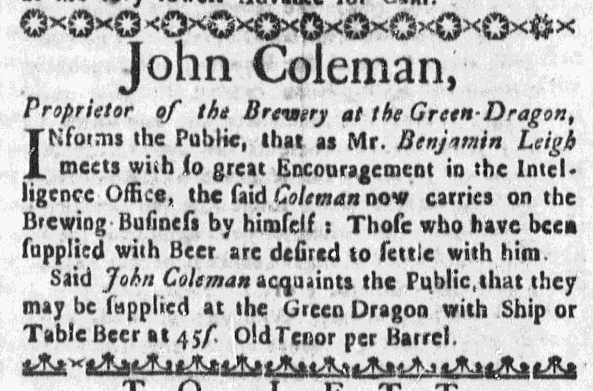
Leigh did not adopt that strategy in his own advertisements in the Boston-Gazette and the Boston Weekly News-Letter when he first opened his business, but evidence of the success of his new business did appear in advertisements printed elsewhere on the page. An advertisement placed by his former partner testified to the success of Leigh’s new endeavor. Shortly after Leigh began inserting his own notices, John Coleman, the “Proprietor of the Brewery at the Green-Dragon,” published a separate advertisement informing current and prospective customers that because Leigh “meets with so great Encouragement in the Intelligence Office” Coleman now ran the brewery on his own. In the August 4 edition of the Boston Weekly News-Letter, Coleman’s notice appeared one column to the right and just above Leigh’s advertisement. The proximity made it that much easier for readers to connect the messages delivered in each. Unlike many of his counterparts in the colonies, Leigh did not attempt to convince prospective clients that they should avail themselves of his services because intelligence offices on the other side of the Atlantic delivered results. Instead, another entrepreneur in Boston asserted the early success of Leigh’s enterprise, assuring potential clients that the system did indeed work in that busy port city.

**********

[1] David Van Arsdale, The Poverty of Work: Selling Servant, Slave and Temporary Labor on the Free Market (Brill, 2016), 85.

[2] Van Arsdale, Poverty of Work, 86.

August 6

What was advertised in a colonial American newspaper 250 years ago today?

Aug 6 - 8:6:1768 Providence Gazette
Providence Gazette (August 6, 1768).

“BLANKS of all Kinds sold by the Printers hereof.”

All of the advertisements on the final page of the August 6, 1768, edition of the Providence Gazette would have looked familiar to readers who perused that newspaper regularly. They included advertisements that Joseph Russell and William Russell had inserted in every issue for the past two months as well as a notice by Joseph Bucklin and Nicholas Clark announcing that they had “set up the CUTLERS Business in Providence.” In addition to earning their livelihood, Bucklin and Clark argued that they served the public by reducing dependence on imported knives and other cutlery. Another advertisement detailed the “SCHEME of a LOTTERY” intended to raise funds “for amending the Great North Road heading from Providence to Plainfield.” It also called on readers to consider the benefits to the general public when making decisions about how to spend their money.

The final advertisement in the August 6 edition would have looked the most familiar since it appeared often but not necessarily in every issue. Sarah Goddard and John Carter, printers of the Providence Gazette, regularly published a short notice that reminded readers “BLANKS of all Kinds sold by the Printers hereof.” Printed blanks (better known as forms today) included a variety of common legal and commercial devices, such as bills of sale, indentures, and powers of attorney. Goddard and Carter’s notice served a dual purpose. It promoted items sold at their printing office at the Sign of Shakespeare’s Head, yet it also played a role in the production of that issue of the newspaper itself. The brief advertisement completed the final column on the final page, a column filled almost entirely with the lengthy advertisements placed by Bucklin and Clark and the directors of the Great North Road Lottery. It was not imperative for it to appear in that issue of the Providence Gazette. After all, the colophon advertised “all Manner of PRINTING WORK” done at the printing office. The compositor inserted the brief advertisement for printed blanks as necessary to fill the page. Its purpose was as much to streamline production of the newspaper as to facilitate sales of widely used legal and commercial forms.

August 5

What was advertised in a colonial American newspaper 250 years ago today?

Aug 5 - 8:5:1768 Connecticut Journal
Connecticut Journal (August 5, 1768).

“colours, Six quarter|London quality’s|common, Spike do”

Although many eighteenth-century newspaper advertisements for consumer goods took the form of long lists delivered in dense paragraphs, some advertisers and compositors experimented with other formats that made advertisements easier to read. Listing only one or two items per line better highlighted each item; the white space aided in directing readers to those goods that most interested them. This strategy, however, reduced the number of items that could be included in the same amount of space. Advertisers had to choose between listing fewer goods or paying for advertisements that occupied greater amounts of space in newspapers.

Getting creative with typography allowed for another choice: dividing an advertisement into columns and listing one item per line per column. When undertaken by a skilled compositor, this strategy still introduced sufficient white space to significantly improve readability while doubling or tripling, depending on the number of columns, the number of goods that appeared in a neatly organized list. List-style advertisements that featured columns usually had only two, but occasionally compositors demonstrated that it was possible to effectively incorporate three columns.

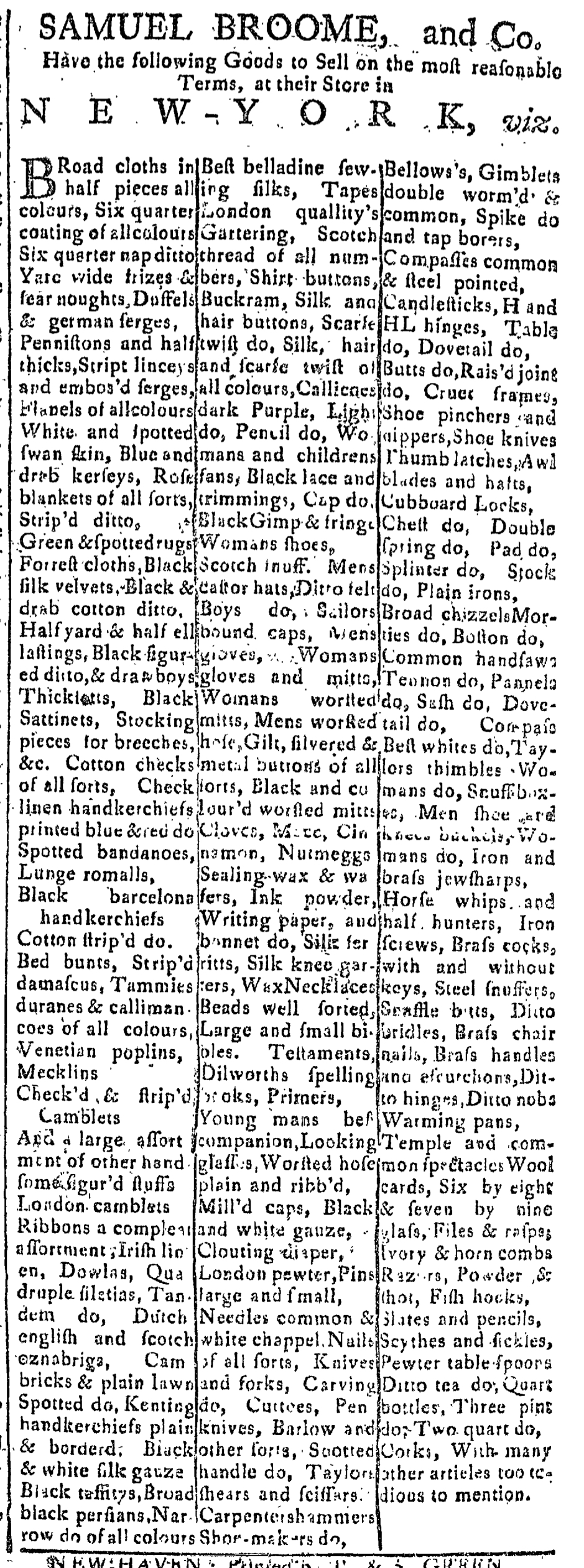
The success of this strategy depended on the skills of the compositor. An advertisement placed by Samuel Broome and Company in the August 5, 1768, edition of the Connecticut Journal demonstrates that experimenting with the graphic design elements of newspaper advertisements did not necessarily produce positive results. In an advertisement that filled an entire column, Broome and Company made an appeal to consumer choice by listing scores of items they sold at their store in New York. The compositor divided the advertisement into three columns, but apparently nobody affiliated with the production of the advertisement – neither Broome and Company when writing the copy nor the compositor when setting the type – insisted that it should list only one item per line per column. Instead, the advertisement featured the dense paragraph format common to so many newspaper advertisements, but divided into three narrow columns. Not only did this not make the contents any easier for prospective customers to read, the lack of space devoted to separating columns made the advertisement even more confusing and difficult to decipher.

While it is possible that the strange format may have attracted some attention, the challenges inherent in reading Broome and Company’s advertisement likely did not prompt potential customers to examine it closely, especially not casual readers who did not already have an interest in some of the goods that Broome and Company carried (if they could only find them in that disorienting list). Good typography helped to develop interest and perhaps incite demand for consumer goods listed in eighteenth-century newspaper advertisements, but clumsy typography that made it more difficult for readers to peruse some advertisements likely made those advertisements even less effective than if they had simply resorted to the traditional dense paragraph format.

Slavery Advertisements Published August 5, 1768

The Slavery Adverts 250 Project chronicles the role of newspaper advertising in perpetuating slavery in the era of the American Revolution. The project seeks to reveal the ubiquity of slavery in eighteenth-century life from New England to Georgia by republishing advertisements for slaves – for sale, wanted to purchase, runaways, captured fugitives – in daily digests on this site as well as in real time via the @SlaveAdverts250 Twitter feed, utilizing twenty-first-century media to stand in for the print media of the eighteenth century.

The project aims to provide modern audiences with a sense of just how often colonists encountered these advertisements in their daily lives. Enslaved men, women, and children appeared in print somewhere in the colonies almost every single day. Those advertisements served as a constant backdrop for social, cultural, economic, and political life in colonial and revolutionary America. Colonists who did not own slaves were still confronted with slavery as well as invited to maintain the system by purchasing slaves or assisting in the capture of runaways. The frequency of these newspaper advertisements suggests just how embedded slavery was in colonial and revolutionary American culture in everyday interactions beyond the printed page.

These advertisements also testify to the experiences of enslaved men, women, and children, though readers must consider that those experiences have been remediated through descriptions offered by slaveholders rather than the slaves themselves. Often unnamed in the advertisements, enslaved men, women, and children were not invisible or unimportant in early America.

These advertisements appeared in colonial American newspapers 250 years ago today.

Aug 5 - New-Hampshire Gazette Slavery 1
New-Hampshire Gazette (August 5, 1768).

**********

Aug 5 - New-London Gazette Slavery 1
New-London Gazette (August 5, 1768).

**********

Aug 5 - South-Carolina and American General Gazette Slavery 1
South-Carolina and American General Gazette (August 5, 1768).

**********

Aug 5 - South-Carolina and American General Gazette Slavery 2
South-Carolina and American General Gazette (August 5, 1768).

**********

Aug 5 - South-Carolina and American General Gazette Slavery 3
South-Carolina and American General Gazette (August 5, 1768).

**********

Aug 5 - South-Carolina and American General Gazette Slavery 4
South-Carolina and American General Gazette (August 5, 1768).

**********

Aug 5 - South-Carolina and American General Gazette Slavery 5
South-Carolina and American General Gazette (August 5, 1768).

**********

Aug 5 - South-Carolina and American General Gazette Slavery 6
South-Carolina and American General Gazette (August 5, 1768).

**********

Aug 5 - South-Carolina and American General Gazette Slavery 7
South-Carolina and American General Gazette (August 5, 1768).

**********

Aug 5 - South-Carolina and American General Gazette Slavery 8
South-Carolina and American General Gazette (August 5, 1768).

**********

Aug 5 - South-Carolina and American General Gazette Slavery 9
South-Carolina and American General Gazette (August 5, 1768).

**********

Aug 5 - South-Carolina and American General Gazette Slavery 10
South-Carolina and American General Gazette (August 5, 1768).

**********

Aug 5 - South-Carolina and American General Gazette Slavery 11
South-Carolina and American General Gazette (August 5, 1768).

**********

Aug 5 - South-Carolina and American General Gazette Slavery 12
South-Carolina and American General Gazette (August 5, 1768).

August 4

What was advertised in a colonial American newspaper 250 years ago today?

Aug 4 - 8:4:1768 New-York Journal
New-York Journal (August 4, 1768).

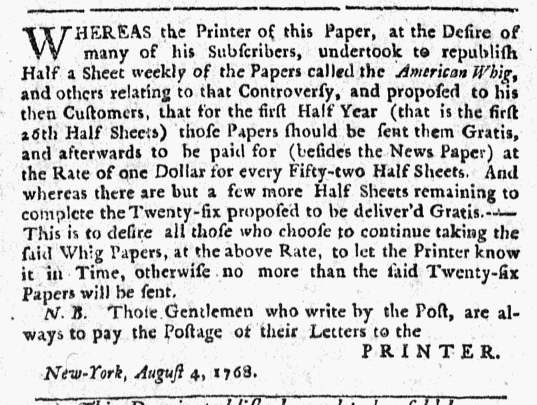
“All those who choose to continue taking the said Whig Papers … let the Printer know.”

Many American printers resorted to subscription notices to assess interest and incite demand for books and other items they considered publishing, but John Holt, publisher of the New-York Journal, experimented with another means of attracting customers for one of his projects. He offered a premium to those who subscribed to his newspaper. As Holt explained in an advertisement inserted in the August 4, 1768, edition of the New-York Journal, he had been republishing “Half a Sheet weekly of the Papers called the American Whig, and others relating to that Controversy.” The “Controversy” referred to “the Residence of Protestant Bishops in the American Colonies.” Holt distributed the first twenty-six half sheets gratis to those who already subscribed to the New-York Journal, but he expected interested readers to subscribe to subsequent half sheets from the American Whig series. He established a subscription rate of “one Dollar for every Fifty-two Half Sheets” in addition to the usual subscription fees for the New-York Journal. Holt instructed those who wished to continue receiving the American Whig supplements to “let the Printer know it in Time, otherwise no more than the said Twenty-six Papers will be sent.”

In terms of generating content for the American Whig, Holt adapted the standard practice that printers throughout the colonies used to fill the pages of their newspapers. They participated in networks of exchange, receiving newspapers from near and far and reprinting items previously published elsewhere. This method gathered and distributed all sorts of news, but Holt suspected that some readers might be interested in creating and preserving a volume devoted specifically to the controversy over Protestant bishops. To that end, the additional half sheets featured only reprinted items relevant to that debate, published separately “for the Conveniency of binding” into a book upon collecting sufficient number. Although Holt reported that he undertook this project “at the Desire of many of his Subscribers,” his initial widespread distribution of the free half sheets combined with his notice calling for subscribers to commit to paying for subsequent items in the series demonstrates that he hoped to enlarge the number of customers who purchased the American Whig. He used the free issues as a tool for enticing subscriptions for publishing a book.

Innovative as this marketing strategy may have been, it seems to have fallen short of Holt’s goals for attracting subscribers. He issued enough half sheets for two volumes, the first drawn from the original twenty-six distributed gratis and the second consisting of the subscription series, but a proposed third volume never went to press. Through his various advertising efforts, Holt managed to generate sufficient interest to sustain the project beyond its initial stages, but not enough to continue it for as long as he intended.

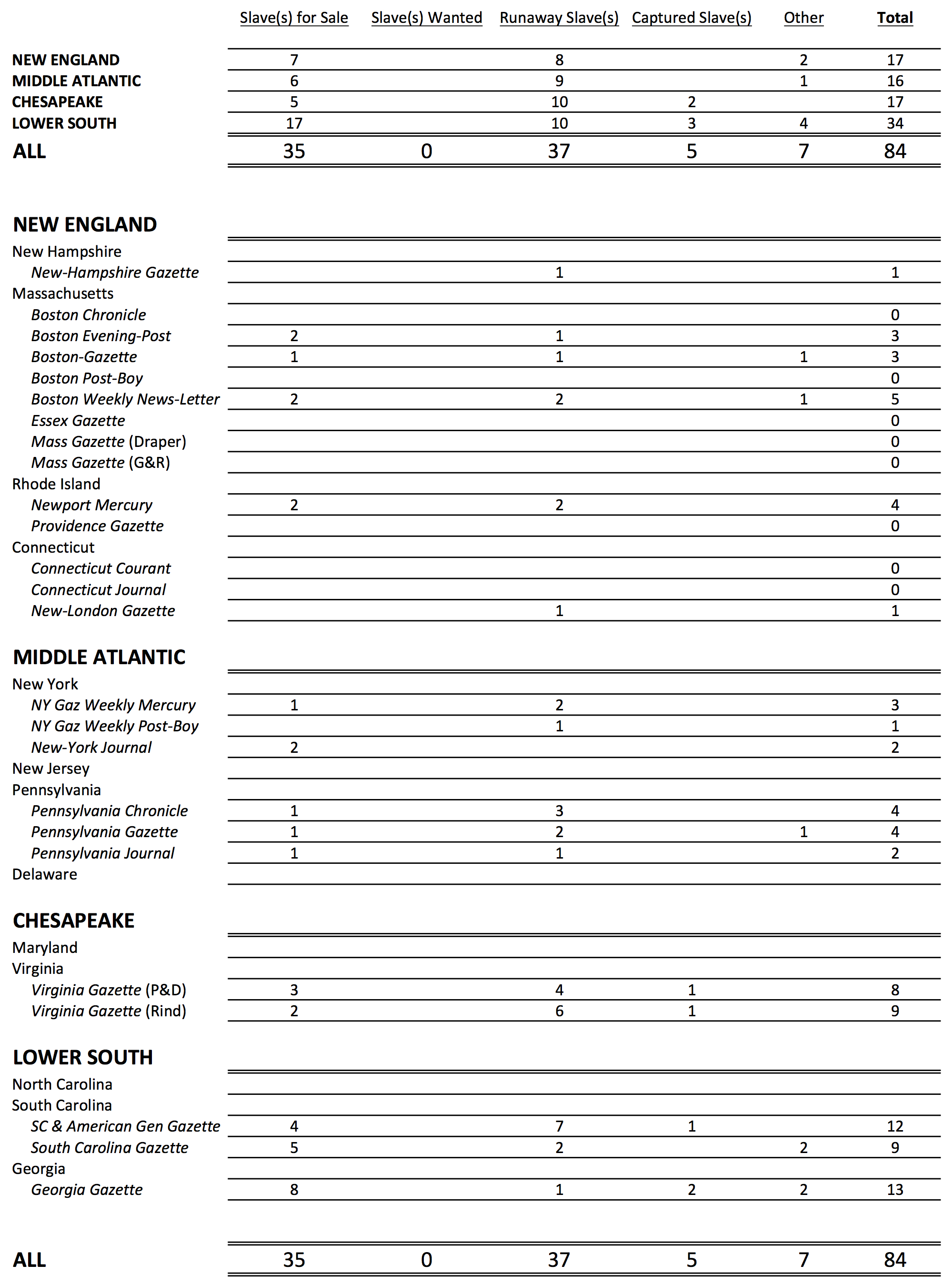
Summary of Slavery Advertisements Published July 29 – August 4, 1768

These tables indicate how many advertisements for slaves appeared in colonial American newspapers during the week of July 29 – August 4, 1768.

Note:  These tables are as comprehensive as currently digitized sources permit, but they may not be an exhaustive account.  They includes all newspapers that have been digitized and made available via Accessible Archives, Colonial Williamsburg’s Digital Library, and Readex’s America’s Historical Newspapers.  There are several reasons some newspapers may not have been consulted:

  • Issues that are no longer extant;
  • Issues that are extant but have not yet been digitized (including the Pennsylvania Journal); and
  • Newspapers published in a language other than English (including the Wochentliche Philadelphische Staatsbote).

**********

Slavery Advertisements Published July 29 – August 4, 1768:  By Date

Slavery Adverts Tables 1768 By Date Jul 29

**********

Slavery Advertisements Published July 29 – August 4:  By Region

Slavery Adverts Tables 1768 By Region Jul 29

Slavery Advertisements Published August 4, 1768

The Slavery Adverts 250 Project chronicles the role of newspaper advertising in perpetuating slavery in the era of the American Revolution. The project seeks to reveal the ubiquity of slavery in eighteenth-century life from New England to Georgia by republishing advertisements for slaves – for sale, wanted to purchase, runaways, captured fugitives – in daily digests on this site as well as in real time via the @SlaveAdverts250 Twitter feed, utilizing twenty-first-century media to stand in for the print media of the eighteenth century.

The project aims to provide modern audiences with a sense of just how often colonists encountered these advertisements in their daily lives. Enslaved men, women, and children appeared in print somewhere in the colonies almost every single day. Those advertisements served as a constant backdrop for social, cultural, economic, and political life in colonial and revolutionary America. Colonists who did not own slaves were still confronted with slavery as well as invited to maintain the system by purchasing slaves or assisting in the capture of runaways. The frequency of these newspaper advertisements suggests just how embedded slavery was in colonial and revolutionary American culture in everyday interactions beyond the printed page.

These advertisements also testify to the experiences of enslaved men, women, and children, though readers must consider that those experiences have been remediated through descriptions offered by slaveholders rather than the slaves themselves. Often unnamed in the advertisements, enslaved men, women, and children were not invisible or unimportant in early America.

These advertisements appeared in colonial American newspapers 250 years ago today.

Aug 4 - Boston Weekly News-Letter Slavery 1
Boston Weekly New-Letter (August 4, 1768).

**********

Aug 4 - Boston Weekly News-Letter Slavery 2
Boston Weekly New-Letter (August 4, 1768).

**********

Aug 4 - Boston Weekly News-Letter Slavery 3
Boston Weekly New-Letter (August 4, 1768).

**********

Aug 4 - Boston Weekly News-Letter Slavery 4
Boston Weekly New-Letter (August 4, 1768).

**********

Aug 4 - Boston Weekly News-Letter Slavery 5
Boston Weekly New-Letter (August 4, 1768).

**********

Aug 4 - New-York Journal Slavery 1
New-York Journal (August 4, 1768).

**********

Aug 4 - New-York Journal Slavery 2
New-York Journal (August 4, 1768).

**********

Aug 4 - Pennsylvania Gazette Slavery 1
Pennsylvania Gazette (August 4, 1768).

**********

Aug 4 - Pennsylvania Gazette Slavery 2
Pennsylvania Gazette (August 4, 1768).

**********

Aug 4 - Pennsylvania Gazette Slavery 3
Pennsylvania Gazette (August 4, 1768).

**********

Aug 4 - Pennsylvania Gazette Supplement Slavery 1
Supplement to the Pennsylvania Gazette (August 4, 1768).

**********

Aug 4 - Pennsylvania Journal Slavery 1
Pennsylvania Journal (August 4, 1768).

**********

Aug 4 - Pennsylvania Journal Slavery 2
Pennsylvania Journal (August 4, 1768).

**********

Aug 4 - Virginia Gazette Purdie and Dixon Slavery 1
Virginia Gazette [Purdie & Dixon] (August 4, 1768).

**********

Aug 4 - Virginia Gazette Purdie and Dixon Slavery 2
Virginia Gazette [Purdie & Dixon] (August 4, 1768).

**********

Aug 4 - Virginia Gazette Purdie and Dixon Slavery 3
Virginia Gazette [Purdie & Dixon] (August 4, 1768).

**********

Aug 4 - Virginia Gazette Purdie and Dixon Slavery 4
Virginia Gazette [Purdie & Dixon] (August 4, 1768).

**********

Aug 4 - Virginia Gazette Purdie and Dixon Slavery 5
Virginia Gazette [Purdie & Dixon] (August 4, 1768).

**********

Aug 4 - Virginia Gazette Purdie and Dixon Slavery 6
Virginia Gazette [Purdie & Dixon] (August 4, 1768).

**********

Aug 4 - Virginia Gazette Purdie and Dixon Slavery 7
Virginia Gazette [Purdie & Dixon] (August 4, 1768).

**********

Aug 4 - Virginia Gazette Purdie and Dixon Slavery 8
Virginia Gazette [Purdie & Dixon] (August 4, 1768).

**********

Aug 4 - Virginia Gazette Rind Slavery 1
Virginia Gazette [Rind] (August 4, 1768).

**********

Aug 4 - Virginia Gazette Rind Slavery 2
Virginia Gazette [Rind] (August 4, 1768).

**********

Aug 4 - Virginia Gazette Rind Slavery 3
Virginia Gazette [Rind] (August 4, 1768).

**********

Aug 4 - Virginia Gazette Rind Slavery 4
Virginia Gazette [Rind] (August 4, 1768).

**********

Aug 4 - Virginia Gazette Rind Slavery 5
Virginia Gazette [Rind] (August 4, 1768).

**********

Aug 4 - Virginia Gazette Rind Slavery 6
Virginia Gazette [Rind] (August 4, 1768).

**********

Aug 4 - Virginia Gazette Rind Slavery 7
Virginia Gazette [Rind] (August 4, 1768).

**********

Aug 4 - Virginia Gazette Rind Slavery 8
Virginia Gazette [Rind] (August 4, 1768).

**********

Aug 4 - Virginia Gazette Rind Slavery 9
Virginia Gazette [Rind] (August 4, 1768).

August 3

What was advertised in a colonial American newspaper 250 years ago today?

Aug 3 - 8:3:1768 Georgia Gazette
Georgia Gazette (August 3, 1768).

“A LARGE ASSORTMENT OF WHITE AND BLUE NEGROE CLOTH.”

The shipping news in the August 3, 1768, edition of the Georgia Gazette reported that five ships had “ENTERED OUTWARD” from the customs house at Savannah in the previous week, including the “Snow Pitt, [captained by] John Copithorn” bound for London. That was not, however, the only mention of the Pitt in that issue of Georgia’s only newspaper. As Copithorn and his crew prepared for their departure, local merchants sold the recently imported goods transported from Bristol aboard the Pitt. They also wrote copy for advertisements and submitted their notices to James Johnston’s printing office on Broughton Street.

The partnership of Inglis and Hall, prominent merchants and slave traders, stocked a variety of goods delivered to the colony by Copithorn and the Pitt. Their inventory included an assortment of textiles as well as “Ironmongery, of all kinds; … Saddlery; … Glass Ware of most kinds; … With many other Articles.” As tall as it was wide, their substantial advertisement occupied a fair amount of space on the page, especially compared to many of the other paid notices comprised of only two to five lines.

Read and Mossman placed one of those other advertisements. In it, they announced: “JUST IMPORTED by the subscribers, in the Snow Pitt, John Copithorn, from Bristol, A LARGE ASSORTMENT OF WHITE AND BLUE NEGROE CLOTH.” In comparison to such brevity, Inglis and Hall listed twenty different textiles as well as “suitable Trimmings” to adorn them according to the latest fashions. Current tastes did not matter nearly as much, if at all, when outfitting slaves for domestic labor or work in the fields. The “WHITE AND BLUE NEGROE CLOTH” sold by Read and Mossman would have been osnaburg or a similarly rough fabric, one valued more for its durability than its comfort or attractiveness.
The “Snow Pitt, John Copithorn, from Bristol” delivered a variety of goods to the Georgia marketplace. Some merited more marketing efforts than others. Inglis and Hall’s extensive list of textiles and other goods conjured images of vast consumer choices for those who would purchase and use the items themselves. On the other hand, Read and Mossman realized that “A LARGE ASSORTMENT OF WHITE AND BLUE NEGROE CLOTH” required no additional marketing, especially since those who would be wearing garments made of the cloth would not make the choice when it came to purchasing it. Although both partnerships focused primarily on fabrics imported on the same ship, Inglis and Hall advertised consumer goods while Read and Mossman advertised commodities.