The Slavery Adverts 250 Project chronicles the role of newspaper advertising in perpetuating slavery in the era of the American Revolution. The project seeks to reveal the ubiquity of slavery in eighteenth-century life from New England to Georgia by republishing advertisements for slaves – for sale, wanted to purchase, runaways, captured fugitives – in daily digests on this site as well as in real time via the @SlaveAdverts250 Twitter feed, utilizing twenty-first-century media to stand in for the print media of the eighteenth century.
The project aims to provide modern audiences with a sense of just how often colonists encountered these advertisements in their daily lives. Enslaved men, women, and children appeared in print somewhere in the colonies almost every single day. Those advertisements served as a constant backdrop for social, cultural, economic, and political life in colonial and revolutionary America. Colonists who did not own slaves were still confronted with slavery as well as invited to maintain the system by purchasing slaves or assisting in the capture of runaways. The frequency of these newspaper advertisements suggests just how embedded slavery was in colonial and revolutionary American culture in everyday interactions beyond the printed page.
These advertisements also testify to the experiences of enslaved men, women, and children, though readers must consider that those experiences have been remediated through descriptions offered by slaveholders rather than the slaves themselves. Often unnamed in the advertisements, enslaved men, women, and children were not invisible or unimportant in early America.
These advertisements appeared in colonial American newspapers 250 years ago today.
What was advertised in a colonial American newspaper 250 years ago today?
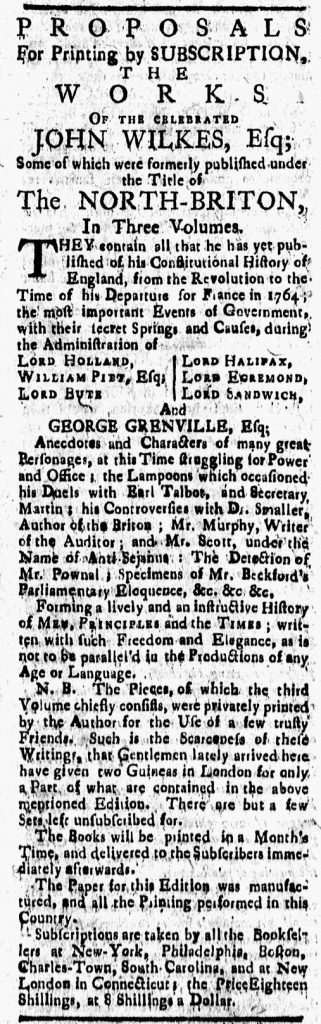
New-London Gazette (January 13, 1769).
“Subscriptions are taken by all the Booksellers.”
A subscription notice for “THE WORKS OF THE CELEBRATED JOHN WILKES” appeared among the advertisements in the January 13, 1769, edition of the New-London Gazette. The advertising copy exactly replicated that of a notice published in the New-York Journal a month earlier, with one exception. Like other subscription notices, it informed prospective customers where to submit their names to reserve a copy: “Subscriptions are taken by all the Booksellers at New-York, Philadelphia, Boston, Charles-Town, South-Carolina, and at New London in Connecticut.” The previous advertisement did not list New London. It had been added to the subscription notice in the New-London Gazette to better engage local readers.
Whether including New London or not, both versions of the subscription notice invoked the concept of what Benedict Anderson has famously described as “imagined community.” Print culture contributed to a sense of community among readers dispersed over great distances by allowing them to read the same newspapers, books, and pamphlets, all while imaging that their counterparts in other cities and towns were simultaneously reading them and imbibing the same information and ideas. This subscription notice envisioned readers in Boston and Charleston and place in between all purchasing and reading the same book. Anderson argues that imagined community achieved via print played a vital role in the formation of the nation. Wilkes, a radical English politician and journalist, had become a popular figure in the colonies during the imperial crisis. The subscription notice for his works appeared while the Townshend Act was in effect, at the same time that many colonists mobilized nonimportation agreements in protest and the New-Hampshire Gazette was printed on smaller sheets because the publishers refused to import paper from England that would require them to pay duties.
The slightly revised version of the subscription notice had the capacity to even more effectively invoke the idea of an imagined community among colonists. It did not limit the collection of subscriptions to the four largest port cities, the places with the most printers and the most newspapers. Instead, by listing New London with Boston, Charleston, New York, and Philadelphia, the subscription notice expanded the sphere of engagement by making the proposed book more accessible on the local level for readers and prospective subscribers in New London and its environs. Reading Wilkes was not just for colonists in urban settings. Instead, it was an endeavor for colonists anywhere and everywhere.
What was advertised in a colonial American newspaper 250 years ago today?
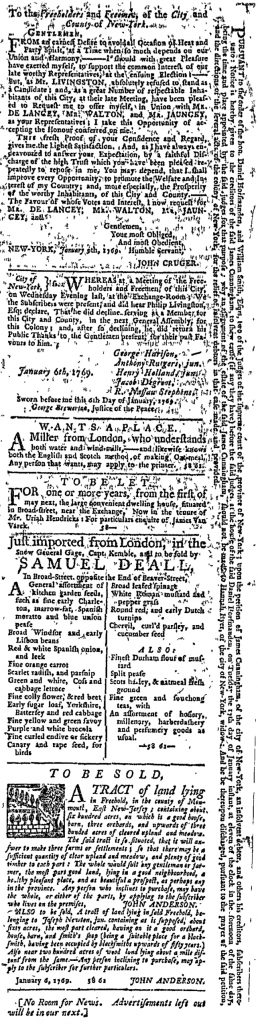
New-York Journal (January 12, 1769)
“[No Room for News. Advertisements left out will be in our next.]”
John Holt, the printer of the New-York Journal, faced a dilemma when he prepared the January 12, 1769, edition to go to press. He had too much content for the standard four-page issue. A short notice at the bottom of the final column on the third page advised readers that there was “[No Room for News. Advertisements left out will be in our next.]”
Why place this notice on the third page instead of the last? Consider the mechanics of printing a four-page newspaper on a hand-operated press in eighteenth-century America. Minimizing the number of impressions reduced the amount of time required working at the press. To maximize efficiency, printers produced the standard four-page edition by printing two pages on each side of a broadsheet and then folding it in half. This required setting type for the fourth and first pages to print simultaneously and then the second and third pages to print together. Compositors usually set the exterior pages first, in part because they included material that repeated from week to week, such as the masthead on the first page and the colophon and advertisements on the fourth page. The type for the third page often would have been the last set for the issue, explaining why Holt’s notice about not having enough space for all the news and advertisements appeared at the bottom of the final column of that page.
Still, Holt made additional efforts to serve his customers. A legal notice concerning James Cunningham, “an insolvent debtor,” that otherwise would have appeared among the advertisements instead ran along the right margin of the third page. It concerned a hearing that would take place on January 17, before publication of the next edition of the New-York Journal. If Holt wished to generate the advertising revenue, it was imperative to find a way to insert that advertisement in the January 12 issue. Printers sometimes ran short advertisements in the margins, rotating the text so it appeared perpendicular to the rest of the column. In most cases such advertisements ran in several columns, only a few lines each and the same width as the columns that ran the length of the entire page. Compositors used advertisements that already appeared in previous issues, transferring lines of type already set. The legal notice concerning Cunningham, however, had not previously appeared in the New-York Journal. It appeared as a short but wide paragraph that ran the length of the page.
Holt also issued a two-page Supplement to the New-York Journal. Except for the masthead, the first page consisted entirely of “The ANATOMIST, No. XIV,” the next installment in a series of essays that ran in the weekly supplement. The essay concluded on the following page, leaving space for some news (“JOURNAL of OCCURRENCES, continued,” with the dateline “BOSTON, December 10”) and two advertisements. One of those advertisements included a notation on the final line, “56 59,” to remind the compositor that the advertisement was to appear in issues 1356 through 1359. The January 12 edition and its supplement comprised issue 1358. Though he did not have sufficient space in the standard issue, Holt made room in the supplement to insert that advertisement.
As the January 12, 1769, edition of the New-York Journal demonstrates, colonial printers and compositors made creative choices in their efforts to circulate news and advertising to colonial readers and consumers. Even as he offered assurances to advertisers that their notices would indeed appear in the next issue, Holt finagled additional space that allowed some to circulate immediately rather than being delayed a week.
The Slavery Adverts 250 Project chronicles the role of newspaper advertising in perpetuating slavery in the era of the American Revolution. The project seeks to reveal the ubiquity of slavery in eighteenth-century life from New England to Georgia by republishing advertisements for slaves – for sale, wanted to purchase, runaways, captured fugitives – in daily digests on this site as well as in real time via the @SlaveAdverts250 Twitter feed, utilizing twenty-first-century media to stand in for the print media of the eighteenth century.
The project aims to provide modern audiences with a sense of just how often colonists encountered these advertisements in their daily lives. Enslaved men, women, and children appeared in print somewhere in the colonies almost every single day. Those advertisements served as a constant backdrop for social, cultural, economic, and political life in colonial and revolutionary America. Colonists who did not own slaves were still confronted with slavery as well as invited to maintain the system by purchasing slaves or assisting in the capture of runaways. The frequency of these newspaper advertisements suggests just how embedded slavery was in colonial and revolutionary American culture in everyday interactions beyond the printed page.
These advertisements also testify to the experiences of enslaved men, women, and children, though readers must consider that those experiences have been remediated through descriptions offered by slaveholders rather than the slaves themselves. Often unnamed in the advertisements, enslaved men, women, and children were not invisible or unimportant in early America.
These advertisements appeared in colonial American newspapers 250 years ago today.
What was advertised in a colonial American newspaper 250 years ago today?
Georgia Gazette (January 11, 1769).
“Just imported … and to be sold by JOHN HIGGIN.”
In January 1769, John Higgin advertised a variety of goods “Just imported, from Liverpool and Corke, and to be sold … At Mr. Moore’s Store opposite the Exchange.” Unlike Inglis and Hall, whose advertisement from the previous week appeared in the Georgia Gazette once again, Higgin did not regularly insert advertisements for consumer goods in the colony’s only newspaper. The shipping news suggests that may have been because Higgin was not a resident of Savannah but instead a ship captain who sometimes did some trading on his own.
According to the shipping news in the January 4 edition of the Georgia Gazette, the “Snow Ann,” captained by John Higgins “ENTERED INWARDS at the CUSTOM-HOUSE” from Montserrat and St. Martin’s that very day. A week later, Higgin published an advertisement for “IRISH linens,” “Cheque, silk, and muslin handkerchiefs,” “Tin saucepans,” and an assortment of other textiles, garments, and housewares. Like many other advertisements, it ran in three consecutive issues (January 11, 18, and 25) before being discontinued. Higgin, however, did not disappear from the pages of the Georgia Gazette. The following week, the “Snow Anne, John Higgin,” headed for Montserrat was listed among the vessels “ENTERED OUTWARDS” at the customhouse. Preparations for departure took some time. Higgin and his vessel remained on that list for nearly two months. In the March 29 edition, the shipping news reported that the “Snow Anne, John Higgin” had “CLEARED” on March 23.
While it is possible that the John Higgin who commanded the Anne and the John Higgin who sold imported goods were two different people, the evidence in the Georgia Gazette suggests otherwise. That the advertisement stated Higgin’s goods came from Liverpool and Cork likely indicated their origins rather than suggesting that they had been transported directly from the British Isles to Georgia. Higgin would have had plenty of opportunities to pursue side ventures on his own while sailing the Anne in the Caribbean. When competing against other purveyors of imported goods in Savannah, he would have been at a disadvantage if he reported that his merchandise from Liverpool and Cork made a detour to the sugar islands first. After all, colonial consumers demanded the newest fashions when it came to clothing and housewares. Selling his wares “At Mr. Moore’s Store” rather than a shop of his own would have been appropriate for someone only in Savannah briefly.
Higgin’s advertisement occupied more space than most advertisements for consumer goods and services that ran in the Georgia Gazette. Although this suggested the array of choices available to prospective customers, Higgin likely envisioned an additional strategy when he composed the advertisement. Unlike Inglis and Hall and other local merchants and shopkeepers already familiar to residents of the colony, Higgin was unknown and in port for a limited time. Especially if he wished to acquire new wares for further trading before departing, he needed to sell as quickly as possible. An advertisement of such length certainly made his presence known.
The Slavery Adverts 250 Project chronicles the role of newspaper advertising in perpetuating slavery in the era of the American Revolution. The project seeks to reveal the ubiquity of slavery in eighteenth-century life from New England to Georgia by republishing advertisements for slaves – for sale, wanted to purchase, runaways, captured fugitives – in daily digests on this site as well as in real time via the @SlaveAdverts250 Twitter feed, utilizing twenty-first-century media to stand in for the print media of the eighteenth century.
The project aims to provide modern audiences with a sense of just how often colonists encountered these advertisements in their daily lives. Enslaved men, women, and children appeared in print somewhere in the colonies almost every single day. Those advertisements served as a constant backdrop for social, cultural, economic, and political life in colonial and revolutionary America. Colonists who did not own slaves were still confronted with slavery as well as invited to maintain the system by purchasing slaves or assisting in the capture of runaways. The frequency of these newspaper advertisements suggests just how embedded slavery was in colonial and revolutionary American culture in everyday interactions beyond the printed page.
These advertisements also testify to the experiences of enslaved men, women, and children, though readers must consider that those experiences have been remediated through descriptions offered by slaveholders rather than the slaves themselves. Often unnamed in the advertisements, enslaved men, women, and children were not invisible or unimportant in early America.
These advertisements appeared in colonial American newspapers 250 years ago today.
What was advertised in a colonial American newspaper 250 years ago today?
Essex Gazette (January 10, 1768).
“THE Overseers of the Poor of the Town of Salem would be glad to bind out a Number of poor Children.”
Colonial newspapers tended to be regional rather than local, as the names sometimes indicated. Consider the newspapers published in 1769. The Georgia Gazette (published in Savannah), the Massachusetts Gazette (published in Boston), the Pennsylvania Gazette (published in Philadelphia), the South-Carolina Gazette (published in Charleston), and the Virginia Gazette (published in Williamsburg) all served their respective colonies and beyond. Other newspapers with names that specified their places of publication also circulated far beyond the towns and cities that appeared in their mastheads. Such was the case for the Boston Evening-Post, the Newport Mercury, and the Providence Gazette. The title of the South-Carolina and American General Gazette summed up the extensive communities served by colonial newspapers. They were simultaneously local and regional publications.
That was the case for advertising as well as news. The majority of paid notices that appeared in any newspaper concerned local affairs, yet a smaller number of advertisements from beyond the city or town where a newspaper was published were interspersed. Artisans and shopkeepers in Albany, for instance, placed advertisements in newspapers published in New York. Colonists in Maryland, Delaware, and New Jersey as well as towns in Pennsylvania beyond Philadelphia placed advertisements for consumer goods and services, legal notices, estate notices, and other sorts of notices in the newspapers published in Philadelphia. In each instance, they depended on the extensive circulation across a vast geography to place their notices before the eyes of readers in their own communities.
By the end of the eighteenth century, however, the number of newspapers increased dramatically. Especially after the American Revolution, printers established newspapers in smaller cities and towns, eliminating some of the need for newspapers to serve regional audiences. Those new publications allowed advertisers to target local readers more effectively. The process began prior to the Revolution. When Samuel Hall commenced publication of the Essex Gazette in Salem, Massachusetts, in August 1768, he offered his community more than just “the freshest Advices, both foreign and domestic.” As the colophon indicated, he took in subscriptions and advertisements at the printing office. Not just for news but also for advertising, residents of Salem and the surrounding towns now had a local alternative to the several newspapers published in Boston. Residents of Salem could continue to insert advertisements in the Boston Chronicle, the Boston Post-Boy, and their competitors as a means of placing them before larger audiences, yet some advertisers likely considered the local alternative more appropriate and more effective for their purposes, whether selling goods or keeping the community informed about local affairs.
What was advertised in a colonial American newspaper 250 years ago today?
New-York Gazette and Weekly Mercury (January 9, 1769).
“The Business of Shoe-making is carried on as usual.”
Mary Ogden likely never appeared in the public prints prior to the death of her husband, but in the wake of that event she placed two advertisements in the New-York Gazette and Weekly Mercury. The first was a standard estate notice for Moses Ogden of Elizabethtown, New Jersey, that listed her as executrix along with executors Robert Ogden, Jr., and John Cousens Ogden. It called on “ALL Persons having any Demands upon the Estate of Moses Ogden” as well as “those who are any wise indebted to the said Estate” to settle their accounts as quickly as possible. The Ogdens also threatened legal action or “further Trouble” for those who did not heed the notice.
Although Mary worked in collaboration with the executors, presumably relatives, in the first advertisement, the second invoked her name alone. Appearing immediately below the estate notice, it deployed her name as a headline in a font much larger than the rest of the advertisement. The widow announced “that the Business of Shoe-making is carried on as usual.” Furthermore, “orders for any Articles in that Way, shall be complied with in the best and most expeditious Manner.” In other words, the death of her husband Moses did not bring an end to the family business. Mary sought to support herself by continuing the endeavor “as usual.”
The widow Ogden did not provide further details about the operations of the business. She may have made shoes herself, or she may have overseen one or more employees who previously worked for her husband. Like many other wives of shopkeepers and artisans, she likely played an important role in maintaining the family business while her husband still lived, although his would have been the most prominent public face associated with their shared enterprise. Still, she may have interacted with customers, helped with bookkeeping, and assisted in making shoes. All of these roles prepared her for running the business on her own after the loss of her husband. At that time, her name became the one associated with the business. Her name achieved much greater prominence in the marketplace and, especially, in print, even if her contributions to the family business did not much change after the death of her husband.
The Slavery Adverts 250 Project chronicles the role of newspaper advertising in perpetuating slavery in the era of the American Revolution. The project seeks to reveal the ubiquity of slavery in eighteenth-century life from New England to Georgia by republishing advertisements for slaves – for sale, wanted to purchase, runaways, captured fugitives – in daily digests on this site as well as in real time via the @SlaveAdverts250 Twitter feed, utilizing twenty-first-century media to stand in for the print media of the eighteenth century.
The project aims to provide modern audiences with a sense of just how often colonists encountered these advertisements in their daily lives. Enslaved men, women, and children appeared in print somewhere in the colonies almost every single day. Those advertisements served as a constant backdrop for social, cultural, economic, and political life in colonial and revolutionary America. Colonists who did not own slaves were still confronted with slavery as well as invited to maintain the system by purchasing slaves or assisting in the capture of runaways. The frequency of these newspaper advertisements suggests just how embedded slavery was in colonial and revolutionary American culture in everyday interactions beyond the printed page.
These advertisements also testify to the experiences of enslaved men, women, and children, though readers must consider that those experiences have been remediated through descriptions offered by slaveholders rather than the slaves themselves. Often unnamed in the advertisements, enslaved men, women, and children were not invisible or unimportant in early America.
These advertisements appeared in colonial American newspapers 250 years ago today.
Boston Evening-Post (January 9, 1769).
**********
Boston-Gazette (January 9, 1769).
**********
Newport Mercury (January 9, 1769).
**********
New-York Gazette and Weekly Mercury (January 9, 1769).
**********
New-York Gazette and Weekly Mercury (January 9, 1769).
**********
New-York Gazette and Weekly Mercury (January 9, 1769).
**********
New-York Gazette: Or, the Weekly Mercury (January 9, 1769).
**********
New-York Gazette: Or, the Weekly Mercury (January 9, 1769).
**********
South-Carolina and American General Gazette (January 9, 1769).
**********
South-Carolina and American General Gazette (January 9, 1769).
**********
South-Carolina and American General Gazette (January 9, 1769).
**********
South-Carolina and American General Gazette (January 9, 1769).
**********
South-Carolina and American General Gazette (January 9, 1769).
**********
South-Carolina and American General Gazette (January 9, 1769).
**********
South-Carolina and American General Gazette (January 9, 1769).
**********
South-Carolina and American General Gazette (January 9, 1769).
**********
South-Carolina and American General Gazette (January 9, 1769).
What was advertised in a colonial American newspaper 250 years ago this week?
Massachusetts Gazette [Draper] (January 5, 1769).“Most of these Papers will, probably, be irrevocably lost in a few Years, unless they be preserved by Printing.”
An advertisement concerning a proposed companion volume to a well-known publication appeared in the January 5, 1769, edition of Richard Draper’s Massachusetts Gazette. In 1764, Boston bookseller Jeremiah Condy published the first volume of The History of the Colony of Massachusetts-Bay by Thomas Hutchinson, lieutenant governor of the colony at the time. Thomas Fleet and John Fleet printed the book, which covered the period “from the first settlement thereof in 1628 until its incorporation with the colony of Plimoth, province of Main, &c. by the Charter of King William and Queen Mary, in 1691.” Three years later, Condy published the second volume, also printed by the Fleets. It extended the narrative “from the charter of King William and Queen Mary, in 1681, until the year 1750.” Both volumes were widely advertised in Boston’s newspapers and beyond.
Condy had been working on a related project when he died in 1768. As the Fleets explained, “THE late Mr. CONDY intended to have published a Volumne of curious Papers, to have served as an Appendix to the Lieutenant-Governor’s HISTORY of the MASSACHUSETTS-BAY, but Death prevented.” Not to be deterred, the Fleets issued a subscription notice “to encourage the Printing of the same Collection.” The proposed volume would be the same size and approximate length as the other two in the series, “about 600 Pages in Octavo.”
The Fleets deployed several strategies to convince readers to purchase the companion volume. They declared that they would publish it only “as soon as a sufficient Number of Subscribers appear to defrey the Expence.” If not enough buyers made a commitment in advance, the book would not go to press. Furthermore, the Fleets warned that “No Books will be printed for Sale.” This suggested a limited edition. They would print only enough copies to fulfill the orders placed by subscribers and no additional copies for subsequent retail sales. The printers attempted to maneuver prospective customers into reserving a copy for fear of missing out if they delayed. This may have been an especially effective strategy targeting those who acquired the first and second volumes as they contemplated completing the series with the companion volume.
In addition, the Fleets called on a sense of civic pride among prospective subscribers. They painted a stark portrait of what might happen if the proposed volume did not garner sufficient interest to go to press. “As most of these Papers will, probably, be irrecoverably lost in a few Years, unless they be preserved by Printing, it is hoped that a sufficient Number of Subscribers will soon appear.” According to the Fleets, the survival of the original documents mattered less than the proliferation of copies produced on the press. Any single document or copy could be lost or destroyed, but the proliferation of copies guaranteed that subsequent generations would continue to have access to the important documents that comprised the history of the colony. In that regard, subscribers practiced a significant public service. Those who subscribed to the companion volume did so not only “for the sake of their particular Entertainment” but also “from a regard to the Public.” The printers layered the act of purchasing this book with social meaning. Acquiring this volume, the Fleets argued, fulfilled a civic responsibility that would benefit the entire community, both now and in the future.