February 6

What was advertised in a colonial American newspaper 250 years ago today?

Feb 6 - 2:6:1770 Essex Gazette
Essex Gazette (February 6, 1770).

“WHOEVER sends Goods … may be assured of the Fidelity of the Master of said Hall.”

In February 1770, John Gerrish “(And COMPANY.)” expanded his efforts to address prospective customers in a regional market when he published an advertisement for his “Auction-Hall” in the Essex Gazette just days after placing an advertisement in the Providence Gazette. He continued to insert advertisements in several of the newspapers printed in Boston.

Although Gerrish tended to submit the same copy to local printing offices, the advertisement he drafted for the Essex Gazette was quite different from the one in the Providence Gazette. He did not provide details about auctions for readers in Rhode Island, instead focusing on “Wholesale and Retail” sales for a “GREAT Variety of ARTICLES.” For readers of the Essex Gazette, however, he extended an invitation to “Public-Vendues” or auctions “held Weekly in said Auction-Hall; but chiefly on TUESDAYS, and THURSDAYS.” He also encouraged prospective bidders to become clients, asserting that “WHOEVER sends Goods … to be Sold by private or public Sale, may be assured of the Fidelity of the Master of said Hall.” In other words, Gerrish recognized that clients took risks when they entrusted goods to him to sell; he sought to alleviate anxiety that he might give deals to close associates who did business with him regularly and, in the process, deprive clients of the best possible prices they could have achieved for their goods. When he pledged “Fidelity” to his clients, Gerrish vowed to operate in their best interests rather than underselling for his own benefit. He was not the only auctioneer in Boston to address such issues of trust in newspapers advertisements in the late 1760s and early 1770s.

To further entice “Country GENTLEMEN, Travelers, and Traders” from beyond Boston to examine the wares or attend a vendue at his auction house, Gerrish added a nota bene that advised they could find “Very Good Lodgings and Boarding … in Court-Square, opposite to AUCTION HALL.” In addition to seeing to the comfort of prospective bidders, buyers, and clients, that establishment also provided “very good Keeping for Horses.”

Gerrish had been advertising in multiple newspapers in Boston for years, but early in 1770 he experimented with placing notices in newspapers published in nearby towns. He likely hoped to expand his client base by enlarging the market for his services as a “Public Vendue-Master” and interest in the “New & Second-Hand” goods available at his auction house. He certainly increased his investment in advertising, hoping that it would result in more business and higher revenues at an auction house that competed with several others in Boston.

Slavery Advertisements Published February 6, 1770

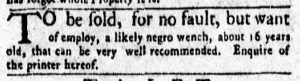
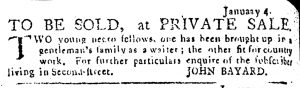
The Slavery Adverts 250 Project chronicles the role of newspaper advertising in perpetuating slavery in the era of the American Revolution. The project seeks to reveal the ubiquity of slavery in eighteenth-century life from New England to Georgia by republishing advertisements for slaves – for sale, wanted to purchase, runaways, captured fugitives – in daily digests on this site as well as in real time via the @SlaveAdverts250 Twitter feed, utilizing twenty-first-century media to stand in for the print media of the eighteenth century.

The project aims to provide modern audiences with a sense of just how often colonists encountered these advertisements in their daily lives. Enslaved men, women, and children appeared in print somewhere in the colonies almost every single day. Those advertisements served as a constant backdrop for social, cultural, economic, and political life in colonial and revolutionary America. Colonists who did not own slaves were still confronted with slavery as well as invited to maintain the system by purchasing slaves or assisting in the capture of runaways. The frequency of these newspaper advertisements suggests just how embedded slavery was in colonial and revolutionary American culture in everyday interactions beyond the printed page.

These advertisements also testify to the experiences of enslaved men, women, and children, though readers must consider that those experiences have been remediated through descriptions offered by slaveholders rather than the slaves themselves. Often unnamed in the advertisements, enslaved men, women, and children were not invisible or unimportant in early America.

These advertisements appeared in colonial American newspapers 250 years ago today.

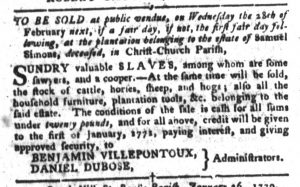
Feb 6 1770 - South-Carolina Gazette and Country Journal Slavery 1
South-Carolina Gazette and Country Journal (February 6, 1770).

**********

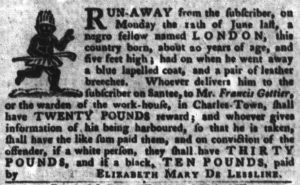
Feb 6 1770 - South-Carolina Gazette and Country Journal Slavery 2
South-Carolina Gazette and Country Journal (February 6, 1770).

**********

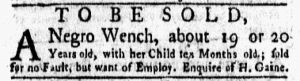
Feb 6 1770 - South-Carolina Gazette and Country Journal Slavery 3
South-Carolina Gazette and Country Journal (February 6, 1770).

**********

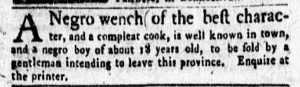
Feb 6 1770 - South-Carolina Gazette and Country Journal Slavery 4
South-Carolina Gazette and Country Journal (February 6, 1770).

**********

Feb 6 1770 - South-Carolina Gazette and Country Journal Slavery 5
South-Carolina Gazette and Country Journal (February 6, 1770).

**********

Feb 6 1770 - South-Carolina Gazette and Country Journal Slavery 6
South-Carolina Gazette and Country Journal (February 6, 1770).

**********

Feb 6 1770 - South-Carolina Gazette and Country Journal Slavery 7
South-Carolina Gazette and Country Journal (February 6, 1770).

**********

Feb 6 1770 - South-Carolina Gazette and Country Journal Slavery 8
South-Carolina Gazette and Country Journal (February 6, 1770).

**********

Feb 6 1770 - South-Carolina Gazette and Country Journal Slavery 9
South-Carolina Gazette and Country Journal (February 6, 1770).

**********

Feb 6 1770 - South-Carolina Gazette and Country Journal Supplement Slavery 1
Supplement to the South-Carolina Gazette and Country Journal (February 6, 1770).

**********

Feb 6 1770 - South-Carolina Gazette and Country Journal Supplement Slavery 2
Supplement to the South-Carolina Gazette and Country Journal (February 6, 1770).

**********

Feb 6 1770 - South-Carolina Gazette and Country Journal Supplement Slavery 3
Supplement to the South-Carolina Gazette and Country Journal (February 6, 1770).

**********

Feb 6 1770 - South-Carolina Gazette and Country Journal Supplement Slavery 4
Supplement to the South-Carolina Gazette and Country Journal (February 6, 1770).

**********

Feb 6 1770 - South-Carolina Gazette and Country Journal Supplement Slavery 5
Supplement to the South-Carolina Gazette and Country Journal (February 6, 1770).

**********

Feb 6 1770 - South-Carolina Gazette and Country Journal Supplement Slavery 6
Supplement to the South-Carolina Gazette and Country Journal (February 6, 1770).

**********

Feb 6 1770 - South-Carolina Gazette and Country Journal Supplement Slavery 7
Supplement to the South-Carolina Gazette and Country Journal (February 6, 1770).

**********

Feb 6 1770 - South-Carolina Gazette and Country Journal Supplement Slavery 8
Supplement to the South-Carolina Gazette and Country Journal (February 6, 1770).

February 5

What was advertised in a colonial American newspaper 250 years ago today?

Feb 5 - 2:5:1770 New-York Gazette and Weekly Mercury
New-York Gazette and Weekly Mercury (February 5, 1770).

“All the Books in this Catalogue are either American Manufacture, or imported long before the Non-Importation Agreement.”

Robert Bell, one of the most industrious booksellers in eighteenth-century America, owed his success in part to savvy advertising. His advertisement for an “Auction of Books” in the February 5, 1770, edition of the New-York Gazette and Weekly Mercury, for instance, incorporated two significant marketing strategies intended to incite consumer demand.

Bell began by announcing that he had just published a “CATALOGUE of new and old BOOKS” that prospective customers could acquire “gratis at the Place of Sale.” Bell likely intended that distributing the catalog would get people through the door. When they came to pick up a catalog many might decide to view the merchandise. Then they carried away a catalog as a reminder of the books they had examined. In passing out catalogs, Bell also enhanced the dissemination of information about his merchandise beyond the reach of his newspaper advertisement. Prospective customers who obtained catalogues could share them with members of their household as well as friends and neighbors. Bell did not rely on a single medium to attract attention to his “Auction of Books.” Instead, he had multiple marketing media in circulation.

He also addressed the politics of consumption, concluding his advertisement with a note about the origins of the books he offered for sale. “[A]ll the Books in this Catalogue,” he assured prospective customers, “are either American Manufacture, or imported long before the Non-Importation Agreement.” Although colonial printers produced some American imprints, the most books in the colonies were imported from England prior to the American Revolution. Bell sought to mediate that reality by focusing on the fact that his books had been imported before merchants, shopkeepers, and others enacted a boycott of imported goods to protest the duties levied on certain imported goods in the Townshend Acts. Rather than focus on where those volumes had been produced he instead emphasized when they had arrived in the colonies. Still, he did make an appeal to the place of production when he could, noting that some of his books were indeed “American Manufacture.” To underscore the importance of these distinctions, he addressed prospective customers as “Lovers and real Practisers of Patriotism,” challenging all readers to consider the political meanings of consumer goods.

Eighteenth-century newspaper advertisements have sometimes been dismissed as mere announcements that made no effort at marketing. Bell’s notice, however, demonstrates that some advertisers engaged in savvy marketing campaigns … and that consumers were exposed to their efforts to shape the colonial marketplace.

Slavery Advertisements Published February 5, 1770

The Slavery Adverts 250 Project chronicles the role of newspaper advertising in perpetuating slavery in the era of the American Revolution. The project seeks to reveal the ubiquity of slavery in eighteenth-century life from New England to Georgia by republishing advertisements for slaves – for sale, wanted to purchase, runaways, captured fugitives – in daily digests on this site as well as in real time via the @SlaveAdverts250 Twitter feed, utilizing twenty-first-century media to stand in for the print media of the eighteenth century.

The project aims to provide modern audiences with a sense of just how often colonists encountered these advertisements in their daily lives. Enslaved men, women, and children appeared in print somewhere in the colonies almost every single day. Those advertisements served as a constant backdrop for social, cultural, economic, and political life in colonial and revolutionary America. Colonists who did not own slaves were still confronted with slavery as well as invited to maintain the system by purchasing slaves or assisting in the capture of runaways. The frequency of these newspaper advertisements suggests just how embedded slavery was in colonial and revolutionary American culture in everyday interactions beyond the printed page.

These advertisements also testify to the experiences of enslaved men, women, and children, though readers must consider that those experiences have been remediated through descriptions offered by slaveholders rather than the slaves themselves. Often unnamed in the advertisements, enslaved men, women, and children were not invisible or unimportant in early America.

These advertisements appeared in colonial American newspapers 250 years ago today.

Feb 5 1770 - Massachusetts Gazette and Boston Post-Boy Slavery 1
Massachusetts Gazette and Boston Post-Boy (February 5, 1770).

**********

Feb 5 1770 - New-York Gazette and Weekly Mercury Slavery 1
New-York Gazette and Weekly Mercury (February 5, 1770).

**********

Feb 5 1770 - New-York Gazette and Weekly Mercury Slavery 2
New-York Gazette and Weekly Mercury (February 5, 1770).

**********

Feb 5 1770 - New-York Gazette and Weekly Mercury Slavery 3
New-York Gazette and Weekly Mercury (February 5, 1770).

**********

Feb 5 1770 - New-York Gazette and Weekly Mercury Slavery 4
New-York Gazette and Weekly Mercury (February 5, 1770).

**********

Feb 5 1770 - New-York Gazette and Weekly Mercury Slavery 5
New-York Gazette and Weekly Mercury (February 5, 1770).

**********

Feb 5 1770 - New-York Gazette and Weekly Mercury Slavery 6
New-York Gazette and Weekly Mercury (February 5, 1770).

**********

Feb 5 1770 - New-York Gazette and Weekly Mercury Slavery 7
New-York Gazette and Weekly Mercury (February 5, 1770).

**********

Feb 5 1770 - New-York Gazette or Weekly Post-Boy Slavery 1
New-York Gazette or Weekly Post-Boy (February 5, 1770).

**********

Feb 5 1770 - New-York Gazette or Weekly Post-Boy Slavery 2
New-York Gazette or Weekly Post-Boy (February 5, 1770).

**********

Feb 5 1770 - Newport Mercury Slavery 1
Newport Mercury (February 5, 1770).

February 4

What was advertised in a colonial American newspaper 250 years ago this week?

Feb 4 - 2:1:1770 Maryland Gazette
Maryland Gazette (February 1, 1770).

“The Smith’s Shop is carried on … with the same Care and Dispatch as was in her Husband’s Lifetime.”

When Thomas Williams, a blacksmith in Prince George’s County, Maryland, passed away, his widow, Cave, served as administratrix of his estate, joined by another Thomas Williams, perhaps an adult son, as administrator. They jointly placed an advertisement in the February 1, 1770, edition of the Maryland Gazette, deploying standard language calling on “ALL Persons having any just Claims” against the estate to present them. At the same time they requested that anyone “indebted to the said Estate” settle accounts or else face legal action.

That advertisement featured an addendum that revealed the widow did not serve as administratrix of the estate merely in a ceremonial capacity. She assumed responsibility for her husband’s business and pledged to maintain it after his death. “The Smith’s shop,” she informed readers, “is carried on, by the Subscriber, with the same Care and Dispatch as was in her Husband’s Lifetime.” The widow most likely did not work as a blacksmith herself, though historians have identified some women who did pursue that trade in colonial America. She much more likely managed the business, continuing and expanding on contributions she made to the family business while her husband was still alive. She may have previously served in a role that Laurel Thatcher Ulrich has described as “deputy husband,” taking on tasks most often associated with men but undertaken by their wives when necessary. Those tasks might have included interacting with customers and ordering supplies on behalf of the business, exercising authority presumed to belong to her husband but seamlessly transferred to her as his representative. The widow certainly had a sense of what needed to be done for the “Smith’s Shop” to serve customers and succeed. She vowed that “all Gentlemen and others may depend on their Work being done faithfully.” She also asserted that she kept on hand “a Sufficiency of Coal and Iron, so as not to disappoint any Customer.” Even if Cave Williams did not pump the bellows or pound a hammer herself, she understood the operations of her family’s blacksmith shop. She aimed to convince previous clients of that, asking for “the Continuance of their Favours,” while simultaneously attracting new customers.

February 3

What was advertised in a colonial American newspaper 250 years ago today?

Feb 3 - 4:3:1770 Providence Gazette
Providence Gazette (February 3, 1770).

“AUCTION HALL, In Court-Square, near the Town-House, opposite the Royal Exchange.”

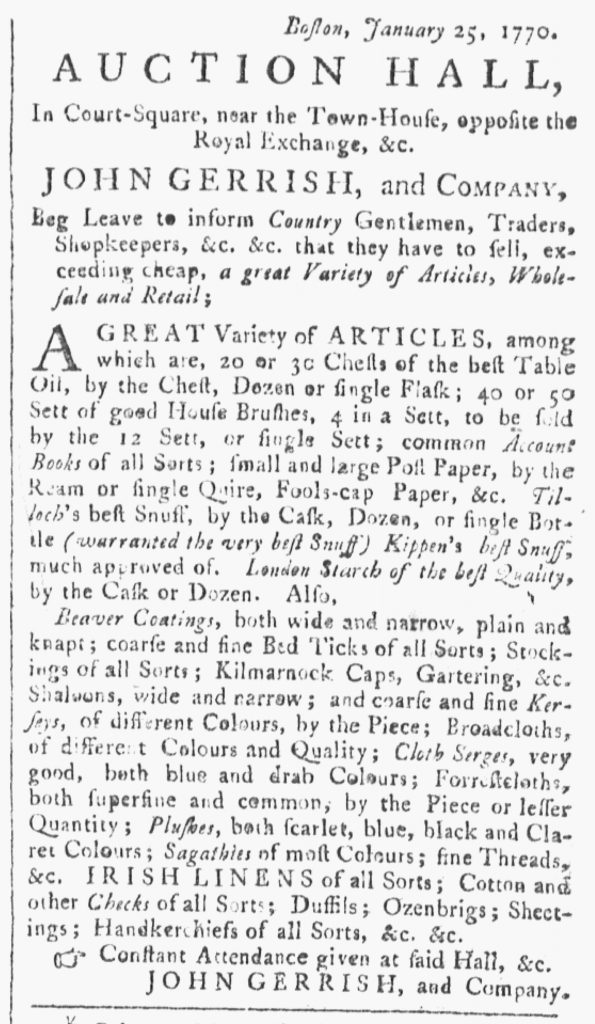
Like other auctioneers, John Gerrish frequently inserted advertisements in several newspapers published in Boston. In a single week, he placed notices about upcoming sales in three local newspapers. On Monday, January 29, 1770, he ran nearly identical advertisements in the Boston Evening-Post and the Boston-Gazette to advise prospective customers of a “publick Vendue” or auction that would take place at his “Auction-Hall,—King-Street” the following evening. On Thursday, February 1, Gerrish placed another advertisement in the Massachusetts Gazette and Boston Weekly News-Letter, this time announcing an auction scheduled for ‘THIS EVENING.” Often promoting specific events happening within a matter of days, advertisements by auctioneers tended to run only once or twice, though Gerrish and others industriously submitted new notices to several printing offices almost every week.

Vendue masters in Boston, however, did not tend to advertise in the Providence Gazette. The short time that elapsed between announcing a sale and it taking place did not allow for sending notices to the printing office in Providence or for readers of that newspaper to make their way to Boston to participate in a particular auction. Yet Gerrish did not solely sell merchandise at auction. He ran a “Wholesale and Retail” operation out of his auction hall to supplement his revenues. For that enterprise he acquired a stable inventory that did not go to the highest bidder at the next sale, prompting him to experiment with placing an advertisement for those goods in the Providence Gazette in hopes of widening the market.

In so doing, Gerrish addressed “Country Gentlemen, Traders, [and] Shopkeepers,” that he offered a “GREAT Variety of ARTICLES.” He listed several items, including popular textiles, different kinds of paper, and more than one brand of snuff. Realizing that he addressed prospective customers much less familiar with his auction hall than residents of Boston, he provided much more extensive directions than he usually included in his local newspapers. Instead of “Auction-Hall,—King-Street,” he directed readers to the “AUCTION HALL, In Court-Square, near the Town-House, opposite the Royal Exchange.” He also assured prospective customers of “Constant Attendance given at said Hall.” Prospective customers from Providence and elsewhere in the “Country” need not worry about traveling some distance and arriving at the auction hall only to be inconvenienced by finding it closed or understaffed.

In the late 1760s and early 1770s, most purveyors of consumer goods and services did not advertise in newspapers other than those published in their own towns. Some, however, did make the investment in hopes of enlarging their clientele. They imagined regional rather than local markets for their wares.

February 2

What was advertised in a colonial American newspaper 250 years ago today?

Feb 2 - 2:2:1770 New-Hampshire Gazette
New-Hampshire Gazette (February 2, 1770).

“He still carries on Clock and Watch making as usual.”

Nathaniel Sheaff Griffith, a clock- and watchmaker, was a prolific advertiser who frequently inserted notices in the New-Hampshire Gazette. The frequency of his advertisements may have been occasioned in large part by his rivalry with John Simnet, a competitor who previously practiced the trade in London for several years before migrating to the colonies and setting up shop in the same market as Griffith. Both men advertised and, in a rare occurrence in eighteenth-century newspaper advertisements, departed from merely promoting their own services in favor of denigrating the skill and even the character of the other. They did not explicitly name their rival, but context made the intent of their remarks clear to readers.

Simnet, the newcomer, was the more aggressive. In his first advertisement for 1770, he proclaimed himself the “only perfect Watchmaker ever in this Country,” a bit of boasting that disparaged Griffith as much as it bolstered Simnet. First appearing in the New-Hampshire Gazette on January 12, that brief but provocative notice continued for several weeks. On February 2, Griffith placed a new advertisement, his first of the year. As he had done sometimes, but not always, in the past, Griffith refused to engage with Simnet. Without much fanfare, he sought to inform “his Customers, and others, that he still carries on Clock and Watch making as usual, at his Shop opposite Dr. Langdon’s Meeting House.”

Although he did not spar with Simnet, Griffith did offer appeals intended to resonate with prospective clients. He acknowledged his previous customers and stated that he continued his trade “as usual,” establishing his prior service to local consumers and the stability of his business. Griffith also reported that he had “all Sorts of Materials for said Business,” reassuring readers that he possessed the supplies necessary for his work. Griffith’s advertisement was not as flashy as Simnet’s, but perhaps it did not need to be. Griffith had much deeper roots in the community and may have believed that he did not need to be as strident as Simnet in his advertisements.

February 1

What was advertised in a colonial American newspaper 250 years ago today?

Feb 1 - 2:1:1770 Maryland Gazette
Maryland Gazette (February 1, 1770).

“Nothing has been contrary to the true Spirit and Intention of the Articles of Association.”

Legh Master’s advertisement for “A CARGO of European and East India GOODS” dated December 6, 1769, continued to run in the February 1, 1770, edition of the Maryland Gazette, nearly two months after it first appeared. In it, Master indicated that he had “JUST IMPORTED” the merchandise. He appended a lengthy note to explain some of the circumstances surrounding the arrival of his wares in Annapolis. The digital remediation of the original eighteenth-century newspaper is difficult to decipher, compelling a transcription of that note in its entirety.

“The Committee of Merchants of this City, having fully considered all the Papers, and Evidence relative to this Affair, and being quite satisfied, that in the Purchase and Importation of those Goods, nothing has been done contrary to the true Spirit and Intention of the Articles of Association of this Province, unanimously consented to their being landed, and disposed of in such Manner as I should think proper. L.M.”

Master imported and sold goods during the era of the imperial crisis that ultimately resulted in the American Revolution. He did so at a time that tensions between colonists and Parliament had intensified due to the duties levied on certain imported goods – paper, glass, paint, lead, and tea – in the Townshend Acts. Colonists engaged in various methods of resistance, including leveraging commerce and consumer culture as political tools when they refused to import a much broader array of goods than just those taxed by Parliament. Merchants, shopkeepers, and others collectively committed to such plans, joining local associations and signing nonimportation agreements. Committees oversaw compliance, alerting the public when fellow colonists refused to join the boycott or violated its terms after signing. Reputations hung in the balance as colonists policed the decisions their friends and neighbors made about imported goods.

Master had concerns about running afoul of the local “Committee of Merchants” in Annapolis. He also sought to reassure prospective customers that they could purchase his merchandise without endangering their own standing in the community. He intended for the lengthy note appended to his advertisement to provide those assurances, especially since his fellow colonists could easily verify whether the committee had indeed examined the evidence and “unanimously consented” to Master accepting the shipment and selling the goods as he saw fit. Like other retailers in the late 1760s and early 1770s, Master made a case that consumers could purchase his wares and be patriotically correct in doing so.

Slavery Advertisements Published February 1, 1770

The Slavery Adverts 250 Project chronicles the role of newspaper advertising in perpetuating slavery in the era of the American Revolution. The project seeks to reveal the ubiquity of slavery in eighteenth-century life from New England to Georgia by republishing advertisements for slaves – for sale, wanted to purchase, runaways, captured fugitives – in daily digests on this site as well as in real time via the @SlaveAdverts250 Twitter feed, utilizing twenty-first-century media to stand in for the print media of the eighteenth century.

The project aims to provide modern audiences with a sense of just how often colonists encountered these advertisements in their daily lives. Enslaved men, women, and children appeared in print somewhere in the colonies almost every single day. Those advertisements served as a constant backdrop for social, cultural, economic, and political life in colonial and revolutionary America. Colonists who did not own slaves were still confronted with slavery as well as invited to maintain the system by purchasing slaves or assisting in the capture of runaways. The frequency of these newspaper advertisements suggests just how embedded slavery was in colonial and revolutionary American culture in everyday interactions beyond the printed page.

These advertisements also testify to the experiences of enslaved men, women, and children, though readers must consider that those experiences have been remediated through descriptions offered by slaveholders rather than the slaves themselves. Often unnamed in the advertisements, enslaved men, women, and children were not invisible or unimportant in early America.

These advertisements appeared in colonial American newspapers 250 years ago today.

Feb 1 1770 - Maryland Gazette Slavery 1
Maryland Gazette (February 1, 1770).

**********

Feb 1 1770 - Maryland Gazette Slavery 2
Maryland Gazette (February 1, 1770).

**********

Feb 1 1770 - New-York Journal Slavery 1
New-York Journal (February 1, 1770).

**********

Feb 1 1770 - New-York Journal Slavery 2
New-York Journal (February 1, 1770).

**********

Feb 1 1770 - New-York Journal Slavery 3
New-York Journal (February 1, 1770).

**********

Feb 1 1770 - New-York Journal Slavery 4
New-York Journal (February 1, 1770).

**********

Feb 1 1770 - Pennsylvania Gazette Slavery 1
Pennsylvania Gazette (February 1, 1770).

**********

Feb 1 1770 - Pennsylvania Journal Slavery 1
Pennsylvania Journal (February 1, 1770).

**********

Feb 1 1770 - South-Carolina Gazette Slavery 1
South-Carolina Gazette (February 1, 1770).

**********

Feb 1 1770 - South-Carolina Gazette Slavery 2
South-Carolina Gazette (February 1, 1770).

**********

Feb 1 1770 - South-Carolina Gazette Slavery 3
South-Carolina Gazette (February 1, 1770).

**********

Feb 1 1770 - South-Carolina Gazette Slavery 4
South-Carolina Gazette (February 1, 1770).

**********

Feb 1 1770 - South-Carolina Gazette Slavery 5
South-Carolina Gazette (February 1, 1770).

**********

Feb 1 1770 - South-Carolina Gazette Slavery 6
South-Carolina Gazette (February 1, 1770).

**********

Feb 1 1770 - South-Carolina Gazette Slavery 7
South-Carolina Gazette (February 1, 1770).

**********

Feb 1 1770 - South-Carolina Gazette Slavery 8
South-Carolina Gazette (February 1, 1770).

**********

Feb 1 1770 - South-Carolina Gazette Slavery 9
South-Carolina Gazette (February 1, 1770).

**********

Feb 1 1770 - South-Carolina Gazette Slavery 10
South-Carolina Gazette (February 1, 1770).

**********

Feb 1 1770 - South-Carolina Gazette Slavery 11
South-Carolina Gazette (February 1, 1770).

**********

Feb 1 1770 - South-Carolina Gazette Slavery 12
South-Carolina Gazette (February 1, 1770).

**********

Feb 1 1770 - South-Carolina Gazette Slavery 13
South-Carolina Gazette (February 1, 1770).

**********

Feb 1 1770 - South-Carolina Gazette Slavery 14
South-Carolina Gazette (February 1, 1770).

**********

Feb 1 1770 - South-Carolina Gazette Slavery 15
South-Carolina Gazette (February 1, 1770).

**********

Feb 1 1770 - South-Carolina Gazette Slavery 16
South-Carolina Gazette (February 1, 1770).

**********

Feb 1 1770 - South-Carolina Gazette Slavery 17
South-Carolina Gazette (February 1, 1770).