Slavery Advertisements Published June 5, 1770

Guest Curator: Jenna Smith

The Slavery Adverts 250 Project chronicles the role of newspaper advertising in perpetuating slavery in the era of the American Revolution. The project seeks to reveal the ubiquity of slavery in eighteenth-century life from New England to Georgia by republishing advertisements for slaves – for sale, wanted to purchase, runaways, captured fugitives – in daily digests on this site as well as in real time via the @SlaveAdverts250 Twitter feed, utilizing twenty-first-century media to stand in for the print media of the eighteenth century.

The project aims to provide modern audiences with a sense of just how often colonists encountered these advertisements in their daily lives. Enslaved men, women, and children appeared in print somewhere in the colonies almost every single day. Those advertisements served as a constant backdrop for social, cultural, economic, and political life in colonial and revolutionary America. Colonists who did not own slaves were still confronted with slavery as well as invited to maintain the system by purchasing slaves or assisting in the capture of runaways. The frequency of these newspaper advertisements suggests just how embedded slavery was in colonial and revolutionary American culture in everyday interactions beyond the printed page.

These advertisements also testify to the experiences of enslaved men, women, and children, though readers must consider that those experiences have been remediated through descriptions offered by slaveholders rather than the slaves themselves. Often unnamed in the advertisements, enslaved men, women, and children were not invisible or unimportant in early America.

From compiling an archive of digitized eighteenth-century newspapers to identifying advertisements about enslaved men, women, and children in those newspapers to preparing images of each advertisement to posting this daily digest, Jenna Smith served as guest curator for this entry. Working on this project fulfilled her senior capstone requirement for completing the major in History at Assumption College in Worcester, Massachusetts.

These advertisements appeared in colonial American newspapers 250 years ago today.

Jun 5 - South Carolina Gazette and Country Journal Slavery 1
South-Carolina Gazette and Country Journal (June 5, 1770).

**********

Jun 5 - South Carolina Gazette and Country Journal Slavery 2
South-Carolina Gazette and Country Journal (June 5, 1770).

**********

Jun 5 - South Carolina Gazette and Country Journal Slavery 3
South-Carolina Gazette and Country Journal (June 5, 1770).

**********

Jun 5 - South Carolina Gazette and Country Journal Slavery 4
South-Carolina Gazette and Country Journal (June 5, 1770).

**********

Jun 5 - South Carolina Gazette and Country Journal Slavery 5
South-Carolina Gazette and Country Journal (June 5, 1770).

**********

Jun 5 - South Carolina Gazette and Country Journal Slavery 6
South-Carolina Gazette and Country Journal (June 5, 1770).

**********

Jun 5 - South Carolina Gazette and Country Journal Slavery 7
South-Carolina Gazette and Country Journal (June 5, 1770).

June 4

What was advertised in a colonial American newspaper 250 years ago today?

Jun 4 - 6:4:1770 Connecticut Courant
Connecticut Courant (June 4, 1770).

The following BOOKS.”

Lathrop and Smith made a significant investment in their advertisement that ran in the June 4, 1770, edition of the Connecticut Courant.  Divided into four narrow columns, it filled the space usually devoted to two of the three columns on the final page of the newspaper.  Overall, it comprised one-sixth of the content (two out of twelve columns) delivered to readers.  Listing just over 250 individual titles, it was a book catalog distribute via alternate means.  Lathrop and Smith could have just as easily arranged for handbills or broadsides to inform prospective customers of the assortment of books they sold at their store in Hartford.

That they stocked these books in a relatively small town did not mean, however, that their customers should expect to pay higher prices.  Lathrop and Smith proclaimed that they sold their books “at as low a rate as they are usually sold inBoston or New-York,” the major urban ports in the region.  Furthermore, they encouraged readers to spot special bargains, asking them to take note that “Those articles marked thus [*] are to be Sold for very little more than the Prime Cost.”  In other words, the local booksellers charged only a small markup on several volumes, including Van Swieten’s Commentaries on Boerhaave’s Aphorisms, Winslow’s Anatomy, Moral Tales, and Vicar of Wakefield.

Lathrop and Smith also aided prospective customers in finding titles of interest by separating them according to genre and inserting headers, such as “DIVINITY,” “LAW,” “PHYSIC, SURGERY, &c.,” “SCHOOL BOOKS,” “HISTORY,” and ‘MISCELLANY.”  Within each category, the books were alphabetized by author or title, with the exception of four titles appended to the books on divinity (though they were also alphabetized).  When it came to writing copy, Lathrop and Smith attempted to make their catalog accessible and easy to navigate.

In general, their advertisement was just as sophisticated as those published by their counterparts in Boston, New York, and Philadelphia.  The Connecticut Courant ran much less advertising than newspapers in those port cities, but that did not necessarily mean that advertisers did not adopt the same methods and strategies for appealing to consumers.

Slavery Advertisements Published June 4, 1770

Guest Curator: Jenna Smith

The Slavery Adverts 250 Project chronicles the role of newspaper advertising in perpetuating slavery in the era of the American Revolution. The project seeks to reveal the ubiquity of slavery in eighteenth-century life from New England to Georgia by republishing advertisements for slaves – for sale, wanted to purchase, runaways, captured fugitives – in daily digests on this site as well as in real time via the @SlaveAdverts250 Twitter feed, utilizing twenty-first-century media to stand in for the print media of the eighteenth century.

The project aims to provide modern audiences with a sense of just how often colonists encountered these advertisements in their daily lives. Enslaved men, women, and children appeared in print somewhere in the colonies almost every single day. Those advertisements served as a constant backdrop for social, cultural, economic, and political life in colonial and revolutionary America. Colonists who did not own slaves were still confronted with slavery as well as invited to maintain the system by purchasing slaves or assisting in the capture of runaways. The frequency of these newspaper advertisements suggests just how embedded slavery was in colonial and revolutionary American culture in everyday interactions beyond the printed page.

These advertisements also testify to the experiences of enslaved men, women, and children, though readers must consider that those experiences have been remediated through descriptions offered by slaveholders rather than the slaves themselves. Often unnamed in the advertisements, enslaved men, women, and children were not invisible or unimportant in early America.

From compiling an archive of digitized eighteenth-century newspapers to identifying advertisements about enslaved men, women, and children in those newspapers to preparing images of each advertisement to posting this daily digest, Jenna Smith served as guest curator for this entry. Working on this project fulfilled her senior capstone requirement for completing the major in History at Assumption College in Worcester, Massachusetts.

These advertisements appeared in colonial American newspapers 250 years ago today.

Jun 4 - Boston Evening-Post Slavery 1
Boston Evening-Post (June 4, 1770).

**********

Jun 4 - Boston Gazette and Country Journal Slavery 1
Boston Gazette and Country Journal (June 4, 1770).

**********

Jun 4 - Boston Gazette and Country Journal Slavery 2
Boston Gazette and Country Journal (June 4, 1770).

**********

Jun 4 - Boston Gazette and Country Journal Supplement Slavery 1
Boston Gazette and Country Journal (June 4, 1770).

**********

Jun 4 - Boston Gazette and Country Journal Supplement Slavery 2
Boston Gazette and Country Journal (June 4, 1770).

**********

Jun 4 - Boston Gazette and Country Journal Supplement Slavery 3
Boston Gazette and Country Journal (June 4, 1770).

**********

Jun 4 - Boston Gazette and Country Journal Supplement Slavery 4
Boston Gazette and Country Journal (June 4, 1770).

**********

Jun 4 - Boston Post-Boy Slavery 1
Boston Post-Boy (June 4, 1770).

**********

Jun 4 - New-York Gazette and the Weekly Mercury Slavery 1
New-York Gazette and Weekly Mercury (June 4, 1770).

**********

Jun 4 - New-York Gazette or Weekly Post-Boy Slavery 1
New-York Gazette or Weekly Post-Boy (June 4, 1770).

**********

Jun 4 - Pennsylvania Chronicle and Universal Advertiser Slavery 1
Pennsylvania Chronicle and Universal Advertiser (June 4, 1770).

**********

Jun 4 - Pennsylvania Chronicle and Universal Advertiser Slavery 2
Pennsylvania Chronicle and Universal Advertiser (June 4, 1770).

June 3

What was advertised in a colonial American newspaper 250 years ago this week?

Jun 3 - 5:31:1770 Pennsylvania Journal
Pennsylvania Journal (May 31, 1770).

“At the sign of the Jolly Sailor.”

In an era before standardized street numbers, advertisers resorted to a variety of means of describing their locations.  Consider the various directions that appeared in the May 31, 1770, edition of the Pennsylvania Gazette.  Some were brief, such as John Willday’s invitation to visit “his store in Fourth-street, near Market-street.”  Willday believed that prospective customers who could locate the intersection of Fourth and Market could then easily locate his store.  Others provided more extensive directions.  John Day and Company, for instance, sold an assortment of remedies at “their Medicinal Store, next door to Jonathan Zane’s in Second-street, between Market and Chesnut streets.”  In addition to listing the cross streets on either side of their store, Day and Company also identified a nearby landmark to aid prospective customers.  Willday also invoked a landmark in giving the location of his second location, a store “near Christiana Bridge.”  Mrs. Bussiere, who sold starch and hair powder, gave extensive directions.  She sold her wares “in Mr. Fishbourn’s house, at the corner of Walnut and Water-streets, opposite Reese Meredith’s.”

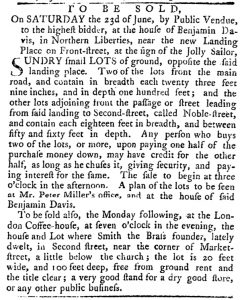
To provide further aid in finding their businesses, some advertisers displayed painted or carved signs.  A notice about an upcoming sale of lots on Noble Street advised bidders to seek “the house of Benjamin Davis, in Northern Liberties, near the new Landing Place on Front-street, at the sign of the Jolly Sailor.”  The street and a nearby landmark directed bidders to the general vicinity, but the sign marked the specific location.  Duffield and Delany, druggists, adopted a similar strategy, instructing prospective clients to find them “At Boerhaave’s Head, the Corner of Second and Walnut streets.”  A sign depicting Herman Boerhaave, the Dutch physician and botanist, helped customers identify their shop once they arrived at the intersection.  Similarly, Robert Kenneday and Thomas Kenneday sold both prints and patent medicines “At their Print Shop, at West’s Head near the Bridge, in Second-street, below Walnut street.”  The streets and a landmark directed prospective customers to their neighborhood, but the sign depicting Benjamin West “of this city, now history painter to the King” clearly identified their place of business.

These examples demonstrate that signs often did not replace the need to offer other sorts of directions, such as streets, intersections, and landmarks, yet in the absence of street numbers they provided a means of denoting a particular location.  They also served as landmarks themselves, aiding both residents and visitors in navigating the streets of bustling port cities.  Some advertisers who did not have signs of their own occasionally made reference to their location in relation to shop signs displayed by others.  The signs listed in advertisements and displayed throughout cities like Boston, Charleston, New York, and Philadelphia helped people make sense of urban geography in eighteenth-century America.

June 2

What was advertised in a colonial American newspaper 250 years ago today?

Jun 2 - 6:2:1770 Providence Gazette
Providence Gazette (June 2, 1770).

“The Foundation is now building, and will be soon finished.”

In 1770, Rhode Island College (now Brown University) moved from Warren to its permanent location in Providence.  An advertisement that ran in the June 2 edition of the Providence Gazette advised that “ALL Person who have undertaken to supply any of the Timber for the COLLEGE, are desired to deliver the same as soon as possible, as the Foundation is now building, and will be soon finished.”  It further requested that “all those who subscribed Lime are desired to bring it immediately, as it is now much wanted.”  Three members of the committee overseeing fundraising for the construction of a new edifice to house the college signed the notice.  By then, the committee was familiar to readers of the Providence Gazette, having regularly placed advertisements encouraging prospective benefactors to contact them to make their donations to the college.

While it took the form of an advertisement, this notice delivered news about the progress of the construction of the college, providing coverage that did not always appear among the news items.  John Carter, the printer of the Providence Gazette, included a short item about a ceremony for laying the foundation stone in the May 19 edition.  The advertisement placed by Stephen Hopkins, John Jenckes, and John Brown two weeks later gave an update as work continued.  Residents of Providence could make their own observations about the status of the building, but readers in other towns could not.  The committee’s advertisement helped to keep them informed.  It conveniently appeared almost immediately after news from Providence, separated only by a notice calling on those “indebted for this paper above one Year” to settle accounts.  Carter craftily inserted his own notice at the end of the news in order to draw greater attention, but the placement of the committee’s new advertisement suggested a continuation of news from Providence.  The next advertisement, promoting medicines sold by Amos Throop, more effectively signaled the transition to paid notices.  Many of the subsequent advertisements, however, were legal notices that also delivered news to readers.  News and advertising could not be easily delineated in colonial newspapers.

June 1

What was advertised in a colonial American newspaper 250 years ago today?

Jun 1 - 6:1:1770 New-Hampshire Gazette
New-Hampshire Gazette (June 1, 1770).

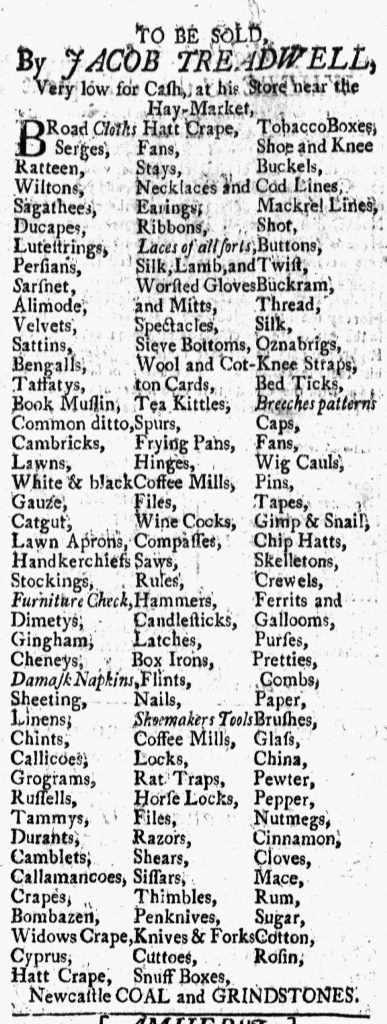
“Ratteen, / Wiltons, / Sagathees, / Ducapes, / Lutestrings.”

James King and Jacob Treadwell each advertised a variety of consumer goods in the June 1m 1770, edition of the New-Hampshire Gazette.  King’s advertisement took the more standard form.  After a brief introduction that included his name and location, the remainder of the advertisement consisted of a dense paragraph of text.  King listed dozens of items available at his shop, from textiles to “a Variety of Necklaces” to hardware.

Treadwell also published a catalog of the goods he sold, but his advertisement had a less common format.  Rather than a single paragraph, Treadwell’s notice divided the goods into three columns, listing only one item on most lines.  Given the space constraints, some items overflowed onto additional lines, such as “Shoe and Knee / Buckels,” “Wool and Cot- / ton Cards,” and “Silk, Lamb, and / Worsted Gloves / and Mitts.”  Creating columns also produced white space within the advertisement; the combination made Treadwell’s advertisement easier to peruse than King’s.  It likely helped prospective customers more fully appreciate Treadwell’s extensive assortment of merchandise.  That columns required more space also communicated the range of consumer choice, though Treadwell paid to make that part of the appeal he presented to readers of the New-Hampshire Gazette.  In the eighteenth century, advertisers paid by the amount of space their notices occupied on the page, not the number of words.

To provide further visual distinction, some goods in Treadwell’s advertisement appeared in italics: “BRoad Cloths,” “Furniture Check,” “Damask Napkins,” “Laces of all sorts,” “Shoemakers Tools,” and “Breeches patterns.”  Why these particular items is not readily apparent today … and may not have been in 1770 either.  Did Treadwell believe they were in high demand?  Did he have surplus inventory?  Did Treadwell even instruct that those items appear in italics or did the compositor independently make the decision to provide even greater variation in the advertisement?  Whatever the reason, the graphic design elements of Treadwell’s advertisement likely garnered greater attention for it than King’s notice in standard format that ran on the same page.

Slavery Advertisements Published June 1, 1770

Guest Curator: Jenna Smith

The Slavery Adverts 250 Project chronicles the role of newspaper advertising in perpetuating slavery in the era of the American Revolution. The project seeks to reveal the ubiquity of slavery in eighteenth-century life from New England to Georgia by republishing advertisements for slaves – for sale, wanted to purchase, runaways, captured fugitives – in daily digests on this site as well as in real time via the @SlaveAdverts250 Twitter feed, utilizing twenty-first-century media to stand in for the print media of the eighteenth century.

The project aims to provide modern audiences with a sense of just how often colonists encountered these advertisements in their daily lives. Enslaved men, women, and children appeared in print somewhere in the colonies almost every single day. Those advertisements served as a constant backdrop for social, cultural, economic, and political life in colonial and revolutionary America. Colonists who did not own slaves were still confronted with slavery as well as invited to maintain the system by purchasing slaves or assisting in the capture of runaways. The frequency of these newspaper advertisements suggests just how embedded slavery was in colonial and revolutionary American culture in everyday interactions beyond the printed page.

These advertisements also testify to the experiences of enslaved men, women, and children, though readers must consider that those experiences have been remediated through descriptions offered by slaveholders rather than the slaves themselves. Often unnamed in the advertisements, enslaved men, women, and children were not invisible or unimportant in early America.

From compiling an archive of digitized eighteenth-century newspapers to identifying advertisements about enslaved men, women, and children in those newspapers to preparing images of each advertisement to posting this daily digest, Jenna Smith served as guest curator for this entry. Working on this project fulfilled her senior capstone requirement for completing the major in History at Assumption College in Worcester, Massachusetts.

These advertisements appeared in colonial American newspapers 250 years ago today.

Jun 1 - New-Hampshire Gazette Slavery 1
New-Hampshire Gazette (June 1, 1770).

**********

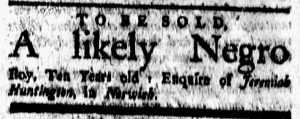
Jun 1 - New-London Gazette Slavery 1
New-London Gazette (June 1, 1770).