June 18

What was advertised in a colonial American newspaper 250 years ago today?
Essex Gazette (June 18, 1771).

“Those who live remote shall have their Orders as faithfully complied with as if present themselves.”

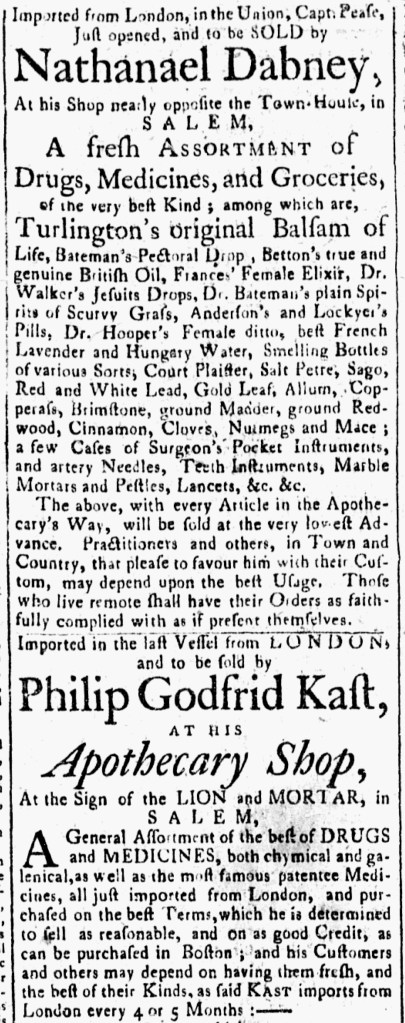
Apothecaries Nathanael Dabney and Philip Godfrid Kast competed for customers.  Each placed an advertisement in the June 18, 1771, edition of the Essex Gazette, inviting prospective customers to their shops in Salem.  Making the choice between the two apothecaries even more visible to readers, their advertisements appeared one after the other.  Kast, the more experienced advertiser, placed the longer notice.  It extended more than a column, extensively listing the items in stock at the Sign of the Lion and Mortar.  Kast also included blurbs about patent medicines, some of them more familiar to consumers than others, such as “Dr. Hill’s Pectoral Balsam of Honey,” “Dr. Robert James’s Powder for Fevers,” “Dr Stoughton’s great Cordial Elixir for the Stomach,” and “Dr. Scott’s Powder for the Teeth.”  Dabney, on the other hand, provided a shorter list of his inventory, but also promising “every Article in the Apothecary’s Way.”  He aimed to make himself competitive with Kast.

Both apothecaries sought clients in Salem and beyond, inviting readers unable to visit their shops to submit orders.  Dabney and Kast each pledged not to favor customers who visited their shops over those who did not.  “Those who live remote,” Dabney proclaimed, “shall have their Orders as faithfully complied with as if present themselves.”  Kast deployed similar language in a nota bene that concluded his advertisement: “Those who will send their Orders shall be as well used as if present themselves.”  That included both consumers and “Practitioners … in Town and Country.”  The apothecaries described an eighteenth-century version of mail order for “DRUGS and MEDICINES,” an effort to enhance their sales and increase their revenues by offering a convenience to their customers.  Some prospective clients may have found Kast’s advertisement the more alluring of the two.  In addition to a longer list of merchandise, the blurbs about various patent medicines served as suggestions for distant customers unable to consult with the apothecary in person.  Furthermore, Kast trumpeted that he sold his wares “as reasonable, and on as good Credit, as can be purchased in Boston.”  The apothecary no doubt sought to engage every reader, but especially prospective customers outside of Salem who might have been likely to look to Boston, the larger port, for better bargains when resorting to sending orders from a distance.

Dabney and Kast promoted the assortment of medicines they carried and pledged good customer service, but Kast further embellished his marketing efforts by comparing his prices to those in Boston and by providing descriptions of certain patent medicines to help prospective customers make their choices.  For instance, Kast declared that Stoughton’s Cordial “is as necessary for all Seamen or Travellers, and others, to take with them as their daily Food.”  That level of detail required purchasing additional space in the Essex Gazette, but Kast may have determined it was well worth the expense if it drummed up additional business.

June 17

Who was the subject of an advertisement in a colonial American newspaper 250 years ago today?

Supplement to the Boston-Gazette (June 17, 1771).

“For further Particulars, enquire of Edes & Gill.”

Two short advertisements about enslaved people appeared in the June 17, 1771, edition of the Boston Evening-Post.  One announced, “TO BE SOLD, A likely Negro Fellow about 15 Years of Age.”  The other declared, “A Negro Child of a good Breed, to be given away.”  The same day, two other advertisements ran in the Boston-Gazette.  “To be Sold for Want of Employ,” stated one, “A likely Negro Woman, about 33 Years old, remarkable for Honesty and a good Temper.”  The other described “a Negro Man named Dick or Richard” who liberated himself.  The clever fugitive for freedom possessed a forged pass.

Each of those advertisements testified to the presence of slavery in northern colonies in the era of the American Revolution.  As colonists debated their rights and objected to abuses perpetrated by Parliament, many continued to enslave Africans and African Americans.  They turned to the same newspapers that kept them informed about politics and current events to facilitate the buying and selling … and even giving away … of enslaved men, women, and children.  In offering a reward for the capture and return of Dick, David Edgar encouraged all readers, whether enslavers or not, to engage in surveillance of Black people to detect the fugitive seeking freedom.  Newspapers, especially advertisements, helped perpetuate slavery in early America.

Most of those advertisements in the Boston Evening-Post and the Boston-Gazette on June 17 had another similarity:  the extent that the printer participated in the transaction.  Edgar was the only advertiser who signed his notice.  Both advertisements in the Boston Evening-Post concluded with “Enquire of the Printers.”  The one offering a “likely Negro Woman” for sale in the Boston-Gazette advised, “For further Particulars, enquire of Edes & Gill.”  In addition to being well known as printers of that newspaper, their names appeared in the colophon at the bottom of the column that featured that advertisement.  The printers of both newspapers not only generated revenues by publishing advertisements about enslaved people but also actively took part in the buying, selling, and giving away of enslaved men, women, and children.  They played the role of information brokers beyond the printed page, providing additional services to enslavers who placed and responded to advertisements.

Slavery Advertisements Published June 17, 1771

The Slavery Adverts 250 Project chronicles the role of newspaper advertising in perpetuating slavery in the era of the American Revolution. The project seeks to reveal the ubiquity of slavery in eighteenth-century life from New England to Georgia by republishing advertisements about enslaved people – for sale as individuals or in groups, wanted to purchase or for hire for short periods, runaways who liberated themselves, and those who were subsequently captured and confined in jails and workhouses – in daily digests on this site as well as in real time via the @SlaveAdverts250 Twitter feed, utilizing twenty-first-century media to stand in for the print media of the eighteenth century.

The project aims to provide modern audiences with a sense of just how often colonists encountered these advertisements in their daily lives. Enslaved men, women, and children appeared in print somewhere in the colonies almost every single day. Those advertisements served as a constant backdrop for social, cultural, economic, and political life in colonial and revolutionary America. Colonists who did not purport to own enslaved people were still confronted with slavery as well as invited to maintain the system by purchasing enslaved men, women, and children or assisting in the capture of so-called “runaways” who sought to free themselves from bondage. The frequency of these newspaper advertisements suggests just how embedded slavery was in colonial and revolutionary American culture in everyday interactions beyond the printed page.

These advertisements also testify to the experiences of enslaved men, women, and children, though readers must consider that those experiences have been remediated through descriptions offered by enslavers rather than enslaved people themselves. Often unnamed in the advertisements, enslaved men, women, and children were not invisible or unimportant in early America.

These advertisements appeared in colonial American newspapers 250 years ago today.

Boston Evening-Post (June 17, 1771).

**********

Boston Evening-Post (June 17, 1771).

**********

Boston-Gazette (June 17, 1771).

**********

Supplement to the Boston-Gazette (June 17, 1771).

**********

Newport Mercury (June 17, 1771).

**********

New-York Gazette and Weekly Mercury Mercury (June 17, 1771).

**********

New-York Gazette and Weekly Mercury Mercury (June 17, 1771).

**********

New-York Gazette and Weekly Mercury Mercury (June 17, 1771).

**********

New-York Gazette and Weekly Mercury Mercury (June 17, 1771).

**********

New-York Gazette and Weekly Mercury Mercury (June 17, 1771).

**********

Supplement to the New-York Gazette and Weekly Mercury Mercury (June 17, 1771).

**********

Supplement to the New-York Gazette and Weekly Mercury Mercury (June 17, 1771).

**********

Supplement to the New-York Gazette and Weekly Mercury Mercury (June 17, 1771).

**********

South-Carolina and American General Gazette (June 17, 1771).

**********

South-Carolina and American General Gazette (June 17, 1771).

**********

South-Carolina and American General Gazette (June 17, 1771).

**********

South-Carolina and American General Gazette (June 17, 1771).

**********

South-Carolina and American General Gazette (June 17, 1771).

**********

South-Carolina and American General Gazette (June 17, 1771).

**********

South-Carolina and American General Gazette (June 17, 1771).

**********

South-Carolina and American General Gazette (June 17, 1771).

**********

South-Carolina and American General Gazette (June 17, 1771).

**********

South-Carolina and American General Gazette (June 17, 1771).

**********

South-Carolina and American General Gazette (June 17, 1771).

**********

South-Carolina and American General Gazette (June 17, 1771).

**********

South-Carolina and American General Gazette (June 17, 1771).

**********

South-Carolina and American General Gazette (June 17, 1771).

**********

South-Carolina and American General Gazette (June 17, 1771).

June 16

What was advertised in a colonial American newspaper 250 years ago this week?

Pennsylvania Gazette (June 13, 1771).

Advertisements … are by him translated gratis.”

When printer Henry Miller (Johann Heinrich Müller) moved to a new location in the spring of 1771, he placed advertisements in the Pennsylvania Chronicle, the Pennsylvania Gazette, and the Pennsylvania Journal to alert current and prospective customers.  He also used the opportunity to advise them of specialized services he provided, proclaiming that he performed “all Manner of PRINTING-WORK, in English, German, and other Languages.”  In particular, Miller noted “English and German ADVERTISEMENTS done on the shortest Notice; and a German NEWS-PAPER published every Tuesday.”  A migrant from Germany himself, Miller granted prospective advertisers greater access to the sizable German community in Pennsylvania and beyond.

Miller commenced printing the Wochentliche Pennsylvanische Staatsbote in 1762, making it well established by the time he ran his advertisements in the colony’s English newspapers in 1771.  The final line of those advertisements in those newspapers echoed a note that appeared in the masthead of his own newspaper, usually the only portion printed in English rather than German.  “All ADVERTISEMENTS,” it read, “to be inserted in this Paper, or printed single by HENRY MILLER, Publisher hereof, are by him translated gratis.”  In offering his services as a translator and not charging for it, Miller sought to generate revenue by increasing the number of advertisers who placed notices in the Wochentliche Pennsylvanische Staatsbote.

The printer also produced other forms of advertising.  Items “printed single” likely included broadsides, handbills, trade cards, billheads, and catalogs.  Like their counterparts printed in English, those advertisements were ephemeral compared to the newspapers and almanacs that came off of Miller’s press.  Few survive today, but Miller’s newspaper advertisements and masthead suggest that various kinds of advertisements in German enhanced the vibrant advertising culture that emerged in Philadelphia in the decades before the American Revolution.  As newspapers, handbills, and other items printed by Miller circulated in Philadelphia and beyond, colonists encountered marketing in more than one language, underscoring global networks of commerce and migration in vast early America.

June 15

What was advertised in a colonial American newspaper 250 years ago today?

Providence Gazette (June 15, 1771).

“He will sell as cheap … as can be purchased anywhere on the Continent.”

Purveyors of goods and services frequently made appeals to price to entice prospective customers, but some made much bolder claims than others.  Consider how advertisers sought to leverage price to their advantage in the June 15, 1771, edition of the Providence Gazette.

William Eliot stocked a variety of textiles “to be sold cheap.”  Similarly, John Fitton sold flour, pork, and peas by the barrel, “all cheap for Cash” (or in trade for “good Melasses”).  In addition to promising low prices, other advertisers insisted that they set the lowest prices for their wares.  The partnership of Nicholas, Joseph, and Moses Brown, for instance, carried “a fine Assortment of Hard Ware and other GOODS, which they will sell on the lowest Terms.”  Coy and Waterman specialized in painting supplies, having “furnished themselves with a compleat Assortment of Painters Colours, which they will sell at the lowest Prices.”

Other advertisers made even more colorful proclamations about prices.  At his shop at the Sign of the Turk’s Head, Paul Allen supposedly offered some of the best bargains anywhere in the colonies.  He trumpeted that “he will sell on as low Terms … as can be purchased anywhere on the Continent.”  Allen informed prospective customers that his prices matched the best deals available in Boston, Charleston, New York, Philadelphia, and other towns and cities.  Joseph Nash made the same comparison, declaring that he sold his “neat Assortment of GOODS … as cheap … as can be purchased anywhere on the Continent.”  Allen and Nash echoed an appeal John Morton and James Morton made in the Connecticut Journal and New-Haven Post-Boy the previous day.  The Mortons promised prospective customers that they could acquire their merchandise “as cheap as in New York or Boston.”

The vast majority of merchants and shopkeepers mentioned low prices in their newspaper advertisements, though some were more creative than others in doing so.  Advertisers like Allen and Nash attempted to attract customers with reassurances that they had the best deals anywhere, not just prices that were low enough to compete in the local marketplace.  In the process, they prompted readers to imagine themselves participating in a consumer revolution taking place throughout the colonies and beyond.  Acquiring goods connected readers of the Providence Gazette to colonists in faraway places, giving them common experiences through their experiences in the marketplace.

June 14

What was advertised in a colonial American newspaper 250 years ago today?

Connecticut Journal (June 14, 1771).

“Town and Country Shopkeepers may supply themselves as cheap as in New York or Boston.”

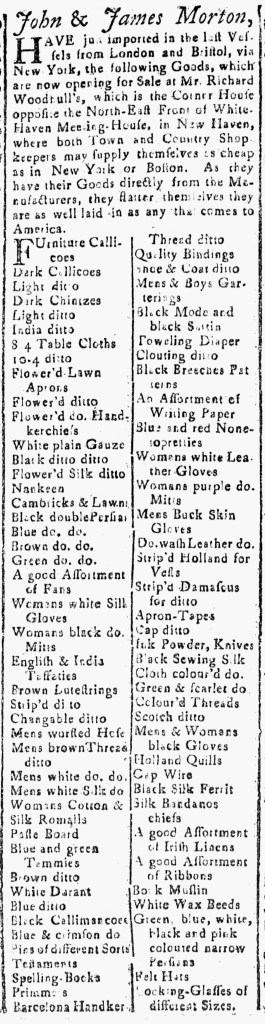
In an advertisement that filled an entire column and overflowed into the next, John Morton and James Morton informed readers of the Connecticut Journal and New-Haven Post-Boy that they carried “all Sorts of English and India Goods.”  To entice prospective customers, the Mortons listed dozens of items, including “Womans White Silk Gloves,” “Mens worsted Hose,” and textiles in many colors and designs. Choices for consumers and retailers alike abounded at the shop; customers made selections among “An Assortment of Writing Paper,” “Looking-Glasses of different Sizes,” “A good Assortment of Ribbons,” “Pins of different Sorts,” and “A good Assortment of Fans.”  Despite the length of the advertisement, it only hinted at the variety of goods offered by the Mortons.

The merchants stocked this inventory at two shops, one in New Haven “at Mr. Richard Woodhull’s, which is the Corner House opposite the North-East Front of White-Haven Meeting-House” and the other in New York “in Queen-Street, near the Fly-Market.”  They intended their advertisement in the Connecticut Journal primarily for residents of New Haven and nearby towns, but noted their original location in New York for the convenience of other customers.  The Mortons underscored that purchasing goods at their shop in New Haven was in no way inferior to acquiring merchandise in any of the major urban ports.  They imported their wares “in the last Vessels from London and Bristol, via New York,” but the additional step in transporting them to New Haven did not result in higher prices.  Customers, especially “Town and Country Shopkeepers,” could “supply themselves as cheap as in New York or Boston.”  The Mortons declared that they would not be undersold by their competitors.  In addition, they offered the same range of choices as merchants in larger port cities.  The Mortons proclaimed “they are as well laid in as any that comes to America.”

The Mortons’ advertisement continued in a second column of the Connecticut Journal (June 14, 1771).

Compared to the New-York Gazette and Weekly Mercury and the New-York Journal, the Connecticut Gazette carried significantly less advertising for imported goods.  That did not mean, however, that consumer culture in New Haven and other towns in Connecticut was any less vibrant than in New York, Boston, and other urban centers.  The Mortons suggested to both shopkeepers and consumers that they had access to the same merchandise available at their store in New York … and at the same prices.  The consumer revolution did not occur only in cities.  The Mortons did their part in making it possible for prospective customers in the countryside to acquire a vast array of goods that rivaled the choices they offered to shoppers in New York.

Slavery Advertisements Published June 14, 1771

The Slavery Adverts 250 Project chronicles the role of newspaper advertising in perpetuating slavery in the era of the American Revolution. The project seeks to reveal the ubiquity of slavery in eighteenth-century life from New England to Georgia by republishing advertisements about enslaved people – for sale as individuals or in groups, wanted to purchase or for hire for short periods, runaways who liberated themselves, and those who were subsequently captured and confined in jails and workhouses – in daily digests on this site as well as in real time via the @SlaveAdverts250 Twitter feed, utilizing twenty-first-century media to stand in for the print media of the eighteenth century.

The project aims to provide modern audiences with a sense of just how often colonists encountered these advertisements in their daily lives. Enslaved men, women, and children appeared in print somewhere in the colonies almost every single day. Those advertisements served as a constant backdrop for social, cultural, economic, and political life in colonial and revolutionary America. Colonists who did not purport to own enslaved people were still confronted with slavery as well as invited to maintain the system by purchasing enslaved men, women, and children or assisting in the capture of so-called “runaways” who sought to free themselves from bondage. The frequency of these newspaper advertisements suggests just how embedded slavery was in colonial and revolutionary American culture in everyday interactions beyond the printed page.

These advertisements also testify to the experiences of enslaved men, women, and children, though readers must consider that those experiences have been remediated through descriptions offered by enslavers rather than enslaved people themselves. Often unnamed in the advertisements, enslaved men, women, and children were not invisible or unimportant in early America.

These advertisements appeared in colonial American newspapers 250 years ago today.

New-London Gazette (June 14, 1771).

June 13

What was advertised in a colonial American newspaper 250 years ago today?

New-York Journal (June 13, 1771).

“James Sloan … hath thought proper to advertise me his Wife for absconding from him.”

In the wake of marital discord in the Sloan household, James placed an advertisement concerning his wife, Altye, in the June 13, 1771, edition of the New-York Journal.  According to James’s version of events, his wife had “in many Respects misbehaved, and without any just Cause eloped from me, wasting and embezling my Substance.”  James further accused Altye of “endeavour[ing] to run me in Debt.”  Accordingly, he placed the advertisement “to warn all Persons not to trust or entertain her on my Account” because he would not pay any “Debt of her contracting since her Elopement.”

Runaway wife advertisements like this one appeared in eighteenth-century newspapers from New England to Georgia. They usually went unanswered, at least in the public prints.  Husbands advanced narratives about what happened, but wives generally did not have the resources to publish their own version of events.  That was not the case, however, for Altye Sloan.  She ran her own notice that acknowledged her husband’s advertisement, suggesting that James had been prompted to tell a tale to the public by “some dissolute Persons like himself.”  In turn, she offered a more accurate rendering of events, claiming that “she neither has embezzled his Substance, nor eloped from him.”  Instead, James “turned her out of Doors” after “beat[ing] and abus[ing] her often Times.”  As far as Altye was concerned, that amounted to “sufficient C[au]se to abandon such an insolent Person.”  She concluded by proclaiming that she would not run her husband into debt and neither would she pay any of his bills.

The two advertisements ran one after the other in the June 13 edition of the New-York Journal.  They did so again in the June 20 and 26 editions, before being discontinued.  The compositor may have chosen to place them together for easy reference, but the notations on the final line of each advertisement suggest that Altye may have requested that her advertisement appear with her husband’s notice.  The notations on the final lines corresponded to the issue numbers for the first and last times advertisements were supposed to run.  They aided compositors in determining whether advertisements belonged in an issue.  The “83 86” in James’s advertisement indicated that it first appeared in issue 1483 (June 6) and ran through issue 1486 (June 27).  For Altye’s advertisement, “84 86” corresponded to first running in issue 1484 (June 13) and concluding in issue 1486 (June 27).  According to the rates in the colophon, most advertisements ran at least four weeks.  James’s advertisement did so, in issues 1483, 1484, 1485, and 1486, but Altye’s advertisement ran for only three weeks.  She may have made special arrangements for a shorter run (and lower fees) that matched the remaining time her husband’s advertisement would appear.  As part of the deal, she could have requested that their advertisements run one after the other.

Altye could not prevent her husband from advertising, but she apparently possessed the means to purchase space in the New-York Journal to tell her side of the story.  Rather than allow her husband to control the narrative, she may have also requested that her notice appear with his in order to give readers a more complete story of what actually transpired in the Sloan household.  Most so-called “runaway wives” did not have opportunities to leverage print to inform the public that it was actually husbands who “misbehaved” and they “eloped” to protect themselves from various kinds of mistreatment and abuse.  Altye Sloan did publish her account of events, managing to have it inserted with her husband’s advertisement to increase the chances that readers would not see his version without the additional context she provided.

Slavery Advertisements Published June 13, 1771

The Slavery Adverts 250 Project chronicles the role of newspaper advertising in perpetuating slavery in the era of the American Revolution. The project seeks to reveal the ubiquity of slavery in eighteenth-century life from New England to Georgia by republishing advertisements about enslaved people – for sale as individuals or in groups, wanted to purchase or for hire for short periods, runaways who liberated themselves, and those who were subsequently captured and confined in jails and workhouses – in daily digests on this site as well as in real time via the @SlaveAdverts250 Twitter feed, utilizing twenty-first-century media to stand in for the print media of the eighteenth century.

The project aims to provide modern audiences with a sense of just how often colonists encountered these advertisements in their daily lives. Enslaved men, women, and children appeared in print somewhere in the colonies almost every single day. Those advertisements served as a constant backdrop for social, cultural, economic, and political life in colonial and revolutionary America. Colonists who did not purport to own enslaved people were still confronted with slavery as well as invited to maintain the system by purchasing enslaved men, women, and children or assisting in the capture of so-called “runaways” who sought to free themselves from bondage. The frequency of these newspaper advertisements suggests just how embedded slavery was in colonial and revolutionary American culture in everyday interactions beyond the printed page.

These advertisements also testify to the experiences of enslaved men, women, and children, though readers must consider that those experiences have been remediated through descriptions offered by enslavers rather than enslaved people themselves. Often unnamed in the advertisements, enslaved men, women, and children were not invisible or unimportant in early America.

These advertisements appeared in colonial American newspapers 250 years ago today.

Pennsylvania Gazette (June 13, 1771).

**********

Pennsylvania Gazette (June 13, 1771).

**********

Pennsylvania Gazette (June 13, 1771).

**********

Pennsylvania Gazette (June 13, 1771).

**********

Pennsylvania Journal (June 13, 1771).

**********

South-Carolina Gazette (June 13, 1771).

**********

South-Carolina Gazette (June 13, 1771).

**********

South-Carolina Gazette (June 13, 1771).

**********

South-Carolina Gazette (June 13, 1771).

**********

South-Carolina Gazette (June 13, 1771).

**********

South-Carolina Gazette (June 13, 1771).

**********

Virginia Gazette [Purdie and Dixon] (June 13, 1771).

**********

Virginia Gazette [Purdie and Dixon] (June 13, 1771).

**********

Virginia Gazette [Purdie and Dixon] (June 13, 1771).

**********

Virginia Gazette [Purdie and Dixon] (June 13, 1771).

June 12

What was advertised in a colonial American newspaper 250 years ago this week?

Massachusetts Gazette and Boston Post-Boy (June 10, 1771).

“Sold as low as at any Store or Shop in Town.”

Advertisements for consumer goods in eighteenth-century newspapers frequently included appeals to price.  In the June 10, 1771, edition of the Massachusetts Gazette and Boston Post-Boy, for instance, William Bant informed his “Friends and Customers” that he sold a “General Assortment of English and India GOODS … at the very lowest Rates.”  Similarly, Lewis Deblois sold cutlery, hardware, and other goods “at the very lowest Price.”  Joshua Isaacs set “reasonable Terms” for the imported goods he sold.  In many instances, advertisers made only brief reference to the price of their merchandise, but some, like Joshua Gardner, underscored price in their attempts to entice customers.

Gardner stocked a “fine Assortment of English Goods” that he acquired from London, Bristol, Manchester, Nottingham, Birmingham, and other towns.  After listing several items, he declared that “the above-mention’d Goods are purchased upon the best Ter[m]s.”  In turn, he passed along the savings to his customers, pledging that everything in his inventory “shall be Sold as low as at any Store or Shop in Town.”  Prospective customers, he proclaimed, would not find better bargains anywhere in Boston.

In addition, Gardner inserted a special “NOTE” to retailers, informing “THOSE Persons who purchase to Sell again” that they “may be supply’d by the Piece, Half-piece or Quarter-piece, Dozen, Half-dozen or Quarter-dozen, at the same advance as if they bought large Quantities.”  Many wholesalers promoted discounts for purchasing in volume in their advertisements, but Gardner went beyond that deal.  He offered retailers an opportunity to purchase in smaller quantities at the same rates as if they placed larger orders.  Such an offer distinguished him among wholesalers who advertised in Boston, perhaps making his wares more attractive to shopkeepers in the city and surrounding towns.

Although many advertisers resorted to formulaic language when making appeals to price, others experimented with both the rates they charged and how they described prices to prospective customers.  Gardner devoted as much space in his advertisement to discussing his prices as he did to listing his goods, making his notice unique among those inserted by Bant, Deblois, Isaacs, and many other merchants and shopkeepers.