October 13

What was advertised in a colonial American newspaper 250 years ago this week?

New-York Journal (October 10, 1771).

“Painters and Limners Colours, / Dyers and Fullers Articles, / Window Glass of all Sizes.”

Gerardus Duyckinck regularly advertised the “UNIVERSAL STORE” in the New-York Journal in the early 1770s, his notices readily recognizable by the ornate cartouche that surrounded most of the copy.  Advertisers who adorned their notices with visual images usually selected woodcuts that appeared either in the upper left corner or above the text.  Most visual images were fairly simple, but Duyckinck invested in perhaps the most elaborate woodcut that enhanced an advertisement in an American newspaper prior to the American Revolution.  The rococo flourishes that composed the border extended more than half a column.  The upper portion featured a depiction of Duyckink’s shop sign, the Looking Glass and Druggist Pot.  Unlike any other advertisement in the New-York Journal or other colonial newspapers, this one resembled the trade cards that circulated in London and, to a lesser extent, the largest ports in the colonies.

Even when he did not incorporate that woodcut into his advertisements, Duyckinck often sought to create visually distinctive notices.  Such was the case for an advertisement in the October 10, 1771, edition of the New-York Journal.  An advertisement featuring his elaborate woodcut ran on the additional half sheet, as it had for many weeks, but the shopkeeper supplemented it with another advertisement, the first among the new notices following the news on the third page.  His new advertisement started with a dense block of text, similar to the format in so many other advertisements for consumer goods and services, but approximately half of that copy directed prospective customers to his new location.  A large portion of his advertisement, however, listed many of the items available at the Universal Store.  Duyckinck apparently arranged for the compositor to include only a couple of items on each line and center them in order to introduce a significant amount of white space.  Doing so gave the copy in that portion of the advertisement a unique shape that distinguished it from others in the same issue.  Duyckinck did not need an elaborate woodcut to make a memorable impression.  He devised other means of being a showman in his supplemental advertisement.

October 12

What was advertised in a colonial American newspaper 250 years ago today?

Providence Gazette (October 12, 1771).

“The PRINTING-OFFICE is removed to a new Building.”

In the fall of 1771, John Carter, printer of the Providence Gazette, moved to a new location.  When he did so, he exercised his prerogative as printer to give his announcement a privileged page in the newspaper he published.  The first item in the first column on the first page of the October 12 edition proclaimed, “The PRINTING-OFFICE is removed to a new Building on the main Street, fronting the COURT-HOUSE.”  In case that was not enough to draw attention, Carter also resorted to ornamental type.  Three asterisks preceded the copy of his notice.  A decorative border enclosed the entire announcement, distinguishing it from other advertisements in the same issue.

Carter also updated the colophon that ran at the bottom of the final page each week, revising the second line to read “in King-Street, Opposite the Court-House” rather than “in King-Street, near the Court-House.”  The remainder of the colophon remained the same, including the invocation of “Shakespear’s Head” as the sign that marked the building where Carter operated the printing office.  When Carter moved to a new location, a sign that assisted residents and visitors in navigating the streets of Providence also moved.  The printer was not the only advertiser who directed prospective customers to the new location for that landmark.  Halsey and Corlis instructed readers that they had “removed their Shop” where they sold imported goods “on the West Side of the Great Bridge, to a new Store directly opposite the Court-House, at the Sign of Shakespear’s Head.”  The sign that marked Carter’s printing office for years moved with him.  When it did, it became a device that helped identify other businesses that opened in a new building.

The advertisements in the Providence Gazette helped readers re-imagine the streets of the town, aiding them in finding the businesses they wished to visit.  A notice on the front page, a slight revision to the colophon, and an advertisement placed by shopkeepers located in the same building all worked together in reorienting the public to the new location of “Shakespear’s Head … opposite the Court-House.”

October 11

What was advertised in a colonial American newspaper 250 years ago today?

New-London Gazette (October 11, 1771).

“The Staffordshire and Liverpool WARE-HOUSE In KING-STREET.”

Ebenezer Bridgham launched a regional advertising campaign for his “Staffordshire and Liverpool WARE-HOUSE In KING-STREET” in Boston in the fall of 1771.  Beyond his own city, he began by placing advertisements in the Essex Gazette, published in Salem, and the Providence Gazette, published in the neighboring colony.  Many of the readers of those newspapers resided in the hinterlands around Boston, making them as likely to order merchandise from shops in that busy port as from shops in Salem or Providence.

Bridgham, however, sought to enlarge his market to include prospective customers who resided at much more considerable distances.  Over several weeks, he inserted advertisements in most of the newspapers published in New England outside of Boston.  On October 11, 1771, Bridgham’s advertisement ran in the New-London Gazette, a newspaper just as likely to carry notices from New York as from Boston.  Indeed, another advertisement in that issue promoted the “Passage-Boat” or passenger ferry that Clark Truman operated between New London and Sag Harbor, a village on Long Island, once a week.  That service helped residents of New London other parts of Connecticut keep better connected to New York, facilitating commerce and purchasing goods from merchants and shopkeepers there.

In each instance that Bridgham’s notices ran in additional newspapers, they featured identical copy but unique formats designed by the compositor who labored in the local printing office.  That copy included a pledge that Bridgham was “able and fully inclin’d to sell” his wares “at least as low as they were ever Sold in America.”  In attempting to create a regional market in which he competed with merchants and shopkeepers beyond Boston, Bridgham considered it imperative to assure prospective customers that he offered prices as good as any they might find locally.  In stating that his prices were “at least as low” as others, he hinted at even better bargains for consumers in distant towns and villages who sent away to Boston for their “China, Glass, Delph, and Stone WARE.”

October 10

What was advertised in a colonial American newspaper 250 years ago today?

New-York Journal (October 10, 1771).

“America is not necessarily obliged to import these articles.”

Many entrepreneurs launched “Buy American” campaigns before the thirteen colonies declared independence from Great Britain.  Advertisements that encouraged consumers to purchase “domestic manufactures” became a common sight in newspapers during the imperial crisis, increasing in number and frequency when the conflict intensified and receding, but not disappearing, when relations cooled.  During the Stamp Acts crisis, for instance, advertisers encouraged consumers to buy goods produced in the colonies.  They did so again while the nonimportation agreements adopted in response to the Townshend Acts remained in effect.  Even when merchants resumed importing merchandise from England following the repeal of all of the duties except the one on tea, some advertisers continued their efforts to convince consumers to buy goods produced in the colonies.

Such was the case for snuff “MADE AND SOLD By GEORGE TRAILE” on Bowery Lane in New York.  Traile proclaimed that his snuff was “equal to any imported from Europe” and then outlined “the advantages which would evidently result to the Colonies from this branch of business, was it to meet proper encouragement.”  In other words, prospective customers had a duty to make good decisions that took into account the common good for the colonies when they purchased snuff.  He estimated that one in ten of the “three millions of people in British America” spent twenty shillings on snuff annually, calculating that amounted to “three hundred thousand pounds.”  Traile supposed that one-fifth of that amount represented profits for the importers, with the remainder “remitted yearly form this country never to return.”  That imbalance harmed the colonies and, especially, the livelihoods of colonists.  Traile concluded with a “Query” for consumers.  “Would it not be better,” he asked, “to save such an immense sum to the colonies, than to put sixty thousand pounds in the pockets of a few individuals by making that remittance?”  Here he identified another problem, at least from the perspective of an artisan who created goods for the market.  A relatively small number of merchants who imported snuff garnered the profits.  Consumers who purchased tobacco products funneled their money to merchants and the mother country rather than supporting colonists like Traile trying to make an honest living.

Traile declared that “America is not necessarily obliged to import” snuff “from any other country.”  Readers of the New-York Journal had it in their power as consumers to make other choices that would accrue benefits to the colonies and residents who supported local economies by producing domestic manufactures.

Slavery Advertisements Published October 10, 1771

GUEST CURATOR: Chloe Amour
with contributions from Colleen Barrett

The Slavery Adverts 250 Project chronicles the role of newspaper advertising in perpetuating slavery in the era of the American Revolution. The project seeks to reveal the ubiquity of slavery in eighteenth-century life from New England to Georgia by republishing advertisements about enslaved people – for sale as individuals or in groups, wanted to purchase or for hire for short periods, runaways who liberated themselves, and those who were subsequently captured and confined in jails and workhouses – in daily digests on this site as well as in real time via the @SlaveAdverts250 Twitter feed, utilizing twenty-first-century media to stand in for the print media of the eighteenth century.

The project aims to provide modern audiences with a sense of just how often colonists encountered these advertisements in their daily lives. Enslaved men, women, and children appeared in print somewhere in the colonies almost every single day. Those advertisements served as a constant backdrop for social, cultural, economic, and political life in colonial and revolutionary America. Colonists who did not purport to own enslaved people were still confronted with slavery as well as invited to maintain the system by purchasing enslaved men, women, and children or assisting in the capture of so-called “runaways” who sought to free themselves from bondage. The frequency of these newspaper advertisements suggests just how embedded slavery was in colonial and revolutionary American culture in everyday interactions beyond the printed page.

These advertisements also testify to the experiences of enslaved men, women, and children, though readers must consider that those experiences have been remediated through descriptions offered by enslavers rather than enslaved people themselves. Often unnamed in the advertisements, enslaved men, women, and children were not invisible or unimportant in early America.

From compiling an archive of digitized eighteenth-century newspapers to identifying advertisements about enslaved men, women, and children in those newspapers to preparing images of each advertisement to posting this daily digest, Chloe Amour served as guest curator for this entry.  She completed this work while enrolled in an independent study for HIS 390 – Digital Humanities Practicum at Assumption University in Worcester, Massachusetts, in Spring 2021.

These advertisements appeared in colonial American newspapers 250 years ago today.

Maryland Gazette (October 10, 1771).

**********

Maryland Gazette (October 10, 1771).

**********

Maryland Gazette (October 10, 1771).

**********

Maryland Gazette (October 10, 1771).

**********

Maryland Gazette (October 10, 1771).

**********

Pennsylvania Gazette (October 10, 1771).

**********

Pennsylvania Journal (October 10, 1771).

**********

South-Carolina Gazette (October 10, 1771).

**********

South-Carolina Gazette (October 10, 1771).

**********

South-Carolina Gazette (October 10, 1771).

**********

South-Carolina Gazette (October 10, 1771).

**********

South-Carolina Gazette (October 10, 1771).

**********

South-Carolina Gazette (October 10, 1771).

**********

South-Carolina Gazette (October 10, 1771).

**********

South-Carolina Gazette (October 10, 1771).

**********

South-Carolina Gazette (October 10, 1771).

**********

South-Carolina Gazette (October 10, 1771).

**********

Virginia Gazette [Purdie and Dixon] (October 10, 1771).

**********

Virginia Gazette [Purdie and Dixon] (October 10, 1771).

**********

Virginia Gazette [Purdie and Dixon] (October 10, 1771).

**********

Virginia Gazette [Purdie and Dixon] (October 10, 1771).

**********

Virginia Gazette [Purdie and Dixon] (October 10, 1771).

October 9

What was (not) advertised in a colonial American newspaper 250 years ago this week?

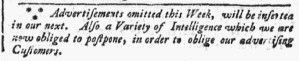
Pennsylvania Chronicle (October 9, 1771).

“Advertisements omitted this Week, will be inserted in our next.”

Nearly three dozen advertisements appeared in the October 7, 1771, edition of the Pennsylvania Chronicle, but William Goddard, the printer, did not have enough space to publish all of the notices submitted to his printing office on Arch Street in Philadelphia.  Neither did he have room for all of the news.  The final column of the third page concluded with a brief note advising that “Advertisements omitted this Week, will be inserted in our next.  Also a Variety of Intelligence which we are now obliged to postpone, in order to oblige our advertising Customers.”

Colonial newspapers generated revenue along two trajectories:  subscriptions and advertising.  Subscribers purchased access to the “freshest advices, foreign and domestic,” as the mastheads for many newspapers described the news. Advertisers, in turn, purchased access to readers.  They sought to place their notices before the eyes of as many readers as possible.  Printers sometimes commented on how many subscribers received their newspapers as a means of encouraging prospective advertisers to place notices.  In making decisions about what to publish, printers had to balance news and advertising in order to satisfy both subscribers and advertisers.  Displeasing one constituency or the other had the potential to negatively affect revenues.

Printers regularly informed readers that they postponed advertisements, a means of assuring advertisers that their notices would indeed soon appear.  Most printers, however, did not often explicitly comment on their endeavors to serve their advertisers, making Goddard’s note about “oblig[ing] our advertising Customers” all the more remarkable.  He revealed to readers, subscribers and advertisers alike, that publishing advertisements sometimes took priority over “a Variety of Intelligence” that he might otherwise have published.  While he framed this as a service to customers who placed notices, the revenues those advertisements represented could not have been far from his mind.  Goddard was willing to delay some advertisements until the next edition, but not too many of them as he aimed to please both subscribers and advertisers.

October 8

What was advertised in a colonial American newspaper 250 years ago today?

South-Carolina Gazette and Country Journal (October 8, 1771).

“Yorkshire STUFFS for Negro [Women’s] Gowns.”

The partnership of Powell, Hopton, and Company announced the sale of “A Cargo of One Hundred and Thirty-three HEALTHY and PRIME NEGROES” recently arrived from Gambia in an advertisement in the October 8, 1771, edition of the South-Carolina Gazette and Country Journal.  Elsewhere in the same issue, an anonymous advertiser offered to hire out an enslaved woman as a wet nurse “by the month,” instructing interested parties to “Enquire of the Printer” for more information.  Both the unnamed advertiser and Powell, Hopton, and Company sought to generate revenues by participating in the slave trade.

John Davies also stood to profit from the slave trade, though not from selling or leasing enslaved people.  Instead, he peddled goods to enslavers.  In his advertisement, Davies hawked “SUNDRY MERCHANDIZE” imported from London, calling special attention to “a large ASSORTMENT of Yorkshire STUFFS for Negro [Women’s] Gowns.”  Other merchants and shopkeepers placed extensive advertisements that listed dozens of items available at their stores and warehouses, hoping to entice consumers with the many choices available to them.  For Davies and his prospective customers, however, choice was largely irrelevant.  The enslaved women who would wear garments made of the textiles Davies sold were not consumers; they did not do the shopping or select the cloth according to their own tastes and budgets.  Davies did not need to make the same marketing appeals to the enslavers who purchased his “Yorkshire STUFFS” as other advertisers made to prospective customers.

Davies received his merchandise from London via the Magna Charta, a vessel named for a royal charter understood as protecting individual English freedoms.  The tension between liberty and enslavement contained within his advertisement apparently did not register with Davies as he attempted to earn his livelihood through supplying enslavers who bought his goods and also purchased the human cargo that arrived in Charleston on ships from Africa.  The slave trade had so many tentacles that colonists did not have to buy and sell enslaved people in order to profit from it.

Slavery Advertisements Published October 8, 1771

GUEST CURATOR: Chloe Amour
with contributions from Katerina Barbas

The Slavery Adverts 250 Project chronicles the role of newspaper advertising in perpetuating slavery in the era of the American Revolution. The project seeks to reveal the ubiquity of slavery in eighteenth-century life from New England to Georgia by republishing advertisements about enslaved people – for sale as individuals or in groups, wanted to purchase or for hire for short periods, runaways who liberated themselves, and those who were subsequently captured and confined in jails and workhouses – in daily digests on this site as well as in real time via the @SlaveAdverts250 Twitter feed, utilizing twenty-first-century media to stand in for the print media of the eighteenth century.

The project aims to provide modern audiences with a sense of just how often colonists encountered these advertisements in their daily lives. Enslaved men, women, and children appeared in print somewhere in the colonies almost every single day. Those advertisements served as a constant backdrop for social, cultural, economic, and political life in colonial and revolutionary America. Colonists who did not purport to own enslaved people were still confronted with slavery as well as invited to maintain the system by purchasing enslaved men, women, and children or assisting in the capture of so-called “runaways” who sought to free themselves from bondage. The frequency of these newspaper advertisements suggests just how embedded slavery was in colonial and revolutionary American culture in everyday interactions beyond the printed page.

These advertisements also testify to the experiences of enslaved men, women, and children, though readers must consider that those experiences have been remediated through descriptions offered by enslavers rather than enslaved people themselves. Often unnamed in the advertisements, enslaved men, women, and children were not invisible or unimportant in early America.

From compiling an archive of digitized eighteenth-century newspapers to identifying advertisements about enslaved men, women, and children in those newspapers to preparing images of each advertisement to posting this daily digest, Chloe Amour served as guest curator for this entry.  She completed this work while enrolled in an independent study for HIS 390 – Digital Humanities Practicum at Assumption University in Worcester, Massachusetts, in Spring 2021.

These advertisements appeared in colonial American newspapers 250 years ago today.

South-Carolina Gazette and Country Journal (October 8, 1771).

**********

South-Carolina Gazette and Country Journal (October 8, 1771).

**********

South-Carolina Gazette and Country Journal (October 8, 1771).

**********

South-Carolina Gazette and Country Journal (October 8, 1771).

**********

South-Carolina Gazette and Country Journal (October 8, 1771).

**********

South-Carolina Gazette and Country Journal (October 8, 1771).

**********

South-Carolina Gazette and Country Journal (October 8, 1771).

**********

South-Carolina Gazette and Country Journal (October 8, 1771).

**********

South-Carolina Gazette and Country Journal (October 8, 1771).

**********

South-Carolina Gazette and Country Journal (October 8, 1771).

**********

South-Carolina Gazette and Country Journal (October 8, 1771).

**********

South-Carolina Gazette and Country Journal (October 8, 1771).

**********

South-Carolina Gazette and Country Journal (October 8, 1771).

**********

South-Carolina Gazette and Country Journal (October 8, 1771).

**********

South-Carolina Gazette and Country Journal (October 8, 1771).

**********

South-Carolina Gazette and Country Journal (October 8, 1771).

October 7

What was advertised in a colonial American newspaper 250 years ago today?

New-York Gazette and Weekly Mercury (October 7, 1771).

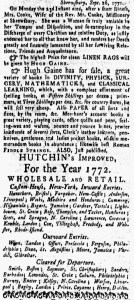
“High Gaine has for sale, a great variety of books.”

Although some colonial printers reserved the final pages of their newspapers for advertising, not all did so.  In many newspapers, paid notices could and did appear on any page, including the front page.  Such was the case in Hugh Gaine’s New-York Gazette and Weekly Mercury.  Consider the issue for October 7, 1771.  Gaine divided the first page between news items and advertising, filling the first two columns with the former and the last two with the latter.  He did the sane on the second page.  On the third page, he arranged news in the first column and into the second, but the bottom half of the second column as well as the remaining two columns consisted entirely of advertising.  Gaine gave over the entire final page to paid notices.

In general, Gaine placed news and advertising next to each other, but, like other printers who followed that method, he did not intersperse news and advertising on the page.  He delineated space intended for news and space intended for advertising rather than having paid notices appear among news items and editorials … with one exception.  He inserted an advertisement for books, stationery, and other items available at his printing office among the news on the third page. That advertisement appeared below a death notice for “Mrs. Cooke, Wife of the Rev. Mr. Cooke, Missionary at Shrewsbury,” and above the shipping news from the New York Custom House.  A line of ornamental type then separated the news (and Gaine’s advertisement) from the advertisements that completed the column and filled the remainder of the page.  In choosing this format, Gaine increased the likelihood that readers perusing the newspaper for news and skipping over the sections for advertising would see his own advertisement.  He was not the only colonial printer who sometimes adopted that strategy, leveraging his access to the press to give his own advertisement a privileged place.  Gaine inserted other advertisements elsewhere in the October 7 edition, most of them short notices intended to complete a column, but he exerted special effort in drawing attention to his most extensive advertisement by embedding it among the news.  His customers who purchased space for their notices did not have the same option.

Slavery Advertisements Published October 7, 1771

GUEST CURATOR: Chloe Amour
with contributions from Katerina Barbas

The Slavery Adverts 250 Project chronicles the role of newspaper advertising in perpetuating slavery in the era of the American Revolution. The project seeks to reveal the ubiquity of slavery in eighteenth-century life from New England to Georgia by republishing advertisements about enslaved people – for sale as individuals or in groups, wanted to purchase or for hire for short periods, runaways who liberated themselves, and those who were subsequently captured and confined in jails and workhouses – in daily digests on this site as well as in real time via the @SlaveAdverts250 Twitter feed, utilizing twenty-first-century media to stand in for the print media of the eighteenth century.

The project aims to provide modern audiences with a sense of just how often colonists encountered these advertisements in their daily lives. Enslaved men, women, and children appeared in print somewhere in the colonies almost every single day. Those advertisements served as a constant backdrop for social, cultural, economic, and political life in colonial and revolutionary America. Colonists who did not purport to own enslaved people were still confronted with slavery as well as invited to maintain the system by purchasing enslaved men, women, and children or assisting in the capture of so-called “runaways” who sought to free themselves from bondage. The frequency of these newspaper advertisements suggests just how embedded slavery was in colonial and revolutionary American culture in everyday interactions beyond the printed page.

These advertisements also testify to the experiences of enslaved men, women, and children, though readers must consider that those experiences have been remediated through descriptions offered by enslavers rather than enslaved people themselves. Often unnamed in the advertisements, enslaved men, women, and children were not invisible or unimportant in early America.

From compiling an archive of digitized eighteenth-century newspapers to identifying advertisements about enslaved men, women, and children in those newspapers to preparing images of each advertisement to posting this daily digest, Chloe Amour served as guest curator for this entry.  She completed this work while enrolled in an independent study for HIS 390 – Digital Humanities Practicum at Assumption University in Worcester, Massachusetts, in Spring 2021.

These advertisements appeared in colonial American newspapers 250 years ago today.

New-York Gazette and Weekly Mercury (October 7, 1771).

**********

New-York Gazette and Weekly Mercury (October 7, 1771).

**********

New-York Gazette and Weekly Mercury (October 7, 1771).

**********

New-York Gazette and Weekly Mercury (October 7, 1771).

**********

New-York Gazette and Weekly Mercury (October 7, 1771).

**********

New-York Gazette and Weekly Mercury (October 7, 1771).

**********

South-Carolina and American General Gazette (October 7, 1771).

**********

South-Carolina and American General Gazette (October 7, 1771).

**********

South-Carolina and American General Gazette (October 7, 1771).

**********

South-Carolina and American General Gazette (October 7, 1771).

**********

South-Carolina and American General Gazette (October 7, 1771).

**********

South-Carolina and American General Gazette (October 7, 1771).

**********

South-Carolina and American General Gazette (October 7, 1771).

**********

South-Carolina and American General Gazette (October 7, 1771).

**********

South-Carolina and American General Gazette (October 7, 1771).

**********

South-Carolina and American General Gazette (October 7, 1771).

**********

South-Carolina and American General Gazette (October 7, 1771).

**********

South-Carolina and American General Gazette (October 7, 1771).

**********

South-Carolina and American General Gazette (October 7, 1771).

**********

South-Carolina and American General Gazette (October 7, 1771).

**********

South-Carolina and American General Gazette (October 7, 1771).

**********

South-Carolina and American General Gazette (October 7, 1771).

**********

South-Carolina and American General Gazette (October 7, 1771).