Slavery Advertisements Published December 14, 1771

GUEST CURATOR: J. Rioux

The Slavery Adverts 250 Project chronicles the role of newspaper advertising in perpetuating slavery in the era of the American Revolution. The project seeks to reveal the ubiquity of slavery in eighteenth-century life from New England to Georgia by republishing advertisements about enslaved people – for sale as individuals or in groups, wanted to purchase or for hire for short periods, runaways who liberated themselves, and those who were subsequently captured and confined in jails and workhouses – in daily digests on this site as well as in real time via the @SlaveAdverts250 Twitter feed, utilizing twenty-first-century media to stand in for the print media of the eighteenth century.

The project aims to provide modern audiences with a sense of just how often colonists encountered these advertisements in their daily lives. Enslaved men, women, and children appeared in print somewhere in the colonies almost every single day. Those advertisements served as a constant backdrop for social, cultural, economic, and political life in colonial and revolutionary America. Colonists who did not purport to own enslaved people were still confronted with slavery as well as invited to maintain the system by purchasing enslaved men, women, and children or assisting in the capture of so-called “runaways” who sought to free themselves from bondage. The frequency of these newspaper advertisements suggests just how embedded slavery was in colonial and revolutionary American culture in everyday interactions beyond the printed page.

These advertisements also testify to the experiences of enslaved men, women, and children, though readers must consider that those experiences have been remediated through descriptions offered by enslavers rather than enslaved people themselves. Often unnamed in the advertisements, enslaved men, women, and children were not invisible or unimportant in early America.

These advertisements appeared in colonial American newspapers 250 years ago today.

Providence Gazette (December 14, 1771).

**********

Providence Gazette (December 14, 1771).

December 13

What was advertised in a colonial America n newspaper 250 years ago today?

New-Hampshire Gazette (December 13, 1771).

“A Civil, Military & Ecclesiastical REGISTER of the Province of New-Hampshire, for the YEAR 1772.”

Each year as fall turned to winter, readers regularly encountered advertisements for almanacs in colonial American newspapers.  Printers often listed the contents as a means of enticing prospective customers to purchase particular titles, emphasizing the range of useful or entertaining items included in one publication or another.  In 1771, Daniel Fowle and Robert Fowle, the printers of the New-Hampshire Gazette gathered together a variety of useful information that might otherwise have appeared in an almanac in a separate pamphlet.  They advertised their “Civil, Military & Ecclesiastical REGISTER of the Province of New-Hampshire, for the YEAR 1772” in their newspaper.

The bulk of their advertisement consisted of an enumeration of the contents, everything from a “List of the Governor, Council and House of Representatives” and “Judges and Officers of the Superiour Court, and Court of Admiralty” to “Barristers of Law and Practising Attornies with their respective Places of Residence” and “Custom House Officers and Notaries Public” to “Trustees and Officers of Dartmouth-College” and “Ministers, Churches and religious Assemblies of the several Denominations in each County.”  The pamphlet also included directions along several roads “with the most noted Houses of Entertainment” for those who needed to travel within the colony for one reason or another.

The Civil, Military and Ecclesiastical Register apparently did not meet with as much success as the Fowles hoped.  They did not update it and publish a new edition for 1773 nor for any subsequent year.  Thomas Fleet and John Fleet printed and sold a register for New Hampshire in 1779, folding it into A Pocket Almanack for the Year of our Lord 1780 … Calculated for the use of the State of Massachusetts Bay in New-England.  Following the American Revolution, George Jerry Osborne published Osborne’s New-Hampshire Register with an Almanack, for the Year 1787, yet another pamphlet that merged the elements of an almanac with those of a register.  Osborne published registers with almanacs for 1788 and 1789.  Others also appeared on the market before the end of the century.  Perhaps the Fowles would have attempted to revive their register if it had not been for the disruptions of the American Revolution.  The register for 1772 testified to their interest in such a project, provided that it found enough buyers willing to purchase it.

December 12

What was advertised in a colonial American newspaper 250 years ago today?

Pennsylvania Journal (December 12, 1771).

“Newest fashionable muffs, tippets and ermine.”

In the fall of 1771, furrier Fromberger and Siemon placed newspaper advertisement in their efforts to entice customers to visit their new shop on Market Street in Philadelphia.  They adopted several strategies that may have served them well, though their effectiveness may have been mitigated by an uneven rollout of the furriers’ advertising campaign.

Fromberger and Siemon commenced advertising in the Pennsylvania Journal in late September.  They incorporated a variety of appeals into their notice.  They informed customers that they catered to the latest tastes, stating that they carried “the newest fashionable muffs, tippets, and ermine, now worn by the ladies at the courts of Great Britain and France.”  They also called on consumers “to encourage their American manufacture” rather than purchase imported items.  In addition, the furriers sought to establish ongoing relationships with their customers by providing ancillary services.  Their customers could send their furs to Fromberger and Siemon to have them “taken care of gratis for the summer season.”  To draw attention to these various marketing strategies, the furriers adorned their advertisements with a woodcut depicting a muff and tippet.

That advertisement did not last long in the Pennsylvania Journal before it appeared in the Pennsylvania Chronicle.  Fromberger and Siemon commissioned only one woodcut, so they arranged to have it transferred from one printing office to another.  Once again, their advertisement quickly lapsed.  They revived it in the Pennsylvania Journal on December 5, though without the woodcut.  The following week, it ran once again, this time with the image of the muff and tippet.  The woodcut made its way back to William Bradford and Thomas Bradford’s printing office.  On December 19, however, Fromberger and Siemon’s advertisement appeared once more without the image that made it so distinctive.  Why, after investing in the woodcut, did the furriers deploy it so haphazardly?  Was it a tradeoff against the expense of purchasing the additional space?  Did the printers play any role in deciding that they needed the space for other content?  What other factors played a role in how Fromberger and Siemon executed their advertising campaign?

Slavery Advertisements Published December 12, 1771

GUEST CURATOR: J. Rioux

The Slavery Adverts 250 Project chronicles the role of newspaper advertising in perpetuating slavery in the era of the American Revolution. The project seeks to reveal the ubiquity of slavery in eighteenth-century life from New England to Georgia by republishing advertisements about enslaved people – for sale as individuals or in groups, wanted to purchase or for hire for short periods, runaways who liberated themselves, and those who were subsequently captured and confined in jails and workhouses – in daily digests on this site as well as in real time via the @SlaveAdverts250 Twitter feed, utilizing twenty-first-century media to stand in for the print media of the eighteenth century.

The project aims to provide modern audiences with a sense of just how often colonists encountered these advertisements in their daily lives. Enslaved men, women, and children appeared in print somewhere in the colonies almost every single day. Those advertisements served as a constant backdrop for social, cultural, economic, and political life in colonial and revolutionary America. Colonists who did not purport to own enslaved people were still confronted with slavery as well as invited to maintain the system by purchasing enslaved men, women, and children or assisting in the capture of so-called “runaways” who sought to free themselves from bondage. The frequency of these newspaper advertisements suggests just how embedded slavery was in colonial and revolutionary American culture in everyday interactions beyond the printed page.

These advertisements also testify to the experiences of enslaved men, women, and children, though readers must consider that those experiences have been remediated through descriptions offered by enslavers rather than enslaved people themselves. Often unnamed in the advertisements, enslaved men, women, and children were not invisible or unimportant in early America.

These advertisements appeared in colonial American newspapers 250 years ago today.

Maryland Gazette (December 12, 1771).

**********

Maryland Gazette (December 12, 1771).

**********

Maryland Gazette (December 12, 1771).

**********

New-York Journal (December 12, 1771).

**********

New-York Journal (December 12, 1771).

**********

New-York Journal (December 12, 1771).

**********

Pennsylvania Gazette (December 12, 1771).

**********

Pennsylvania Gazette (December 12, 1771).

**********

Pennsylvania Journal (December 12, 1771).

**********

Pennsylvania Journal (December 12, 1771).

**********

Virginia Gazette [Purdie and Dixon] (December 12, 1771).

**********

Virginia Gazette [Purdie and Dixon] (December 12, 1771).

**********

Virginia Gazette [Purdie and Dixon] (December 12, 1771).

**********

Virginia Gazette [Purdie and Dixon] (December 12, 1771).

**********

Virginia Gazette [Purdie and Dixon] (December 12, 1771).

**********

Virginia Gazette [Purdie and Dixon] (December 12, 1771).

**********

Virginia Gazette [Purdie and Dixon] (December 12, 1771).

**********

Virginia Gazette [Purdie and Dixon] (December 12, 1771).

**********

Virginia Gazette [Purdie and Dixon] (December 12, 1771).

**********

Virginia Gazette [Purdie and Dixon] (December 12, 1771).

**********

Virginia Gazette [Purdie and Dixon] (December 12, 1771).

**********

Virginia Gazette [Purdie and Dixon] (December 12, 1771).

December 11

What was advertised in a colonial American newspaper 250 years ago this week?

Boston Evening-Post (December 9, 1771).

“[I]f the Teas should not please those that have not yet made trial, they will be received back and the Money returned.”

Archibald Cunningham took to the pages of the Boston Evening-Post to advertise a variety of groceries and housewares in December 1771.  His inventory included sugar, rice, nutmegs, and an assortment of spices as well as “Blue and white China Cups and Saucers” and “Delph & Glass Ware” in several colors.  Cunningham listed each of these items, some with short descriptions, but devoted an entire paragraph to promoting tea.

He informed prospective customers that he carried “Bohea Tea very good” and “excellent Souchong and Hyson Tea.”  According to Cunningham, his tea “has been approved of by good Judges to be of a superior Quality in Flavor and Color to that commonly imported.”  He did not name those “good Judges,” but he also did not expect consumers to accept such testimonials without question.  Instead, Cunningham promised satisfaction by offering a money back guarantee.  [I]f the Teas should not please those that have not yet made trial,” the shopkeeper declared, “they will be received back and the Money returned.”  That likely attracted the attention of some readers as they encountered advertisements placed by several shopkeepers who included tea among their merchandise.

On occasion, purveyors of goods and services experimented with money back guarantees in the eighteenth century, but not so often that such offers regularly appeared in advertisements.  Cunningham provided his customers with an additional benefit that distinguished how he marketed tea from others who advertised the same varieties.  Lewis Deblois and George Deblois listed “Bohea Tea per Chest or Dozen” in their advertisement, giving customer options when it came to quantity.  John Adams and Company commented on the quality of their “Best Hyson and Bohea Tea,” but did not encourage customers to take it home, try it, and then return it for a refund if it did not meet with satisfaction.

In offering a money back guarantee, Cunningham further testified to the quality of his tea.  He would not have made such an offer unless he was confident consumers would rarely invoke the option of returning what they purchased.  The guarantee provided security at the same time that it reassured prospective customers about the quality “in Flavor and Color” of Cunningham’s “Bohea Tea very good” and “excellent Souchong and Hyson Tea.”

December 10

What was advertised in a colonial American newspaper 250 years ago today?

Essex Gazette (December 10, 1771).

“Some of the above-mentioned Lawns and Gauzes are perhaps the most genteel of any ever imported into North-America.”

Several merchants and shopkeepers placed advertisements promoting imported goods in the December 10, 1771, edition of the Essex Gazette.  With the exception of the notice from John Cabot and Andrew Cabot with its text running upward diagonally, most of those advertisements looked quite similar at a glance.  The name of the purveyor of the goods, set in a larger font, functioned as a headline, an introduction outlined the origins of the merchandise and the location of the shop or warehouse, and dozens of items appeared in a catalog of current inventory.

Some advertisers, however, attempted to distinguish their notices from others by incorporating additional appeals to prospective customers.  John Andrew, for instance, informed readers that they could expect good bargains at his shop at the Sign of the Gold Cup.  “Those who favour him with their Custom,” he confided, “may depend upon being served with good Pennyworths, as he is determined to be undersold by none.”  Elsewhere on the same page, Samuel Cottman described his prices as “Extremely cheap,” while John Gould and Company declared that they set prices “as low as at any Store in the Province.”  Andrew made it clear that customers could expect competitive prices from him.

Rather than price, John Grozart made an appeal to fashion in the nota bene that enhanced his advertisement.  He drew attention to certain textiles, declaring that “Some of the above-mentioned Lawns and Gauzes are perhaps the most genteel of any ever imported into North-America.”  Those fabrics were not merely fashionable, Grozart suggested, but superlative in their fashionableness.  Customers could not go wrong in purchasing them, especially if they wanted to impress their friends and acquaintances.  Folsom and Hart advertised wigs “made in the present Taste,” but did not make claims nearly as bold as Grozart did about his wares as he attempted to incite curiosity among readers.

Neither Andrew nor Grozart included images in their advertisements.  The copy had to do all the work of enticing prospective customers to visit their stores.  To that end, they each devised an additional appeal to enhance the otherwise standard format of their newspaper notices, trusting that consumers practiced the close reading necessary to detect the differences among the advertisements in the Essex Gazette.

Slavery Advertisements Published December 10, 1771

GUEST CURATOR: Samantha Rhodes

The Slavery Adverts 250 Project chronicles the role of newspaper advertising in perpetuating slavery in the era of the American Revolution. The project seeks to reveal the ubiquity of slavery in eighteenth-century life from New England to Georgia by republishing advertisements about enslaved people – for sale as individuals or in groups, wanted to purchase or for hire for short periods, runaways who liberated themselves, and those who were subsequently captured and confined in jails and workhouses – in daily digests on this site as well as in real time via the @SlaveAdverts250 Twitter feed, utilizing twenty-first-century media to stand in for the print media of the eighteenth century.

The project aims to provide modern audiences with a sense of just how often colonists encountered these advertisements in their daily lives. Enslaved men, women, and children appeared in print somewhere in the colonies almost every single day. Those advertisements served as a constant backdrop for social, cultural, economic, and political life in colonial and revolutionary America. Colonists who did not purport to own enslaved people were still confronted with slavery as well as invited to maintain the system by purchasing enslaved men, women, and children or assisting in the capture of so-called “runaways” who sought to free themselves from bondage. The frequency of these newspaper advertisements suggests just how embedded slavery was in colonial and revolutionary American culture in everyday interactions beyond the printed page.

These advertisements also testify to the experiences of enslaved men, women, and children, though readers must consider that those experiences have been remediated through descriptions offered by enslavers rather than enslaved people themselves. Often unnamed in the advertisements, enslaved men, women, and children were not invisible or unimportant in early America.

These advertisements appeared in colonial American newspapers 250 years ago today.

South-Carolina Gazette and Country Journal (December 10, 1771).

**********

South-Carolina Gazette and Country Journal (December 10, 1771).

**********

South-Carolina Gazette and Country Journal (December 10, 1771).

**********

South-Carolina Gazette and Country Journal (December 10, 1771).

**********

South-Carolina Gazette and Country Journal (December 10, 1771).

**********

South-Carolina Gazette and Country Journal (December 10, 1771).

**********

South-Carolina Gazette and Country Journal (December 10, 1771).

**********

South-Carolina Gazette and Country Journal (December 10, 1771).

**********

South-Carolina Gazette and Country Journal (December 10, 1771).

**********

South-Carolina Gazette and Country Journal (December 10, 1771).

**********

South-Carolina Gazette and Country Journal (December 10, 1771).

**********

South-Carolina Gazette and Country Journal (December 10, 1771).

**********

South-Carolina Gazette and Country Journal (December 10, 1771).

**********

South-Carolina Gazette and Country Journal (December 10, 1771).

December 9

What was advertised in a colonial American newspaper 250 years ago today?

Massachusetts Gazette and Boston Post-Boy (December 9, 1771).

“Subscriptions for the CENSOR, a New Political Paper.”

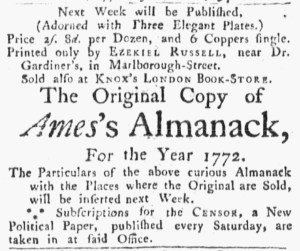
In a crowded market for selling almanacs, Ezekiel Russell advertised “The Original Copy of Ames’s Almanack, For the Year 1772” in the December 9, 1771, edition of the Massachusetts Gazette and Boston Post-Boy.  Russell claimed that only he printed that version of the popular almanac and announced that he would publish it, along with “Three Elegant Plates,” at his printing office on Marlborough Street the following week.  In addition, he advised prospective customers to look for an updated advertisement that included the “Particulars of the above curious Almanack with the Places where the Original are Sold.”

Although Russell opted not to include that information in his current advertisement, he did devote space to promoting another publication that he recently launched on November 23.  “Subscriptions for the CENSOR, a New Political Paper, published every Saturday,” he declared, “are taken in at said Office.”  According to newspaper historian and bibliographer Clarence Brigham, The Censor was more of a magazine than a newspaper, though the advertising supplements that sometimes accompanied it resembled those distributed with newspapers.

Isaiah Thomas, printer of the Massachusetts Spy at the time Russell published The Censor, declared that “those who were in the interest of the British government” supported The Censor “during the short period of its existence” in his History of Printing in America (1810).[1]  Thomas credited his own newspaper with inspiring The Censor.  “A dissertation in the Massachusetts Spy, under the signature of Mucius Scaevola,” he explained, “probably occasioned the attempt to establish this paper.”  The piece “attached Governor Hutchinson with a boldness and severity before unknown in the political disputes of this country.”  In turn, it “excited great warmth among those who supported the measures of the British administration, and they immediately commenced the publication of the Censor; in which the governor and the British administration were defended.”

Thomas, one of the most ardent patriots among Boston’s printers, had little use for The Censor.  Neither did most other residents of the city.  According to Thomas, “the circulation of the paper was confined to a few of their own party.  As the Censor languished, its printer made an effort to convert it into a newspaper; and, with this view, some of its last numbers were accompanied with a separate half sheet, containing a few articles of news and some advertisements.”  In the end, Russell discontinued The Censor “before the revolution of a year from its first publication.”[2]  The last known issue bears the date May 2, 1772.  Despite Russell’s attempts to attract subscribers, he did not manage to establish a market for a publication, whether magazine or newspaper or amalgamation of the two, that defended the governor and British policies.

**********

[1] Isaiah Thomas, The History of Printing in America: With a Biography of Printers and an Account of Newspapers, ed. Marcus McCorison (1810; New York: Weathervane Books, 1970), 153.

[2] Thomas, History of Printing, 284-285.

Slavery Advertisements Published December 9, 1771

GUEST CURATOR: Samantha Rhodes

The Slavery Adverts 250 Project chronicles the role of newspaper advertising in perpetuating slavery in the era of the American Revolution. The project seeks to reveal the ubiquity of slavery in eighteenth-century life from New England to Georgia by republishing advertisements about enslaved people – for sale as individuals or in groups, wanted to purchase or for hire for short periods, runaways who liberated themselves, and those who were subsequently captured and confined in jails and workhouses – in daily digests on this site as well as in real time via the @SlaveAdverts250 Twitter feed, utilizing twenty-first-century media to stand in for the print media of the eighteenth century.

The project aims to provide modern audiences with a sense of just how often colonists encountered these advertisements in their daily lives. Enslaved men, women, and children appeared in print somewhere in the colonies almost every single day. Those advertisements served as a constant backdrop for social, cultural, economic, and political life in colonial and revolutionary America. Colonists who did not purport to own enslaved people were still confronted with slavery as well as invited to maintain the system by purchasing enslaved men, women, and children or assisting in the capture of so-called “runaways” who sought to free themselves from bondage. The frequency of these newspaper advertisements suggests just how embedded slavery was in colonial and revolutionary American culture in everyday interactions beyond the printed page.

These advertisements also testify to the experiences of enslaved men, women, and children, though readers must consider that those experiences have been remediated through descriptions offered by enslavers rather than enslaved people themselves. Often unnamed in the advertisements, enslaved men, women, and children were not invisible or unimportant in early America.

These advertisements appeared in colonial American newspapers 250 years ago today.

Boston Evening-Post (December 9, 1771).

**********

Boston-Gazette (December 9, 1771).

**********

Massachusetts Gazette and Boston Post-Boy (December 9, 1771).

**********

Newport Mercury (December 9, 1771).

**********

New-York Gazette and Weekly Mercury (December 9, 1771).

**********

New-York Gazette and Weekly Mercury (December 9, 1771).

**********

Supplement to the New-York Gazette and Weekly Mercury (December 9, 1771).

**********

Supplement to the New-York Gazette and Weekly Mercury (December 9, 1771).

**********

Supplement to the New-York Gazette and Weekly Mercury (December 9, 1771).

**********

Supplement to the New-York Gazette and Weekly Mercury (December 9, 1771).

**********

Supplement to the New-York Gazette and Weekly Mercury (December 9, 1771).

December 8

What was advertised in a colonial American newspaper 250 years ago this week?

Providence Gazette (December 7, 1771).

“(T. b. c.)”

Did printers require advertisers to pay for their notices in advance?  They frequently extended credit to subscribers and regularly placed their own notices threatening to sue subscribers who had not paid for months or years, though they rarely seemed to follow through on those threats.  Did printers offer such leeway to subscribers because they more strictly enforced policies that advertisers had to pay before seeing their notices in print?  After all, advertising had the potential to generate significant revenue, eclipsing subscriptions.

John Carter, the printer of the Providence Gazette, included his policy in the colophon at the bottom of the last page: “ADVERTISEMENTS) of a moderate Length (accompanied with the Pay) are inserted in this Paper three Weeks for Four Shillings Lawful Money.”  Did he enforce his own policy?  Some evidence suggests that he did not always do so, especially for advertisements placed by customers who established good relations with the printing office.

Last week, I examined a notation, “(T. b. c.),” that appeared on the final line of George Olney’s advertisement.  That advertisement ran for eight weeks, for the first four weeks without the notation and for the final four weeks with the notation.  I suggested that “(T. b. c.)” meant “to be continued,” a signal to the compositor to continue inserting the notice until instructed otherwise by the advertiser.  How did that correlate with paying for advertisements in advance?  I hypothesized that since the notation did not initially appear in Olney’s advertisement that he paid for several weeks and then Carter extended credit for the remainder of the advertisement’s run.

Providence Gazette (December 7, 1771).

Today, I am testing that theory against two other advertisements that featured the “(T. b. c.)” notation, one for a “compleat assortment of English and India GOODS” placed by Edward Thurber and the other for “DRUGS and MEDICINES” placed by Amos Throop.  Thurber’s advertisement ran without the notation for three weeks (November 2, 9, and 16, 1771) and then ran for ten weeks with the notation.  In addition, Thurber ran a different advertisement for three weeks in October that did not have the “(T. b. c.)” notation as well as other advertisements earlier in the year that similarly did not include the notation.  If Thurber did indeed pay for inserting those advertisements in advance, then Carter very well could have extended credit for his “(T. b. c.)” advertisements.

Throop’s advertisement ran for six weeks in November and December 1771, each time with “(T. b. c.)” on the final line.  That deviates from Olney and Thurber first running their advertisements without the notation and then with it.  However, Throop had recently inserted another advertisement that ran for three weeks (September 28 and October 5 and 12) without the “(T. b. c.)” notation.  He also ran other advertisements earlier in the year, establishing a recent history with Carter.  That may have been sufficient for the printer to extend credit when Throop submitted an advertisement to appear for the first time on November 23.  It made its final appearance on December 28, perhaps as part of an agreement that credit would not extend into the new year.

Newspapers were important vehicles for disseminating information (via news accounts, letters, editorials, advertisements, and other features) in the era of the American Revolution, so much so that the business practices of printers merit scrutiny.  Notices placed by printers make clear that they extended credit to subscribers, but sometimes those notice made more general references to “customers” instead.  Those customers may have purchased advertisements, job printing, books, stationery, or a variety of other goods and services commonly available at printing offices.  Even though some printers declared that advertisements must pay in advance, it seems likely that they extended credit to some advertisers that they knew well.