July 20

What was advertised in a colonial American newspaper 250 years ago today?

Boston Evening-Post (July 20, 1772).

“Ebenezer Oliver Hereby informs the Publick and the Customers of his late Mother …”

In the summer of 1772, Ebenezer Oliver ran advertisements to advise “the Publick and the Customers of his late Mother Mrs. Bethiah Oliver, deceased,” that he had for sale a variety of goods “at the Shop formerly improved by her, nearly opposite the Old South Meeting-House, in Boston.”  The inventory included a “fine Assortment of China, Cream-colour’d, Glass, Delph, Flint and Stone WARE” as well as tea, sugar, coffee, and spices.

Ebenezer placed more emphasis on marketing those items than his mother had before her death.  Between 1765 and 1771, she placed advertisements in several newspapers each spring, joining the ranks of female seed sellers who sought customers among the residents of Boston.  Most of those women advertised seeds exclusively, even though they likely sold other items.  On occasion, Bethiah listed additional items at the end of an advertisement for “All Sorts of Garden Seeds,” such as a “general Assortment of Glass, Delph and Stone Ware, Lynn Shoes, best Bohea Tea, Coffee, Chocolate, and all other Groceries” in a notice in the April 14, 1766, edition of the Boston Evening-Post.  In contrast, Ebenezer placed an advertisement that did not mention seeds at all, but did provide an extensive list of groceries organized in two columns.

He did not, however, immediately transform the advertisements placed by his mother.  Bethiah died in the spring of 1771.  The following spring, her name appeared as a headline in advertisements for “GARDEN SEEDS Just imported by Captain Scott, from LONDON” in several newspapers, including the April 6, 1772, edition of the Boston-Gazette.  That advertisement included an extensive list of seeds, similar to the lists Bethiah published in recent years.  On closer examination, readers noted that the advertisement specified that the seeds were “to be Sold at the Shop formerly improved by Bethiah Oliver.”  Ebenezer replicated the marketing strategy that his mother had deployed mother in the late 1760s and early 1770s, probably hoping that name recognition and customer loyalty would draw friends and former customers to the shop that he now operated.

When Ebenezer expanded his marketing efforts beyond selling seeds in the spring, he initially invoked Bethiah’s name and “the Shop formerly improved by her” as a means of enticing “the Customers of his late Mother.”  As spring approached in 1773, nearly two years after his mother’s death, Ebenezer placed advertisements for “GARDEN SEEDS … just Imported in Capt. Jarvis from London” that deployed his name as a headline and referred to “his Shop,” though he added “(formerly improv’d by his late Mother Mrs. Bethiah Oliver, deceased.”  In the February 25, 1773, edition of the Massachusetts Gazette and Boston Weekly News-Letter, he added a nota bene that alerted prospective customers that he also stocked “a fine Assortment of Cream-colour’d Ware, Glass, Delph, Flint and Stone Ware, with a general Assortment of Groceries.”  In so doing, he revived the format his mother formerly used but abandoned several years earlier when she decided that her notices in the public prints, like those of so many of her fellow female seed sellers, would focus exclusively on “GARDEN SEEDS.”

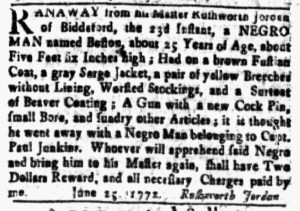
Slavery Advertisements Published July 20, 1772

The Slavery Adverts 250 Project chronicles the role of newspaper advertising in perpetuating slavery in the era of the American Revolution. The project seeks to reveal the ubiquity of slavery in eighteenth-century life from New England to Georgia by republishing advertisements about enslaved people – for sale as individuals or in groups, wanted to purchase or for hire for short periods, runaways who liberated themselves, and those who were subsequently captured and confined in jails and workhouses – in daily digests on this site as well as in real time via the @SlaveAdverts250 Twitter feed, utilizing twenty-first-century media to stand in for the print media of the eighteenth century.

The project aims to provide modern audiences with a sense of just how often colonizers encountered these advertisements in their daily lives. Enslaved men, women, and children appeared in print somewhere in the colonies almost every single day. Those advertisements served as a constant backdrop for social, cultural, economic, and political life in colonial and revolutionary America. Colonizers who did not purport to own enslaved people were still confronted with slavery as well as invited to maintain the system by purchasing enslaved men, women, and children or assisting in the capture of so-called “runaways” who sought to free themselves from bondage. The frequency of these newspaper advertisements suggests just how embedded slavery was in colonial and revolutionary American culture in everyday interactions beyond the printed page.

These advertisements also testify to the experiences of enslaved men, women, and children, though readers must consider that those experiences have been remediated through descriptions offered by enslavers rather than enslaved people themselves. Often unnamed in the advertisements, enslaved men, women, and children were not invisible or unimportant in early America.

These advertisements appeared in colonial American newspapers 250 years ago today.

New-York Gazette and Weekly Mercury (July 20, 1772).

**********

New-York Gazette and Weekly Mercury (July 20, 1772).

**********

New-York Gazette and Weekly Mercury (July 20, 1772).

**********

New-York Gazette and Weekly Mercury (July 20, 1772).

**********

New-York Gazette and Weekly Mercury (July 20, 1772).

**********

New-York Gazette and Weekly Mercury (July 20, 1772).

**********

Pennsylvania Chronicle (July 20, 1772).

**********

Pennsylvania Packet (July 20, 1772).

July 19

What was advertised in a colonial American newspaper 250 years ago this week?

New-York Journal (July 16, 1772).

“WATCHES, HORIZONTAL, REPEATING, or PLAIN.”

By coincidence or by design, the compositor made the feud between rival watchmakers James Yeoman and John Simnet difficult to overlook in the July 16, 1772, edition of the New-York Journal, placing their advertisements next to each other.  The two had been sparring in the public prints for months, but their advertisements did not previously appear in such close proximity.

Yeoman devised a distinctive headline for his advertisement: “WATCHES, / HORIZONTAL, REPEATING, or PLAIN; / CLOCKS, / ASTRONOMICAL, Musical or / Plain.”  He then asserted that “he can with Propriety declare himself a realManufacturer, having had the Government of a large Manufactory from its Infancy to its Maturity, one Hundred Miles from London.”  In so doing, he answered allegations that Simnet made about Yeoman’s lack of skill and experience.  Yeoman also proclaimed that he could supply “proper Testimonials … to prove the Assertion” that he managed a “large Manufactory” in England.  A notation on the final line, “27,” indicated that the advertisement first appeared in issue 1527 on April 9.

For his part, Simnet had a history of mocking his competitors.  In this instance, he appropriated Yeoman’s headline for his own advertisement: “WATCHES, / HORIZONTAL, REPEATING, or PLAIN; CLOCKS, / ASTRONOMICAL, MUSICAL.”  He then insinuated that Yeoman greatly exaggerated his abilities, asking “IS any ingenious Artificer (or Spirit) within 100 Miles, capable of making either, or a Thing in Imitation of either?”  The reference to “100 Miles” underscored that Simnet sought to twist the contents of Yeoman’s advertisement against his competitor.

By the time Simnet’s advertisement first appeared in the New-York Journal on July 2, readers were familiar with Yeoman’s notice, making it difficult to overlook the derision of the intentional replication and alteration of the original.  Positioning the notices next to each other served Simnet’s purposes, even for readers who quickly scanned the advertisements and missed the interplay between notices when they previously appeared on different pages.

July 18

What was advertised in a colonial American newspaper 250 years ago today?

Providence Gazette (July 18, 1772).

Thurber and Cahoon WANT to purchase … Red Oak Staves.”

In the early 1770s, Thurber and Cahoon regularly advertised imported goods for sale at “the Sign of the BUNCH of GRAPES” in Providence.  For instance, they hawked a “compleat Assortment of English and India GOODS, Of almost every Kind” in an advertisement in the July 18, 1772, edition of the Providence Gazette.  In addition, they promoted a “general Assortment of WEST-INDIA GOODS” in the same notice.  A notation at the end, “(3 M),” indicated that they planned to run the advertisement for three months.

Thurber and Cahoon did not turn to the public prints solely to market merchandise to consumers in Providence and nearby towns.  They also placed advertisements seeking resources they needed to participate in transatlantic trade, including wooden barrel staves.  Two such advertisements ran on the final page of the Providence Gazette on July 18, 1772.  In one, Thurber and Cahoon joined with Edward Thurber in calling on the public to supply them with a “Quantity of LONG STAVES.”  They needed the staves “immediately,” offering “good Pay” for them.  In another advertisement, they stated that they “WANT to purchase a Quantity of square edged Yellow Pine Boards, and Red Oak Stvaes.”  Again, they offered “good Pay” for those items.  The notation “(T. b. c.)” appeared on the final line, alerting the compositor that that Thurber and Cahoon intended for the advertisement “to be continued” until they alerted the printing office to discontinue it.

As Thurber and Cahoon utilized the Providence Gazette for both selling merchandise at their shop and acquiring supplies from other colonizers, John Carter, the printer, enjoyed a steady revenue stream.  Those advertisements helped in funding the distribution of news from London, Marseilles, Albany and Boston that appeared in the July 18 edition, including “the report of a Committee of the Honourable House of Representatives” in Massachusetts “to consider of a message from his Excellency the Governor.”  That report raised concerns about the governor, Thomas Hutchinson, “receiving his support, independent of the grants and acts of the General Assembly,” considering it a “dangerous innovation” because it made the governor less accountable to “the people” of Massachusetts.  Readers of the Providence Gazette learned about some of the most important issues that eventually resulted in the colonies declaring independence in part because Thurber and Cahoon ran advertisements seeking barrel staves “(T. b. c.)”

Slavery Advertisements Published July 18, 1772

The Slavery Adverts 250 Project chronicles the role of newspaper advertising in perpetuating slavery in the era of the American Revolution. The project seeks to reveal the ubiquity of slavery in eighteenth-century life from New England to Georgia by republishing advertisements about enslaved people – for sale as individuals or in groups, wanted to purchase or for hire for short periods, runaways who liberated themselves, and those who were subsequently captured and confined in jails and workhouses – in daily digests on this site as well as in real time via the @SlaveAdverts250 Twitter feed, utilizing twenty-first-century media to stand in for the print media of the eighteenth century.

The project aims to provide modern audiences with a sense of just how often colonizers encountered these advertisements in their daily lives. Enslaved men, women, and children appeared in print somewhere in the colonies almost every single day. Those advertisements served as a constant backdrop for social, cultural, economic, and political life in colonial and revolutionary America. Colonizers who did not purport to own enslaved people were still confronted with slavery as well as invited to maintain the system by purchasing enslaved men, women, and children or assisting in the capture of so-called “runaways” who sought to free themselves from bondage. The frequency of these newspaper advertisements suggests just how embedded slavery was in colonial and revolutionary American culture in everyday interactions beyond the printed page.

These advertisements also testify to the experiences of enslaved men, women, and children, though readers must consider that those experiences have been remediated through descriptions offered by enslavers rather than enslaved people themselves. Often unnamed in the advertisements, enslaved men, women, and children were not invisible or unimportant in early America.

These advertisements appeared in colonial American newspapers 250 years ago today.

Providence Gazette (July 18, 1772).

July 17

What was advertised in a colonial American newspaper 250 years ago today?

New-London Gazette (July 17, 1772).

“Articles of JEWELLERY.”

John B. Brimmer stocked an array of goods at his store in Norwich Landing, Connecticut, in the summer of 1772.  In an advertisement in the New-London Gazette on July 17, he promoted a “great Variety of English and Hard Ware Goods,” but claimed to have “too great a Variety to be enumerated in an Advertisement.”  That differed from his marketing efforts the previous summer, but perhaps Brimmer determined that he did not wish to incur the expense of inserting lengthy lists of his goods in the newspaper.  He did list a couple of dozen items in a dense paragraph that included “best London Pewter,” “Brass Kettles,” “Iron Tea-Kettles,” concluding with “&c. &c. &c.”  In repeating the abbreviation for et ceterathree times, he suggested to prospective customers that they would discover much more when they visited his store.

Brimmer also informed the public that he carried many “Articles of JEWELLERY.”  Those items he did choose to enumerate, listing “Cypher Drops,” “Brilliants for Rings,” “Cyphers for Buttons,” “Brilliant Drops,” and “Sparks and Garnets.”  To draw attention to this merchandise, Brimmer arranged it in two columns with only item on each line.  Decorative type separated the two columns, giving the advertisement a unique visual component compared to any other notice in that issue of the New-London Gazette.  Only the “POETS CORNER,” a weekly feature at the top of the final page, featured anything similar, lines of decorative type appearing both above and below its headline.

Like most eighteenth-century advertisers, Brimmer relied on the copy to do most of the work in marketing his goods.  He made appeals to consumer choice, invoking the word “variety” more than once, and promised low prices.  However, he also introduced a bit of graphic design to engage readers of the New-London Gazette.  The decorative type enhanced the visibility of his advertisement, distinguishing it from others.

Slavery Advertisements Published July 17, 1772

The Slavery Adverts 250 Project chronicles the role of newspaper advertising in perpetuating slavery in the era of the American Revolution. The project seeks to reveal the ubiquity of slavery in eighteenth-century life from New England to Georgia by republishing advertisements about enslaved people – for sale as individuals or in groups, wanted to purchase or for hire for short periods, runaways who liberated themselves, and those who were subsequently captured and confined in jails and workhouses – in daily digests on this site as well as in real time via the @SlaveAdverts250 Twitter feed, utilizing twenty-first-century media to stand in for the print media of the eighteenth century.

The project aims to provide modern audiences with a sense of just how often colonizers encountered these advertisements in their daily lives. Enslaved men, women, and children appeared in print somewhere in the colonies almost every single day. Those advertisements served as a constant backdrop for social, cultural, economic, and political life in colonial and revolutionary America. Colonizers who did not purport to own enslaved people were still confronted with slavery as well as invited to maintain the system by purchasing enslaved men, women, and children or assisting in the capture of so-called “runaways” who sought to free themselves from bondage. The frequency of these newspaper advertisements suggests just how embedded slavery was in colonial and revolutionary American culture in everyday interactions beyond the printed page.

These advertisements also testify to the experiences of enslaved men, women, and children, though readers must consider that those experiences have been remediated through descriptions offered by enslavers rather than enslaved people themselves. Often unnamed in the advertisements, enslaved men, women, and children were not invisible or unimportant in early America.

These advertisements appeared in colonial American newspapers 250 years ago today.

New-Hampshire Gazette (July 17, 1772).

July 16

What was advertised in a colonial American newspaper 250 years ago today?

Massachusetts Gazette and Boston Weekly News-Letter (July 16, 1772).

“Printed Catalogues may be had at the Auction-Room.”

In the summer of 1772, Joseph Russell, the proprietor of the “Auction-Room in Queen street” in Boston,” advertised a sale of a “very Large and Valuable Collection of BOOKS, in almost every Branch of polite Literature” scheduled for July 17.  In anticipation of the auction, he offered “Printed Catalogues” for customers to peruse and mark.  Some historians of the book have suggested that many catalogs mentioned in newspaper advertisements never existed.  Some booksellers and auctioneers may have promised catalogs as a means of increasing foot traffic, achieving their goal whether or not they passed out any catalogs to anyone who visited their shops or auction halls.  Others may have had the best intentions of supplying catalogs, but lack of time or lack of resources worked against them.

Revisions to Russell’s advertisement as the day of the auction approached suggest that he did indeed distribute catalogs.  In an advertisement in the July 6 edition of the Boston-Evening Post July 9 edition of the Massachusetts Gazette and Boston Weekly News-Letter, Russell informed the public that “Printed Catalogues may be had at the Auction-Room in Queen-street, the Monday preceding the Time of Sale.”  On Monday, July 13, the Boston Evening-Post ran the same advertisement again, but a new advertisement in the Massachusetts Gazette and Boston Post-Boy stated that “Printed Catalogues may be had at the Auction-Room in Queen-street.”  A few days later, the advertisement in the Massachusetts Gazette and Boston Weekly News-Letter featured some new copy.  Instead of opening with “On Friday 17th July,” the new headline proclaimed “TO-MORROW.”  Russell also removed reference to “the Monday preceding the Time of Sale,” asserting that “Printed Catalogues may be had at the Auction-Room in Queen-street.”  That brought his advertisement in line with the one recently placed in the Massachusetts Gazette and Post-Boy.  Even though Russell neglected to update the advertisement in the Boston Evening-Post, he altered the notice in the Massachusetts Gazette and Boston Weekly News-Letter, suggesting that he sought to bring it into conformity with new developments.

Slavery Advertisements Published July 16, 1772

The Slavery Adverts 250 Project chronicles the role of newspaper advertising in perpetuating slavery in the era of the American Revolution. The project seeks to reveal the ubiquity of slavery in eighteenth-century life from New England to Georgia by republishing advertisements about enslaved people – for sale as individuals or in groups, wanted to purchase or for hire for short periods, runaways who liberated themselves, and those who were subsequently captured and confined in jails and workhouses – in daily digests on this site as well as in real time via the @SlaveAdverts250 Twitter feed, utilizing twenty-first-century media to stand in for the print media of the eighteenth century.

The project aims to provide modern audiences with a sense of just how often colonizers encountered these advertisements in their daily lives. Enslaved men, women, and children appeared in print somewhere in the colonies almost every single day. Those advertisements served as a constant backdrop for social, cultural, economic, and political life in colonial and revolutionary America. Colonizers who did not purport to own enslaved people were still confronted with slavery as well as invited to maintain the system by purchasing enslaved men, women, and children or assisting in the capture of so-called “runaways” who sought to free themselves from bondage. The frequency of these newspaper advertisements suggests just how embedded slavery was in colonial and revolutionary American culture in everyday interactions beyond the printed page.

These advertisements also testify to the experiences of enslaved men, women, and children, though readers must consider that those experiences have been remediated through descriptions offered by enslavers rather than enslaved people themselves. Often unnamed in the advertisements, enslaved men, women, and children were not invisible or unimportant in early America.

These advertisements appeared in colonial American newspapers 250 years ago today.

Maryland Gazette (July 16, 1772).

**********

Maryland Gazette (July 16, 1772).

**********

Maryland Gazette (July 16, 1772).

**********

Massachusetts Gazette and Boston Weekly News-Letter (July 16, 1772).

**********

Massachusetts Gazette and Boston Weekly News-Letter (July 16, 1772).

**********

New-York Journal (July 16, 1772).

**********

Pennsylvania Gazette (July 16, 1772).

**********

Pennsylvania Gazette (July 16, 1772).

**********

Pennsylvania Gazette (July 16, 1772).

**********

Pennsylvania Gazette (July 16, 1772).

**********

Pennsylvania Gazette (July 16, 1772).

**********

South-Carolina Gazette (July 16, 1772).

**********

South-Carolina Gazette (July 16, 1772).

**********

South-Carolina Gazette (July 16, 1772).

**********

South-Carolina Gazette (July 16, 1772).

**********

South-Carolina Gazette (July 16, 1772).

**********

South-Carolina Gazette (July 16, 1772).

**********

South-Carolina Gazette (July 16, 1772).

**********

South-Carolina Gazette (July 16, 1772).

**********

South-Carolina Gazette (July 16, 1772).

**********

South-Carolina Gazette (July 16, 1772).

**********

South-Carolina Gazette (July 16, 1772).

**********

South-Carolina Gazette (July 16, 1772).

**********

South-Carolina Gazette (July 16, 1772).

**********

Supplement to the South-Carolina Gazette (July 16, 1772).

**********

Supplement to the South-Carolina Gazette (July 16, 1772).

**********

Supplement to the South-Carolina Gazette (July 16, 1772).

**********

Supplement to the South-Carolina Gazette (July 16, 1772).

**********

Supplement to the South-Carolina Gazette (July 16, 1772).

**********

Supplement to the South-Carolina Gazette (July 16, 1772).

**********

Virginia Gazette [Purdie and Dixon] (July 16, 1772).

**********

Virginia Gazette [Purdie and Dixon] (July 16, 1772).

**********

Virginia Gazette [Purdie and Dixon] (July 16, 1772).

**********

Virginia Gazette [Purdie and Dixon] (July 16, 1772).

**********

Virginia Gazette [Purdie and Dixon] (July 16, 1772).

**********

Virginia Gazette [Purdie and Dixon] (July 16, 1772).

**********

Virginia Gazette [Purdie and Dixon] (July 16, 1772).

**********

Virginia Gazette [Purdie and Dixon] (July 16, 1772).

**********

Virginia Gazette [Purdie and Dixon] (July 16, 1772).

**********

Virginia Gazette [Purdie and Dixon] (July 16, 1772).

**********

Virginia Gazette [Purdie and Dixon] (July 16, 1772).

Slavery Advertisements Published July 15, 1772

The Slavery Adverts 250 Project chronicles the role of newspaper advertising in perpetuating slavery in the era of the American Revolution. The project seeks to reveal the ubiquity of slavery in eighteenth-century life from New England to Georgia by republishing advertisements about enslaved people – for sale as individuals or in groups, wanted to purchase or for hire for short periods, runaways who liberated themselves, and those who were subsequently captured and confined in jails and workhouses – in daily digests on this site as well as in real time via the @SlaveAdverts250 Twitter feed, utilizing twenty-first-century media to stand in for the print media of the eighteenth century.

The project aims to provide modern audiences with a sense of just how often colonizers encountered these advertisements in their daily lives. Enslaved men, women, and children appeared in print somewhere in the colonies almost every single day. Those advertisements served as a constant backdrop for social, cultural, economic, and political life in colonial and revolutionary America. Colonizers who did not purport to own enslaved people were still confronted with slavery as well as invited to maintain the system by purchasing enslaved men, women, and children or assisting in the capture of so-called “runaways” who sought to free themselves from bondage. The frequency of these newspaper advertisements suggests just how embedded slavery was in colonial and revolutionary American culture in everyday interactions beyond the printed page.

These advertisements also testify to the experiences of enslaved men, women, and children, though readers must consider that those experiences have been remediated through descriptions offered by enslavers rather than enslaved people themselves. Often unnamed in the advertisements, enslaved men, women, and children were not invisible or unimportant in early America.

These advertisements appeared in colonial American newspapers 250 years ago today.

Pennsylvania Journal (July 15, 1772).

**********

Pennsylvania Journal (July 15, 1772).

**********

Pennsylvania Journal (July 15, 1772).