May 13

What was advertised in a colonial American newspaper 250 years ago today?

Massachusetts Spy (May 13, 1773).

“Hand and Shop BILLS.”

At the bottom of the final page of each issue of the Massachusetts Spy, the colophon informed readers that they could purchase subscriptions from Isaiah Thomas at his printing office in Boston or from local agents in several other towns in the colony.  In addition, the colophon stated, “ADVERTISEMENTS taken in,” “PRINTING in its various Branches, performed in a neat Manner,” and “HAND BILLS at an Hour’s Notice.”  Thomas aimed to generate revenue from both notices in the newspaper and advertisements printed to distribute separately.

In the spring of 1773, the printer enhanced his efforts to encourage colonizers to purchase advertising.  He commenced with a newspaper notice that appeared as the first item at the top of the first column on the first page of the April 16 edition.  Thomas advised that “THE extensive circulation of the MASSACHUSETTS SPY, through town and country, renders it very beneficial for those who ADVERTISE therein.”  Furthermore, “Advertisements (sent in season) are inserted in a neat and conspicuous manner on the most reasonable terms.”  The remainder of the notice solicited subscriptions, though the printer’s comment that the newspaper “has met with very great encouragement from the public” also assured advertisers of its “extensive circulation” that made advertising a good investment.

Three weeks later, Thomas inserted another advertisement about advertising, this time for “Hand and Shop BILLS.”  Printers occasionally hawked handbills, as Thomas did in the colophon, but rarely did they advertiser shop bills.  Those billheads, the precursors to modern letterheads, included the name and location of the merchant, shopkeeper, or artisan.  They often featured a visual image or a brief advertisement describing the goods and services available at the shop or both.  Most of the sheet remained blank, leaving space to write in a list of purchases.  Billheads simultaneously served as both advertisements and receipts.

Thomas apparently sought to increase the amount of advertising produced at his shop.  He declared that he “furnished himself with an elegant assortment of LARGE, and other TYPES, for the purpose of printing in the best manner, SHOP and other BILLS.”  He acknowledged that the type he used for printing the newspapers was not always the best choice for freestanding advertisements like broadsides, handbills, and billheads.  Instead, Thomas acquired the necessary equipment for crafting the most effective advertisements.

He also gave his notice about “Hand and Shop BILLs” a privileged spot the first time it appeared, placing it after news from Boston dated May 5 and before news from Boston dated May 6.  Even readers who only skimmed or completely skipped over advertisements were likely to see it there.  His previous notice about advertising in the Massachusetts Spyran as the final item in the Postscript, the only advertisement in that supplement, reinforcing the printer’s efforts to market advertising.  As with other instances of advertising ephemera mentioned in newspaper notices, the “Hand and Shop BILLS” that Thomas promoted in the spring of 1773 testifies to a vibrant culture of advertising in early America, though most such items have not been collected and preserved in research libraries and historical societies.

Slavery Advertisements Published May 13, 1773

The Slavery Adverts 250 Project chronicles the role of newspaper advertising in perpetuating slavery in the era of the American Revolution. The project seeks to reveal the ubiquity of slavery in eighteenth-century life from New England to Georgia by republishing advertisements about enslaved people – for sale as individuals or in groups, wanted to purchase or for hire for short periods, runaways who liberated themselves, and those who were subsequently captured and confined in jails and workhouses – in daily digests on this site as well as in real time via the @SlaveAdverts250 Twitter feed, utilizing twenty-first-century media to stand in for the print media of the eighteenth century.

The project aims to provide modern audiences with a sense of just how often colonizers encountered these advertisements in their daily lives. Enslaved men, women, and children appeared in print somewhere in the colonies almost every single day. Those advertisements served as a constant backdrop for social, cultural, economic, and political life in colonial and revolutionary America. Colonizers who did not purport to own enslaved people were still confronted with slavery as well as invited to maintain the system by purchasing enslaved men, women, and children or assisting in the capture of so-called “runaways” who sought to free themselves from bondage. The frequency of these newspaper advertisements suggests just how embedded slavery was in colonial and revolutionary American culture in everyday interactions beyond the printed page.

These advertisements also testify to the experiences of enslaved men, women, and children, though readers must consider that those experiences have been remediated through descriptions offered by enslavers rather than enslaved people themselves. Often unnamed in the advertisements, enslaved men, women, and children were not invisible or unimportant in early America.

These advertisements appeared in colonial American newspapers 250 years ago today.

Maryland Gazette (May 13, 1773).

**********

Massachusetts Gazette and Boston Weekly News-Letter (May 13, 1773).

**********

Supplement to the Massachusetts Gazette and Boston Weekly News-Letter (May 13, 1773).

**********

New-York Journal (May 13, 1773).

**********

Rivington’s New-York Gazetteer (May 13, 1773).

**********

Rivington’s New-York Gazetteer (May 13, 1773).

**********

Virginia Gazette [Purdie and Dixon] (May 13, 1773).

**********

Virginia Gazette [Purdie and Dixon] (May 13, 1773).

**********

Virginia Gazette [Purdie and Dixon] (May 13, 1773).

**********

Virginia Gazette [Purdie and Dixon] (May 13, 1773).

**********

Supplement to the Virginia Gazette [Purdie and Dixon] (May 13, 1773).

**********

Supplement to the Virginia Gazette [Purdie and Dixon] (May 13, 1773).

**********

Supplement to the Virginia Gazette [Purdie and Dixon] (May 13, 1773).

**********

Supplement to the Virginia Gazette [Purdie and Dixon] (May 13, 1773).

**********

Supplement to the Virginia Gazette [Purdie and Dixon] (May 13, 1773).

**********

Supplement to the Virginia Gazette [Purdie and Dixon] (May 13, 1773).

**********

Supplement to the Virginia Gazette [Purdie and Dixon] (May 13, 1773).

**********

Supplement to the Virginia Gazette [Purdie and Dixon] (May 13, 1773).

**********

Supplement to the Virginia Gazette [Purdie and Dixon] (May 13, 1773).

**********

Supplement to the Virginia Gazette [Purdie and Dixon] (May 13, 1773).

**********

Supplement to the Virginia Gazette [Purdie and Dixon] (May 13, 1773).

**********

Virginia Gazette [Rind] (May 13, 1773).

**********

Virginia Gazette [Rind] (May 13, 1773).

**********

Virginia Gazette [Rind] (May 13, 1773).

May 12

What was advertised in a colonial American newspaper 250 years ago today?

Supplement to the Pennsylvania Gazette (May 12, 1773).

“A MUSICIAN.”

When an anonymous musician offered “to teach the art of playing on the Guittar, in the best and newest taste” and “likewise teaches the German flute,” he adorned his advertisement in the May 12, 1773, edition of the Pennsylvania Gazette with an image of a guitar, a flute, and a sheet of music.  The woodcut accounted for half of the space occupied by the advertisement.  The combination of visual image and advertising copy likely drew the attention of readers, especially since most advertisements did not feature any sort of image.

Some did have a stock image in the upper left corner.  For instance, four advertisements that sought passengers and freight for ships preparing to depart for other ports incorporated woodcuts of vessels at sea, perhaps the most common image that appeared in a newspaper published in the bustling urban port of Philadelphia.  In contrast, images depicting enslaved people appeared about as often as images of ships in advertisements in newspapers published in Charleston.  The May 12 edition of the Pennsylvania Gazette did not have any images of enslaved people, even though it included advertisements about enslaved men, women, and children for sale as well as notices describing enslaved people who liberated themselves and offering rewards for their capture and return.  That issue did feature one advertisement with a woodcut depicting an indentured servant who absconded.  Two advertisements for stallions “to cover” (or breed with) mares had woodcuts of horses.

Pennsylvania Gazette (May 12, 1773).

In addition to those stock images supplied by the printers, three images commissioned by advertisers to correspond to the goods and services they marketed adorned advertisements in that issue.  A woodcut depicting a stagecoach drawn by two horses enhanced the notice for the route that connected Philadelphia and New York, operated by Charles Bessonett and Company.  An image of a sickle accompanied the advertising copy in Jacob Eckfelt’s notice.  Finally, the woodcut depicting the guitar, flute, and sheet music distinguished the anonymous musician’s advertisement from others that consisted solely of text.

To varying degrees, eighteenth-century advertisers experimented with images in their newspaper notices, sometimes opting for stock images provided by the printers and other times commissioning woodcuts for their sole use.  Although the majority of advertisers did not incorporate images into their notices, enough did so to demonstrate both curiosity about the practice and a suspicion or even a belief that images were worth the additional investment.  While these images may seem quaint or rudimentary when viewed through modern eyes, they likely resonated with eighteenth-century readers who usually encountered images in advertisements and nowhere else in newspapers, with the exception of the image that appeared in the masthead on the first page of each issue.

Slavery Advertisements Published May 12, 1773

The Slavery Adverts 250 Project chronicles the role of newspaper advertising in perpetuating slavery in the era of the American Revolution. The project seeks to reveal the ubiquity of slavery in eighteenth-century life from New England to Georgia by republishing advertisements about enslaved people – for sale as individuals or in groups, wanted to purchase or for hire for short periods, runaways who liberated themselves, and those who were subsequently captured and confined in jails and workhouses – in daily digests on this site as well as in real time via the @SlaveAdverts250 Twitter feed, utilizing twenty-first-century media to stand in for the print media of the eighteenth century.

The project aims to provide modern audiences with a sense of just how often colonizers encountered these advertisements in their daily lives. Enslaved men, women, and children appeared in print somewhere in the colonies almost every single day. Those advertisements served as a constant backdrop for social, cultural, economic, and political life in colonial and revolutionary America. Colonizers who did not purport to own enslaved people were still confronted with slavery as well as invited to maintain the system by purchasing enslaved men, women, and children or assisting in the capture of so-called “runaways” who sought to free themselves from bondage. The frequency of these newspaper advertisements suggests just how embedded slavery was in colonial and revolutionary American culture in everyday interactions beyond the printed page.

These advertisements also testify to the experiences of enslaved men, women, and children, though readers must consider that those experiences have been remediated through descriptions offered by enslavers rather than enslaved people themselves. Often unnamed in the advertisements, enslaved men, women, and children were not invisible or unimportant in early America.

These advertisements appeared in colonial American newspapers 250 years ago today.

Pennsylvania Gazette (May 12, 1773).

**********

Pennsylvania Gazette (May 12, 1773).

**********

Supplement to the Pennsylvania Gazette (May 12, 1773).

**********

Supplement to the Pennsylvania Gazette (May 12, 1773).

**********

Supplement to the Pennsylvania Gazette (May 12, 1773).

**********

Supplement to the Pennsylvania Gazette (May 12, 1773).

**********

Supplement to the Pennsylvania Gazette (May 12, 1773).

**********

Supplement to the Pennsylvania Gazette (May 12, 1773).

**********

Pennsylvania Journal (May 12, 1773).

**********

Pennsylvania Journal (May 12, 1773).

May 11

What was advertised in a colonial American newspaper 250 years ago today?

Connecticut Courant (May 11, 1773).

“BOOKS.”

Hezekiah Merrill’s advertisement for books “JUST IMPORTED, FROM LONDON” filled most of the second page of the May 11, 1773, edition of the Connecticut Courant, filling the space allotted to two columns on other pages.  The compositor, however, did not abide by the usual column width.  Instead, the headline and introduction at the top of the advertisement and a nota bene giving more information at the bottom extended the entire width.  A list of books, one title per line, arranged in three columns accounted for most of the advertisement.  To direct prospective customers to items of interest, Merrill included headers for “DIVINITY,” “LAW,” “PHYSIC & SURGERY,” “HISTORY,” “SCHOOL BOOKS,” and “MISCELLANY.”

Merrill’s advertisement had the appearance of a broadside book catalog that just happened to appear in the pages of a newspaper … and the bookseller may very well have had it printed separately.  Ebenezer Watson, the printer of the Connecticut Courant, made similar arrangements with other advertisers.  In July 1773, for instance, Watson printed a broadside book catalog for Smith and Coit to distribute on their own and inserted it in the Connecticut Courant.  It filled an entire page.  I believe that this previously happened with a full-page advertisement that Smith and Coit placed on August 4, 1772, though no separate broadside book catalog has yet been located.  Similarly, no extant broadside version of Merrill’s advertisement has been identified.

Entrepreneurs created and distributed printed advertisements in a variety of formats in eighteenth-century America, from broadsides and handbills to trade cards and billheads to furniture labels and catalogs.  All of those formats were much more ephemeral than newspaper notices because printers and some subscribers saved their newspapers.  For many newspapers published in the 1700s, we have complete or nearly complete runs, granting access to an array of content that included extensive advertising.  Newspaper notices, in turn, provide evidence of other forms of advertising that have not been preserved by research libraries, historical societies, and private collectors.  Booksellers and auctioneers frequently mentioned catalogs in their newspaper advertisements, but few remain extant.  Merchants, shopkeepers, artisans, tavernkeepers, and others described the signs that marked their locations, sometimes including woodcuts that depicted them, though few of those signs survive today.  Similarly, printers and advertisers likely worked together in producing and distributing far more handbills and broadsides, including broadside book catalogs, than have been saved.  Given its size and unusual format, Merrill’s newspaper advertisement could have circulated separately as part of larger marketing campaign.

Slavery Advertisements Published May 11, 1773

The Slavery Adverts 250 Project chronicles the role of newspaper advertising in perpetuating slavery in the era of the American Revolution. The project seeks to reveal the ubiquity of slavery in eighteenth-century life from New England to Georgia by republishing advertisements about enslaved people – for sale as individuals or in groups, wanted to purchase or for hire for short periods, runaways who liberated themselves, and those who were subsequently captured and confined in jails and workhouses – in daily digests on this site as well as in real time via the @SlaveAdverts250 Twitter feed, utilizing twenty-first-century media to stand in for the print media of the eighteenth century.

The project aims to provide modern audiences with a sense of just how often colonizers encountered these advertisements in their daily lives. Enslaved men, women, and children appeared in print somewhere in the colonies almost every single day. Those advertisements served as a constant backdrop for social, cultural, economic, and political life in colonial and revolutionary America. Colonizers who did not purport to own enslaved people were still confronted with slavery as well as invited to maintain the system by purchasing enslaved men, women, and children or assisting in the capture of so-called “runaways” who sought to free themselves from bondage. The frequency of these newspaper advertisements suggests just how embedded slavery was in colonial and revolutionary American culture in everyday interactions beyond the printed page.

These advertisements also testify to the experiences of enslaved men, women, and children, though readers must consider that those experiences have been remediated through descriptions offered by enslavers rather than enslaved people themselves. Often unnamed in the advertisements, enslaved men, women, and children were not invisible or unimportant in early America.

These advertisements appeared in colonial American newspapers 250 years ago today.

South-Carolina Gazette and Country Journal (May 11, 1773).

**********

South-Carolina Gazette and Country Journal (May 11, 1773).

**********

South-Carolina Gazette and Country Journal (May 11, 1773).

**********

South-Carolina Gazette and Country Journal (May 11, 1773).

**********

South-Carolina Gazette and Country Journal (May 11, 1773).

**********

South-Carolina Gazette and Country Journal (May 11, 1773).

**********

South-Carolina Gazette and Country Journal (May 11, 1773).

**********

South-Carolina Gazette and Country Journal (May 11, 1773).

**********

South-Carolina Gazette and Country Journal (May 11, 1773).

**********

South-Carolina Gazette and Country Journal (May 11, 1773).

**********

South-Carolina Gazette and Country Journal (May 11, 1773).

**********

South-Carolina Gazette and Country Journal (May 11, 1773).

**********

South-Carolina Gazette and Country Journal (May 11, 1773).

**********

South-Carolina Gazette and Country Journal (May 11, 1773).

May 10

What was advertised in a colonial American newspaper 250 years ago today?

Supplement to the Newport Mercury (May 10, 1773).

“A general and good Assortment Of English and India GOODS.”

“Commissioners, to receive the claims against the estate of Mary Malling, deceased.”

“TO BE SOLD … a young NEGRO fellow.”

Advertising accounted for over a third of the content in the May 10, 1773, edition of the Newport Mercury.  Paid notices filled four and a half columns of the twelve columns in the standard issue.  Yet that was not enough space for all of the advertisements submitted to Solomon Southwick’s printing office that week.  Advertising meant revenue, so Southwick opted to print and distribute a supplement that consisted solely of advertisements.

That supplement did not have the same format as the standard issue, something that distinguished it from most other newspaper supplements of the era.  Like other newspapers, the standard issue consisted of four pages created by printing two pages on each side of a broadsheet and then folding it in half.  Most supplements provided two more pages of content, one page on each side of a half sheet.  When printers had enough additional content, they produced four-page supplements on broadsheets of the same size as the standard issue.

Neither happened to be the case for the Supplement to the Newport Mercury, of May 10, 1773.  Southwick resorted to a smaller sheet, one that accommodated only two columns rather than the three columns in the standard issue.  In addition, those columns were not as long as those that ran in the standard issue.  Still, they offered enough space for Southwick to publish nineteen more advertisements, ten on one side and nine on the other.  Most promoted imported goods for sale by merchants and shopkeepers, four concerned settling the estates of deceased colonizers, and two offered enslaved people for sale.  By distributing the supplement, Southwick maintained good relationships with advertisers who expected their notices to appear in the public prints in a timely manner.  Doing so paved the way for generating more revenue through repeat business rather than alienating his current advertisers.

A supplement printed on a smaller sheet raises questions about how many similar supplements Southwick and other printers may have issued that got separated from the standard issues they accompanied and, as a result, have not been preserved by historical societies and research libraries.  How often did Southwick resort to such supplements?  The Supplement to the Newport Mercury, of May 10, 1773 suggests that even more advertising may have circulated in Newport and nearby towns, on sheets the size of handbills rather than newspapers, than extant collections of early American newspapers reveal.

Slavery Advertisements Published May 10, 1773

The Slavery Adverts 250 Project chronicles the role of newspaper advertising in perpetuating slavery in the era of the American Revolution. The project seeks to reveal the ubiquity of slavery in eighteenth-century life from New England to Georgia by republishing advertisements about enslaved people – for sale as individuals or in groups, wanted to purchase or for hire for short periods, runaways who liberated themselves, and those who were subsequently captured and confined in jails and workhouses – in daily digests on this site as well as in real time via the @SlaveAdverts250 Twitter feed, utilizing twenty-first-century media to stand in for the print media of the eighteenth century.

The project aims to provide modern audiences with a sense of just how often colonizers encountered these advertisements in their daily lives. Enslaved men, women, and children appeared in print somewhere in the colonies almost every single day. Those advertisements served as a constant backdrop for social, cultural, economic, and political life in colonial and revolutionary America. Colonizers who did not purport to own enslaved people were still confronted with slavery as well as invited to maintain the system by purchasing enslaved men, women, and children or assisting in the capture of so-called “runaways” who sought to free themselves from bondage. The frequency of these newspaper advertisements suggests just how embedded slavery was in colonial and revolutionary American culture in everyday interactions beyond the printed page.

These advertisements also testify to the experiences of enslaved men, women, and children, though readers must consider that those experiences have been remediated through descriptions offered by enslavers rather than enslaved people themselves. Often unnamed in the advertisements, enslaved men, women, and children were not invisible or unimportant in early America.

These advertisements appeared in colonial American newspapers 250 years ago today.

Boston Evening-Post (May 10, 1773).

**********

Boston Evening-Post (May 10, 1773).

**********

Boston-Gazette (May 10, 1773).

**********

Supplement to the Boston-Gazette (May 10, 1773).

**********

Massachusetts Gazette and Boston Post-Boy (May 10, 1773).

**********

Newport Mercury (May 10, 1773).

**********

Supplement to the Newport Mercury (May 10, 1773).

**********

Supplement to the Newport Mercury (May 10, 1773).

**********

New-York Gazette and Weekly Mercury (May 10, 1773).

**********

New-York Gazette and Weekly Mercury (May 10, 1773).

**********

New-York Gazette and Weekly Mercury (May 10, 1773).

**********

Pennsylvania Packet (May 10, 1773).

**********

Supplement to the Pennsylvania Packet (May 10, 1773).

**********

South-Carolina Gazette (May 10, 1773).

**********

South-Carolina Gazette (May 10, 1773).

**********

South-Carolina Gazette (May 10, 1773).

**********

South-Carolina Gazette (May 10, 1773).

**********

Supplement to the South-Carolina Gazette (May 10, 1773).

**********

Supplement to the South-Carolina Gazette (May 10, 1773).

**********

Supplement to the South-Carolina Gazette (May 10, 1773).

**********

Supplement to the South-Carolina Gazette (May 10, 1773).

**********

Supplement to the South-Carolina Gazette (May 10, 1773).

**********

Supplement to the South-Carolina Gazette (May 10, 1773).

**********

Supplement to the South-Carolina Gazette (May 10, 1773).

**********

Supplement to the South-Carolina Gazette (May 10, 1773).

**********

Supplement to the South-Carolina Gazette (May 10, 1773).

**********

Supplement to the South-Carolina Gazette (May 10, 1773).

**********

Supplement to the South-Carolina Gazette (May 10, 1773).

**********

Supplement to the South-Carolina Gazette (May 10, 1773).

May 9

What was advertised in a colonial American newspaper 250 years ago this week?

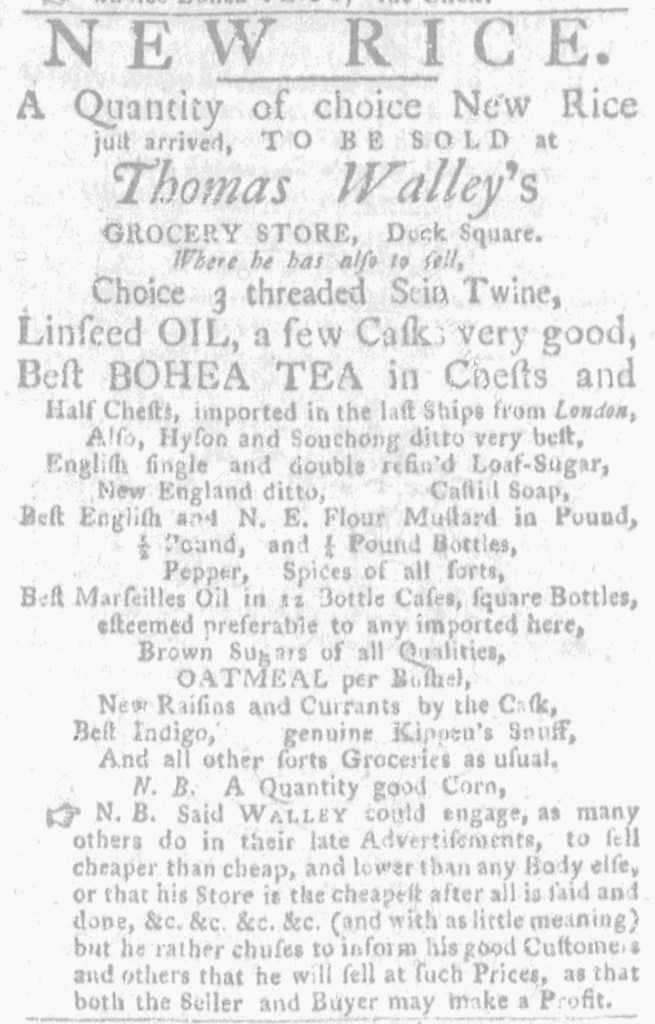
Massachusetts Gazette and Boston Weekly News-Letter (May 6, 1773).

“His Store is the cheapest after all is said and done, &c. &c. &c. &c.”

Thomas Walley stocked a variety of items at his “GROCERY STORE” on Dock Square in Boston in the spring of 1773.  In an advertisement in the May 6 edition of the Massachusetts Gazette and Boston Weekly News-Letter, he listed many of those items, from “New Rice” to “BOHEA TEA” to “Flour Mustard” to “Brown Sugars of all Qualities.”

Walley concluded his advertisement with a lively nota bene that commented on the marketing strategies deployed in the city’s newspapers by various purveyors of goods.  He stated that he “could engage, as others do in their late Advertisements, to sell cheaper than cheap, and lower than any Body else, or that his Store is the cheapest after all is said and done, &c. &c. &c. &c.”  The string of “&c.” (which modern readers would recognize as “etc. etc. etc. etc.”) communicated his exasperation with advertisers who went on and on about the bargains that they made available to their customers.  More bluntly, he declared that if he did the same that it would have “as little meaning,” something that he suspected both advertisers and savvy consumers realized.  Instead of making bold claims about his prices to dazzle prospective customers, Walley considered simplicity and honesty the better means of cultivating relationships of trust.  He “rather chuses to inform his good Customers and others that he will sell at such Prices, as that both the Seller and the Buyer may make a Profit.”  In other words, both parties got a good deal.

Walley’s approach echoed the one taken by Samuel Flagg when he advertised imported goods available at his store in Salem several months earlier.  Flagg proclaimed that he did not “mean to make such a Parade, not furnish the Publick with so many pompous Promises (as have lately been exhibited) of Goods being so amazingly cheap, but would rather convince them of the Cheapness of his Goods and of his Integrity in dealing, whenever they may please to call and favour him with their Custom.”  When it came to engaging prospective customers with his advertisements, he did not wish to “tell them a Story” like in “so many flashy Advertisements as weekly present themselves.”  Flagg asserted that such stories had no “true Meaning” … and readers knew that as well as he did.

Both Walley and Flagg saw critiquing advertising as the most effect means of marketing their wares.  They flattered readers by suggesting that they all knew that other advertisers inflated their claim yet Walley and Flagg would not insult the intelligence of their prospective customers.  Instead, they opted for honesty and integrity in presenting prices that worked to the advantage of both the shopkeepers and consumers.

May 8

What was advertised in a colonial American newspaper 250 years ago today?

Providence Gazette (May 8, 1773).

“At the Sign of the GREYHOUND.”

Some of the advertisers who placed notices in the May 8, 1773, edition of the Providence Gazette described the shop signs that marked the locations of their businesses.  Thurber and Cahoon, for instance, informed readers that they stocked an “Assortment as compleat as in any Shop or Store in New-England” at the “Sign of the Bunch of Grapes.”  Samuel Young once again declared that he sold a “fine ASSORTMENT of Spring and Summer GOODS … cheaper than he has ever done” at his store at the “Sign of the Black Boy.”  Nathaniel Wheaton also offered low prices for a “new supply of Spring and Summer GOODS,” proclaiming that he “sells cheaper than any one, after all is said and done” at his shop at the “Sign of the GREYHOUND.”  Even the printer, John Carter, noted in the colophon that he operated a printing office at “Shakespear’s Head, … where all manner of Printing-Work is performed with Care and Expedition.”

No advertisers adorned their notices with visual images.  Thurber and Cahoon, Young, and Wheaton did not enhance their advertisements with depictions of their shop signs, but one of them had previously done so.  Within the past year, Wheaton had twice published advertisements that featured a profile view of a greyhound sitting on its hind legs with its tongue sticking out of its mouth, first for several weeks in May 1772 and again for several weeks in November 1772.  He presumably still had access to the woodcut, yet chose not to incorporate it into his new round of advertising in the Providence Gazette.  He already invested in commissioning the woodcut for his exclusive use, but perhaps he did not wish to purchase the additional space required to include an image in his advertisements in the spring of 1773.  After all, the woodcut would have doubled the amount of space occupied by Wheaton’s advertisement, doubling the price as well.  Perhaps Wheaton believed that residents of Providence glimpsed his sign often enough as they went about their daily business that merely mentioning his sign would be enough to evoke images of it for many readers of the Providence Gazette.  It served as a brand or trademark that consumers did not need to see in order to imagine it for themselves.