May 7

What was advertised in a colonial American newspaper 250 years ago today?

Connecticut Journal (May 7, 1773).

“ALL Persons indebted for this Paper, whose Accounts have been above 12 Months standing, are requested to make immediate Payment.”

It was the only decorative type in the May 7, 1773, edition of the Connecticut Journal and New-Haven Post-Boy.  It had been the only decorative type in the previous issue of that newspaper.  It would be the only decorative type in the following issue.  Thomas Green and Samuel Green, the printers, used decorative type sparingly.  What prompted them to deploy it in three consecutive issues in the spring of 1773?  They wished to call attention to their own notice that called on “ALL Persons indebted for this Paper, whose Accounts have been above 12 Months standing … to make immediate Payment.”  Such notices appeared frequently in newspapers throughout the colonies.  Printers often gave them privileged places to help direct readers to them.  Less often, they used decorative type to distinguish their notices from other advertisements.

Connecticut Journal (April 23, 1773).

The Greens enclosed their notice within an ornate border, enhancing its visibility no matter where it appeared on the page, whether near the bottom of the last column on the third page when it first ran on April 30 or as the last item on the last page in subsequent issues on May 7 and May 14.  No other advertisements in those issues featured decorative type, nor did the remainder of the contents.  In the previous issue published on April 23, a single line of printing ornaments that separated news items comprised the extent of decorative type.  After the Greens discontinued their notice, printing ornaments depicting skulls and bones appeared above a death notice for “Mrs. MARY LOTHROP, the agreable Consort of Mr. John Lothrop, of this Town,” in the May 21 edition.  No other decorative type appeared among the news or advertisements.

Connecticut Journal (May 21, 1773).

The Greens certainly had printing ornaments among their type.  They apparently believed that decorative type had practical value, that it could draw attention to an advertisement they considered important.  While they recognized the potential for adorning advertisements and other content, they did not embrace all the possible uses of printing ornaments in their newspaper in the eighteenth century.  That innovation came later.  Like other colonial printers, the Greens produced pages rather conservative in appearance compared to the vibrant use of printing ornaments in advertisements in many nineteenth-century newspapers.

Slavery Advertisements Published May 7, 1773

The Slavery Adverts 250 Project chronicles the role of newspaper advertising in perpetuating slavery in the era of the American Revolution. The project seeks to reveal the ubiquity of slavery in eighteenth-century life from New England to Georgia by republishing advertisements about enslaved people – for sale as individuals or in groups, wanted to purchase or for hire for short periods, runaways who liberated themselves, and those who were subsequently captured and confined in jails and workhouses – in daily digests on this site as well as in real time via the @SlaveAdverts250 Twitter feed, utilizing twenty-first-century media to stand in for the print media of the eighteenth century.

The project aims to provide modern audiences with a sense of just how often colonizers encountered these advertisements in their daily lives. Enslaved men, women, and children appeared in print somewhere in the colonies almost every single day. Those advertisements served as a constant backdrop for social, cultural, economic, and political life in colonial and revolutionary America. Colonizers who did not purport to own enslaved people were still confronted with slavery as well as invited to maintain the system by purchasing enslaved men, women, and children or assisting in the capture of so-called “runaways” who sought to free themselves from bondage. The frequency of these newspaper advertisements suggests just how embedded slavery was in colonial and revolutionary American culture in everyday interactions beyond the printed page.

These advertisements also testify to the experiences of enslaved men, women, and children, though readers must consider that those experiences have been remediated through descriptions offered by enslavers rather than enslaved people themselves. Often unnamed in the advertisements, enslaved men, women, and children were not invisible or unimportant in early America.

These advertisements appeared in colonial American newspapers 250 years ago today.

Connecticut Journal (May 7, 1773).

**********

New-London Gazette (May 7, 1773).

**********

New-London Gazette (May 7, 1773).

**********

New-London Gazette (May 7, 1773).

May 6

Who was the subject of an advertisement in a colonial American newspaper 250 years ago today?

Rivington’s New-York Gazetteer (May 6, 1773).

“TO BE SOLD, A Very fine Negro Boy.”

Three issues.  That was how long it took James Rivington to become a broker in the slave trade when he launched Rivington’s New-York Gazetteer or the Connecticut, New-Jersey, Hudson’s-River and Quebec Weekly Advertiser in the spring of 1773.  The Adverts 250 Project has examined some of the advertisements that appeared in the first and second issues of that newspaper.  With the third issue, the Slavery Adverts 250 Project begins chronicling advertisements about enslaved men, women, and children that appeared in Rivington’s New-York Gazetteer.

Rivington, like other colonial printers, generated revenues by publishing and disseminating such advertisements, yet their complicity in perpetuating slavery and the slave trade did not end there.  When they published advertisements that provided descriptions of enslaved people who liberated themselves by running away from their enslavers and offered rewards for their capture and return, colonial printers encouraged and facilitated the widespread surveillance of Black men and women, including by colonizers who did not purport to own enslaved people themselves.  When colonial printers instructed readers to “Enquire of the Printer” for more information about enslaved people for sale, they became brokers in the transactions.

Such was the case with an advertisement in the May 6, 1773, edition of Rivington’s New-York Gazetteer.  In just five short lines, Rivington implicated himself in perpetuating slavery and the slave trade: “TO BE SOLD, A Very fine Negro Boy, about seventeen years old, capable of waiting on a gentleman, and in a family extremly useful, he is strong, well built, and remarkably sober, and well worth £. 100.  Enquire of the Printer.”  In his examination of “Enquire of the Printer” advertisements, Jordan E. Taylor notes, “Printers had several reasons to traffic enslaved people.  Many probably viewed this work as a way of encouraging advertisers.  To refuse to perform this service may have led an advertiser to taker his or her business to competitors.”[1]

Rivington’s competitors certainly did not refuse such business.  On the same day that Rivington’s New-York Gazetteer ran its first “Enquire of the Printer” advertisement, an advertisement describing and offering a reward for Cush, an enslaved man who liberated himself from John Foster of Southampton on Long Island, ran in John Holt’s New-York Journal.  Earlier in the week, Hugh Gaine published three advertisements concerning enslaved people in his New-York Gazette and Weekly Mercury, one seeking a “NEGROE man-servant,” another offering an enslaved woman for sale, and the third describing and offering a reward for Sam, an enslaved man who could speak English and Dutch.  Gaine acted as the broker in the first advertisement, instructing anyone willing to hire out an enslaved “NEGROE man-servant” to learn more “by applying to the printer.”

Still, Rivington made a choice about whether to participate in this aspect of the printing business, just as Nathaniel Mills and John Hicks did when they became proprietors of the Massachusetts Gazette and Boston Post-Boy.  Three days before Rivington published his first advertisement concerning an enslaved person, Mills and Hicks published theirs, joining with other printers in Boston who carried the same notice in their newspapers.  The following week, the fourth issue of Rivington’s New-York Gazetteer carried its first advertisement about an enslaved man, Pompey, who liberated himself.  Rivington had made his editorial decision about what he was willing to publish among the advertisements in his newspaper.  He did not seem to hesitate in doing so.

**********

[1] Jordan E. Taylor, “Enquire of the Printer: Newspaper Advertising and the Moral Economy of the North American Slave Trade, 1704-1807,” Early American Studies 18, no. 3 (Summer 2020): 296.

Slavery Advertisements Published May 6, 1773

The Slavery Adverts 250 Project chronicles the role of newspaper advertising in perpetuating slavery in the era of the American Revolution. The project seeks to reveal the ubiquity of slavery in eighteenth-century life from New England to Georgia by republishing advertisements about enslaved people – for sale as individuals or in groups, wanted to purchase or for hire for short periods, runaways who liberated themselves, and those who were subsequently captured and confined in jails and workhouses – in daily digests on this site as well as in real time via the @SlaveAdverts250 Twitter feed, utilizing twenty-first-century media to stand in for the print media of the eighteenth century.

The project aims to provide modern audiences with a sense of just how often colonizers encountered these advertisements in their daily lives. Enslaved men, women, and children appeared in print somewhere in the colonies almost every single day. Those advertisements served as a constant backdrop for social, cultural, economic, and political life in colonial and revolutionary America. Colonizers who did not purport to own enslaved people were still confronted with slavery as well as invited to maintain the system by purchasing enslaved men, women, and children or assisting in the capture of so-called “runaways” who sought to free themselves from bondage. The frequency of these newspaper advertisements suggests just how embedded slavery was in colonial and revolutionary American culture in everyday interactions beyond the printed page.

These advertisements also testify to the experiences of enslaved men, women, and children, though readers must consider that those experiences have been remediated through descriptions offered by enslavers rather than enslaved people themselves. Often unnamed in the advertisements, enslaved men, women, and children were not invisible or unimportant in early America.

These advertisements appeared in colonial American newspapers 250 years ago today.

Supplement to the Maryland Gazette (May 6, 1773).

**********

Massachusetts Gazette and Boston Weekly News-Letter (May 6, 1773).

**********

Massachusetts Gazette and Boston Weekly News-Letter (May 6, 1773).

**********

New-York Journal (May 6, 1773).

**********

Rivington’s New-York Gazetteer (May 6, 1773).

**********

Virginia Gazette [Purdie and Dixon] (May 6, 1773).

**********

Virginia Gazette [Purdie and Dixon] (May 6, 1773).

**********

Virginia Gazette [Purdie and Dixon] (May 6, 1773).

**********

Virginia Gazette [Purdie and Dixon] (May 6, 1773).

**********

Virginia Gazette [Purdie and Dixon] (May 6, 1773).

**********

Virginia Gazette [Purdie and Dixon] (May 6, 1773).

**********

Virginia Gazette [Purdie and Dixon] (May 6, 1773).

**********

Virginia Gazette [Purdie and Dixon] (May 6, 1773).

**********

Virginia Gazette [Purdie and Dixon] (May 6, 1773).

**********

Virginia Gazette [Purdie and Dixon] (May 6, 1773).

**********

Virginia Gazette [Purdie and Dixon] (May 6, 1773).

**********

Virginia Gazette [Purdie and Dixon] (May 6, 1773).

**********

Virginia Gazette [Purdie and Dixon] (May 6, 1773).

**********

Virginia Gazette [Rind] (May 6, 1773).

**********

Virginia Gazette [Rind] (May 6, 1773).

**********

Virginia Gazette [Rind] (May 6, 1773).

**********

Virginia Gazette [Rind] (May 6, 1773).

**********

Virginia Gazette [Rind] (May 6, 1773).

**********

Virginia Gazette [Rind] (May 6, 1773).

**********

Supplement to the Virginia Gazette [Rind] (May 6, 1773).

May 5

What was advertised in a colonial American newspaper 250 years ago today?

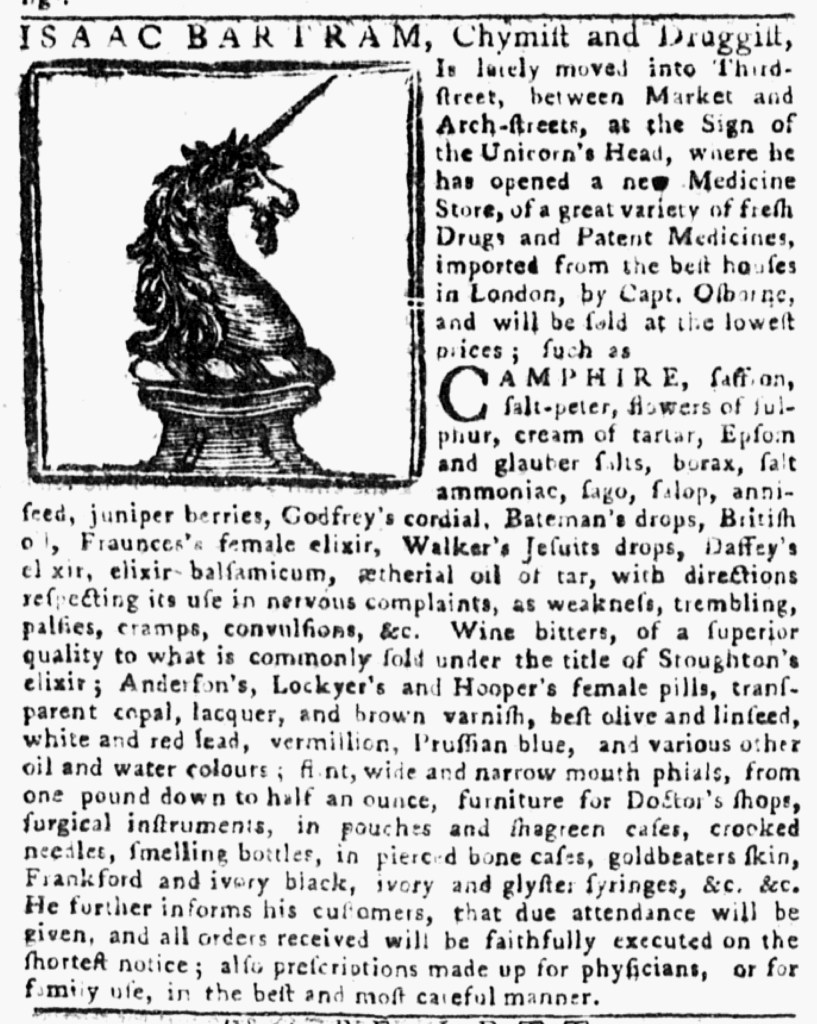
Pennsylvania Gazette (May 5, 1773).

“Chymist and Druggist … at the Sign of the Unicorn’s Head.”

Isaac Bartram, “Chymist and Druggist,” offered a variety of goods and services at his “new Medicine Store” in Philadelphia in the spring of 1773.  According to his advertisement in the May 5 edition of the Pennsylvania Gazette, he sold a “great variety of fresh Drugs and Patent Medicines, imported from the best houses in London.”  Prospective customers would have been familiar with the patent medicines that Bartram listed in his notice, just as modern consumers recognize various brands of over-the-counter medications.  Among other nostrums, the apothecary carried “Godfrey’s cordial, Bateman’s drops, … Walker’s Jesuits drops, Daffey’s elixir, [and] Anderson’s Lockyer’s and Hooper’s female pills.”  For those willing to try equivalent products, like modern consumers who purchase generics, Bartram marketed “Wine bitters, of a superior quality to what is commonly sold under the title of Stoughton’s elixir.”  He also stocked medical equipment, including syringes, vials, and surgical instruments, and prepared prescriptions “for physicians, or for family use.”

In addition to the copy, Bartram deployed an image to draw more attention to his advertisement.  He indicated that he kept shop “at the Sign of the Unicorn’s Head.”  Appropriately, a woodcut depicting a unicorn’s head enclosed within a border adorned the upper left corner of his notice, accounting for nearly one-quarter of the space occupied by his advertisement.  This certainly increased Bartram’s advertising costs since he had to commission the unique image associated with his business and then pay for the additional space.  Most advertisers did not invest in images for their notices, though a growing number adopted the practice in the early 1770s.  Elsewhere in the same issue of the Pennsylvania Gazette, Stephen Paschall and son Stephen Paschall, as they styled themselves, included an image of a scythe, a sickle, and other sort of iron work available at their workshop “at the Sign of the Scythe and Sickle.”  The initials “SP” marked one of the items.  The Paschalls first published the image a year earlier.  These images may have replicated the signs displayed by Bartram and the Paschalls, the only surviving visual representations of signs that colonizers glimpsed as they traversed the streets of Philadelphia.

Most advertisers relied solely on the text of their notices to encourage readers to visit their shops.  Such was the case for Robert Bass, an apothecary whose advertisement for a “new and fresh Assortment of DRUGS and PATENT MEDICINES” appeared on the same page as Bartram’s advertisement.  The woodcut depicting the Sign of the Unicorn’s Head certainly made Bartram’s notice much more visible to readers, prompting them to read about his wares and, in the process, quite possibly justifying the investment.

Slavery Advertisements Published May 5, 1773

The Slavery Adverts 250 Project chronicles the role of newspaper advertising in perpetuating slavery in the era of the American Revolution. The project seeks to reveal the ubiquity of slavery in eighteenth-century life from New England to Georgia by republishing advertisements about enslaved people – for sale as individuals or in groups, wanted to purchase or for hire for short periods, runaways who liberated themselves, and those who were subsequently captured and confined in jails and workhouses – in daily digests on this site as well as in real time via the @SlaveAdverts250 Twitter feed, utilizing twenty-first-century media to stand in for the print media of the eighteenth century.

The project aims to provide modern audiences with a sense of just how often colonizers encountered these advertisements in their daily lives. Enslaved men, women, and children appeared in print somewhere in the colonies almost every single day. Those advertisements served as a constant backdrop for social, cultural, economic, and political life in colonial and revolutionary America. Colonizers who did not purport to own enslaved people were still confronted with slavery as well as invited to maintain the system by purchasing enslaved men, women, and children or assisting in the capture of so-called “runaways” who sought to free themselves from bondage. The frequency of these newspaper advertisements suggests just how embedded slavery was in colonial and revolutionary American culture in everyday interactions beyond the printed page.

These advertisements also testify to the experiences of enslaved men, women, and children, though readers must consider that those experiences have been remediated through descriptions offered by enslavers rather than enslaved people themselves. Often unnamed in the advertisements, enslaved men, women, and children were not invisible or unimportant in early America.

These advertisements appeared in colonial American newspapers 250 years ago today.

Pennsylvania Gazette (May 5, 1773).

**********

Pennsylvania Gazette (May 5, 1773).

**********

Pennsylvania Journal (May 5, 1773).

**********

Pennsylvania Journal (May 5, 1773).

**********

Pennsylvania Journal (May 5, 1773).

May 4

What was advertised in a colonial American newspaper 250 years ago today?

Connecticut Courant (May 4, 1773).

“A new PLAN.”

When William Beadle “open’d a new Store” in Wethersfield, just south of Hartford, he placed an advertisement in the Connecticut Courant to inform prospective customers that he sold his wares according to “A new PLAN.”  Before explaining that plan, Beadle first attempted to entice consumers to browse the “great Variety for Gentlemen and Ladies wear,” placing particular emphasis on the choices he made available to female customers.  He also carried a “good Supply of necessary Articles for Family Use and Country Business.”  Beadle sold all of that merchandise “as cheap as Goods can be sold in the Country.”

However, he did not extend credit to his customers.  That was the “new PLAN” that he featured in the headline for his advertisement.  Beadle wished “to prevent all Distinctions, and the Difficulties and Inconvenience that attend the common Practice of trusting” or allowing customers to make purchases on credit.  He did not assume the responsibility of making “Distinctions” among his customers, deciding who merited credit and how much, nor did he intend to experience the “Difficulties and Inconveniences” of pleading with customers to settle accounts when their bills came due.  Merchants and shopkeepers frequently ran advertisements encouraging customers to settle accounts, some of them threatening legal action against those who proved recalcitrant.  Beadle’s solution to such problems was “not to trust at all, not even a Shilling to any Person whatsoever.”

He asked prospective customers to consider that “he is a Stranger in this Place, and consequently free from all Connections.”  In other words, he recently moved to the area and did not possess sufficient knowledge of the residents to make judicious decisions about granting credit to prospective customers.  That being the case, Beadle “hopes this Resolution will give no Offence.”  Furthermore, he invited “all Persons who are convinced of the Utility of Business being done in this Method, (considered either as a public or private Advantage) [to] favour him with their Countenance and Custom.”  As much as they enjoyed participating in a transatlantic consumer revolution, some colonizers began to consider purchasing on credit a vice and a character flaw.  As Kate Haulman notes, fine garments, like those sold by Beadle, often “expressed neither merit nor wealth, since [they were] purchased on credit.”[1]  Beadle framed his refusal to give credit as a virtue that consumers should reward with their patronage, a virtue that transferred to them when they did so.

As a newcomer to Wethersfield, Beadle presented his “new PLAN” for selling all sorts of goods, including garments for men and women, as a sound business practice that not only benefited his business but also his prospective customers by reeling in some of the excesses of the consumer revolution.  He wanted prospective customers to spend money and gave them a means of feeling as though they did so responsibly.

**********

[1] Kate Haulman, “Fashion and the Culture Wars of Revolutionary Philadelphia,” William and Mary Quarterly, 3rd ser., 62, no. 4 (October 2005): 634.

Slavery Advertisements Published May 4, 1773

The Slavery Adverts 250 Project chronicles the role of newspaper advertising in perpetuating slavery in the era of the American Revolution. The project seeks to reveal the ubiquity of slavery in eighteenth-century life from New England to Georgia by republishing advertisements about enslaved people – for sale as individuals or in groups, wanted to purchase or for hire for short periods, runaways who liberated themselves, and those who were subsequently captured and confined in jails and workhouses – in daily digests on this site as well as in real time via the @SlaveAdverts250 Twitter feed, utilizing twenty-first-century media to stand in for the print media of the eighteenth century.

The project aims to provide modern audiences with a sense of just how often colonizers encountered these advertisements in their daily lives. Enslaved men, women, and children appeared in print somewhere in the colonies almost every single day. Those advertisements served as a constant backdrop for social, cultural, economic, and political life in colonial and revolutionary America. Colonizers who did not purport to own enslaved people were still confronted with slavery as well as invited to maintain the system by purchasing enslaved men, women, and children or assisting in the capture of so-called “runaways” who sought to free themselves from bondage. The frequency of these newspaper advertisements suggests just how embedded slavery was in colonial and revolutionary American culture in everyday interactions beyond the printed page.

These advertisements also testify to the experiences of enslaved men, women, and children, though readers must consider that those experiences have been remediated through descriptions offered by enslavers rather than enslaved people themselves. Often unnamed in the advertisements, enslaved men, women, and children were not invisible or unimportant in early America.

These advertisements appeared in colonial American newspapers 250 years ago today.

Essex Gazette (May 4, 1773).

**********

South-Carolina Gazette and Country Journal (May 4, 1773).

**********

South-Carolina Gazette and Country Journal (May 4, 1773).

**********

South-Carolina Gazette and Country Journal (May 4, 1773).

May 3

Who was the subject of an advertisement in a colonial American newspaper 250 years ago today?

Massachusetts Gazette and Boston Post-Boy (May 3, 1773).

“RAN away from Admiral Montagu … a Negro Man, named JOHN POLITE.”

Two issues.  That was how long after they became printers of the Massachusetts Gazette and Boston Post-Boy it took for Nathaniel Mills and John Hicks to aid in perpetuating slavery in colonial New England by publishing advertisements offering rewards for the capture of enslaved people who liberated themselves.  The April 26, 1773, edition commenced with a notice that John Green and Joseph Russell transferred the “Printing and Publishing of this PAPER” to Mills and Hicks.  That issue featured a new colophon that promoted the various goods and services available in Mills and Hicks’s printing office, where “Advertisements … for this Paper are taken in.”  In the next issue, the new proprietors of Massachusetts Gazette and Boston Post-Boy ran an advertisement that described “a Negro Man, named JOHN POTITE,” and offered a reward to “Whoever will apprehend the above Negro, and bring him to Admiral Montagu.”[1]

Mills and Hicks were not alone in publishing that advertisement.  On the same day, May 3, Thomas Fleet and John Fleet included it (along with two other advertisements concerning enslaved people) in the Boston Evening-Post and Benjamin Edes and John Gill included it (along with an advertisement about another enslaved man who liberated himself) in the Boston-Gazette.  The other two newspapers published in Boston at the time did not happen to carry that particular advertisement, but Richard Draper did publish two advertisements about enslaved people for sale in the May 6 edition of the Massachusetts Gazette and Boston Weekly News-Letter.  Isaiah Thomas had not printed any advertisements concerning enslaved people in the Massachusetts Spy since late February when a notice in that newspaper instructed readers interested in purchasing a “NEGRO WOMAN … as good a house-negro as any in America” to “Enquire of [t]he Printer” for more information, effectively making him a broker in the sale.

Mills and Hicks participated in a practice established throughout the colonies.  No printers refused to publish such advertisements out of principle.  Instead, they inserted notices about enslaved men, women, and children in their newspapers, disseminated them far and wide, and collected the advertising fees for providing those services.  In many cases, they acted as brokers after publishing and disseminating the advertisements, as Thomas did for the sale of enslaved woman advertised in his newspaper in February 1773.  Although the practice had been well established by the time Mills and Hicks became proprietors of the Massachusetts Gazette and Boston Post-Boy, they chose to accept new advertisements concerning enslaved people when enslavers submitted them to their printing office.  They could have enacted a different editorial policy, just as other printers in Boston and beyond could have done so at any time.  Apparently, colonial printers considered publishing such advertisements too lucrative to discontinue them during the era of the American Revolution.

**********

[1] That advertisement misspelled the enslaved man’s name: John Polite.  The compositor fixed the error in the May 10 edition.

Slavery Advertisements Published May 3, 1773

The Slavery Adverts 250 Project chronicles the role of newspaper advertising in perpetuating slavery in the era of the American Revolution. The project seeks to reveal the ubiquity of slavery in eighteenth-century life from New England to Georgia by republishing advertisements about enslaved people – for sale as individuals or in groups, wanted to purchase or for hire for short periods, runaways who liberated themselves, and those who were subsequently captured and confined in jails and workhouses – in daily digests on this site as well as in real time via the @SlaveAdverts250 Twitter feed, utilizing twenty-first-century media to stand in for the print media of the eighteenth century.

The project aims to provide modern audiences with a sense of just how often colonizers encountered these advertisements in their daily lives. Enslaved men, women, and children appeared in print somewhere in the colonies almost every single day. Those advertisements served as a constant backdrop for social, cultural, economic, and political life in colonial and revolutionary America. Colonizers who did not purport to own enslaved people were still confronted with slavery as well as invited to maintain the system by purchasing enslaved men, women, and children or assisting in the capture of so-called “runaways” who sought to free themselves from bondage. The frequency of these newspaper advertisements suggests just how embedded slavery was in colonial and revolutionary American culture in everyday interactions beyond the printed page.

These advertisements also testify to the experiences of enslaved men, women, and children, though readers must consider that those experiences have been remediated through descriptions offered by enslavers rather than enslaved people themselves. Often unnamed in the advertisements, enslaved men, women, and children were not invisible or unimportant in early America.

These advertisements appeared in colonial American newspapers 250 years ago today.

Boston Evening-Post (May 3, 1773).

**********

Boston Evening-Post (May 3, 1773).

**********

Boston Evening-Post (May 3, 1773).

**********

Boston-Gazette (May 3, 1773).

**********

Boston-Gazette (May 3, 1773).

**********

Massachusetts Gazette and Boston Post-Boy (May 3, 1773).

**********

Newport Mercury (May 3, 1773).

**********

Newport Mercury (May 3, 1773).

**********

New-York Gazette and Weekly Mercury (May 3, 1773).

**********

New-York Gazette and Weekly Mercury (May 3, 1773).

**********

New-York Gazette and Weekly Mercury (May 3, 1773).

**********

South-Carolina Gazette (May 3, 1773).

**********

South-Carolina Gazette (May 3, 1773).

**********

South-Carolina Gazette (May 3, 1773).

**********

South-Carolina Gazette (May 3, 1773).

**********

South-Carolina Gazette (May 3, 1773).

**********

South-Carolina Gazette (May 3, 1773).

**********

South-Carolina Gazette (May 3, 1773).

**********

South-Carolina Gazette (May 3, 1773).

**********

Supplement to the South-Carolina Gazette (May 3, 1773).

**********

Supplement to the South-Carolina Gazette (May 3, 1773).

**********

Supplement to the South-Carolina Gazette (May 3, 1773).

**********

Supplement to the South-Carolina Gazette (May 3, 1773).

**********

Supplement to the South-Carolina Gazette (May 3, 1773).

**********

Supplement to the South-Carolina Gazette (May 3, 1773).

**********

Supplement to the South-Carolina Gazette (May 3, 1773).

**********

Supplement to the South-Carolina Gazette (May 3, 1773).

**********

Supplement to the South-Carolina Gazette (May 3, 1773).

**********

Supplement to the South-Carolina Gazette (May 3, 1773).

**********

Supplement to the South-Carolina Gazette (May 3, 1773).

**********

Supplement to the South-Carolina Gazette (May 3, 1773).

**********

Supplement to the South-Carolina Gazette (May 3, 1773).

**********

Supplement to the South-Carolina Gazette (May 3, 1773).

**********

Supplement to the South-Carolina Gazette (May 3, 1773).