May 19

What was advertised in a colonial American newspaper 250 years ago today?

Pennsylvania Gazette (May 19, 1773).

“STOPPED, from a Person (supposed to be stolen) a SILVER TABLE-SPOON.”

Newspaper advertisements promoted a variety of new merchandise in the eighteenth century, encouraging colonizers to participate in a transatlantic consumer revolution.  In the May 19, 1773, edition of the Pennsylvania Gazette, for instance, Owen Biddle advertised a “large and neat ASSORTEMNT of EUROPEAN & EAST-INDIA GOODS” recently imported from London and Bristol.  He listed dozens of textiles and housewares available at his shop.  Similarly, John McCalla and Son and other merchants and shopkeepers attempted to incite demand for their own “neat Assortment of MERCHANDIZE.”

Colonizers also participated in the consumer revolution by acquiring secondhand goods, sometimes at auctions and other times through estate sales.  Other sales took place through less formal mechanisms.  That led to more possibilities for participating in the consumer revolution, through theft and fencing stolen goods and knowingly or unknowingly buying stolen goods.  Historian Serena Zabin has described those exchanges as part of an informal economy that operated parallel to the legitimate marketplace.  The informal economy made space for indentured servants, free and enslaved Black men and women, and the poor to acquire goods, whether secondhand or stolen.

This also caused many colonizers to remain vigilant about secondhand goods offered for sale, prompting them to seize items when not satisfied with explanations about how the sellers acquired them.  Such was the case for a “SILVER TABLE-SPOON, marked T.P.A. and three Silver Tea-Spoons, marked A.H. in a Cypher.”  Among the advertisements for new goods in the May 19 edition of the Pennsylvania Gazette, another notice described those spoons and stated that they had been “STOPPED” or confiscated on suspicion of being stolen.  Whoever “STOPPED” the spoons informed the rightful owner or owners that they could reclaim them “on proving their Property, and paying Charges” (most likely, paying for the advertisement).

Newspaper advertisements chronicled the consumption and circulation of goods, whether the newest and most fashionable items just imported or secondhand goods sold at auctions and estate sales or stolen items that thieves attempted to fence.  Colonizers from many backgrounds devised numerous ways to participate in the consumer revolution.
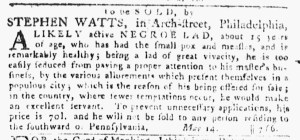
Slavery Advertisements Published May 19, 1773

The Slavery Adverts 250 Project chronicles the role of newspaper advertising in perpetuating slavery in the era of the American Revolution. The project seeks to reveal the ubiquity of slavery in eighteenth-century life from New England to Georgia by republishing advertisements about enslaved people – for sale as individuals or in groups, wanted to purchase or for hire for short periods, runaways who liberated themselves, and those who were subsequently captured and confined in jails and workhouses – in daily digests on this site as well as in real time via the @SlaveAdverts250 Twitter feed, utilizing twenty-first-century media to stand in for the print media of the eighteenth century.

The project aims to provide modern audiences with a sense of just how often colonizers encountered these advertisements in their daily lives. Enslaved men, women, and children appeared in print somewhere in the colonies almost every single day. Those advertisements served as a constant backdrop for social, cultural, economic, and political life in colonial and revolutionary America. Colonizers who did not purport to own enslaved people were still confronted with slavery as well as invited to maintain the system by purchasing enslaved men, women, and children or assisting in the capture of so-called “runaways” who sought to free themselves from bondage. The frequency of these newspaper advertisements suggests just how embedded slavery was in colonial and revolutionary American culture in everyday interactions beyond the printed page.

These advertisements also testify to the experiences of enslaved men, women, and children, though readers must consider that those experiences have been remediated through descriptions offered by enslavers rather than enslaved people themselves. Often unnamed in the advertisements, enslaved men, women, and children were not invisible or unimportant in early America.

These advertisements appeared in colonial American newspapers 250 years ago today.

Pennsylvania Gazette (May 19, 1773).

**********

Pennsylvania Journal (May 19, 1773).

May 18

What was advertised in a colonial American newspaper 250 years ago today?

Essex Gazette (May 18, 1773).

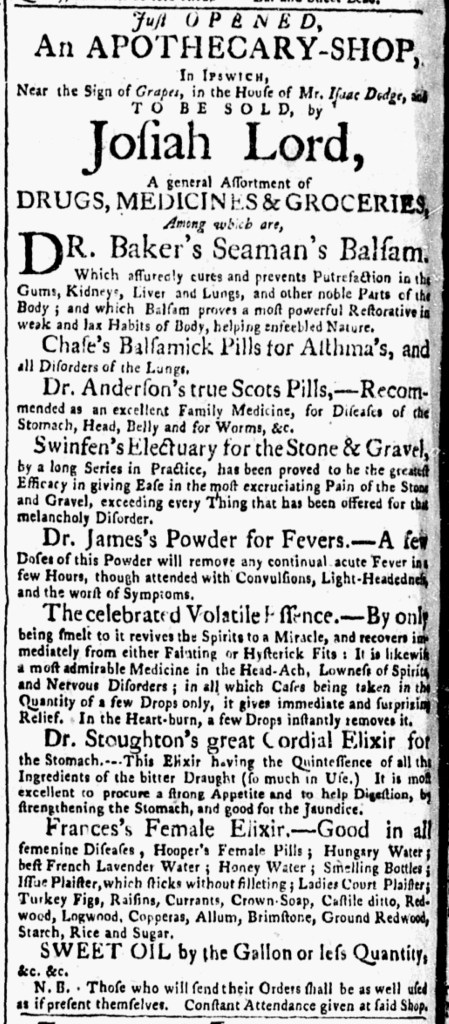
“DR. Baker’s Seaman’s Balsam … proves a most powerful Restorative.”

Nathaniel Dabney and Philip Godfrid Kast had a new competitor in the pages of the Essex Gazette.  Both apothecaries regularly ran advertisements in Salem’s only newspaper, Dabney for his shop “at the Head of Hippocrates” and Kast for his shop “at the Sign of the LION and MORTAR.”  On May 18, 1773, Josiah Lord commenced advertising a “general Assortment of DRUG, MEDICINES & GROCERIES” available at his “APOTHECARY-SHOP … Near the Sign of Grapes” in Ipswich.  He advised that “Those who will send their Orders shall be as well used as if present themselves.”  Lord likely hoped that prospective customers who previously did business with Dabney and Kast would instead visit his shop or take advantage of the convenience of sending orders through the post.  He operated the eighteenth-century equivalent of a mail order pharmacy.

The apothecary devoted most of his advertisement to describing several of the patent medicines among his inventory.  A few of them would have been widely familiar among colonizers, including “Dr. Anderson’s true Scots Pills … for Diseases of the Stomach, Head, Belly and for Worms,” “Dr. James’s Powder for Fevers,” and “Dr. Stoughton’s great Cordial Elixir for the Stomach.”  These medicines were so popular that apothecaries, shopkeepers, and even printers stocked them and promoted them in their newspaper notices, usually referring to them only as Anderson’s Pills, James’s Powder, and Stoughton’s Elixir.  Still, Lord gave more details in hopes of wooing customers.  For instance, he explained that a “few Doses of [James’s] Powder will remove any continual acute Fever in a few Hours, though attended with Convulsions, Light-Headedness, and the worst of Symptoms.”

Lord gave even more attention to lesser-known patent medicines, marketing them as alternatives to familiar nostrums.  “DR. Baker’s Seaman’s Balsam” did not appear in advertisements for drugs and medicines nearly as often as certain other patent medicines, so Lord educated prospective customers about its uses.  He declared that this balsam “assuredly cures and prevents Putrefaction in the Gums, Kidneys, Liver and Lungs, and other noble Parts of the Body” and it “proves a most powerful Restorative in weak and lax Habits of Body, helping enfeebled Nature.”  Similarly, he dedicated a paragraph to directions for using the “celebrated Volatile Essence” to relieve a variety of symptoms.  “By only being smelt,” Lord declared, “it revives the Spirits to a Miracle, and recovers immediately from either Fainting or Hysterick Fits.  It is likewise a most admirable Medicine in the Head-Ach, Lowness of Spirits, and Nervous Disorders; in all which Cases being taken in the Quantity of a few Drops only, it gives immediate and surprising Relief.”  As an added bonus, “In the Heart-burn, a few Drops instantly removes it.”

Such descriptions of each medicine were extensive compared to the lists that appeared in many advertisements placed by apothecaries and others who sold patent medicines.  Given that Lord “Just OPENED” his “APOTHECARY-SHOP” in Ipswich, he may have wished to demonstrate his knowledge of a variety of medicines, both familiar and obscure, to prospective customers.  Doing so may have reassured them that Lord’s expertise rivaled that of Dabney, Kast, and other competitors in the area.

Slavery Advertisements Published May 18, 1773

The Slavery Adverts 250 Project chronicles the role of newspaper advertising in perpetuating slavery in the era of the American Revolution. The project seeks to reveal the ubiquity of slavery in eighteenth-century life from New England to Georgia by republishing advertisements about enslaved people – for sale as individuals or in groups, wanted to purchase or for hire for short periods, runaways who liberated themselves, and those who were subsequently captured and confined in jails and workhouses – in daily digests on this site as well as in real time via the @SlaveAdverts250 Twitter feed, utilizing twenty-first-century media to stand in for the print media of the eighteenth century.

The project aims to provide modern audiences with a sense of just how often colonizers encountered these advertisements in their daily lives. Enslaved men, women, and children appeared in print somewhere in the colonies almost every single day. Those advertisements served as a constant backdrop for social, cultural, economic, and political life in colonial and revolutionary America. Colonizers who did not purport to own enslaved people were still confronted with slavery as well as invited to maintain the system by purchasing enslaved men, women, and children or assisting in the capture of so-called “runaways” who sought to free themselves from bondage. The frequency of these newspaper advertisements suggests just how embedded slavery was in colonial and revolutionary American culture in everyday interactions beyond the printed page.

These advertisements also testify to the experiences of enslaved men, women, and children, though readers must consider that those experiences have been remediated through descriptions offered by enslavers rather than enslaved people themselves. Often unnamed in the advertisements, enslaved men, women, and children were not invisible or unimportant in early America.

These advertisements appeared in colonial American newspapers 250 years ago today.

South-Carolina Gazette and Country Journal (May 18, 1773).

**********

South-Carolina Gazette and Country Journal (May 18, 1773).

**********

South-Carolina Gazette and Country Journal (May 18, 1773).

**********

South-Carolina Gazette and Country Journal (May 18, 1773).

**********

South-Carolina Gazette and Country Journal (May 18, 1773).

**********

South-Carolina Gazette and Country Journal (May 18, 1773).

**********

South-Carolina Gazette and Country Journal (May 18, 1773).

**********

South-Carolina Gazette and Country Journal (May 18, 1773).

May 17

What was advertised in a colonial American newspaper 250 years ago today?

Boston-Gazette (May 17, 1773).

“We might go … to ANDREW DEXTER’S CHEAP STORE … and get every Thing we want at our own Price!”

As the summer of 1773 approached, Andrew Dexter experimented with a quirky advertisement in the May 17 edition of the Boston-Gazette.  Though brief, his notice contained a message intended to arouse the curiosity of consumers and entice them to visit his shop.  “What a needless Loss of Time and Labour it is,” Dexter proclaimed, “to go about Town, from North to South, cheapening of Goods, when we might go, with so little Trouble, to ANDREW DEXTER’S CHEAP STORE near the Mill-Bridge, and get every Thing we want at out our own Price!”  A border composed of decorative type helped draw attention to this advertisement.

Dexter encouraged consumers to dispense with haggling and comparison shopping, suggesting that they would not find any better bargains at other stores no matter how many they visited or how much time and energy they invested.  His tone suggested sage advice delivered by an experienced shopper to prospective customers, advising that “we might go” to Dexter’s “CHEAP STORE.”  Rather than thank his patrons as other advertisers often did in their notices, Dexter marketed his wares by assuming the voice of a satisfied customer speaking to other consumers.  He likely intended that this shift in perspective would imbue the advice to go directly to his store to save time, effort, and money with greater authority.  Other advertisers presented all kinds of choices to prospective customers and promised low prices for their wares, encouraging and playing on appetites to participate in the transatlantic consumer revolution.  Dexter adopted a novel strategy with an approach that offered guidance for satisfying those appetites.  Cleverly, he suggested that consumers exercised more power in his store than in any of the other shops “about Town” since they did not need to haggle or compare prices but instead “get every Thing we want at our own Price!”  Dexter’s customers, the “satisfied customer” asserted, would not experience the frustrations and disappointments that they encountered elsewhere in their endeavors to get the deals they wanted.

Slavery Advertisements Published May 17, 1773

The Slavery Adverts 250 Project chronicles the role of newspaper advertising in perpetuating slavery in the era of the American Revolution. The project seeks to reveal the ubiquity of slavery in eighteenth-century life from New England to Georgia by republishing advertisements about enslaved people – for sale as individuals or in groups, wanted to purchase or for hire for short periods, runaways who liberated themselves, and those who were subsequently captured and confined in jails and workhouses – in daily digests on this site as well as in real time via the @SlaveAdverts250 Twitter feed, utilizing twenty-first-century media to stand in for the print media of the eighteenth century.

The project aims to provide modern audiences with a sense of just how often colonizers encountered these advertisements in their daily lives. Enslaved men, women, and children appeared in print somewhere in the colonies almost every single day. Those advertisements served as a constant backdrop for social, cultural, economic, and political life in colonial and revolutionary America. Colonizers who did not purport to own enslaved people were still confronted with slavery as well as invited to maintain the system by purchasing enslaved men, women, and children or assisting in the capture of so-called “runaways” who sought to free themselves from bondage. The frequency of these newspaper advertisements suggests just how embedded slavery was in colonial and revolutionary American culture in everyday interactions beyond the printed page.

These advertisements also testify to the experiences of enslaved men, women, and children, though readers must consider that those experiences have been remediated through descriptions offered by enslavers rather than enslaved people themselves. Often unnamed in the advertisements, enslaved men, women, and children were not invisible or unimportant in early America.

These advertisements appeared in colonial American newspapers 250 years ago today.

Boston Evening-Post (May 17, 1773).

**********

Boston Evening-Post (May 17, 1773).

**********

Boston-Gazette (May 17, 1773).

**********

Supplement to the Boston-Gazette (May 17, 1773).

**********

Massachusetts Gazette and Boston Post-Boy (May 17, 1773).

**********

Newport Mercury (May 17, 1773).

**********

Newport Mercury (May 17, 1773).

**********

Newport Mercury (May 17, 1773).

**********

New-York Gazette and Weekly Mercury (May 17, 1773).

**********

New-York Gazette and Weekly Mercury (May 17, 1773).

**********

Pennsylvania Packet (May 17, 1773).

**********

Pennsylvania Packet (May 17, 1773).

**********

South-Carolina Gazette (May 17, 1773).

**********

South-Carolina Gazette (May 17, 1773).

**********

South-Carolina Gazette (May 17, 1773).

**********

South-Carolina Gazette (May 17, 1773).

**********

South-Carolina Gazette (May 17, 1773).

**********

South-Carolina Gazette (May 17, 1773).

**********

South-Carolina Gazette (May 17, 1773).

**********

South-Carolina Gazette (May 17, 1773).

**********

South-Carolina Gazette (May 17, 1773).

**********

South-Carolina Gazette (May 17, 1773).

**********

Supplement to the South-Carolina Gazette (May 17, 1773).

**********

Supplement to the South-Carolina Gazette (May 17, 1773).

**********

Supplement to the South-Carolina Gazette (May 17, 1773).

**********

Supplement to the South-Carolina Gazette (May 17, 1773).

**********

Supplement to the South-Carolina Gazette (May 17, 1773).

**********

Supplement to the South-Carolina Gazette (May 17, 1773).

**********

Supplement to the South-Carolina Gazette (May 17, 1773).

**********

Supplement to the South-Carolina Gazette (May 17, 1773).

**********

Supplement to the South-Carolina Gazette (May 17, 1773).

**********

Supplement to the South-Carolina Gazette (May 17, 1773).

**********

Supplement to the South-Carolina Gazette (May 17, 1773).

**********

Supplement to the South-Carolina Gazette (May 17, 1773).

May 16

What was advertised in a colonial American newspaper 250 years ago this week?

Massachusetts Gazette and Boston Weekly News-Letter (May 13, 1773).

“[The Avertisements that are omitted this Week, will have a good Place in out next.]”

Richard Draper, the printer of the Massachusetts Gazette and Boston Weekly News-Letter, inserted notes to readers and subscribers at the bottom of the third page of the May 13, 1773, edition.  In those notes, he provided information about the contents of the current issue and the next issue, acknowledging that he did not have sufficient space for all the materials received in his printing office that week.  Placing the notes on the third page made sense considering how eighteenth-century printers produced each standard issue of a four-page newspaper.  They printed two pages on each side of a broadsheet and then folded it in half, usually printing the first and fourth pages first and the second and third pages later.  That meant that they set the type of the third page last.

It was only when setting type for the third page that Draper or a compositor who worked in his printing office knew the layout of the entire issue.  In this instance, that meant that “A variety of domestic Articles are in the last Page, and London Articles in the SUPPLEMENT.”  That note ran across all three columns at the bottom of the third page, a thick line separating it from the rest of the content.  In another note, this one appearing at the bottom of the first column, Draper advised that “[The Avertisements that are omitted this Week, will have a good Place in out next.]”  Draper may not have yet realized that news from London would occupy only one page of the two-page supplement, leaving room for another entire page of advertisements … or he may have realized that even with the extra space he still would not have enough room for all the paid notices that customers expected to see in his newspaper.  After all, he resorted to a supplement again the following week in order to increase the content he disseminated from four pages to six pages.

Given that advertising represented such an important revenue stream for colonial printers, Draper erred on the side of caution in letting advertisers know that their notices might not appear in the current issue or its supplement and, as a consolation, promised “a good Place” in the next issue.  His advertisers had the option of giving their business to any of the four other newspapers printed in Boston at the time, prompting Draper to provide updates and reassurances about when they could expect to see their notices in the Massachusetts Gazette and Boston Weekly News-Letter.

May 15

What was advertised in a colonial American newspaper 250 years ago today?

Providence Gazette (May 15, 1773).

“Once more!”

The headline expressed some exasperation.  The partnership of Stewart and Taylor sought to settle their “Company Accounts, which was to have taken Place in November last,” but six months later they were placing an advertisement in the Providence Gazette to “Once more!” call on “all that are indebted to them to make immediate Payment.”  Merchants, shopkeepers, and others regularly ran newspaper notices for the same purpose.  John Carter, the printer of the Providence Gazette, inserted his own notice in the same issue that carried Stewart and Taylor’s advertisement, though it was brief in comparison.  Carter declared, “ALL Persons indebted for this Gazette one Year, or more, are requested to make immediate Payment.”

Along with the headline intended to attract attention, Stewart and Taylor provided details about the consequences for not complying with their final notice.  They wished to settle accounts quickly, “otherwise they will be necessitated to sue [at the] June Court.”  The partners hoped that such threats would prompt “all Delinquents [to] come and make Payment, to prevent a Method being taken that will be very disagreeable.”  Although not all advertisements placed for the purpose of settling accounts included allusions to legal action, enough did so that readers recognized the tactic for leveraging the “Delinquents.”  Relatively few, however, included such a headline.  The “Once more!” likely communicated to those “Delinquents” that Stewart and Taylor meant business.

Among those who devised headlines, most advertisers used their names, including Jabez Bowen, Nicholas Brown and Company, Polly Chace, Nathaniel Green, Jonathan Russell, Thurber and Cahoon, John Updike, Joseph West, and Samuel Young.  Joseph Russell and William Russell deployed their names as a secondary headline that followed the primary headline that promoted “WEST-INDIA RUM.”  In his advertisement about an indentured servant who absconded, Samuel Jefferys used “Eight Dollars Reward” as the headline.  That made “Once more!” unique among the headlines featured in advertisements in the May 15, 1773, edition of the Providence Gazette.  Stewart and Taylor shrewdly invoked a phrase intended to arouse curiosity and capture the attention of the “Delinquents” who had not yet settled accounts.

May 14

What was advertised in a colonial American newspaper 250 years ago today?

New-Hampshire Gazette (May 14, 1773).

“Will be sold … as low as at any Store or Shop in America.”

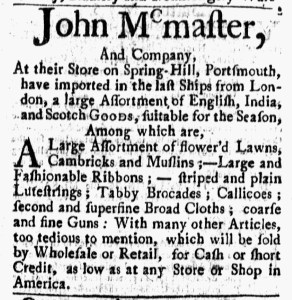
Among the advertisements and notices in the May 14, 1773, edition of the New-Hampshire Gazette, John McMaster and Company promoted a “large Assortment of English, India, and Scotch GOODS” recently received via “the last Ships from London.”  They invited prospective customers to visit their store in Portsmouth to examine their “Large Assortment of flower’d Lawns, Cambricks and Muslins,” “striped and plain Lutestrings,” and “Tabby Brocades.”  In addition to textiles, McMaster and Company stocked “Large and Fashionable Ribbons,” “coarse and fine Guns,” and “may other Articles, too tedious to mention.”  Advertisers often used that phrase to entice curious readers to browse their merchandise.

Beyond providing an array of choices to consumers, McMaster and Company called attention to their prices, proclaiming that their customers could acquire these goods “as low as at any Store or Shop in America.”  They did not merely compare their prices to those set by local competitors in and near Portsmouth.  Instead, they boldly declared that neither consumers who purchased on their own behalf nor retailers who bought to sell again would not find better deals anywhere else, not even in the much larger ports of Boston, Charleston, New York, and Philadelphia.  McMaster and Company were not alone in making that claim.  In another advertisement, an entrepreneur who identified himself as McIntyre but did not give a first name hawked “CHINA and EARTHEN WARE” available at “his Store near the Market.”  He asserted that he charged prices “as cheap as sold in America.”

Both McMaster and Company and McIntyre attempted to leverage promises of good deals, indeed the best deals possible, to induce prospective customers to imagine themselves purchasing their wares.  They whet readers’ appetites with allusions to a “large Assortment” or “Good Assortment” of merchandise and then presented their low prices, the lowest anywhere, as the means of satisfying those appetites.

Slavery Advertisements Published May 14, 1773

The Slavery Adverts 250 Project chronicles the role of newspaper advertising in perpetuating slavery in the era of the American Revolution. The project seeks to reveal the ubiquity of slavery in eighteenth-century life from New England to Georgia by republishing advertisements about enslaved people – for sale as individuals or in groups, wanted to purchase or for hire for short periods, runaways who liberated themselves, and those who were subsequently captured and confined in jails and workhouses – in daily digests on this site as well as in real time via the @SlaveAdverts250 Twitter feed, utilizing twenty-first-century media to stand in for the print media of the eighteenth century.

The project aims to provide modern audiences with a sense of just how often colonizers encountered these advertisements in their daily lives. Enslaved men, women, and children appeared in print somewhere in the colonies almost every single day. Those advertisements served as a constant backdrop for social, cultural, economic, and political life in colonial and revolutionary America. Colonizers who did not purport to own enslaved people were still confronted with slavery as well as invited to maintain the system by purchasing enslaved men, women, and children or assisting in the capture of so-called “runaways” who sought to free themselves from bondage. The frequency of these newspaper advertisements suggests just how embedded slavery was in colonial and revolutionary American culture in everyday interactions beyond the printed page.

These advertisements also testify to the experiences of enslaved men, women, and children, though readers must consider that those experiences have been remediated through descriptions offered by enslavers rather than enslaved people themselves. Often unnamed in the advertisements, enslaved men, women, and children were not invisible or unimportant in early America.

These advertisements appeared in colonial American newspapers 250 years ago today.

Connecticut Journal (May 14, 1773).

**********

New-London Gazette (May 14, 1773).

**********

New-London Gazette (May 14, 1773).

**********

New-London Gazette (May 14, 1773).

**********

New-London Gazette (May 14, 1773).