Slavery Advertisements Published August 3, 1773

The Slavery Adverts 250 Project chronicles the role of newspaper advertising in perpetuating slavery in the era of the American Revolution. The project seeks to reveal the ubiquity of slavery in eighteenth-century life from New England to Georgia by republishing advertisements about enslaved people – for sale as individuals or in groups, wanted to purchase or for hire for short periods, runaways who liberated themselves, and those who were subsequently captured and confined in jails and workhouses – in daily digests on this site as well as in real time via the @SlaveAdverts250 Twitter feed, utilizing twenty-first-century media to stand in for the print media of the eighteenth century.

The project aims to provide modern audiences with a sense of just how often colonizers encountered these advertisements in their daily lives. Enslaved men, women, and children appeared in print somewhere in the colonies almost every single day. Those advertisements served as a constant backdrop for social, cultural, economic, and political life in colonial and revolutionary America. Colonizers who did not purport to own enslaved people were still confronted with slavery as well as invited to maintain the system by purchasing enslaved men, women, and children or assisting in the capture of so-called “runaways” who sought to free themselves from bondage. The frequency of these newspaper advertisements suggests just how embedded slavery was in colonial and revolutionary American culture in everyday interactions beyond the printed page.

These advertisements also testify to the experiences of enslaved men, women, and children, though readers must consider that those experiences have been remediated through descriptions offered by enslavers rather than enslaved people themselves. Often unnamed in the advertisements, enslaved men, women, and children were not invisible or unimportant in early America.

These advertisements appeared in colonial American newspapers 250 years ago today.

South-Carolina Gazette and Country Journal (August 3, 1773).

**********

South-Carolina Gazette and Country Journal (August 3, 1773).

**********

South-Carolina Gazette and Country Journal (August 3, 1773).

**********

South-Carolina Gazette and Country Journal (August 3, 1773).

**********

South-Carolina Gazette and Country Journal (August 3, 1773).

**********

South-Carolina Gazette and Country Journal (August 3, 1773).

**********

South-Carolina Gazette and Country Journal (August 3, 1773).

**********

South-Carolina Gazette and Country Journal (August 3, 1773).

**********

South-Carolina Gazette and Country Journal (August 3, 1773).

**********

South-Carolina Gazette and Country Journal (August 3, 1773).

**********

South-Carolina Gazette and Country Journal (August 3, 1773).

August 2

What was advertised in a colonial American newspaper 250 years ago today?

New-York Gazette and Weekly Mercury (August 2, 1773).

“He makes all sorts of coaches … equal to any imported from England.”

William Deane made appeals to price and quality in an advertisement for the coaches he constructed at his shop “in Broad-street” in the August 2, 1773, edition of the New-York Gazette and Weekly Mercury.  Compared to most other advertisers, however, he devised much more elaborate marketing strategies to convince prospective customers of the price and quality he offered.

Deane started by describing the various services in his shop.  He made several different kinds of carriages as well as “all sorts of harness and saddlers work.”  In addition, he also did “painting, gilding and Japanning, in the neatest and most elegant manner.”  Deane emphasized that he achieved a high level of quality while offering the lowest possible prices because he did not outsource any of those jobs to artisans.  Instead, he “finishes all carriages whatever in his own shop, without applying to any other.”  Accordingly, he was “determined to make them as good, sell them as cheap, and be as expeditious as there is a possibility.”

The carriagemaker realized that he needed “to convince the public of the truth of what he asserts.”  To that end, he vowed that he “will make any piece of work that is required, equal to any imported from England, and will sell it at the prime cost of that imported.”  His customers did not have to sacrifice either price or quality, one for the other, when they supported domestic manufacture by purchasing carriages made in his shop in New York.  Furthermore, they benefitted from additional bargains since they “will save the freight, insurance, and the expences naturally attending to putting the carriages to rights after they arrive.”  In so many ways, purchasing a carriage from Deane was so much easier than importing one made in England.  In addition, he “has now a considerable stock of the best of all materials fit for making carriages,” so he was ready to serve customers who placed orders.

Deane offered a “further inducement,” a one-year guarantee on the carriages made in his shop.  He had been providing guarantees in newspaper advertisements for at least six years (including in an advertisement with nearly identical copy in the New-York Journal more than a year earlier).  The carriagemaker declared that he “will engage his work for a year after it is delivered, that is, if any part gives way, or fails by fair usage, he will make it good at his own expence.”   To make the choice even more clear, he underscored that prospective customers would not have access to that kind of customer service in maintaining their carriages if they opted for ones made in England.  “Those advantages,” Deane intoned, “cannot be obtained on carriages imported.”

The carriagemaker’s advertisement revolved around price and quality.  He did more than make casual reference to them, developing a sophisticated marketing strategy that touted the advantages of purchasing carriages made in his shop.  He used only the best materials and oversaw every aspect of the construction to produce carriages that rivaled in craftsmanship those imported from England.  He also offered competitive prices, especially since his customers saved on shipping and insurance, and a one-year guarantee on any parts that might require repairs.  Deane sought to convince prospective customers that all of this made his carriages the best choice.

Slavery Advertisements Published August 2, 1773

The Slavery Adverts 250 Project chronicles the role of newspaper advertising in perpetuating slavery in the era of the American Revolution. The project seeks to reveal the ubiquity of slavery in eighteenth-century life from New England to Georgia by republishing advertisements about enslaved people – for sale as individuals or in groups, wanted to purchase or for hire for short periods, runaways who liberated themselves, and those who were subsequently captured and confined in jails and workhouses – in daily digests on this site as well as in real time via the @SlaveAdverts250 Twitter feed, utilizing twenty-first-century media to stand in for the print media of the eighteenth century.

The project aims to provide modern audiences with a sense of just how often colonizers encountered these advertisements in their daily lives. Enslaved men, women, and children appeared in print somewhere in the colonies almost every single day. Those advertisements served as a constant backdrop for social, cultural, economic, and political life in colonial and revolutionary America. Colonizers who did not purport to own enslaved people were still confronted with slavery as well as invited to maintain the system by purchasing enslaved men, women, and children or assisting in the capture of so-called “runaways” who sought to free themselves from bondage. The frequency of these newspaper advertisements suggests just how embedded slavery was in colonial and revolutionary American culture in everyday interactions beyond the printed page.

These advertisements also testify to the experiences of enslaved men, women, and children, though readers must consider that those experiences have been remediated through descriptions offered by enslavers rather than enslaved people themselves. Often unnamed in the advertisements, enslaved men, women, and children were not invisible or unimportant in early America.

These advertisements appeared in colonial American newspapers 250 years ago today.

Boston Evening-Post (August 2, 1773).

**********
Boston Evening-Post (August 2, 1773).

**********

Boston Evening-Post (August 2, 1773).

**********

Boston-Gazette (August 2, 1773).

**********

Boston-Gazette (August 2, 1773).

**********

Massachusetts Gazette and Boston Post-Boy (August 2, 1773).

**********

Newport Mercury (August 2, 1773).

**********

New-York Gazette and Weekly Mercury (August 2, 1773).

**********

New-York Gazette and Weekly Mercury (August 2, 1773).

**********

New-York Gazette and Weekly Mercury (August 2, 1773).

**********

New-York Gazette and Weekly Mercury (August 2, 1773).

**********

New-York Gazette and Weekly Mercury (August 2, 1773).

**********

New-York Gazette and Weekly Mercury (August 2, 1773).

**********

New-York Gazette and Weekly Mercury (August 2, 1773).

**********

New-York Gazette and Weekly Mercury (August 2, 1773).

**********

New-York Gazette and Weekly Mercury (August 2, 1773).

**********

Supplement to the New-York Gazette and Weekly Mercury (August 2, 1773).

**********

Pennsylvania Chronicle (August 2, 1773).

**********

South-Carolina Gazette (August 2, 1773).

**********

South-Carolina Gazette (August 2, 1773).

**********

South-Carolina Gazette (August 2, 1773).

**********

South-Carolina Gazette (August 2, 1773).

**********

South-Carolina Gazette (August 2, 1773).

**********

South-Carolina Gazette (August 2, 1773).

**********

South-Carolina Gazette (August 2, 1773).

**********

South-Carolina Gazette (August 2, 1773).

**********

South-Carolina Gazette (August 2, 1773).

**********

South-Carolina Gazette (August 2, 1773).

**********

South-Carolina Gazette (August 2, 1773).

**********

South-Carolina Gazette (August 2, 1773).

**********

South-Carolina Gazette (August 2, 1773).

**********

Supplement South-Carolina Gazette (August 2, 1773).

**********

Supplement South-Carolina Gazette (August 2, 1773).

**********

Supplement South-Carolina Gazette (August 2, 1773).

**********

Supplement South-Carolina Gazette (August 2, 1773).

August 1

What was advertised in a colonial American newspaper 250 years ago this week?

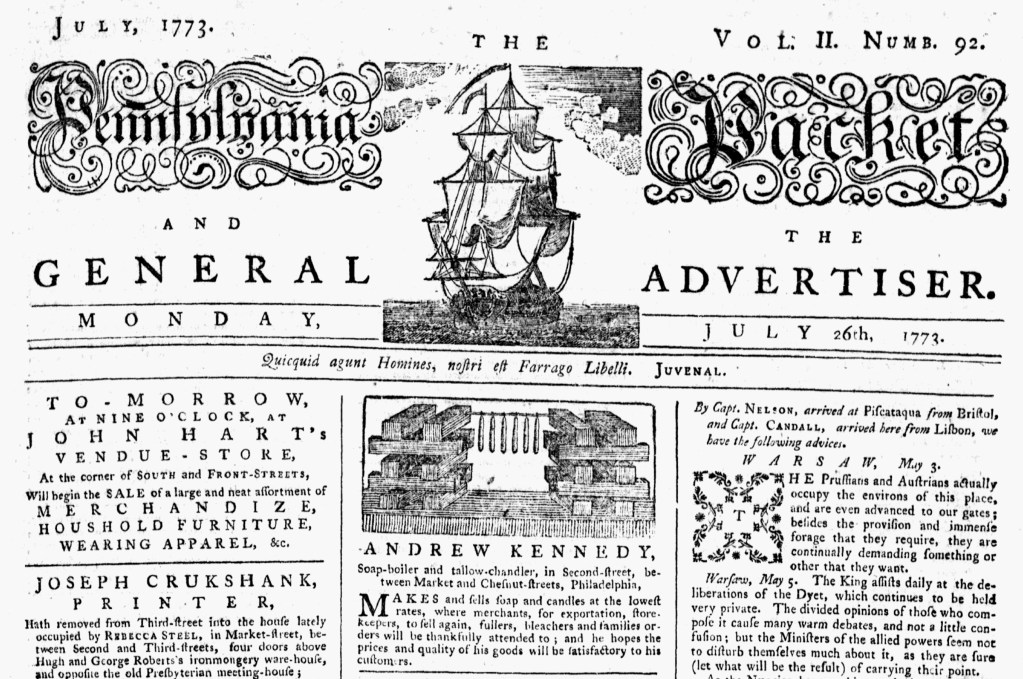
Pennsylvania Packet (July 26, 1773).

“MAKES and sells soap and candles … for exportation.”

The front page of the July 26, 1773, edition of the Pennsylvania Packet and General Advertiser featured two images.  As usual, a woodcut depicting a ship at sea appeared in the masthead.  The newspaper took its name from the packet ships that crisscrossed the Atlantic, transporting passengers and freight.  Significantly, packet ships also carried information, whether written in letters, printed in newspapers, or shared by captains, other officers, and crew.  The Pennsylvania Packet, like a packet ship, disseminated news to every destination it reached.  Whether accounts of current events, rosters of vessels arriving and departing from customs houses, prices current for commodities, or advertisements, the contents of the Pennsylvania Packet facilitated commerce in Philadelphia, its figurative home port, and readers wherever they happened to peruse the newspaper.

Andrew Kennedy certainly hoped that the Pennsylvania Packet and General Advertiser would facilitate his own commercial interests.  The “soap-boiler and tallow-chandler” ran a shop in Philadelphia, though he aimed to serve consumers far beyond that bustling port.  Like packet ships and newspapers, he envisioned the soap and candles that he made and sold “at the lowest rates” reaching faraway places.  He offered them to “merchants, for exportation,” and to “storekeepers, to sell again,” presenting those options for buying by volume first before mentioning “families orders.”  Like many other artisans and shopkeepers who advertised in colonial newspapers, he promoted the “prices and quality of his goods” and concluded with overtures about customer satisfaction.  Kennedy commenced his advertisement with an image that readers immediately recognized, stacks of blocks on the right and left to support a string dangling six freshly-dipped candles.  Without even skimming the rest of the advertisement, readers knew that Kennedy sold candles.

Only two other images appeared in that issue of the Pennsylvania Packet, both of them woodcuts of indentured servants who ran away from their masters.  John Dunlap, the printer, provided those stock images to the advertisers, but Kennedy commissioned a woodcut for his own exclusive use.  That image likely helped attract attention to the appeals to price and quality that he intended to resonate with merchants, shopkeepers, and other prospective customers.