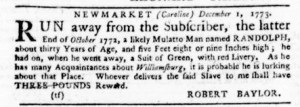
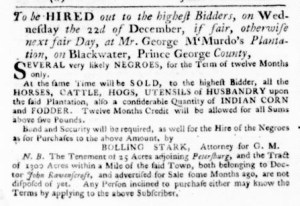
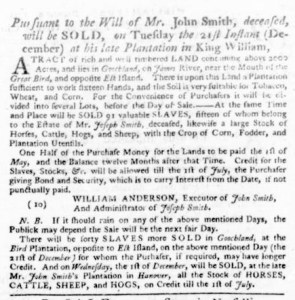
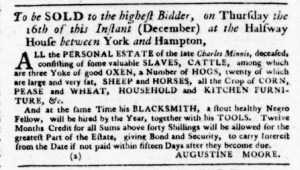
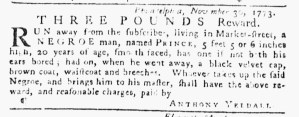
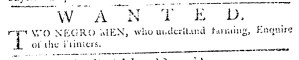
Slavery Advertisements Published December 14, 1773

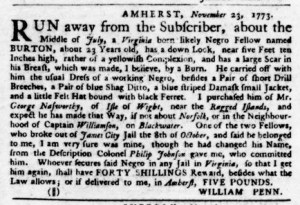
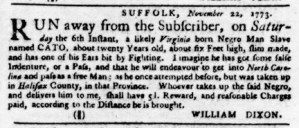
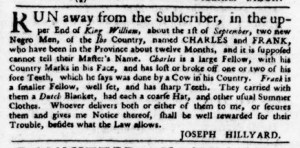
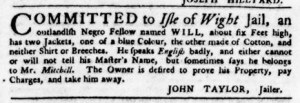
The Slavery Adverts 250 Project chronicles the role of newspaper advertising in perpetuating slavery in the era of the American Revolution. The project seeks to reveal the ubiquity of slavery in eighteenth-century life from New England to Georgia by republishing advertisements about enslaved people – for sale as individuals or in groups, wanted to purchase or for hire for short periods, runaways who liberated themselves, and those who were subsequently captured and confined in jails and workhouses – in daily digests on this site as well as in real time via the @SlaveAdverts250 Twitter feed, utilizing twenty-first-century media to stand in for the print media of the eighteenth century.

The project aims to provide modern audiences with a sense of just how often colonizers encountered these advertisements in their daily lives. Enslaved men, women, and children appeared in print somewhere in the colonies almost every single day. Those advertisements served as a constant backdrop for social, cultural, economic, and political life in colonial and revolutionary America. Colonizers who did not purport to own enslaved people were still confronted with slavery as well as invited to maintain the system by purchasing enslaved men, women, and children or assisting in the capture of so-called “runaways” who sought to free themselves from bondage. The frequency of these newspaper advertisements suggests just how embedded slavery was in colonial and revolutionary American culture in everyday interactions beyond the printed page.

These advertisements also testify to the experiences of enslaved men, women, and children, though readers must consider that those experiences have been remediated through descriptions offered by enslavers rather than enslaved people themselves. Often unnamed in the advertisements, enslaved men, women, and children were not invisible or unimportant in early America.

These advertisements appeared in colonial American newspapers 250 years ago today.

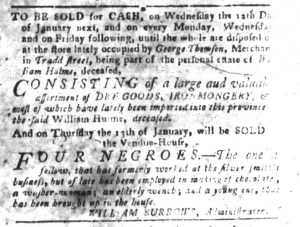
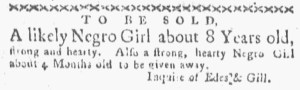
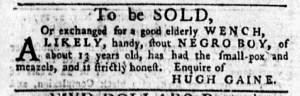
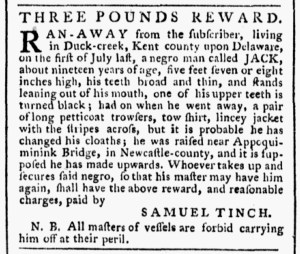
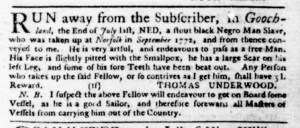
Connecticut Courant (December 14, 1773).

**********
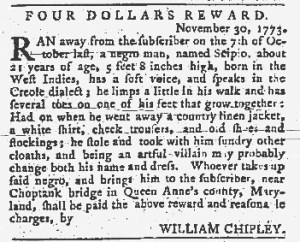
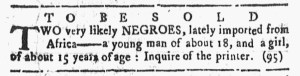
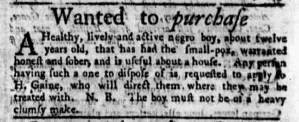
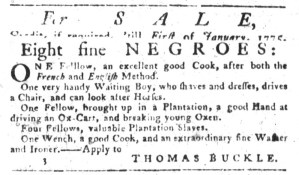
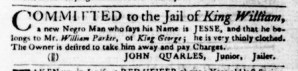
Essex Gazette (December 14, 1773).

**********
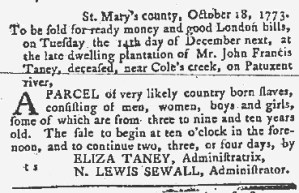
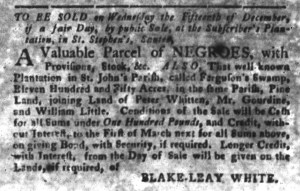
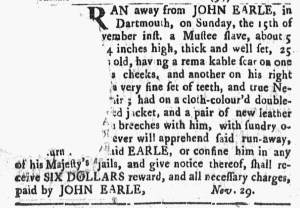
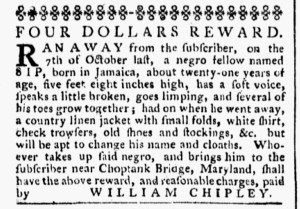
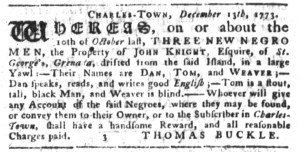
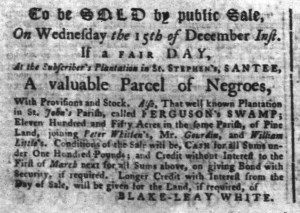
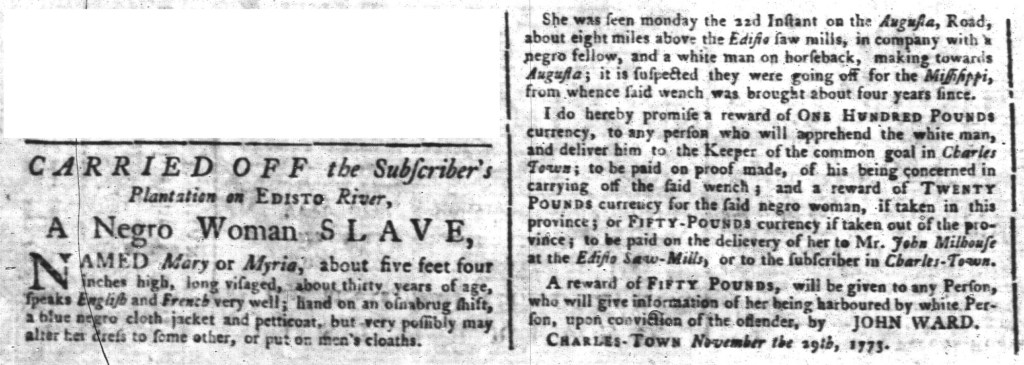
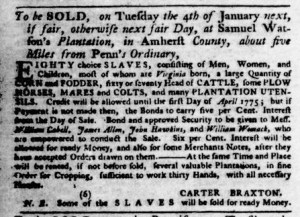
South-Carolina Gazette and Country Journal (December 14, 1773).

**********
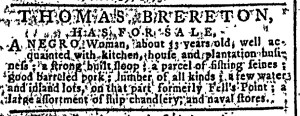
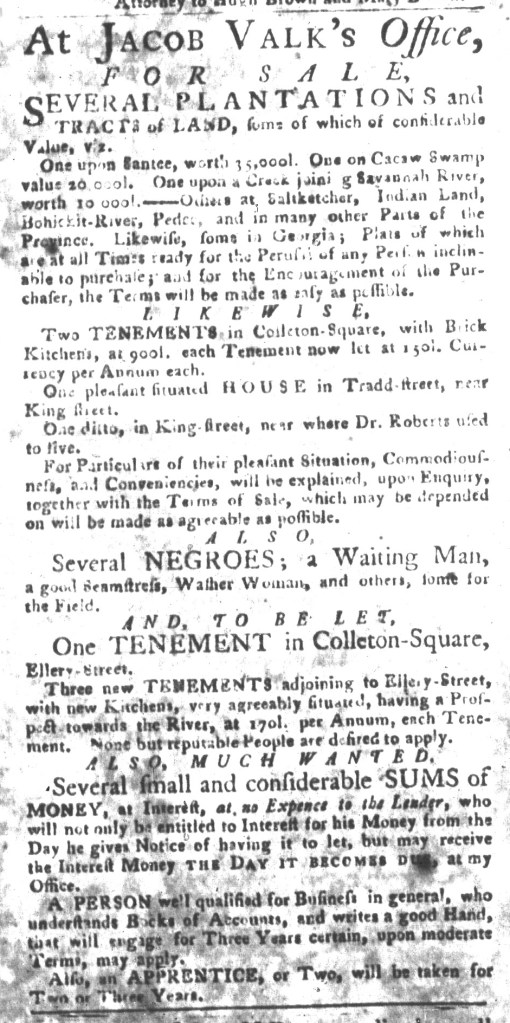
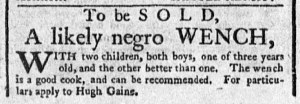
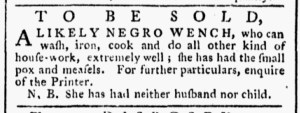
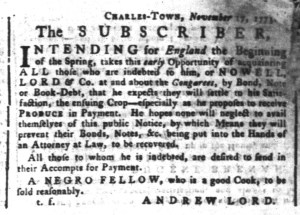
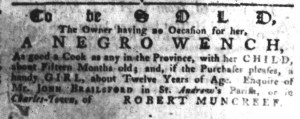
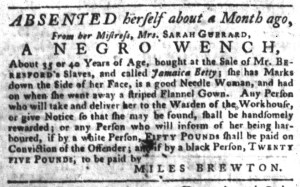
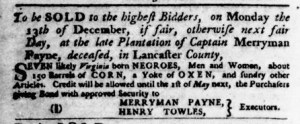
South-Carolina Gazette and Country Journal (December 14, 1773).

**********
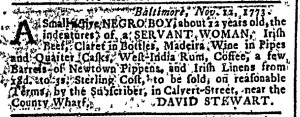
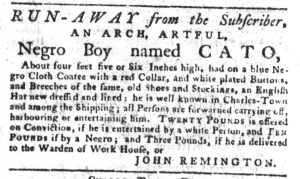
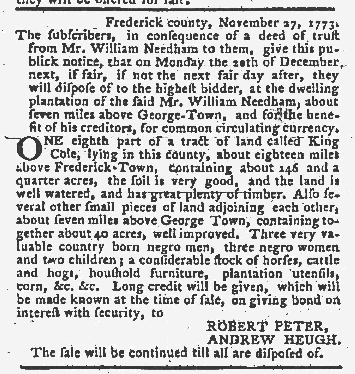
South-Carolina Gazette and Country Journal (December 14, 1773).

**********
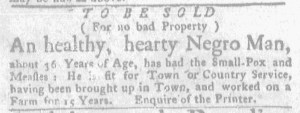
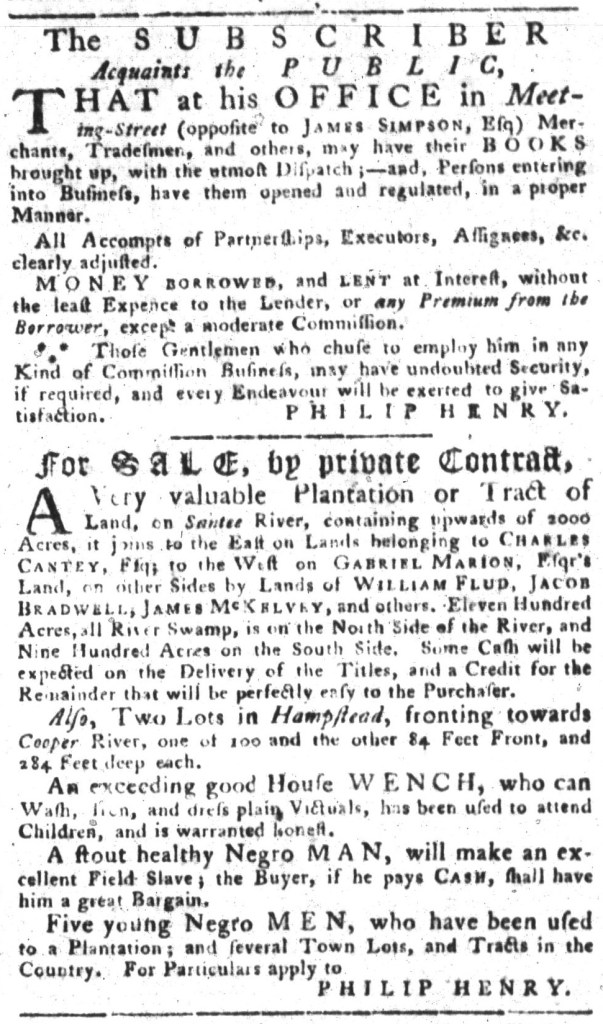
South-Carolina Gazette and Country Journal (December 14, 1773).

**********
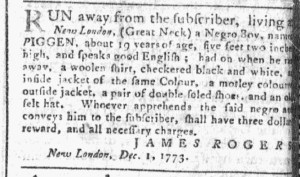
South-Carolina Gazette and Country Journal (December 14, 1773).

**********
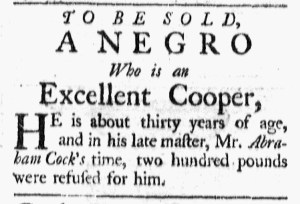
South-Carolina Gazette and Country Journal (December 14, 1773).

**********
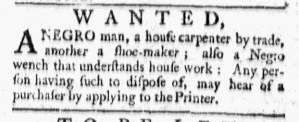
South-Carolina Gazette and Country Journal (December 14, 1773).

**********
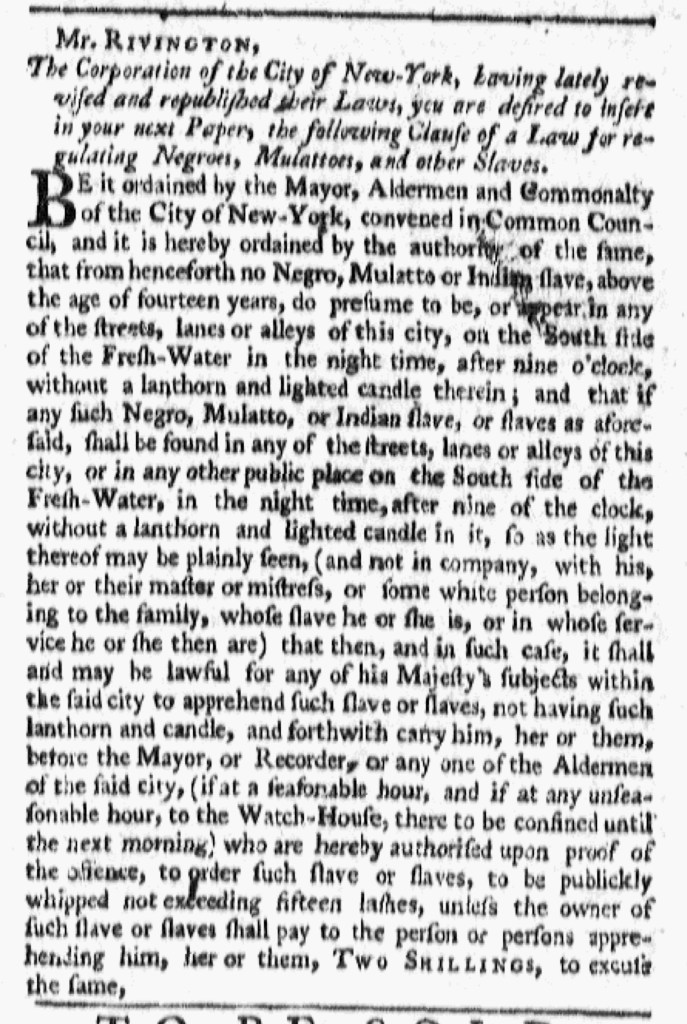
South-Carolina Gazette and Country Journal (December 14, 1773).

**********
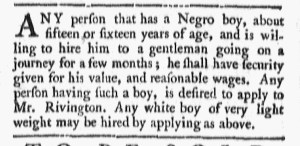
South-Carolina Gazette and Country Journal (December 14, 1773).

**********
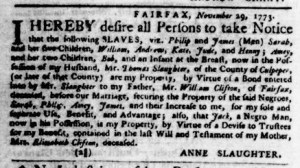
South-Carolina Gazette and Country Journal (December 14, 1773).

December 13

What was advertised in a colonial American newspaper 250 years ago today?

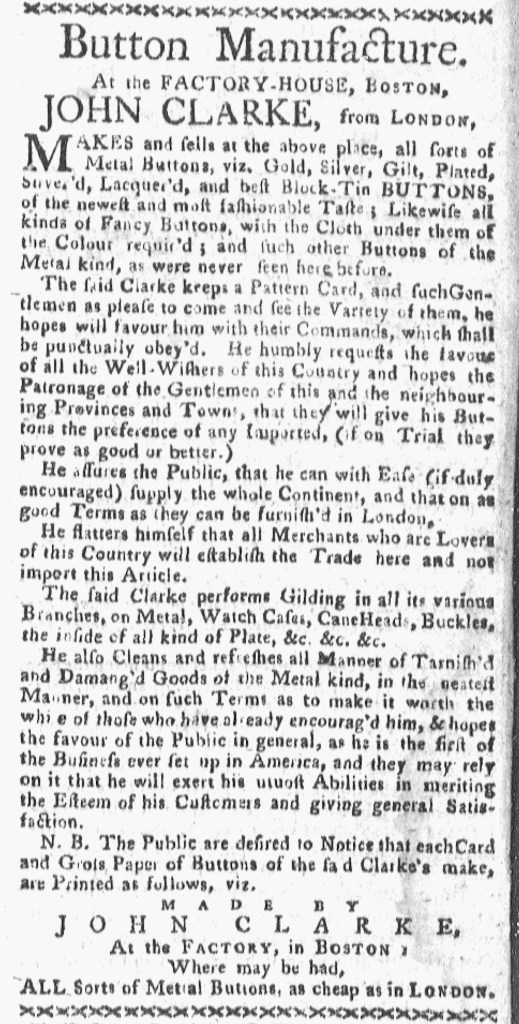
Boston-Gazette (December 13, 1773).

“He flatters himself that all Merchants who are Lovers of this Country will establish the Trade here and not import this Article.”

John Clarke made and sold “all sorts of Metal Buttons” at the “FACTORY-HOUSE” in Boston.  His advertisement in the December 13, 1773, edition of the Boston-Gazette testified to the many ways that he marketed his buttons, both within and beyond newspaper notices.  For instance, Clarke did more than describe his “Gold, Silver, Gilt, Plated, Silver’d, Lacquer’d, and best Block-Tin BUTTONS, of the newest and most fashionable Taste” and “Fancy Buttons with the Cloth under them of the Colour requir’d.”  He also provided samples on “a Pattern Card,” inviting prospective customers to “come and see the Variety of them.”  Clarke hoped that after examining those specimens they would place orders.  He also devised a means of identifying his buttons once they left his manufactory, advising that “each Card and Gross Paper of Buttons of the said Clarke’s make, are printed as follows, viz. MADE BY JOHN CLARKE, At the FACTORY, in Boston: Where may be had, ALL Sorts of Metal Buttons, as cheap as in London.”  His newspaper advertisement reproduced a shorter advertisement that appeared on the packaging of his products.

Clarke also made an appeal to support domestic manufactures, echoing the sentiments that John Keating so often published in advertisements for his “PAPER MANUFACTORY” in New York and others who wished to support local economies rather than importing so many goods from Great Britain.  He presented his buttons to “all the Well-Wishers of this Country and hopes the Patronage of the Gentlemen of this and the neighbouring Provinces and Towns, that they will give his Buttons the preference of any imported.”  Clarke made this appeal as tensions mounted in Boston over the arrival of ships carrying tea that Parliament intended to tax under the new Tea Act.  Within a week, colonizers would board those ships and throw the tea into the harbor.  Clarke likely expected that his message would resonate with readers of theBoston-Gazette, one of the newspapers that most often decried the abuses of Parliament and the colonial officials that attempted to implement its policies.  Those readers (and his prospective customers) included “Merchants who are Lovers of this Country” who had a duty, Clarke asserted, to “establish the Trade here and not import this Article.”  He did not, however, expect merchants, shopkeepers, tailors, and consumers to accept an inferior product as an alternative to the buttons imported from London.  He asked customers to try his buttons, determine “if on Trial they prove as good or better,” and only then place orders for larger quantities “on as good Terms as they can be furnish’d in London.”

At a time when the imperial crisis intensified, Clarke encouraged colonizers to “Buy American” and support his “FACTORY HOUSE” for making buttons, “the first of the Business ever set up in America.”  In addition to his extensive appeal that ran in the Boston-Gazette, the packaging for his buttons included an abbreviated version that promoted his “FACTORY, in BOSTON,” and compared its output, “ALL Sorts of Metal Buttons,” to those imported from London.

Slavery Advertisements Published December 13, 1773

The Slavery Adverts 250 Project chronicles the role of newspaper advertising in perpetuating slavery in the era of the American Revolution. The project seeks to reveal the ubiquity of slavery in eighteenth-century life from New England to Georgia by republishing advertisements about enslaved people – for sale as individuals or in groups, wanted to purchase or for hire for short periods, runaways who liberated themselves, and those who were subsequently captured and confined in jails and workhouses – in daily digests on this site as well as in real time via the @SlaveAdverts250 Twitter feed, utilizing twenty-first-century media to stand in for the print media of the eighteenth century.

The project aims to provide modern audiences with a sense of just how often colonizers encountered these advertisements in their daily lives. Enslaved men, women, and children appeared in print somewhere in the colonies almost every single day. Those advertisements served as a constant backdrop for social, cultural, economic, and political life in colonial and revolutionary America. Colonizers who did not purport to own enslaved people were still confronted with slavery as well as invited to maintain the system by purchasing enslaved men, women, and children or assisting in the capture of so-called “runaways” who sought to free themselves from bondage. The frequency of these newspaper advertisements suggests just how embedded slavery was in colonial and revolutionary American culture in everyday interactions beyond the printed page.

These advertisements also testify to the experiences of enslaved men, women, and children, though readers must consider that those experiences have been remediated through descriptions offered by enslavers rather than enslaved people themselves. Often unnamed in the advertisements, enslaved men, women, and children were not invisible or unimportant in early America.

These advertisements appeared in colonial American newspapers 250 years ago today.

Boston-Gazette (December 13, 1773).

**********

Supplement to the Boston-Gazette (December 13, 1773).

**********

Newport Mercury (December 13, 1773).

**********

Newport Mercury (December 13, 1773).

**********

New-York Gazette and Weekly Mercury (December 13, 1773).

**********

New-York Gazette and Weekly Mercury (December 13, 1773).

**********

Supplement to the New-York Gazette and Weekly Mercury (December 13, 1773).

**********

Supplement to the New-York Gazette and Weekly Mercury (December 13, 1773).

**********

Postscript to the Pennsylvania Packet (December 13, 1773).

**********

Postscript to the Pennsylvania Packet (December 13, 1773).

**********

Postscript to the Pennsylvania Packet (December 13, 1773).

**********

South-Carolina Gazette (December 13, 1773).

**********

South-Carolina Gazette (December 13, 1773).

**********

South-Carolina Gazette (December 13, 1773).

**********

South-Carolina Gazette (December 13, 1773).

**********

South-Carolina Gazette (December 13, 1773).

**********

South-Carolina Gazette (December 13, 1773).

**********

Supplement to the South-Carolina Gazette (December 13, 1773).

**********

Supplement to the South-Carolina Gazette (December 13, 1773).

**********

Supplement to the South-Carolina Gazette (December 13, 1773).

December 12

What was advertised in a colonial American newspaper 250 years ago this week?

New-York Journal (December 9, 1773).

“Advertisements of no more Length than Breadth are inserted for Five Shillings, four Weeks, and One Shilling for each Week after, and larger Advertisements in the same Proportion.”

Some printers kept the colophons for their newspapers quite simple, if they included one at all.  The colophon for the Boston-Gazette, for instance, simply stated, “Boston: Printed by EDES & GILL, in Queen-Street, 1773.”  The colophon for the Boston Evening-Post was even more streamlined: “BOSTON: Printed by THOMAS & JOHN FLEET.”  In each instance, the colophon usually appeared at the bottom of the final column on the last page, rather unobtrusive, though the printers sometimes moved the colophon to the third page if they lacked space.

In contrast, other printers inserted much more elaborate colophons that ran across all the columns at the bottom of the final page, that position a permanent element of the design of their newspapers.  In such cases, the colophons often doubled as advertisements, providing much more information than the name of the printer and place of publication.  Such was the case with the colophon for the New-York Journal.  The first line covered the basics: “NEW-YORK: Printed by JOHN HOLT, at the Printing-Office near the COFFEE-HOUSE.”  Two more lines made a sales pitch for the services available at Holt’s printing office, declaring “all Sorts of Printing is done in the neatest Manner, with Care and Expedition.”  Holt invited job printing orders, whether for broadsides, handbills, trade cards, or blanks, touting both his skill and speed in producing them.  He also solicited advertisements for the New-York Journal, an important source of revenue for any newspaper.  The colophon even listed the rates for placing notices: “Advertisements of no more Length than Breadth are inserted for Five Shillings, four Weeks, and One Shilling for each Week after, and larger Advertisements in the same Proportion.”  That initial fee covered both space in the newspaper, one shilling per week, and setting type, an additional shilling.  Setting four weeks as a minimum run generated content while simultaneously enhancing revenues.  Many advertisements in the New-York Journal ran for months rather than weeks.  (This raises suspicions about whether Holt actually charged for each insertion or continued running some advertisements to testify to current and prospective subscribers and potential advertisers about the popularity of his newspaper.)  While every printer welcomed advertisements for their newspapers, most did not regularly comment on the business of advertising.  Holt provided important details in his colophon.

December 11

What was advertised in a colonial American newspaper 250 years ago today?

Providence Gazette (December 11, 1773).

“WEST’s ALMANACK for the year 1774.”

For more than a decade, Benjamin West, an astronomer and mathematician, collaborated with the printers of the Providence Gazette in publishing “THE NEW-ENGLAND ALMANACK, OR Lady’s and Gentleman’s DIARY.”  In 1773, John Carter worked with West, but other printers previously entered into partnership with him before Carter became the proprietor of the Providence Gazette.  Advertisements promoting the New-England Almanack became a familiar sight in that newspaper each fall, continuing into the winter.  Some notices provided extensive details about the contents of the new edition for the next year.  A shorter advertisement in the December 11 edition of the Providence Gazette promoted “the usual astronomical Calculations,” “a brief historical Account of the Rise and Settlement of RHODE-ISLAND Government,” and “some Anecdotes of the celebrated Mr. ROGER WILLIAMS, Founder of this Colony” in the almanac for 1774.

Carter sold the almanac in “large or small Quantities.”  Consumers could purchase individual copies for use in their own households, while merchants and shopkeepers could obtain multiple copies to sell in their own stores and shops.  Thurber and Cahoon, for instance, acquired copies to sell in their shop “at the Sign of the Bunch of Grapes.”  They stocked a “great Variety of English and India GOODS” imported via “the last Vessel from London” as well as the almanac produced in their own town.  To entice prospect customers to visit their shop, Thurber and Cahoon listed many of those items, concluding with “WEST’s ALMANACK for the year 1774.”  They had done so the previous year as well.  Apparently, Thurber and Cahoon considered the New-England Almanack such a draw that it would help get customers into their shop, though it may have been Carter, rather than the merchants, who decided that the title should appear in capital letters, thus drawing attention to it over the rest of the merchandise in the advertisement.  Regardless of who made that decision, Carter and West certainly welcomed the assistance in marketing the almanac beyond their own advertisements.

December 10

What was advertised in a colonial American newspaper 250 years ago today?

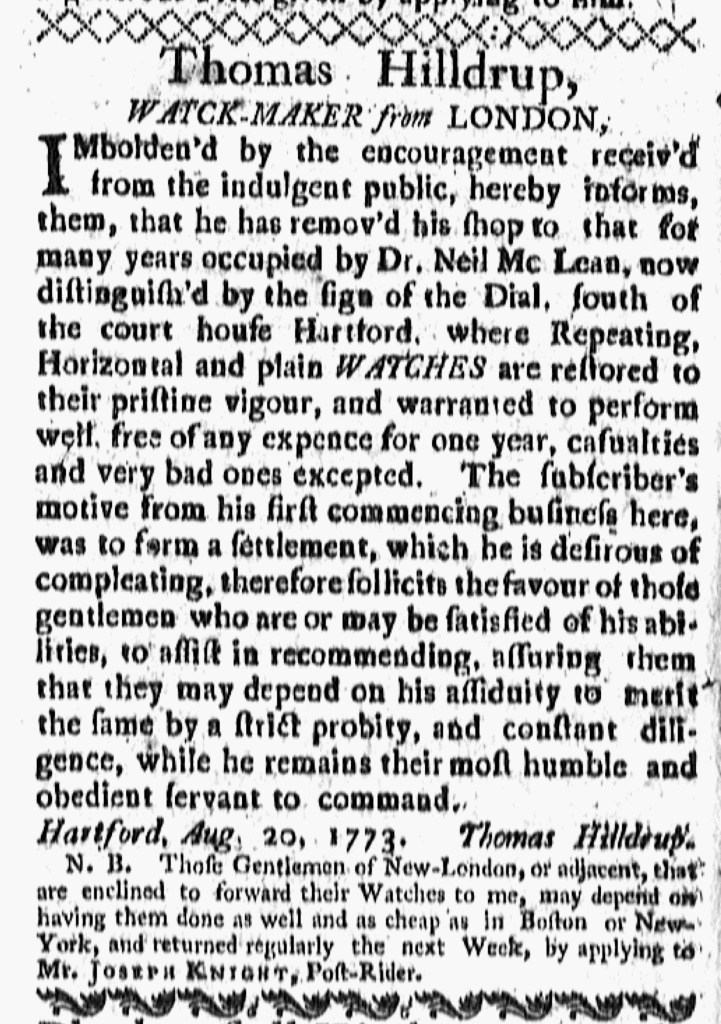
New-London Gazette (December 10, 1773).

“Forward their Watches to me … by applying to Mr. JOSEPH KNIGHT, Post-Rider.”

Thomas Hilldrup, “WATCK-MAKER from LONDON,” continued his advertising campaign in the fall of 1773.  Having settled in Hartford the previous year, he first set about cultivating a local clientele with advertisements in the Connecticut Courant, that town’s only newspaper.  Over time, he expanded his marketing efforts to include the Connecticut Journal and New-Haven Post-Boy and the New-London Gazette.  That meant that he advertised in every newspaper published in Connecticut at the time.  In an advertisement that ran for several months, Hilldrup declared that he had been “IMbolden’d by the encouragement receiv’d from the indulgent public” to move to a new location “now distinguish’d by the sign of the Dial.”  In other words, business had been good, customers had entrusted their watches to the enterprising newcomer for cleaning and repairs, and that demand for his services meant that others should engage him as well.

To that end, Hilldrup presented instructions for sending watches to his shop.  He appended a nota bene to his advertisement in the New-London Gazette, stating that the “Gentlemen of New-London, or adjacent, that are inclined to forward their Watches to me, may depend on having them done as well and as cheap as in Boston or New-York.”  In addition, Hilldrup offered speedy service, promising to return watches “the next Week.”  Clients could take advantage of these services, including a one-year warranty, “by applying to Mr. JOSEPH KNIGHT, Post-Rider.”  Knight did far more than deliver letters and newspapers from town to town.  He also contracted with various entrepreneurs to facilitate their businesses.  In addition to transporting watches for Hilldrup, Knight also sold “An ORATION, Upon the BEAUTIES of LIBERTY,” a popular political tract, in collaboration with Timothy Green, the printer of the New-London Gazette, and Nathan Bushnell, Jr., another post rider.  In forming a partnership with Knight, Hilldrup established an infrastructure for transporting watches to and from his shop, one that he could promote to prospective clients who might have otherwise been anxious about sending their watches over long distances.  Enlisting an associate already familiar in several towns in Connecticut, Hilldrup marketed an approved and secure method for sending watches to him to restore “to their pristine vigour.”

December 9

What was advertised in a colonial American newspaper 250 years ago today?

Massachusetts Gazette and Boston Weekly News-Letter (December 9, 1773).

“She will engage to sell as Cheap as can be bought in Town.”

Mrs. Sheaffe sold “GROCERIES of all Kinds, and of the best Qualities,” at her shop in Boston in 1773.  In an advertisement in the December 9 edition of the Massachusetts Gazette and Boston Weekly News-Letter, she listed many of the items she stocked, including “Superfine and common Philadelphia Flour by the Barrel or less,” “Fresh Jar and Cask Raisins,” “Choice Hyson, Souchong and Bohea Tea,” “Spanish and French Olives,” “single, middling and double refin’d Loaf-Sugar,” anchovies, oatmeal, coffee, “split Peas,” and “Fresh Spices.”  In addition, she sold corks, “Choice Frontineac WINE,” “crown & hard Soap,” “Playing-Cards,” and two different kinds of snuff.

An enterprising entrepreneur, Sheaffe stated that she would not be undersold by any of the merchants in Boston.  Her name served as the primary headline, preceded by a note declaring, “TO BE SOLD CHEAP.”  That sentiment framed Sheaffe’s entire advertisement, setting up expectations for prospective customers before they encountered the list of groceries available at her shop.  She concluded her notice with a nota bene, promising that she “will engage to sell as Cheap as can be bought in Town.”  Sheaffe faced competition on that front.  Immediately below her advertisement, Penuel Brown’s notice listed several of the items that Sheaffe enumerated, including “Choice New FLOUR per Barrel,” “RAISINS per Cask nearly equal to Jarr,” “SPICES fresh and good, by all Quantities,” and “all other GROCERIES.”  Bowen also pledged to sell his wares “As Cheap as any in Boston.”  As prospective customers did their comparison shopping to find the best deals, Sheaffe and Bowen both wanted to increase the chances that they would consult with them about their prices.

Unlike Bowen, Sheaffe also made clear that she sold her groceries “by WHOLESALE AND RETAIL.”  She welcomed customers seeking to buy in large or small quantities, whether shopkeepers looking to replenish their own inventory or consumers acquiring essentials for their households.  Matching the best bargains in town did not require purchasing in large volumes.  Sheaffe intended to win her share of the market by making appeals concerning low prices that demonstrated to prospective customers that they should choose to shop with her rather than any of her competitors.

Slavery Advertisements Published December 9, 1773

The Slavery Adverts 250 Project chronicles the role of newspaper advertising in perpetuating slavery in the era of the American Revolution. The project seeks to reveal the ubiquity of slavery in eighteenth-century life from New England to Georgia by republishing advertisements about enslaved people – for sale as individuals or in groups, wanted to purchase or for hire for short periods, runaways who liberated themselves, and those who were subsequently captured and confined in jails and workhouses – in daily digests on this site as well as in real time via the @SlaveAdverts250 Twitter feed, utilizing twenty-first-century media to stand in for the print media of the eighteenth century.

The project aims to provide modern audiences with a sense of just how often colonizers encountered these advertisements in their daily lives. Enslaved men, women, and children appeared in print somewhere in the colonies almost every single day. Those advertisements served as a constant backdrop for social, cultural, economic, and political life in colonial and revolutionary America. Colonizers who did not purport to own enslaved people were still confronted with slavery as well as invited to maintain the system by purchasing enslaved men, women, and children or assisting in the capture of so-called “runaways” who sought to free themselves from bondage. The frequency of these newspaper advertisements suggests just how embedded slavery was in colonial and revolutionary American culture in everyday interactions beyond the printed page.

These advertisements also testify to the experiences of enslaved men, women, and children, though readers must consider that those experiences have been remediated through descriptions offered by enslavers rather than enslaved people themselves. Often unnamed in the advertisements, enslaved men, women, and children were not invisible or unimportant in early America.

These advertisements appeared in colonial American newspapers 250 years ago today.

Maryland Gazette (December 9, 1773).

**********

Maryland Gazette (December 9, 1773).

**********

Maryland Gazette (December 9, 1773).

**********

Maryland Journal (December 9, 1773).

**********

Maryland Journal (December 9, 1773).

**********

Massachusetts Gazette and Boston Weekly News-Letter (December 9, 1773).

**********

Norwich Packet (December 9, 1773).

**********

Rivington’s New-York Gazetteer (December 9, 1773).

**********

Rivington’s New-York Gazetteer (December 9, 1773).

**********

Rivington’s New-York Gazetteer (December 9, 1773).

**********

Rivington’s New-York Gazetteer (December 9, 1773).

**********

Virginia Gazette [Purdie & Dixon] (December 9, 1773).

**********

Virginia Gazette [Purdie & Dixon] (December 9, 1773).

**********

Virginia Gazette [Purdie & Dixon] (December 9, 1773).

**********

Virginia Gazette [Purdie & Dixon] (December 9, 1773).

**********

Virginia Gazette [Purdie & Dixon] (December 9, 1773).

**********

Virginia Gazette [Purdie & Dixon] (December 9, 1773).

**********

Virginia Gazette [Purdie & Dixon] (December 9, 1773).

**********

Virginia Gazette [Purdie & Dixon] (December 9, 1773).

**********

Virginia Gazette [Purdie & Dixon] (December 9, 1773).

**********

Virginia Gazette [Purdie & Dixon] (December 9, 1773).

**********

Virginia Gazette [Purdie & Dixon] (December 9, 1773).

**********

Virginia Gazette [Purdie & Dixon] (December 9, 1773).

**********

Virginia Gazette [Purdie & Dixon] (December 9, 1773).

**********

Virginia Gazette [Purdie & Dixon] (December 9, 1773).

**********

Virginia Gazette [Purdie & Dixon] (December 9, 1773).

**********

Virginia Gazette [Purdie & Dixon] (December 9, 1773).

**********

Virginia Gazette [Purdie & Dixon] (December 9, 1773).

**********

Virginia Gazette [Purdie & Dixon] (December 9, 1773).

**********

Virginia Gazette [Rind] (December 9, 1773).

**********

Virginia Gazette [Rind] (December 9, 1773).

**********

Virginia Gazette [Rind] (December 9, 1773).

**********

Virginia Gazette [Rind] (December 9, 1773).

December 8

What was advertised in a colonial American newspaper 250 years ago today?

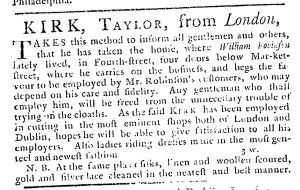
Pennsylvania Journal (December 8, 1773).

“Any gentlemen who shall employ him, will be freed from the unnecessary trouble of trying on the cloaths.”

Upon arriving in Philadelphia, “KIRK, TAYLOR, from London,” placed an advertisement in the Pennsylvania Journal to introduce himself to prospective clients.  Like so many other artisans who migrated across the Atlantic, Kirk did not have the benefit of his new community’s long familiarity with his work.  Instead, he had to establish his reputation by reporting on his prior experience serving customers in faraway places.  To that end, Kirk proclaimed that he “has been employed in cutting in the most eminent shops of London and Dublin.”  Prospective clients in the largest city in the colonies associated some level of cachet with such connections to even larger and more cosmopolitan cities.  Furthermore, his origins suggested that Kirk had special insight into the latest trends in those places, especially when he declared that he made garments “in the most genteel and newest fashion.”

When he set up shop in Philadelphia, Kirk took the house “where William Robinson lately lived” on Fourth Street.  Not only did he take over that residence, the tailor also hoped to acquire Robinson’s clientele, an efficient means of cultivating relationships in his new city.  The newcomer “begs the favour to be employed by Mr. Robinson’s customers, who may depend on his care and fidelity.”  Earning repeat business, generating word-of-mouth recommendations, and bolstering his reputation depended on attentive service and producing quality work for Robinson’s customers and anyone else who gave him a chance.  Kirk clearly communicated that he was confident in his abilities.  He was such a good tailor, he reported, that “gentlemen who shall employ him, will be freed from the unnecessary trouble of trying on the cloaths,” so precise were his measurements and sewing.  They did not need to tarry in his shop, spending unnecessary time better devoted to their own business or leisure.

Kirk aimed to capture some portion of the market for tailoring services in Philadelphia.  He devised an advertisement that gave prospective clients good reason to give him a chance and then decide for themselves if he merited more orders.  He hoped to gain some of the clients accustomed to visiting a tailoring shop at the same location, but did not entrust his fate to that circumstance alone.  Instead, he advised Robinson’s former customers and other prospective customers that he had experience in the best shops in London and Dublin, knowledge of the latest fashions, and the skills necessary “to give satisfaction to all his employers.”

Slavery Advertisements Published December 8, 1773

The Slavery Adverts 250 Project chronicles the role of newspaper advertising in perpetuating slavery in the era of the American Revolution. The project seeks to reveal the ubiquity of slavery in eighteenth-century life from New England to Georgia by republishing advertisements about enslaved people – for sale as individuals or in groups, wanted to purchase or for hire for short periods, runaways who liberated themselves, and those who were subsequently captured and confined in jails and workhouses – in daily digests on this site as well as in real time via the @SlaveAdverts250 Twitter feed, utilizing twenty-first-century media to stand in for the print media of the eighteenth century.

The project aims to provide modern audiences with a sense of just how often colonizers encountered these advertisements in their daily lives. Enslaved men, women, and children appeared in print somewhere in the colonies almost every single day. Those advertisements served as a constant backdrop for social, cultural, economic, and political life in colonial and revolutionary America. Colonizers who did not purport to own enslaved people were still confronted with slavery as well as invited to maintain the system by purchasing enslaved men, women, and children or assisting in the capture of so-called “runaways” who sought to free themselves from bondage. The frequency of these newspaper advertisements suggests just how embedded slavery was in colonial and revolutionary American culture in everyday interactions beyond the printed page.

These advertisements also testify to the experiences of enslaved men, women, and children, though readers must consider that those experiences have been remediated through descriptions offered by enslavers rather than enslaved people themselves. Often unnamed in the advertisements, enslaved men, women, and children were not invisible or unimportant in early America.

These advertisements appeared in colonial American newspapers 250 years ago today.

Pennsylvania Gazette (December 8, 1773).

**********

Pennsylvania Gazette (December 8, 1773).

**********

Pennsylvania Journal (December 8, 1773).

**********

Pennsylvania Journal (December 8, 1773).