January 12

What was advertised in a colonial American newspaper 250 years ago today?

Essex Journal (January 12, 1774).

“Said MAGAZINE was not published on Saturday last, agreeable to his promise.”

Throughout the second half of 1773, Isaiah Thomas, the printer of the Massachusetts Spy, attempted to launch another publication, the Royal American Magazine.  If he could attract a sufficient number of subscribers to take the project to press, it would be the only magazine published in the colonies at the time.  After a few months, Thomas announced that subscribers had indeed answered his call, responding to the proposals and other advertisements he placed in newspapers in Massachusetts, New Hampshire, Rhode Island, Connecticut, New York, Pennsylvania, and Maryland.  He planned to distribute the first issue of the Royal American Magazine on January 1, 1774.

That, however, did not come to pass.  In the January 6 edition of the Massachusetts Spy, the first issue of the new year, Thomas inserted an update that explained that “the only Reason why said MAGAZINE was not published on Saturday last, agreeable to his Promise, was, that he sent to England for a compleat Set of Types, for said Work” and the ship that was supposed to deliver them to Boston ran ashore on Cape Cod about three weeks earlier.  Fortunately, “the Cargo was saved.”  Thomas eventually received the new type, but not by “the Day intended for Publication.”  He assured subscribers that the magazine “will THIS WEEK be put in the Press, and published on the first Day of February next.”  In the eighteenth century, monthly magazines often came out during the final days of the month rather than the beginning of the month, so this plan still allowed Thomas to produce a January issue.

This misfortune also presented an opportunity for “Gentlemen and Ladies who intend subscribing for the Royal AMERICAN MAGAZINE” but had not yet done so to “send in their Names immediately, otherwise they may be disappointed of having the first Number.”  In addition to encouraging more subscribers, Thomas also continued soliciting “LUCUBRATIONS” or essays for the inaugural issue.  Given the delay caused by not receiving the type by the expected date, Thomas had more time to collect content produced by American authors for the magazine.

After this update ran in the Massachusetts Spy on January 6, Thomas placed it in the Massachusetts Gazette and Boston Post-Boy on January 10 and the Essex Journal, published in Newburyport, Massachusetts, on January 12.  Thomas had recently commenced publishing the Essex Journal in partnership with Henry-Walter Tinges.  Not surprisingly, his advertisement was the only one to appear on the front page of Essex Journal.  Other advertisements appeared elsewhere in the issue.

January 11

What was advertised in a colonial American newspaper 250 years ago today?

South-Carolina Gazette and Country Journal (January 11, 1774).

“Their assortment is as compleat as most in the province.”

In an advertisement in the January 11, 1774, edition of the South-Carolina Gazette and Country Journal, George Cooke and Company informed prospective customers that they recently imported a “fresh SUPPLY of GOODS” from London on the Portland.  Their merchandise included “very fashionable brocades” and other textiles, “men and boys fine beaver hats,” “womens black and coloured satin hats,” “all sorts of gloves and mitts,” “hosiery of all kinds,” and “a great variety of other goods.”

Cooke and Company competed in Charleston’s bustling marketplace.  John Webb advertised a similar inventory, as did Z. Kingsley and Samuel Gordon.  Other merchants and shopkeepers placed advertisements in the city’s other newspapers, the South-Carolina Gazette and the South-Carolina and American General Gazette.  Many did not advertise in the public prints, relying instead on other means of attracting customers to their stores and shops.  Consumers had many choices for acquiring goods in the busy port.

Realizing that was the case, Cooke and Company strove to convince readers that they offered a selection as extensive as those they would find just about anywhere else in Charleston or the rest of the colony.  The items they just received from the Portland supplemented previous shipments.  Those “several late importations from London and Bristol” made their assortment of goods “as compleat as most in the province.”  Customers did not need to go from shop to shop, looking for wares that appealed to them, when Cooke and Company stocked just about anything they could imagine.

Webb, Kingsley, and Gordon all demonstrated some of the choices they offered to consumers by listing dozens of items in their advertisements, each of them indicating that they carried much more than they could include in newspaper advertisements, yet Cooke and Company alone in that issue of the South-Carolina Gazette and Country Journal provided assurances that few if any of their competitors surpassed the selection at their shop.  Whether or not that swayed any prospective customers, Cooke and Company attempted to give their enterprise an advantage over the marketing undertaken by other merchants and shopkeepers.

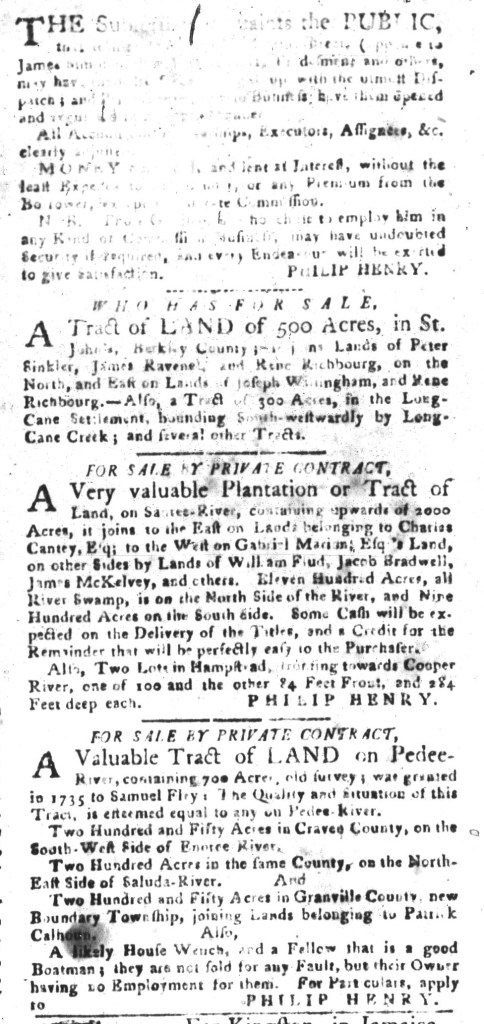
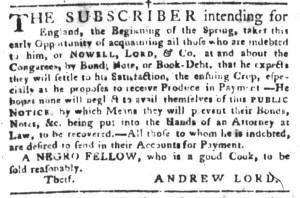
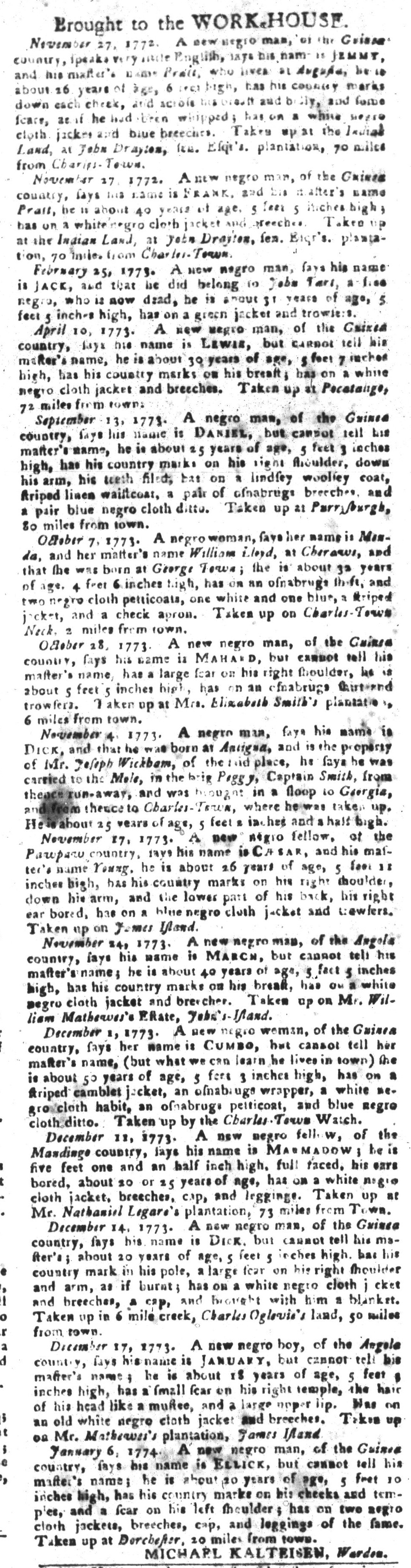
Slavery Advertisements Published January 11, 1774

The Slavery Adverts 250 Project chronicles the role of newspaper advertising in perpetuating slavery in the era of the American Revolution. The project seeks to reveal the ubiquity of slavery in eighteenth-century life from New England to Georgia by republishing advertisements about enslaved people – for sale as individuals or in groups, wanted to purchase or for hire for short periods, runaways who liberated themselves, and those who were subsequently captured and confined in jails and workhouses – in daily digests on this site as well as in real time via the @SlaveAdverts250 Twitter feed, utilizing twenty-first-century media to stand in for the print media of the eighteenth century.

The project aims to provide modern audiences with a sense of just how often colonizers encountered these advertisements in their daily lives. Enslaved men, women, and children appeared in print somewhere in the colonies almost every single day. Those advertisements served as a constant backdrop for social, cultural, economic, and political life in colonial and revolutionary America. Colonizers who did not purport to own enslaved people were still confronted with slavery as well as invited to maintain the system by purchasing enslaved men, women, and children or assisting in the capture of so-called “runaways” who sought to free themselves from bondage. The frequency of these newspaper advertisements suggests just how embedded slavery was in colonial and revolutionary American culture in everyday interactions beyond the printed page.

These advertisements also testify to the experiences of enslaved men, women, and children, though readers must consider that those experiences have been remediated through descriptions offered by enslavers rather than enslaved people themselves. Often unnamed in the advertisements, enslaved men, women, and children were not invisible or unimportant in early America.

These advertisements appeared in colonial American newspapers 250 years ago today.

South-Carolina Gazette and Country Journal (January 11, 1774).

**********

South-Carolina Gazette and Country Journal (January 11, 1774).

**********

South-Carolina Gazette and Country Journal (January 11, 1774).

**********

South-Carolina Gazette and Country Journal (January 11, 1774).

**********

South-Carolina Gazette and Country Journal (January 11, 1774).

**********

South-Carolina Gazette and Country Journal (January 11, 1774).

**********

South-Carolina Gazette and Country Journal (January 11, 1774).

**********

South-Carolina Gazette and Country Journal (January 11, 1774).

**********

South-Carolina Gazette and Country Journal (January 11, 1774).

January 10

What was advertised in a colonial American newspaper 250 years ago today?

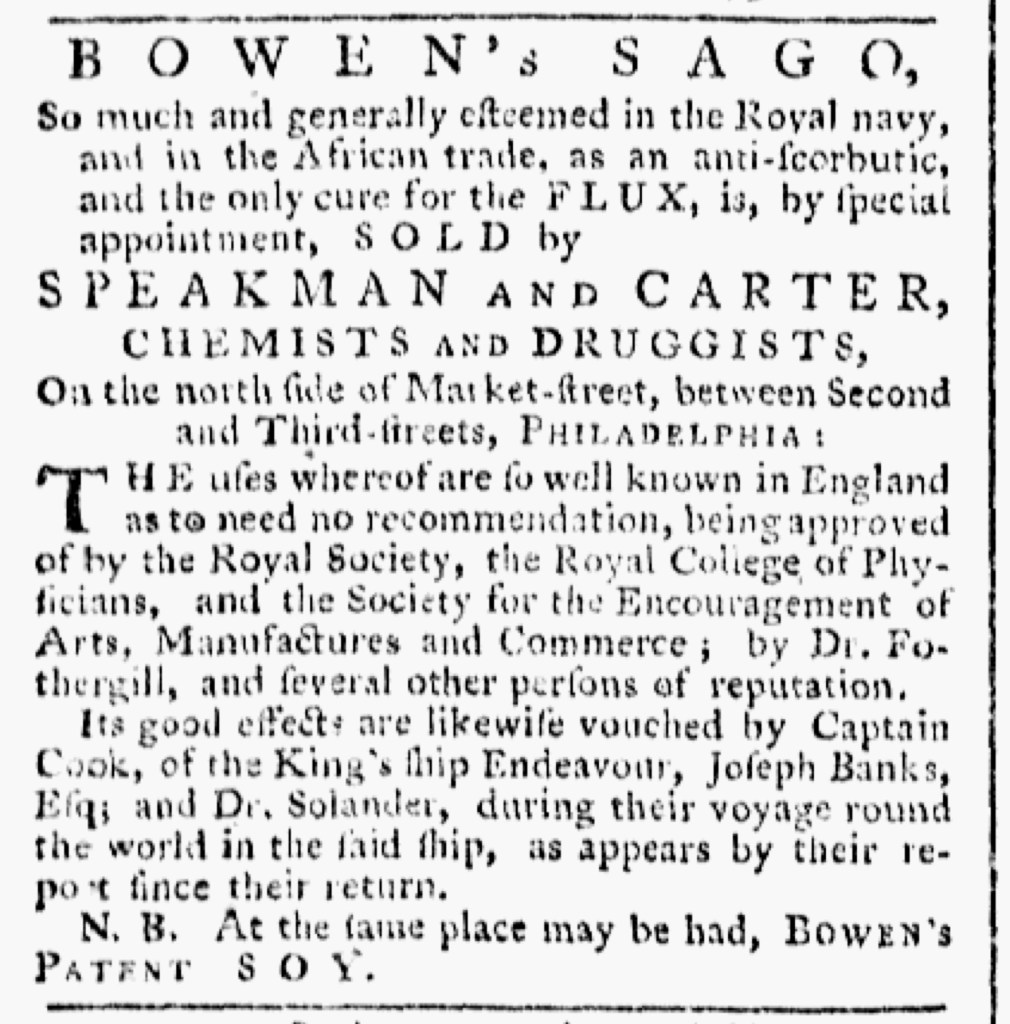
Dunlap’s Pennsylvania Packet (January 10, 1774).

“BOWEN’s SAGO … the only cure for the FLUX.”

Townsend Speakman and Christopher Carter, “CHEMISTS AND DRUGGISTS” in Philadelphia, took to the pages of Dunlap’s Pennsylvania Packet to advertise “BOWEN’s SAGO,” a medicine for preventing and curing scurvy.  The apothecaries did not, however, appear to generate their own copy.  Instead, they seemed to borrow heavily from advertisements that Zepheniah Kingsley placed in the South-Carolina Gazette and Country Journal and other newspapers published in Charleston several months earlier.

The headline differed only slightly, “BOWEN’s patent SAGO” in the original shortened to “BOWEN’s SAGO” in Speakman and Carter’s advertisement.  The introductory remarks remained the same, describing the product as “So much and generally esteemed in the Royal navy, and in the African trade, as an anti-scorbutic, and the only cure for the FLUX.”  In the original, the retailer then announced, “SOLD By Z. KINGSLEY,” and directed customers to his store in Beadon’s Alley.  The apothecaries in Philadelphia altered that portion slightly, declaring that the medicine “is, by special appointment, SOLD by SPEAKMAN AND CARTER, CHEMISTS AND DRUGGISTS,” and then gave directions to their shop.  The main body of both advertisements included an overview of endorsements by “the Royal Society, the Royal College of Physicians, and the Society for the Encouragement of Arts, Manufactures and Commerce.”  Speakman and Carter added additional endorsements: “by Dr. Fothergill, and several other persons of reputation.”  Another paragraph described how Captain James Cook and botanists who sailed with him during the Endeavour’s “voyage round the world” also “vouched” for the “good effects” of Bowen’s Sago in the report they published upon their return.  It appeared almost word-for-word, substituting “Joseph Banks, Esq” for “Mr. BANKES.”  A brief note appeared at the end, “SOLD at same Place, BOWEN’s patent SOY” in the original and “At the same place may be had, BOWEN’S PATENT SOY.”

Speakman and Carter created their advertisement at a time that most people thought little of reprinting what others had written or published, at least in certain contexts.  Colonial printers liberally reprinted content from one newspaper to another, often attributing their sources but sometimes not doing so.  Printers and booksellers who advertised books frequently copied the extensive subtitles or contents that appeared on the title page, treating those as advertising copy. Apothecaries, shopkeepers, and others who sold patent medicines sometimes published newspaper advertisements that drew heavily from the directions or promotional materials provided by the producers.  In this instance, Speakman and Carter may have used Kingsley’s advertisement as a model, revising it slightly for their purposes, or both the apothecaries in Philadelphia and the merchant in Charleston may have adapted handbills, newspaper advertisements, or other marketing materials sent to them by their suppliers.  Whatever the explanation, consumers in two major ports encountered nearly identical marketing for a product sold by local vendors.

Slavery Advertisements Published January 10, 1774

The Slavery Adverts 250 Project chronicles the role of newspaper advertising in perpetuating slavery in the era of the American Revolution. The project seeks to reveal the ubiquity of slavery in eighteenth-century life from New England to Georgia by republishing advertisements about enslaved people – for sale as individuals or in groups, wanted to purchase or for hire for short periods, runaways who liberated themselves, and those who were subsequently captured and confined in jails and workhouses – in daily digests on this site as well as in real time via the @SlaveAdverts250 Twitter feed, utilizing twenty-first-century media to stand in for the print media of the eighteenth century.

The project aims to provide modern audiences with a sense of just how often colonizers encountered these advertisements in their daily lives. Enslaved men, women, and children appeared in print somewhere in the colonies almost every single day. Those advertisements served as a constant backdrop for social, cultural, economic, and political life in colonial and revolutionary America. Colonizers who did not purport to own enslaved people were still confronted with slavery as well as invited to maintain the system by purchasing enslaved men, women, and children or assisting in the capture of so-called “runaways” who sought to free themselves from bondage. The frequency of these newspaper advertisements suggests just how embedded slavery was in colonial and revolutionary American culture in everyday interactions beyond the printed page.

These advertisements also testify to the experiences of enslaved men, women, and children, though readers must consider that those experiences have been remediated through descriptions offered by enslavers rather than enslaved people themselves. Often unnamed in the advertisements, enslaved men, women, and children were not invisible or unimportant in early America.

These advertisements appeared in colonial American newspapers 250 years ago today.

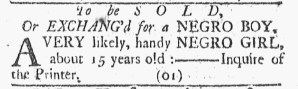
Newport Mercury (January 10, 1773).

**********

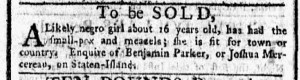
Newport Mercury (January 10, 1773).

**********

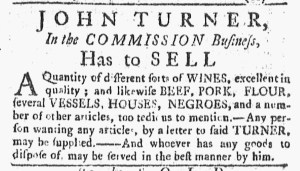
New-York Gazette and Weekly Mercury (January 10, 1773).

January 9

What was advertised in a colonial American newspaper 250 years ago this week?

Maryland Gazette (January 6, 1774).

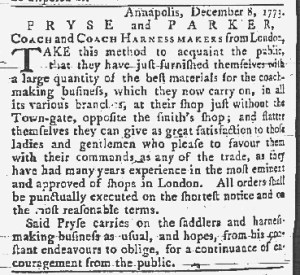
“They have had many years experience in the most eminent and approved of shops in London.”

The partnership of Pryse and Parker constructed coaches and other sorts of carriages as well as harnesses at their shop in Annapolis.  In December 1773, they placed an advertisement in the Maryland Gazette to inform prospective customers that they “just furnished themselves with a large quantity of the best materials for the coach-making business.”  They introduced themselves as “from London,” though that did not necessarily mean that they were recent arrivals in Annapolis.  After all, some artisans continued to burnish their London credentials for years after they set up shop in colonies.  Pryse and Parker’s advertisement did not indicate how long they had pursued their trade in town, though a brief note at the end advised that Pryse “carries on the saddlers and harness-making business as usual, and hopes … for a continuance of encouragement from the public.”  That suggested that Pryse had been in Annapolis long enough to gain some familiarity, even if the partnership with Parker was relatively new.  Just over a year earlier, Pryse did indeed advertise on his own.

No matter how long they had been making carriages in Annapolis, Pryse and Parker considered it helpful to their marketing efforts to tout their connections to the most cosmopolitan city in the empire.  In addition to identifying themselves as “from London,” they trumpeted that “they have had many years experience in the most eminent and approved of shops in London.”  Although they stated that they “flatter themselves they can give as great satisfaction to those ladies and gentlemen who please to favour them with their commands, as any of the trade,” Pryse and Parker thought that the time they labored in those “most eminent and approved of shops in London” should distinguish them from their competitors.  They expected that the local gentry who could afford to purchase and maintain coaches and carriages would place a premium on acquiring those items from artisans with the kind of background they boasted.  Even as colonizers protested against the Tea Act and other measures enacted by Parliament, many of them continued to consider links to London a selling point when engaging the services of artisans.

January 8

What was advertised in a colonial American newspaper 250 years ago today?

Maryland Journal (January 8, 1774).

“My Entreaty to a great Majority of the Subscribers … to pay the Entrance Money, (a small Sum!)”

Less than five months after William Goddard commenced publication of the Maryland Journal on August 20, 1773, he found the enterprise in a dire financial position, at least according to the notice that he placed in the January 8, 1774, edition.  It appeared under a heading for “New Advertisements,” the first item following news, letters, and editorials.  With a manicule to help draw attention to his message, the printer lamented, “IT gives me real Pain to find myself under the Necessity of repeating my Entreaty to a great Majority of the Subscribers for the Encouragement of this paper, to pay the Entrance Money, (a small Sum!) agreeable to Contract.”  Indeed, Goddard had specified in his subscription proposals that Baltimore’s first newspaper would cost “the moderate Price of TEN SHILLINGS, … per Annum, one Half to be paid at the Time of subscribing, and the Remainder at the Expiration of the Year.”  He also pledged to begin publication “as soon … as I shall obtain a sufficient Number of Subscribers barely to defray the Expence of this Work.”

Enough subscribers may have submitted payment “barely to defray” the cost of printing those first issues, but Goddard apparently did not insist that more subscribers actually pay the entrance fee before he launched the venture.  Publishing a newspaper was a complex endeavor.  With a large enough subscription base, printers could convince others to subscribe.  The size of that subscription base also testified to the circulation of the newspaper, important for bringing in advertisements.  Many printers considered advertising more lucrative than subscriptions, allowing credit for subscriptions but not advertisements.  Still, that was not the deal that Goddard outlined in the subscription proposals for the Maryland Journal.  He may have figured that subscribers would pay once he distributed the first issue, so he gambled on taking the newspaper to press before most subscribers paid.  Goddard may have also been concerned about the prospects of competition.  The growing port had reached the point that it might support its own newspaper instead of relying on newspapers published in Annapolis and Philadelphia … but could it support two newspapers?  At the same time that Goddard circulated proposals for the Maryland Journal, Robert Hodge and Frederick Shober announced that they “intend shortly to exhibit Proposals for publishing a NEWS-PAPER, which shall be justly entitled to the Attention and Encouragement of this FLOURISHING TOWN.”  In the end, Goddard printed a newspaper in Baltimore, while Hodge and Shober did not.  Perhaps Goddard overextended himself when he faced competition.

If the Maryland Journal failed and Goddard shuttered his printing shop in Baltimore, it would not be his fault.  At least that was what he claimed in his notice, asserting that “[t]hose who neglect complying with this reasonable Request” to pay the entrance fee “may consider themselves individually accessary to the Fall of the Maryland Journal.”   Goddard did not acknowledge that he may have been overzealous in publishing the newspaper before he secured sufficient funding, nor did he acknowledge reasons that some subscribers may have been dissatisfied.  For instance, publication had been sporadic at times in those first months.  From Goddard’s perspective, however, that did not absolve subscribers of their obligation to pay.  After all, publishing a newspaper was an “arduous and very expensive Undertaking” that would not endure without “that Assistance which was expected, according to the Terms of the Proposals.”  Even if Goddard got a little ahead of himself by publishing the newspaper before collecting the entrance fees, subscribers now had a duty to catch up with their payments.  Otherwise, the public would lose a newspaper that disseminated all sorts of advertisements and news, including coverage of the crisis over tea that resulted in colonizers in Boston dumping tea shipped by the East India Company into the harbor.

Slavery Advertisements Published January 8, 1774

The Slavery Adverts 250 Project chronicles the role of newspaper advertising in perpetuating slavery in the era of the American Revolution. The project seeks to reveal the ubiquity of slavery in eighteenth-century life from New England to Georgia by republishing advertisements about enslaved people – for sale as individuals or in groups, wanted to purchase or for hire for short periods, runaways who liberated themselves, and those who were subsequently captured and confined in jails and workhouses – in daily digests on this site as well as in real time via the @SlaveAdverts250 Twitter feed, utilizing twenty-first-century media to stand in for the print media of the eighteenth century.

The project aims to provide modern audiences with a sense of just how often colonizers encountered these advertisements in their daily lives. Enslaved men, women, and children appeared in print somewhere in the colonies almost every single day. Those advertisements served as a constant backdrop for social, cultural, economic, and political life in colonial and revolutionary America. Colonizers who did not purport to own enslaved people were still confronted with slavery as well as invited to maintain the system by purchasing enslaved men, women, and children or assisting in the capture of so-called “runaways” who sought to free themselves from bondage. The frequency of these newspaper advertisements suggests just how embedded slavery was in colonial and revolutionary American culture in everyday interactions beyond the printed page.

These advertisements also testify to the experiences of enslaved men, women, and children, though readers must consider that those experiences have been remediated through descriptions offered by enslavers rather than enslaved people themselves. Often unnamed in the advertisements, enslaved men, women, and children were not invisible or unimportant in early America.

These advertisements appeared in colonial American newspapers 250 years ago today.

Maryland Journal (January 8, 1774).

**********

Providence Gazette (January 8, 1774).

January 7

What was advertised in a colonial American newspaper 250 years ago today?

New-Hampshire Gazette (January 7, 1774).

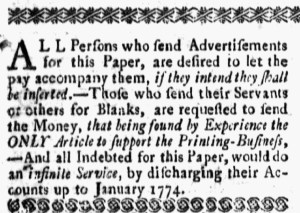
“ALL Persons who send Advertisements for this Paper, are desired to let the pay accompany them, if they intend they shall be inserted.”

Daniel Fowle, the printer of the New-Hampshire Gazette, frequently inserted notices that tended to the business of operating a newspaper.  He had also done so when in partnership with his nephew, Robert Fowle, with most such notices most often calling on subscribers to settle accounts.  Fowle commenced 1774 with an advertisement that addressed several services available at his printing office in Portsmouth.  He exercised his prerogative as proprietor to give that notice a privileged place on the page; it appeared as the first item in the first column on the first page of the first issue of the New-Hampshire Gazette published in the new year.

Fowle presented a variety of instructions to current and prospective customers.  “ALL Persons who send Advertisements for this Paper,” he advised, “are desired to let the pay accompany them, if they intend they shall be inserted.”  In other words, Fowle did not extend credit for advertising.  Most colonial printers likely required advertisers to pay in advance, securing revenues from advertising to balance the credit they allowed for subscriptions, though occasionally some placed notices that called on advertisers to pay overdue bills.  Whatever the policies at the New-Hampshire Gazette had been in the past, Fowle made clear that no advertisements would make it into the pages of his newspaper before receiving payment.  He concluded his notice with a familiar appeal to subscribers to pay what they owed: “all Indebted for this Paper, would do an infinite Service, by discharging their Accounts up to January 1774.”

In addition, Fowle addressed another aspect of his business between his directions about advertisements and subscriptions.  “Those who send their Servants or others for Blanks,” he declared, “are requested to send the Money, that being found by Experience the ONLY  Article to support the Printing-Business.”  Fowle and other printers frequently advertised blanks or printed forms for common commercial and legal transactions.  In the January 7 issue, Fowle ran a short advertisement, “Blanks of most sorts, sold cheap At the Printing Office in Portsmouth,” on the final page.  He suggested that printing and selling blanks represented the only lucrative element of his business, provided that customers paid for them at the time of purchase.  He implied that he only broke even, at best, on advertisements, while the chronic tardiness of subscribers meant that he lost money on subscriptions.  In that case, printing the New-Hampshire Gazetteamounted to a public service rather than a profitable venture for Fowle.  He may have exaggerated whether he made money on anything other than blanks, but Fowle’s exasperation with advertisers and subscribers who did not pay their bills was unmistakable.

Slavery Advertisements Published January 7, 1774

The Slavery Adverts 250 Project chronicles the role of newspaper advertising in perpetuating slavery in the era of the American Revolution. The project seeks to reveal the ubiquity of slavery in eighteenth-century life from New England to Georgia by republishing advertisements about enslaved people – for sale as individuals or in groups, wanted to purchase or for hire for short periods, runaways who liberated themselves, and those who were subsequently captured and confined in jails and workhouses – in daily digests on this site as well as in real time via the @SlaveAdverts250 Twitter feed, utilizing twenty-first-century media to stand in for the print media of the eighteenth century.

The project aims to provide modern audiences with a sense of just how often colonizers encountered these advertisements in their daily lives. Enslaved men, women, and children appeared in print somewhere in the colonies almost every single day. Those advertisements served as a constant backdrop for social, cultural, economic, and political life in colonial and revolutionary America. Colonizers who did not purport to own enslaved people were still confronted with slavery as well as invited to maintain the system by purchasing enslaved men, women, and children or assisting in the capture of so-called “runaways” who sought to free themselves from bondage. The frequency of these newspaper advertisements suggests just how embedded slavery was in colonial and revolutionary American culture in everyday interactions beyond the printed page.

These advertisements also testify to the experiences of enslaved men, women, and children, though readers must consider that those experiences have been remediated through descriptions offered by enslavers rather than enslaved people themselves. Often unnamed in the advertisements, enslaved men, women, and children were not invisible or unimportant in early America.

These advertisements appeared in colonial American newspapers 250 years ago today.

Connecticut Gazette (January 7, 1774).