August 25

What was advertised in a colonial American newspaper 250 years ago today?
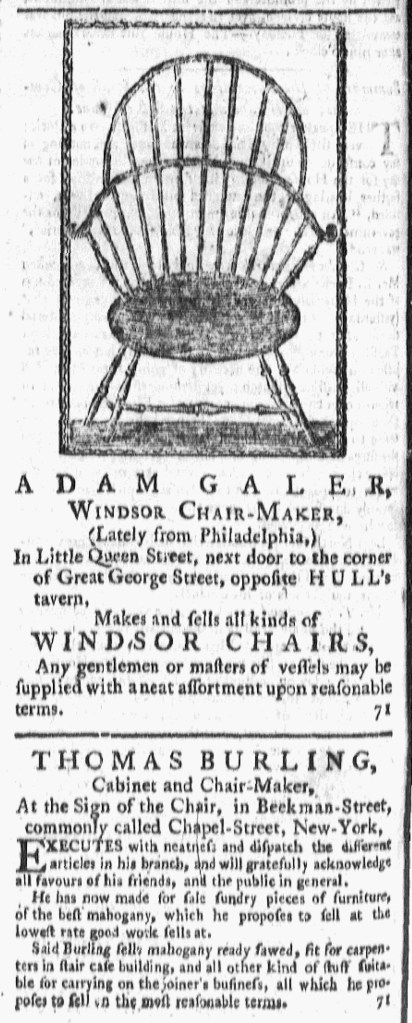
Rivington’s New-York Gazetteer (August 25, 1774).

“Sundry pieces of furniture, of the best mahogany.”

Both Adam Galer and Thomas Burling made and sold furniture in New York in the mid 1770s, yet they took different approaches when they advertised in Rivington’s New-York Gazetteer.  Their advertisements appeared one after the other in the August 25, 1774, edition, not by design but rather by coincidence since printers and compositors did not classify or organize paid notices by genre or purpose.  The proximity of the advertisements made the differences in their marketing efforts even more stark.

For his part, Galer, a “WINDSOR CHAIR-MAKER,” made an image of a Windsor chair within a decorative border the focal point of his advertisement.  That device filled about two-thirds of the space, immediately drawing attention.  Having recently arrived in New York from Philadelphia, Galer may have considered it worth the extra expense of commissioning the woodcut to enhance his visibility in the public prints.  In the copy, he gave his location and advised “gentlemen” and “masters of vessels” that they could acquire Windsor chairs “upon reasonable terms.”

Thomas Burling, on the other hand, relied exclusively on advertising copy without any images.  In that regard, his notice resembled the vast majority of newspapers advertisements.  He informed readers that they could find him “At the Sign of the Chair, in Beekman-Street, commonly called Chapel-Street,” indicating that he deployed visual images in other formats to promote his nosiness.  Burling, a “Cabinet and Chair-Maker,” produced a wider array of furniture than Galer, declaring that he “EXECUTES with neatness and dispatch the different articles in his branch.”  He reinforced his appeal to quality when he described the material, “the best mahogany,” and his own skill as an artisan.  He linked the latter to the price: “he proposes to sell at the lowest rate good work sells at.”

Burling may have benefited from the proximity of the two advertisements if readers took note of the image in Galer’s notice and then happened to continue reading the notice that followed.  Still, both artisans likely felt that they were in a better position than if they had not advertised at all.  Their direct competition in the public prints gave them an advantage over other competitors who did not advertise at all.
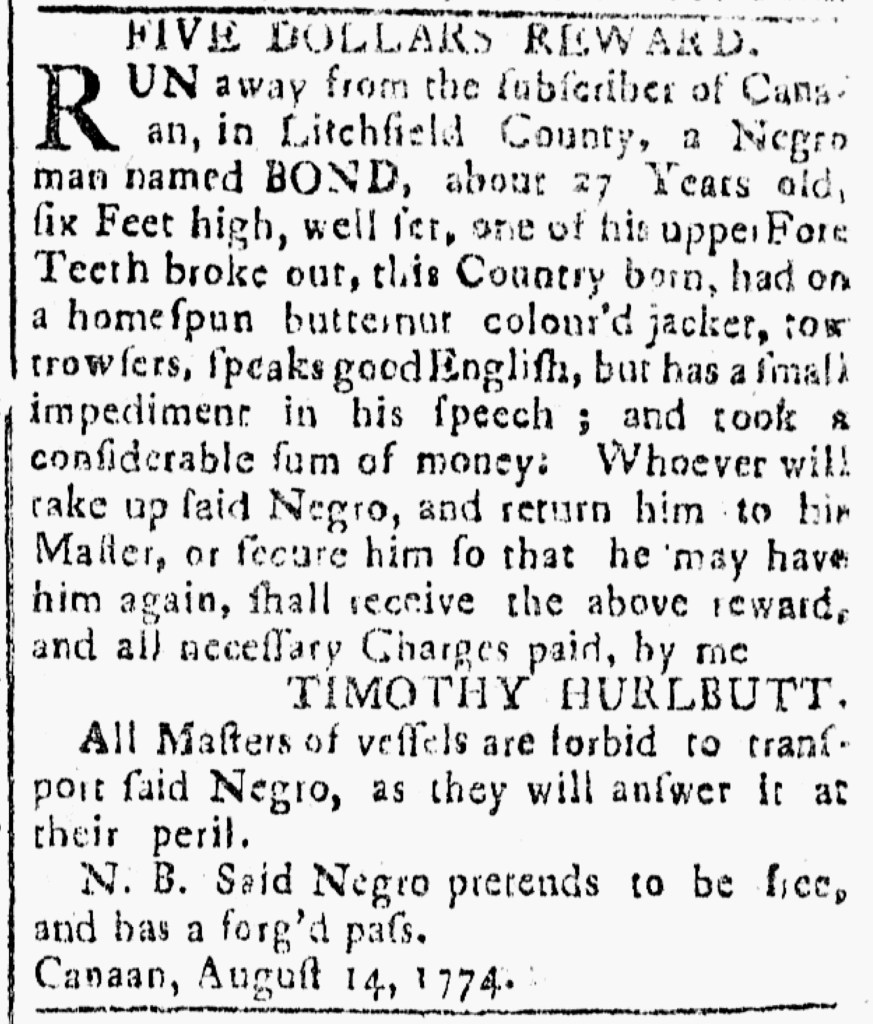
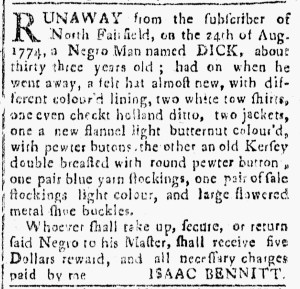
Slavery Advertisements Published August 25, 1774

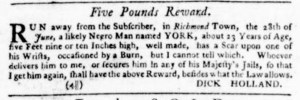
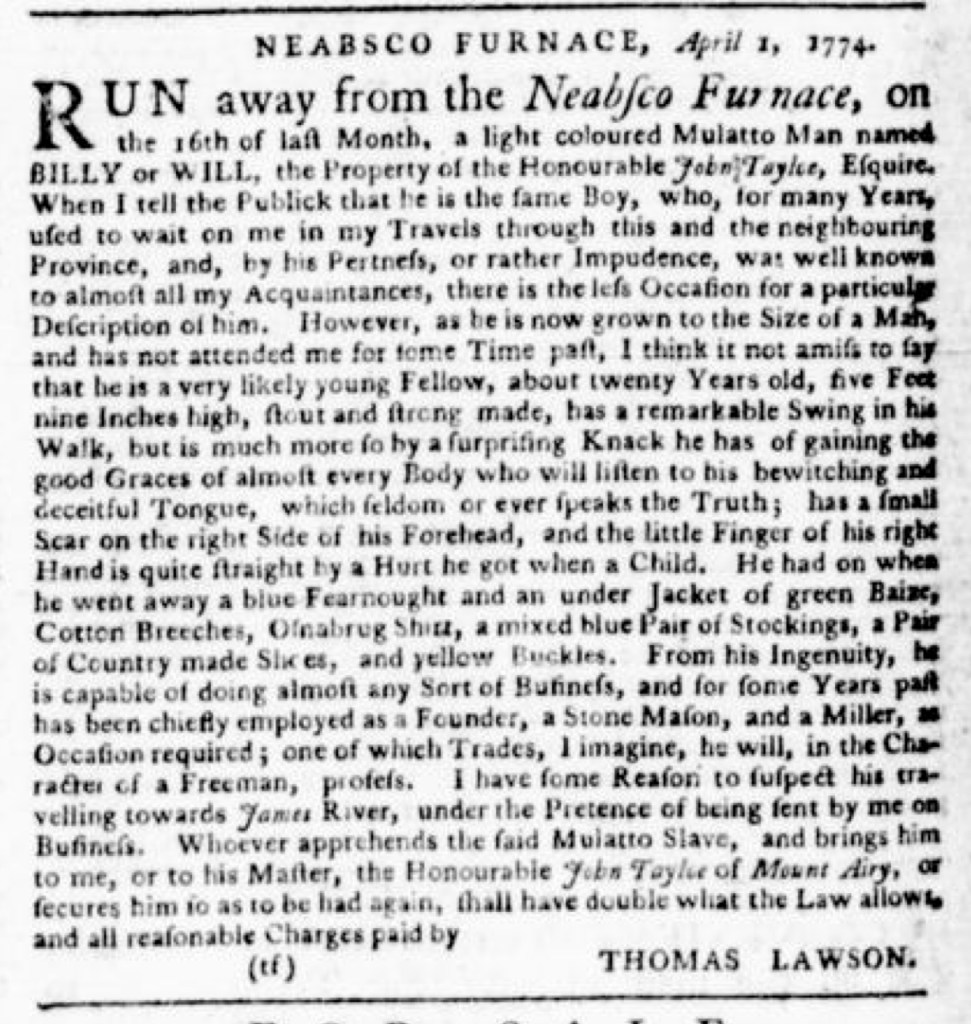
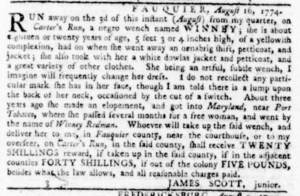
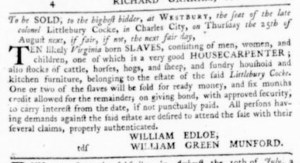
The Slavery Adverts 250 Project chronicles the role of newspaper advertising in perpetuating slavery in the era of the American Revolution. The project seeks to reveal the ubiquity of slavery in eighteenth-century life from New England to Georgia by republishing advertisements about enslaved people – for sale as individuals or in groups, wanted to purchase or for hire for short periods, runaways who liberated themselves, and those who were subsequently captured and confined in jails and workhouses – in daily digests on this site as well as in real time via the @SlaveAdverts250 Twitter feed, utilizing twenty-first-century media to stand in for the print media of the eighteenth century.

The project aims to provide modern audiences with a sense of just how often colonizers encountered these advertisements in their daily lives. Enslaved men, women, and children appeared in print somewhere in the colonies almost every single day. Those advertisements served as a constant backdrop for social, cultural, economic, and political life in colonial and revolutionary America. Colonizers who did not purport to own enslaved people were still confronted with slavery as well as invited to maintain the system by purchasing enslaved men, women, and children or assisting in the capture of so-called “runaways” who sought to free themselves from bondage. The frequency of these newspaper advertisements suggests just how embedded slavery was in colonial and revolutionary American culture in everyday interactions beyond the printed page.

These advertisements also testify to the experiences of enslaved men, women, and children, though readers must consider that those experiences have been remediated through descriptions offered by enslavers rather than enslaved people themselves. Often unnamed in the advertisements, enslaved men, women, and children were not invisible or unimportant in early America.

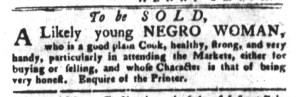
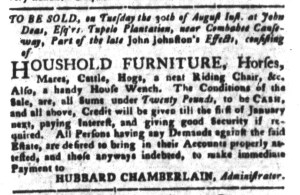
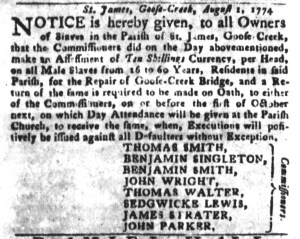
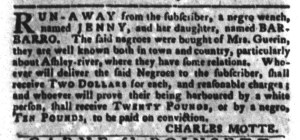
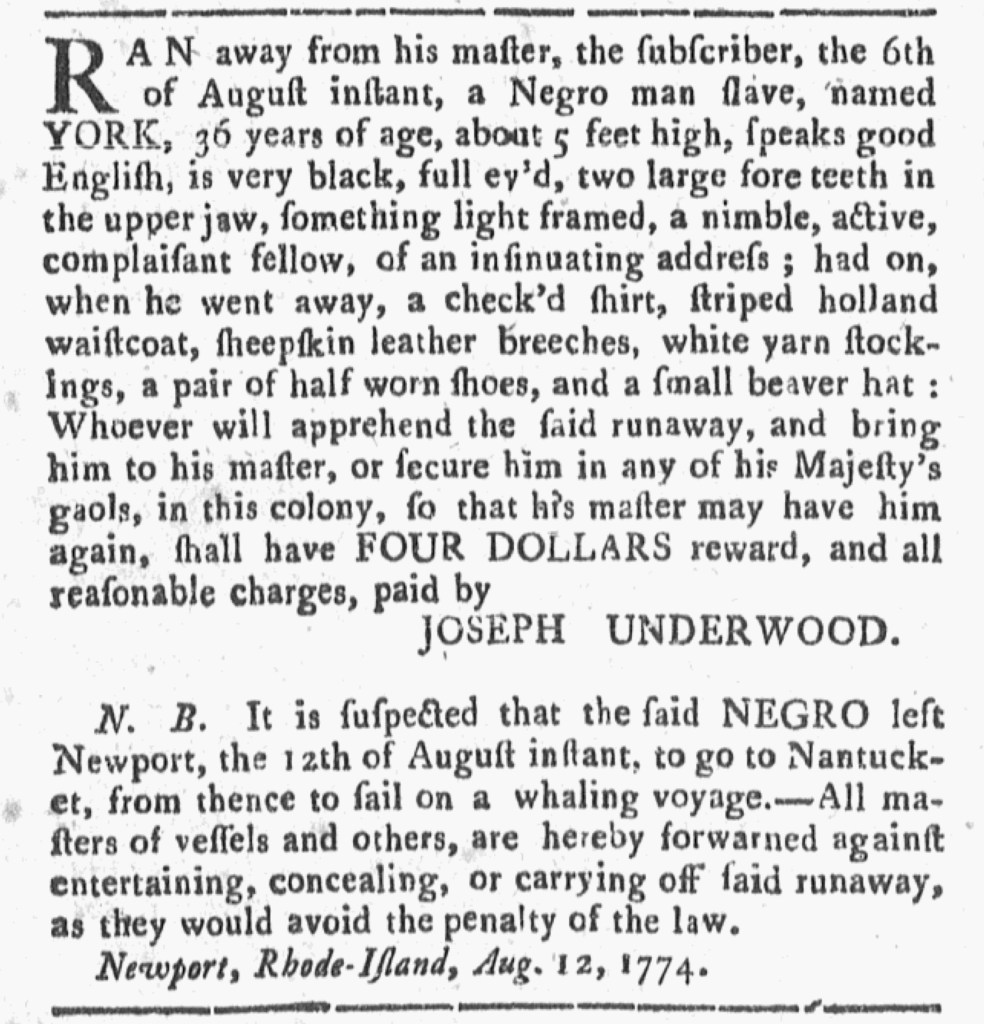
These advertisements appeared in colonial American newspapers 250 years ago today.

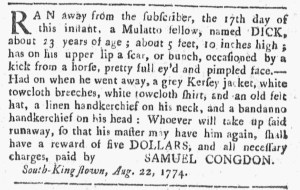
Connecticut Journal (August 25, 1774).

**********

Connecticut Journal (August 25, 1774).

**********

Connecticut Journal (August 25, 1774).

**********

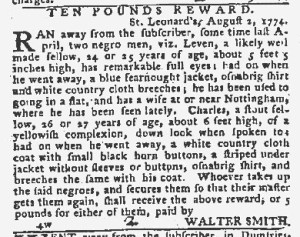
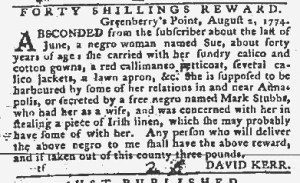
Maryland Gazette (August 25, 1774).

**********

Maryland Gazette (August 25, 1774).

**********

Maryland Gazette (August 25, 1774).

**********

Maryland Gazette (August 25, 1774).

**********

Maryland Gazette (August 25, 1774).

**********

Maryland Gazette (August 25, 1774).

**********

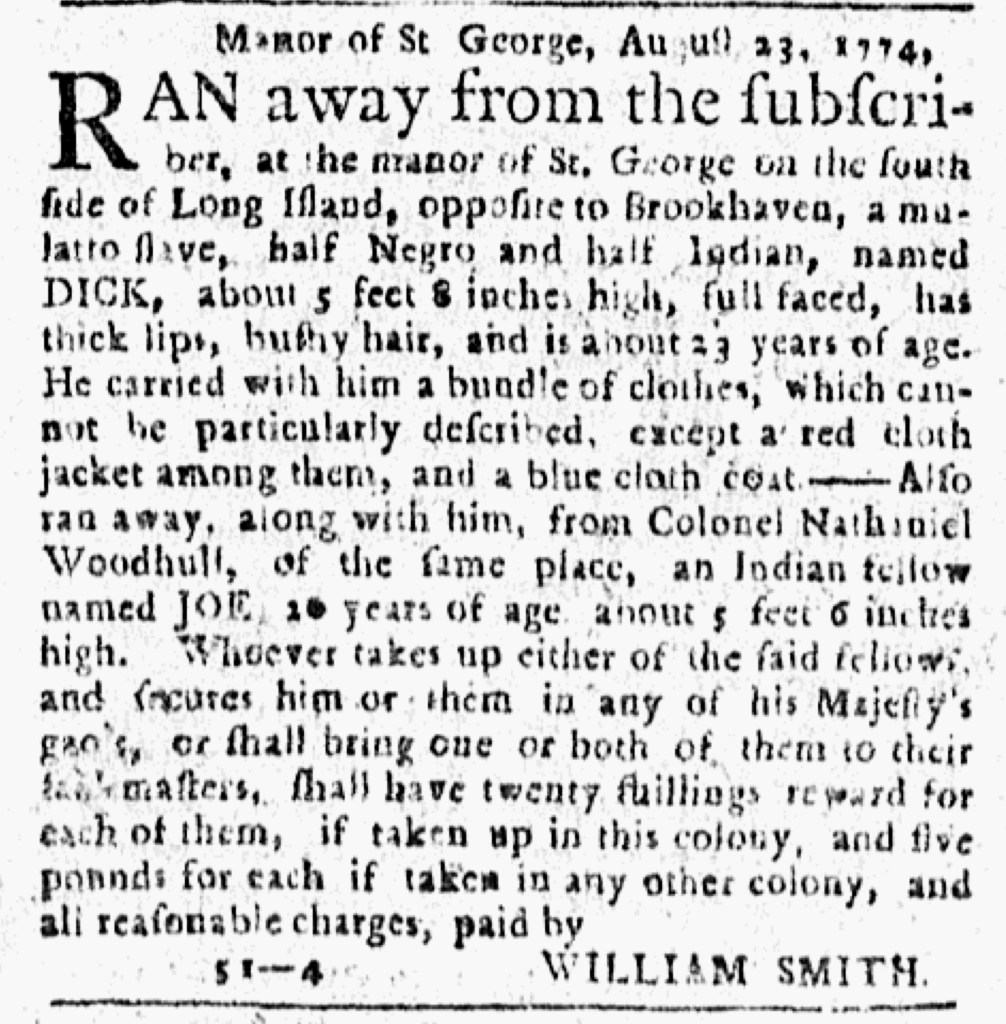
New-York Journal (August 25, 1774).

**********

Norwich Packet (August 25, 1774).

**********

Rivington’s New-York Gazetteer (August 25, 1774).

**********

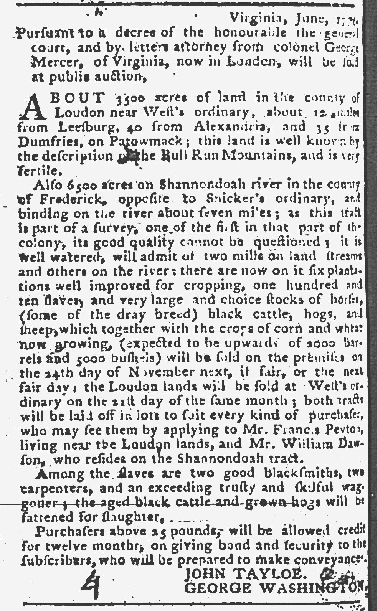
Virginia Gazette [Purdie and Dixon] (August 25, 1774).

**********

Virginia Gazette [Purdie and Dixon] (August 25, 1774).

**********

Virginia Gazette [Purdie and Dixon] (August 25, 1774).

**********

Virginia Gazette [Purdie and Dixon] (August 25, 1774).

**********

Virginia Gazette [Purdie and Dixon] (August 25, 1774).

**********

Virginia Gazette [Purdie and Dixon] (August 25, 1774).

**********

Virginia Gazette [Purdie and Dixon] (August 25, 1774).

**********

Virginia Gazette [Purdie and Dixon] (August 25, 1774).

**********

Virginia Gazette [Purdie and Dixon] (August 25, 1774).

**********

Virginia Gazette [Purdie and Dixon] (August 25, 1774).

**********

Virginia Gazette [Purdie and Dixon] (August 25, 1774).

**********

Virginia Gazette [Purdie and Dixon] (August 25, 1774).

**********

Virginia Gazette [Rind] (August 25, 1774).

**********

Virginia Gazette [Rind] (August 25, 1774).

**********

Virginia Gazette [Rind] (August 25, 1774).

**********

Virginia Gazette [Rind] (August 25, 1774).

**********

Virginia Gazette [Rind] (August 25, 1774).

August 24

What was advertised in a colonial American newspaper 250 years ago today?

Pennsylvania Journal (August 24, 1774).

“They neatly engrave: Shop Bills; Bills of Exchange; Bills of Lading.”

When John Norman, “ARCHITECT and LANDSCAPE-ENGRAVER, from London,” arrived in Philadelphia in May 1774, he introduced himself to prospective clients via an advertisement in the Pennsylvania Journal.  A few months later, he once again took to the pages of that publication, this time to announce that the partnership of Norman and Ward, “ENGRAVERS and DRAWING-MASTERS,” had opened a shop where they engraved a variety of items and sold “an assortment of Pictures and Frames … much cheaper than imported.”  In addition, they established “an Evening Drawing School” for teaching “that most noble and polite Art in all its various and useful Branches.”  Still a newcomer in the city, Norman devised multiple ways to earn his livelihood.
The various kinds of engraving that Norman and Ward proposed testified to the prevalence of advertising in early America, especially in urban ports.  They indicated that they could produce all sorts of items but could not list them all because they were “too tedious to mention in an Advertisement.”  Yet they named more than a dozen kinds of engraved items, leading their list with “Shop Bills.”  They likely meant both trade cards with an engraved image that filled the entire sheet and billheads that featured an engraved image at the top and blank space for recording purchases.  On occasion, merchants, shopkeepers, and artisans wrote receipts on the reverse side of trade cards.  Norman and Ward next named “Bills of Exchange; Bills of Lading; [and] Bills of Parcels.”  Those could have been simple printed blanks, but that would have defeated the purpose of ordering them from an engraver rather than acquiring those common business forms from printers who produced them in volume.  In this instance, the bills of exchange, bills of lading, and bills of parcels likely included engraved images, not solely text, that served as advertisements for the merchants who ordered them.  Later in the list, Norman and Ward considered “Devices for News-Papers” important enough to include rather than “too tedious to mention.”  Presumably they produced woodcuts in additional to copperplate engravings.  In addition to newspaper printers seeking images to adorn their mastheads and stock images for use elsewhere, the engravers offered their services to advertisers who desired unique images that represented their businesses exclusively.  Trade cards, billheads, and other advertising ephemera have not survived in the numbers that they were likely produced and circulated in early America, yet Norman and Ward’s advertisement suggests that they were part of everyday life as colonizers engaged in commerce and participated in consumer culture.

Slavery Advertisements Published August 24, 1774

The Slavery Adverts 250 Project chronicles the role of newspaper advertising in perpetuating slavery in the era of the American Revolution. The project seeks to reveal the ubiquity of slavery in eighteenth-century life from New England to Georgia by republishing advertisements about enslaved people – for sale as individuals or in groups, wanted to purchase or for hire for short periods, runaways who liberated themselves, and those who were subsequently captured and confined in jails and workhouses – in daily digests on this site as well as in real time via the @SlaveAdverts250 Twitter feed, utilizing twenty-first-century media to stand in for the print media of the eighteenth century.

The project aims to provide modern audiences with a sense of just how often colonizers encountered these advertisements in their daily lives. Enslaved men, women, and children appeared in print somewhere in the colonies almost every single day. Those advertisements served as a constant backdrop for social, cultural, economic, and political life in colonial and revolutionary America. Colonizers who did not purport to own enslaved people were still confronted with slavery as well as invited to maintain the system by purchasing enslaved men, women, and children or assisting in the capture of so-called “runaways” who sought to free themselves from bondage. The frequency of these newspaper advertisements suggests just how embedded slavery was in colonial and revolutionary American culture in everyday interactions beyond the printed page.

These advertisements also testify to the experiences of enslaved men, women, and children, though readers must consider that those experiences have been remediated through descriptions offered by enslavers rather than enslaved people themselves. Often unnamed in the advertisements, enslaved men, women, and children were not invisible or unimportant in early America.

These advertisements appeared in colonial American newspapers 250 years ago today.

Maryland Journal (August 24, 1774).

**********

Pennsylvania Gazette (August 24, 1774).

**********

Pennsylvania Journal (August 24, 1774).

Slavery Advertisements Published August 23, 1774

The Slavery Adverts 250 Project chronicles the role of newspaper advertising in perpetuating slavery in the era of the American Revolution. The project seeks to reveal the ubiquity of slavery in eighteenth-century life from New England to Georgia by republishing advertisements about enslaved people – for sale as individuals or in groups, wanted to purchase or for hire for short periods, runaways who liberated themselves, and those who were subsequently captured and confined in jails and workhouses – in daily digests on this site as well as in real time via the @SlaveAdverts250 Twitter feed, utilizing twenty-first-century media to stand in for the print media of the eighteenth century.

The project aims to provide modern audiences with a sense of just how often colonizers encountered these advertisements in their daily lives. Enslaved men, women, and children appeared in print somewhere in the colonies almost every single day. Those advertisements served as a constant backdrop for social, cultural, economic, and political life in colonial and revolutionary America. Colonizers who did not purport to own enslaved people were still confronted with slavery as well as invited to maintain the system by purchasing enslaved men, women, and children or assisting in the capture of so-called “runaways” who sought to free themselves from bondage. The frequency of these newspaper advertisements suggests just how embedded slavery was in colonial and revolutionary American culture in everyday interactions beyond the printed page.

These advertisements also testify to the experiences of enslaved men, women, and children, though readers must consider that those experiences have been remediated through descriptions offered by enslavers rather than enslaved people themselves. Often unnamed in the advertisements, enslaved men, women, and children were not invisible or unimportant in early America.

These advertisements appeared in colonial American newspapers 250 years ago today.

Connecticut Courant (August 23, 1774).

**********

Connecticut Courant (August 23, 1774).

**********

South-Carolina Gazette and Country Journal (August 23, 1774).

**********

South-Carolina Gazette and Country Journal (August 23, 1774).

**********

South-Carolina Gazette and Country Journal (August 23, 1774).

**********

South-Carolina Gazette and Country Journal (August 23, 1774).

**********

South-Carolina Gazette and Country Journal (August 23, 1774).

**********

South-Carolina Gazette and Country Journal (August 23, 1774).

**********

South-Carolina Gazette and Country Journal (August 23, 1774).

**********

South-Carolina Gazette and Country Journal (August 23, 1774).

**********

South-Carolina Gazette and Country Journal (August 23, 1774).

**********

South-Carolina Gazette and Country Journal (August 23, 1774).

**********

South-Carolina Gazette and Country Journal (August 23, 1774).

**********

South-Carolina Gazette and Country Journal (August 23, 1774).

**********

South-Carolina Gazette and Country Journal (August 23, 1774).

**********

South-Carolina Gazette and Country Journal (August 23, 1774).

**********

South-Carolina Gazette and Country Journal (August 23, 1774).

**********

South-Carolina Gazette and Country Journal (August 23, 1774).

**********

South-Carolina Gazette and Country Journal (August 23, 1774).

August 22

What was advertised in a colonial American newspaper 250 years ago today?

Boston-Gazette (August 22, 1774).

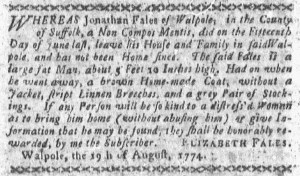
Bring him home (without abusing him) or give Information that he may be found.”

Newspaper advertisements carried all sorts of local news that printers did not otherwise select for inclusion in their publications, keeping readers apprised of both ordinary and extraordinary occurrences.  A variety of legal notices, for instance, provided news about the finances and deaths of colonizers, while other advertisements revealed marital discord when husbands decreed that they would not pay the debts of their wives.  Some advertisements provided coverage of thefts and burglaries.  Many described runaway apprentices and indentured servants or enslaved men and women who liberated themselves by running away from their enslavers.  In most colonial newspapers, the local news section was quite short, especially compared to the amount of space devoted to news from England, Europe, and other colonies.  Many historians have explained that news of local events of consequence spread via word of mouth before printers had the chance to take their weekly newspapers to press.  Yet that perspective overlooks the extensive local news that appeared among advertisements.

Among their other purposes, advertisements sometimes served as missing persons notifications.  Such was the case in June 1774 when Jonathan Fales of Walpole, a “Non Compos Mentis” or a man with cognitive disabilities, disappeared from “his House and Family … and has not been Home since.”  Elizabeth Fales, perhaps his mother, sister, or wife, placed an advertisement in the August 22 edition of the Boston-Gazette, stating that Jonathan had not been seen for more than two months and requesting aid in finding and returning him to his family.  She gave a short physical description and described the clothes he wore “when he went away.”  Her concern was apparent, both in calling herself a “distress’d Woman” and pleading that anyone who found Jonathan “bring him home (without abusing him).”  Elizabeth and her family cared for and protected the “large fat Man” at home, but he risked others taking advantage of him or treating him cruelly on his own.  Elizabeth promised a reward to anyone who brought Jonathan home or provided “Information that he may be found.”  Placing an advertisement allowed her to disseminate local news that was most important to her and her family.

Slavery Advertisements Published August 22, 1774

The Slavery Adverts 250 Project chronicles the role of newspaper advertising in perpetuating slavery in the era of the American Revolution. The project seeks to reveal the ubiquity of slavery in eighteenth-century life from New England to Georgia by republishing advertisements about enslaved people – for sale as individuals or in groups, wanted to purchase or for hire for short periods, runaways who liberated themselves, and those who were subsequently captured and confined in jails and workhouses – in daily digests on this site as well as in real time via the @SlaveAdverts250 Twitter feed, utilizing twenty-first-century media to stand in for the print media of the eighteenth century.

The project aims to provide modern audiences with a sense of just how often colonizers encountered these advertisements in their daily lives. Enslaved men, women, and children appeared in print somewhere in the colonies almost every single day. Those advertisements served as a constant backdrop for social, cultural, economic, and political life in colonial and revolutionary America. Colonizers who did not purport to own enslaved people were still confronted with slavery as well as invited to maintain the system by purchasing enslaved men, women, and children or assisting in the capture of so-called “runaways” who sought to free themselves from bondage. The frequency of these newspaper advertisements suggests just how embedded slavery was in colonial and revolutionary American culture in everyday interactions beyond the printed page.

These advertisements also testify to the experiences of enslaved men, women, and children, though readers must consider that those experiences have been remediated through descriptions offered by enslavers rather than enslaved people themselves. Often unnamed in the advertisements, enslaved men, women, and children were not invisible or unimportant in early America.

These advertisements appeared in colonial American newspapers 250 years ago today.

Boston-Gazette (August 22, 1774).

**********

Dunlap’s Pennsylvania Packet (August 22, 1774).

**********

Dunlap’s Pennsylvania Packet (August 22, 1774).

**********

Massachusetts Gazette and Boston Post-Boy (August 22, 1774).

**********

Newport Mercury (August 22, 1774).

**********

New-York Gazette and Weekly Mercury (August 22, 1774).

**********

Newport Mercury (August 22, 1774).

August 21

What was advertised in a colonial American newspaper 250 years ago this week?

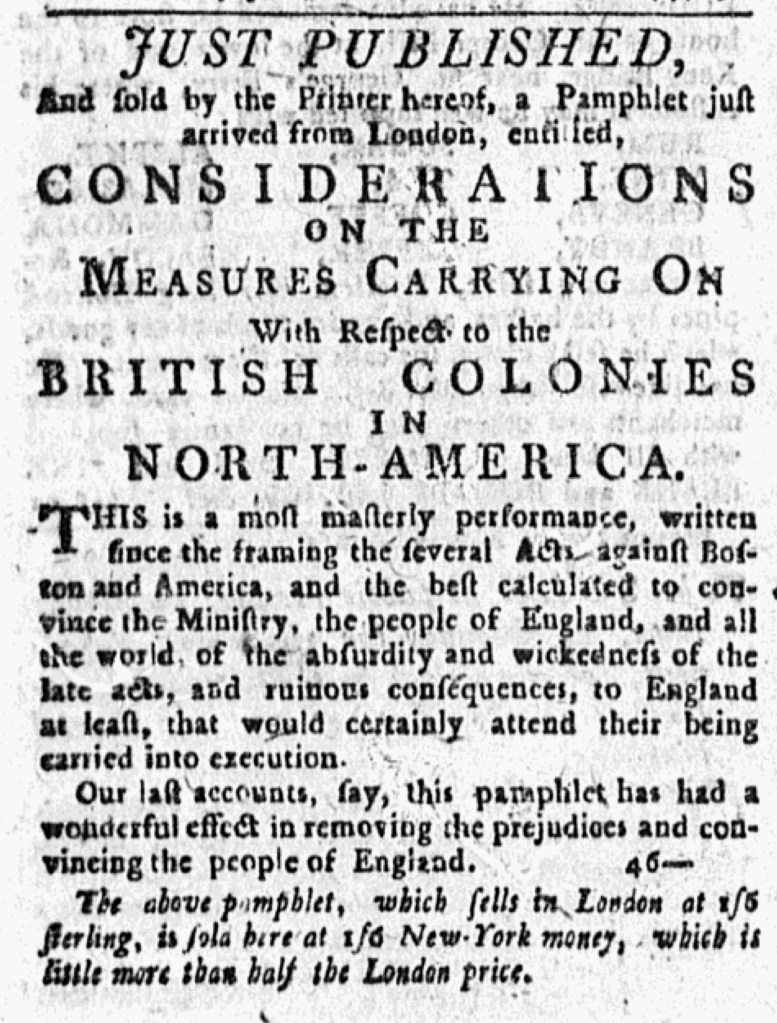
Supplement to the New-York Journal (August 18, 1774).

Sold here at 1s6 New-York money, which is little more than half the London price.”

The Adverts 250 Project previously examined an advertisement for a political tract, Considerations on the Measures Carrying On with Respect to the British Colonies in North-America, that appeared in a prominent place in the August 1, 1774, edition of the Boston-Gazette, attributing the copy to Benjamin Edes and John Gill, the printers of that newspaper and the Boston edition of the pamphlet.  Yet Edes and Gill were not the only printers to produce an American edition of Considerations, nor were they the first to advertise it.  When they did, they borrowed advertising copy that previously appeared when John Holt marketed his edition in the New-York Journal.

Holt first announced publication of a New York edition of this “Pamphlet just arrived from London” on July 21.  When Edes and Gill advertised the same pamphlet eleven days later, they used copy identical to Holt’s advertisement, embellishing it with a quotation from Phillippe de Commines that appeared on the title page of the pamphlet.  As was often the case with advertisements for books and pamphlets, the printers did not devise any of the copy on their own, except for “THIS DAY PUBLISHED, (Price 9d.) And sold by EDES and GILL, in Queen-Street.”  Holt may have written the copy that lauded the pamphlet as a “most masterly performance” against the Coercive Acts and reported on its reception in England when he first advertised the pamphlet, though he could have borrowed that overview from someone else, just as Edes and Gill appropriated it from him.  Either way, Holt did eventually make an addition to his advertisement. After it ran twice, he added a note that the pamphlet “sells in London at 1s5 sterling” yet “is sold here at 1s6 New-York money, which is little more than half the London price.”  That suggests that the initial appeals might not have been enough to convince readers to buy the tract, no matter how much they may have been interested in the arguments it made about current events.  The printer found it necessary to add an appeal to price in hopes of selling the pamphlet.  Holt and other patriot printers sought to spread the rhetoric of the American Revolution (and generate revenues for themselves in the process), but doing so required more than merely announcing political pamphlets for sale.  Their advertisements aimed to convince colonizers, even those already sympathetic to their cause, to purchase the books and pamphlets about politics and political philosophy they printed and sold.

August 20

What was advertised in a colonial American newspaper 250 years ago today?

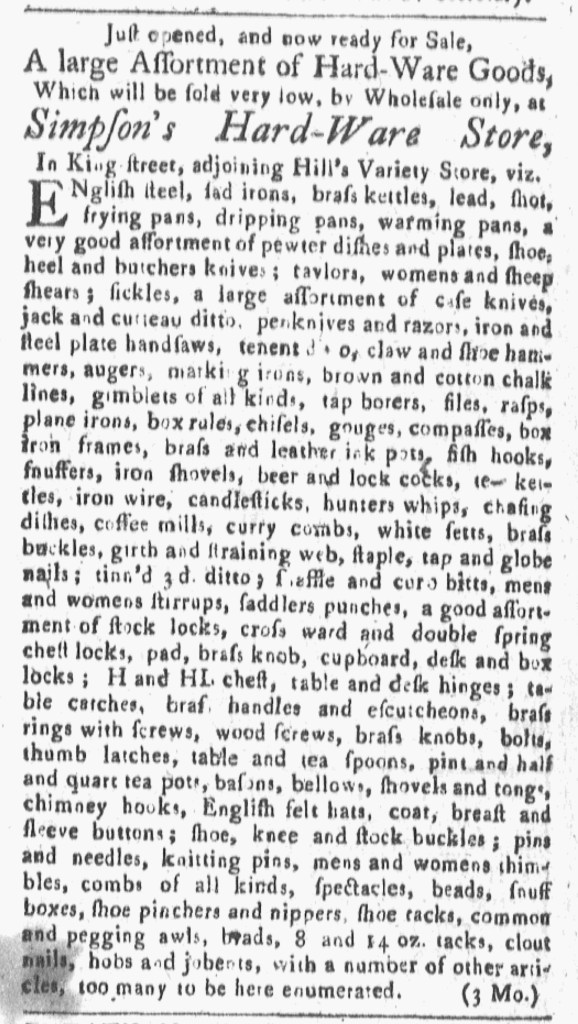
Providence Gazette (August 20, 1774).

Simpson’s Hard-Ware Store.”

As fall approached in 1774, a new advertisement in the Providence Gazette alerted the public that “Simpson’s Hard-Ware Store” had “Just opened” and offered a “large Assortment of Hard-Ware Goods” for “Wholesale only.”  Shopkeepers seeking to replenish their inventories could acquire merchandise there rather than place orders with merchants who would then import those goods.  The speed and convenience may have been especially attractive considering that many colonizers anticipated a general boycott on importing textiles, hardware, and all sorts of other items from England in response to the Coercive Acts passed by Parliament.  Delegates were already enroute to Philadelphia or arrived there to discuss a united response at what would become known as the First Continental Congress.

Simpson did not make explicit mention of politics, but doing so would not have been necessary for readers to understand the context in which he marketed his wares.  Several articles in the August 20 edition of the Providence Gazette provided coverage, in addition to the conversations, debates, and anxious musings taking place in private and public spaces throughout town.  Simpson instead focused on demonstrating the many choices he made available, just as his neighbor, Hill’s Variety Store, had done for many months.  His “Hard-Ware Store” stocked everything from “claw and shoe hammers” to “a good assortment of stock locks, cross ward and double spring locks” to Taylors, womens and sheep shears” to “a very good assortment of pewter dishes and plates,” far more than just hardware.  In addition to the items included in the extensive catalog in his advertisement, Simpson also carried “a number of other articles, too many to be here enumerated.”  If prospective customers could not find what they desired at Hill’s Variety Store they needed to check the shelves right next door at the hardware store.

A notation that read “(3 Mo.)” appeared at the end of Simpson’s advertisement, indicating that he intended for it to run for three months from its first insertion in the August 12 edition of the Providence Gazette.  He hoped to part with as much merchandise as possible by then, yet the anticipated longevity of his advertisement also testified to his confidence in its effectiveness.  After all, he would not have agreed to pay to run the notice so many times if he did not expect a return on his investment.  Perhaps he had been inspired by his neighbor, Hill, or even received advice from him after seeing his advertisement week after week for six months.