November 19

What kinds of principles were expressed in advertisements in colonial American newspaper 250 years ago today?

Providence Gazette (November 19, 1774).

“VOTES and PROCEEDINGS of the AMERICAN CONTINENTAL CONGRESS.”

“RUN away … a Negro Man, named Prince.”

The press was a powerful engine for promoting freedom and rallying colonizers to resist abuses perpetrated by Parliament and, eventually, declare independence from Britain during the era of the American Revolution, yet it simultaneously aided in perpetuating the enslavement of Black and Indigenous people by publishing advertisements offering enslaved people for sale or offering rewards for the capture and return of those who liberated themselves by running away from their enslavers.  The juxtaposition of liberty and slavery in colonial newspapers was common, as Jordan E. Taylor has demonstrated in “Enquire of the Printer: Newspaper Advertising and the Moral Economy of the North American Slave Trade, 1704-1807.”  Among the most stark examples he identifies, Solomon Southwick, the printer of the Newport Mercury, published the Declaration of Independence and an advertisement for a “NEGRO BOY” on July 18, 1776.[1]

Providence Gazette (November 19, 1774).

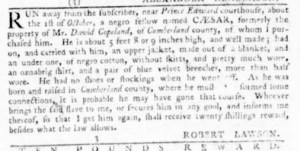
In addition to news and editorials advocating for liberty while advertisements perpetuated slavery, sometimes other advertisements also stood in such contrast.  On November 19, 1774, for instance, John Carter, the printer of the Providence Gazette, inserted advertisements for “EXTRACTS From the VOTES and PROCEEDINGS of the AMERICAN CONTINENTAL CONGRESS” and “ENGLISH LIBERTIES, OR, The free-born Subject’s INHERITANCE” in the same issue that carried an advertisement that described “a Negro Man, named Prince” who had liberated himself by running away from Thomas Wood earlier in the month.  The Adverts 250 Project has noted the publication and dissemination of the Extracts in several towns in the fall of 1774.  The Providence Gazette certainly was not the only newspaper that advertised this important political pamphlet while simultaneously running notices about enslaved people.  On November 2, William Bradford and Thomas Bradford, printers of the Pennsylvania Journal, were the first to announce that they published the Extracts.  In the same issue they ran two advertisements that sought to capture fugitives seeking freedom, one about “a Negro Man named CAESAR” and another an unnamed “NEGRO MAN” who “speaks Low Dutch.”  Almost all the newspapers carrying advertisements for the Extracts that the Adverts 250 Project has featured so far ran them alongside advertisements about enslaved people.  The juxtaposition of liberty and enslavement in revolutionary print culture that Taylor identifies was not merely incidental or occasional.  It occurred consistently, even in newspapers published in New England, New York, and Pennsylvania.

**********

[1] Jordan E. Taylor, “Enquire of the Printer: Newspaper Advertising and the Moral Economy of the North American Slave Trade, 1704-1807,” Early American Studies 18, no. 3 (Summer 2020): 313-4.

Slavery Advertisements Published November 19, 1774

The Slavery Adverts 250 Project chronicles the role of newspaper advertising in perpetuating slavery in the era of the American Revolution. The project seeks to reveal the ubiquity of slavery in eighteenth-century life from New England to Georgia by republishing advertisements about enslaved people – for sale as individuals or in groups, wanted to purchase or for hire for short periods, runaways who liberated themselves, and those who were subsequently captured and confined in jails and workhouses – in daily digests on this site as well as in real time via the @SlaveAdverts250 Twitter feed, utilizing twenty-first-century media to stand in for the print media of the eighteenth century.

The project aims to provide modern audiences with a sense of just how often colonizers encountered these advertisements in their daily lives. Enslaved men, women, and children appeared in print somewhere in the colonies almost every single day. Those advertisements served as a constant backdrop for social, cultural, economic, and political life in colonial and revolutionary America. Colonizers who did not purport to own enslaved people were still confronted with slavery as well as invited to maintain the system by purchasing enslaved men, women, and children or assisting in the capture of so-called “runaways” who sought to free themselves from bondage. The frequency of these newspaper advertisements suggests just how embedded slavery was in colonial and revolutionary American culture in everyday interactions beyond the printed page.

These advertisements also testify to the experiences of enslaved men, women, and children, though readers must consider that those experiences have been remediated through descriptions offered by enslavers rather than enslaved people themselves. Often unnamed in the advertisements, enslaved men, women, and children were not invisible or unimportant in early America.

These advertisements appeared in colonial American newspapers 250 years ago today.

Providence Gazette (November 19, 1774).

November 18

What was advertised in a colonial American newspaper 250 years ago today?

Connecticut Journal (November 18, 1774).

“THE New-Haven Committee for soliciting Subscriptions for Relief of their suffering Brethren at Boston.”

Colonizers in Connecticut and other places rallied to support residents of Boston once the Boston Port Act went into effect on June 1, 1774.  In retaliation for the Boston Tea Party, Parliament passed legislation that closed and blockaded the harbor until the town made restitution for the property that had been destroyed.  As Bob Ruppert explains, “All shipping and commerce came to standstill.  Ships-of-war appeared in the harbor, army regiments arrived from England and only food was allowed to enter the town (by way of the town of Marblehead, sixteen miles to the north).”
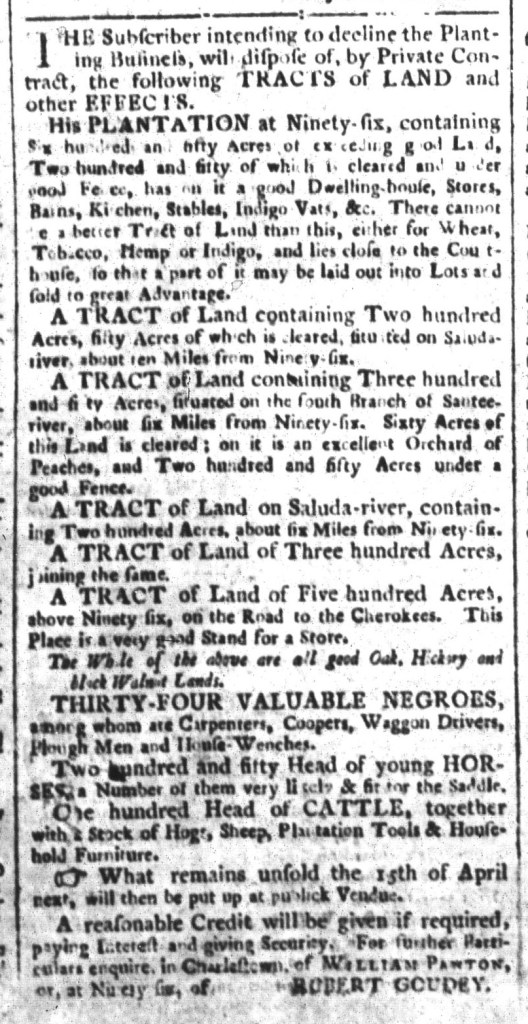
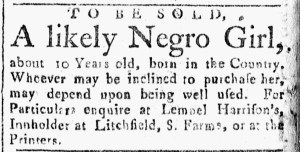
As far away as South Carolina, patriots formed committees to aid Boston.  In Connecticut, the “New-Haven Committee for soliciting Subscriptions for Relief of their suffering Brethren at Boston” provided an update of their activities and invited readers to join their efforts in an advertisement in the November 18 edition of the Connecticut Journal.  It ran in the same column as advertisements for the “Votes & Proceedings Of the American CONTINENTAL CONGRESS” and a “likely Negro Girl, about 10 Years old,” for sale.  The committee advised their “generous Subscribers to being in their Grain, &c. [et cetera] on Thanksgiving Week, as they expect a Vessel will then be lying at the Long-Wharf for the purpose of taking in such Benefactions.”  In other advertisements, Josiah Burr hawked an “Assortment of GOODS suitable for the Season,” Jacob Daggett promoted a “fresh Assortment of Goods,” and Joseph Howell touted a “good Assortment of English and India GOODS,” making overtures to consumers.  In contrast, the Committee for the Relief of Boston put advertising to another purpose, alerting the public to an opportunity to play a part in current events and express their political principles.  Their notice also served as a news update, supplementing the content selected for inclusion by the printers of the Connecticut Journal.

Slavery Advertisements Published November 18, 1774

The Slavery Adverts 250 Project chronicles the role of newspaper advertising in perpetuating slavery in the era of the American Revolution. The project seeks to reveal the ubiquity of slavery in eighteenth-century life from New England to Georgia by republishing advertisements about enslaved people – for sale as individuals or in groups, wanted to purchase or for hire for short periods, runaways who liberated themselves, and those who were subsequently captured and confined in jails and workhouses – in daily digests on this site as well as in real time via the @SlaveAdverts250 Twitter feed, utilizing twenty-first-century media to stand in for the print media of the eighteenth century.

The project aims to provide modern audiences with a sense of just how often colonizers encountered these advertisements in their daily lives. Enslaved men, women, and children appeared in print somewhere in the colonies almost every single day. Those advertisements served as a constant backdrop for social, cultural, economic, and political life in colonial and revolutionary America. Colonizers who did not purport to own enslaved people were still confronted with slavery as well as invited to maintain the system by purchasing enslaved men, women, and children or assisting in the capture of so-called “runaways” who sought to free themselves from bondage. The frequency of these newspaper advertisements suggests just how embedded slavery was in colonial and revolutionary American culture in everyday interactions beyond the printed page.

These advertisements also testify to the experiences of enslaved men, women, and children, though readers must consider that those experiences have been remediated through descriptions offered by enslavers rather than enslaved people themselves. Often unnamed in the advertisements, enslaved men, women, and children were not invisible or unimportant in early America.

These advertisements appeared in colonial American newspapers 250 years ago today.

Connecticut Journal (November 18, 1774).

**********

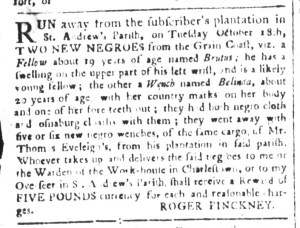
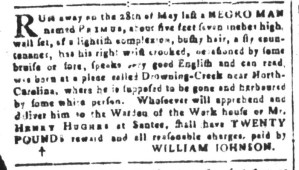
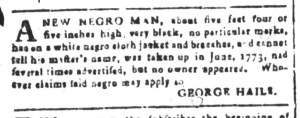
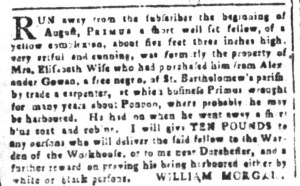
South-Carolina and American General Gazette (November 18, 1774).

**********

South-Carolina and American General Gazette (November 18, 1774).

**********

South-Carolina and American General Gazette (November 18, 1774).

**********

South-Carolina and American General Gazette (November 18, 1774).

**********

South-Carolina and American General Gazette (November 18, 1774).

**********

South-Carolina and American General Gazette (November 18, 1774).

**********

South-Carolina and American General Gazette (November 18, 1774).

**********

South-Carolina and American General Gazette (November 18, 1774).

**********

South-Carolina and American General Gazette (November 18, 1774).

**********

South-Carolina and American General Gazette (November 18, 1774).

**********

South-Carolina and American General Gazette (November 18, 1774).

**********

South-Carolina and American General Gazette (November 18, 1774).

**********

South-Carolina and American General Gazette (November 18, 1774).

**********

South-Carolina and American General Gazette (November 18, 1774).

**********

South-Carolina and American General Gazette (November 18, 1774).

**********

South-Carolina and American General Gazette (November 18, 1774).

**********

South-Carolina and American General Gazette (November 18, 1774).

**********

South-Carolina and American General Gazette (November 18, 1774).

**********

South-Carolina and American General Gazette (November 18, 1774).

**********

South-Carolina and American General Gazette (November 18, 1774).

**********

South-Carolina and American General Gazette (November 18, 1774).

**********

South-Carolina and American General Gazette (November 18, 1774).

**********

South-Carolina and American General Gazette (November 18, 1774).

**********

South-Carolina and American General Gazette (November 18, 1774).

**********

South-Carolina and American General Gazette (November 18, 1774).

**********

South-Carolina and American General Gazette (November 18, 1774).

**********

South-Carolina and American General Gazette (November 18, 1774).

**********

South-Carolina and American General Gazette (November 18, 1774).

**********

South-Carolina and American General Gazette (November 18, 1774).

**********

South-Carolina and American General Gazette (November 18, 1774).

**********

South-Carolina and American General Gazette (November 18, 1774).

**********

South-Carolina and American General Gazette (November 18, 1774).

**********

South-Carolina and American General Gazette (November 18, 1774).

**********

South-Carolina and American General Gazette (November 18, 1774).

**********

South-Carolina and American General Gazette (November 18, 1774).

**********

South-Carolina and American General Gazette (November 18, 1774).

**********

South-Carolina and American General Gazette (November 18, 1774).

November 17

What was advertised in a colonial American newspaper 250 years ago today?

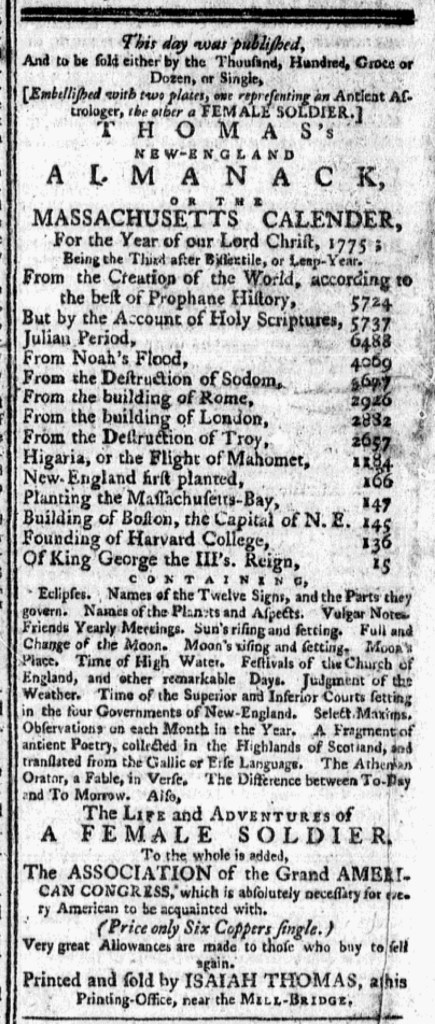
Massachusetts Spy (November 17, 1774).

“To the whole is added, The ASSOCIATION of the Grand AMERICAN CONGRESS.”

Like many colonial printers, Isaiah Thomas generated significant revenue from publishing almanacs.  From the most affluent to the most humble households in port cities and in the countryside, each year colonizers acquired these handy reference manuals that included all kinds of information.  Thomas’s “NEW-ENGLAND ALMANACK, OR THE MASSACHUSETTS CALENDER, For the Year of our Lord Christ, 1775,” for instance, had everything from the tides or “Time of High Water” to a schedule of “the Superior and Inferior Courts setting in the four Governments of New-England” to poetry.  Thomas “Embellished” the almanac with two images, “one representing an Antient Astrologer, the other a FEMALE SOLDIER.”  The latter corresponded to the “LIFE and ADVENTURES of A FEMALE SOLDIER” that the printer promoted among the content of his almanac.  Practically every almanac included the tides and many listed the dates for important meetings in Connecticut, Massachusetts, New Hampshire, and Rhode Island, so Thomas and other printers sought ways to distinguish their almanacs from others, including images and novel stories.

Thomas anticipated doing brisk business with the contents that he selected for his almanac.  He announced that he sold it “by the Thousand, Hundred, Groce or Dozen, or Single,” offering peddlers, booksellers, and shopkeepers the opportunity to purchase in volume for resale.  A single copy cost “Six Coppers,” yet Thomas promised that “Very great Allowances are made to those who buy to sell again.”  In addition to turning a profit on his almanac, this patriot printer also wanted it disseminated widely because of a particular item that he inserted among the contents.  His almanac included “The ASSOCIATION of the Grand AMERICAN CONGRESS.”  He referred to the Continental Association, a nonimportation agreement recently adopted by the First Continental Congress when it met in Philadelphia in September and October 1774.  The inclusion of the Continental Association distinguished Thomas’s almanac from others advertised in the same issue of the Massachusetts Spy, including “BICKERSTAFF’S BOSTON ALMANACK” published by Nathaniel Mills and John Hicks and “LOW’S ALMANACK” published by John Kneeland.  That newspaper also featured advertisements for two different editions of “EXTRACTS from the Votes and Proceedings of the American Continental CONGRESS,” which included the Continental Association.  Whether or not readers happened to purchase that political pamphlet, Thomas provided easy access to what they needed to know about the nonimportation agreement in an almanac that they would consult for a variety of purposes throughout the coming year.  He asserted that the Continental Association “is absolutely necessary for every American to be acquainted with” … and since so many colonizers already planned to purchase an almanac for 1775 they might as well become acquainted with the Continental Association by purchasing Thomas’s almanac, the one that he sought to distribute “by the Thousand, Hundred, Groce or Dozen” to get into as many households as possible.
Slavery Advertisements Published November 17, 1774

The Slavery Adverts 250 Project chronicles the role of newspaper advertising in perpetuating slavery in the era of the American Revolution. The project seeks to reveal the ubiquity of slavery in eighteenth-century life from New England to Georgia by republishing advertisements about enslaved people – for sale as individuals or in groups, wanted to purchase or for hire for short periods, runaways who liberated themselves, and those who were subsequently captured and confined in jails and workhouses – in daily digests on this site as well as in real time via the @SlaveAdverts250 Twitter feed, utilizing twenty-first-century media to stand in for the print media of the eighteenth century.

The project aims to provide modern audiences with a sense of just how often colonizers encountered these advertisements in their daily lives. Enslaved men, women, and children appeared in print somewhere in the colonies almost every single day. Those advertisements served as a constant backdrop for social, cultural, economic, and political life in colonial and revolutionary America. Colonizers who did not purport to own enslaved people were still confronted with slavery as well as invited to maintain the system by purchasing enslaved men, women, and children or assisting in the capture of so-called “runaways” who sought to free themselves from bondage. The frequency of these newspaper advertisements suggests just how embedded slavery was in colonial and revolutionary American culture in everyday interactions beyond the printed page.

These advertisements also testify to the experiences of enslaved men, women, and children, though readers must consider that those experiences have been remediated through descriptions offered by enslavers rather than enslaved people themselves. Often unnamed in the advertisements, enslaved men, women, and children were not invisible or unimportant in early America.

These advertisements appeared in colonial American newspapers 250 years ago today.

Maryland Gazette (November 17, 1774).

**********

Maryland Gazette (November 17, 1774).

**********

Maryland Gazette (November 17, 1774).

**********

Maryland Gazette (November 17, 1774).

**********

Maryland Gazette (November 17, 1774).

**********

Maryland Gazette (November 17, 1774).

**********

Maryland Gazette (November 17, 1774).

**********

Massachusetts Spy (November 17, 1774).

**********

Massachusetts Spy (November 17, 1774).

**********

New-York Journal (November 17, 1774).

**********

New-York Journal (November 17, 1774).

**********

Supplement to the New-York Journal (November 17, 1774).

**********

Rivington’s New-York Gazetteer (November 17, 1774).

**********

Rivington’s New-York Gazetteer (November 17, 1774).

**********

Virginia Gazette [Pinkney] (November 17, 1774).

**********

Virginia Gazette [Pinkney] (November 17, 1774).

**********

Virginia Gazette [Pinkney] (November 17, 1774).

**********

Virginia Gazette [Pinkney] (November 17, 1774).

**********

Virginia Gazette [Pinkney] (November 17, 1774).

**********

Virginia Gazette [Pinkney] (November 17, 1774).

**********

Virginia Gazette [Purdie and Dixon] (November 17, 1774).

**********

Virginia Gazette [Purdie and Dixon] (November 17, 1774).

**********

Virginia Gazette [Purdie and Dixon] (November 17, 1774).

**********

Virginia Gazette [Purdie and Dixon] (November 17, 1774).

**********

Virginia Gazette [Purdie and Dixon] (November 17, 1774).

**********

Virginia Gazette [Purdie and Dixon] (November 17, 1774).

**********

Virginia Gazette [Purdie and Dixon] (November 17, 1774).

**********

Virginia Gazette [Purdie and Dixon] (November 17, 1774).

November 16

What was advertised in a colonial American newspaper 250 years ago today?

Pennsylvania Journal (November 16, 1774).

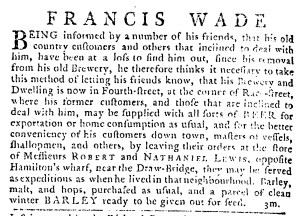
“For the better conveniency of his customers … leav[e] their orders at the store of Messieurs ROBERT and NATHANIEL LEWIS.”

Moving to a new location had caused some difficulty for Francis Wade, a brewer, prompting him to insert an advertisement in the Pennsylvania Journal in hopes of remedying the situation.  He formerly operated his brewery in the vicinity of “Hamilton’s Wharf, near the Draw-Bridge,” in Philadelphia, but in the fall of 1774 he could be found on Fourth Street “at the corner of Race-street.”  Wade reported that he had been “informed by a number of his friends,” likely including some of his former neighbors, “that his old country customers and other that inclined to deal with him, have been at a loss to find him out” since he moved.  Although many residents of the city knew about his new location, his “former customers” from the countryside did not have the same familiarity with the happenings in Philadelphia.  Since the Pennsylvania Journal circulated far beyond Philadelphia, Wade hoped that his notice would reach them and encourage them to seek him out on Fourth Street.

The brewer realized that his new location might not have been as convenient for some customers as his old one, so he used his advertisement as an opportunity to offer them an alternative.  Wade instructed “his customers down town, masters of vessels, shallopmen, and others” that they could place their orders at the store operated by Robert Lewis and Nathaniel Lewis.  When they did so, they could expect that they would “be served as expeditious as when he lived in that neighbourhood.”  Wade enlisted the aid of associates in his efforts to maintain and grow his client base, seeking to ameliorate an obstacle that he encountered following “his removal from his old Brewery.”  Working with the Lewises allowed him to maintain a presence in the vicinity of his former location.  Running newspaper advertisements made that presence visible to his “country customers” and other prospective customers.  Wade endeavored to sell “all sorts of BEER for exportation or home consumption as usual,” yet his move caused him to devise new methods of doing business that had not been part of his usual routine.

Slavery Advertisements Published November 16, 1774

The Slavery Adverts 250 Project chronicles the role of newspaper advertising in perpetuating slavery in the era of the American Revolution. The project seeks to reveal the ubiquity of slavery in eighteenth-century life from New England to Georgia by republishing advertisements about enslaved people – for sale as individuals or in groups, wanted to purchase or for hire for short periods, runaways who liberated themselves, and those who were subsequently captured and confined in jails and workhouses – in daily digests on this site as well as in real time via the @SlaveAdverts250 Twitter feed, utilizing twenty-first-century media to stand in for the print media of the eighteenth century.

The project aims to provide modern audiences with a sense of just how often colonizers encountered these advertisements in their daily lives. Enslaved men, women, and children appeared in print somewhere in the colonies almost every single day. Those advertisements served as a constant backdrop for social, cultural, economic, and political life in colonial and revolutionary America. Colonizers who did not purport to own enslaved people were still confronted with slavery as well as invited to maintain the system by purchasing enslaved men, women, and children or assisting in the capture of so-called “runaways” who sought to free themselves from bondage. The frequency of these newspaper advertisements suggests just how embedded slavery was in colonial and revolutionary American culture in everyday interactions beyond the printed page.

These advertisements also testify to the experiences of enslaved men, women, and children, though readers must consider that those experiences have been remediated through descriptions offered by enslavers rather than enslaved people themselves. Often unnamed in the advertisements, enslaved men, women, and children were not invisible or unimportant in early America.

These advertisements appeared in colonial American newspapers 250 years ago today.

Pennsylvania Gazette (November 16, 1774).

**********

Pennsylvania Journal (November 16, 1774).

**********

Pennsylvania Journal (November 16, 1774).

**********

Pennsylvania Journal (November 16, 1774).

November 15

What was advertised in a colonial American newspaper 250 years ago today?

South-Carolina Gazette and Country Journal (November 15, 1774).

“PUBLIC NOTICE in the three Gazettes of this Province.”

The section for “NEW ADVERTISEMENTS” in the November 15, 1774, edition of the South-Carolina Gazette and Country Journal included a notice from David Deas and John Deas.  “OUR Co-partnership being now expired,” they declared, “we are desirous of brining all our Concerns in Trade to a speedy and final Settlement.”  Like many other merchants, shopkeepers, and other entrepreneurs, the Deases used a newspaper advertisement to call on associates to settle accounts.  Their notice replicated so many others that ran in newspapers throughout the colonies, including a threat of legal action against those who did not respond.  Any “Bonds, Notes, and Book Debts, due to us, which shall not be discharged or settled to our Satisfaction, on or before the 10th Day of March next,” they warned, “will then be put in Suit without Distinction.”  The Deases did not plan to make any exceptions for any reasons, so those with outstanding accounts needed to tend to them by the specified date.

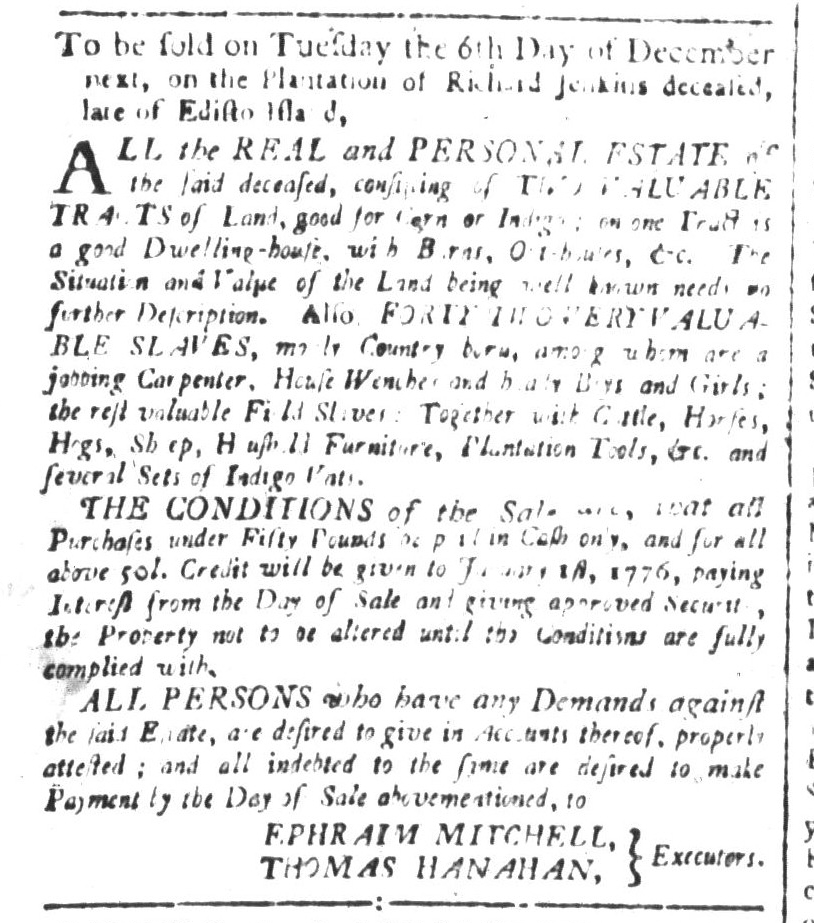
Today, the Deases are best known among historians for their broadside advertising the sale of “A CARGO OF NINETY-FOUR PRIME, HEALTHY NEGROES, CONSISTING OF Thirty-nine MEN, Fifteen BOYS, Twenty-four WOMEN, and Sixteen GIRLS …from SIERRA-LEON” held in Charleston on July 24, 1769.  Yet that was not the only time that they leveraged the power of the press in advancing their business interests.  In this instance, they published their “PUBLIC NOTICE in the three Gazettes of this Province,” submitting it to the South-Carolina and American General Gazette and the South Carolina Gazette as well as the South-Carolina Gazette and Country Journal.  While inserting it in just one of those newspapers would have been sufficient to argue that they gave fair notice, running it in all three increased the likelihood that associates who owed them debts would see their announcement and take heed.  At the same time, placing the advertisement in all three newspapers increased their investment in the endeavor, apparently money the Deases considered well spent if it either had the desired results or gave them a stronger case when they had to resort to going to court.

Slavery Advertisements Published November 15, 1774

The Slavery Adverts 250 Project chronicles the role of newspaper advertising in perpetuating slavery in the era of the American Revolution. The project seeks to reveal the ubiquity of slavery in eighteenth-century life from New England to Georgia by republishing advertisements about enslaved people – for sale as individuals or in groups, wanted to purchase or for hire for short periods, runaways who liberated themselves, and those who were subsequently captured and confined in jails and workhouses – in daily digests on this site as well as in real time via the @SlaveAdverts250 Twitter feed, utilizing twenty-first-century media to stand in for the print media of the eighteenth century.

The project aims to provide modern audiences with a sense of just how often colonizers encountered these advertisements in their daily lives. Enslaved men, women, and children appeared in print somewhere in the colonies almost every single day. Those advertisements served as a constant backdrop for social, cultural, economic, and political life in colonial and revolutionary America. Colonizers who did not purport to own enslaved people were still confronted with slavery as well as invited to maintain the system by purchasing enslaved men, women, and children or assisting in the capture of so-called “runaways” who sought to free themselves from bondage. The frequency of these newspaper advertisements suggests just how embedded slavery was in colonial and revolutionary American culture in everyday interactions beyond the printed page.

These advertisements also testify to the experiences of enslaved men, women, and children, though readers must consider that those experiences have been remediated through descriptions offered by enslavers rather than enslaved people themselves. Often unnamed in the advertisements, enslaved men, women, and children were not invisible or unimportant in early America.

These advertisements appeared in colonial American newspapers 250 years ago today.

South-Carolina Gazette and Country Journal (November 15, 1774).

**********

South-Carolina Gazette and Country Journal (November 15, 1774).

**********

South-Carolina Gazette and Country Journal (November 15, 1774).

**********

South-Carolina Gazette and Country Journal (November 15, 1774).

**********

South-Carolina Gazette and Country Journal (November 15, 1774).

**********

South-Carolina Gazette and Country Journal (November 15, 1774).

**********

South-Carolina Gazette and Country Journal (November 15, 1774).

**********

South-Carolina Gazette and Country Journal (November 15, 1774).

**********

South-Carolina Gazette and Country Journal (November 15, 1774).

**********

South-Carolina Gazette and Country Journal (November 15, 1774).

**********

South-Carolina Gazette and Country Journal (November 15, 1774).

**********

South-Carolina Gazette and Country Journal (November 15, 1774).

**********

Supplement to the South-Carolina Gazette and Country Journal (November 15, 1774).

**********

Supplement to the South-Carolina Gazette and Country Journal (November 15, 1774).

**********

Supplement to the South-Carolina Gazette and Country Journal (November 15, 1774).

**********

Supplement to the South-Carolina Gazette and Country Journal (November 15, 1774).

**********

Supplement to the South-Carolina Gazette and Country Journal (November 15, 1774).

**********

Supplement to the South-Carolina Gazette and Country Journal (November 15, 1774).

**********

Supplement to the South-Carolina Gazette and Country Journal (November 15, 1774).

**********

Supplement to the South-Carolina Gazette and Country Journal (November 15, 1774).

**********

Supplement to the South-Carolina Gazette and Country Journal (November 15, 1774).

**********

Supplement to the South-Carolina Gazette and Country Journal (November 15, 1774).

**********

Supplement to the South-Carolina Gazette and Country Journal (November 15, 1774).

**********

Supplement to the South-Carolina Gazette and Country Journal (November 15, 1774).