November 14

What was advertised in a colonial American newspaper 250 years ago today?

New-York Gazette and Weekly Mercury (November 14, 1774).

“The great Demand for the Proceedings of the Continental Congress, has caused a second Edition to be printed.”

Hot off the press and flying off the shelf!  Hugh Gaine, the printer of the New-York Gazette and Weekly Mercury, reported a high level of public interest in the Extracts from the Votes and Proceedings of the American Continental Congress.  On November 14, 1774, he took the unusual measure of inserting an advertisement among the news to inform readers that the “great Demand for the Proceedings of the Continental Congress, has caused a second Edition to be printed; — which is this Day published, and sold by Hugh Gaine, in Hanover-Square.”  Although news and advertisements often appeared next to each other in colonial newspapers, printers did not ordinarily intersperse advertisements and news.  That made it noteworthy that Gaine’s advertisement appeared below local news from New York and above shipping news from the custom house.

Although Gaine published and sold a “second Edition” of the Extracts, he was not responsible for the first edition printed in New York.  On November 3, John Holt, the printer of the New-York Journal, ran a notice advising of “THE PROCEEDINGS OF THE CONTINENTAL CONGRESS, With their Letter to the People of QUEBEC, To be sold by the Printer.”  Unlike an advertisement for a Philadelphia edition in the Pennsylvania Journal the previous day, Holt’s notice did not list the contents.  He apparently considered the meeting of the First Continental Congress sufficient recommendation for marketing a pamphlet that gave an overview of the decisions made by the delegates.  He ran the same advertisement, without update, a week later.  Not long after that, Gaine advertised a “second Edition” that seems to have been a competing edition.  He had not previously advertised the Extracts in the New-York Gazette and Weekly Mercury, suggesting that he had witnessed the popularity of Holt’s edition and decided to generate revenue by printing and selling his own edition.  The political pamphlet had not necessarily sold out, as Gaine’s advertisement suggested, but instead a second printer entered the market.  In his History of Printing in America (1810), patriot printer Isaiah Thomas remarked that “Gaine’s political creed, it seems, was to join the strongest party.”[1]  Gaine may not have held to any political principles as strongly as Holt, who had incorporated the “Unite or Die” political cartoon into the masthead of his newspaper, yet his actions did serve the purposes of the First Continental Congress.  The delegates had ordered the publication of the Extracts.  Disseminating that political pamphlet did not require sincere belief on the part of Gaine or any other printer, though most who published and marketed it did tend to vocally support the American cause throughout the imperial crisis.

**********

[1] Isaiah Thomas, The History of Printing in America: With a Biography of Printers and an Account of Newspapers (1810; New York: Weathervane Books, 1970), 472.
Slavery Advertisements Published November 14, 1774

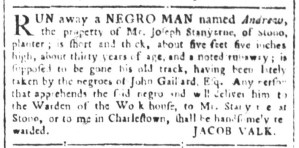
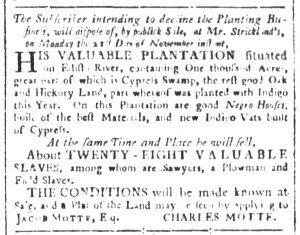
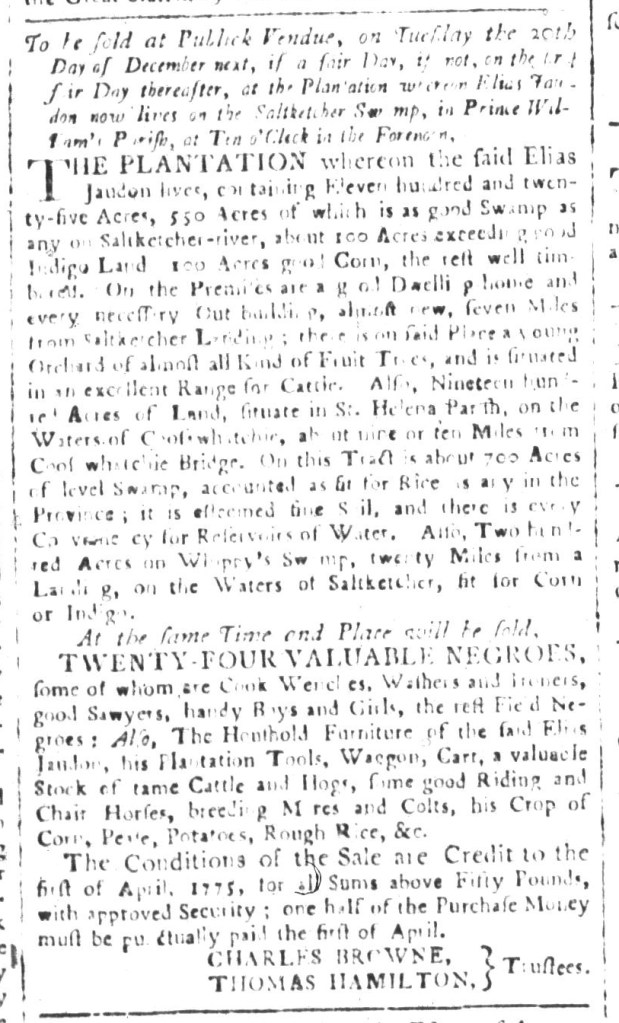
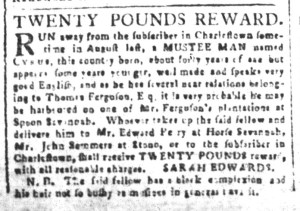
The Slavery Adverts 250 Project chronicles the role of newspaper advertising in perpetuating slavery in the era of the American Revolution. The project seeks to reveal the ubiquity of slavery in eighteenth-century life from New England to Georgia by republishing advertisements about enslaved people – for sale as individuals or in groups, wanted to purchase or for hire for short periods, runaways who liberated themselves, and those who were subsequently captured and confined in jails and workhouses – in daily digests on this site as well as in real time via the @SlaveAdverts250 Twitter feed, utilizing twenty-first-century media to stand in for the print media of the eighteenth century.

The project aims to provide modern audiences with a sense of just how often colonizers encountered these advertisements in their daily lives. Enslaved men, women, and children appeared in print somewhere in the colonies almost every single day. Those advertisements served as a constant backdrop for social, cultural, economic, and political life in colonial and revolutionary America. Colonizers who did not purport to own enslaved people were still confronted with slavery as well as invited to maintain the system by purchasing enslaved men, women, and children or assisting in the capture of so-called “runaways” who sought to free themselves from bondage. The frequency of these newspaper advertisements suggests just how embedded slavery was in colonial and revolutionary American culture in everyday interactions beyond the printed page.

These advertisements also testify to the experiences of enslaved men, women, and children, though readers must consider that those experiences have been remediated through descriptions offered by enslavers rather than enslaved people themselves. Often unnamed in the advertisements, enslaved men, women, and children were not invisible or unimportant in early America.

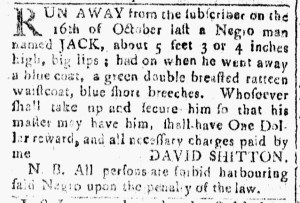
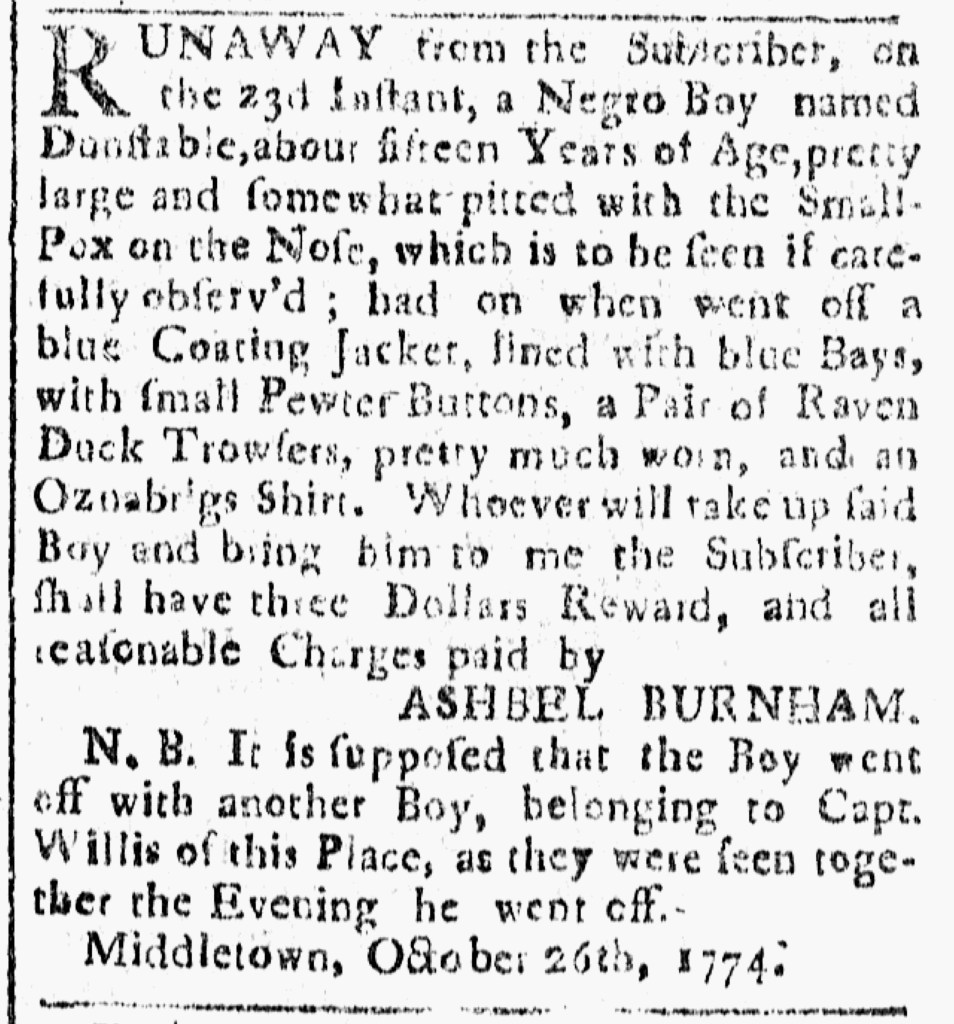
These advertisements appeared in colonial American newspapers 250 years ago today.

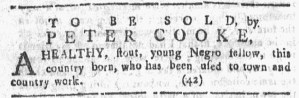
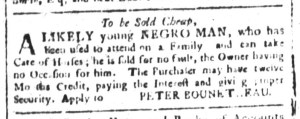
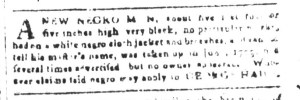
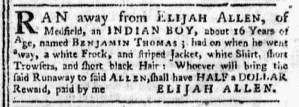
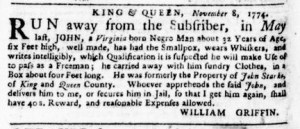
Dunlap’s Pennsylvania Packet (November 14, 1774).

**********

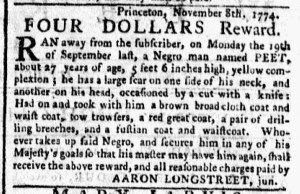
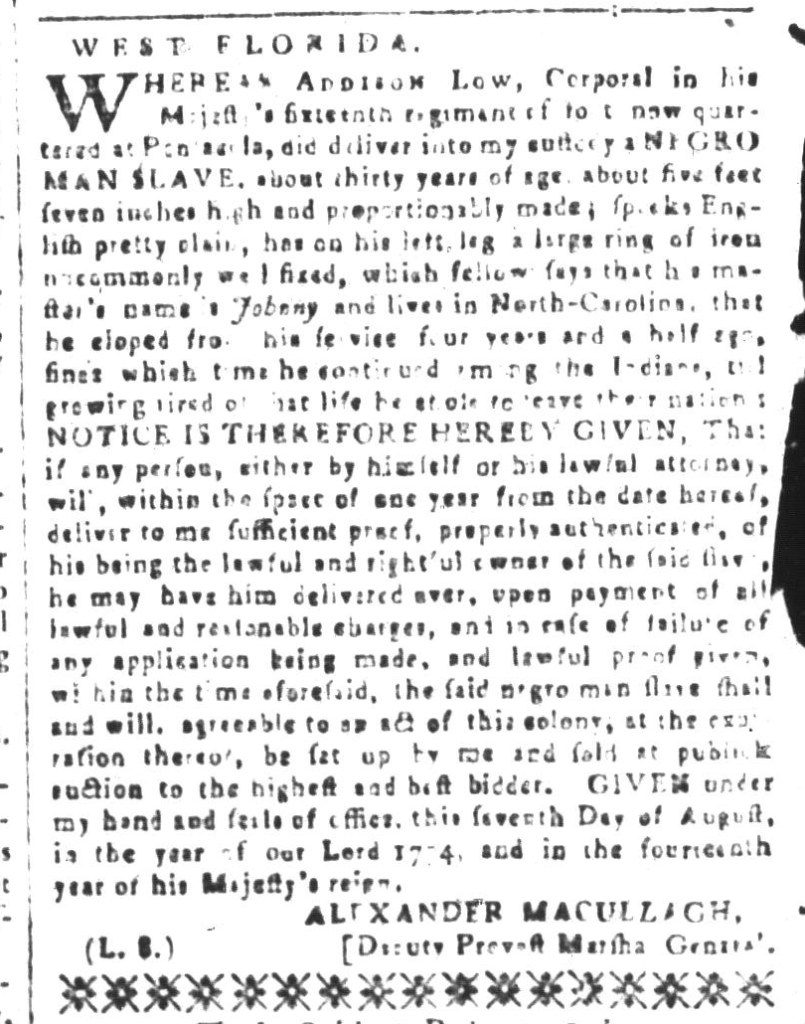
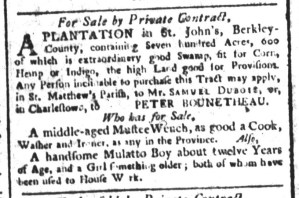
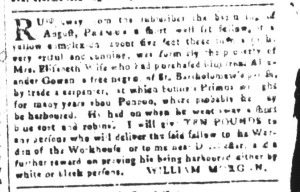
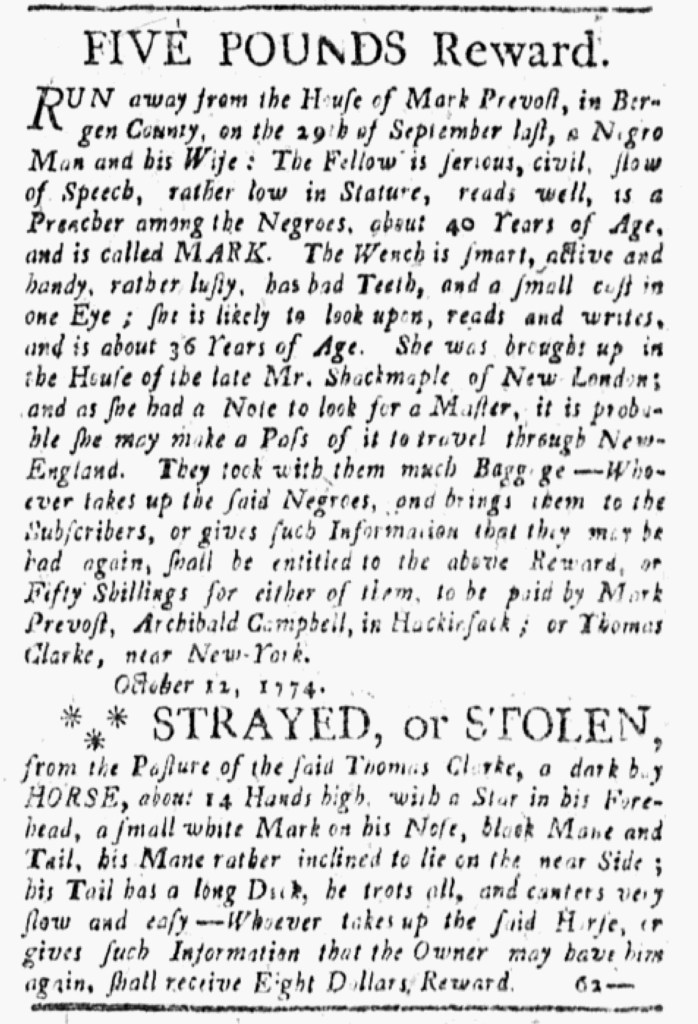
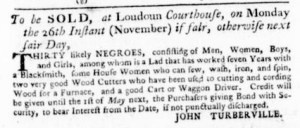
Dunlap’s Pennsylvania Packet (November 14, 1774).

**********

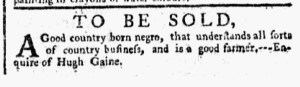
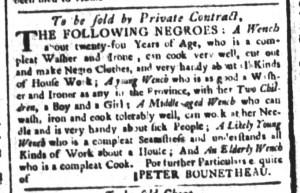
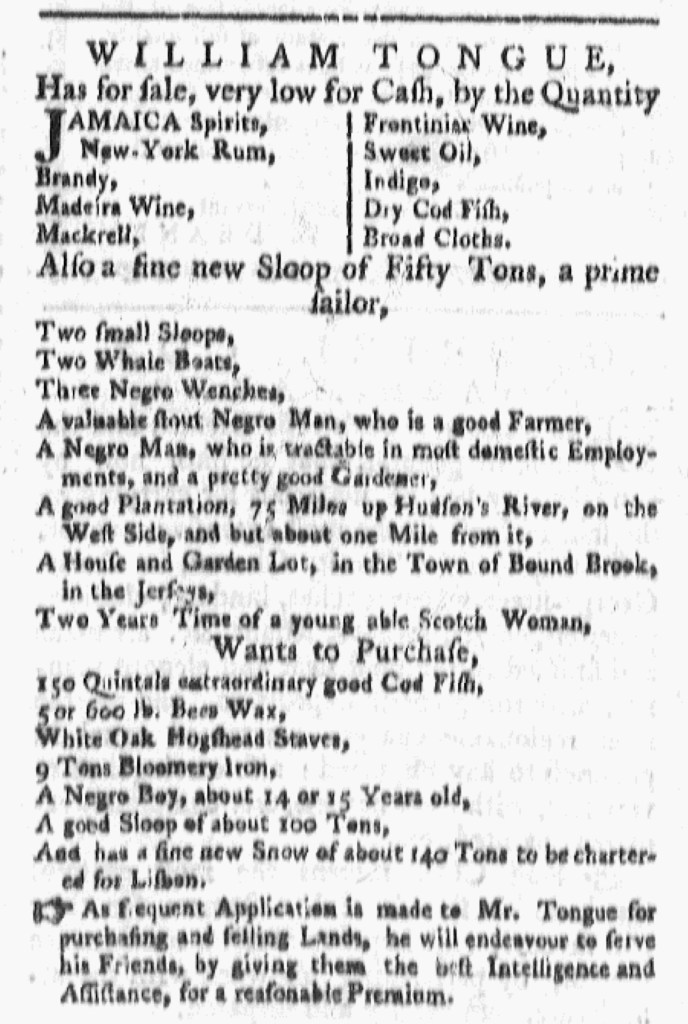
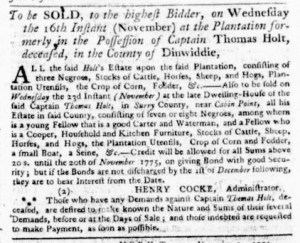
Newport Mercury (November 14, 1774).

**********

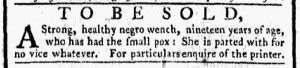
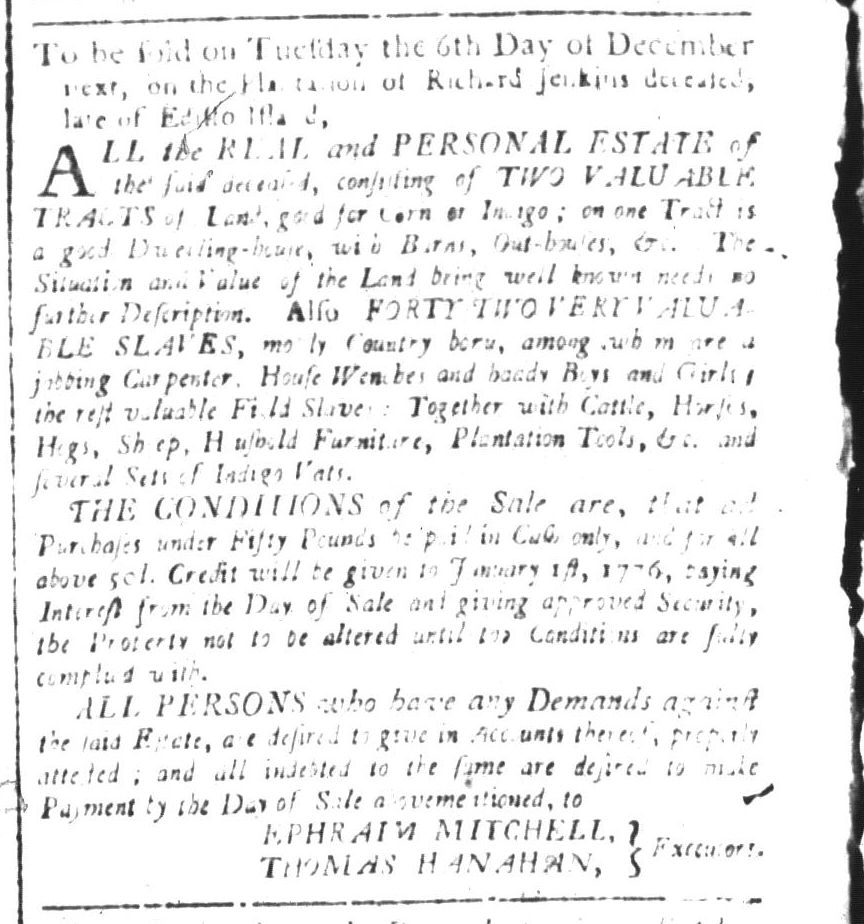
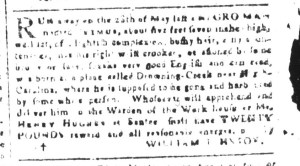
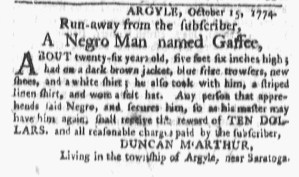
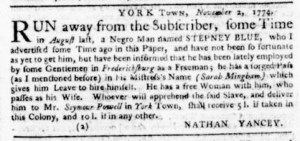
New-York Gazette and Weekly Mercury (November 14, 1774).

**********

New-York Gazette and Weekly Mercury (November 14, 1774).

**********

New-York Gazette and Weekly Mercury (November 14, 1774).

**********

New-York Gazette and Weekly Mercury (November 14, 1774).

**********

Supplement to the New-York Gazette and Weekly Mercury (November 14, 1774).

November 13

What was advertised in a colonial American newspaper 250 years ago this week?

Massachusetts Gazette and Boston Weekly News-Letter (November 10, 1774).

“*** The Votes and Proceedings of the Grand American Continental CONGRESS.”

Just over a week after William Bradford and Thomas Bradford first advertised their Philadelphia edition of Extracts from the Votes and Proceedings of the American Continental Congress in the Pennsylvania Journal, printers in Boston ran advertisements advising the public that they published and sold their own local editions.  Those notices first appeared in the Massachusetts Gazette and Boston Weekly News-Letter and the Massachusetts Spy on November 10, 1774.  Readers could choose between two editions published in Boston.

Thomas Fleet and John Fleet, the printers of the Boston Evening-Post, and the Benjamin Edes and John Gill, the printers of the Boston-Gazette, partnered in publishing one of those editions.  Their advertisements in both the Massachusetts Gazette and Boston Weekly News-Letter and the Massachusetts Spy followed a familiar format for notices about books, pamphlets, almanacs, and other printed items.  A headline proclaimed, “This Day is Published,” followed by a secondary headline that listed the names of the printers.  The body of the advertisement consisted of the title of the pamphlet and a list of its contents.

Massachusetts Gazette and Boston Weekly News-Letter (November 10, 1774).

Nathaniel Mills and John Hicks, the printers of the Massachusetts Gazette and Boston Post-Boy, worked with fellow printer John Boyle as well booksellers Edward Cox and Edward Berry to publish and sell another Boston edition of the Extracts of the First Continental Congress.  That meant that the printers of all five newspapers published in Boston in 1774 participated either in publishing or advertising that important political pamphlet that informed the public about the decisions made by the delegates in Philadelphia.

The advertisement for this edition in the Massachusetts Spy followed the same format as the notice about the other edition, though the secondary headline gave only the names of Mills and Hicks and Boyle.  The notice in the Massachusetts Gazette and Boston Weekly News-Letter, on the other hand, looked more like a news update, especially since it appeared immediately to the left of a report that “Last Evening arrived in Town form the GRAND CONGRESS, the Hon. Thomas Cushing, Esq; John Adams, Esq; Mr. Samuel Adams, and Robert Treat Paine, Esq; … on which Occasion, most of the Bells in Town were rung.”  With three asterisks to draw attention, the notice about the pamphlet started with the title, continued with the contents, and concluded with “sold by Cox and Berry, Mills and Hicks and John Boyle.”

Residents of Boston and nearby towns had ready access to the Extracts as soon as delegates returned from the meeting of the First Continental Congress.  They likely heard about the meetings through conversation and learned about it from reading newspapers, yet they could purchase an overview of the proceedings to examine in as much detail as often as they liked.

November 12

What was advertised in a colonial American newspaper 250 years ago today?

Providence Gazette (November 12, 1774).

“He pretends not to say that no one can sell so cheap, but believes no one will.”

According to his advertisement in the November 12, 1774, edition of the Providence Gazette, Amos Throop stocked a variety of popular patent medicines, including Hooper’s Pills, Stoughton’s Elixir, Bateman’s Drops, Godfrey’s Cordial, James’s Fever Powder, Turlington’s Balsam of Life, and Hill’s Balsam of Honey “for coughs and consumptions.”  He also sold a variety of medical supplies for both physicians, apothecaries, and home use, such as “pocket cases of surgeons instruments,” “a pretty assortment of bell-metal and glass mortars,” and “beautiful smelling bottles of various figures.”

Throop’s advertisement did not list every item that he recently imported from London.  Like other retailers often did, he promised that prospective customers would discover much more merchandise upon visiting his shop.  “Many more articles might be enumerated,” he proclaimed, “but suffice to say, that a more general assortment never was imported.”  Not only did he offer an array of choices, but the selection was supposedly unrivaled in Providence or anywhere else in the colonies.

In case that was not enough to get the attention of prospective customers, Throop also promoted his prices.  He initially referred to them as “very cheap indeed,” but then elaborated on that point.  Readers would not find more choices elsewhere, “nor can any reasonable objection be made to the prices.  He pretends not to say that no one can sell so cheap, but believes no one will.”  In making that declaration, he invited readers to consider the choices made by purveyors of goods when they set prices for their wares.  Throop claimed that he was not in any sort of special position to offer such bargains.  Anyone else in his line of business could have done the same, but he did not suspect that anyone would.  Throop deliberately chose to sell his merchandise “very cheap indeed.”  Physicians, apothecaries, and other consumers, he suggested, should reward that choice by choosing to buy their patent medicines and medical supplies from him rather than any of his competitors.

Slavery Advertisements Published November 12, 1774

The Slavery Adverts 250 Project chronicles the role of newspaper advertising in perpetuating slavery in the era of the American Revolution. The project seeks to reveal the ubiquity of slavery in eighteenth-century life from New England to Georgia by republishing advertisements about enslaved people – for sale as individuals or in groups, wanted to purchase or for hire for short periods, runaways who liberated themselves, and those who were subsequently captured and confined in jails and workhouses – in daily digests on this site as well as in real time via the @SlaveAdverts250 Twitter feed, utilizing twenty-first-century media to stand in for the print media of the eighteenth century.

The project aims to provide modern audiences with a sense of just how often colonizers encountered these advertisements in their daily lives. Enslaved men, women, and children appeared in print somewhere in the colonies almost every single day. Those advertisements served as a constant backdrop for social, cultural, economic, and political life in colonial and revolutionary America. Colonizers who did not purport to own enslaved people were still confronted with slavery as well as invited to maintain the system by purchasing enslaved men, women, and children or assisting in the capture of so-called “runaways” who sought to free themselves from bondage. The frequency of these newspaper advertisements suggests just how embedded slavery was in colonial and revolutionary American culture in everyday interactions beyond the printed page.

These advertisements also testify to the experiences of enslaved men, women, and children, though readers must consider that those experiences have been remediated through descriptions offered by enslavers rather than enslaved people themselves. Often unnamed in the advertisements, enslaved men, women, and children were not invisible or unimportant in early America.

These advertisements appeared in colonial American newspapers 250 years ago today.

Providence Gazette (November 12, 1774).

November 11

What was advertised in a colonial American newspaper 250 years ago today?

Connecticut Journal (November 11, 1774).

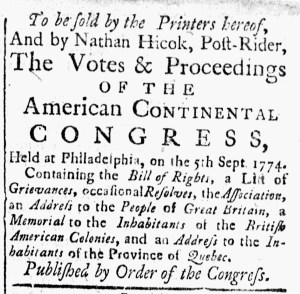
“To be sold by the Printers hereof, And by Nathan Hicok, Post-Rider.”

Throughout the colonies, printers provided updates from the First Continental Congress during its meeting in September and October 1774.  After the delegates adjourned and traveled home, printers quickly set about publishing, advertising, distributing, and selling a pamphlet that included an overview of the “Votes & Proceedings” as well as “the Bill of Rights, a List of Grievances, occasional Resolves, the Association, an Address to the People of Great Britain, a Memorial to the Inhabitants of the British American Colonies, and an Address to the Inhabitants of the Province of Quebec.”  William Bradford and Thomas Bradford, printers of the Pennsylvania Journal, first made the pamphlet available in Philadelphia just a week after the meeting ended.  Other printers soon joined them, producing their own local editions.

That included Thomas Green and Samuel Green, the printers of the Connecticut Journal and New-Haven Post-Boy.  On November 4, they alerted readers that the “Proceedings of the Continental Congress will shortly be ready for sale at the Printing Office.”  A week later, they ran a new advertisement, this time announcing that they sold the pamphlet.  Yet customers did not have to visit the printing office or send an order to acquire copies because the Greens enlisted Nathan Hicok, a post rider, in selling as well as delivering the “Votes & Proceedings” to colonizers seeking to keep informed beyond the coverage in newspapers.  It was not the first time that the Greens designated Hicok as one of their agents for disseminating printed items that supported the patriot cause.  On September 30, 1774, they advertised “The celebrated SPEECH, of the Bishop of St. Asaph, on the Bill for altering the Charter of the Colony of Massachusetts-Bay.  To be sold by the Printers, and Nathan Hicok, jun.”  Advertisements in several newspapers demonstrate that several post riders became partners with printers in marketing and selling political pamphlets as the imperial crisis intensified.  Even more post riders, though not named in newspaper advertisements, may have assumed similar responsibilities, actively promoting sales of such items rather than merely delivering them at the behest of printers and their customers.

Slavery Advertisements Published November 11, 1774

The Slavery Adverts 250 Project chronicles the role of newspaper advertising in perpetuating slavery in the era of the American Revolution. The project seeks to reveal the ubiquity of slavery in eighteenth-century life from New England to Georgia by republishing advertisements about enslaved people – for sale as individuals or in groups, wanted to purchase or for hire for short periods, runaways who liberated themselves, and those who were subsequently captured and confined in jails and workhouses – in daily digests on this site as well as in real time via the @SlaveAdverts250 Twitter feed, utilizing twenty-first-century media to stand in for the print media of the eighteenth century.

The project aims to provide modern audiences with a sense of just how often colonizers encountered these advertisements in their daily lives. Enslaved men, women, and children appeared in print somewhere in the colonies almost every single day. Those advertisements served as a constant backdrop for social, cultural, economic, and political life in colonial and revolutionary America. Colonizers who did not purport to own enslaved people were still confronted with slavery as well as invited to maintain the system by purchasing enslaved men, women, and children or assisting in the capture of so-called “runaways” who sought to free themselves from bondage. The frequency of these newspaper advertisements suggests just how embedded slavery was in colonial and revolutionary American culture in everyday interactions beyond the printed page.

These advertisements also testify to the experiences of enslaved men, women, and children, though readers must consider that those experiences have been remediated through descriptions offered by enslavers rather than enslaved people themselves. Often unnamed in the advertisements, enslaved men, women, and children were not invisible or unimportant in early America.

These advertisements appeared in colonial American newspapers 250 years ago today.

Connecticut Journal (November 11, 1774).

**********

Connecticut Journal (November 11, 1774).

**********

Connecticut Journal (November 11, 1774).

**********

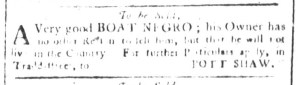
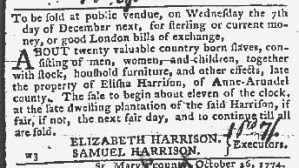
South-Carolina and American General Gazette (November 11, 1774).

**********

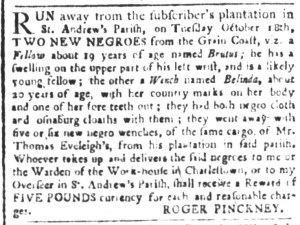
South-Carolina and American General Gazette (November 11, 1774).

**********

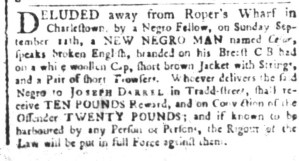
South-Carolina and American General Gazette (November 11, 1774).

**********

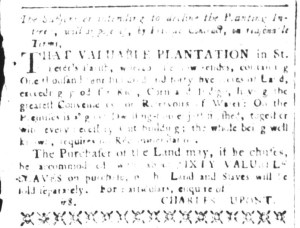
South-Carolina and American General Gazette (November 11, 1774).

**********

South-Carolina and American General Gazette (November 11, 1774).

**********

South-Carolina and American General Gazette (November 11, 1774).

**********

South-Carolina and American General Gazette (November 11, 1774).

**********

South-Carolina and American General Gazette (November 11, 1774).

**********

South-Carolina and American General Gazette (November 11, 1774).

**********

South-Carolina and American General Gazette (November 11, 1774).

**********

South-Carolina and American General Gazette (November 11, 1774).

**********

South-Carolina and American General Gazette (November 11, 1774).

**********

South-Carolina and American General Gazette (November 11, 1774).

**********

South-Carolina and American General Gazette (November 11, 1774).

**********

South-Carolina and American General Gazette (November 11, 1774).

**********

South-Carolina and American General Gazette (November 11, 1774).

**********

South-Carolina and American General Gazette (November 11, 1774).

**********

South-Carolina and American General Gazette (November 11, 1774).

**********

South-Carolina and American General Gazette (November 11, 1774).

**********

South-Carolina and American General Gazette (November 11, 1774).

**********

South-Carolina and American General Gazette (November 11, 1774).

**********

South-Carolina and American General Gazette (November 11, 1774).

**********

South-Carolina and American General Gazette (November 11, 1774).

**********

South-Carolina and American General Gazette (November 11, 1774).

**********

South-Carolina and American General Gazette (November 11, 1774).

**********

South-Carolina and American General Gazette (November 11, 1774).

**********

South-Carolina and American General Gazette (November 11, 1774).

**********

South-Carolina and American General Gazette (November 11, 1774).

November 10

What was advertised in a colonial American newspaper 250 years ago today?

Virginia Gazette [Pinkney] (November 10, 1774).

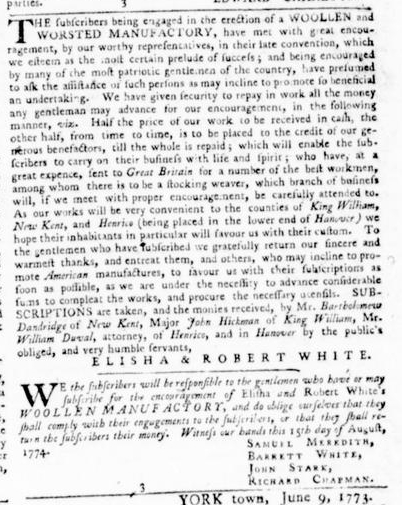
“A WOOLEN and WORSTED MANUFACTORY … American manufactures.”

As John Pinkney published updates from the First Continental Congress in the Virginia Gazette in November 1774, Elisha White and Robert White ran an advertisement to announce that they were “engaged in the erection of a WOOLLEN and WORSTED MANUFACTORY” that they anticipated would meet with great success.  They had already been “encouraged by many of the most patriotic gentlemen of the country,” yet sought even greater support for “so beneficial an undertaking” among the public.  In other words, they sought investors to defray the costs of this endeavor, addressing those “who may incline to promote American manufactures” as alternatives to goods imported from Britain.  The Whites had already gone to some expense, recruiting “a number of the best workmen,” though they still needed to “compleat the works, and procure the necessary utensils.”  Their enterprise would have even greater urgency as colonizers learned more about the Continental Association, a nonimportation pact, adopted by the First Continental Congress.

To raise the necessary funds to make their “MANUFACTORY” viable, the Whites established a subscription and designated local agents in several towns who collected the money on their behalf.  They also outlined their scheme for repaying these loans: “Half the price of our work to be received in cash, the other half, from time to time, is to be placed to the credit of our generous benefactors, till the whole is repaid.”  In case that seemed like too much of a gamble, the Whites appended a note from some of those “most patriotic gentlemen” to offer assurances.  Samuel Meredith, Barrett White, John Stark, and Richard Chapman pledged that they “will be responsible to the gentlemen who have or may subscribe for the encouragement of Elisha and Robert White’s WOOLLEN MANUFACTORY.”  If the project did not succeed, those four men “shall return the subscribers their money.”  That promise reflected their confidence in the Whites’ ability to “carry on their business with life and spirit” while simultaneously underscoring that civic duty called for supporting the “MANUFACTORY” through investing in it and, eventually, purchasing the goods produced there.  Political principles guided participation in both production and consumption of “American manufactures” as the imperial crisis intensified in 1774.

Slavery Advertisements Published November 10, 1774

The Slavery Adverts 250 Project chronicles the role of newspaper advertising in perpetuating slavery in the era of the American Revolution. The project seeks to reveal the ubiquity of slavery in eighteenth-century life from New England to Georgia by republishing advertisements about enslaved people – for sale as individuals or in groups, wanted to purchase or for hire for short periods, runaways who liberated themselves, and those who were subsequently captured and confined in jails and workhouses – in daily digests on this site as well as in real time via the @SlaveAdverts250 Twitter feed, utilizing twenty-first-century media to stand in for the print media of the eighteenth century.

The project aims to provide modern audiences with a sense of just how often colonizers encountered these advertisements in their daily lives. Enslaved men, women, and children appeared in print somewhere in the colonies almost every single day. Those advertisements served as a constant backdrop for social, cultural, economic, and political life in colonial and revolutionary America. Colonizers who did not purport to own enslaved people were still confronted with slavery as well as invited to maintain the system by purchasing enslaved men, women, and children or assisting in the capture of so-called “runaways” who sought to free themselves from bondage. The frequency of these newspaper advertisements suggests just how embedded slavery was in colonial and revolutionary American culture in everyday interactions beyond the printed page.

These advertisements also testify to the experiences of enslaved men, women, and children, though readers must consider that those experiences have been remediated through descriptions offered by enslavers rather than enslaved people themselves. Often unnamed in the advertisements, enslaved men, women, and children were not invisible or unimportant in early America.

These advertisements appeared in colonial American newspapers 250 years ago today.

Maryland Gazette (November 10, 1774).

**********

Maryland Gazette (November 10, 1774).

**********

Maryland Gazette (November 10, 1774).

**********

Maryland Gazette (November 10, 1774).

**********

Maryland Gazette (November 10, 1774).

**********

Massachusetts Spy (November 10, 1774).

**********

Massachusetts Spy (November 10, 1774).

**********

New-York Journal (November 10, 1774).

**********

Rivington’s New-York Gazetteer (November 10, 1774).

**********

Rivington’s New-York Gazetteer (November 10, 1774).

**********

Virginia Gazette [Pinkney] (November 10, 1774).

**********

Virginia Gazette [Pinkney] (November 10, 1774).

**********

Virginia Gazette [Pinkney] (November 10, 1774).

**********

Virginia Gazette [Pinkney] (November 10, 1774).

**********

Virginia Gazette [Pinkney] (November 10, 1774).

**********

Virginia Gazette [Pinkney] (November 10, 1774).

**********

Virginia Gazette [Pinkney] (November 10, 1774).

**********

Virginia Gazette [Purdie and Dixon] (November 10, 1774).

**********

Virginia Gazette [Purdie and Dixon] (November 10, 1774).

**********

Virginia Gazette [Purdie and Dixon] (November 10, 1774).

**********

Postscript to the Virginia Gazette [Purdie and Dixon] (November 10, 1774).

**********

Postscript to the Virginia Gazette [Purdie and Dixon] (November 10, 1774).

**********

Postscript to the Virginia Gazette [Purdie and Dixon] (November 10, 1774).

**********

Postscript to the Virginia Gazette [Purdie and Dixon] (November 10, 1774).

**********

Postscript to the Virginia Gazette [Purdie and Dixon] (November 10, 1774).

**********

Postscript to the Virginia Gazette [Purdie and Dixon] (November 10, 1774).

**********

Postscript to the Virginia Gazette [Purdie and Dixon] (November 10, 1774).

**********

Postscript to the Virginia Gazette [Purdie and Dixon] (November 10, 1774).

November 9

What was advertised in a colonial American newspaper 250 years ago today?

Pennsylvania Journal (November 9, 1774).

“Dr. Hill’s own direction is wrapped about each bottle.”

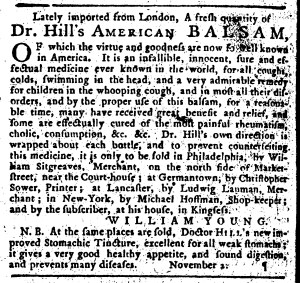
In the fall of 1774, William Young and his associates offered consumers exclusive access to “Dr. Hill’s AMERICAN BALSAM.”  According to an advertisement in the November 9 edition of the Pennsylvania Journal, this patent medicine “is an infallible, innocent, sure and effectual” cure for “coughs, colds, [and] swimming in the head” as well as a “very admirable remedy for children in the whooping cough, and in most all their disorders.”  Young implied that such recommendations may not have been necessary since the “virtue and goodness” of the medicine “are now so well known in America,” yet figured that trumpeting the efficacy of Dr. Hill’s American Balsam would aid in convincing consumers not yet familiar with this product.

As a means of guarding the reputation of this medicine and “to prevent counterfeiting,” a limited number of local agents stocked and sold this medicine.  Young made it available in Kingsess (or Kingsessing), just outside of Philadelphia.  William Sitgreaves, a merchant in Philadelphia, Christoper Sower, a printer in Germantown, and Ludwig Lauman, a merchant in Lancaster, each sold it as well.  Young also distributed Dr. Hill’s American Balsam to Michael Hoffman, a shopkeeper in New York, to sell there.  He had relied on that method for some time, having placed similar advertisement in May and October 1772.  Unlike some popular patent medicines widely stocked by apothecaries, merchants, shopkeepers, printers, booksellers, and other retailers throughout the colonies, only a select few carried Dr. Hill’s American Balsam.  The medicine came with “Dr. Hill’s own direction … wrapped about each bottle” to instruct patients how to use it to relieve or even cure “the most painful rheumatism, cholic, consumption,” and other maladies.  Such packaging represented another layer of marketing for this product, continuing to promote it to customers after they purchased it and took it home.
Young apparently considered these various strategies effective given that he invested in them on several occasions.  His marketing of Dr. Hill’s American Balsam incorporated the same elements in November 1774 that he deployed two and a half years earlier in May 1772.  That does not demonstrate the impact those methods had on consumers yet does suggest that Young considered them successful enough to repeat when he advertised once again.