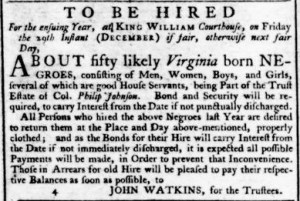
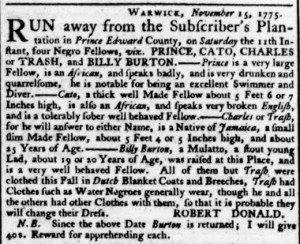
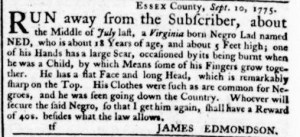
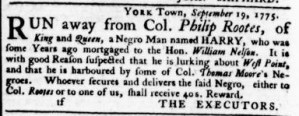
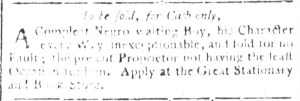
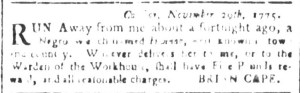
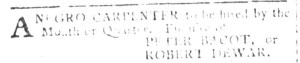
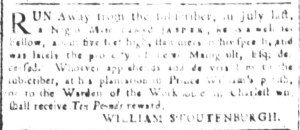
Slavery Advertisements Published December 9, 1775

GUEST CURATOR: Massimo Sgambati

The Slavery Adverts 250 Project chronicles the role of newspaper advertising in perpetuating slavery in the era of the American Revolution. The project seeks to reveal the ubiquity of slavery in eighteenth-century life from New England to Georgia by republishing advertisements about enslaved people – for sale as individuals or in groups, wanted to purchase or for hire for short periods, runaways who liberated themselves, and those who were subsequently captured and confined in jails and workhouses – in daily digests on this site as well as in real time via the @SlaveAdverts250 Twitter feed, utilizing twenty-first-century media to stand in for the print media of the eighteenth century.

The project aims to provide modern audiences with a sense of just how often colonizers encountered these advertisements in their daily lives. Enslaved men, women, and children appeared in print somewhere in the colonies almost every single day. Those advertisements served as a constant backdrop for social, cultural, economic, and political life in colonial and revolutionary America. Colonizers who did not purport to own enslaved people were still confronted with slavery as well as invited to maintain the system by purchasing enslaved men, women, and children or assisting in the capture of so-called “runaways” who sought to free themselves from bondage. The frequency of these newspaper advertisements suggests just how embedded slavery was in colonial and revolutionary American culture in everyday interactions beyond the printed page.

These advertisements also testify to the experiences of enslaved men, women, and children, though readers must consider that those experiences have been remediated through descriptions offered by enslavers rather than enslaved people themselves. Often unnamed in the advertisements, enslaved men, women, and children were not invisible or unimportant in early America.

From compiling an archive of digitized eighteenth-century newspapers to identifying advertisements about enslaved men, women, and children in those newspapers to preparing images of each advertisement to posting this daily digest, Massimo Sgambati served as guest curator for this entry. He completed this work as part of the Summer Scholars Program, funded by a fellowship from the D’Amour College of Liberal Arts and Sciences at Assumption University in Worcester, Massachusetts, in Summer 2025.

These advertisements appeared in colonial American newspapers 250 years ago today.
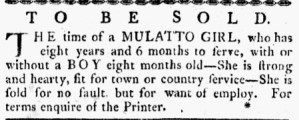
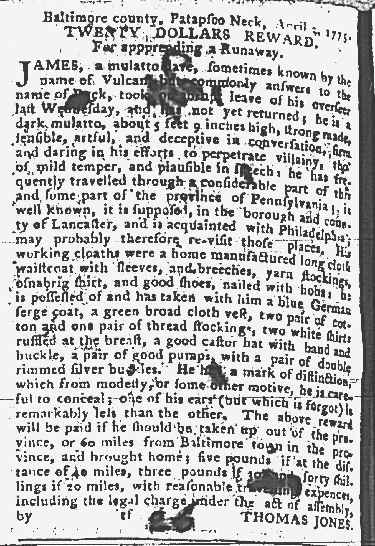
Pennsylvania Ledger (December 9, 1775)

**********
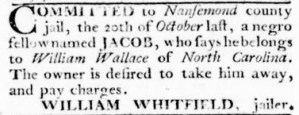
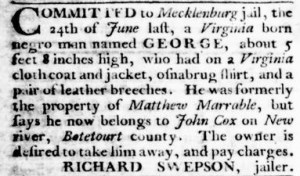
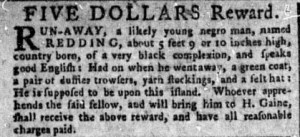
Virginia Gazette [Dixon and Hunter] (December 9, 1775)

**********

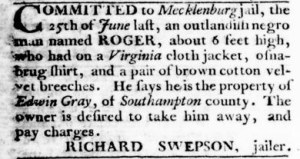
Virginia Gazette [Dixon and Hunter] (December 9, 1775)

**********
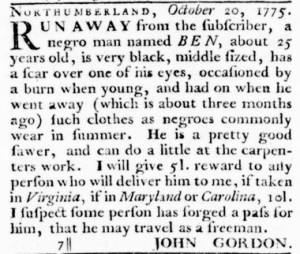
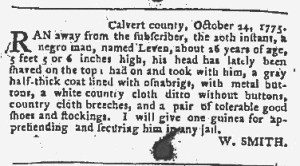
Virginia Gazette [Dixon and Hunter] (December 9, 1775)

**********
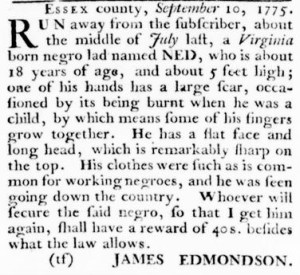
Virginia Gazette [Dixon and Hunter] (December 9, 1775)

**********
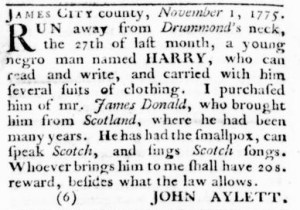
Virginia Gazette [Dixon and Hunter] (December 9, 1775)

**********
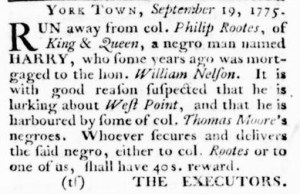
Virginia Gazette [Dixon and Hunter] (December 9, 1775)

**********
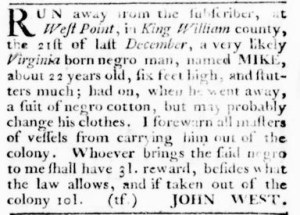
Virginia Gazette [Dixon and Hunter] (December 9, 1775)

**********
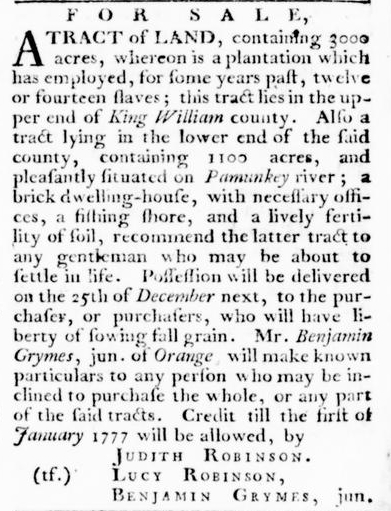
Virginia Gazette [Dixon and Hunter] (December 9, 1775)

**********
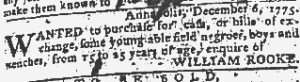
Virginia Gazette [Pinkney] (December 9, 1775)

**********
Virginia Gazette [Pinkney] (December 9, 1775)

December 8

What was advertised in a revolutionary American newspaper 250 years ago today?

Connecticut Gazette (December 8, 1775).

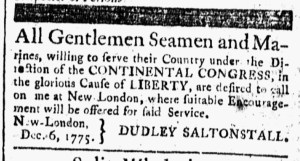
“All Gentlemen Seamen and Marines, willing to serve their Country … are desired to call on me.”

A variety of advertisements ran in the December 8, 1775, edition of the Connecticut Gazette.  Some marketed consumer goods and services, one described an indentured servant who ran away, one offered a “convenient Dwelling-House for Sale,” and a couple concerned strayed livestock.  The advertisement that appeared first after the news, however, was a recruiting notice.  A thick black line helped to draw attention to it, though that visual element that signified mourning was part of the memorial to “Mrs. FAITH HUNTINGTON, the late amiable Consort of Col. JEDEDIAH HUNTINGTON of Norwich … and greatly beloved Daughter of the Honorable Governor [Jonathan] TRUMBULL,” the only governor who supported the American cause at the beginning of the Revolutionary War.  The memorial attributed Huntington’s death to the distress she experienced during her husband’s absence from their home while he dedicated himself to military service, declaring that the “Authors of American Oppression and the public Calamity, are accountable for her death.”  That assertion may have helped rally readers to respond to the recruiting notice that appeared immediately after the memorial.  “All Gentlemen Seamen and Marines, willing to serve their Country under the Direction of the CONTINENTAL CONGRESS, in the glorious Cause of LIBERTY,” it proclaimed, “are desired to call on me at New-London, where suitable Encouragement will be offered for said Service.”  Dudley Saltonstall signed the notice.

Who was Dudley Saltonstall?  The finding aid for the Dudley Saltonstall Papers at the Penobscot Marine Museum notes that Saltonstall “sailed as a privateer during the Seven Years’ War.  At the beginning of the Revolutionary War, he was one of the first men commissioned by Connecticut as a Navy captain.”  His brother-in-law, Silas Deane, a delegate to the First Continental Congress and the Second Continental Congress, recommended Saltonstall.  He also had a career as a slave trader.  In 1779, he had command of an expedition “sent to dislodge the British from Castine, Maine.”  The Penobscot Expedition resulted in failure, the entire American fleet lost, and Saltonstall court martialed and dismissed from the Continental Navy.  Although Saltonstall is now best known for the Penobscot Expedition, at the time he placed this recruiting notice in the Connecticut Gazette he was putting together a crew for other ventures.  A few months later, he sailed for the Bahamas to acquire gunpowder.  The fleet captured Nassau, but only after the governor moved most of the gunpowder.

Slavery Advertisements Published December 8, 1775

GUEST CURATOR: Massimo Sgambati

The Slavery Adverts 250 Project chronicles the role of newspaper advertising in perpetuating slavery in the era of the American Revolution. The project seeks to reveal the ubiquity of slavery in eighteenth-century life from New England to Georgia by republishing advertisements about enslaved people – for sale as individuals or in groups, wanted to purchase or for hire for short periods, runaways who liberated themselves, and those who were subsequently captured and confined in jails and workhouses – in daily digests on this site as well as in real time via the @SlaveAdverts250 Twitter feed, utilizing twenty-first-century media to stand in for the print media of the eighteenth century.

The project aims to provide modern audiences with a sense of just how often colonizers encountered these advertisements in their daily lives. Enslaved men, women, and children appeared in print somewhere in the colonies almost every single day. Those advertisements served as a constant backdrop for social, cultural, economic, and political life in colonial and revolutionary America. Colonizers who did not purport to own enslaved people were still confronted with slavery as well as invited to maintain the system by purchasing enslaved men, women, and children or assisting in the capture of so-called “runaways” who sought to free themselves from bondage. The frequency of these newspaper advertisements suggests just how embedded slavery was in colonial and revolutionary American culture in everyday interactions beyond the printed page.

These advertisements also testify to the experiences of enslaved men, women, and children, though readers must consider that those experiences have been remediated through descriptions offered by enslavers rather than enslaved people themselves. Often unnamed in the advertisements, enslaved men, women, and children were not invisible or unimportant in early America.

From compiling an archive of digitized eighteenth-century newspapers to identifying advertisements about enslaved men, women, and children in those newspapers to preparing images of each advertisement to posting this daily digest, Massimo Sgambati served as guest curator for this entry. He completed this work as part of the Summer Scholars Program, funded by a fellowship from the D’Amour College of Liberal Arts and Sciences at Assumption University in Worcester, Massachusetts, in Summer 2025.

These advertisements appeared in colonial American newspapers 250 years ago today.

Connecticut Gazette (December 8, 1775)


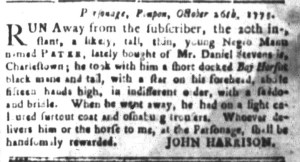
South-Carolina and American General Gazette (December 8, 1775)


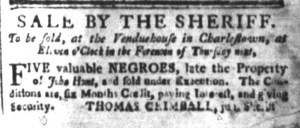
South-Carolina and American General Gazette (December 8, 1775)


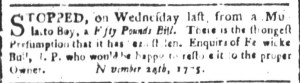
South-Carolina and American General Gazette (December 8, 1775)


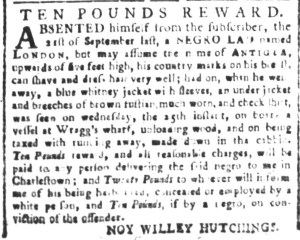
South-Carolina and American General Gazette (December 8, 1775)


South-Carolina and American General Gazette (December 8, 1775)


South-Carolina and American General Gazette (December 8, 1775)


South-Carolina and American General Gazette (December 8, 1775)


South-Carolina and American General Gazette (December 8, 1775)


South-Carolina and American General Gazette (December 8, 1775)


South-Carolina and American General Gazette (December 8, 1775)


South-Carolina and American General Gazette (December 8, 1775)


South-Carolina and American General Gazette (December 8, 1775)


South-Carolina and American General Gazette (December 8, 1775)


South-Carolina and American General Gazette (December 8, 1775)


South-Carolina and American General Gazette (December 8, 1775)


South-Carolina and American General Gazette (December 8, 1775)


South-Carolina and American General Gazette (December 8, 1775)


South-Carolina and American General Gazette (December 8, 1775)


South-Carolina and American General Gazette (December 8, 1775)


South-Carolina and American General Gazette (December 8, 1775)


South-Carolina and American General Gazette (December 8, 1775)


Virginia Gazette [Purdie] (December 8, 1775)

December 7

What was advertised in a revolutionary American newspaper 250 years ago today?

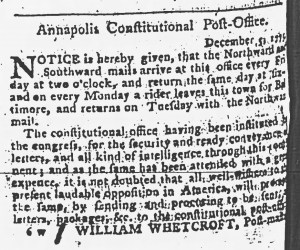
Maryland Gazette (December 7, 1775).

“Annapolis Constitutional Post-Office.”

In early December 1775, William Whetcroft became the latest postmaster to run a newspaper advertisement promoting a local branch of the Constitutional Post Office established by the Second Continental Congress.  In October, Mary Katharine Goddard placed a notice about the Baltimore office in the Maryland Journal.  Otherwise, advertisements for local branches appeared in newspapers published in New England, New York, and Pennsylvania, but not yet in newspapers from colonies south of Maryland.  The headline for this newest advertisement proclaimed, “Annapolis Constitutional Post-Office,” alerting readers of the Maryland Gazette that they had an alternative to the British imperial system.  Whetcroft commenced with an overview of his office’s schedule: “the Northward and Southward mail arrive at this office every Friday at two o’clock, and return the same day at six.”  In addition, “on Monday a rider leaves this town for Baltimore, and returns on Tuesday with the Northward mail.”

Yet Whetcroft used his advertisement to relay more than just the logistical details.  He gave an overview of the purpose that the Constitutional Post Office served as the imperial crisis intensified, hostilities commenced, and some colonizers considered whether they should declare independence rather than continue seeking redress of their grievances against Parliament.  “The constitutional office having been instituted by the congress,” the postmaster explained, “for the security and ready conveyance of letters, and all kinds of intelligence through this continent; and as the same has been attended with a great expence, it is not doubted that all well-wishers to the present laudable opposition in America, will promote the same, by sending and procuring to be sent all letters, packages, &c. to the constitutional post-office.”  Supporters of the American cause had a civic duty, Whetcroft asserted, to make use of this service.

Frederick Green, the printer of the Maryland Gazette, gave Whetcroft’s notice a privileged place the first time it appeared in that newspaper.  It appeared as the second advertisement following the news, preceded only by Green’s own advertisement for the almanac he just published and sold at the printing office.  As much as Green may have been a supporter of the Constitutional Post Office, he still had to earn his livelihood with his own endeavors!  Still, the printer had room for only two advertisements at the bottom of the final column on the second page.  He could have chosen from among several of a similar length to Whetcroft’s advertisement, yet he selected the notice about the Constitutional Post Office to appear alongside news of the revolutionary events taking place in Maryland and beyond.  In subsequent editions, that advertisement ran intermingled among others, but that was common practice for notices that printers initially gave privileged places the first time they ran in their newspapers.

Slavery Advertisements Published December 7, 1775

GUEST CURATOR: Massimo Sgambati

The Slavery Adverts 250 Project chronicles the role of newspaper advertising in perpetuating slavery in the era of the American Revolution. The project seeks to reveal the ubiquity of slavery in eighteenth-century life from New England to Georgia by republishing advertisements about enslaved people – for sale as individuals or in groups, wanted to purchase or for hire for short periods, runaways who liberated themselves, and those who were subsequently captured and confined in jails and workhouses – in daily digests on this site as well as in real time via the @SlaveAdverts250 Twitter feed, utilizing twenty-first-century media to stand in for the print media of the eighteenth century.

The project aims to provide modern audiences with a sense of just how often colonizers encountered these advertisements in their daily lives. Enslaved men, women, and children appeared in print somewhere in the colonies almost every single day. Those advertisements served as a constant backdrop for social, cultural, economic, and political life in colonial and revolutionary America. Colonizers who did not purport to own enslaved people were still confronted with slavery as well as invited to maintain the system by purchasing enslaved men, women, and children or assisting in the capture of so-called “runaways” who sought to free themselves from bondage. The frequency of these newspaper advertisements suggests just how embedded slavery was in colonial and revolutionary American culture in everyday interactions beyond the printed page.

These advertisements also testify to the experiences of enslaved men, women, and children, though readers must consider that those experiences have been remediated through descriptions offered by enslavers rather than enslaved people themselves. Often unnamed in the advertisements, enslaved men, women, and children were not invisible or unimportant in early America.

From compiling an archive of digitized eighteenth-century newspapers to identifying advertisements about enslaved men, women, and children in those newspapers to preparing images of each advertisement to posting this daily digest, Massimo Sgambati served as guest curator for this entry. He completed this work as part of the Summer Scholars Program, funded by a fellowship from the D’Amour College of Liberal Arts and Sciences at Assumption University in Worcester, Massachusetts, in Summer 2025.

These advertisements appeared in colonial American newspapers 250 years ago today.

Maryland Gazette (December 7, 1775)

**********
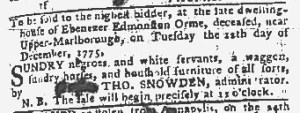
Maryland Gazette (December 7, 1775)

**********
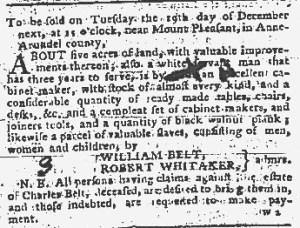
Maryland Gazette (December 7, 1775)

**********

Maryland Gazette (December 7, 1775)

**********

Maryland Gazette (December 7, 1775)

**********

Maryland Gazette (December 7, 1775)

**********

New-England Chronicle (December 7, 1775)

December 6

What was advertised in a revolutionary American newspaper 250 years ago today?

Pennsylvania Journal (December 6, 1775).

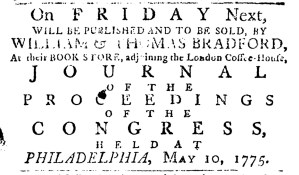
“JOURNAL OF THE PROCEEDINGS OF THE CONGRESS, HELD AT PHILADELPHIA, MAY 10, 1775.”

On Wednesday, December 6, 1775, William Bradford and Thomas Bradford, printers of the Pennsylvania Journal, announced that “On FRIDAY Next, WILL BE PUBLISHED … [the] JOURNAL OF THE PROCEEDINGS OF THE CONGRESS, HELD AT PHILADELPHIA, MAY 10, 1775.”  The contents of that volume covered the period from May 10 through August 1.  Throughout the colonies, readers had been able to follow news from the Second Continental Congress reprinted from newspaper to newspaper.  Local printers made editorial decisions about which items to include.  With this volume, however, readers gained access to the entire proceedings.  It supplemented the news they previously read or heard.  It also provided a convenient means of collecting the information in a single place, though some colonizers did save newspapers and one, Harbottle Dorr, even created an extensive index to aid him as he reviewed news of the imperial crisis that eventually became a revolution.

The Bradfords announced publication of the Journal of the Proceedings of the Congress in advance in hopes that the anticipation would incite demand.  They gave their advertisement a privileged place in their newspaper, placing it immediately after the news.  The “ARTICLES of CAPITULATION made and entered into between Richard Montgomery, Esq; Brigadier General of the Continental army, and the citizens and inhabitants of Montreal” on November 12 appeared in the column to the left of the Bradfords’ advertisement.  They may have hoped that news of an American victory in the two-pronged invasion of Canada that targeted Montreal and Quebec City would help to sell copies of the Journal of the Proceedings of the Congress.  In addition to publishing the journal documenting the first months of the Second Continental Congress, the Bradfords previously printed and advertised a complete journal of the proceedings of the First Continental Congress held in Philadelphia in September and October 1774.  Nearly as soon as that body adjourned, the Bradfords published and advertised a collection of Extracts that included “a List of Grievances” and the Continental Association, a nonimportation and nonconsumption agreement intended to use commercial leverage to achieve political goals.  Within a month of marketing the Extracts, the Bradfords made the complete journal available to the public.  These publications supplemented and expanded newspaper coverage of the debates and decisions made by delegates meeting in Philadelphia.

Slavery Advertisements Published December 6, 1775

GUEST CURATOR: Massimo Sgambati

The Slavery Adverts 250 Project chronicles the role of newspaper advertising in perpetuating slavery in the era of the American Revolution. The project seeks to reveal the ubiquity of slavery in eighteenth-century life from New England to Georgia by republishing advertisements about enslaved people – for sale as individuals or in groups, wanted to purchase or for hire for short periods, runaways who liberated themselves, and those who were subsequently captured and confined in jails and workhouses – in daily digests on this site as well as in real time via the @SlaveAdverts250 Twitter feed, utilizing twenty-first-century media to stand in for the print media of the eighteenth century.

The project aims to provide modern audiences with a sense of just how often colonizers encountered these advertisements in their daily lives. Enslaved men, women, and children appeared in print somewhere in the colonies almost every single day. Those advertisements served as a constant backdrop for social, cultural, economic, and political life in colonial and revolutionary America. Colonizers who did not purport to own enslaved people were still confronted with slavery as well as invited to maintain the system by purchasing enslaved men, women, and children or assisting in the capture of so-called “runaways” who sought to free themselves from bondage. The frequency of these newspaper advertisements suggests just how embedded slavery was in colonial and revolutionary American culture in everyday interactions beyond the printed page.

These advertisements also testify to the experiences of enslaved men, women, and children, though readers must consider that those experiences have been remediated through descriptions offered by enslavers rather than enslaved people themselves. Often unnamed in the advertisements, enslaved men, women, and children were not invisible or unimportant in early America.

From compiling an archive of digitized eighteenth-century newspapers to identifying advertisements about enslaved men, women, and children in those newspapers to preparing images of each advertisement to posting this daily digest, Massimo Sgambati served as guest curator for this entry. He completed this work as part of the Summer Scholars Program, funded by a fellowship from the D’Amour College of Liberal Arts and Sciences at Assumption University in Worcester, Massachusetts, in Summer 2025.

These advertisements appeared in colonial American newspapers 250 years ago today.

Maryland Journal (December 6, 1775)

**********

Maryland Journal (December 6, 1775)

**********

Virginia Gazette [Pinkney] (December 6, 1775)

December 5

What was advertised in a revolutionary American newspaper 250 years ago today?

New-Hampshire Gazette (December 5, 1775).

“Shopkeepers are cautioned, not to advance on their Goods, which is contrary to the Resolves of the Continental Congress.”

The December 5, 1775, edition of the New-Hampshire Gazette consisted of only two pages rather than the usual four.  That limited the amount of news and advertising that the printer, Daniel Fowle, could disseminate to readers, yet that issue carried good news that the “Printing Press is now again removed from Greenland to Portsmouth.”  Fowle had moved his press to Greenland, about six miles from Portsmouth, to protect it from an anticipated British attack on New Hampshire’s most important port.  In early December, he moved his press back to Portsmouth, “into an old Building adjoining the late Printing-Office … where it is hop’d the Types will remain undisturb’d, as this Harbour is so well fortified that any Enemy must pass thro’ a Hell of Fire, intermix’d with Brimstone, Pitch Tar, Turpentine, and almost every Sort of Combustible Matter to make the Passage dreadful.”

Yet enemies to the American cause did not approach Portsmouth solely by sea.  Some enemies resided in the port and nearby towns, undermining efforts to resist British tyranny through their actions in the marketplace rather than on the battlefield.  At the bottom of the last column on the last page, Fowle concluded that issue of the New-Hampshire Gazettewith a warning published “By desire” of a correspondent that “Shopkeepers are cautioned, not to advance on their Goods, which is contrary to the Resolves of the Continental Congress.”  The correspondent invoked the ninth article of the Continental Association, a nonimportant agreement devised by the First Continental Congress that went into effect on December 1, 1774.  That article stated that “such as are Venders of Goods or Merchandise will not take Advantage of the Scarcity of Goods that may be occasioned by this Association, but will sell the same at the Rates we have been respectively accustomed to do for twelve months past.”  Some shopkeepers in and near Portsmouth apparently considered charging an “Advance” (or markup) on their wares, prompting the patriotic correspondent to remind them of the Continental Association and the consequences they faced.  That would be their only warning because “if they do [raise prices], their Names will be return’d to the Congress ad publish’d, without further Notice.”  Once that happened, the ninth article specified that “if any Venders of Goods or Merchandise shall sell any such Goods on higher Terms … no Person ought, nor will any of us deal with any such Person … at any Time thereafter, for any Commodity whatever.”  That issue carried only two advertisements from local retailers, yet the address applied to all the shopkeepers in the vicinity.

December 4

What was advertised in a revolutionary American newspaper 250 years ago today?

Connecticut Courant (December 4, 1775).

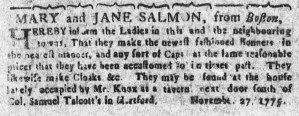
“Newest fashioned Bonnets … at the same reasonable prices that they have been accustomed to in times past.”

When they relocated to Hartford, milliners Mary Salmon and Jane Salmon placed an advertisement in the December 4, 1775, edition of the Connecticut Courant to introduce themselves to their new neighbors and, especially, to prospective customers.  They informed “the Ladies in this and the neighbouring towns, That they make the newest fashioned Bonnets in the neatest manner, and any sort of Caps.”  They also noted that they “make Cloaks” and other garments.  The milliners hoped to establish a clientele and earn their livelihood in a town new to them.  In the headline for their advertisement, they described themselves as “from Boston.”  The Salmons were not the only newcomers from Boston who ran an advertisement in that issue of the Connecticut Courant.  James Lamb and Son, tailors “From Boston” who had previously inserted a notice in that newspaper in September, ran a new advertisement that appeared in the same column as the Salmons’ notice.  Like the Lambs, the Salmons may have been refugees who left Boston following the outbreak of hostilities at Lexington and Concord in the spring.

In marketing their wares, the Salmons did not allow the difficulties of the war to overshadow prospective customers’ desire for hats that followed the latest styles.  They intentionally declared that they made “the newest fashioned Bonnets” and did so “in the neatest manner.”  They combined appeals to taste with a pledge about the quality of their hats and their skill as milliners.  The Salmons also incorporated promises regarding price into their brief advertisement, asserting that they charged “the same reasonable prices that [prospective customers] have been accustomed to in times past.”  The disruptions caused by the war did not cause them to raise prices.  In addition, they made a nod to the ninth article of the Continental Association: “That such as are Venders of Goods or Merchandise will not take Advantage of the Scarcity of Goods that may be occasioned by this Association, but will sell the same at the Rates we have been respectively accustomed to do so for twelve Months last past.”  The Salmons could not rely on their reputation among an existing clientele to generate business as they had done in Boston.  Instead, they devised an advertisement that said a lot in just a few lines, deploying appeals to fashion, quality, skill, and price.  They may have also expected that current events would resonate with their notice, anticipating that prospective customers would realize why they moved from Boston and their commitment to abiding by the Continental Association.

Slavery Advertisements Published December 4, 1775

GUEST CURATOR: Massimo Sgambati

The Slavery Adverts 250 Project chronicles the role of newspaper advertising in perpetuating slavery in the era of the American Revolution. The project seeks to reveal the ubiquity of slavery in eighteenth-century life from New England to Georgia by republishing advertisements about enslaved people – for sale as individuals or in groups, wanted to purchase or for hire for short periods, runaways who liberated themselves, and those who were subsequently captured and confined in jails and workhouses – in daily digests on this site as well as in real time via the @SlaveAdverts250 Twitter feed, utilizing twenty-first-century media to stand in for the print media of the eighteenth century.

The project aims to provide modern audiences with a sense of just how often colonizers encountered these advertisements in their daily lives. Enslaved men, women, and children appeared in print somewhere in the colonies almost every single day. Those advertisements served as a constant backdrop for social, cultural, economic, and political life in colonial and revolutionary America. Colonizers who did not purport to own enslaved people were still confronted with slavery as well as invited to maintain the system by purchasing enslaved men, women, and children or assisting in the capture of so-called “runaways” who sought to free themselves from bondage. The frequency of these newspaper advertisements suggests just how embedded slavery was in colonial and revolutionary American culture in everyday interactions beyond the printed page.

These advertisements also testify to the experiences of enslaved men, women, and children, though readers must consider that those experiences have been remediated through descriptions offered by enslavers rather than enslaved people themselves. Often unnamed in the advertisements, enslaved men, women, and children were not invisible or unimportant in early America.

From compiling an archive of digitized eighteenth-century newspapers to identifying advertisements about enslaved men, women, and children in those newspapers to preparing images of each advertisement to posting this daily digest, Massimo Sgambati served as guest curator for this entry. He completed this work as part of the Summer Scholars Program, funded by a fellowship from the D’Amour College of Liberal Arts and Sciences at Assumption University in Worcester, Massachusetts, in Summer 2025.

These advertisements appeared in colonial American newspapers 250 years ago today.

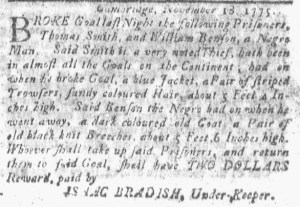
Boston Gazette (December 4, 1775)

**********

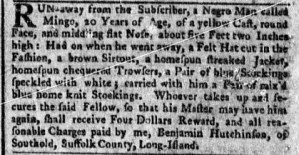
New-York Gazette and Weekly Mercury (December 4, 1775)

**********

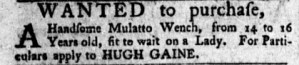
New-York Gazette and Weekly Mercury (December 4, 1775)

**********

New-York Gazette and Weekly Mercury (December 4, 1775)

**********

New-York Gazette and Weekly Mercury (December 4, 1775)

**********

New-York Gazette and Weekly Mercury (December 4, 1775)