January 17

What was advertised in a revolutionary American newspaper 250 years ago today?
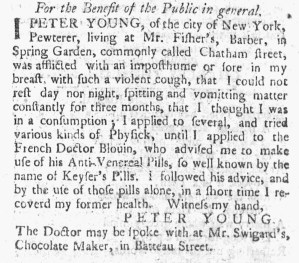
Constitutional Gazette (January 17, 1776).

“I applied to the French Doctor Blouin, who advised me to make use of his Anti-Venereal Pills.”

Peter Young, a pewterer in New York, went through quite an ordeal.  According to the advertisement he placed in the January 17, 1776, edition of the Constitutional Gazette, he “was afflicted with an imposthume or sore in my breast, with such a violent cough, that I could not rest day or night.”  In addition, he was “spitting and vomitting matter constantly for three months,” so much so that he thought he “was in a consumption.”  Young sought out medical assistance from several providers and “tried various kinds of Physick,” but none of them could alleviate the disorder that he suffered … at least not until he “applied to the French Doctor Blouin.”  That doctor advised Young “to make use of his Anti-Venereal Pills, so well known by the name of Keyser’s Pills.”  The pewterer followed Blouin’s advice and “by the use of those pills alone, in a short time [he] recovered [his] former health.”

According to the advertisement’s header, Young inserted his testimonial in the Constitutional GazetteFor the Benefit of the Public in general.”  Beneath his signature, a note advised, “The Doctor may be spoke with at Mr. Swigard’s, Chocolate Maker, in Batteau Street.”  The advertisement gave no indication about who added that note.  It could have been Young or it could have been John Anderson, the printer of the Constitutional Gazette, out of his own desire to assist the public.  Most likely, Blouin added that detail and engineered publishing the testimonial while seeking to make it appear that Young published it independently.  After all, if Young pursued that course on his own, solely “For the Benefit of the Public in general,” that made the recommendation even more noteworthy for readers who hoped for relief from similar symptoms.  Blouin previously placed advertisements in the Constitutional Gazette, introducing himself and his pills “TO THE PUBLIC.”  Young’s testimonial supplemented his previous marketing efforts.
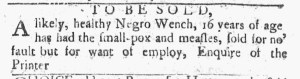
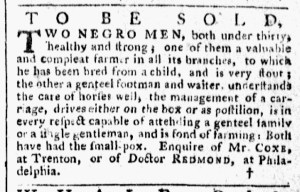
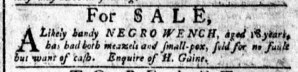
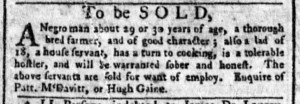
Slavery Advertisements Published January 17, 1776

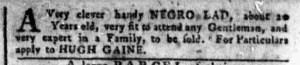
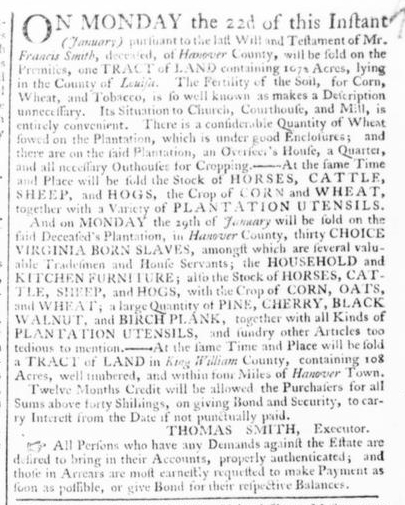
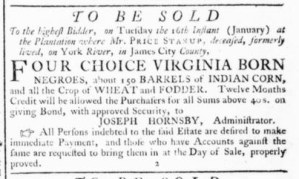
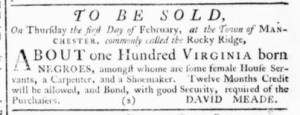
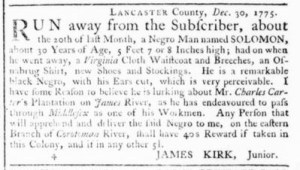
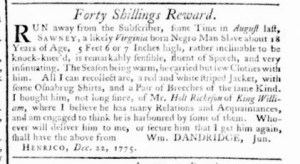
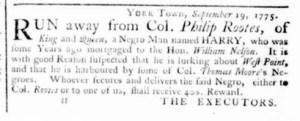
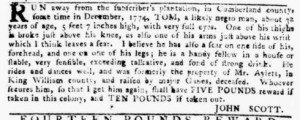
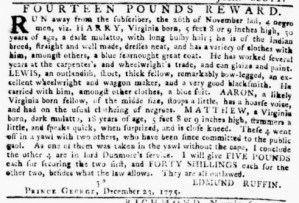
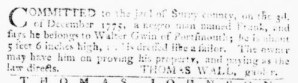
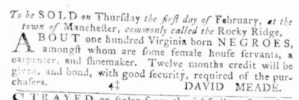
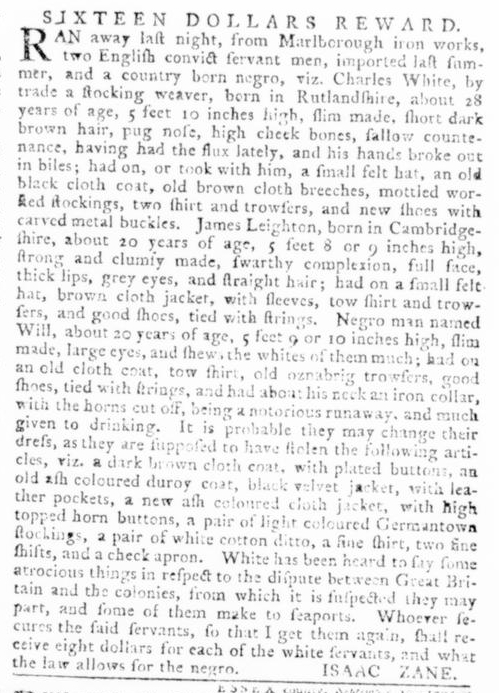
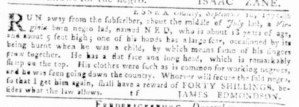
The Slavery Adverts 250 Project chronicles the role of newspaper advertising in perpetuating slavery in the era of the American Revolution. The project seeks to reveal the ubiquity of slavery in eighteenth-century life from New England to Georgia by republishing advertisements about enslaved people – for sale as individuals or in groups, wanted to purchase or for hire for short periods, runaways who liberated themselves, and those who were subsequently captured and confined in jails and workhouses – in daily digests on this site as well as in real time via the @SlaveAdverts250 Twitter feed, utilizing twenty-first-century media to stand in for the print media of the eighteenth century.

The project aims to provide modern audiences with a sense of just how often colonizers encountered these advertisements in their daily lives. Enslaved men, women, and children appeared in print somewhere in the colonies almost every single day. Those advertisements served as a constant backdrop for social, cultural, economic, and political life in colonial and revolutionary America. Colonizers who did not purport to own enslaved people were still confronted with slavery as well as invited to maintain the system by purchasing enslaved men, women, and children or assisting in the capture of so-called “runaways” who sought to free themselves from bondage. The frequency of these newspaper advertisements suggests just how embedded slavery was in colonial and revolutionary American culture in everyday interactions beyond the printed page.

These advertisements also testify to the experiences of enslaved men, women, and children, though readers must consider that those experiences have been remediated through descriptions offered by enslavers rather than enslaved people themselves. Often unnamed in the advertisements, enslaved men, women, and children were not invisible or unimportant in early America.

Massimo Sgambati made significant contributions to this entry as part of the Summer Scholars Program, funded by a fellowship from the D’Amour College of Liberal Arts and Sciences at Assumption University in Worcester, Massachusetts, in Summer 2025.

These advertisements appeared in revolutionary American newspapers 250 years ago today.

Constitutional Gazette (January 17, 1776).

**********

Maryland Journal (January 17, 1776).

**********

Pennsylvania Journal (January 17, 1776).

**********

Pennsylvania Journal (January 17, 1776).

January 16

What was advertised in a revolutionary American newspaper 250 years ago today?

Henrich Millers Pennsylvanischer Staatsbote (January 16, 1776).

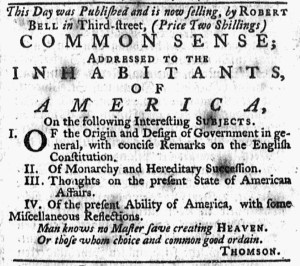
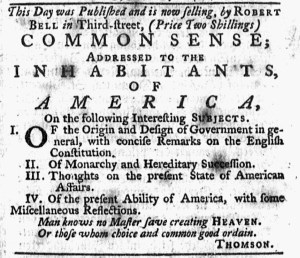
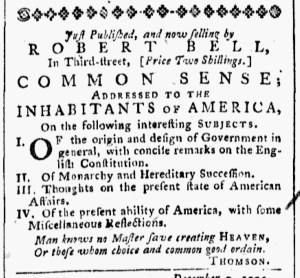
“COMMON SENSE; ADDRESSED TO THE INHABITANTS OF AMERICA.”

On January 16, 1776, Robert Bell’s advertisement for the first edition of Thomas Paine’s Comon Sense made its third appearance in the Pennsylvania Evening Post.  That newspaper, the only triweekly published in Philadelphia at the time, was the first to carry Bell’s advertisement.  It ran on January 9, 13, and 16, but not on January 11.  During that week, Bell also inserted an advertisement for Common Sense in each of the other five newspapers printed in Philadelphia at the time. On January 16, Henrich Millers Pennsylvanische Staatsbote was the last to feature it, the only advertisement in that newspaper printed in English rather than German.  Bell, already known for his savvy marketing, made sure that German settlers who could read English saw the political pamphlet advertised in the newspaper they were most likely to consult.

By that time, many of them may have already heard about the incendiary Common Sense, the way it mocked monarchy, and the arguments it made in favor of the colonies declaring independence.  Throughout most of the imperial crisis, colonizers blamed Parliament for perpetrating various abuses.  They sought redress for their grievances from the king. Over time, however, many identified George III as the author of their misfortune.  The monarch, after all, possessed ultimate responsibility for what occurred in his realm.  The Declaration of Independence listed more than two dozen grievances, assigning them all to the king rather than Parliament.  The publication of Common Sense in January 1776 played a significant role in shifting attitudes about the role the king played in the imperial crisis and the war that began with the skirmishes at Lexington and Concord in April 1775.

Among the observations and arguments that Paine advanced, he stated that “in America THE LAW IS KING.  For as in absolute governments, the King is law, so in free countries the law ought to be King and there ought to be no other.”  It was an ideal embraced by the founding generation … and it is an ideal under threat today as the nation commemorates 250 years since the Revolutionary War and the Declaration of Independence.  Citizens and the legislators who represent them must hold those who seek to be absolute rulers accountable to the rule of law so the republic remains a place where “THE LAW IS KING.”

Advertisements for Common Sense Published January 16, 1776

Historians consider Thomas Paine’s Common Sense, published anonymously on January 9, 1776, the most influential political pamphlet that circulated in the colonies during the era of the American Revolution.  Written in plain language accessible to readers of all backgrounds, the pamphlet made a bold case for declaring independence at a time that many colonizers still sought a redress their grievances by George III and Parliament.  Paine’s pamphlet played a vital role in swaying public opinion in favor of declaring independence.

Common Sense was an eighteenth-century bestseller, though Paine wildly overestimated how many copies were published, claiming 150,000 circulated in 1776, and historians later made even more dubious claims that American printing presses produced as many as 500,000 copies.  Contrary to those exaggerations, American printers most likely published between 35,000 and 50,000 copies in 1776.  Scholars have identified twenty-five American editions, more than twice as many as any other American book or pamphlet published in the eighteenth century.

Colonizers certainly discussed Paine’s pamphlet … and printers, booksellers, and others advertised it widely.  As a special feature, the Adverts 250 Project chronicles those advertisements, starting with newspaper notices for Robert Bell’s first edition published in Philadelphia and then subsequent advertisements for that and other editions published and sold throughout the colonies.

These advertisements for Common Sense appeared in American newspapers 250 years ago today.

Henrich Millers Pennsylvanischer Staatsbote (January 16, 1776).

**********

Pennsylvania Evening Post (January 16, 1776).

January 15

What was advertised in a revolutionary American newspaper 250 years ago today?

New-York Gazette and Weekly Mercury (January 15, 1776).

“Dr. Hill’s American Balsam; whose great efficacy is so well known.”

Nine months after his advertisements first appeared in newspapers in New York, shopkeeper Michael Hoffman continued receiving shipments of “DOCTOR HILL’s newly improved great STOMACHIC TINCTURE” and “Dr. Hill’s American Balsam” from an associate in Philadelphia.  His advertisement in the January 15, 1776, edition of the New-York Gazette and Weekly Mercury echoed the one he previously placed in the May 4, 1775, edition of the New-York Journal, though it featured slightly different copy.  Hoffman reminded prospective customers that the tincture was “a very excellent medicine for all weak stomach, as it procures a good healthy appetite, and a sound digestion.”  In addition, it supposedly prevented all sorts of diseases since most, according to the advertisement, “have their origin contracted in a weak stomach.”  The balsam, on the other hand, “is so well known to cure the most inveterate disorder in the breast, as shortness of breath, colds, coughs, and whooping coughs in children.”  Yet that was not all!  Through “a proper use and continuing the same a reasonable time,” the balsam “effectually cured … the most painful rhumatisms, cholic, gravel [kidney stones] and consumption.”

Yet Hoffman did not promote just the efficacy of these patent medicines.  In his effort to attract customers, he assured them that “Doctor Hill’s own directions, printed in London, are wrapt about each bottle” to prevent confusion about the dosage once they took the medicines home.  Those directions, however, included the price in “sterling money,” but Hoffman’s customers could ignore that.  He had worked out a deal for bargain pricing for the benefit of “the poor and indigent” in New York.  In that city, the medicines sold for four shilling and ten pence per bottle.  Even better, those who bought a dozen bottles received a discount, only four shillings and four pence per bottle.  Those customers saved ten percent, a good deal for those who intended to follow Hoffman’s directions to continue taking the medicine for “a reasonable time.”  As had been the case all along, Hoffman had an exclusive appointment to sell Dr. Hill’s tincture and balsam in New York.  He directed customers to his shop “in the Broad-Way, near the Oswego-Market” so they could avoid counterfeits peddled elsewhere.

Slavery Advertisements Published January 15, 1776

The Slavery Adverts 250 Project chronicles the role of newspaper advertising in perpetuating slavery in the era of the American Revolution. The project seeks to reveal the ubiquity of slavery in eighteenth-century life from New England to Georgia by republishing advertisements about enslaved people – for sale as individuals or in groups, wanted to purchase or for hire for short periods, runaways who liberated themselves, and those who were subsequently captured and confined in jails and workhouses – in daily digests on this site as well as in real time via the @SlaveAdverts250 Twitter feed, utilizing twenty-first-century media to stand in for the print media of the eighteenth century.

The project aims to provide modern audiences with a sense of just how often colonizers encountered these advertisements in their daily lives. Enslaved men, women, and children appeared in print somewhere in the colonies almost every single day. Those advertisements served as a constant backdrop for social, cultural, economic, and political life in colonial and revolutionary America. Colonizers who did not purport to own enslaved people were still confronted with slavery as well as invited to maintain the system by purchasing enslaved men, women, and children or assisting in the capture of so-called “runaways” who sought to free themselves from bondage. The frequency of these newspaper advertisements suggests just how embedded slavery was in colonial and revolutionary American culture in everyday interactions beyond the printed page.

These advertisements also testify to the experiences of enslaved men, women, and children, though readers must consider that those experiences have been remediated through descriptions offered by enslavers rather than enslaved people themselves. Often unnamed in the advertisements, enslaved men, women, and children were not invisible or unimportant in early America.

Massimo Sgambati made significant contributions to this entry as part of the Summer Scholars Program, funded by a fellowship from the D’Amour College of Liberal Arts and Sciences at Assumption University in Worcester, Massachusetts, in Summer 2025.

These advertisements appeared in revolutionary American newspapers 250 years ago today.

Dunlap’s Pennsylvania Packet (January 15, 1776).

**********

New-York Gazette and Weekly Mercury (January 15, 1776).

**********

New-York Gazette and Weekly Mercury (January 15, 1776).

**********

New-York Gazette and Weekly Mercury (January 15, 1776).

**********

New-York Gazette and Weekly Mercury (January 15, 1776).

**********

New-York Gazette and Weekly Mercury (January 15, 1776).

Advertisements for Common Sense Published January 15, 1776

Historians consider Thomas Paine’s Common Sense, published anonymously on January 9, 1776, the most influential political pamphlet that circulated in the colonies during the era of the American Revolution.  Written in plain language accessible to readers of all backgrounds, the pamphlet made a bold case for declaring independence at a time that many colonizers still sought a redress their grievances by George III and Parliament.  Paine’s pamphlet played a vital role in swaying public opinion in favor of declaring independence.

Common Sense was an eighteenth-century bestseller, though Paine wildly overestimated how many copies were published, claiming 150,000 circulated in 1776, and historians later made even more dubious claims that American printing presses produced as many as 500,000 copies.  Contrary to those exaggerations, American printers most likely published between 35,000 and 50,000 copies in 1776.  Scholars have identified twenty-five American editions, more than twice as many as any other American book or pamphlet published in the eighteenth century.

Colonizers certainly discussed Paine’s pamphlet … and printers, booksellers, and others advertised it widely.  As a special feature, the Adverts 250 Project chronicles those advertisements, starting with newspaper notices for Robert Bell’s first edition published in Philadelphia and then subsequent advertisements for that and other editions published and sold throughout the colonies.

These advertisements for Common Sense appeared in American newspapers 250 years ago today.

Dunlap’s Pennsylvania Packet (January 15, 1776).

January 14

What was advertised in a revolutionary American newspaper 250 years ago this week?

New-Hampshire Gazette (January 9, 1776).

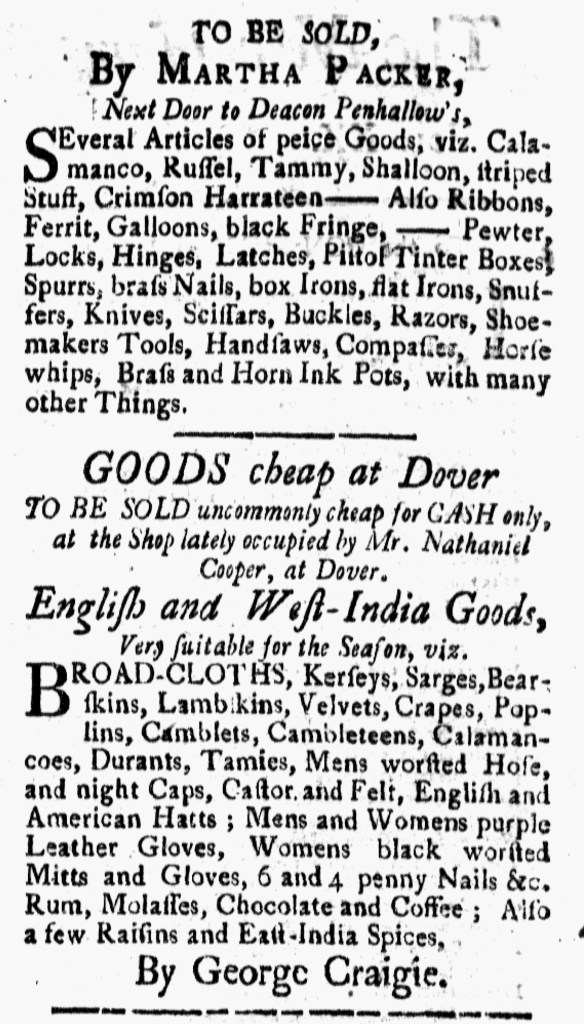
English and West-India Goods, Very suitable for the Season.”

In January 1776, Martha Packer ran a shop “Next Door to Deacon Penhallow’s” in Portsmouth.  According to her advertisement in the January 9 edition of the New-Hampshire Gazette, she stocked several kinds of textiles, ribbons, hardware, horse whips, ink pots, and “many other things.”  Immediately below her notice, George Craigie promoted “GOODS cheap at Dover TO BE SOLD uncommonly cheap.”  His inventory of “English and West-India Goods” included textiles, hats, gloves, rum, molasses, chocolate, and coffee.  Both advertisements looked much like those that ran in the New-Hampshire Gazette and other colonial newspapers before the Revolutionary War began.

Although those advertisements looked like business as usual, that was far from the case for the New-Hampshire Gazette.  Daniel Fowle, the printer, experienced disruptions in his supply of paper and, for a brief period in the fall of 1775, moved the press to Greenland when rumors circulated about a possible British attack on Portsmouth.  The issue that carried Packer’s and Craigie’s advertisements was the last one published for more than two years.  Edward Connery Lathem gives a brief overview in his Chronological Tables of American Newspapers, 1690-1820, noting that the New-Hampshire Gazette was suspended on January 9, 1776, and resumed on June 16, 1778.[1]  In his History and Bibliography of American Newspapers, 1690-1820, Clarence S. Brigham offers a more complete overview.[2]  He states that the January 9, 1776, issue featured “a communication strongly attacking independency.”  In turn, on January 17, “the New Hampshire House of Representatives ‘Voted that Daniel Fowle Esqr the Supposed Printer of said Paper be forthwith Sent for and ordered to Appear before this house and give an account of the Author of said Piece, and further to answer for his Printing said piece.’”  Brigham does not, however, indicate that displeasure with that editorial caused the suspension.  For his part, Isaiah Thomas, a Patriot printer and contemporary of Fowle, thought that the New-Hampshire Gazette “was not remarkable in its political features; but its general complexion was favorable to the cause of the country” when he discussed the newspaper in his History of Printing in America in 1810.[3]  Neither Thomas nor Brigham reported why Fowle suspended the New-Hampshire Gazette.  It may have simply been the difficulty of continuing the newspaper during the war.  Whatever the reason, the New-Hampshire Gazette, which has sometimes been disproportionately represented in this project, will disappear from the Adverts 250 Project for a while, but it will not be long before the project features advertisements from other newspapers established in New-Hampshire during the war.  For instance, Benjamin Dearborn commenced publishing the Freeman’s Journal, or New-Hampshire Gazette in Portsmouth on May 25, 1776.

**********

[1] Edward Connery Lathem, Chronological Tables of American Newspapers, 1690-1802 (American Antiquarian Society and Barre Publishers, 1972), 11.

[2] Clarence S. Brigham, History and Bibliography of American Newspapers, 1690-1820 (American Antiquarian Society, 1947), 471-473.

[3] Isaiah Thomas, The History of Printing in America: With a Biography of Printers and an Account of Newspapers (1810; Weathervane Books, 1970), 335.

January 13

What was advertised in a revolutionary American newspaper 250 years ago today?

Pennsylvania Ledger (January 13, 1776).

“COMMON SENSE; ADDRESSED TO THE INHABITANTS OF AMERICA.”

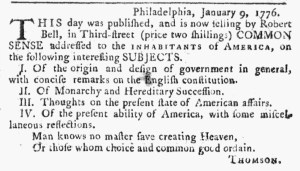
Robert Bell, one of the most prominent printers and booksellers in America, already had experience with extensive advertising campaigns by the time he published and marketed Thomas Paine’s Common Sense in January 1776.  Within a week, Bell inserted advertisements for what would become the most influential political pamphlet of the era of the American Revolution in all six newspapers printed in Philadelphia.

He started with the Pennsylvania Evening Post on January 9, then placed nearly identical advertisements in the Pennsylvania Gazette and the Pennsylvania Journal on January 10.  On January 13, the advertisement ran in the Pennsylvania Ledger (and once again in the Pennsylvania Evening Post, the city’s only triweekly rather than weekly newspaper).  Bell also ran the advertisement in Dunlap’s Pennsylvania Packet on January 15.  His notice had a privileged place in Pennsylvania Ledger (the first item in the first column on the first page) and Dunlap’s Pennsylvania Packet (the first advertisement following the news).

Even the Henrich Millers Pennsylvanischer Staaatsbote carried the advertisement on January 16, one week after Bell’s first advertisement appeared in the Pennsylvania Evening Post.  It was the only advertisement in English, even though the newspaper’s masthead advised that “All ADVERTISEMENTS to be inserted in this Paper, or printed single by HENRY MILLER, Publisher hereof, are by him translated gratis.”  Perhaps, since the pamphlet had not yet been translated into German, Bell instructed Miller to publish the advertisement in English to entice bilingual German colonizers.  Later in 1776, Melchior Steiner and Carl Cist, who had recently advertised that they printed in English, German, and other languages, published a German translation, Gesunde Vernunft.

The arguments and ideas that Paine presented in Common Sense caused a popular uproar.  Steiner and Cist’s German translation was only one of many local editions; printers in other cities and towns, especially in New York and New England, produced and advertised their own editions of the pamphlet.  Yet neither Paine nor Bell knew in advance that Common Sense would have such a reception.  It was not long before the author and the publisher had a falling out, causing Paine to work with William Bradford and Thomas Bradford, the printers of the Pennsylvania Journal, on the second edition.  Before that, however, Bell applied his long experience advertising books to promoting Common Sense in the public prints when he published the first edition.

Slavery Advertisements Published January 13, 1776

The Slavery Adverts 250 Project chronicles the role of newspaper advertising in perpetuating slavery in the era of the American Revolution. The project seeks to reveal the ubiquity of slavery in eighteenth-century life from New England to Georgia by republishing advertisements about enslaved people – for sale as individuals or in groups, wanted to purchase or for hire for short periods, runaways who liberated themselves, and those who were subsequently captured and confined in jails and workhouses – in daily digests on this site as well as in real time via the @SlaveAdverts250 Twitter feed, utilizing twenty-first-century media to stand in for the print media of the eighteenth century.

The project aims to provide modern audiences with a sense of just how often colonizers encountered these advertisements in their daily lives. Enslaved men, women, and children appeared in print somewhere in the colonies almost every single day. Those advertisements served as a constant backdrop for social, cultural, economic, and political life in colonial and revolutionary America. Colonizers who did not purport to own enslaved people were still confronted with slavery as well as invited to maintain the system by purchasing enslaved men, women, and children or assisting in the capture of so-called “runaways” who sought to free themselves from bondage. The frequency of these newspaper advertisements suggests just how embedded slavery was in colonial and revolutionary American culture in everyday interactions beyond the printed page.

These advertisements also testify to the experiences of enslaved men, women, and children, though readers must consider that those experiences have been remediated through descriptions offered by enslavers rather than enslaved people themselves. Often unnamed in the advertisements, enslaved men, women, and children were not invisible or unimportant in early America.

Massimo Sgambati made significant contributions to this entry as part of the Summer Scholars Program, funded by a fellowship from the D’Amour College of Liberal Arts and Sciences at Assumption University in Worcester, Massachusetts, in Summer 2025.

These advertisements appeared in revolutionary American newspapers 250 years ago today.

Pennsylvania Ledger (January 13, 1776).

**********

Virginia Gazette [Dixon and Hunter] (January 13, 1776).

**********

Virginia Gazette [Dixon and Hunter] (January 13, 1776).

**********

Virginia Gazette [Dixon and Hunter] (January 13, 1776).

**********

Virginia Gazette [Dixon and Hunter] (January 13, 1776).

**********

Virginia Gazette [Dixon and Hunter] (January 13, 1776).

**********

Virginia Gazette [Dixon and Hunter] (January 13, 1776).

**********

Virginia Gazette [Pinkney] (January 13, 1776).

**********

Virginia Gazette [Pinkney] (January 13, 1776).

**********

Virginia Gazette [Pinkney] (January 13, 1776).

**********

Virginia Gazette [Pinkney] (January 13, 1776).

**********

Virginia Gazette [Pinkney] (January 13, 1776).

**********

Virginia Gazette [Pinkney] (January 13, 1776).