Historians consider Thomas Paine’s Common Sense, published anonymously on January 9, 1776, the most influential political pamphlet that circulated in the colonies during the era of the American Revolution. Written in plain language accessible to readers of all backgrounds, the pamphlet made a bold case for declaring independence at a time that many colonizers still sought a redress their grievances by George III and Parliament. Paine’s pamphlet played a vital role in swaying public opinion in favor of declaring independence.
Common Sense was an eighteenth-century bestseller, though Paine wildly overestimated how many copies were published, claiming 150,000 circulated in 1776, and historians later made even more dubious claims that American printing presses produced as many as 500,000 copies. Contrary to those exaggerations, American printers most likely published between 35,000 and 50,000 copies in 1776. Scholars have identified twenty-five American editions, more than twice as many as any other American book or pamphlet published in the eighteenth century.
Colonizers certainly discussed Paine’s pamphlet … and printers, booksellers, and others advertised it widely. As a special feature, the Adverts 250 Projectchronicles those advertisements, starting with newspaper notices for Robert Bell’s first edition published in Philadelphia and then subsequent advertisements for that and other editions published and sold throughout the colonies.
These advertisements for Common Sense appeared in American newspapers 250 years ago today.
What was advertised in a revolutionary American newspaper 250 years ago today?
Connecticut Gazette (January 12, 1776).
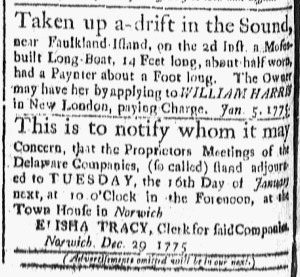
“(Advertisements omitted will be in our next.)”
Instead of the usual four pages, the January 12, 1776, edition of the Connecticut Gazette consisted of only two pages. Most issues of colonial newspapers had four pages, created by printing two pages on each side of a broadsheet and folding it in half. Timothy Green, the printer of the Connecticut Gazette, had only enough paper that he was forced to condense the contents to a half sheet, one page printed on each side. He certainly was not the only printer to experience a disruption in his paper supply during the first year of the Revolutionary War.
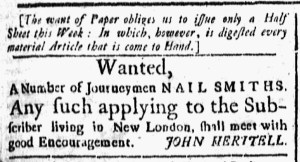
Green acknowledged the situation with a note that appeared at the top of the first column on the first page: “[The want of Paper obliges us to issue only a Half Sheet this Week: In which, however, is digested every material Article that is come to Hand.]” In other words, subscribers and other readers did not need to worry that they missed important news because Green did not have enough space to print it. Instead, he carefully undertook his duties as an editor to include everything of importance received in the printing office since the previous week’s issue of the Connecticut Gazette. The small font for news items, smaller than the font used for advertisements, also allowed Green to squeeze a significant amount of content into just two pages.
Connecticut Gazette (January 12, 1776).
What about the advertisements? Only three paid notices appeared in that issue, one for “Journeyman NAIL SMITHS” immediately below the printer’s note on the first page and two more at the bottom of the final column on the second page. The printer concluded the issue with a brief note: “(Advertisements omitted will be in our next.)” Green assured advertisers, especially those who paid in advance of publication, that the Connecticut Gazette would indeed disseminate their notices. In this instance, however, he prioritized the needs of subscribers (many of whom did not make timely payments) and other readers (who did not pay the printer at all) over advertisers (who comprised an important revenue stream). It was a careful balancing act for all colonial printers as they served multiple constituencies simultaneously. For this issue, Green considered keeping subscribers and the rest of the public informed about “The King’s SPEECH, to both Houses of Parliament, October 26, 1775,” and news from London, Philadelphia, New York, Newport, Worcester, and Watertown (where the Continental Army continued the siege of Boston) more important than publishing many of the advertisements submitted to his printing office.
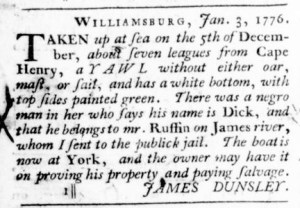
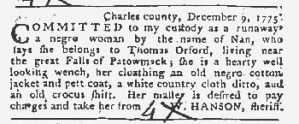
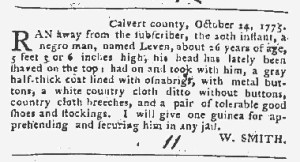
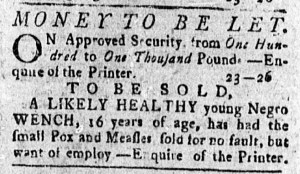
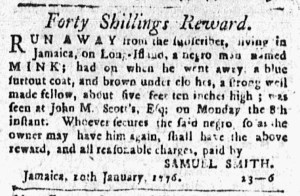
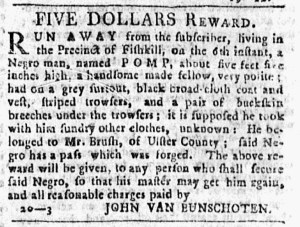
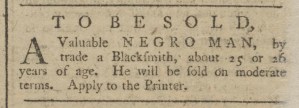
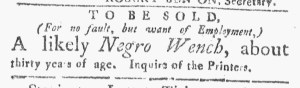
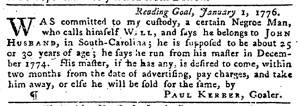
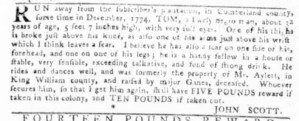
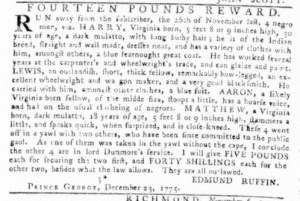
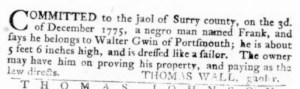
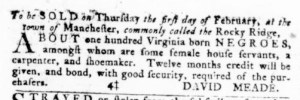
The Slavery Adverts 250 Project chronicles the role of newspaper advertising in perpetuating slavery in the era of the American Revolution. The project seeks to reveal the ubiquity of slavery in eighteenth-century life from New England to Georgia by republishing advertisements about enslaved people – for sale as individuals or in groups, wanted to purchase or for hire for short periods, runaways who liberated themselves, and those who were subsequently captured and confined in jails and workhouses – in daily digests on this site as well as in real time via the @SlaveAdverts250 Twitter feed, utilizing twenty-first-century media to stand in for the print media of the eighteenth century.
The project aims to provide modern audiences with a sense of just how often colonizers encountered these advertisements in their daily lives. Enslaved men, women, and children appeared in print somewhere in the colonies almost every single day. Those advertisements served as a constant backdrop for social, cultural, economic, and political life in colonial and revolutionary America. Colonizers who did not purport to own enslaved people were still confronted with slavery as well as invited to maintain the system by purchasing enslaved men, women, and children or assisting in the capture of so-called “runaways” who sought to free themselves from bondage. The frequency of these newspaper advertisements suggests just how embedded slavery was in colonial and revolutionary American culture in everyday interactions beyond the printed page.
These advertisements also testify to the experiences of enslaved men, women, and children, though readers must consider that those experiences have been remediated through descriptions offered by enslavers rather than enslaved people themselves. Often unnamed in the advertisements, enslaved men, women, and children were not invisible or unimportant in early America.
Massimo Sgambati made significant contributions to this entry as part of the Summer Scholars Program, funded by a fellowship from the D’Amour College of Liberal Arts and Sciences at Assumption University in Worcester, Massachusetts, in Summer 2025.
These advertisements appeared in revolutionary American newspapers 250 years ago today.
What was advertised in a revolutionary American newspaper 250 years ago today?
New-York Journal (January 11, 1776).
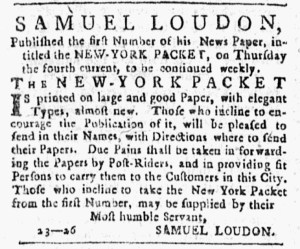
“SAMUEL LOUDON, Published the first Number of his News Paper, intitled the NEW-YORK PACKET.”
After spending several weeks distributing subscription proposals for a new newspaper, the New-York Packet, Samuel Loudon released the first issue on schedule on January 4, 1776. On that day, Loudon’s notice that he planned to establish the newspaper appeared for the fourth and final time in the New-York Journal. A week later, a new advertisement promoting the New-York Packet ran in the New-York Journal. The notation at the end, “23-26” (corresponding to the issue numbers), indicated that Loudon planned for that notice to run for four consecutive weeks as well.
In it, the printer announced that he “Published the first Number of his News Paper … on Thursday the fourth current, to be continued weekly.” He then provided an abbreviated version of the subscription proposal, stating that the New-York Packet “IS printed on large and good Paper, with elegant Types, almost new.” For readers who did not subscribe in time to receive that “first Number,” it was not too late to start a subscription that included the first issue and all subsequent issues. “Those who incline to encourage the Publication of it,” Loudon advised, “will be pleased to send in their Names, with Directions where to send their Papers.” Loudon had disseminated the subscription proposals widely, including in the Connecticut Journal and the Pennsylvania Gazette. He hoped to gain subscribers far beyond the city where he printed the New-York Packet. To that end, he promised that “Due Pains shall be taken in forwarding the Papers by Post-Riders, and in providing fit Persons to carry them to the Customers in this City.” That was a necessary part of satisfying both subscribers and advertisers.
Despite the fanfare around its founding, the New-York Packet lasted only eight months. Loudon suspended the newspaper shortly before the British occupation of New York. Unfortunately, surviving issues have not been digitized for greater access, so advertisements and other content from the New-York Packet will not appear in the Adverts 250 Project, though advertisements about the newspaper inserted in other publications testify to its short run at the beginning of the Revolutionary War.
The Slavery Adverts 250 Project chronicles the role of newspaper advertising in perpetuating slavery in the era of the American Revolution. The project seeks to reveal the ubiquity of slavery in eighteenth-century life from New England to Georgia by republishing advertisements about enslaved people – for sale as individuals or in groups, wanted to purchase or for hire for short periods, runaways who liberated themselves, and those who were subsequently captured and confined in jails and workhouses – in daily digests on this site as well as in real time via the @SlaveAdverts250 Twitter feed, utilizing twenty-first-century media to stand in for the print media of the eighteenth century.
The project aims to provide modern audiences with a sense of just how often colonizers encountered these advertisements in their daily lives. Enslaved men, women, and children appeared in print somewhere in the colonies almost every single day. Those advertisements served as a constant backdrop for social, cultural, economic, and political life in colonial and revolutionary America. Colonizers who did not purport to own enslaved people were still confronted with slavery as well as invited to maintain the system by purchasing enslaved men, women, and children or assisting in the capture of so-called “runaways” who sought to free themselves from bondage. The frequency of these newspaper advertisements suggests just how embedded slavery was in colonial and revolutionary American culture in everyday interactions beyond the printed page.
These advertisements also testify to the experiences of enslaved men, women, and children, though readers must consider that those experiences have been remediated through descriptions offered by enslavers rather than enslaved people themselves. Often unnamed in the advertisements, enslaved men, women, and children were not invisible or unimportant in early America.
Massimo Sgambati made significant contributions to this entry as part of the Summer Scholars Program, funded by a fellowship from the D’Amour College of Liberal Arts and Sciences at Assumption University in Worcester, Massachusetts, in Summer 2025.
These advertisements appeared in revolutionary American newspapers 250 years ago today.
What was advertised in a revolutionary American newspaper 250 years ago today?
Pennsylvania Gazette (January 10, 1776).
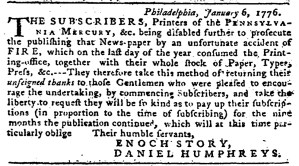
“Disabled further to prosecute the publishing that News-paper by an unfortunate accident of FIRE.”
As the imperial crisis intensified, Enoch Story and Daniel Humphreys launched the Pennsylvania Mercury (quickly renamed Story and Humphreys’s Pennsylvania Mercury) on April 7, 1775. That newspaper joined two others founded earlier in the year, the Pennsylvania Evening Post on January 24 and the Pennsylvania Ledger on January 28, as well as Dunlap’s Pennsylvania Packet, the Pennsylvania Gazette, the Pennsylvania Journal, and the Wochentliche Pennsylvanische Staatsbote. During the first four months of 1775, Philadelphia surpassed Boston in terms of the number of newspapers printed there. With the outbreak of hostilities at Lexington and Concord on April 19 and the ensuing siege of Boston, several of Boston’s newspapers ceased publication or relocated to other towns.
Yet Boston was not the only major port city that saw one of its newspapers cease publication during the first year of the Revolutionary War. Story and Humphreys’s Pennsylvania Mercury lasted less than a year, though disruptions caused by the war did not lead to its demise. Unfortunately, “an unfortunate accident of FIRE … consumed the Printing-office, together with their whole Stock of Paper, Types, Press,” and other equipment on December 31. The situation did not leave any possibility for the partners to recover and eventually resume publication. “[B]eing disabled further to prosecute the publishing [of] that News-paper,” they announced in an advertisement in the Pennsylvania Gazette, they instead expressed “their unfeigned thanks” to the subscribers who had supported the venture and requested that they “will be so kind as to pay up their subscriptions (in proportion to the time of subscribing) for the nine months the publication continued.” In other words, they expected customers to make prorated payments based on the number of issues they received. Humphreys eventually tried again, but not until after the Revolutionary War. On August 20, 1784, he commenced publishing a new Pennsylvania Mercury.
Even with the loss of Story and Humphreys’s Pennsylvania Mercury, Philadelphia still had more newspapers than any other city or town in the colonies. As the war continued, not all of them survived. Some closed permanently while others moved to other towns or suspended publication during the British occupation of Philadelphia. Yet, as the “unfortunate accident of FIRE” at Story and Humphreys’s printing office demonstrated, disruptions caused by the war were not the only dangers that forced newspapers to fold.
The Slavery Adverts 250 Project chronicles the role of newspaper advertising in perpetuating slavery in the era of the American Revolution. The project seeks to reveal the ubiquity of slavery in eighteenth-century life from New England to Georgia by republishing advertisements about enslaved people – for sale as individuals or in groups, wanted to purchase or for hire for short periods, runaways who liberated themselves, and those who were subsequently captured and confined in jails and workhouses – in daily digests on this site as well as in real time via the @SlaveAdverts250 Twitter feed, utilizing twenty-first-century media to stand in for the print media of the eighteenth century.
The project aims to provide modern audiences with a sense of just how often colonizers encountered these advertisements in their daily lives. Enslaved men, women, and children appeared in print somewhere in the colonies almost every single day. Those advertisements served as a constant backdrop for social, cultural, economic, and political life in colonial and revolutionary America. Colonizers who did not purport to own enslaved people were still confronted with slavery as well as invited to maintain the system by purchasing enslaved men, women, and children or assisting in the capture of so-called “runaways” who sought to free themselves from bondage. The frequency of these newspaper advertisements suggests just how embedded slavery was in colonial and revolutionary American culture in everyday interactions beyond the printed page.
These advertisements also testify to the experiences of enslaved men, women, and children, though readers must consider that those experiences have been remediated through descriptions offered by enslavers rather than enslaved people themselves. Often unnamed in the advertisements, enslaved men, women, and children were not invisible or unimportant in early America.
Massimo Sgambati made significant contributions to this entry as part of the Summer Scholars Program, funded by a fellowship from the D’Amour College of Liberal Arts and Sciences at Assumption University in Worcester, Massachusetts, in Summer 2025.
These advertisements appeared in revolutionary American newspapers 250 years ago today.
Historians consider Thomas Paine’s Common Sense, published anonymously on January 9, 1776, the most influential political pamphlet that circulated in the colonies during the era of the American Revolution. Written in plain language accessible to readers of all backgrounds, the pamphlet made a bold case for declaring independence at a time that many colonizers still sought a redress their grievances by George III and Parliament. Paine’s pamphlet played a vital role in swaying public opinion in favor of declaring independence.
Common Sense was an eighteenth-century bestseller, though Paine wildly overestimated how many copies were published, claiming 150,000 circulated in 1776, and historians later made even more dubious claims that American printing presses produced as many as 500,000 copies. Contrary to those exaggerations, American printers most likely published between 35,000 and 50,000 copies in 1776. Scholars have identified twenty-five American editions, more than twice as many as any other American book or pamphlet published in the eighteenth century.
Colonizers certainly discussed Paine’s pamphlet … and printers, booksellers, and others advertised it widely. As a special feature, the Adverts 250 Projectchronicles those advertisements, starting with newspaper notices for Robert Bell’s first edition published in Philadelphia and then subsequent advertisements for that and other editions published and sold throughout the colonies.
These advertisements for Common Sense appeared in American newspapers 250 years ago today.
What was advertised in a revolutionary American newspaper 250 years ago today?
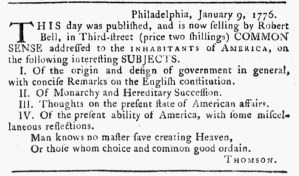
Pennsylvania Evening Post (January 9, 1776).
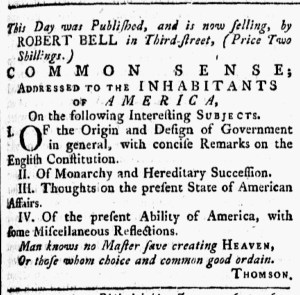
“THIS day was published … COMMON SENSE addressed to the INHABITANTS of AMERICA.”
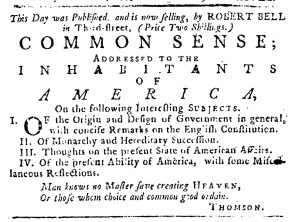
On January 9, 1776, the first advertisement for Thomas Paine’s Common Sense appeared in an American newspaper. The notice did not include Paine’s name. Instead, it stated that Robert Bell, the prominent printer and bookseller, “published, and is now selling … COMMON SENSE addressed to the INHABITANTS of AMERICA, on the following subjects.” The advertisement then listed the headings for the several sections in the first edition: “I. Of the origin and design of government in general, with concise Remarks on the English constitution. II. Of Monarchy and Hereditary Succession. III. Thoughts on the present state of American affairs. IV. Of the present ability of America, with some miscellaneous reflections.”
Over the next several months, printers in many towns would publish and advertise local editions of Common Sense, making it the most widely disseminated political pamphlet during the era of the American Revolution (though, as Trish Loughran convincingly demonstrates, the number of copies has been wildly exaggerated).[1] Historians also consider Common Sense the most persuasive pamphlet that advocated for the American cause. Even though hostilities commenced at Lexington and Concord in April 1775, many Americans still hoped that the king would intervene to address their grievances. The plain language of Common Sense (along with unflattering depictions of monarchy) played a significant role in convincing many colonizers to support independence over a redress of grievances. Paine made a strong case for “the present ability of America” to establish a new government and trading relationships beyond the British Empire.
There seems to be some confusion about the publication date for Common Sense. Some sources claim that it was published on January 10, 1776. I suspect that is because advertisements for the pamphlet first appeared in the January 10 editions of the Pennsylvania Gazette, the newspaper Benjamin Franklin formerly operated, and the Pennsylvania Journal, published by Patriot printers William Bradford and Thomas Bradford. Those advertisements featured almost identical copy (but different choices for the format made by the compositors), including the phrase “THIS DAY IS PUBLISHED” in the Pennsylvania Gazette and “This Day was Published” in the Pennsylvania Journal. I have previously examined other instances of similar phrases, demonstrating that they did not literally refer to the publication date but instead meant that a book or pamphlet was now available for purchase. When the advertisement ran in the Pennsylvania Ledger on January 13 and in the Wochentliche Pennsylvanische Staatsbote on January 16, both versions stated, “This Day was Published.” Eighteenth-century readers knew how to interpret the phrase. I wonder if some scholars consulted the more famous and the more venerable Pennsylvania Gazette (founded 1728) and Pennsylvania Journal (founded 1742), saw a phrase that suggested the date of the newspaper was indeed the publication date for Common Sense, and overlooked a newspaper that had been in production for a little less than a year when it carried its first advertisement for Common Sense. (Benjamin Towne distributed the first issue of the Pennsylvania Evening Post on January 24, 1775.) Bell may have been selling copies of Common Sense before January 9. The advertisement in the Pennsylvania Evening Post does not definitively demonstrate that the pamphlet was published on January 9, but it does show when marketing for the pamphlet began and that Bell published it no later than January 9, 1776.
**********
[1] Trish Loughran, “Disseminating Common Sense: Thomas Paine and the Problem of the Early National Bestseller,” American Literature 78., no. 1 (March 2006), 1-28.
The Slavery Adverts 250 Project chronicles the role of newspaper advertising in perpetuating slavery in the era of the American Revolution. The project seeks to reveal the ubiquity of slavery in eighteenth-century life from New England to Georgia by republishing advertisements about enslaved people – for sale as individuals or in groups, wanted to purchase or for hire for short periods, runaways who liberated themselves, and those who were subsequently captured and confined in jails and workhouses – in daily digests on this site as well as in real time via the @SlaveAdverts250 Twitter feed, utilizing twenty-first-century media to stand in for the print media of the eighteenth century.
The project aims to provide modern audiences with a sense of just how often colonizers encountered these advertisements in their daily lives. Enslaved men, women, and children appeared in print somewhere in the colonies almost every single day. Those advertisements served as a constant backdrop for social, cultural, economic, and political life in colonial and revolutionary America. Colonizers who did not purport to own enslaved people were still confronted with slavery as well as invited to maintain the system by purchasing enslaved men, women, and children or assisting in the capture of so-called “runaways” who sought to free themselves from bondage. The frequency of these newspaper advertisements suggests just how embedded slavery was in colonial and revolutionary American culture in everyday interactions beyond the printed page.
These advertisements also testify to the experiences of enslaved men, women, and children, though readers must consider that those experiences have been remediated through descriptions offered by enslavers rather than enslaved people themselves. Often unnamed in the advertisements, enslaved men, women, and children were not invisible or unimportant in early America.
Massimo Sgambati made significant contributions to this entry as part of the Summer Scholars Program, funded by a fellowship from the D’Amour College of Liberal Arts and Sciences at Assumption University in Worcester, Massachusetts, in Summer 2025.
These advertisements appeared in revolutionary American newspapers 250 years ago today.