
What was advertised in a revolutionary American newspaper 250 years ago this week?
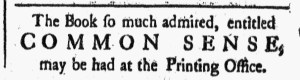
“The Book so much admired, entitled COMMON SENSE, may be had at the Printing Office.”
The July 6, 1776, edition of the Freeman’s Journal concluded with an advertisement for Thomas Paine’s Common Sense, the most influential political pamphlet published during the era of the American Revolution. Benjamin Dearborn, the printer of the newspaper, repeated the advertisement that first appeared a week earlier: “The Book so much admired, entitled COMMON SENSE, may be had at the Printing Office.” He apparently stocked copies produced by other printers since no records exist of a local edition published in Portsmouth, New Hampshire, in 1776.
Dearborn and the readers of the Freeman’s Journal did not yet know that the Continental Congress voted to declare independence on July 2 and then voted to approve a declaration of independence drafted by a committee that included Thomas Jefferson, John Adams, and Benjamin Franklin on July 4. The most recent updates from Philadelphia in that issue of the Freeman’s Journal were dated June 19 and June 25. For the moment, Dearborn continued hawking a pamphlet that made a convincing case for declaring independence, unaware that the Continental Congress had already done so.
The same advertisement appeared in the next two issues of the Freeman’s Journal on July 13 and July 20. The type for the fourth page of the July 13 edition, the page that carried the advertisement, may have already been set by the time that Dearborn received word, via Boston, that the Continental Congress declared independence. He reprinted news from the July 11 edition of the New-England Chronicle: “We are assured that on July the 2d, the Congress voted for INDEPENDENCY, not one colony dissenting; but the delegates of New-York remaining neuter, for want of being instructed on the head.” In the next issue, Dearborn’s final advertisement for Common Sense moved from the bottom of the last page to the bottom of the first page. He devoted the entire final page to the Declaration of Independence (with the colophon running across the bottom). Dearborn offered readers one last chance to acquire the pamphlet that had played such an important role in the decision to declare independence.