What was advertised in a revolutionary American newspaper 250 years ago today?
Independent Chronicle (October 3, 1776).
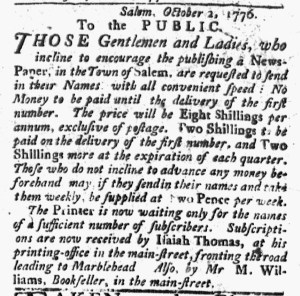
“The Printer is now waiting only for the names of a sufficient number of subscribers.”
In early October 1776, Isaiah Thomas took to the pages of the Independent Chronicle to provide an update about the newspaper he proposed publishing in Salem, Massachusetts. In a previous notice, dated August 28, he announced that he “intends publishing a NEWS-PAPER, as soon as a sufficient Number of Subscribers appear to support it, which, it is supposed, will be in about four Weeks from the Date hereof.”
More than four weeks passed without Thomas printing and circulating the first issue of the newspaper. He explained that he was “now waiting only for the names of a sufficient number of subscribers,” suggesting that his previous advertisements had not yielded as much demand as he anticipated. Ther printer once again appealed to “THOSE Gentlemen and Ladies, who incline to encourage the publishing a News-Paper, in the Town of Salem … to send in their Names” and to do so “with all convenient speed.” Subscribers could submit their names directly to Thomas “at his printing-office in the main-street” or to his associate, “Mr. M. Williams, Bookseller, in the main-street.” The printer did not ask for any payment in advance but only upon “delivery of the first number.” This time around, Thomas did not make any predictions about when subscribers would receive that “first number.”
He did, however, provide an overview of the price, which he had not done in his previous advertisement. Perhaps he thought more “Gentlemen and Ladies” would subscribe upon learning that that the newspaper cost “Eight Shillings per annum, exclusive of Postage,” with only two shillings due each quarter. Alternately, Thomas allowed for subscribers “who do not incline to advance any money beforehand” to pay a slightly higher rate of two pence for each weekly issue. In the end, neither option enticed enough subscribers for Thomas to print the “first number” or any other issue of his proposed newspaper in Salem. After a couple of years, he returned to Worcester and resumed printing the Massachusetts Spy after leasing that newspaper to other printers during his time in Salem.
What was advertised in a revolutionary American newspaper 250 years ago today?
New-England Chronicle (September 5, 1776).
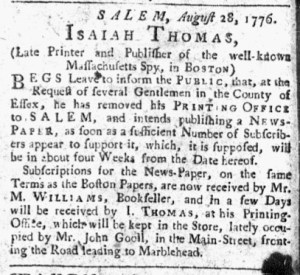
“ISAIAH THOMAS … has removed his PRINTING OFFICE to SALEM.”
Isaiah Thomas had plans to establish a new newspaper in Salem in the fall of 1776. He announced his intention in an advertisement in the September 5 edition of the New-England Chronicle, declaring that “at the Request of several Gentlemen in the County of Essex, he has removed his PRINTING OFFICE to SALEM” and would begin publishing a newspaper there “as soon as a sufficient Number of Subscribers appear to support it.” Thomas described himself as the “Late Printer and Publisher of the well-known Massachusetts Spy, in BOSTON,” but he did not mention that he had also left Boston just before the battles at Lexington and Concord and printed the Massachusetts Spy in Worcester throughout the siege of Boston. Not long after the British evacuated Boston in March 1776, Thomas made plans to return to the coast and leased the Massachusetts Spy to William Stearns and Daniel Bigelow. He had more experience printing a newspaper that supported the American cause than he acknowledged in his advertisement.
To make his new newspaper competitive with others printed in and near Boston, Thomas pledged that customers could purchase subscriptions “on the same Terms as the Boston Papers.” M. Williams, a bookseller, already collected subscriptions. The printer anticipated that he would soon take in subscriptions at his printing office in the store previously occupied by John Gooll “in the Main-Street, fronting the Road leading to Marblehead.” He estimated that it would take about four weeks to gather enough subscribers to support the newspaper. Despite his efforts and experience, however, the new newspaper never materialized. Thomas recounted what happened only briefly in his History of Printing in America(1810), stating that “many obstructions to the plan arising in consequence of the war” caused him to sell “the printing materials which he carried to that town.” In 1778, he returned to Worcester, “took into possession the press which he had left there, and resumed the publication” of the Massachusetts Spy.[1] People clamored for the news, as a notice from Stearns and Bigelow in the Massachusetts Spy demonstrated, yet that was not necessarily enough to make printing a newspaper a viable enterprise. Whether or not Thomas attracted enough subscribers, a variety of challenges, including shortages of paper during the Revolutionary War, prevented him from launching a newspaper in Salem.
**********
[1] Isaiah Thomas, The History of Printing in America: With a Biography of Printers and an Account of Newspapers (1810; New York: Weathervane Books, 1970), 181.
What was advertised in a colonial American newspaper 250 years ago today?
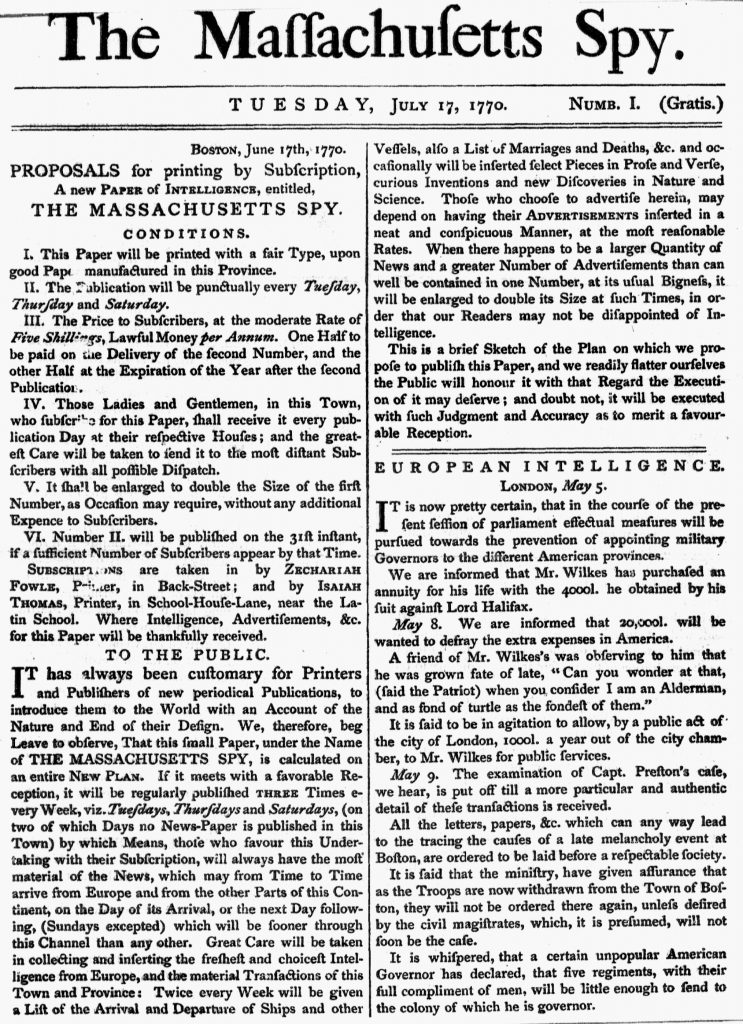
Massachusetts Spy (July 17, 1770).
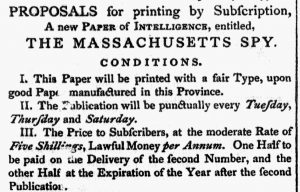
“PROPOSALS for printing by Subscription, A new PAPER of INTELLIGENCE, entitled, THE MASSACHUSETTS SPY.”
Isaiah Thomas, now remembered as the renowned patriot printer who published The History of Printing in America in 1810 and founded the American Antiquarian Society in 1812, launched his newspaper, the Massachusetts Spy, on July 17, 1770. The first issue, distributed free, began with an advertisement from the printer himself, the “PROPOSALS” that frequently inaugurated eighteenth-century newspapers. The proposal included two parts, the “CONDITIONS” of publication and an address “TO THE PUBLIC” in which the printer outlined the purpose of the newspaper.
The first condition stated that the Massachusetts Spy “will be printed with a fair Type, upon good Paper manufactured in this Province.” From the start Thomas took a political position. The Townshend Acts imposed duties on imported paper and other goods, prompting a boycott among colonial merchants. Although those duties, except for the one on tea, had been repealed recently, the nonimportation agreement still remained in effect in Boston. Thomas made clear that his newspaper would encourage domestic manufactures, specifically “good Paper manufactured in this Province,” as an alternative to imported goods.
Unlike most newspapers that consisted of four pages created by printed two pages on each side of a broadsheet and folding it in half, the Massachusetts Spy originally consisted of only two pages per issue. However, as Thomas explained in the second condition, the “Publication will be punctually every Tuesday, Thursday and Saturday.” The Boston Chronicle published two issues per week, on Mondays and Thursdays, but it folded in June 1770. No newspaper in Boston published more than one issue a week at the time Thomas founded the Massachusetts Spy. With three issues per week, Thomas provided six pages of news and advertising compared to only four pages for other newspapers. Furthermore, he explained in the address that on two of those days “no News-Paper is published in this Town.” As a result, his subscribers “will always have the most material of the News, which may from Time to Time arrive from Europe and from other Parts of this Continent, on the Day of its Arrival, or the next Day following, (Sundays excepted).” This was a particular advantage to subscribers. Thomas proclaimed that they would receive news “sooner through this Channel than any other.” The frequency of publication more than made up for the smaller size of the Massachusetts Spy.
Yet Thomas already envisioned expanding the newspaper when circumstances demanded. In the fifth condition he pledged that it “shall be enlarged to double the Size of the first Number,” the two-page issue in which the “PROPOSALS” appeared, “as Occasion may require, without any additional Expence to Subscribers.” In other word, Thomas would issue supplements when breaking news or an abundance of advertisements made doing so necessary, a common practice among eighteenth-century printers. Any additional pages were presented to subscribers free of charge. Thomas also made promises concerning the balance of news and advertising. In the address he stated, “When there happens to be a larger Quantity of News and a greater Number of Advertisements than can be contained in one Number, at its usual Bigness, it will be enlarged to double its Size at such Times, in order that our Readers may not be disappointed of Intelligence.” Thomas had no intention of allowing advertisements, often more lucrative for printers than subscriptions, crowd out the news, including “the freshest and choicest Intelligence from Europe, and the material Transactions of this Town and Province” as well as a “List of the Arrival and Departure of Ships and other Vessels” and a “List of Marriages and Deaths.” Thomas welcomed advertisements “at the most Reasonable Rates,” but had no plans for the Massachusetts Spy to fill its pages almost entirely with advertising.
Thomas anticipated publishing the second issue two weeks later on July 31 “if a sufficient Number of Subscribers appear by that Time.” It took an extra week for Thomas to issue “Number II” on August 7, but after that the Massachusetts Spy joined the ranks of the public prints in Boston. Thomas continued publication until April 1775. Shortly before the skirmishes at Lexington and Concord, he fled to Worcester and took his press with him. As an influential patriot printer, he feared British authorities and sought the safety of the smaller town in the countryside. He revived the Massachusetts Spy in Worcester in May 1775, but the newspaper had its origins on July 17, 1770, in Boston. The “PROPOSALS” for the newspaper, an extended advertisement, inaugurated the first issue.