Historians consider Thomas Paine’s Common Sense, published anonymously on January 9, 1776, the most influential political pamphlet that circulated in the colonies during the era of the American Revolution. Written in plain language accessible to readers of all backgrounds, the pamphlet made a bold case for declaring independence at a time that many colonizers still sought a redress their grievances by George III and Parliament. Paine’s pamphlet played a vital role in swaying public opinion in favor of declaring independence.
Common Sense was an eighteenth-century bestseller, though Paine wildly overestimated how many copies were published, claiming 150,000 circulated in 1776, and historians later made even more dubious claims that American printing presses produced as many as 500,000 copies. Contrary to those exaggerations, American printers most likely published between 35,000 and 50,000 copies in 1776. Scholars have identified twenty-five American editions, more than twice as many as any other American book or pamphlet published in the eighteenth century.
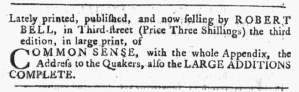
Colonizers certainly discussed Paine’s pamphlet … and printers, booksellers, and others advertised it widely. As a special feature, the Adverts 250 Projectchronicles those advertisements, starting with newspaper notices for Robert Bell’s first edition published in Philadelphia and then subsequent advertisements for that and other editions published and sold throughout the colonies.
These advertisements for Common Sense appeared in American newspapers 250 years ago today.
What was advertised in a revolutionary American newspaper 250 years ago today?
Norwich Packet (March 4, 1776).
“All Sorts of Doe and Buck-Skin Breeches.”
This advertisement announced the arrival of John Saltmarsh, a “LEATHER BREECHES MAKER” from London. He offered to make breeches for anyone who needed them in Norwich, Connecticut. He uses both doe and buckskin and made them fit properly. He also promised they would fit well, offering to “make them fit properly, or demand nothing for his trouble.” This sounds confusing, but it was the equivalent of modern lawyers only asking for a payment if they win. Saltmarsh was that confident in his ability to make new breeches or alterations that pleased his customers.
I was not sure what “breeches” were when I first read this advertisement. From an interview with historian Kate Haulman in Vox, I learned that breeches are a kind of pants made distinctive through the wrappings that tighten them just below the knees. Some had buttons or buckles, but for a cheaper option some just had simple ties to hold them in place. They were fashionable, which was one reason Saltmarsh said that he was “from London,” but that was not the only way he tried to convince customers to buy breeches from him. He also focused on service, promising the work to be done with “one Day’s Notice” or else he will compensate the customer for the inconvenience. He even said, “he will pay for their trouble of coming after them.” Overall, Saltmarsh ran an honest business. He focused on not only making a good product that fits the needs of each customer, but also on a timetable that works for them.
**********
ADDITIONAL COMMENTARY: Carl Robert Keyes
One of my favorite parts of having students in my upper-level early American history courses serve as guest curators for the Adverts 250 Project is observing their sense of wonder and discovery as they encounter everyday life in the eighteenth century for the first time. That starts with each student compiling an archive that consists of one week of newspapers published during the era of the American Revolution. Those newspapers look familiar, but they also have significant difference compared to modern newspapers … and not just the long “s” that looks so strange to novice researchers. The purposes of some advertisements surprise them, such as what are today known as “runaway wife” advertisements in which husbands made public proclamations that they would not pay any expenses incurred by the unruly women who abandoned their household responsibilities (and that gives us a chance to discuss both coverture and the perspectives of the wives who did not have ready access to the public prints). Students also encounter consumer goods commonly advertised in early America that are not familiar to them, such as andirons and “AMERICAN CAKE-INK.” Breeches also fall in that category. Ethan was not the only student enrolled in my senior seminar in Fall 2025 who included an entry on breeches in the advertising portfolio he created throughout the semester.
In addition to seeing fresh perspectives on consumer goods, I am always interested to see which advertisements draw the attention of my students because they usually select different advertisements to examine as guest curators than I would if I produced that entry of the Adverts 250 Project on my own. I would have skipped over “JOHN SALTMARSH, LEATHER BREECHES MAKER, FROM LONDON,” in favor of the two advertisements for Thomas Paine’s Common Sense that appeared in the March 4, 1776, edition of the Norwich Packet, advertisements even more notable because the printers also included “EXTRACTS FROM A PAMPHLET ENTITLED, COMMON SENSE.” Perhaps they previewed the pamphlet for the edification of their readers, though they likely also hoped to incite greater demand for sales of the pamphlet at their printing office. This helps make a point that I underscore in all my courses: the stories that historians tell about the past depend on the sources they consult and, among those, which they choose to examine in greater detail. Ethan and I both chose advertisements that illuminate the past, though different advertisements engaged our curiosity. Elsewhere in his advertising portfolio, Ethan examined other advertisements from other newspapers. Considered together, his advertisements looked at many aspects of consumer culture, commerce, politics, and everyday life during the first year of the Revolutionary War. They included an advertisement for a riding manual “for gentlemen of every rank and profession,” an advertisement for pig iron, an advertisement for an assortment of books and pamphlets for supporters of the American cause, … and an advertisement for a local edition of Common Sense that appeared in the March 1 edition of the Connecticut Gazette. When we perused that newspaper, Ethan and I selected the same advertisement!
What was advertised in a revolutionary American newspaper 250 years ago today?
Pennsylvania Evening Post (February 22, 1776).
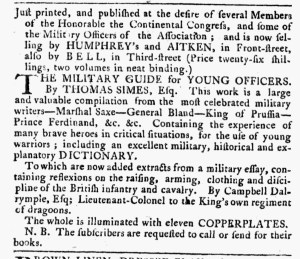
“THE MILITARY GUIDE for YOUNG OFFICERS. By THOMAS SIMES, Esq.”
Several printers in Philadelphia advertised “THE MILITARY GUIDE for YOUNG OFFICERS” by Thomas Simes in February 1776. The manual was published in 1776 and contained a compilation of “works of several military authors, including Humphrey Bland and the comte de Saxe.” When the American Revolution began in 1775, military manuals, such as the one Simes wrote, became popular among young men preparing to join the war and those who had already joined. According to the American Revolution Institute of the Society of the Cincinnati, “to meet the demand for military texts, a flood of printings began to appear from the American presses.” Additionally, the advertisement above, published in the Pennsylvania Evening Post, which was a newspaper located in Philadelphia, displays how that flood of printing was “centered in Philadelphia, where more than thirty works on military subjects were published in the years 1775 and 1776 alone.” The advertisement briefly summarizes the book, stating that it included “the experience of many brave heroes in critical situations, for the use of young warriors” to entice the target audience of young men who would serve as officers to purchase the book as a helpful guide. The advertisement even noted that the guide came with its own “explanatory DICTIONARY,” a bonus section. One signer of the Declaration of Independence, William Floyd, owned a copy of Simes’s guide, which can be taken as an indicator of both the quality and popularity of its contents.
**********
ADDITIONAL COMMENTARY: Carl Robert Keyes
Robert Bell, the publisher of the first edition of Thomas Paine’s Common Sense, continued his feud with William Bradford and Thomas Bradford, the printers of the Pennsylvania Journal, with a new advertisement in the February 22, 1776, edition of the Pennsylvania Evening Post. Dissatisfied with Bell’s bookkeeping, Paine collaborated with the Bradfords on an expanded edition of his popular political pamphlet, yet Bell took an unauthorized second edition to press and simultaneously published diatribes about Paine and the Bradfords. His latest advertisement would be the last in the series that attacked the author and his fellow printers. It filled more than a column, starting on the third page of the February 22 issue of the Pennsylvania Evening Post and overflowing onto the fourth page. The advertisement for Thomas Simes’s Military Guide for Young Officers, jointly published by Bell, Robert Aitken, and James Humphreys, Jr., immediately followed Bell’s advertisement. In the column to the right, the Bradfords promoted their “NEW EDITION of COMMON SENSE, With ADDITIONS and IMPROVEMENTS,” and warned that the “Pamphlet advertised by Robert Bell intitled ADDITIONS to COMMON SENSE … consists of Pieces taken out of News Papers, and not written by the Author of COMMON SENSE.”
The advertisement for Simes’s Military Guide for Young Officers thus appeared in the middle of the controversy over the publication of new editions of Common Sense. Unlike Bell’s questionable decision to produce a second edition of the political pamphlet and then attempt to capitalize off it by publishing another pamphlet of “ADDITIONS” drawn from newspapers rather than written by Paine, he collaborated with Aitken and Humphreys in producing the military manual “at the desire of several Members of the Honorable the Continental Congress, and some of the Military Officers of the Association.” Bell (along with Aitken and Humphreys) had the right endorsements for an American edition of a manual previously published in London and the printers attempted to leverage that in marketing Simes’s Military Guide for Young Officers to prospective customers who, as Madison notes, could choose from among many similar works published in Philadelphia at the time. In the Pennsylvania Evening Post, the advertisement appeared in the middle of the various notices in the February 22 edition, but two days later it had a privileged place in the Pennsylvania Ledger. Humphreys, the printer of that newspaper, placed the advertisement on the first page, making it the first item in the first column. The printers of the Pennsylvania Gazette gave the advertisement the same treatment in the February 28 edition of their newspaper. The flamboyant Bell took a more measured approach to marketing the military manual compared to some of the other books and pamphlets he printed and, especially, his new editions of Common Sense. Perhaps his partners in the endeavor took the lead in marketing Simes’s Military Guide for Young Officers.
What was advertised in a colonial American newspaper 250 years ago today?
Boston Evening-Post (February 27, 1775).
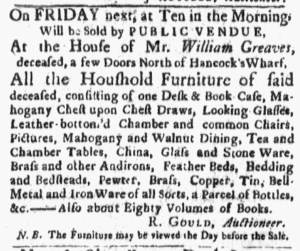
“Will be Sold … Brass and other Andirons, Feather Beds.”
This advertisement features a variety of household goods sold at an auction held by R. Gould after the death of William Greaves. What caught my eye about this advertisement was some of the items being sold, like andirons and feather beds. I was not familiar with these items before reading this advertisement.
Andirons are a pair of brass or iron bracket supports used to hold up logs in an open fireplace. Andirons allow for better burning and less smoke due to the air circulation underneath the wood. In 1775, most homes used wood-burning fireplaces to keep warm, especially during cold winters. The use of andirons was widespread during this time.
The other item that caught my eye was featherbeds. According to art historians interviewed by Sunny Sea Gold, many people slept on beds of several different layers during this time. She reports, “At the bottom was a simple, firm mattress pad or cushion filled with corn husks or horsehair. Next came a big featherbed for comfort.” We would equate these to mattresses today, just instead filled with feathers. These featherbeds often sagged and caused problems when people laid flat on them. Wealthier colonists could buy professionally made featherbeds, while those less fortunate usually made their own out of goose or duck feathers.
Goods being sold at an auction as part of an estate sale generally cost less than when bought new. For those who may have needed a pair of andirons but were unwilling or unable to spend much, seeing this advertisement would have likely drawn them to the auction to get a good deal. The same goes for the featherbed, even a used one. An opportunity to increase the comfort of their bed at a cheap price would have provoked the interest of many people.
**********
ADDITIONAL COMMENTARY: Carl Robert Keyes
When I invite students to serve as guest curators for the Adverts 250 Project, I do so in hopes that they will immerse themselves in eighteenth-century life and culture in new ways. I assign both primary sources and secondary sources for our classes, yet I want my students to examine some aspect of life in early America even more intensively. That begins with compiling a digital archive of newspapers published during a particular week during the era of the American Revolution and continues with searching through those newspapers to select advertisements that interest them.
Seeing why different advertisements spark interest for different students is always an interesting and illustrative part of working on this project together. I learn from my students, especially when they explain what they see in their advertisements as they work with early American newspapers for the first time compared to the assumptions that I make after reading those newspapers for years. I appreciate how Kamryn took an advertisement that would have appeared plain and ordinary to eighteenth-century readers familiar with the material culture of the period and demonstrated that some of the everyday items that colonizers purchased and used are no longer everyday items in the twenty-first century. As a result, they require some explanation to understand their purpose and significance in the eighteenth century.
I also appreciate that Kamryn commented on auctions as the way that consumers sometimes acquired those objects of everyday life. R. Gould, one of several auctioneers in Boston, oversaw an estate sale at the home of William Greaves. The advertisement for that auction appeared between notices for upcoming sales at “RUSSELL’s Auction Room in Queen street” and William Hunter’s “New Auction-Room, Dock-Square.” Some of the items for sale at “Hunter’sAuction-Room” were certainly secondhand goods, like at the estate sale, being the “Property of a Gentleman leaving the Province,” yet others, as far as the advertisements revealed, were new. As Kamryn notes, auctions offered bargains to consumers, whether they purchased new or used goods.
What was advertised in a colonial American newspaper 250 years ago today?
Essex Gazette (February 14, 1775).
“The great Misfortune of losing his House and Store by Fire, with almost every Thing in and about them.”
Peter Frye was a justice of the peace in Salem, Massachusetts, when the town had a fire on October 6, 1774. According to Donna Seger, Frye was a Tory. Tories were also known as Loyalists, colonists who remained loyal to the king and Parliament. In an advertisement that he placed four months after the fire, Frye points out his misfortune of losing his house, store, and belongings due to the fire. “He is now obliged to beg all of those who were then indebted to him by Bond, Note, or on Account” to pay him what they justly owed.
Frye called for sympathy amongst the people of Salem by stating his misfortune of losing his house, store, and belongings. He thought that some readers would hesitate to engage because he was a Tory, either overlooking or disregarding his plea. He knew he was asking a lot of the people to help him recover, so began by noting that he lost everything.
Advertisements calling on readers to settle accounts and debts were common, but most advertisements were due to regular business transactions, not due to fires. Additionally, he not only lost his house and store, but allegedly all that was in them. In this matter, Frye no longer had his ledgers and account books due to the fire, which meant he had no records to confirm who owed him and what amount.
Frye relied on the sympathy and the good consciences of the people of Salem to help him out in this time of tragedy to gain back what he had lost. As Donna Seger explains, “Frye had tried to find his way back to ‘friendship’ with his Salem neighbors, but they had never been able to forget his commercial and judicial dealings contrary to Patriot proclamations.” Due to his position as a Tory on the eve of the American Revolution, townspeople held a grudge against him. Seger notes that Frye left Salem, moving to Ipswich and then Britain.
**********
ADDITIONAL COMMENTARY: Carl Robert Keyes
I enjoyed working with Ashley on this entry for many reasons, including the confluence of primary and secondary sources that went into crafting it. We began with negotiating whether I would approve Frye’s advertisement as Ashley’s selection for this project. I encouraged students to choose advertisements about consumer goods and services to build on our readings and discussions about the consumer revolution, but I also told them that I would consider other kinds of advertisements if they made convincing cases for what they hoped to learn from them and why they should be included in the Adverts 250 Project. Ashley convincingly argued that she did not previously know about the fire in Salem in 1774. Frye’s advertisement offered an opportunity to learn about that piece of local history and its aftermath.
To fill in the details, she consulted Streets of Salem, a blog produced by Donna Seger, Professor of History at Salem State University. Seger composes “[s]omewhat random but still timely posts about culture, history, and the material environment, from the perspectives of academia, Salem and beyond.” In the nine years that I have been producing the Adverts 250 Project, I have consulted and linked to Streets of Salem on many occasions, so I was pleased that Ashley discovered that wonderful and engaging resource when researching Frye’s advertisement. In the entry that gave so much information about Frye, Seger weaves together various primary sources, informed by Mary Beth Norton’s 1774: The Long Year of Revolution. Ashley was already familiar with Norton from our discussions about the historiography of the American Revolution. Seger’s post about “Tea, Fire and a new Congress” vividly illustrated how historians incorporate secondary sources into their research on primary sources, not only for background information but also in presenting an interpretation of what happened, why it mattered then, and why we consider it important now.
During the research, writing, and revision process, Ashley also had an opportunity to learn more about early American print culture and various kinds of advertisements, especially notices that called on colonizers to settle accounts. As a result, she was able to make a distinction between the familiar and standard notices that so often appeared in the pages of early American newspapers and the appeal that Frye made as he attempted to recover from a fire that had devasted his household and business. I sometimes select advertisements that deliver local news (including some that ran in the Essex Gazette right after the Salem fire) to feature on the Adverts 250 Project. Ashley contributed to the project’s examination of those sorts of newspaper advertisements.
What was advertised in a colonial American newspaper 250 years ago today?
Norwich Packet (January 19, 1775).
“A fresh ASSORTMENT of DRUGS, and GENUINE PATENT MEDICINES.”
Benjamin Dyer Published this advertisement in the Norwich Packet on January 19, 1775. The advertisement says that he was selling many items, including “GENUINE PATENT MEDICINES,” at his shop in Norwich-Landing. Patent medicines were available to anyone without needing a prescription. According to the American Antiquarian Society’s Past Is Present blog, “Usually patent medicines were made of relatively inexpensive ingredients sold at high prices. It is important to know that because many patent medicines did not explicitly list their ingredients.” Due to this the people selling the items can make claims about what was in the medicine without being fact checked. It is also important to realize that Dyer referred to all the medicines as “GENUINE,” meaning that whatever was supposed to be in each medicine was in that medicine. Another interesting thing about this advertisement was how it listed each type of medicine that he sold instead of just saying that medicines were available. I believe that this is because he wanted to show that he had a large number of medicines available. Shopkeepers like Dyer tried to convince people that their “ASSORTMENT” of medicines were truly genuine and not fakes.
**********
ADDITIONAL COMMENTARY: Carl Robert Keyes
When Braydon and I met to discuss the advertisement that he selected to examine for the Adverts 250 Project, we talked about patent medicines as the over-the-counter medications of the eighteenth century. They were so familiar to consumers that they did not need descriptions of what each did. Readers of the Norwich Packet recognized, for instance, Turlington’s Balsam of Life and knew which illnesses, complaints, or discomforts that nostrum treated. Stoughton’s Elixir, Godfrey’s Cordial, and Bateman’s Drops were the name brands of the period. When consumers had access to multiple remedies that purported to treat the same symptoms, many had favorites based on experience and reputation. Reading the list of “GENUINE PATENT MEDICINES” in Dyer’s advertisement in 1775 would have been similar to browsing the aisles of a pharmacy in 2025.
As I worked on other aspects of producing the Adverts 250 Project and Slavery Adverts 250 Project beyond working with Braydon on developing his entry, I noticed another interesting aspect of Dyer’s advertisement. In addition to running it in the Norwich Packet, he also inserted it in the Connecticut Gazette, published in New London, on January 20. That increased the circulation of his advertisement, placing it before the eyes of many more prospective customers. This aspect of Dyer’s marketing campaign resonates with the analysis of yesterday’s advertisement, also selected by a student in my Revolutionary America course, that ran in the Connecticut Journal, published in New Haven. Connecticut had four newspapers, printed in four towns, yet each circulated widely throughout the colony and beyond. Many advertisers dispatched advertising copy to printing offices in more than one town. In addition to Dyer’s advertisement, the January 19, 1775, edition of the Norwich Packet featured a notice from clock- and watchmaker Thomas Harland. He simultaneously ran an advertisement in the Connecticut Courant, published in Hartford. In his case, he ran two different advertisements rather than submitting identical copy. Though both advertised in more than one publication, Dyer and Harland made decisions that suited their needs when it came to which messages for consumers they wished to disseminate in which newspapers.
What was advertised in a colonial American newspaper 250 years ago today?
Connecticut Journal (January 18, 1775).
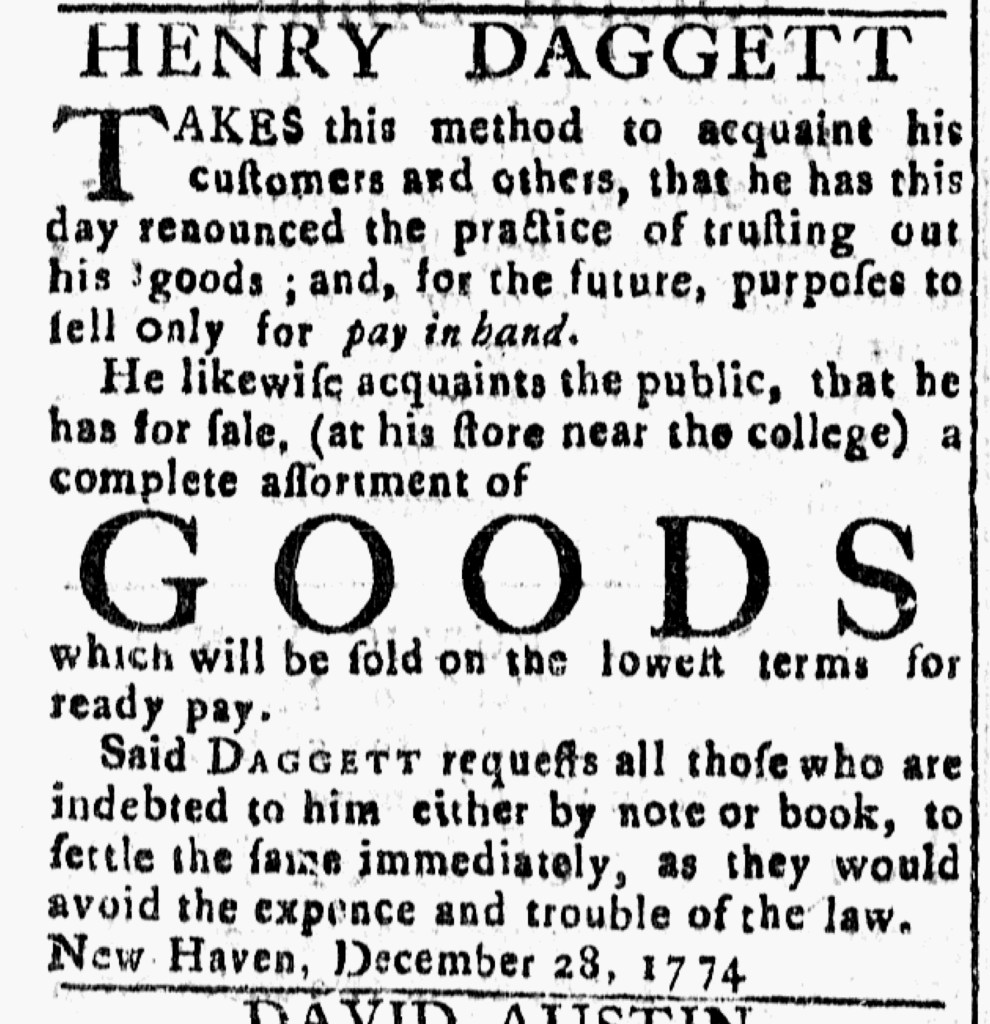
“HENRY DAGGETT TAKES this method to acquaint his customers and others …”
The advertisement from the Connecticut Journal that I have selected was published by Henry Daggett. He created it with three different purposes. First, Daggett mentions that he has stopped accepting lines of credit as payments from customers: he “renounced the practice of trusting out his goods; and, for the future, purposes to sell only for pay in hand.” He wanted customers to pay the same day as their purchases. Next, Daggett moves into stating that he has an assortment of goods to sell in his store “on the lowest terms” or for the lowest prices. Finally, Daggett aggressively mentions that anyone who is in debt to him “either by note or book” must settle with him immediately or he will take them to court, what he called “the expence and trouble of the law.”
In addition to figuring out why Daggett placed this advertisement, I wanted to know more about how it was distributed to the public. I read about “Printing Presses and Distribution” on the webpage about “Connecticut’s Newspaper History” created by the Connecticut State Library.” Once newspapers were printed, “[d]istribution of the final product was usually by the carrier, often the printer’s apprentice. Subscribers who had the paper delivered to their homes were charged a fee. … Outside of town, the post rider was the main distributor of newspapers. The post, or mail, came in once a week in the early days. Often the printer was also postmaster and would see that newspapers were carried free of charge from office to office.” I imagine that Henry Daggett got his point across to the public because of wide distribution of newspapers in Connecticut during the era of the American Revolution. They were delivered not only in the town of publication but also to many other towns as well.
**********
ADDITIONAL COMMENTARY: Carl Robert Keyes
When Dominic and I met to discuss this advertisement, I asked him why he chose Henry Daggett’s notice in the Connecticut Journal. He was especially interested in the circulation of newspapers and the advertisements they contained. As Dominic outlines, Daggett had several reasons for running his advertisement. He wanted to know more about how confident Daggett would have been that others, especially prospective customers and former customers who still owed him for previous purchases, would see the advertisement. That gave us a chance to talk about readership and distribution throughout the colonies and then look for secondary sources about newspapers published in Connecticut in the eighteenth century.
This also gave me an opportunity to share with Dominic that the production of newspapers in Connecticut differed from other many other colonies in early 1775. The sites of publication were more centralized in other colonies. For instance, three newspapers were published in South Carolina, all of them in Charleston, and disseminated throughout the colony from there. Similarly, two newspapers were published in Virginia (with a third established only a few weeks after Daggett’s advertisement ran on January 18, 1775). Printers in Williamsburg published those newspapers. In Pennsylvania, three English-language newspapers were published in Philadelphia (with two more established by the end of the month) and two German-language newspapers were published in Germantown. Three newspapers were published in New York, all of them in New York City.
The situation was a little different in most colonies in New England. While the New-Hampshire Gazette, published in Portsmouth, was the only newspaper in that colony, Rhode Island has two newspapers, the Newport Mercury and the Providence Gazette, and Massachusetts had five newspapers printed in Boston as well as Essex Gazette, published in Salem, and the Essex Journal, published in Newburyport. In early 1775, Connecticut was the only colony with newspapers published in four towns: the Connecticut Courant and Hartford Weekly Intelligencer, the Connecticut Gazette (published in New London), the Connecticut Journal and New-Haven Post-Boy, and the Norwich Packet and the Connecticut, Massachusetts, New-Hampshire, and Rhode-Island Weekly Advertiser. As the full title of the Norwich Packet suggests, colonial newspapers circulated widely beyond their sites of publication.
Advertisers in Boston, Charleston, New York, Philadelphia, and Williamsburg could easily visit or send messages to multiple printing offices when they wished for their notices to appear in more than one newspaper. In contrast, advertisers in Connecticut had ready access to one printing office, if they happened to live in one of the four towns with a newspaper, yet had to devote more effort in submitting their notices to other printing offices when they wished to disseminate them in multiple newspapers.
What was advertised in a colonial American newspaper 250 years ago today?
Connecticut Journal (January 11, 1775).
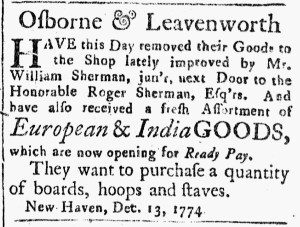
“A fresh Assortment of European & India GOODS.”
Osborne and Leavenworth advertised a “fresh Assortment of European & India GOODS” in the Connecticut Journalon January 11, 1775. Their advertisement was dated December 13, 1774, very shortly after the implementation of the Continental Association on December 1. In October 1774, the First Continental Congress organized that nonimportation agreement in response to the oppressive policies of Great Britain, especially the Coercive Acts. Osborne and Leavenworth may have been undertaking a clearance sale on stock acquired prior to the importation ban. In The Colonial Merchants and the American Revolution, 1763-1776, Arthur M. Schlesinger observes that merchants had to comply with boycott agreements while they had preexisting inventories to manage. He observes that “the enforcement of non-importation agreements placed merchants in a precarious position, compelling them to balance between patriotic compliance and economic survival.”[1] Osborne and Leavenworth probably advertised goods imported before the Continental Association went into effect and colonists refused to import British goods as a sign of unity.
**********
ADDITIONAL COMMENTARY: Carl Robert Keyes
Osborne and Leavenworth’s advertisement does indeed raise questions about when they received their goods compared to when the Continental Association went into effect. They placed their notice to advise prospective customers that they had moved to a new location and received a new shipment that they “are now opening.” They did not specify when that “fresh Assortment” arrived, though they likely hoped that readers would assume they acquired their wares before December 1. After all, it took time to unpack goods and prepare them for sale, especially when setting up shop in a new location. Alternately, the goods may have arrived in the colonies, likely New York, prior to December 1 before merchants there dispatched them to Osborne and Leavenworth in New Haven.
The date that appeared in their advertisement made it possible to reach the conclusion that they peddled only wares imported before December 1. Other merchants and shopkeepers who advertised in the same issue of the Connecticut Journal did not give any indication about when they received merchandise that they promoted as new arrivals. Jeremiah Atwater, for instance, “just received a fresh Assortment of GOODS.” Similarly, Anthony Perit “just received a large and general Assortment of English and India GOODS.” Yet neither of them included any dates nor mentioned the Continental Association. Josiah Burr proclaimed that he “just receiv’d a large Assortment of GOODS” and gave an extensive list of imported textiles, housewares, and groceries (including tea) in an advertisement dated “Jan. 1775,” well after the Continental Association commenced. Perhaps each of these local retailers had received new goods from merchants in New York rather than directly from English ports. After all, five out of six ships that the custom house in New Haven listed as “ENTERED IN” in the January 11 edition of the Connecticut Journal arrived from New York. In that case, neither advertisers nor readers may have been concerned about breaking the prohibition on buying and selling imported goods. Six weeks after the Continental Association went into effect, advertisements for consumer goods in the Connecticut Journal looked much the same as they had for years, unlike some advertisements in newspapers published in major ports that announced the sales of imported goods under the direction of local Committees of Inspection.
**********
[1] Arthur M. Schlesinger, The Colonial Merchants and the American Revolution, 1763-1776 (New York: Frederick Ungar Publishing Company, 1957), 240.
John King’s advertisement for this “coach” first interested me because, according to Ron Vineyard at Colonial Williamsburg, coaches were bought mainly by the gentry (or upper class) in eighteenth-century America. Upon further consideration, however, I noticed that this was an advertisement for a “post coach,” which confused me, as I thought that only the postal system would have use for “post coaches.” Most people rode horses or travelled by foot at this time, but those who had the luxury of owning a coach could decide between different kinds of coaches. In “Wheeled Carriages in Eighteenth-Century Virginia,” Mary Goodwin identified “plain,” “neat ornamented,” “town,” “travelling,” and “elegant crane neck” coaches among the variety of coaches that buyers could choose from, as well as “post coaches.” Depending on the size and price of the coach, buyers had certain preferences about the coach they would purchase. While “post coaches” were typically used by the postal system for the distribution of mail in the colonies, they could also be bought by private owners, who may have enjoyed the style, price, and other features of the vehicles.
**********
ADDITIONAL COMMENTARY: Carl Robert Keyes
John King sought to sell a used post coach. In his advertisement in the April 14, 1774, edition of the Maryland Gazette, he noted that the wheels “are as good as new, and the carriage in good order, having been through a thorough repair last year,” assuring prospective customers that even though the carriage was used it was in good order. He also had a “genteel phaeton” for sale at his stables in Annapolis, that carriage also presumably used.
In selling secondhand carriages, King competed with Pryse and Parker, “COACH and COACH HARNESSMAKERS from London,” and the new carriages they built according to the instructions they received then customers placed orders. In the same issue that carried King’s advertisement, Pryse and Parker once again inserted their notice to inform the public that they acquired “the best materials for the coachmaking business, which they now carry on, in all its various branches.” Colonizers in the market for a coach had the option, if they wished, to order a new one made to their specifications, one that matched the latest styles in London and port cities in the colonies.
Yet new coaches were more expensive than secondhand coaches, not unlike new and used cars today. Consumers made decisions that took into account price, quality, fashion, and prestige. The eighteenth-century marketplace for carriages anticipated some of the common practices of the modern automobile industry, especially when it came to used carriages. For instance, Adino Paddock, a coachmaker in Boston, advertised that he “will take second hand Chaises in part Pay for new,” a version of trading in a new vehicle to reduce the cost of a new one. He also offered for sale a “very good second-hand Coach, Curricule, and several Chaises, some almost new.” Paddock operated a precursor to a used car lot, making bargains available to those who chose not to invest in new carriages. With a “neat post coach” and a “genteel phaeton” for sale at his stables, King adopted a similar business model.
What was advertised in a colonial American newspaper 250 years ago today?
Rivington’s New-York Gazetteer (April 7, 1774).
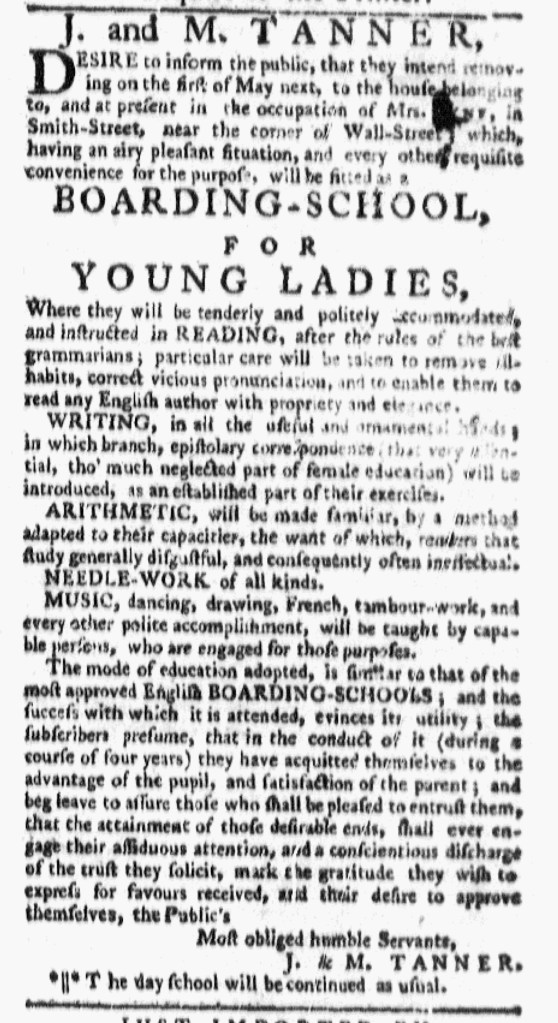
“BOARDING-SCHOOL, FOR YOUNG LADIES.”
J. & M. Tanner’s notice in Rivington’s New-York Gazetteer advertised an opportunity for young women to attend a boarding school “in Smith-Street, near the corner of Wall Street.” At this school, the “YOUNG LADIES” would improve in reading, writing, needlework, music, dancing, and other subjects considered appropriate for them. The Tanners include a comparison of their new school to what a British boarding school had to offer, stating that their curriculum “was similar to that of the most approved English BOARDING-SCHOOLS.” According to Mary Cathcart Borer in Willingly to School: A History of Women’s Education, boarding schools for young ladies popped up in England as early as 1711, with nearly the same curriculum at each.[1] However, arithmetic was a subject that the Tanners’ school in the colonies included that many British schools for girls and young women did not. While still expected to stay in the private sphere, Tanners’ boarding school allowed for young women’s opportunities in arithmetic, which was not always an option for many young women elsewhere. We cannot conclude exactly why the Tanners chose to incorporate arithmetic into their school’s curriculum. However, it indicates that while still using the British model, there were variations of the boarding school systems in the colonies.
The Tanners’ boarding school seems to have been an effort to demonstrate that the colonies could also partake in the same developments that England did, particularly in women’s education and manners. Considering that this advertisement was published in 1774, a year before the first battles of the American Revolution, tensions increasingly inspired colonists to establish self-sufficiency in government and commerce and other aspects of life, such as education, without reliance on Britain. Even as that happened, it is critical to recognize that while the colonies were looking to have their own self-sufficient systems and government, they still included British ideals. Britain was still influential in colonial culture, which was especially shared through ideas of education and what made well-educated and well-mannered young ladies.
**********
ADDITIONAL COMMENTARY: Carl Robert Keyes
Rather than expand on Maria’s interpretation of today’s advertisement, I am reflecting on pedagogy and my experiences integrating the Adverts 250 Project and the Slavery Adverts 250 Project into the courses I teach at Assumption University. Throughout this academic year, including the time that Maria and her peers were enrolled in my Revolutionary America course last fall, faculty and staff have engaged in a series of programs about “awaken[ing] in students a sense of wonder” and how we seek to fulfill the University’s mission. I have learned some valuable lessons along the way, from my colleagues at those events and from my students in the classroom.
Maria and her classmates commence their responsibilities as guest curators by compiling a mini-archive of newspapers published during a particular week in 1774. I provide each of them with a list of extant newspapers that have been digitized and train them in using several databases. Once they have created their mini-archives, each student examines the newspapers for their week to identify all of the advertisements about enslaved people for inclusion in the Slavery Adverts 250 Project and to select an advertisement about consumer goods or services to feature on the Adverts 250 Project. I provide students with hard copies of their newspapers, encouraging them to work back and forth with the digitized ones.
One morning last fall, I arrived in class intending to discuss advertisements about enslaved people and what students learned from that portion of the project. We had a robust discussion, but, to my initial frustration, students did not stick to the topic for the day! Instead of focusing solely on advertisements about enslaved people, they started discussing other kinds of advertisements and asking about other aspects of the newspapers as well. I had a lesson plan, an “agenda” of material that I “needed” to cover that day, and their “off-topic” questions did not facilitate the good order that I had envisioned.
Then I realized that I was witnessing authentic wonder in my classroom, that the conversation taking place was more important than anything I scripted in my mind in advance, and that students were learning more from the experience than by following my outline for that class. I spend so much time working with (digitized) eighteenth-century newspapers that they are as familiar to me as modern media … but having a week’s worth of newspapers published in 1774 in front of them was completely new to my students. The advertisements were new to them, but so were the conventions of eighteenth-century print culture! They immersed themselves in their newspapers, learning as much as they could on their own and then asking questions about life in early America based on what they encountered in those newspapers.
When I finally understood what was happening, I jettisoned my outline so we could have a lengthy conversation about anything my students found interesting or confusing or strange in their newspapers. However unintentional, my first instinct had been to stifle their sense of wonder by attempting to rigidly follow my outline for that class. In the end, we all – professor and students – got so much more out of that class when I learned from my students that I could better facilitate how they learned about the past by giving them opportunities to express their wonder. As the semester progressed, we circled back, repeatedly, to discussing advertisements about enslaved people as my students worked on the Slavery Adverts 250 Project. At the same time, I allowed for more opportunities to “get off track” as we examined a variety of other primary sources. My students learned more and I had a more fulfilling experience as an instructor, energized by the quality of the discussions we had in class on those occasions that my students deviated from what I planned for the day.
**********
[1] Mary Cathcart Borer, Willingly to School: A History of Women’s Education (Cambridge, UK: Lutterworth Press, 1976).