Slavery Advertisements Published September 27, 1776

The Slavery Adverts 250 Project chronicles the role of newspaper advertising in perpetuating slavery in the era of the American Revolution. The project seeks to reveal the ubiquity of slavery in eighteenth-century life from New England to Georgia by republishing advertisements about enslaved people – for sale as individuals or in groups, wanted to purchase or for hire for short periods, runaways who liberated themselves, and those who were subsequently captured and confined in jails and workhouses – in daily digests on this site as well as in real time via the @SlaveAdverts250 Twitter feed, utilizing twenty-first-century media to stand in for the print media of the eighteenth century.

The project aims to provide modern audiences with a sense of just how often colonizers encountered these advertisements in their daily lives. Enslaved men, women, and children appeared in print somewhere in the colonies almost every single day. Those advertisements served as a constant backdrop for social, cultural, economic, and political life in colonial and revolutionary America. Colonizers who did not purport to own enslaved people were still confronted with slavery as well as invited to maintain the system by purchasing enslaved men, women, and children or assisting in the capture of so-called “runaways” who sought to free themselves from bondage. The frequency of these newspaper advertisements suggests just how embedded slavery was in colonial and revolutionary American culture in everyday interactions beyond the printed page.

These advertisements also testify to the experiences of enslaved men, women, and children, though readers must consider that those experiences have been remediated through descriptions offered by enslavers rather than enslaved people themselves. Often unnamed in the advertisements, enslaved men, women, and children were not invisible or unimportant in early America.

These advertisements appeared in revolutionary American newspapers 250 years ago today.
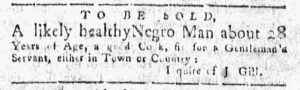
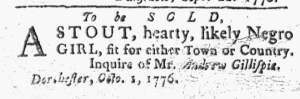
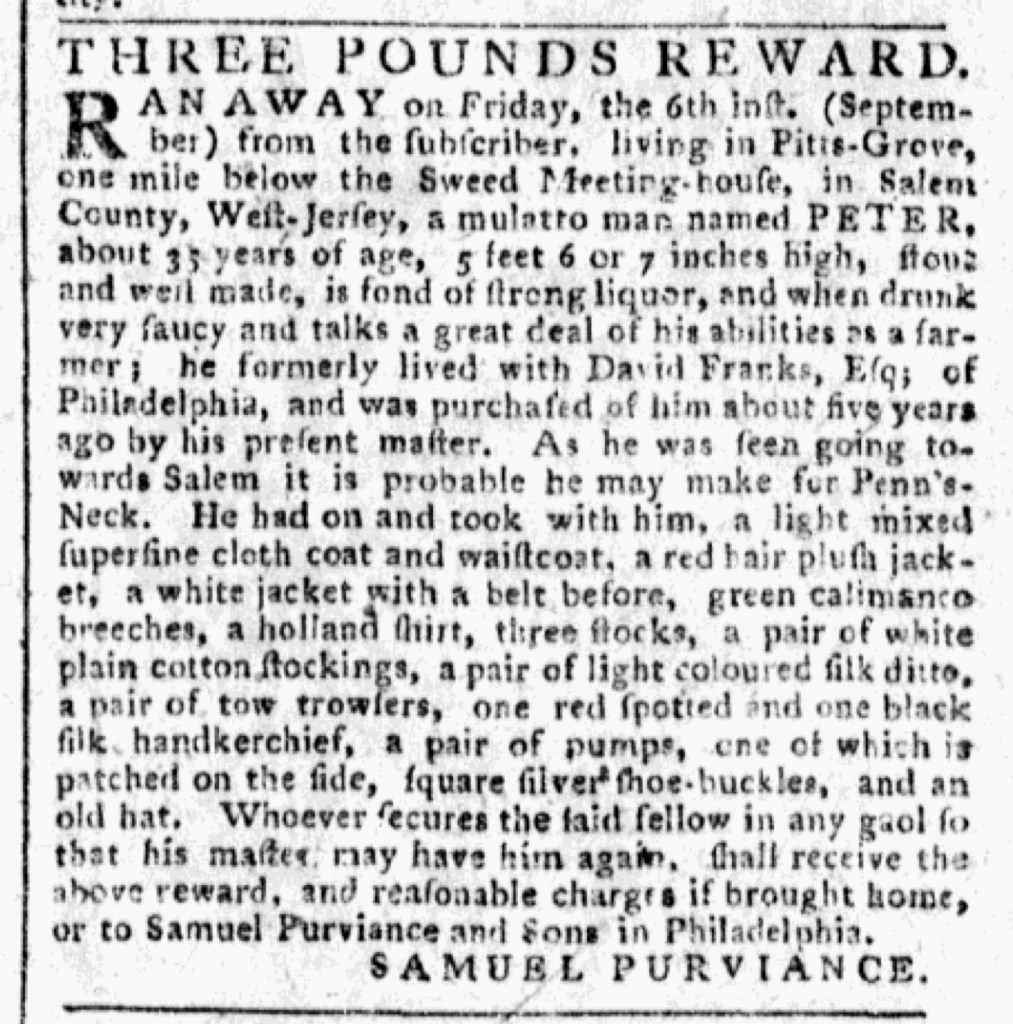
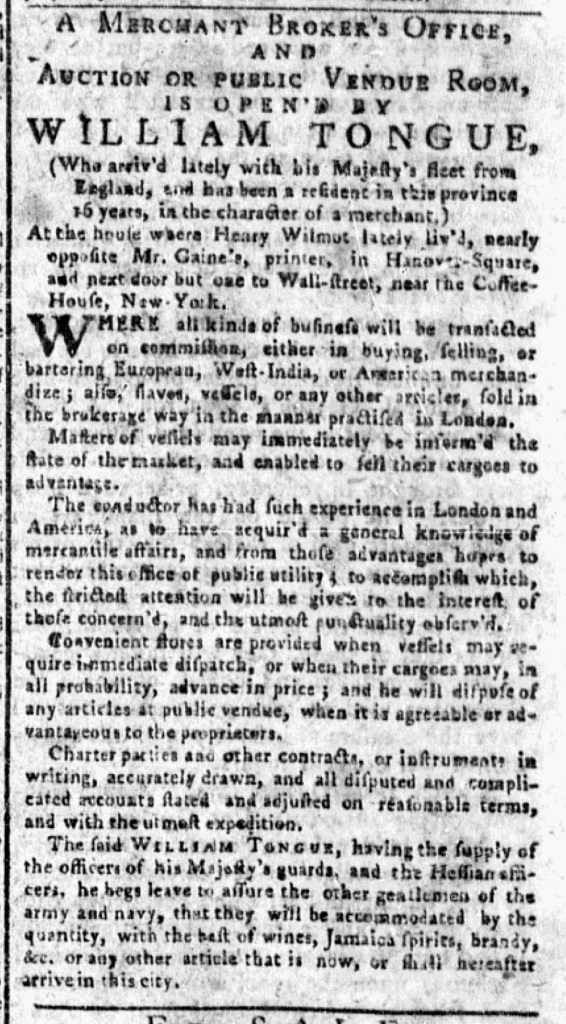
Connecticut Gazette (September 27, 1776).

**********
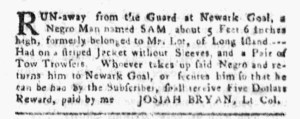
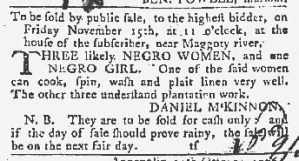
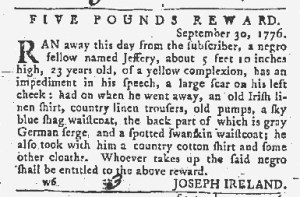
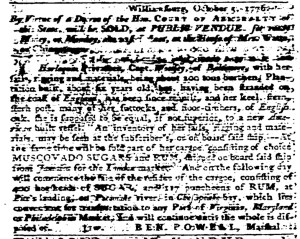
Virginia Gazette [Dixon and Hunter] (September 27, 1776).

**********
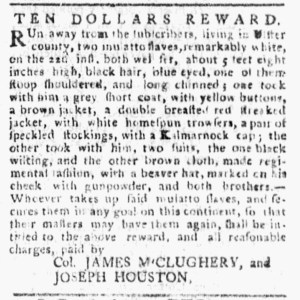
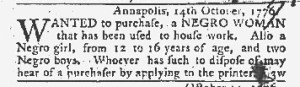
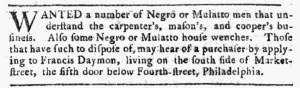
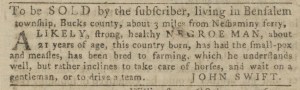
Virginia Gazette [Dixon and Hunter] (September 27, 1776).

**********
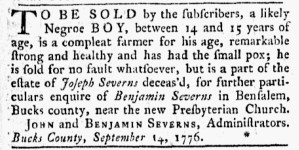
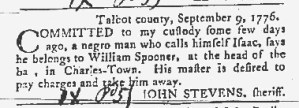
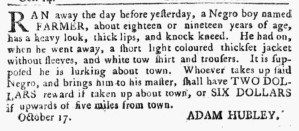
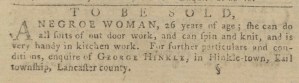
Virginia Gazette [Dixon and Hunter] (September 27, 1776).

**********
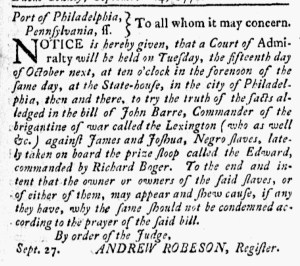
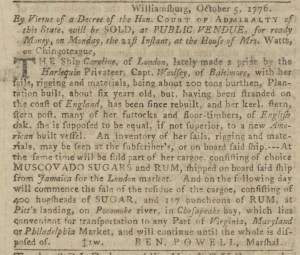
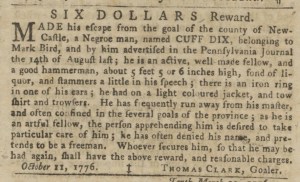
Virginia Gazette [Dixon and Hunter] (September 27, 1776).

**********
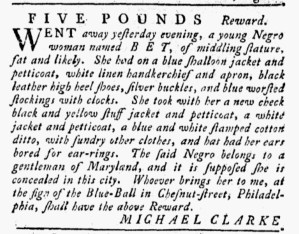
Virginia Gazette [Purdie] (September 27, 1776).

**********
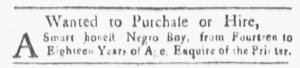
Virginia Gazette [Purdie] (September 27, 1776).

**********

Virginia Gazette [Purdie] (September 27, 1776).

**********

Virginia Gazette [Purdie] (September 27, 1776).

**********

Virginia Gazette [Purdie] (September 27, 1776).

**********

Virginia Gazette [Purdie] (September 27, 1776).

**********

Virginia Gazette [Purdie] (September 27, 1776).

**********

Virginia Gazette [Purdie] (September 27, 1776).

September 26

What was advertised in a revolutionary American newspaper 250 years ago today?

Continental Journal (September 26, 1776).

“Keeping up a Correspondence with our inveterate enemies … is in direct violation of the laws of this State.”

The Committee of Correspondence, Inspection, and Safety had a message for new arrivals in Boston.  They used an advertisement in the Continental Journal to let them know that they needed to identify themselves to the committee and surrender any letters they carried with them.

“WHEREAS the keeping up a Correspondence with our inveterate enemies,” Ellis Gray explained on behalf of the committee, “is in direct violation of laws of this State, … ALL persons theretofore who may arrive in this town from Halifax, or any port or place in possession of, or infested by our said enemies, are hereby directed to leave their names with all the letters they bring with them … with some member of this committee.”  That included contact with “the fleet and army now employed against the UNITED STATES,” referring to British forces, and “those open and avowed opposers of our rights, who have forfeited all title to our confidence and protection, by seeking refu[g]e under the power which has long been engaged in the destruction of this country,” referring to Loyalists, especially those who joined the British when they evacuated from Boston to Halifax.  In addition to turning over the letters they carried with them, new arrivals had to leave “a memorandum of their place of abode” so the committee knew where to find them.  They were to do so “as soon as may be after their arrival here.”  Gray warned that “non-compliance with this requisition will be deemed evidence of an unfriendly design … against the interest of the UNITED STATES” and those in violation “will be proceeded against accordingly.”

This important message appeared as an advertisement, first in the September 5, 1776, edition of the Continental Journal and again in the September 26 edition.  The printer interspersed it among paid notices placed for a variety of purposes rather than featuring it as a news item.  Like many other advertisements that ran in American newspapers during the era of the American Revolution, this notice from Boston’s Committee of Correspondence, Inspection, and Safety delivered news that did not appear elsewhere in the newspaper.  Readers perused advertisements as well as articles and editorials to learn about current events, including, on occasion, new regulations enacted in their communities.

Slavery Advertisements Published September 26, 1776

The Slavery Adverts 250 Project chronicles the role of newspaper advertising in perpetuating slavery in the era of the American Revolution. The project seeks to reveal the ubiquity of slavery in eighteenth-century life from New England to Georgia by republishing advertisements about enslaved people – for sale as individuals or in groups, wanted to purchase or for hire for short periods, runaways who liberated themselves, and those who were subsequently captured and confined in jails and workhouses – in daily digests on this site as well as in real time via the @SlaveAdverts250 Twitter feed, utilizing twenty-first-century media to stand in for the print media of the eighteenth century.

The project aims to provide modern audiences with a sense of just how often colonizers encountered these advertisements in their daily lives. Enslaved men, women, and children appeared in print somewhere in the colonies almost every single day. Those advertisements served as a constant backdrop for social, cultural, economic, and political life in colonial and revolutionary America. Colonizers who did not purport to own enslaved people were still confronted with slavery as well as invited to maintain the system by purchasing enslaved men, women, and children or assisting in the capture of so-called “runaways” who sought to free themselves from bondage. The frequency of these newspaper advertisements suggests just how embedded slavery was in colonial and revolutionary American culture in everyday interactions beyond the printed page.

These advertisements also testify to the experiences of enslaved men, women, and children, though readers must consider that those experiences have been remediated through descriptions offered by enslavers rather than enslaved people themselves. Often unnamed in the advertisements, enslaved men, women, and children were not invisible or unimportant in early America.

These advertisements appeared in revolutionary American newspapers 250 years ago today.

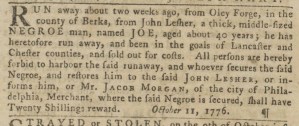
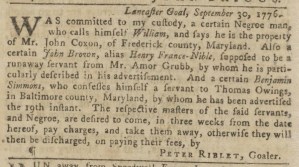
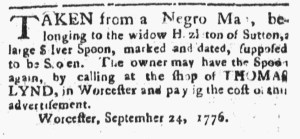
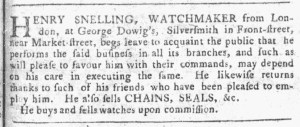
Maryland Gazette (September 26, 1776).

September 25

What was advertised in a revolutionary American newspaper 250 years ago today?

Pennsylvania Gazette (September 25, 1776).

“THOMAS LEIPER, TOBACCONIST.”

In early June 1776, tobacconists Hamilton and Leiper announced that they dissolved their partnership.  Each man set off on a new venture.  Hamilton and Son operated a “Scotch snuff and tobacco Manufactory” on Second Street in Philadelphia, while Thomas Leiper remained “in the house occupied by the [former] company” at the corner of Spruce and Walnut.  Leiper emphasized in his advertisements that he “manufactures in the best manner Snuff and Tobacco of the first quality, equal, if not superior, to any heretofore imported from Europe.”

Leiper advertised aggressively.  He inserted advertisements with identical copy in Dunlap’s Pennsylvania Packet, the Pennsylvania Gazette, the Pennsylvania Journal, and the Pennsylvania Ledger.  He aimed to maintain as much of the clientele that he and his former partner had cultivated as he could as well as attract new customers.  To that end, he arranged for his advertisements to run in some of those newspapers for months, making a significant investment in doing so.  Most printers offered a standard package that included setting type and inserting an advertisement in three or four issues before discontinuing it.  Advertisers could pay for each additional insertion if they wished to extend the run of their notices.  Leiper apparently did so.  His advertisement ran in both the Pennsylvania Gazette and the Pennsylvania Journalon September 25, 1776.  The one in the Pennsylvania Gazette even included a notation – “3 m” – on the final line, likely intended to remind the printer that it was supposed to run for three months.

Leiper competed with his former partner and other tobacconists in Philadelphia.  He likely believed that an advertising campaign that extended for several months would yield the kind of name recognition that would convince prospective customers to give his snuff and other products a chance.  The repetition of his advertisements, appearing week after week in some of Philadelphia’s most popular newspapers, probably made his business familiar to many readers as they perused the advertisements for all sorts of information about commerce and current events.

Slavery Advertisements Published September 25, 1776

The Slavery Adverts 250 Project chronicles the role of newspaper advertising in perpetuating slavery in the era of the American Revolution. The project seeks to reveal the ubiquity of slavery in eighteenth-century life from New England to Georgia by republishing advertisements about enslaved people – for sale as individuals or in groups, wanted to purchase or for hire for short periods, runaways who liberated themselves, and those who were subsequently captured and confined in jails and workhouses – in daily digests on this site as well as in real time via the @SlaveAdverts250 Twitter feed, utilizing twenty-first-century media to stand in for the print media of the eighteenth century.

The project aims to provide modern audiences with a sense of just how often colonizers encountered these advertisements in their daily lives. Enslaved men, women, and children appeared in print somewhere in the colonies almost every single day. Those advertisements served as a constant backdrop for social, cultural, economic, and political life in colonial and revolutionary America. Colonizers who did not purport to own enslaved people were still confronted with slavery as well as invited to maintain the system by purchasing enslaved men, women, and children or assisting in the capture of so-called “runaways” who sought to free themselves from bondage. The frequency of these newspaper advertisements suggests just how embedded slavery was in colonial and revolutionary American culture in everyday interactions beyond the printed page.

These advertisements also testify to the experiences of enslaved men, women, and children, though readers must consider that those experiences have been remediated through descriptions offered by enslavers rather than enslaved people themselves. Often unnamed in the advertisements, enslaved men, women, and children were not invisible or unimportant in early America.

These advertisements appeared in revolutionary American newspapers 250 years ago today.

Connecticut Journal (September 25, 1776).

**********

Connecticut Journal (September 25, 1776).

**********

Connecticut Journal (September 25, 1776).

**********

Connecticut Journal (September 25, 1776).

**********

Pennsylvania Gazette (September 25, 1776).

**********

Pennsylvania Gazette (September 25, 1776).

**********

Massachusetts Spy (September 25, 1776).

September 24

What was advertised in a revolutionary American newspaper 250 years ago today?

Pennsylvania Evening Post (September 24, 1776).

“Hancock and other printed handkerchiefs.”

When William Adcock first announced a “VENDUE” or auction of “a great variety of goods suitable to the season” to be held on September 18, 1776, he included “Hancock and Washington handkerchiefs, and a great variety of other printed handkerchiefs” among the items “exposed for sale.”  A week later he inserted another advertisement in the Pennsylvania Evening Post, informing the public that he would host another sale “at his vendue store.”  This time he promoted “a variety of GOODS, among which are … coarse white linens, checks, stripes, superfine mens and womens cotton stockings, silk and worsted knee garters, flax, gimps, fringes, [and] Hancock and other printed handkerchiefs.”  He did not include “Washington handkerchiefs” among his wares.

Did that mean that he had sold all the handkerchiefs bearing a depiction of the commander-in-chief of the Continental Army at his previous sale?  Possibly.  Even if that was the case, it did not necessarily indicate that commemorative items depicting the general were more popular than those with a likeness of the president of the Continental Congress.  The advertisements did not mention the quantity of each handkerchief available.  Adcock may have had a limited supply of “Washington handkerchiefs” compared to “Hancock handkerchiefs.”  The second advertisement did, however, clarify an element of the design of those handkerchiefs.  It was not clear from the first advertisement whether “Hancock and Washington handkerchiefs” featured both men on a single handkerchief.  Other handkerchiefs produced during the era, after all, had images of multiple prominent politicians and military officers.  “Hancock and Washington handkerchiefs” could have had profiles of the two men facing each other, but the second advertisement suggests that each prominent leader had his own commemorative handkerchief.  They may have been made in the same workshop by a savvy entrepreneur who hoped that patriotic consumers would treat them as collectibles by purchasing both rather than just one.  Given that vendues often sold goods in quantities, retailers likely purchased some of the “Hancock and Washington handkerchiefs” to stock in their own shop and sell to consumers who visited with other purchases in mind.

Slavery Advertisements Published September 24, 1776

The Slavery Adverts 250 Project chronicles the role of newspaper advertising in perpetuating slavery in the era of the American Revolution. The project seeks to reveal the ubiquity of slavery in eighteenth-century life from New England to Georgia by republishing advertisements about enslaved people – for sale as individuals or in groups, wanted to purchase or for hire for short periods, runaways who liberated themselves, and those who were subsequently captured and confined in jails and workhouses – in daily digests on this site as well as in real time via the @SlaveAdverts250 Twitter feed, utilizing twenty-first-century media to stand in for the print media of the eighteenth century.

The project aims to provide modern audiences with a sense of just how often colonizers encountered these advertisements in their daily lives. Enslaved men, women, and children appeared in print somewhere in the colonies almost every single day. Those advertisements served as a constant backdrop for social, cultural, economic, and political life in colonial and revolutionary America. Colonizers who did not purport to own enslaved people were still confronted with slavery as well as invited to maintain the system by purchasing enslaved men, women, and children or assisting in the capture of so-called “runaways” who sought to free themselves from bondage. The frequency of these newspaper advertisements suggests just how embedded slavery was in colonial and revolutionary American culture in everyday interactions beyond the printed page.

These advertisements also testify to the experiences of enslaved men, women, and children, though readers must consider that those experiences have been remediated through descriptions offered by enslavers rather than enslaved people themselves. Often unnamed in the advertisements, enslaved men, women, and children were not invisible or unimportant in early America.

These advertisements appeared in revolutionary American newspapers 250 years ago today.

Dunlap’s Maryland Gazette (September 24, 1776).

**********

Dunlap’s Pennsylvania Packet (September 24, 1776).

**********

Pennsylvania Evening Post (September 24, 1776).

September 23

What was advertised in a revolutionary American newspaper 250 years ago today?

Norwich Packet (September 23, 1776).

“Lately published … THE Manual Exercise.”

As fall arrived in 1776, John Trumbull inserted an advertisement for “THE Manual Exercise, As ordered by his Majesty in 1764, and now adopted in the various Provinces of North-America” in his newspaper, the Norwich Packet.  He described the military manual as “Lately published, and to be sold by the Printer hereof.”  Eighteenth-century readers understood that “Lately published” did not mean that it just came off the press.  Instead, it meant that the book had been published and was available rather than being in the proposal or preparation stage.  After all, advertisements proposing to publish many books ran in early American newspapers, but not all of them garnered enough demand that printers moved beyond merely gauging interest in them.

Local editions of this military manual, The Manual Exercise as Ordered by His Majesty in 1764: Together with Plans and Explanations of the Method Generally Practised at Reviews and Field-Days, had been published in at least ten towns from Massachusetts to Virginia in 1774 and 1775.  It did so well that some printers issued second editions.  Such had been the case with John Trumbull and his former partners, Alexander Robertson and James Roberston.  They published their first Norwich edition in 1774 and a second Norwich edition in 1775.  When Trumbull advertised the book in the fall of 1776, he did not promote a new edition but instead sought to sell remaining copies of the 1775 that he published with his former partners, Loyalists who had since moved to New York.  His latest advertisement indicated that the manual included “General WOLFE’s Instructions to young OFFICERS.”  The Robertsons and Trumbull previously added that content to the second Norwich edition, further evidence that Trumbull now hawked that book rather than a new edition.  In asserting that it was “Lately published,” the printer did not claim that the military manual just hit the market but rather that production was complete and copies were available for sale immediately.

Slavery Advertisements Published September 23, 1776

The Slavery Adverts 250 Project chronicles the role of newspaper advertising in perpetuating slavery in the era of the American Revolution. The project seeks to reveal the ubiquity of slavery in eighteenth-century life from New England to Georgia by republishing advertisements about enslaved people – for sale as individuals or in groups, wanted to purchase or for hire for short periods, runaways who liberated themselves, and those who were subsequently captured and confined in jails and workhouses – in daily digests on this site as well as in real time via the @SlaveAdverts250 Twitter feed, utilizing twenty-first-century media to stand in for the print media of the eighteenth century.

The project aims to provide modern audiences with a sense of just how often colonizers encountered these advertisements in their daily lives. Enslaved men, women, and children appeared in print somewhere in the colonies almost every single day. Those advertisements served as a constant backdrop for social, cultural, economic, and political life in colonial and revolutionary America. Colonizers who did not purport to own enslaved people were still confronted with slavery as well as invited to maintain the system by purchasing enslaved men, women, and children or assisting in the capture of so-called “runaways” who sought to free themselves from bondage. The frequency of these newspaper advertisements suggests just how embedded slavery was in colonial and revolutionary American culture in everyday interactions beyond the printed page.

These advertisements also testify to the experiences of enslaved men, women, and children, though readers must consider that those experiences have been remediated through descriptions offered by enslavers rather than enslaved people themselves. Often unnamed in the advertisements, enslaved men, women, and children were not invisible or unimportant in early America.

These advertisements appeared in revolutionary American newspapers 250 years ago today.

Connecticut Courant (September 23, 1776).

September 22

What was advertised in a revolutionary American newspaper 250 years ago this week?

Virginia Gazette [Dixon and Hunter] (September 21, 1776).

“I HAVE still on Hand a considerable Quantity of CALF SKINS … and a tolerable Assortment of other Goods.”

Matthew Anderson ran a lengthy advertisement about merchandise available at his store in Gloucester, Virginia, in John Dixon and William Hunter’s Virginia Gazette in August and September 1776.  He listed dozens of items, enumerating an extensive array of textiles, housewares, hardware, and even books, noting at the conclusion that he also stocked “some other Trifles, too tedious to mention.”  Despite the disruptions caused by the war, consumers could still acquire certain necessities at Anderson’s shop or participate in some retail therapy to distract them for a moment.

By the end of September, Anderson ran a new advertisement, a much shorter one.  He used it to inform prospective customers that he “still [had] on Hand a considerable Quantity of CALF SKINS, HARNESS LEATHER, SOLE LEATHER, Mens strong SHOES, BAR IRON, COFFEE, BROWN SUGAR, [and] Mens coarse and fine HATS.”  In addition, his inventory included “a tolerable Assortment of other Goods.”  He did not replicate the catalog from his previous advertisement, nor did he use the same effusive language about having so many goods that they were “too tedious to mention.”  He also did not mention any of the books, such as “Watts’s Hymns and Psalms” and “Observations on Civil Liberty,” that he highlighted in his previous advertisement.  Perhaps he did not wish to make a significant investment in the new notice, so he reduced the length.  In addition, the changes may have indicated the effectiveness of his first advertisement and a considerable reduction in his inventory, yet he still had plenty of merchandise – that “tolerable Assortment of other Goods” – to delight shoppers when they visited his store.  Anderson may have assumed that many prospective customers who read his new advertisement would have also seen his previous one, making it unnecessary to do more than publish a reminder that mentioned some of the most popular items.  That he inserted a second advertisement suggests that he believed the first one worked.