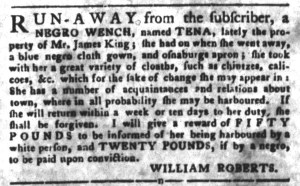
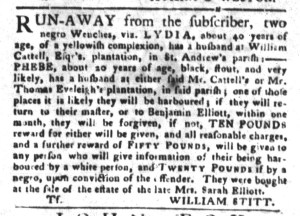
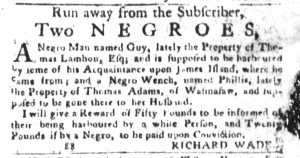
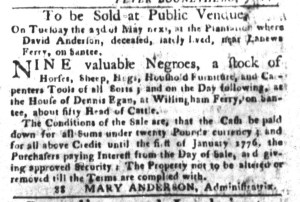
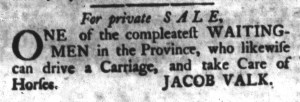
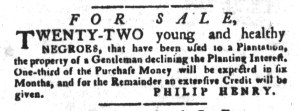
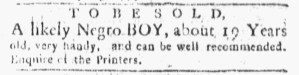
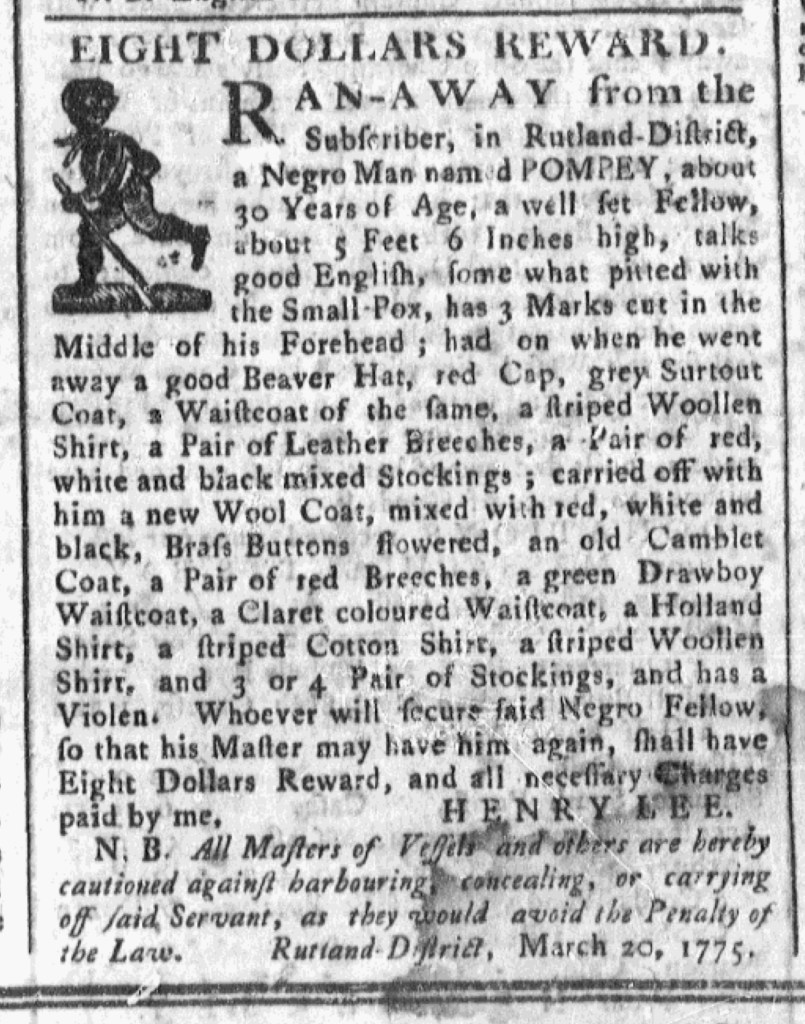
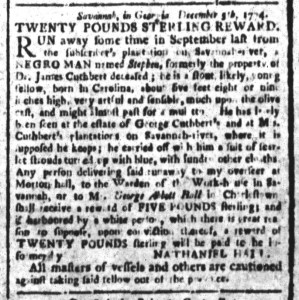
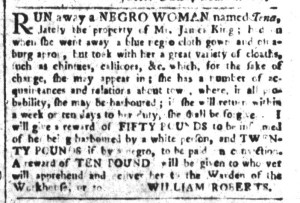
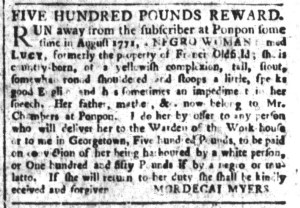
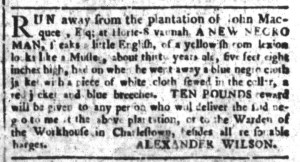
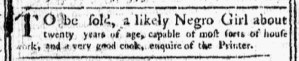
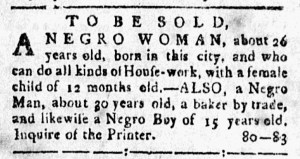
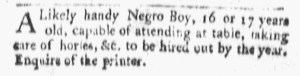
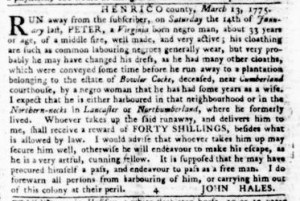
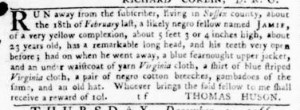
The Slavery Adverts 250 Project chronicles the role of newspaper advertising in perpetuating slavery in the era of the American Revolution. The project seeks to reveal the ubiquity of slavery in eighteenth-century life from New England to Georgia by republishing advertisements about enslaved people – for sale as individuals or in groups, wanted to purchase or for hire for short periods, runaways who liberated themselves, and those who were subsequently captured and confined in jails and workhouses – in daily digests on this site as well as in real time via the @SlaveAdverts250 Twitter feed, utilizing twenty-first-century media to stand in for the print media of the eighteenth century.
The project aims to provide modern audiences with a sense of just how often colonizers encountered these advertisements in their daily lives. Enslaved men, women, and children appeared in print somewhere in the colonies almost every single day. Those advertisements served as a constant backdrop for social, cultural, economic, and political life in colonial and revolutionary America. Colonizers who did not purport to own enslaved people were still confronted with slavery as well as invited to maintain the system by purchasing enslaved men, women, and children or assisting in the capture of so-called “runaways” who sought to free themselves from bondage. The frequency of these newspaper advertisements suggests just how embedded slavery was in colonial and revolutionary American culture in everyday interactions beyond the printed page.
These advertisements also testify to the experiences of enslaved men, women, and children, though readers must consider that those experiences have been remediated through descriptions offered by enslavers rather than enslaved people themselves. Often unnamed in the advertisements, enslaved men, women, and children were not invisible or unimportant in early America.
These advertisements appeared in colonial American newspapers 250 years ago today.
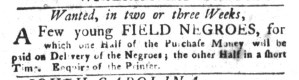
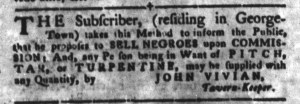
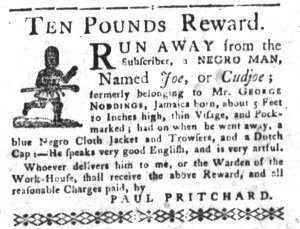
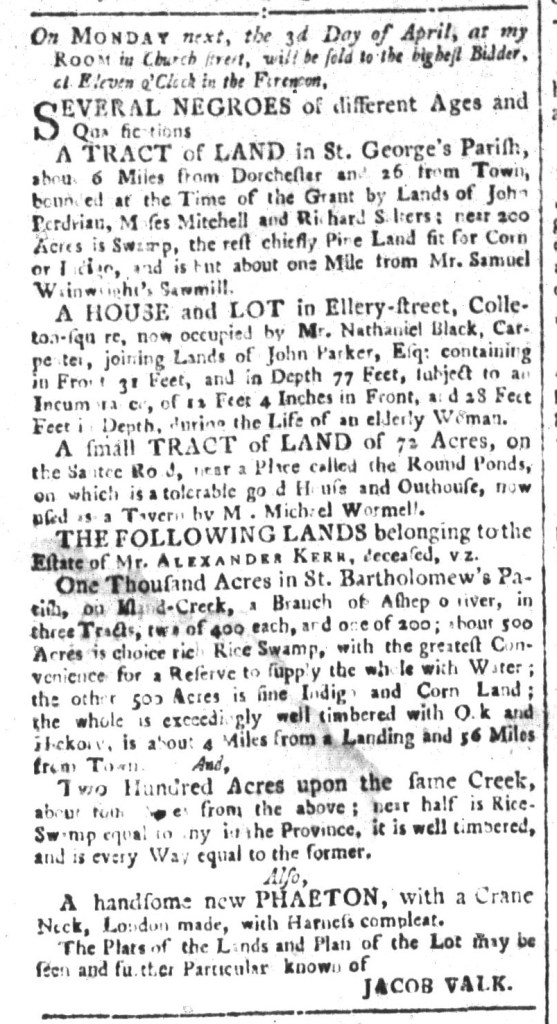
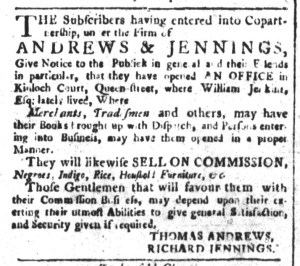
South-Carolina Gazette and Country Journal (April 4, 1775).
**********
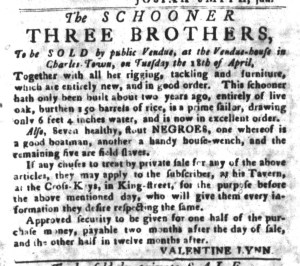
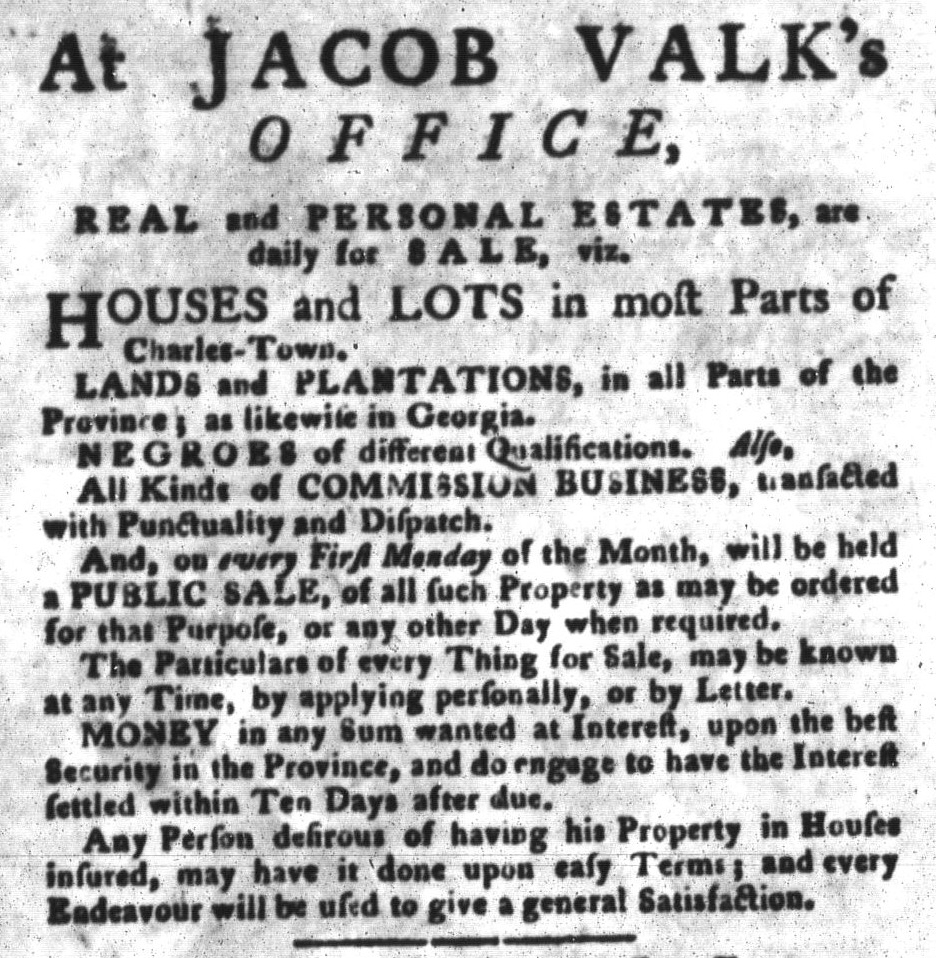
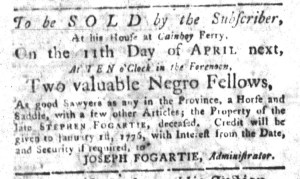
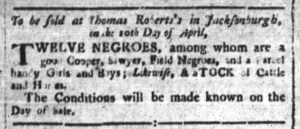
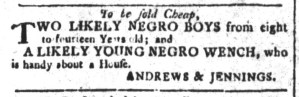
South-Carolina Gazette and Country Journal (April 4, 1775).
**********
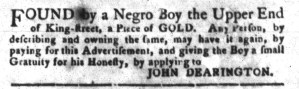
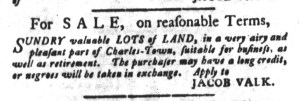
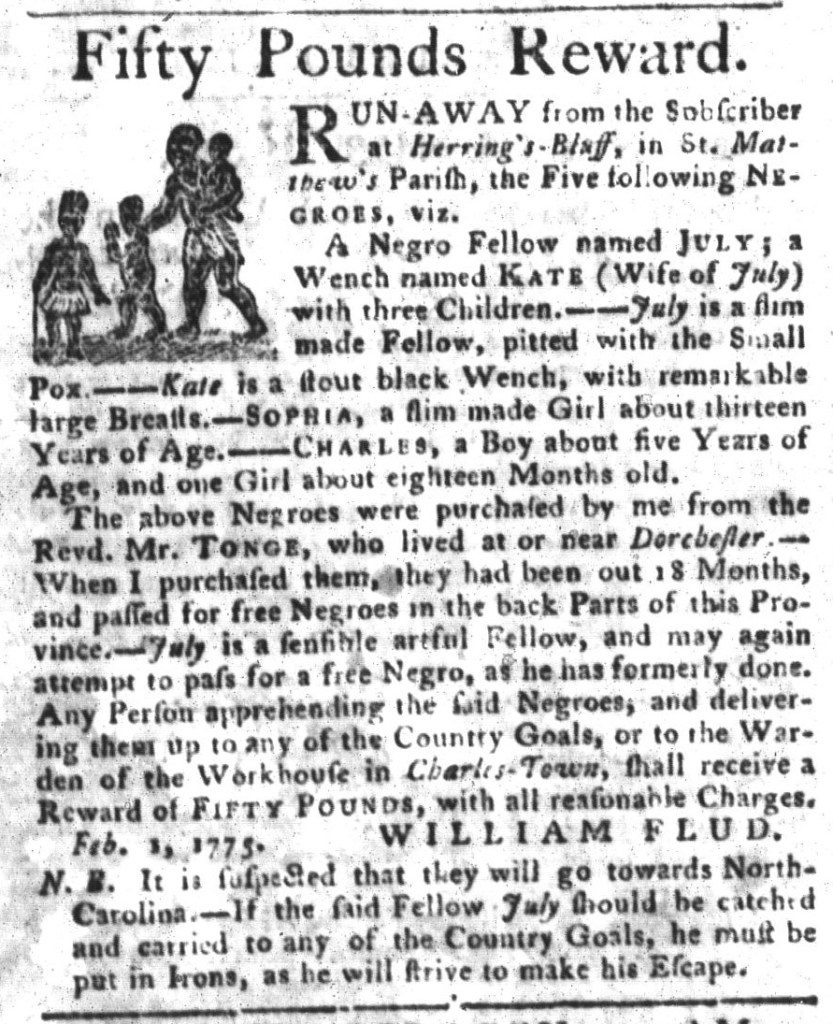
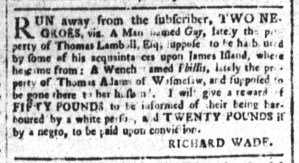
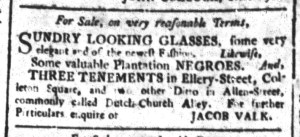
South-Carolina Gazette and Country Journal (April 4, 1775).
**********
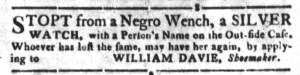
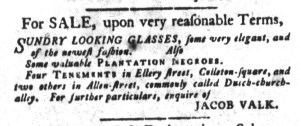
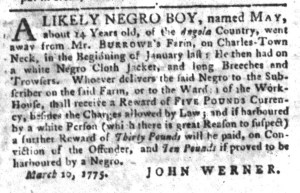
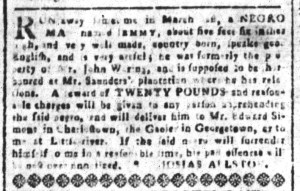
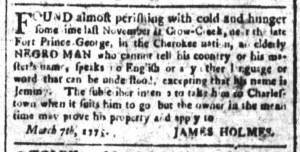
South-Carolina Gazette and Country Journal (April 4, 1775).
**********
South-Carolina Gazette and Country Journal (April 4, 1775).
**********
South-Carolina Gazette and Country Journal (April 4, 1775).
**********
South-Carolina Gazette and Country Journal (April 4, 1775).
**********
South-Carolina Gazette and Country Journal (April 4, 1775).
**********
South-Carolina Gazette and Country Journal (April 4, 1775).
**********
South-Carolina Gazette and Country Journal (April 4, 1775).
**********
South-Carolina Gazette and Country Journal (April 4, 1775).
**********
South-Carolina Gazette and Country Journal (April 4, 1775).
**********
South-Carolina Gazette and Country Journal (April 4, 1775).
**********
South-Carolina Gazette and Country Journal (April 4, 1775).
**********
South-Carolina Gazette and Country Journal (April 4, 1775).
What was advertised in a colonial American newspaper 250 years ago today?
Newport Mercury (April 3, 1775).
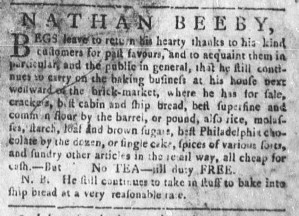
“No TEA – till duty FREE.”
When Thomas Green advertised a variety of grocery items in the April 3, 1775, edition of the Newport Mercury, he listed “SUGAR, FLOUR, COFFEE, … CHOCOLATE, … PEPPER, … NUTMEGS, CLOVES, and MACE.” Tea, one of the commodities that so often appeared in such lists, was conspicuously absent. Many shopkeepers had refused to stock, advertise, or sell tea in the aftermath of the Boston Tea Party in December 1773, just as many consumers refrained from purchasing tea. Abstaining from tea was not universal, however, as some advertisers did continue to include it in their advertisements even after the colonies received word of the Boston Port Act, the Massachusetts Government Act, and the other Coercive Acts that Parliament passed in response to the destruction of the tea by colonizers who masqueraded as Indigenous Americans. Tea even merited particular notice in the Continental Association, the nonimportation pact devised by the First Continental Congress during its meetings in Philadelphia in September and October 1774, yet Peter Oliver, a noted Loyalist judge in Boston, alleged in his Origin and Progress of the American Rebellion that colonizers, especially women, manufactured all sorts of justifications for continuing to drink tea.
Nathan Beeby, a baker in Newport, took a stand regarding tea in the same issue of the newspaper that carried Green’s advertisement. He thanked his “kind customers for past favours” and advised the public that “he still continues to carry on the baking business at his house, where he has for sale, crackers, best cabin and ship bread, [and] best superfine and common flour by the barrel, or pound.” He also peddled “rice, molasses, starch, loaf and brown sugars, best Philadelphia chocolate …, spices of various sorts, and sundry other articles in the retail way.” As many retailers did at the time, he specified that he did not extended credit, accepting only cash, and then he added: “– But No TEA – till duty FREE.” Green left it to readers to realize that tea did not appear in his advertisement, while Beeby made a point of announcing that he did not stock or sell the problematic commodity. The amount of space that appeared between “But” and “No TEA” amounted to a dramatic pause, further emphasizing Beeby’s commitment and perhaps serving as a reminder to readers of the pledges they made to refuse to consume that beverage. The baker practiced politics in his advertisement, using the space he purchased in the Newport Mercury to participate in public discourse.
The Slavery Adverts 250 Project chronicles the role of newspaper advertising in perpetuating slavery in the era of the American Revolution. The project seeks to reveal the ubiquity of slavery in eighteenth-century life from New England to Georgia by republishing advertisements about enslaved people – for sale as individuals or in groups, wanted to purchase or for hire for short periods, runaways who liberated themselves, and those who were subsequently captured and confined in jails and workhouses – in daily digests on this site as well as in real time via the @SlaveAdverts250 Twitter feed, utilizing twenty-first-century media to stand in for the print media of the eighteenth century.
The project aims to provide modern audiences with a sense of just how often colonizers encountered these advertisements in their daily lives. Enslaved men, women, and children appeared in print somewhere in the colonies almost every single day. Those advertisements served as a constant backdrop for social, cultural, economic, and political life in colonial and revolutionary America. Colonizers who did not purport to own enslaved people were still confronted with slavery as well as invited to maintain the system by purchasing enslaved men, women, and children or assisting in the capture of so-called “runaways” who sought to free themselves from bondage. The frequency of these newspaper advertisements suggests just how embedded slavery was in colonial and revolutionary American culture in everyday interactions beyond the printed page.
These advertisements also testify to the experiences of enslaved men, women, and children, though readers must consider that those experiences have been remediated through descriptions offered by enslavers rather than enslaved people themselves. Often unnamed in the advertisements, enslaved men, women, and children were not invisible or unimportant in early America.
These advertisements appeared in colonial American newspapers 250 years ago today.
Boston Evening-Post (April 3, 1775).
**********
Boston Evening-Post (April 3, 1775).
**********
Boston Evening-Post (April 3, 1775).
**********
Boston Evening-Post (April 3, 1775).
**********
Boston-Gazette (April 3, 1775).
**********
Dunlap’s Pennsylvania Packet (April 3, 1775).
**********
Massachusetts Gazette and Boston Post-Boy (April 3, 1775).
**********
Newport Mercury (April 3, 1775).
**********
New-York Gazette and Weekly Mercury (April 3, 1775).
**********
New-York Gazette and Weekly Mercury (April 3, 1775).
**********
New-York Gazette and Weekly Mercury (April 3, 1775).
**********
New-York Gazette and Weekly Mercury (April 3, 1775).
**********
New-York Gazette and Weekly Mercury (April 3, 1775).
**********
New-York Gazette and Weekly Mercury (April 3, 1775).
**********
New-York Gazette and Weekly Mercury (April 3, 1775).
“Advertisements … will be ranged, without partiality as they come to Hand.”
Baltimore did not have its own newspaper until William Goddard commenced publication of the Maryland Journal on August 20, 1773. Less than two years later, John Dunlap, the printer of Dunlap’s Pennsylvania Packet, proposed publishing a second newspaper in that growing port on the Chesapeake Bay. He followed a model designed by Goddard, who had been publishing the Pennsylvania Chronicle in Philadelphia when he set about opening a second printing office and establishing another newspaper in a neighboring colony.
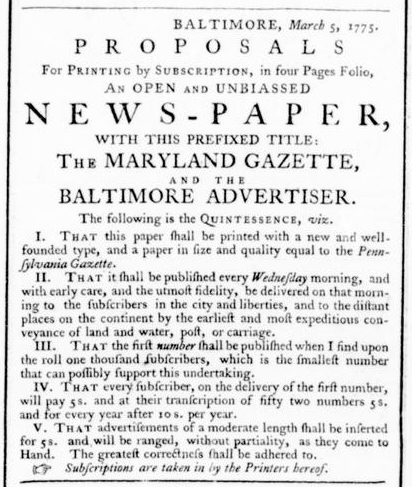
Dunlap disseminated subscription proposals widely, including inserting them in John Dixon and William Hunter’s Virginia Gazette. He announced a plan for an “OPEN AND UNBIASED NEWS-PAPER,” a claim made by many printers during the era of the American Revolution even though they often took an editorial stance that favored either Patriots or Loyalists. He planned to call it the “MARYLAND GAZETTE, AND THE BALTIMORE ADVERTISER,” distinguishing it from the Maryland Gazette published in Annapolis since 1745, but he would not take it to press until he attracted “one thousand subscribers, which is the smallest number that can possibly support this undertaking.” The proposed newspaper apparently drew that many subscribers (or at least enough that Dunlap considered it a viable enterprise) because he issued the “first number” of Dunlap’s Maryland Gazette; or the Baltimore General Advertiser on May 2, just two months after the date on the proposals. Perhaps subscribers grew eager for an additional source of news as the imperial crisis intensified, or perhaps news of the skirmishes at Lexington and Concord in April convinced Dunlap that the time was right to launch his newspaper, even if he did not yet have one thousand subscribers, because current events would guarantee its success.
His subscription proposal covered some of the usual nuts and bolts, what many printers called “conditions,” yet Dunlap referred to as “the QUINTESSENCE.” He indicated that the newspaper “shall be printed with a new and well-founded type, and a paper in size and quality to the Pennsylvania Gazette,” curiously drawing comparison to another newspaper published in Philadelphia rather than his own. He planned to publish a new issue “every Wednesday morning,” the same day that Goddard distributed copies of the Maryland Journal. He promised delivery “on that morning to the subscribers in the city and liberties.” Those in “the distant places on the continent,” such as readers of Dixon and Hunter’s Virginia Gazette, could expect “the earliest and most expeditious conveyance of land and water, post, or carriage.” Subscriptions cost five shillings, due at the time of delivery of the first issues, and then another five shillings upon receiving fifty-two issues. They continued at ten shillings each year.
While many subscription proposals for newspapers solicited advertisements, few specified how much they cost; instead, they declared that they charged the same fees as their competitors. In the proposals for the Pennsylvania Ledger that also circulated in the first months of 1775, for instance, Jame Humphreys, Jr., stated, “Advertisements to be inserted on the same Terms as is usual with other Papers in this City.” Similarly, Isaiah Thomas pronounced that advertisements in the Worcester Gazette would be “inserted in a neat and conspicuous [manner], at the same rates as they are in Boston.” Dunlap, in contrast, gave a price: “advertisements of a moderate length shall be inserted for 5s.” He did not, however, indicate how many times notices ran for that rate nor whether advertisers received discounts for subsequent insertions. He did assert that they “will be ranged, without partiality, as they come to Hand. The greatest correctness shall be adhered to.” In other words, he would print notices in the order they arrived in the printing office; no advertisements would receive a privileged place based on their content, the printer’s relationship with the advertiser, or other factors. All advertisers could depend on their notices appearing accurately in the Maryland Gazette. The inaugural issue featured one advertisement. The Adverts 250 Project will turn its attention to that advertisement and others in the coming months.
What was advertised in a colonial American newspaper 250 years ago today?
Pennsylvania Evening Post (April 1, 1775).
“The COLD BATH, At BATH TOWN.”
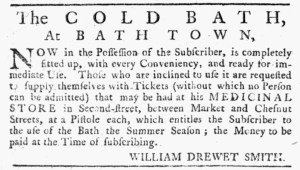
William Drewet Smith, a “Chemist and Druggist,” diversified his business interests in the spring of 1775. He operated a shop “At HIPPOCRATES’s HEAD” on Second Street Philadelphia, selling a “general Assortment of Druggs and patent medicines, surgeons instruments, [and] shop furniture.” In an advertisement in the March 25 edition of the Pennsylvania Ledger, he promoted one of those patent medicines, “Baron SCHOMBERG’s Grand Prophylactic LIMIMENT” to prevent venereal diseases and treat the symptoms of those who did not practice prevention soon enough. In that same issue, he inserted a second advertisement, that one hawking “Baron Van Haake’s royal letters pattent composition, for manuring land” to farmers and gardeners.
A week later, Smith ran yet another notice to announce that he was now the proprietor of the “COLD BATH, At BATH TOWN.” The facility, he reported, “is completely fitted up, with every Conveniency, and ready for immediate Use.” Those seeking entry needed to buy tickets (“without which no Person can be admitted”). The apothecary sold them for “a Pistole each” at his “MEDICINAL STORE.” Those who intended to travel to Bath, about sixty-five miles north of Philadelphia, could obtain their tickets before making the trip. Rather than a single admission, each ticket entitled the bearer “to the use of the Bath [throughout] the Summer Season,” but they had to pay the entire balance “at the Time of subscribing.” Smith did not allow guests to avail themselves of the amenities at his spa on credit.
Advertising in both the Pennsylvania Evening Post and the Pennsylvania Ledger, Smith joined the ranks of eighteenth-century entrepreneurs who marketed health tourism in America. The apothecary probably figured that it made sense to branch out in that direction. When clients visited his shop in Philadelphia, especially clients of means who had the leisure to travel, he could recommend the rejuvenating waters at the “COLD BATH” and the benefits of being away from the bustling urban port to supplement the medicines that he supplied. He likely believed that his reputation and experience as a “Chemist and Druggist” made him a trustworthy provider of other health services in the eyes of the public.
The Slavery Adverts 250 Project chronicles the role of newspaper advertising in perpetuating slavery in the era of the American Revolution. The project seeks to reveal the ubiquity of slavery in eighteenth-century life from New England to Georgia by republishing advertisements about enslaved people – for sale as individuals or in groups, wanted to purchase or for hire for short periods, runaways who liberated themselves, and those who were subsequently captured and confined in jails and workhouses – in daily digests on this site as well as in real time via the @SlaveAdverts250 Twitter feed, utilizing twenty-first-century media to stand in for the print media of the eighteenth century.
The project aims to provide modern audiences with a sense of just how often colonizers encountered these advertisements in their daily lives. Enslaved men, women, and children appeared in print somewhere in the colonies almost every single day. Those advertisements served as a constant backdrop for social, cultural, economic, and political life in colonial and revolutionary America. Colonizers who did not purport to own enslaved people were still confronted with slavery as well as invited to maintain the system by purchasing enslaved men, women, and children or assisting in the capture of so-called “runaways” who sought to free themselves from bondage. The frequency of these newspaper advertisements suggests just how embedded slavery was in colonial and revolutionary American culture in everyday interactions beyond the printed page.
These advertisements also testify to the experiences of enslaved men, women, and children, though readers must consider that those experiences have been remediated through descriptions offered by enslavers rather than enslaved people themselves. Often unnamed in the advertisements, enslaved men, women, and children were not invisible or unimportant in early America.
These advertisements appeared in colonial American newspapers 250 years ago today.
What was advertised in a colonial American newspaper 250 years ago today?
South-Carolina and American General Gazette (March 31, 1775).
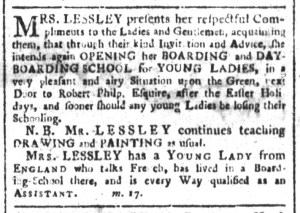
“She intends again OPENING her BOARDING and DAY-BOARDING SCHOOL.”
Mrs. Lessley ran a “BOARDING and DAY-BOARDING SCHOOL for YOUNG LADIES” in Charleston in the 1770s. She closed the school for a while, as schoolmasters and schoolmistresses often did for various reasons, but, as spring arrived in 1775, she took to the pages of the South-Carolina and American General Gazette to announce that she planned on “again OPENING” her school “after the Easter Holiday.” She decided to do so, she stated, at the “kind Invitation and Advice” of “Ladies and Gentlemen” familiar with her school, offering an implicit endorsement she hoped would convince prospective pupils and their families.
Lessley also gave information about others who worked at her school. “MR. LESSLEY continues teaching DRAWING and PAINTING as usual,” enriching the curriculum offered by his wife. Readers, especially former students, may have assumed that was the case, but they did not necessarily know about a new employee. The schoolmistress reported that she “has a YOUNG LADY from ENGLAND who talks French, has lived in a Boarding-School there, and is every Way qualified as an ASSISTANT.” Those cosmopolitan skills and experiences enhanced the education that Lessley provided for her charges. Her assistant aided in teaching a language considered a marker of gentility among the gentry and those who aspired to join their ranks. Perhaps she even served as the primary instructor for that subject. She may have consulted with Lessley on replicating an English boarding school without students having to cross the Atlantic while also serving as a role model for how “YOUNG LADIES” should comport themselves at such a school.
The schoolmistress gave less attention to the amenities at her school, though she did mention that it was located “in a very pleasant and airy Situation upon the Green.” With classes slated to begin sometime after April 16, she assured prospective students and their families that they would live and learn in a comfortable environment. She also indicated that she would commence lessons “sooner should any young Ladies be losing their Schooling.” In other words, if other schoolmasters and schoolmistresses closed or suspended their schools, Lessley would gladly accept their students. She hoped that these additional appeals in combination with her description of those who taught at her school would help in encouraging prospective pupils and their families to enroll.
The Slavery Adverts 250 Project chronicles the role of newspaper advertising in perpetuating slavery in the era of the American Revolution. The project seeks to reveal the ubiquity of slavery in eighteenth-century life from New England to Georgia by republishing advertisements about enslaved people – for sale as individuals or in groups, wanted to purchase or for hire for short periods, runaways who liberated themselves, and those who were subsequently captured and confined in jails and workhouses – in daily digests on this site as well as in real time via the @SlaveAdverts250 Twitter feed, utilizing twenty-first-century media to stand in for the print media of the eighteenth century.
The project aims to provide modern audiences with a sense of just how often colonizers encountered these advertisements in their daily lives. Enslaved men, women, and children appeared in print somewhere in the colonies almost every single day. Those advertisements served as a constant backdrop for social, cultural, economic, and political life in colonial and revolutionary America. Colonizers who did not purport to own enslaved people were still confronted with slavery as well as invited to maintain the system by purchasing enslaved men, women, and children or assisting in the capture of so-called “runaways” who sought to free themselves from bondage. The frequency of these newspaper advertisements suggests just how embedded slavery was in colonial and revolutionary American culture in everyday interactions beyond the printed page.
These advertisements also testify to the experiences of enslaved men, women, and children, though readers must consider that those experiences have been remediated through descriptions offered by enslavers rather than enslaved people themselves. Often unnamed in the advertisements, enslaved men, women, and children were not invisible or unimportant in early America.
These advertisements appeared in colonial American newspapers 250 years ago today.
South-Carolina and American General Gazette (March 31, 1775).
**********
South-Carolina and American General Gazette (March 31, 1775).
**********
South-Carolina and American General Gazette (March 31, 1775).
**********
South-Carolina and American General Gazette (March 31, 1775).
**********
South-Carolina and American General Gazette (March 31, 1775).
**********
South-Carolina and American General Gazette (March 31, 1775).
**********
South-Carolina and American General Gazette (March 31, 1775).
**********
South-Carolina and American General Gazette (March 31, 1775).
**********
South-Carolina and American General Gazette (March 31, 1775).
**********
South-Carolina and American General Gazette (March 31, 1775).
**********
South-Carolina and American General Gazette (March 31, 1775).
**********
South-Carolina and American General Gazette (March 31, 1775).
**********
South-Carolina and American General Gazette (March 31, 1775).
**********
South-Carolina and American General Gazette (March 31, 1775).
**********
South-Carolina and American General Gazette (March 31, 1775).
**********
South-Carolina and American General Gazette (March 31, 1775).
**********
South-Carolina and American General Gazette (March 31, 1775).
**********
South-Carolina and American General Gazette (March 31, 1775).
**********
South-Carolina and American General Gazette (March 31, 1775).
**********
South-Carolina and American General Gazette (March 31, 1775).
**********
South-Carolina and American General Gazette (March 31, 1775).
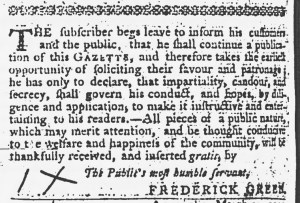
“He shall continue a publication of this GAZETTE.”
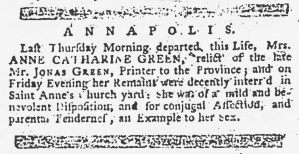
On March 30, 1775, the colophon for the Maryland Gazette stated, “ANNAPOLIS: Printed by FREDERICK GREEN,” for the first time. In the previous issue, it read, “ANNAPOLIS: Printed by ANNE CATHARINE GREEN and SON.” Anne Catharine Green had been publishing the newspaper since April 16, 1767, upon the death of her husband, Jonas. She commenced a partnership with her son, William, in January 1768, but it ended with his death in August 1770. In January 1772, she commenced another partnership, that one with another son, Frederick. When she died on March 23, 1775, he became the sole publisher.
On that occasion, he inserted his own notice in the Maryland Gazette, placing it first among the advertisements in the March 30 edition. Frederick “inform[ed] his customers and the public, that he shall continue a publication of this GAZETTE.” He offered assurances of his editorial strategy, pledging that “impartiality, candour, and secrecy, shall govern his conduct.” Through “diligence and application,” he intended to make the newspaper “instructive and entertaining to his readers.” To that end, “All pieces of a public nature, which may merit attention, and be thought conducive to the welfare and happiness of the community, will be thankfully received, and inserted gratis.” As had been the case when he worked alongside his mother, the printer needed to cultivate relationships with readers who would supply content to fill the pages of his newspaper.
Elsewhere on the same page, Frederick ran a death notice in memory of his mother. Thick black borders appeared above and below it, a common practice readily recognized as a sign of mourning. “Last Thursday Morning,” the notice reported, “departed this Life, Mrs. ANNE CATHARINE GREEN, relict of the late Mr. JONAS GREEN, Printer to the Province.” Her son remembered her “mild and benevolent Disposition,” declaring that “for conjugal Affection, and parental Tenderness” she was “an Example to her Sex.” He did not elaborate on the service she provided to Annapolis and the rest of the colony. Throughout most of her tenure as printer, the Maryland Gazette had been the only newspaper published in Maryland. Anne Catharine Green was one of several women who ran printing offices in colonial America during the imperial crisis that culminated in a war for independence. Along with Margaret Draper, Sarah Goddard, and Clementina Rind, she contributed to the dissemination of news and shaping of public opinion as momentous events occurred.
The Slavery Adverts 250 Project chronicles the role of newspaper advertising in perpetuating slavery in the era of the American Revolution. The project seeks to reveal the ubiquity of slavery in eighteenth-century life from New England to Georgia by republishing advertisements about enslaved people – for sale as individuals or in groups, wanted to purchase or for hire for short periods, runaways who liberated themselves, and those who were subsequently captured and confined in jails and workhouses – in daily digests on this site as well as in real time via the @SlaveAdverts250 Twitter feed, utilizing twenty-first-century media to stand in for the print media of the eighteenth century.
The project aims to provide modern audiences with a sense of just how often colonizers encountered these advertisements in their daily lives. Enslaved men, women, and children appeared in print somewhere in the colonies almost every single day. Those advertisements served as a constant backdrop for social, cultural, economic, and political life in colonial and revolutionary America. Colonizers who did not purport to own enslaved people were still confronted with slavery as well as invited to maintain the system by purchasing enslaved men, women, and children or assisting in the capture of so-called “runaways” who sought to free themselves from bondage. The frequency of these newspaper advertisements suggests just how embedded slavery was in colonial and revolutionary American culture in everyday interactions beyond the printed page.
These advertisements also testify to the experiences of enslaved men, women, and children, though readers must consider that those experiences have been remediated through descriptions offered by enslavers rather than enslaved people themselves. Often unnamed in the advertisements, enslaved men, women, and children were not invisible or unimportant in early America.
These advertisements appeared in colonial American newspapers 250 years ago today.