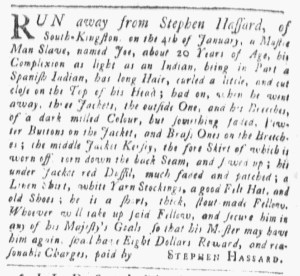
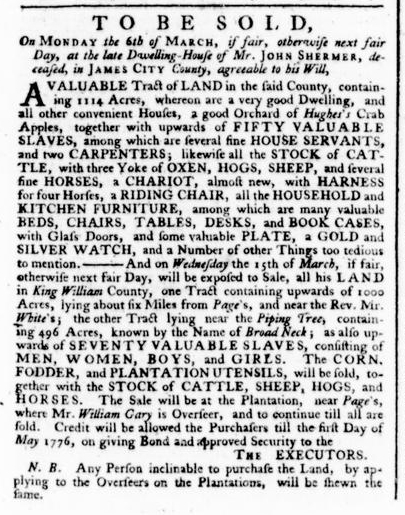
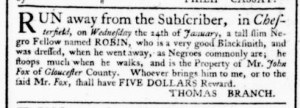
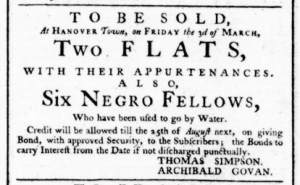
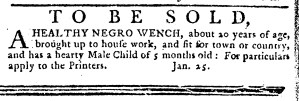
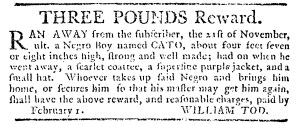
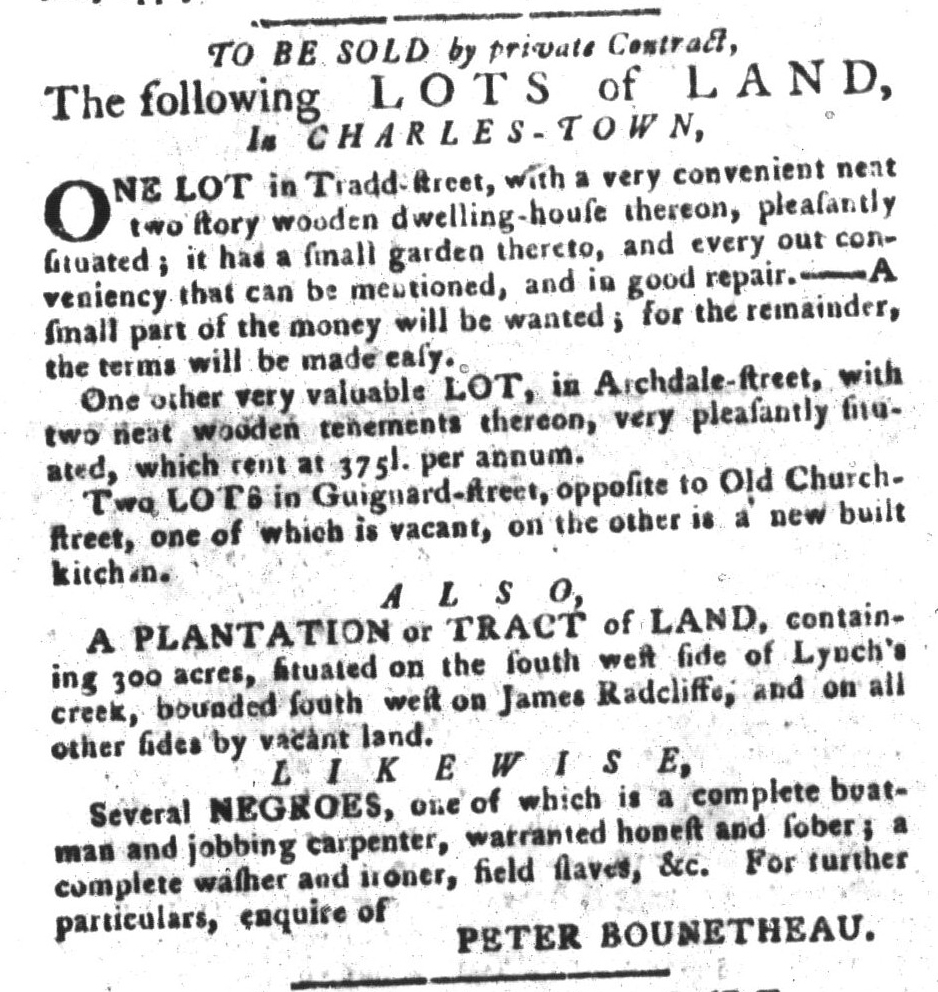
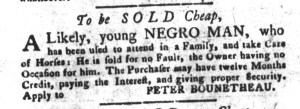
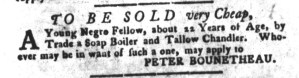
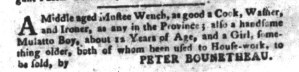
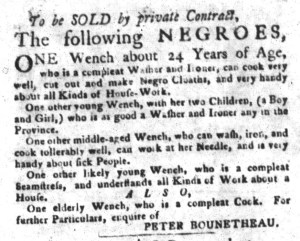
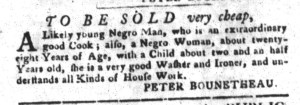
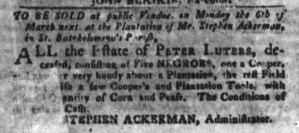
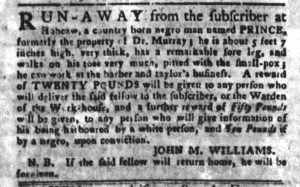
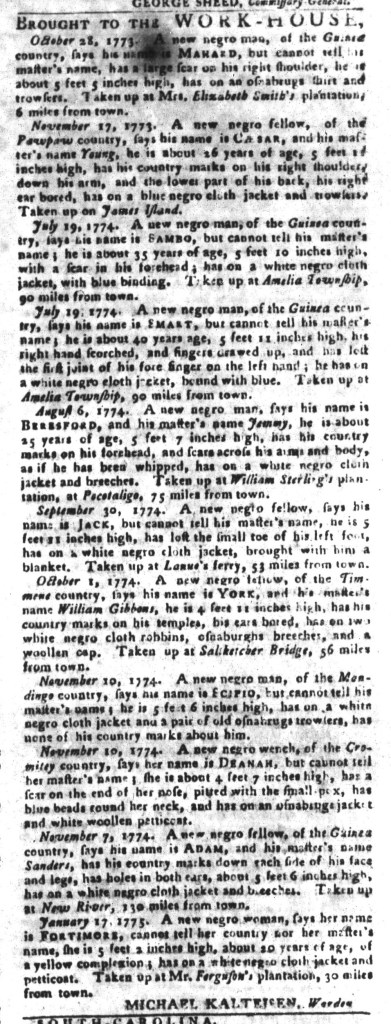
The Slavery Adverts 250 Project chronicles the role of newspaper advertising in perpetuating slavery in the era of the American Revolution. The project seeks to reveal the ubiquity of slavery in eighteenth-century life from New England to Georgia by republishing advertisements about enslaved people – for sale as individuals or in groups, wanted to purchase or for hire for short periods, runaways who liberated themselves, and those who were subsequently captured and confined in jails and workhouses – in daily digests on this site as well as in real time via the @SlaveAdverts250 Twitter feed, utilizing twenty-first-century media to stand in for the print media of the eighteenth century.
The project aims to provide modern audiences with a sense of just how often colonizers encountered these advertisements in their daily lives. Enslaved men, women, and children appeared in print somewhere in the colonies almost every single day. Those advertisements served as a constant backdrop for social, cultural, economic, and political life in colonial and revolutionary America. Colonizers who did not purport to own enslaved people were still confronted with slavery as well as invited to maintain the system by purchasing enslaved men, women, and children or assisting in the capture of so-called “runaways” who sought to free themselves from bondage. The frequency of these newspaper advertisements suggests just how embedded slavery was in colonial and revolutionary American culture in everyday interactions beyond the printed page.
These advertisements also testify to the experiences of enslaved men, women, and children, though readers must consider that those experiences have been remediated through descriptions offered by enslavers rather than enslaved people themselves. Often unnamed in the advertisements, enslaved men, women, and children were not invisible or unimportant in early America.
These advertisements appeared in colonial American newspapers 250 years ago today.
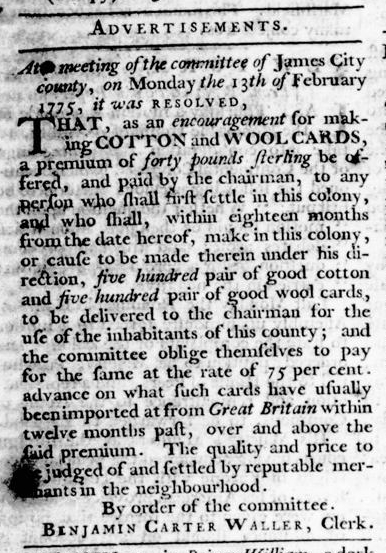
“An encouragement for making COTTON and WOOL CARDS … in this colony.”
Residents of James City County took the Continental Association seriously, especially the eighth article. When the First Continental Congress devised that nonimportation, nonconsumption, and nonexportation agreement in response to the Coercive Acts, they included an article that called for colonizers “in our several Stations, [to] encourage Frugality, Economy, and Industry; and promote Agriculture, Arts, and the Manufactures of this Country, especially that of Wool.” In turn, the “committee of James City county” passed a resolution for the “encouragement for making COTTON and WOOL CARDS” at its meeting in February 1775.
Within days an advertisement appeared in Alexander Purdie’s Virginia Gazette and John Dixon and William Hunter’s Virginia Gazette to inform enterprising entrepreneurs that the committee offered “a premium of forty pounds sterling … to any person who shall first settle in this colony, and who shall, within eighteen months from the date hereof, make in this colony, or cause to be made therein under his direction, five hundred pair of good cotton and five hundred pair of good wool cards … for the use of the inhabitants of this county.”
Preparing wool and cotton for spinning involved separating and straightening the fibers using two cards or paddles with fine wire teeth. That process made wool and cotton easier to spin; it also made the cards an essential tool for producing textiles as alternatives to imported fabrics. While the committee assumed that men would make the cards, it would be women who used them. That gave political meaning to the activities they undertook in carding, spinning, and weaving, just as women participated in politics when they refused to purchase imported cards, imported textiles, or any other imported goods.
Making cotton and wool cards in Virginia had the potential to be a profitable venture. In addition to the premium, the committee offered a “75 per cent. advance on what such cards have usually been imported at from Great Britain within the twelve months past.” In other words, the committee agreed to pay nearly twice what importers had recently paid for this important tool, another incentive for producing cards in the colony.
Supporters of the American cause had already mobilized in boycotting imported goods and producing alternatives. This advertisement suggested one more means of contributing to those efforts, making cotton and wool cards in Virginia. A successful venture would have ripple effects as women purchased those cards and used them in processing cotton and wool to produce homespun cloth rather than buying imported textiles. The premium offered for making cotton and wool cards was part of a larger project with significant political implications.
The Slavery Adverts 250 Project chronicles the role of newspaper advertising in perpetuating slavery in the era of the American Revolution. The project seeks to reveal the ubiquity of slavery in eighteenth-century life from New England to Georgia by republishing advertisements about enslaved people – for sale as individuals or in groups, wanted to purchase or for hire for short periods, runaways who liberated themselves, and those who were subsequently captured and confined in jails and workhouses – in daily digests on this site as well as in real time via the @SlaveAdverts250 Twitter feed, utilizing twenty-first-century media to stand in for the print media of the eighteenth century.
The project aims to provide modern audiences with a sense of just how often colonizers encountered these advertisements in their daily lives. Enslaved men, women, and children appeared in print somewhere in the colonies almost every single day. Those advertisements served as a constant backdrop for social, cultural, economic, and political life in colonial and revolutionary America. Colonizers who did not purport to own enslaved people were still confronted with slavery as well as invited to maintain the system by purchasing enslaved men, women, and children or assisting in the capture of so-called “runaways” who sought to free themselves from bondage. The frequency of these newspaper advertisements suggests just how embedded slavery was in colonial and revolutionary American culture in everyday interactions beyond the printed page.
These advertisements also testify to the experiences of enslaved men, women, and children, though readers must consider that those experiences have been remediated through descriptions offered by enslavers rather than enslaved people themselves. Often unnamed in the advertisements, enslaved men, women, and children were not invisible or unimportant in early America.
These advertisements appeared in colonial American newspapers 250 years ago today.
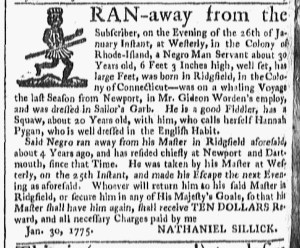
Connecticut Gazette (February 17, 1775).
**********
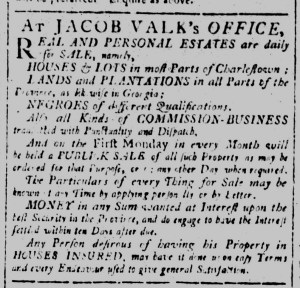
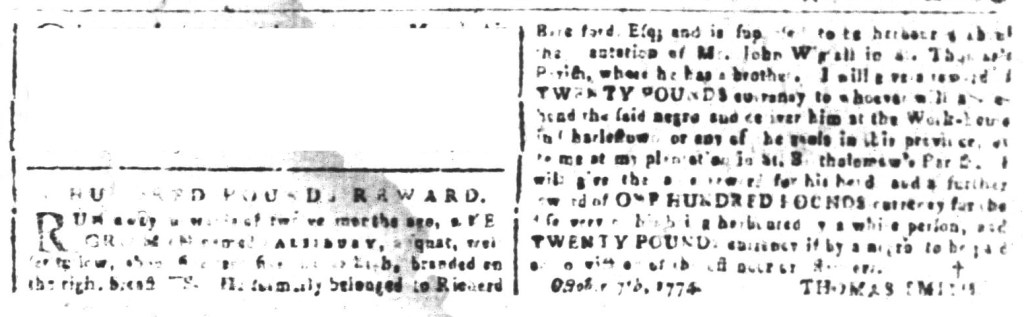
South-Carolina and American General Gazette (February 17, 1775).
**********
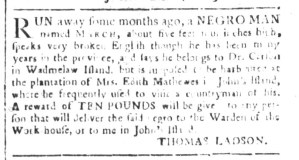
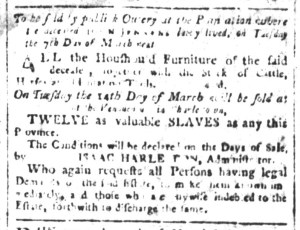
South-Carolina and American General Gazette (February 17, 1775).
**********
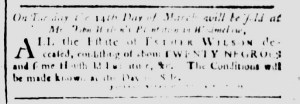
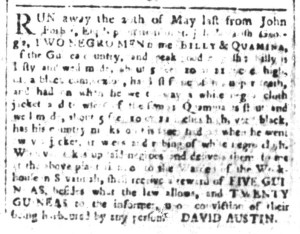
South-Carolina and American General Gazette (February 17, 1775).
**********
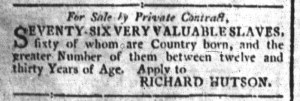
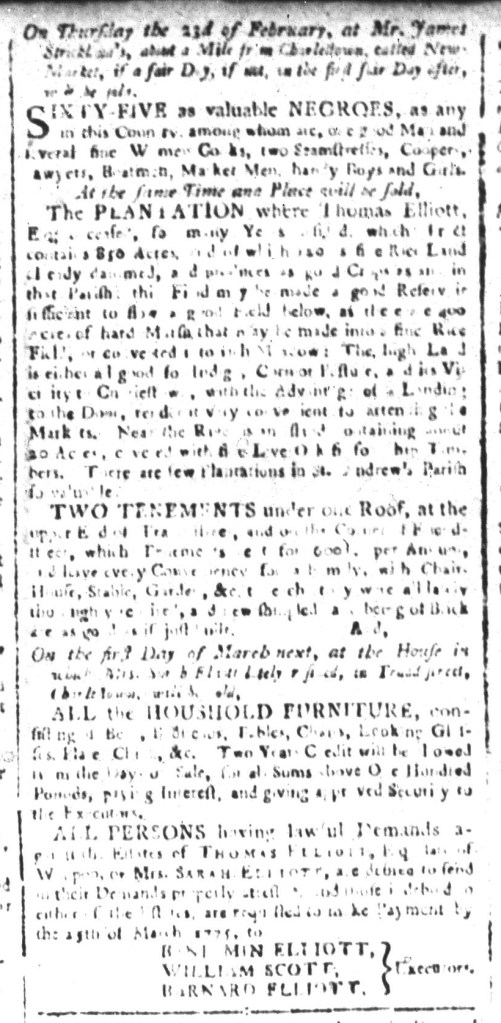
South-Carolina and American General Gazette (February 17, 1775).
**********
South-Carolina and American General Gazette (February 17, 1775).
**********
South-Carolina and American General Gazette (February 17, 1775).
**********
South-Carolina and American General Gazette (February 17, 1775).
**********
South-Carolina and American General Gazette (February 17, 1775).
**********
South-Carolina and American General Gazette (February 17, 1775).
**********
South-Carolina and American General Gazette (February 17, 1775).
**********
South-Carolina and American General Gazette (February 17, 1775).
**********
South-Carolina and American General Gazette (February 17, 1775).
**********
South-Carolina and American General Gazette (February 17, 1775).
**********
South-Carolina and American General Gazette (February 17, 1775).
**********
South-Carolina and American General Gazette (February 17, 1775).
**********
South-Carolina and American General Gazette (February 17, 1775).
**********
South-Carolina and American General Gazette (February 17, 1775).
**********
South-Carolina and American General Gazette (February 17, 1775).
**********
South-Carolina and American General Gazette (February 17, 1775).
**********
South-Carolina and American General Gazette (February 17, 1775).
What was advertised in a colonial American newspaper 250 years ago today?
Massachusetts Spy (February 16, 1775).
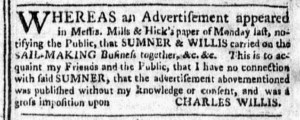
“I have no connection with said SUMNER.”
Charles Willis needed to correct an error. An advertisement in the February 13, 1775, edition of the Massachusetts Gazette and Boston Post-Boy proclaimed that “SUMNER and WILLIS … CARRY on the Sail-Making Business in all its Branches.” It gave their location and listed prices. Yet Willis had no knowledge of this partnership. Rather than wait for the next issue of the Massachusetts Gazette and Boston Post-Boy on February 20, he submitted his own advertisement to the Massachusetts Spy for inclusion in its February 16 edition.
“WHEREAS an Advertisement appeared in Messrs. Mills & Hick’s paper of Monday last, notifying the Public, that SUMNER & WILLIS carried on the SAIL-MAKING business together,” the aggrieved Willis asserted, “This is to acquaint my Friends and the Public, that I have no connection with said SUMNER, that the advertisement abovementioned was published without my knowledge or consent, and was a gross imposition upon CHARLES WILLIS.” The sailmaker was angry as he set the record straight. Readers of the Massachusetts Spy, on the other hand, may have been mildly amused by the drama that unfolded in the public prints. After all, a dispute between sailmakers could have been a welcome distraction from the hardships they encountered while the harbor remained closed to commerce because of the Boston Port Act.
Willis likely visited or contacted Mills and Hicks’s printing office about the offensive advertisement. It did not appear a second time, though the standard fee for advertisements provided for inserting them in three consecutive issues. Willis’s advertisement, for instance, ran in the Massachusetts Spy twice more before it was discontinued. Willis opted not to run a similar notice in the Massachusetts Gazette and Boston Post-Boy, the newspaper that carried the original “SUMNER and WILLIS” advertisement. That could have been because he did not wish to invest any more money on such notices in the public prints, yet it also suggests his confidence in the circulation of the Massachusetts Spy and ensuing conversations inspired by its contents, both news and advertisements. Advertising in just one newspaper sufficiently clarified that “SUMNER and WILLIS” were not indeed partners in the “Sail-Making Business.”
The Slavery Adverts 250 Project chronicles the role of newspaper advertising in perpetuating slavery in the era of the American Revolution. The project seeks to reveal the ubiquity of slavery in eighteenth-century life from New England to Georgia by republishing advertisements about enslaved people – for sale as individuals or in groups, wanted to purchase or for hire for short periods, runaways who liberated themselves, and those who were subsequently captured and confined in jails and workhouses – in daily digests on this site as well as in real time via the @SlaveAdverts250 Twitter feed, utilizing twenty-first-century media to stand in for the print media of the eighteenth century.
The project aims to provide modern audiences with a sense of just how often colonizers encountered these advertisements in their daily lives. Enslaved men, women, and children appeared in print somewhere in the colonies almost every single day. Those advertisements served as a constant backdrop for social, cultural, economic, and political life in colonial and revolutionary America. Colonizers who did not purport to own enslaved people were still confronted with slavery as well as invited to maintain the system by purchasing enslaved men, women, and children or assisting in the capture of so-called “runaways” who sought to free themselves from bondage. The frequency of these newspaper advertisements suggests just how embedded slavery was in colonial and revolutionary American culture in everyday interactions beyond the printed page.
These advertisements also testify to the experiences of enslaved men, women, and children, though readers must consider that those experiences have been remediated through descriptions offered by enslavers rather than enslaved people themselves. Often unnamed in the advertisements, enslaved men, women, and children were not invisible or unimportant in early America.
These advertisements appeared in colonial American newspapers 250 years ago today.
What was advertised in a colonial American newspaper 250 years ago today?
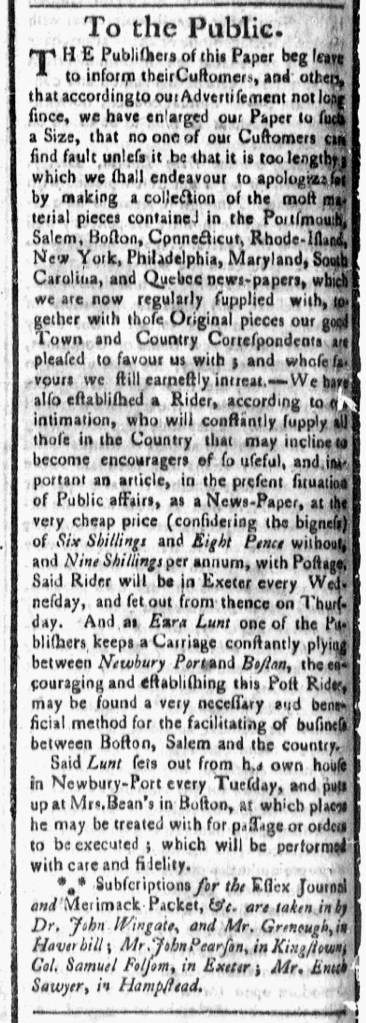
Essex Journal (February 15, 1775).
“We have enlarged our Paper to such a Size, that no one of our Customers can find fault.”
An advertisement in the February 15, 1775, edition of the Essex Journal, printed in Newburyport, Massachusetts, revealed important details about its production and circulation. Ezra Lunt and Henry-Walter Tinges, the publishers, inserted an address “To the Public” to celebrate that they recently “enlarged our Paper to such a Size, that no one of our Customers can find fault unless it be that it is too lengthy.” Lunt and Tinges coyly declared that they would “apologize” for the length by “making a collection of the most material pieces contained the Portsmouth, Salem, Boston, Connecticut, Rhode-Island, New York, Philadelphia, Maryland, South Carolina, and Quebec news-papers.” They asserted that they “are now regularly supplied with” newspapers from all those places. Like other colonial printers, Lunt and Tinges participated in exchange networks with their counterparts in other cities and towns. Upon receiving newspapers, they scoured them for content to include in their own publication, usually reprinting articles, editorials, essays, and letters word for word. One header in the February 15 edition, for instance, stated, “From the Massachusetts Spy.” They supplemented news from far and wide with “Original pieces our good Town and Country Correspondents are pleased to favour us with.”
Lunt and Tinges’s also gave details about the circulation of the Essex Journal, both where to subscribe and logistics for delivery. They informed readers that subscriptions “are taken in by Dr. John Wingate, and Mr. Grenough, in Haverhill; Mr. John Pearson, in Kingstown; Col. Samuel Folsom, in Exeter; Mr. Enoch Sawyer, in Hampstead.” That list of local agents resembled the one that appeared in the colophon of each issue of the Massachusetts Spy, printed by Isaiah Thomas in Boston. At the bottom of the last page, readers glimpsed an announcement that “J. Larkin, Chairmaker, and Mr. W. Calder, Painter, in Charlestown; Mr. J. Hiller, Watch maker, in Salem; Mr. B. Emerson, Bookseller, in Newbury-Port; Mr. M. Belcher, in Bridgewater; and [] Dr. Elijah Hewins, in Stoughtonham” collected subscriptions for the Massachusetts Spy. Tinges likely learned about recruiting local agents from Thomas, a founding partner of the Essex Journal. When it came to delivering the newspaper to subscribers, Lunt and Tinges promoted the services of both a post rider whose route included Exeter, New Hampshire, and the carriage that Lunt operated between Newburyport and Boston. This network “facilitate[ed] business between Boston, Salem, and the country” in addition to disseminating newspapers.
Intended to increase the number of subscribers (and, in turn, advertisers), this advertisement in the Essex Journal testified to several business practices followed by printers throughout the colonies. Lunt and Tinges described the various kinds of networks that played a role in gathering subscriptions, collecting news and other content, and delivering newspapers to readers. Each played a role in making information more widely available to the public during the era of the American Revolution.
The Slavery Adverts 250 Project chronicles the role of newspaper advertising in perpetuating slavery in the era of the American Revolution. The project seeks to reveal the ubiquity of slavery in eighteenth-century life from New England to Georgia by republishing advertisements about enslaved people – for sale as individuals or in groups, wanted to purchase or for hire for short periods, runaways who liberated themselves, and those who were subsequently captured and confined in jails and workhouses – in daily digests on this site as well as in real time via the @SlaveAdverts250 Twitter feed, utilizing twenty-first-century media to stand in for the print media of the eighteenth century.
The project aims to provide modern audiences with a sense of just how often colonizers encountered these advertisements in their daily lives. Enslaved men, women, and children appeared in print somewhere in the colonies almost every single day. Those advertisements served as a constant backdrop for social, cultural, economic, and political life in colonial and revolutionary America. Colonizers who did not purport to own enslaved people were still confronted with slavery as well as invited to maintain the system by purchasing enslaved men, women, and children or assisting in the capture of so-called “runaways” who sought to free themselves from bondage. The frequency of these newspaper advertisements suggests just how embedded slavery was in colonial and revolutionary American culture in everyday interactions beyond the printed page.
These advertisements also testify to the experiences of enslaved men, women, and children, though readers must consider that those experiences have been remediated through descriptions offered by enslavers rather than enslaved people themselves. Often unnamed in the advertisements, enslaved men, women, and children were not invisible or unimportant in early America.
These advertisements appeared in colonial American newspapers 250 years ago today.
What was advertised in a colonial American newspaper 250 years ago today?
Essex Gazette (February 14, 1775).
“The great Misfortune of losing his House and Store by Fire, with almost every Thing in and about them.”
Peter Frye was a justice of the peace in Salem, Massachusetts, when the town had a fire on October 6, 1774. According to Donna Seger, Frye was a Tory. Tories were also known as Loyalists, colonists who remained loyal to the king and Parliament. In an advertisement that he placed four months after the fire, Frye points out his misfortune of losing his house, store, and belongings due to the fire. “He is now obliged to beg all of those who were then indebted to him by Bond, Note, or on Account” to pay him what they justly owed.
Frye called for sympathy amongst the people of Salem by stating his misfortune of losing his house, store, and belongings. He thought that some readers would hesitate to engage because he was a Tory, either overlooking or disregarding his plea. He knew he was asking a lot of the people to help him recover, so began by noting that he lost everything.
Advertisements calling on readers to settle accounts and debts were common, but most advertisements were due to regular business transactions, not due to fires. Additionally, he not only lost his house and store, but allegedly all that was in them. In this matter, Frye no longer had his ledgers and account books due to the fire, which meant he had no records to confirm who owed him and what amount.
Frye relied on the sympathy and the good consciences of the people of Salem to help him out in this time of tragedy to gain back what he had lost. As Donna Seger explains, “Frye had tried to find his way back to ‘friendship’ with his Salem neighbors, but they had never been able to forget his commercial and judicial dealings contrary to Patriot proclamations.” Due to his position as a Tory on the eve of the American Revolution, townspeople held a grudge against him. Seger notes that Frye left Salem, moving to Ipswich and then Britain.
**********
ADDITIONAL COMMENTARY: Carl Robert Keyes
I enjoyed working with Ashley on this entry for many reasons, including the confluence of primary and secondary sources that went into crafting it. We began with negotiating whether I would approve Frye’s advertisement as Ashley’s selection for this project. I encouraged students to choose advertisements about consumer goods and services to build on our readings and discussions about the consumer revolution, but I also told them that I would consider other kinds of advertisements if they made convincing cases for what they hoped to learn from them and why they should be included in the Adverts 250 Project. Ashley convincingly argued that she did not previously know about the fire in Salem in 1774. Frye’s advertisement offered an opportunity to learn about that piece of local history and its aftermath.
To fill in the details, she consulted Streets of Salem, a blog produced by Donna Seger, Professor of History at Salem State University. Seger composes “[s]omewhat random but still timely posts about culture, history, and the material environment, from the perspectives of academia, Salem and beyond.” In the nine years that I have been producing the Adverts 250 Project, I have consulted and linked to Streets of Salem on many occasions, so I was pleased that Ashley discovered that wonderful and engaging resource when researching Frye’s advertisement. In the entry that gave so much information about Frye, Seger weaves together various primary sources, informed by Mary Beth Norton’s 1774: The Long Year of Revolution. Ashley was already familiar with Norton from our discussions about the historiography of the American Revolution. Seger’s post about “Tea, Fire and a new Congress” vividly illustrated how historians incorporate secondary sources into their research on primary sources, not only for background information but also in presenting an interpretation of what happened, why it mattered then, and why we consider it important now.
During the research, writing, and revision process, Ashley also had an opportunity to learn more about early American print culture and various kinds of advertisements, especially notices that called on colonizers to settle accounts. As a result, she was able to make a distinction between the familiar and standard notices that so often appeared in the pages of early American newspapers and the appeal that Frye made as he attempted to recover from a fire that had devasted his household and business. I sometimes select advertisements that deliver local news (including some that ran in the Essex Gazette right after the Salem fire) to feature on the Adverts 250 Project. Ashley contributed to the project’s examination of those sorts of newspaper advertisements.
Ashley Schofield is a junior at Assumption University in Worcester, Massachusetts. She is majoring in Psychology with a mental health concentration and minoring in Theology. Ashley is involved with Best Buddies on campus and enjoys going on nature walks, working out at the gym, drinking good coffee, and spending time with friends and family. She intends to obtain her Master’s of Clinical Psychology, become a therapist, and support the community around her in any way she can. Ashley made her contributions to the Adverts 250 Project and the Slavery Adverts 250 Project while enrolled in HIS 359 Revolutionary America, 1763-1815, in Fall 2024.
The Slavery Adverts 250 Project chronicles the role of newspaper advertising in perpetuating slavery in the era of the American Revolution. The project seeks to reveal the ubiquity of slavery in eighteenth-century life from New England to Georgia by republishing advertisements about enslaved people – for sale as individuals or in groups, wanted to purchase or for hire for short periods, runaways who liberated themselves, and those who were subsequently captured and confined in jails and workhouses – in daily digests on this site as well as in real time via the @SlaveAdverts250 Twitter feed, utilizing twenty-first-century media to stand in for the print media of the eighteenth century.
The project aims to provide modern audiences with a sense of just how often colonizers encountered these advertisements in their daily lives. Enslaved men, women, and children appeared in print somewhere in the colonies almost every single day. Those advertisements served as a constant backdrop for social, cultural, economic, and political life in colonial and revolutionary America. Colonizers who did not purport to own enslaved people were still confronted with slavery as well as invited to maintain the system by purchasing enslaved men, women, and children or assisting in the capture of so-called “runaways” who sought to free themselves from bondage. The frequency of these newspaper advertisements suggests just how embedded slavery was in colonial and revolutionary American culture in everyday interactions beyond the printed page.
These advertisements also testify to the experiences of enslaved men, women, and children, though readers must consider that those experiences have been remediated through descriptions offered by enslavers rather than enslaved people themselves. Often unnamed in the advertisements, enslaved men, women, and children were not invisible or unimportant in early America.
These advertisements appeared in colonial American newspapers 250 years ago today.
South-Carolina Gazette and Country Journal (February 14, 1775).
**********
South-Carolina Gazette and Country Journal (February 14, 1775).
**********
South-Carolina Gazette and Country Journal (February 14, 1775).
**********
South-Carolina Gazette and Country Journal (February 14, 1775).
**********
South-Carolina Gazette and Country Journal (February 14, 1775).
**********
South-Carolina Gazette and Country Journal (February 14, 1775).
**********
South-Carolina Gazette and Country Journal (February 14, 1775).
**********
South-Carolina Gazette and Country Journal (February 14, 1775).
**********
South-Carolina Gazette and Country Journal (February 14, 1775).
**********
South-Carolina Gazette and Country Journal (February 14, 1775).
**********
South-Carolina Gazette and Country Journal (February 14, 1775).
**********
South-Carolina Gazette and Country Journal (February 14, 1775).
**********
South-Carolina Gazette and Country Journal (February 14, 1775).
**********
South-Carolina Gazette and Country Journal (February 14, 1775).
**********
South-Carolina Gazette and Country Journal (February 14, 1775).
**********
South-Carolina Gazette and Country Journal (February 14, 1775).
**********
South-Carolina Gazette and Country Journal (February 14, 1775).
**********
South-Carolina Gazette and Country Journal (February 14, 1775).