January 31

What was advertised in a revolutionary American newspaper 250 years ago today?
Constitutional Gazette (January 31, 1776).

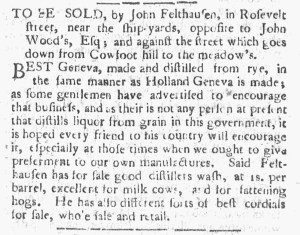
“BEST Geneva, made and distilled from rye.”

Advertisements for consumer goods and services crowded the pages of early American newspaper.  Did they work?  Unfortunately, that question is difficult to answer.  The advertisements reveal what kinds of marketing appeals merchants, shopkeepers, artisans, and other entrepreneurs thought would resonate with consumers and influence them to make purchases, but they rarely indicated how readers responded.

That so many entrepreneurs advertised and that they invested in advertising regularly suggests that they believed that they received a sufficient return on their investment to make the expense worth it.  Consider John Felthausen and his advertisement for “BEST Geneva [or Jenever, a type of gin], made and distilled from rye,” in the January 31, 1776, edition of the Constitutional Gazette.  That was not the first time that Felthausen placed that advertisement.  Three months earlier, he ran an advertisement with nearly identical copy in the New-York Gazette and Weekly Mercury.  If Felthausen believed that previous advertisement had not yielded results, would he have run it again in another newspaper a few months later?

That new advertisement had nearly identical copy, though the compositor for the Constitutional Gazette made very different decisions about the format than the compositor for the New-York Gazette and Weekly Mercury.  Felthausen may have even clipped the advertisement from one newspaper and delivered it to the printing office for the other, making marks on it to indicate copy he wished to update.  Those revisions amounted to adding a sentence at the end: “He has also different sorts of best cordials for sale, wholesale and retail.”  He retained his appeal to “every friend to this country” to “encourage” or support his business, “especially at those times when we ought to give preferment to our own manufactures.”  The distiller apparently believed that his previous advertisement met with sufficient success to merit repeating it to hawk both his “BEST Geneva” and additional products not previously included.
January 16

What was advertised in a revolutionary American newspaper 250 years ago today?

Henrich Millers Pennsylvanischer Staatsbote (January 16, 1776).

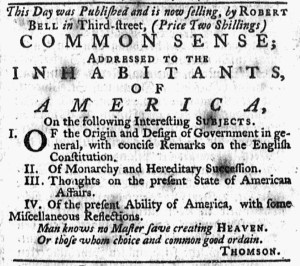
“COMMON SENSE; ADDRESSED TO THE INHABITANTS OF AMERICA.”

On January 16, 1776, Robert Bell’s advertisement for the first edition of Thomas Paine’s Comon Sense made its third appearance in the Pennsylvania Evening Post.  That newspaper, the only triweekly published in Philadelphia at the time, was the first to carry Bell’s advertisement.  It ran on January 9, 13, and 16, but not on January 11.  During that week, Bell also inserted an advertisement for Common Sense in each of the other five newspapers printed in Philadelphia at the time. On January 16, Henrich Millers Pennsylvanische Staatsbote was the last to feature it, the only advertisement in that newspaper printed in English rather than German.  Bell, already known for his savvy marketing, made sure that German settlers who could read English saw the political pamphlet advertised in the newspaper they were most likely to consult.

By that time, many of them may have already heard about the incendiary Common Sense, the way it mocked monarchy, and the arguments it made in favor of the colonies declaring independence.  Throughout most of the imperial crisis, colonizers blamed Parliament for perpetrating various abuses.  They sought redress for their grievances from the king. Over time, however, many identified George III as the author of their misfortune.  The monarch, after all, possessed ultimate responsibility for what occurred in his realm.  The Declaration of Independence listed more than two dozen grievances, assigning them all to the king rather than Parliament.  The publication of Common Sense in January 1776 played a significant role in shifting attitudes about the role the king played in the imperial crisis and the war that began with the skirmishes at Lexington and Concord in April 1775.

Among the observations and arguments that Paine advanced, he stated that “in America THE LAW IS KING.  For as in absolute governments, the King is law, so in free countries the law ought to be King and there ought to be no other.”  It was an ideal embraced by the founding generation … and it is an ideal under threat today as the nation commemorates 250 years since the Revolutionary War and the Declaration of Independence.  Citizens and the legislators who represent them must hold those who seek to be absolute rulers accountable to the rule of law so the republic remains a place where “THE LAW IS KING.”

January 13

What was advertised in a revolutionary American newspaper 250 years ago today?

Pennsylvania Ledger (January 13, 1776).

“COMMON SENSE; ADDRESSED TO THE INHABITANTS OF AMERICA.”

Robert Bell, one of the most prominent printers and booksellers in America, already had experience with extensive advertising campaigns by the time he published and marketed Thomas Paine’s Common Sense in January 1776.  Within a week, Bell inserted advertisements for what would become the most influential political pamphlet of the era of the American Revolution in all six newspapers printed in Philadelphia.

He started with the Pennsylvania Evening Post on January 9, then placed nearly identical advertisements in the Pennsylvania Gazette and the Pennsylvania Journal on January 10.  On January 13, the advertisement ran in the Pennsylvania Ledger (and once again in the Pennsylvania Evening Post, the city’s only triweekly rather than weekly newspaper).  Bell also ran the advertisement in Dunlap’s Pennsylvania Packet on January 15.  His notice had a privileged place in Pennsylvania Ledger (the first item in the first column on the first page) and Dunlap’s Pennsylvania Packet (the first advertisement following the news).

Even the Henrich Millers Pennsylvanischer Staaatsbote carried the advertisement on January 16, one week after Bell’s first advertisement appeared in the Pennsylvania Evening Post.  It was the only advertisement in English, even though the newspaper’s masthead advised that “All ADVERTISEMENTS to be inserted in this Paper, or printed single by HENRY MILLER, Publisher hereof, are by him translated gratis.”  Perhaps, since the pamphlet had not yet been translated into German, Bell instructed Miller to publish the advertisement in English to entice bilingual German colonizers.  Later in 1776, Melchior Steiner and Carl Cist, who had recently advertised that they printed in English, German, and other languages, published a German translation, Gesunde Vernunft.

The arguments and ideas that Paine presented in Common Sense caused a popular uproar.  Steiner and Cist’s German translation was only one of many local editions; printers in other cities and towns, especially in New York and New England, produced and advertised their own editions of the pamphlet.  Yet neither Paine nor Bell knew in advance that Common Sense would have such a reception.  It was not long before the author and the publisher had a falling out, causing Paine to work with William Bradford and Thomas Bradford, the printers of the Pennsylvania Journal, on the second edition.  Before that, however, Bell applied his long experience advertising books to promoting Common Sense in the public prints when he published the first edition.

September 1

What was advertised in a revolutionary American newspaper 250 years ago today?

Story and Humphreys’s Pennsylvania Mercury (September 1, 1775).

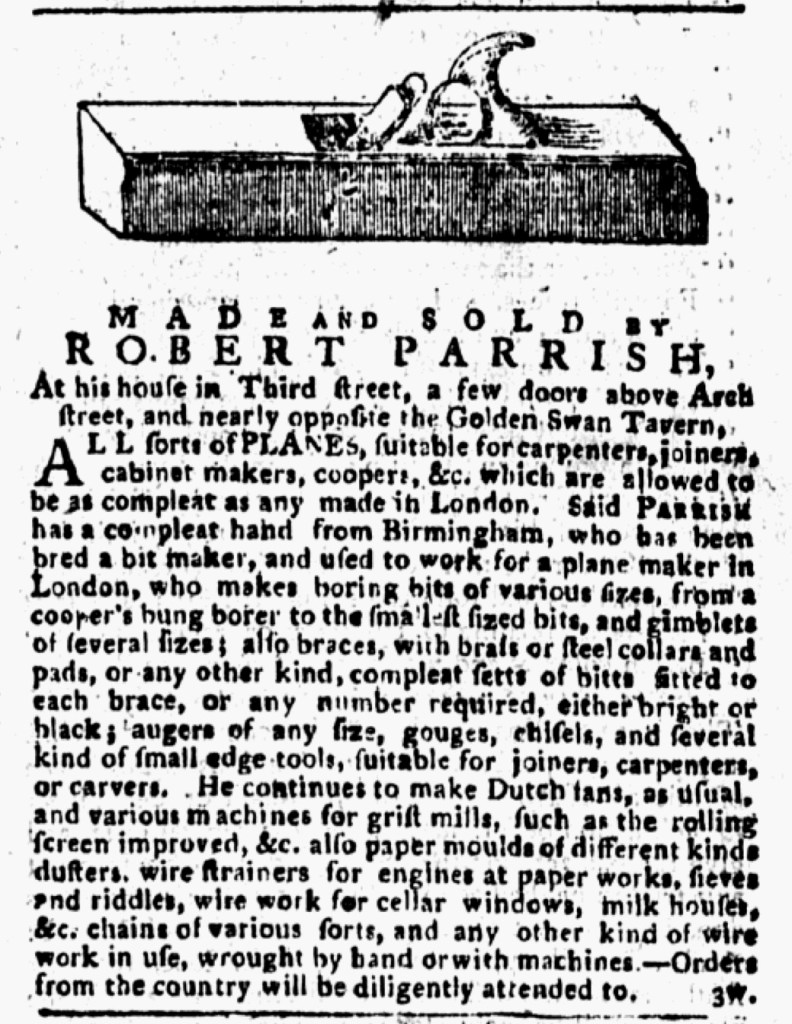
“ALL sorts of PLANES, suitable for carpenters.”

When Robert Parrish published an advertisement adorned with a woodcut depicting a carpenter’s plane in the August 26, 1775, edition of the Pennsylvania Ledger, it was the first of several appearances that image would make in newspapers printed in Philadelphia over the course of eight weeks.  It next appeared in Story and Humphreys’s Pennsylvania Mercuryon September 1 as part of an advertisement with identical copy.  Perhaps Parrish had clipped his advertisement from the Pennsylvania Ledger and delivered it to Story and Humphreys’s printing office along with the woodcut that he retrieved from the Pennsylvania Ledger.

Having commissioned only one woodcut constrained Parrish’s schedule for publishing his advertisements.  Story and Humphreys’s Pennsylvania Mercury came out on Fridays and the Pennsylvania Mercury on Saturdays.  That did not leave enough time to transfer the woodcut back and forth between the two printing offices and have the compositors in each include them in the new issues when they set the type and laid them out.  Compositors, after all, sought to streamline that process as much as possible.  To that end, the initial insertion of Parrish’s advertisement in the Pennsylvania Ledgerincluded a dateline, “Philadelphia, August 25, 1775,” above the woodcut, but the compositor did not include it with subsequent insertions (even though advertisements often ran with their original dates for weeks or months).  It was much easier to retain the copy for the main body of the advertisement without worrying about a header that ran above the woodcut.

Parrish’s advertisement first ran in the Pennsylvania Ledger on a Saturday (in the first week of his advertising campaign) and then in Story and Humphreys’s Pennsylvania Mercury the following Friday (in the second week of his advertising campaign).  It did not appear in the Pennsylvania Ledger the next day.  Instead, it ran in that newspaper a week later (in the third week of his advertising campaign).  In the fourth week, the woodcut returned to Story and Humphreys’s printing office and Parrish’s advertisement appeared in their newspaper once again on September 15.  It did not run in either newspaper the following week but instead found its way to yet another newspaper, the Pennsylvania Journal published on Wednesday, September 27.  That allowed enough time to get the woodcut back to the Pennsylvania Ledger for its September 30 edition (during the sixth week of Parrish’s advertising campaign).  Parrish returned to alternating between the two original newspapers during the next two weeks.  His advertisement with the woodcut went back to Story and Humphreys’s Pennsylvania Mercury for the October 6 issue and then ran in the Pennsylvania Ledger on October 14.

Investing in a woodcut increased the chances that prospective customers would take note of an advertisement, but Parrish and other advertisers had limits to how much they would spend.  He apparently considered it worth it to commission a single woodcut but not more than one.  Instead, he arranged to transfer that woodcut from printing office to printing office to printing office over the course of many weeks.

June 28

What was advertised in a revolutionary American newspaper 250 years ago today?

Pennsylvania Gazette (June 28, 1775).

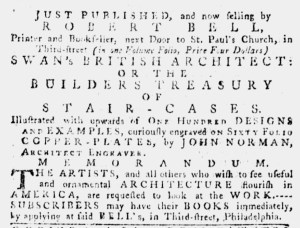
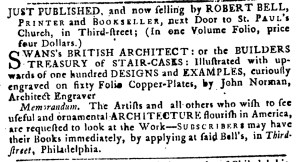
“JUST PUBLISHED … SWAN’s BRITISH ARCHITECT … Illustrated with upwards of ONE HUNDRED DESIGNS AND EXAMPLES.”

At the end of June 1775, Robert Bell, “Printer and Bookseller,” and John Norman, “Architect Engraver,” published an American edition of Abraham Swan’s British Architect: Or, the Builders Treasury of Staircases.  Norman had previously promoted the work with newspaper advertisements and proposals “with a specimen of the plates and letter press” that prospective subscribers could examine.  When the volume was ready for sale and for subscribers to collect the copies they reserved, Bell and Norman ran advertisements in the Pennsylvania Gazette and the Pennsylvania Journal on June 28.  The following day they placed the same advertisement in the Pennsylvania Evening Post.  On July 1, it appeared in the Pennsylvania Ledger and in Story and Humphreys’s Pennsylvania Mercury on July 7.  Of the newspapers printed in English in Philadelphia at the time, only Dunlap’s Pennsylvania Packet did not carry the advertisement.  Bell and Norman made a significant investment in marketing their edition of Swan’s British Architect.

Pennsylvania Journal (June 28, 1775).

To entice prospective customers, they specified that the book was “Illustrated with upwards of one hundred DESIGNS and EXAMPLES, curiously engraved on sixty Folio Copper-Plates” bound into the volume.  They also appended a “Memorandum” requesting that the “Artists and all others who wish to see useful and ornamental ARCHITECTURE flourish … look at the Work.”  If residents of the largest and most cosmopolitan urban port in the colonies wanted their city to maintain and enhance its level of sophistication, Bell and Norman implied, they needed to consider architecture and design important cultural pursuits.  To that end, they also marketed similar publications to those who purchased Swan’s British Architect.  Readers found to subscription proposals bound into the book.  The first one, advertising The Gentleman and Cabinet-Maker’s Assistant with drawings by John Folwell, a local cabinetmaker, and engravings by Norman (dated June 20), faced the title page.  The other, advertising an American edition of Swan’s Collection of Designs in Architecture, Containing New Plans and Elevations of Houses, for General Use (dated June 26), appeared immediately after the letterpress explanations of the engraved illustrations.  The dates on the subscription proposals suggest that they might have circulated separately, yet Bell and Norman made certain to place them before customers who already confirmed an interest in the subject matter.

June 25

What was advertised in a revolutionary American newspaper 250 years ago this week?

Rivington’s New-York Gazetteer (June 22, 1775).

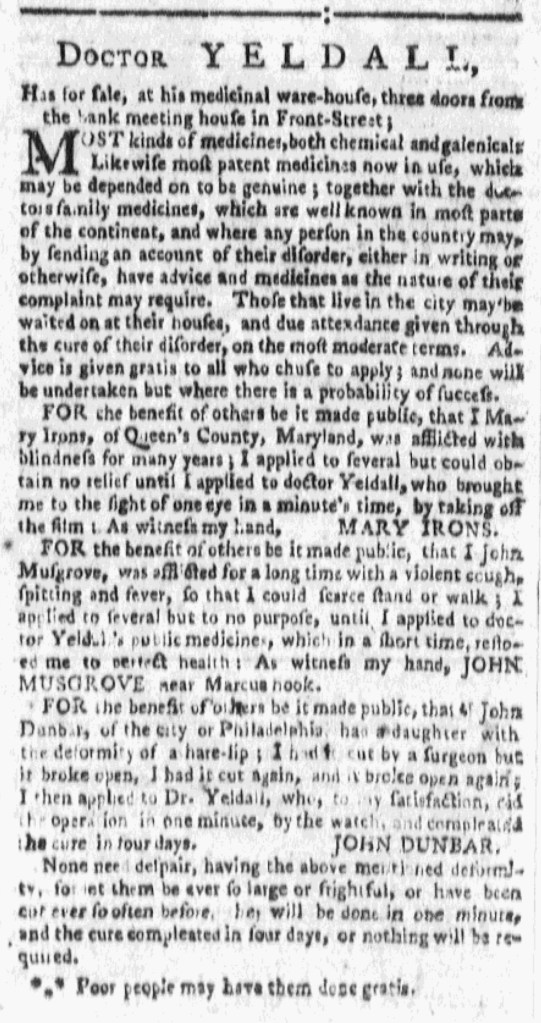
“The doctors family medicines, which are well known in most parts of the continent.”

Doctor Yeldall ran his advertisement for remedies available “at his medicinal ware-house” on Front Street in Philadelphia in Rivington’s New-York Gazetteer at the same time that it appeared in the Pennsylvania Ledger.  He did, after all, claim that the “doctors family medicines” that he produced as an alternative to other patent medicines were “well known in most parts of the continent” and advised that “any person in the country may, be sending an account of their disorder … have advice and medicines as the nature of their complaint may require.”  Yeldall operated the eighteenth-century version of a mail order pharmacy.  Advertising in Rivington’s New-York Gazetteer: Or, the Connecticut, Hudson’s River, New-Jersey, and Quebec Weekly Advertiser placed his notice before the eyes of many more prospective patients.  In addition to selling medicines, Yeldall also performed medical procedures.  Two of the four testimonials in the original advertisement described restoring sight “by taking off the film” from a patient’s eye and repairing “the deformity of a Hare-Lip.”  New York was close enough to Philadelphia that Yeldall may have expected that some prospective patients who exhausted their options in one place would travel to Philadelphia in hopes that he would successfully treat them.

The advertisements in the two newspapers were nearly identical.  The use of capital letters and italics varied, likely the result the decisions made by compositors in the two printing offices.  That was usually the case when advertisers submitted the same copy to multiple newspapers.  The version in Rivington’s New-York Gazetteer lacked the longest of the four testimonials that ran in the Pennsylvania Ledger.  The compositor might have removed Alexander Martin’s description of how Yeldall “recovered me to my perfect health” after being “afflicted with a consumptive disorder for upwards of three years” in the interest of space.  Yeldall’s advertisement ran at the bottom of the final column on the third page of the June 22, 1775, edition of Rivington’s New-York Gazetteer, making it one of the last items inserted during the production of that issue.  The compositor, lacking space for the entire advertisement, may have simply removed one of the testimonials.  The notice still made the point that Yeldall supposedly cured several patients who “could obtain no relief” until they sought medical care from him.

January 19

GUEST CURATOR: Braydon Booth-Desmarais

What was advertised in a colonial American newspaper 250 years ago today?

Norwich Packet (January 19, 1775).

“A fresh ASSORTMENT of DRUGS, and GENUINE PATENT MEDICINES.”

Benjamin Dyer Published this advertisement in the Norwich Packet on January 19, 1775.  The advertisement says that he was selling many items, including “GENUINE PATENT MEDICINES,” at his shop in Norwich-Landing.  Patent medicines were available to anyone without needing a prescription.  According to the American Antiquarian Society’s Past Is Present blog, “Usually patent medicines were made of relatively inexpensive ingredients sold at high prices. It is important to know that because many patent medicines did not explicitly list their ingredients.”  Due to this the people selling the items can make claims about what was in the medicine without being fact checked.  It is also important to realize that Dyer referred to all the medicines as “GENUINE,” meaning that whatever was supposed to be in each medicine was in that medicine. Another interesting thing about this advertisement was how it listed each type of medicine that he sold instead of just saying that medicines were available.  I believe that this is because he wanted to show that he had a large number of medicines available.  Shopkeepers like Dyer tried to convince people that their “ASSORTMENT” of medicines were truly genuine and not fakes.

**********

ADDITIONAL COMMENTARY: Carl Robert Keyes

When Braydon and I met to discuss the advertisement that he selected to examine for the Adverts 250 Project, we talked about patent medicines as the over-the-counter medications of the eighteenth century.  They were so familiar to consumers that they did not need descriptions of what each did.  Readers of the Norwich Packet recognized, for instance, Turlington’s Balsam of Life and knew which illnesses, complaints, or discomforts that nostrum treated.  Stoughton’s Elixir, Godfrey’s Cordial, and Bateman’s Drops were the name brands of the period.  When consumers had access to multiple remedies that purported to treat the same symptoms, many had favorites based on experience and reputation.  Reading the list of “GENUINE PATENT MEDICINES” in Dyer’s advertisement in 1775 would have been similar to browsing the aisles of a pharmacy in 2025.

As I worked on other aspects of producing the Adverts 250 Project and Slavery Adverts 250 Project beyond working with Braydon on developing his entry, I noticed another interesting aspect of Dyer’s advertisement.  In addition to running it in the Norwich Packet, he also inserted it in the Connecticut Gazette, published in New London, on January 20.  That increased the circulation of his advertisement, placing it before the eyes of many more prospective customers. This aspect of Dyer’s marketing campaign resonates with the analysis of yesterday’s advertisement, also selected by a student in my Revolutionary America course, that ran in the Connecticut Journal, published in New Haven.  Connecticut had four newspapers, printed in four towns, yet each circulated widely throughout the colony and beyond.  Many advertisers dispatched advertising copy to printing offices in more than one town.  In addition to Dyer’s advertisement, the January 19, 1775, edition of the Norwich Packet featured a notice from clock- and watchmaker Thomas Harland.  He simultaneously ran an advertisement in the Connecticut Courant, published in Hartford.  In his case, he ran two different advertisements rather than submitting identical copy.  Though both advertised in more than one publication, Dyer and Harland made decisions that suited their needs when it came to which messages for consumers they wished to disseminate in which newspapers.

November 15

What was advertised in a colonial American newspaper 250 years ago today?

South-Carolina Gazette and Country Journal (November 15, 1774).

“PUBLIC NOTICE in the three Gazettes of this Province.”

The section for “NEW ADVERTISEMENTS” in the November 15, 1774, edition of the South-Carolina Gazette and Country Journal included a notice from David Deas and John Deas.  “OUR Co-partnership being now expired,” they declared, “we are desirous of brining all our Concerns in Trade to a speedy and final Settlement.”  Like many other merchants, shopkeepers, and other entrepreneurs, the Deases used a newspaper advertisement to call on associates to settle accounts.  Their notice replicated so many others that ran in newspapers throughout the colonies, including a threat of legal action against those who did not respond.  Any “Bonds, Notes, and Book Debts, due to us, which shall not be discharged or settled to our Satisfaction, on or before the 10th Day of March next,” they warned, “will then be put in Suit without Distinction.”  The Deases did not plan to make any exceptions for any reasons, so those with outstanding accounts needed to tend to them by the specified date.

Today, the Deases are best known among historians for their broadside advertising the sale of “A CARGO OF NINETY-FOUR PRIME, HEALTHY NEGROES, CONSISTING OF Thirty-nine MEN, Fifteen BOYS, Twenty-four WOMEN, and Sixteen GIRLS …from SIERRA-LEON” held in Charleston on July 24, 1769.  Yet that was not the only time that they leveraged the power of the press in advancing their business interests.  In this instance, they published their “PUBLIC NOTICE in the three Gazettes of this Province,” submitting it to the South-Carolina and American General Gazette and the South Carolina Gazette as well as the South-Carolina Gazette and Country Journal.  While inserting it in just one of those newspapers would have been sufficient to argue that they gave fair notice, running it in all three increased the likelihood that associates who owed them debts would see their announcement and take heed.  At the same time, placing the advertisement in all three newspapers increased their investment in the endeavor, apparently money the Deases considered well spent if it either had the desired results or gave them a stronger case when they had to resort to going to court.

September 7

What was advertised in a colonial American newspaper 250 years ago today?

Pennsylvania Journal (September 7, 1774).

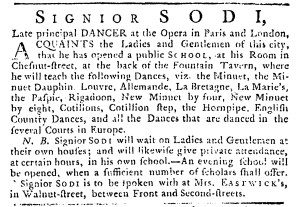
“He will teach … all the Dances that are danced in the several Courts in Europe.”

It could have been a coincidence that dancing masters Mr. Pike and Signior Sodi placed advertisements in Dunlap’s Pennsylvania Packet, the Pennsylvania Gazette, and the Pennsylvania Journal at the same time.  When Pike arrived in the Pennsylvania after teaching fencing and dancing in Charleston for a decade, he introduced himself to prospective pupils and the rest of the public with an advertisement in the September 5, 1775, edition of Dunlap’s Pennsylvania Packet.  He placed the same advertisement in the Pennsylvania Gazette two days later.

Sodi ran his own advertisement in the same issue of Dunlap’s Pennsylvania Packet.  The two notices appeared on the same page, Sodi’s at the bottom of one column and Pike’s at the top of the next one.  Two days later, Sodi inserted his advertisement in the Pennsylvania Journal.  Perhaps the “Late principal DANCER at the Opera in Paris and London” had previously intended to advertise in early September.  After all, he stated in his newspaper notice about a “GRAND CONCERT & BALL” in June that he “proposes to open a School publicly next September.”  He did not, however, commence advertising that school before Pike was on the scene.  Sodi may have heard that a new competitor would soon offer lessons to the local gentry, prompting him to advertise in the city’s newspaper published on Mondays and one of the two published on Wednesdays.

While Pike touted his experience as an instructor and a reputation that could be confirmed by “many respectable gentlemen” from South Carolina “present in this city,” likely including delegates to the First Continental Congress, Sodi emphasized his connections to some of the most cosmopolitan and refined places in Europe.  In addition to describing himself as the “Late Principal DANCER at the Opera in Paris and London,” he declared that he assisted students in learning “all the Dances that are dance in the several Courts in Europe.”  He also gave French names for several dances, suggesting the sophistication associated with the steps he taught at the Fountain Tavern and at private lessons in the homes of his pupils.

The advertisements that ran in Philadelphia’s newspapers outlined the choices available to prospective students and their families.  They could engage the services of a newcomer with endorsements from prominent men visiting the city or an Italian dancing master with experience in Paris, London, and European courts.  No matter which one they chose, the presence of these advertisements in the public prints reminded readers that dancing proficiently and gracefully was an important part of demonstrating gentility and status.

August 12

What was advertised in a colonial American newspaper 250 years ago today?

Connecticut Gazette (August 12, 1774).

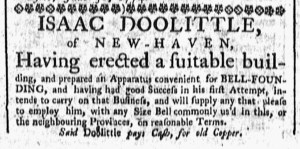
“ISAAC DOOLITTLE, of NEW-HAVEN … prepared an Apparatus convenient for BELL-FOUNDING.”

On August 12, 1774, “ISAAC DOOLITTLE, of NEW-HAVEN,” placed an advertisement in the Connecticut Gazette, published in New London, to alert readers that he could cast “any Size Bell commonly us’d in this, or the neighbouring Provinces.”  The entrepreneur explained that he had “erected a suitable building, and prepared an Apparatus convenient for BELL-FOUNDING.”  Furthermore, he “had good Success in his first Attempt,” prompting him to follow that trade and seek customers.  Realizing that the market in and near New Haven would not support his business, he embarked on an advertising campaign in multiple newspapers published in Connecticut.  Along with his notice in the Connecticut Gazette, he simultaneously inserted an advertisement in the Connecticut Journal and New-Haven Post-Boy.  It featured almost identical copy, though Doolittle did not consider it necessary to advise readers of the newspaper that served his town that he was “of NEW-HAVEN.”

Not surprisingly, he did so once again in his advertisement in the August 16 edition of the Connecticut Courant, directing prospective customers in Hartford and nearby towns to send orders and other correspondence to him in New Haven.  He did not, however, run his advertisement in the Norwich Packet, the last of the four newspapers printed in Connecticut at the time.  It was also the newest, having commenced publication less than a year earlier.  Perhaps that influenced Doolittle’s decision not to invest in advertising in yet another newspaper.  He may have been unfamiliar with the Norwich Packet or doubtful that its circulation would justify the cost of advertising.  He was not the only advertiser who opted for notices in the Connecticut Courant, the Connecticut Gazette, and the Connecticut Journal, but not the Norwich Packet during that newspaper’s first year.  Even one advertiser new to Norwich passed over the Norwich Packet in favor of placing his notice in the well-established Connecticut Gazette, though he may have depended on word-of-mouth to reach prospective customers in his new location.  The colophon for the Norwich Packet advised that the printers “thankfully received” both subscriptions and advertisements “for this Paper,” but that was not sufficient to convince some prospective advertisers in other towns to extend their marketing campaigns to include the colony’s newest newspaper.