September 7

What was advertised in a colonial American newspaper 250 years ago today?
Pennsylvania Journal (September 7, 1774).

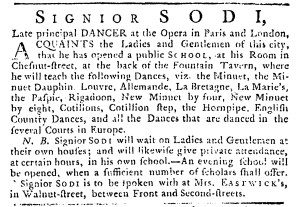
“He will teach … all the Dances that are danced in the several Courts in Europe.”

It could have been a coincidence that dancing masters Mr. Pike and Signior Sodi placed advertisements in Dunlap’s Pennsylvania Packet, the Pennsylvania Gazette, and the Pennsylvania Journal at the same time.  When Pike arrived in the Pennsylvania after teaching fencing and dancing in Charleston for a decade, he introduced himself to prospective pupils and the rest of the public with an advertisement in the September 5, 1775, edition of Dunlap’s Pennsylvania Packet.  He placed the same advertisement in the Pennsylvania Gazette two days later.

Sodi ran his own advertisement in the same issue of Dunlap’s Pennsylvania Packet.  The two notices appeared on the same page, Sodi’s at the bottom of one column and Pike’s at the top of the next one.  Two days later, Sodi inserted his advertisement in the Pennsylvania Journal.  Perhaps the “Late principal DANCER at the Opera in Paris and London” had previously intended to advertise in early September.  After all, he stated in his newspaper notice about a “GRAND CONCERT & BALL” in June that he “proposes to open a School publicly next September.”  He did not, however, commence advertising that school before Pike was on the scene.  Sodi may have heard that a new competitor would soon offer lessons to the local gentry, prompting him to advertise in the city’s newspaper published on Mondays and one of the two published on Wednesdays.

While Pike touted his experience as an instructor and a reputation that could be confirmed by “many respectable gentlemen” from South Carolina “present in this city,” likely including delegates to the First Continental Congress, Sodi emphasized his connections to some of the most cosmopolitan and refined places in Europe.  In addition to describing himself as the “Late Principal DANCER at the Opera in Paris and London,” he declared that he assisted students in learning “all the Dances that are dance in the several Courts in Europe.”  He also gave French names for several dances, suggesting the sophistication associated with the steps he taught at the Fountain Tavern and at private lessons in the homes of his pupils.

The advertisements that ran in Philadelphia’s newspapers outlined the choices available to prospective students and their families.  They could engage the services of a newcomer with endorsements from prominent men visiting the city or an Italian dancing master with experience in Paris, London, and European courts.  No matter which one they chose, the presence of these advertisements in the public prints reminded readers that dancing proficiently and gracefully was an important part of demonstrating gentility and status.
August 12

What was advertised in a colonial American newspaper 250 years ago today?

Connecticut Gazette (August 12, 1774).

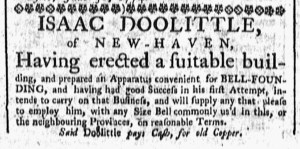
“ISAAC DOOLITTLE, of NEW-HAVEN … prepared an Apparatus convenient for BELL-FOUNDING.”

On August 12, 1774, “ISAAC DOOLITTLE, of NEW-HAVEN,” placed an advertisement in the Connecticut Gazette, published in New London, to alert readers that he could cast “any Size Bell commonly us’d in this, or the neighbouring Provinces.”  The entrepreneur explained that he had “erected a suitable building, and prepared an Apparatus convenient for BELL-FOUNDING.”  Furthermore, he “had good Success in his first Attempt,” prompting him to follow that trade and seek customers.  Realizing that the market in and near New Haven would not support his business, he embarked on an advertising campaign in multiple newspapers published in Connecticut.  Along with his notice in the Connecticut Gazette, he simultaneously inserted an advertisement in the Connecticut Journal and New-Haven Post-Boy.  It featured almost identical copy, though Doolittle did not consider it necessary to advise readers of the newspaper that served his town that he was “of NEW-HAVEN.”

Not surprisingly, he did so once again in his advertisement in the August 16 edition of the Connecticut Courant, directing prospective customers in Hartford and nearby towns to send orders and other correspondence to him in New Haven.  He did not, however, run his advertisement in the Norwich Packet, the last of the four newspapers printed in Connecticut at the time.  It was also the newest, having commenced publication less than a year earlier.  Perhaps that influenced Doolittle’s decision not to invest in advertising in yet another newspaper.  He may have been unfamiliar with the Norwich Packet or doubtful that its circulation would justify the cost of advertising.  He was not the only advertiser who opted for notices in the Connecticut Courant, the Connecticut Gazette, and the Connecticut Journal, but not the Norwich Packet during that newspaper’s first year.  Even one advertiser new to Norwich passed over the Norwich Packet in favor of placing his notice in the well-established Connecticut Gazette, though he may have depended on word-of-mouth to reach prospective customers in his new location.  The colophon for the Norwich Packet advised that the printers “thankfully received” both subscriptions and advertisements “for this Paper,” but that was not sufficient to convince some prospective advertisers in other towns to extend their marketing campaigns to include the colony’s newest newspaper.

May 31

Who was the subject of an advertisement in a colonial American newspaper 250 years ago today?

Essex Gazette (May 31, 1774).

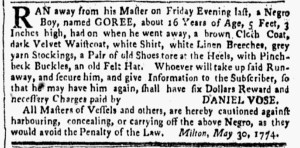
“RAN away … a Negro Boy, named GOREE.”

As the summer of 1774 approached, an enslaved youth named Goree saw his opportunity to liberate himself by running away from Daniel Vose of Milton, Massachusetts.  Vose, for his part, joined the ranks of enslavers who placed newspaper advertisement that offered rewards for the capture and return of enslaved men and women who made similar declarations of independence during the era of the American Revolution.  He provided a description of the Goree, encouraging readers to engage in surveillance of all Black people, especially young Black men, with the intention that such scrutiny would aid in identifying him.  Vose also warned “All Masters of Vessels and others … against harbouring, concealing, or carrying off” Goree or else face “the Penalty of the Law” for aiding him.

Massachusetts Gazette and Boston Post-Boy (May 30, 1774).

Vose made quite an investment in locating and securing Goree.  In addition to offering “six Dollars Reward and necessary Charges” for securing him in jail and sending word to Milford, he also ran advertisements in several newspapers.  On May 30, his notice appeared in the Boston Evening-Post, the Boston-Gazette, and the Massachusetts Gazette and Boston Post-Boy, all three newspapers published in Boston on Mondays.  His advertisement in the Massachusetts Gazette and Boston Post-Boy even included a crude woodcut depicting an enslaved man on the run as a means of drawing attention to it.  Apart from the masthead, that was the only image in that issue of the newspaper.  The following day, Vose ran the same advertisement in the Essex Gazette, published in Salem.  He did not place his advertisement in the Massachusetts Gazette and Boston Weekly News-Letter or the Massachusetts Spy, both published in Boston on Thursdays, perhaps believing that four newspapers printed in two towns provided sufficient dissemination of Goree’s description and the reward for capturing him.

South-Carolina Gazette and Country Journal (May 31, 1774).

Vose was not alone in placing such advertisements in multiple newspapers.  At the same time that he sought to enlist the aid of other colonizers in securing an enslaved youth who liberated himself, Charles Ogilvie ran advertisement about “a Negro Man named MINOS” in the South-Carolina and American General Gazette on May 27, the South-Carolina Gazette on May 30, and the South-Carolina Gazette and Country Journal on May 31.  That accounted for every newspaper published in Charleston and the rest of the colony at the time.  Ogilvie had recently purchased Minos “at Mr. Benjamin Wigfall’s Sale,” but Minos had other ideas.  The enslaver suspected that Minos had assistance from “his Wife at Mr. Elias Wigfall’s” or his “many Relations” in the “Parishes of St. James, Santee, and Christ Church,” believing that they “harboured” or hid him.  Although not his purpose in placing the advertisement, Ogilvie revealed one of Minos’s likely motivations for liberating himself.

In both New England and South Carolina, enslavers like Vose and Ogilvie went to great expense in running advertisements about enslaved people who liberated themselves.  Such notices were not a feature solely of the newspapers published in southern colonies during the era of the American Revolution.  Instead, they appeared in newspapers throughout the colonies, part of the everyday culture of slavery from New England to Georgia.

May 8

What was advertised in a colonial American newspaper 250 years ago this week?

Supplement to the Massachusetts Gazette and Boston Weekly News-Letter (May 5, 1774).

“City Tavern, Philadelphia.”

When the City Tavern opened in Philadelphia, Daniel Smith inserted advertisements in the Pennsylvania Gazette and the Pennsylvania Packet in February 1774.  The opening had been much anticipated in that city, following the efforts of some of the most prominent residents to erect the building via subscription.  In 1772, Samuel Powel entrusted the land to seven wealthy colonizers.  In turn, those “Gentlemen Proprietors” oversaw a “voluntary subscription of the principal gentlemen of the city” to raise funds to build the tavern and then selected Smith to lease and operate the City Tavern.

About three months after his advertisement ran in Philadelphia’s newspaper, it appeared in the Supplement to the Massachusetts Gazette and Boston Weekly News-Letter on May 5.  It featured identical copy and, except for the headline, identical format in terms of capitalization and italics.  Smith may have written it out exactly, but just as likely he clipped the advertisement from his local newspaper and sent it to Richard Draper’s printing office in Boston.  Alternately, he could have sent instructions to reprint the notice from a newspaper that Draper received via his exchange networks with other printers, but Smith would not have been certain that Draper received the issues that originally carried his advertisement.  Given that the tavernkeeper proclaimed that he “fitted up a genteel Coffee Room, … properly supplied with English and American papers and magazines,” he likely corresponded directly with Draper, ordering a newspaper subscription and arranging to run his advertisement in the public prints in Boston.

That advertisement provided a brief history of the City Tavern that would have been familiar to many residents of Philadelphia yet new to readers in Boston.  Smith hoped to impress prospective visitors to his city with the “largest and most elegant house occupied in that way [as a tavern, coffeehouse, and inn], in America.”  He emphasized his own “very great expence” in furnishing it with “every article of the first quality, in the stile of a London tavern.”  Indeed, when John Adams traveled to Philadelphia to attend the First Continental Congress several months later, he described it as “the most genteel [tavern] in America.”[1]  That was the reputation Smith hoped to cultivate, not only in his city but throughout the colonies.  He positioned the City Tavern as a destination itself, not just a place to eat, drink, and lodge while visiting Philadelphia.

**********

[1] See entry for August 29, 1774, in John Adams diary 21, 15 August – 3 September 1774 [electronic edition]. Adams Family Papers: An Electronic Archive. Massachusetts Historical Society. http://www.masshist.org/digitaladams/

April 13

What was advertised in a colonial American newspaper 250 years ago today?

Pennsylvania Gazette (April 13, 1774).

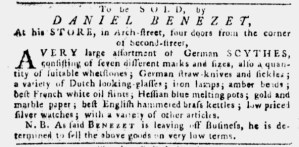
“Said BENEZET is leaving off Business.”

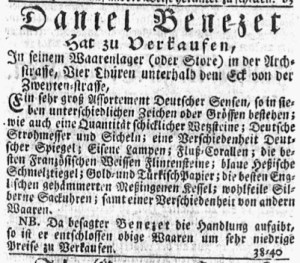
Daniel Benezet increased the likelihood that prospective customers would see his advertisements by placing them in every newspaper published in Philadelphia the spring of 1774.  Notices with identical copy appeared in Dunlap’s Pennsylvania Packet, the Pennsylvania Gazette, and the Pennsylvania Journal.  Benezet even took advantage of the offer that Henry Miller made in the masthead of each issue of the Wöchentliche Pennsylvanische Staatsbote: “All ADVERTISEMENTS to be inserted in this Paper, or printed single by HENRY MILLER, Publisher hereof, are by him translated gratis.”  That newspaper carried Benezet’s notice to German settlers.  No matter which newspaper colonizers in Pennsylvania read, they would encounter Benezet’s advertisement.

Wöchentliche Pennsylvanische Staatsbote (April 12, 1773).

Like many other entrepreneurs, Benezet listed some of his merchandise in hopes of enticing prospective customers.  He stocked “A VERY large assortment of German SCYTHES,” “a variety of Dutch looking-glasses,” “gold and marble paper,” “best English hammered brass kettles,” “low priced silver watches,” and “a variety of other articles” that consumers would discover when they visited “his STORE, in Arch-street, four doors from the corner of Second-street.”  Yet Benezet did not rely on appeals to choice alone to market his wares.  He also emphasized price and offered a reason for prospective customers to trust that he did indeed offer bargains.  In a nota bene, Benezet advised that since he “is leaving off Business, he is determined to sell the above goods on very low terms.”  In other words, he was holding an eighteenth-century version of a “going out of business” sale.  His desire to liquidate his merchandise justified not only low prices but also investing in advertising in four newspapers to make sure as many prospective customers as possible saw his notice.  Benezet saturated the local media market with his advertisements, signaling that he was serious about the deals at his store as he prepared for “leaving off Business.”

March 18

What was advertised in a colonial American newspaper 250 years ago today?

Connecticut Gazette (March 18, 1774).

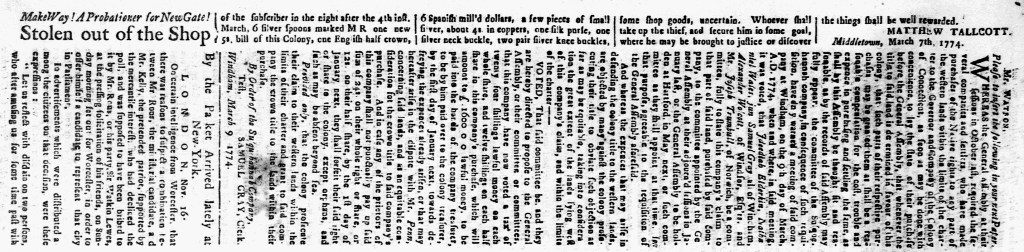
Make Way! A Probationer for NEW GATE!

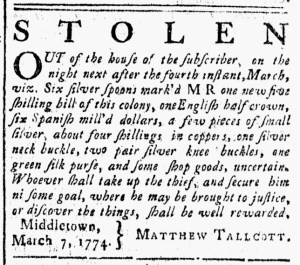
For Matthew Talcott, all was fine on the evening of March 4, 1774, but he woke up to discover a calamity the next morning.  Sometime during the night six silver spoons “marked M R,” “one silver neck buckle, two pair silver knee buckels,” quite a bit of cash, and “some shop goods, uncertain,” had been stolen from his shop in Middletown, Connecticut.  In response, Talcott turned to the public prints, running advertisements in hopes that someone “shall take up the thief, and secure him in some [jail], where he may be brought to justice.”  He also sought to recover the stolen items and money.  In addition to giving a reward, he invested in advertisements in three newspapers published in the colony.

Connecticut Journal (March 18, 1774).

Talcott’s advertisement first appeared in the Connecticut Gazette, published in New London, and the Connecticut Journal and New-Haven Post-Boy on March 11.  In each instance, a headline alerted readers to the contents of the rest of the advertisement.  The Connecticut Journal used “STOLEN” as the headline, while the Connecticut Gazette featured a more playful one that may have attracted even more attention: “Make Way! A Probationer for NEW GATE!”  The colony had recently opened a prison in a copper mine converted for that purpose in East Granby.  Someone in the printing office, rather than Talcott, may have devised the headline.

What suggests that was the case?  The two advertisements featured some variations.  The one in the Connecticut Gazette indicated that the theft took place “out of the Shop” while the Connecticut Journal stated it occurred “OUT of the house” of the unfortunate Talcott.  He likely worked where he resided.  Some of the stolen goods also appeared in slightly different order.  Talcott likely wrote the copy once for one newspaper and then copied it for the other, but was not exact in the process.  The compositor for the Connecticut Journal then used the first word as the headline, a common practice.  The editor or the compositor for the Connecticut Gazette, on the other hand, may have spotted an opportunity for creativity.

Connecticut Courant (March 15, 1774).

Consider that Talcott’s advertisement next ran in the Connecticut Courant, published in Hartford, on March 15.  It featured the same copy, including the snappy headline, that appeared in the Connecticut Gazette.  It also appeared in the margin on the final page, suggesting that the printing office received the advertisement at the last moment.  Type had already been set for the rest of the issue, but the compositor found a way to include Talcott’s notice.  Rather than Talcott submitting his advertisement directly to the Connecticut Courant, he may have made arrangements with the printer of the Connecticut Gazette to instruct his counterpart in Hartford to publish it, marking it in the copy sent as part of an exchange network of printers throughout the colony and the region.

While not conclusive, the circumstances collectively suggest that Talcott wrote the original copy, the Connecticut Gazetteembellished it with a provocative headline, and the Connecticut Courant reprinted it.  Several people played a role in creating the advertisement ultimately distributed to readers throughout the colony.

February 25

What was advertised in a colonial American newspaper 250 years ago today?

Norwich Packet (February 24, 1774).

“CLOCKS and WATCHES, if left with Mr. JOHN CHAMPLIN, in New-London, will be carefully forwarded to the said HARLAND, and returned with all Expedition.”

In February 1774, Thomas Harland, “WATCH & CLOCK MAKER, From LONDON,” ran an advertisement in the Norwich Packet “to acquaint the public, that he has opened a Shop … in Norwich.”  In it, he incorporated some of the appeals commonly advanced by artisans who migrated across the Atlantic.  In particular, Harland emphasized the quality of his work, declaring that he “makes, in the neatest manner, and on the most improved principles, horizontal, repeating, and plain watches.”  Like others in his trade, he also “cleans and repairs watches and clocks with the greatest care and dispatch.”  Harland devoted a nota bene to engraving and finishing clock faces and cutting and finishing parts, such as watch wheels and fusees, as “neat as in LONDON and at the same price.”  Harland suggested that he offered the sort of superior workmanship available in the largest and most cosmopolitan city in the empire.

Connecticut Gazette (February 25, 1774).

Residents of Norwich and surrounding towns were not the only prospective customers that Harland sought to attract.  He simultaneously ran the same advertisement, with a few modifications, in the Connecticut Gazette, published in New London.  His notice appeared on the front page of the February 25, 1774, edition, supplemented with a short paragraph that informed readers, “CLOCKS and WATCHES, if left with Mr. JOHN CHAMPLIN, in New-London, will be carefully forwarded to the said HARLAND, and returned with all Expedition.”  In his own advertisement on the fourth page of that issue, Champlin, a “GOLDSMITH and JEWELLER,” promoted the work he undertook in his shop and “likewise informs his Customers and others that they may have Clocks and Watches repaired at his Shop as usual.”  Harland’s advertisement suggests that those repairs did not take place in Champlin’s shop, that he instead sent them to Norwich.  Champlin had a history of partnering with associates to provide ancillary services to attract customers to his shop.  The previous fall, Champlin and Daniel Jennings jointly advertised in the New-London Gazette.  In April 1772, Champlin placed a notice in which he stated that he “employed a Person well acquainted” with “Clock and Watch making, mending, cleaning and repairing.”  In December 1769, James Watson advertised that he moved from one silversmith’s shop to Champlin’s shop “where he makes, mends and repairs all kinds of clocks and watches.”  Harland and Champlin mutually benefited from their partnership.  Harland, a newcomer, had an established artisan generating business for him, while Champlin continued providing the same array of services to current and prospective customers.

Champlin may have also played a role in Harland’s marketing efforts.  The watch- and clockmaker in Norwich may have sent his advertising copy to Champlin as part of their regular correspondence rather than directly to the printing office in New London.  An advertisement that had a rather plain appearance in the Norwich Packet featured a variety of embellishments in the Connecticut Gazette.  That version had greater variation in fonts as well as a decorative border.  Champlin’s advertisement also had a decorative border, while most paid notices in the Connecticut Gazette did not.  The compositor could have been responsible for sprucing up Harland’s advertisement, but the connection between Champlin and Harland suggests that the changes may have resulted from specific instructions from one of the advertisers.

February 22

What was advertised in a colonial American newspaper 250 years ago today?

Connecticut Courant (February 22, 1774).

“Three Dollars Reward [for] one of the said books.”

A headline offering “Three Dollars Reward” usually opened an advertisement about a runaway apprentice, livestock that escaped, an indentured servant who departed without permission, or enslaved people who liberated themselves.  On occasion, such a headline appeared in advertisements for lost items that the owners wished to recover.  In this instance, however, Benjamin Trumbull, a minister and historian, sought a copy of a book that had been published more than a century earlier.

Trumbull explained that in 1656 “the colony of New Haven, printed a code of laws, introduced with an account of the settlement of New Haven, in New England, by Governor Eaton.”  He asserted that “Five hundred of those books were distributed in the towns of New Haven, Milford, Guilford, Stanford, Branford, and Southold, on Long-Island.”  Trumbull imagined that with “so large a number it is not improvable that some remain legible,” so he put out a call for copies to his fellow colonizers, hoping that the reward would encourage them to “convey one of the said books” to him within two months.  The historian was “very desirous of obtaining” the book because “much light may probably be reflected on the history of New Haven.”

He was so eager to acquire a copy that he advertised in both the Connecticut Journal and New-Haven Post-Boy, starting on February 18, 1774, and the Connecticut Courant, published in Hartford, starting on February 22.  Despite disseminating his notice throughout much of the colony in those newspapers, this apparently did not have the intended results as quickly as Trumbull wished.  On March 11, three weeks after the notice first appeared, he inserted it in the Connecticut Gazette, published in New London, expanding the reach of his plea.  He did not, however, advertise in the colony’s other newspaper, the Norwich Packet, during that “term of two months.”  Perhaps he did not consider it worth the investment, that newspaper being less than six months old at the time and likely having less circulation than the others.

Whether or not Trumbull managed to acquire a copy of the book, he eventually published the first volume of A Complete History of Connecticut, Civil and Ecclesiastical, from the Emigration of Its First Planters from England, in MDCXXX, to MDCCXXIII in 1797.  According to the historical background in the American Antiquarian Society’s catalog, that book “took over twenty years to complete but remained the best work on Connecticut for a century.”  One of the historians of the founding generation, he also published the first volume of A General History of the United States of America in 1810.  It spanned the period “from the discovery of North America, to the year 1765.”  Trumbull died before completing the intended second and third volumes.

December 15

What was advertised in a colonial American newspaper 250 years ago today?

Pennsylvania Journal (December 15, 1773).

“Gentlemen’s natural wigs … and all other fashioned wigs now worn in England.”

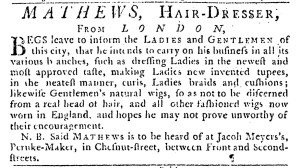
In December 1773, “MATHEWS, HAIR-DRESSER, FROM LONDON,” introduced himself to prospective clients in Philadelphia via advertisements in the Pennsylvania Gazette and the Pennsylvania Journal.  He informed “LADIES and GENTLEMEN of this city, that he intends to carry on his business in all its various branches.”  That included “dressing Ladies in the newest and most approved taste,” no doubt drawing on his connections to London to make sure they followed the latest trends, and “making Ladies new invented tupees, in the neatest manner.”  He also made “natural wigs” for gentlemen, “so as not to be discerned from a real head of hair,” as well as “other fashioned wigs now worn in England.”  His clients, Mathews suggested, could depend on looking as sophisticated as their cosmopolitan cousins in the capital of the empire.

Mathews had several choices for disseminating this message.  He opted for two newspapers, increasing the number of readers who would see his advertisement compared to publishing it in just one.  In addition to the Pennsylvania Gazetteand the Pennsylvania Journal, he could have placed it in the Pennsylvania Chronicle and the Pennsylvania Packet.  The cost of advertising may have prevented him from running notices in all four English-language newspapers published in Philadelphia at the time (and he likely considered advertising in the Wöchtenliche Pennsylvanische Staatsboteimpractical, even though the printer translated advertisements gratis).  Yet why did he choose the Pennsylvania Gazetteand the Pennsylvania Journal over the others?  The printers distributed those two newspapers on Wednesdays, while the printers of the Pennsylvania Chronicle and the Pennsylvania Packet distributed their publications on Mondays.  Mathews did not aim to have his advertisements spread out on different days, but that may not have mattered much in the context of weekly rather than daily publication.  Perhaps the cost of advertising influenced his decision, but that may not have been the case.  Although none of the printers included advertising fees in their colophons, they likely offered competitive rates.  All of them except for the Pennsylvania Gazette did include the annual subscription cost in their colophon.  The consistency, ten shilling for each of them, suggests that they set similar fees for advertising.  Perhaps Mathews selected the Pennsylvania Gazette and the Pennsylvania Journal because he believed they had a wider circulation or reached more of the local gentry that he hoped to cultivate as clients.  His example raises a larger question about why any advertiser in cities with multiple newspapers (including Boston, Charleston, New York, and Williamsburg) chose one over another or some over others to run their notices.

August 27

What was advertised in a colonial American newspaper 250 years ago today?

New-London Gazette (August 27, 1773).

“WATCHES are restored to their pristine vigour.”

A month had passed since Thomas Hilldrup, a “WATCH MAKER from LONDON” who recently relocated to Hartford, inserted an advertisement that originally ran for several weeks in the Connecticut Courant, published in Hartford, in the Connecticut Journal and New-Haven Post-Boy as well.  When he did so, he revised the dateline to “July 20, 1773,” but did not otherwise alter his advertising copy.  Near the end of August, he decided that he wished for the same notice to run in the New-London Gazette.  He once again altered the dateline, this time to “Aug. 20, 1773,” but did not make other changes.  Apparently, the watchmaker felt confident in his address to prospective customers as it appeared in the Connecticut Courant for the past two months.

By the time he placed that notice in the New-London Gazette, Hilldrup had been in Connecticut for the better part of a year.  He had been there long enough that it was not the first time that he attempted to extend his share of the market by saturating the newspapers published in the colony with his advertisements.  He initially published an advertisement in the September 15, 1772, edition of the Connecticut Courant and then revised it a month later.  Over time, he placed the revised advertisement in the Connecticut Journal on January 8, 1773, and in the New-London Gazette three weeks later.  The watchmaker established a pattern of starting with a single newspaper, the one printed in his own town, and then attempting to reach other prospective customers in the region though the same advertisement in other newspapers.

Such industriousness may have caught the attention of John Simnet, a watchmaker in New York, as newspapers published in Connecticut circulated beyond that colony.  Simnet learned his craft in London and had decades of experience working with clients there, a point of pride that he frequently highlighted in his advertisements.  Given his background, Simnet also promoted himself as the only truly skilled watchmaker in the area.  He had a long history of denigrating his competitors in his advertisements.  The cantankerous Simnet may have taken exception to Hilldrup’s arrival on the scene, considering Hartford too close for a competitor who listed similar credentials in his advertisements.  He had not previously placed notices in any of the newspapers printed in Connecticut, but decided to run an advertisement in the January 26, 1773, edition of the Connecticut Courant.  In choosing the newspaper published in Hartford, Hilldrup’s new location and a town more distant from New York than New Haven and New London, Simnet increased the chances that Hilldrup would see his advertisement.

For his part, Hilldrup did not respond directly to Simnet in the public prints, but he did follow the other watchmaker’s lead in making veiled references to competitors in an advertisement in the April 27 edition of the Connecticut Courant.  The headline for that advertisement, “WATCHES! only,” seemed to comment on a notice in which Enos Doolittle offered his services repairing clocks and watches in the previous issue.  In addition, Hilldrup included a nota bene that seemingly mocked Doolittle for hiring a journey who completed an apprenticeship in London, proclaiming that “I am capable of going through the business myself without any assistance.”  That nota bene also appeared in the original iteration of Hilldrup’s second advertisement that eventually found its way into multiple newspapers, though he removed it after several weeks in the Connecticut Courant.

As Hilldrup worked to cultivate a clientele that would secure his position in Hartford, he published advertisements in newspapers in several towns.  Achieving that kind of reach with his notices was only part of his marketing strategy.  In addition to engaging prospective customers, those advertisements put Hilldrup in conversation with competitors, directly and indirectly.  Rather than mere announcements that readers might easily dismiss, the watchmaker crafted messages that resonated beyond any single issue of a colonial newspaper.  In an advertisement that eventually appeared in all three newspapers published in Connecticut, he requested “the favour of those gentlemen who are or may be satisfied of his abilities, to assist in recommending” his services to others.