May 28

Who was the subject of an advertisement in a revolutionary American newspaper 250 years ago today?

Pennsylvania Evening Post (May 28, 1776).

“TO be SOLD, a NEGRO BOY, about four or five years of age.”

Advertisements placed for a variety of purposes appeared in the May 28, 1776, edition of the Pennsylvania Evening Post.  Hyns Taylor, an upholsterer, and Ameia Taylor, a milliner and mantuamaker, once again offered their services.  Charles Eddy offered a reward for the return of a lost “RED MOROCCO LEATHER POCKET BOOK” and the papers it contained.  Andrew Robeson, the secretary of the Library Company of Philadelphia, called on members to attend a meeting later in the month.  Mary Jenkins advertised a vendue or auction of household goods and furniture.  An anonymous advertiser sought a buyer for “a NEGRO BOY, about four or five years of age, who had had the smallpox and measles,” instructing interested parties to “Inquire of the printer.”

That advertisement appeared immediately below one for a wet nurse and above one selling hay, undifferentiated from any of the paid notices in that issue of the Pennsylvania Evening Post.  News items in that issue concerned the war and meetings of provincial congresses or conventions held in other colonies.  A unanimous resolution from North Carolina, for instance, stated, “That the Delegates for this colony in the Continental Congress be empowered to concur with the Delegates of the other colonies in declaring independency, and forming foreign alliances, reserving for this colony the sole and exclusive right of forming a constitution and laws for this colony.”  A unanimous resolution, this one from Virginia, declared, “That the Delegates appointed to represent this colony in General Congress be instructed to propose to that respectable body TO DECLARE THE UNITED COLONIES FREE AND INDEPENDANT STATES, absolved from all allegiance to, or dependance upon, the Crown or Parliament of Great-Britain.”  Readers were thinking about their own freedom as they perused the advertisement offering “a NEGRO BOY, about four or five years of age,” for sale.

That was one of countless juxtapositions of liberty and enslavement in American newspaper published during the era of the Revolution.  Jordan E. Taylor notes that “was not unusual.  Many newspaper notices for enslaved people appeared alongside high-minded essays about politics and news of revolutions at home or abroad.”[1]  That did not seem as jarring to eighteenth-century readers as modern readers, he explains, because newspapers “provided a model of the mental compartmentalization that Americans needed to embrace in order to avoid recognizing their own hypocrisy and complicity.  …  Vertical and horizontal lines divided these items, drawing distinctions and signaling difference.  In this mapping of the public consciousness, newspaper printers assured readers that the topics were unrelated.”[2]  The business of the slave trade and the business of advertising enslaved people for sale continued to thrive during the era of the American Revolution.  The same newspapers that were engines of liberty for Patriots simultaneously played a significant role in perpetuating slavery.

**********

[1] Jordan E. Taylor, “Enquire of the Printer: Newspaper Advertising and the Moral Economy of the North American Slave Trade, 1704, 1807,” Early American Studies 18, no. 3 (Summer 2020): 314-315.

[2] Taylor, “Enquire of the Printer,” 291.
April 20

What was advertised in a revolutionary American newspaper 250 years ago today?

Pennsylvania Evening Post (April 20, 1776).

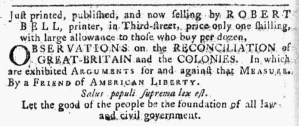
“OBSERVATIONS on the RECONCILIATION of GREAT-BRITAIN and the COLONIES … ARGUMENTS for and against.”

As colonizers marked the first anniversary of the battles of Lexington and Concord in April 1776, they debated the purpose of the war.  When it began, most wanted a redress of grievances within the imperial system, just as they had sought in response to the Stamp Act in 1765 and 1766 and the Townshend Acts in the late 1760s.  Yet as the war continued, more and more colonizers determined that it was no longer possible nor desirable to return to their position within the British Empire before the imperial crisis began.  The publication and widespread dissemination of Thomas Paine’s Common Sense in January 1776 convinced many readers to support declaring independence.

Robert Bell, the bold printer who published the first edition of Common Sense, contributed to the debate by printing, advertising, and selling several political pamphlets that expressed a range of views.  For instance, he published and sold “PLAIN TRUTH … containing Remarks on a late Pamphlet intituled COMMON SENSE,” a pamphlet that argued that “permanent Liberty, and true Happiness can only be obtained by Reconciliation” with Great Britain.  For readers interested in a pamphlet that considered both sides of the issue, Bell also marketed “OBSERVATIONS on the RECONCILIATION of GREAT-BRITAIN and the COLONIES.  In which are exhibited ARGUMENTS for and against that MEASURE.  By a FRIEND of AMERICAN LIBERTY.”

When Bell’s advertisement for that pamphlet appeared in the April 20, 1776, edition of the Pennsylvania Evening Post, much of the other content argued against reconciliation.  The column next to Bell’s advertisement featured a list of seven “Reasons for a DECLARATION of the INDEPENDANCE of the American Colonies” submitted by a reader.  On the final page, another item submitted by a reader outlined “The PROGRESS of an American’s CREED for obtaining a redress of grievances, and brining about a reconciliation with Great-Britain.”  That timeline mocked colonizers who consistently advocated for one more effort to restore the colonies’ relationship with George III and Parliament.  It started with the rationale given in September 1774, “I believe in the efficacy of the union of the colonies,” and continued with other milestones, including “I believe in the efficacy of Lord Chatham’s speech, and Mr. Wilke’s opposition to the court,” invoking support from politicians in Britain, in January 1775, “I believe in the efficacy of a second petition to the King,” now known as the Olive Branch Petition, in July 1775, and “I believe in the efficacy of the reduction of Chamblee, St. John’s and Montreal,” referring to the invasion of Canada, in November 1775.  The final item, dated March and April 1776, stated, “I believe in the efficacy of COMMISSIONERS coming over to redress all our grievances, and to bring about a constitutional reconciliation with Great-Britain.”  Colonizers who advocated for reconciliation, this litany suggested, snatched at false hope as they made rationalization after rationalization for not declaring independence.  No matter the political or military measures that should have worked to the colonies’ advantage, they were never enough to get the king and Parliament to reach a satisfactory settlement.  It was time to stop generating new excuses and insisting that their opponents would finally see the light and negotiate in good faith.  The correspondents who submitted these items to the Pennsylvania Evening Post did not have much use for the arguments for reconciliation presented in latest pamphlet that came off Bell’s press.