October 27

What was advertised in a revolutionary American newspaper 250 years ago today?
Connecticut Gazette (October 27, 1775).

“AN AMERICAN EDITION.”

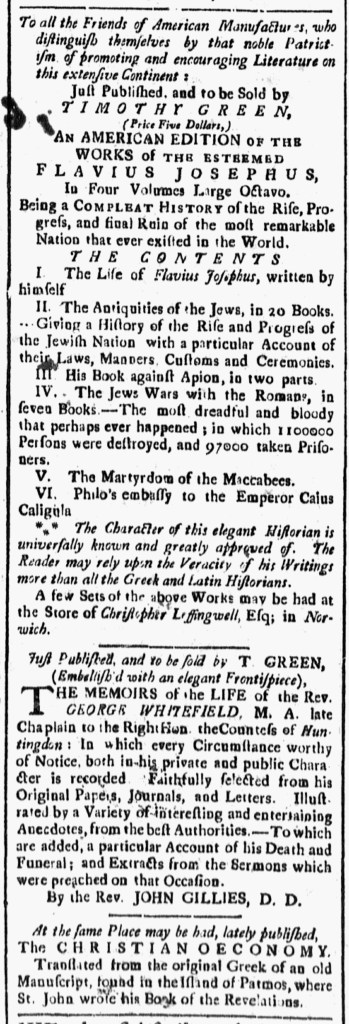
Calls to “Buy American” during the imperial crisis and the Revolutionary War extended to advertisements for books.  In the October 27, 1775, edition of the Connecticut Gazette, Timothy Green, the printer, promoted three works published in the colonies and available at his printing office in New London.  He addressed the advertisement to “all the Friends of American Manufactures, who distinguish themselves by that noble Patriotism of promoting and encouraging Literature on this extensive Continent.”

Those books included the “MEMOIRS of the LIFE of the Rev. GEORGE WHITEFIELD,” one of the most famous ministers of the era.  When he died in Newburyport, Massachusetts, on September 30, 1770, news spread throughout the colonies as widely and as quickly as news about the Boston Massacre earlier that year.  John Gillies compiled the memoir from Whitefield’s “Original Papers, Journals, and Letters” and added “a particular Account of his Death and Funeral; and Extracts from the Sermons which were preached on that Occasion.”  They originally appeared in a London edition published in 1772, but Green most likely sold an American edition printed by Robert Hodge and Frederick Shober in New York in 1774.

For another of the books, The Works of Flavius Josephus in four volumes, Green triumphantly proclaimed that it was an “AMERICAN EDITION.”  Earlier in the eighteenth century, American printers sometimes put a London imprint on the title page of books they printed in the colonies, believing that customers preferred imported works.  Mitch Fraas, curator at the Kislak Center for Special Collections, Rare Books, and Manuscripts at the University of Pennsylvania, notes the prevalence of “books printed in America … bearing the false imprint of European cities.”  That seems to have been the case with two 1773 editions of The Works of Flavius Josephus with a New York imprint yet “Probably printed in Glasgow,” according to the entries in the American Antiquarian Society’s catalog.  Yet colonizers had access to an authentic American edition … and Hodge and Shober had been involved in the production, just as they had printed an edition of The Christian Oeconomy, the final book in Green’s advertisement, in 1773.

Rather than looking to London to provide them with books, some printers and booksellers embraced American editions and encouraged prospective customers to do the same.  Green framed doing so as the patriotic duty of “Friends of American Manufactures” who supported the American cause and participated in the Continental Association, a nonimportation agreement enacted throughout the colonies in response to the Coercive Acts.  Readers could do their part to defend American liberties through the choices they made in the marketplace, including purchasing an “AMERICAN EDITION” when they went to the bookstore.

January 4

What was advertised in a colonial American newspaper 250 years ago today?

Pennsylvania Gazette (January 4, 1775).

“Printed proposals, with conditions and a specimen of the work, are given gratis.”

Robert Bell, one of the most significant publishers and booksellers of the eighteenth century, frequently ran advertisements in newspapers and disseminated subscription proposals, book catalogues, and other marketing media.  At the beginning of 1775, he promoted an “AMERICAN EDITION of LECTURES on the MATERIA MEDICA, as delivered by WILLIAM CULLEN, M.D. Professor of Medicine in the University of Edinburgh.”  Yet Bell supposedly did not envision this project on his own.  He pursued it, he declared, “At the desire of several PHYSICIANS.”  Given the initial interest expressed by “Gentlemen of that Profession,” Bell inserted an advertisement in the Pennsylvania Gazette in hopes of generating additional demand and determining the viability of publishing an American edition of the influential text.

To that end, he invited physicians and others to obtain “Printed proposals, with conditions and a specimen of the work” at his shop.  Those proposals may have taken the form of a handbill or a short pamphlet, similar to the proposals for A Dissent from the Church of England and the proposals for The Catholic Christian Instructed that Bell disseminated in 1774.  The latter pamphlet devoted two pages to a prospectus that described the purpose of the work, a page to “Conditions” for subscribing (such as number of pages, cost, and payment schedule), and a page to a “Specimen of the type” that demonstrated the quality of an important material aspect of the book.  Based on the description of the printed proposals in Bell’s newspaper advertisement, the proposals for Cullen’s Materia Medica likely had a similar format.

Bell called on “gentlemen, who are desirous of encouraging improvements in the divine art of healing,” to submit their name “speedily” so the book “may be carried into execution immediately.”  He warned against dallying and assuming that surplus copies would be offered for sale after the work went to press: “it will be printed only for those who possess so much animation as to encourage the work by their subscription.”  In other words, anyone who desired copies of this American edition of Cullen’s Materia Medica had only a limited time to pre-order them.  When Bell published the book in 1775, the imprint stated, “Printed for the SUBSCRIBERS,” though perhaps the savvy bookseller produced a small quantity of additional copies to sell to those who neglected to subscribe.  Yet there was no guarantee that he would do so.  Bell attempted to leverage scarcity of the proposed work to encourage customers to reserve copies in advance.

December 8

What was advertised in a colonial American newspaper 250 years ago today?

Rivington’s New-York Gazetteer (December 8, 1774).

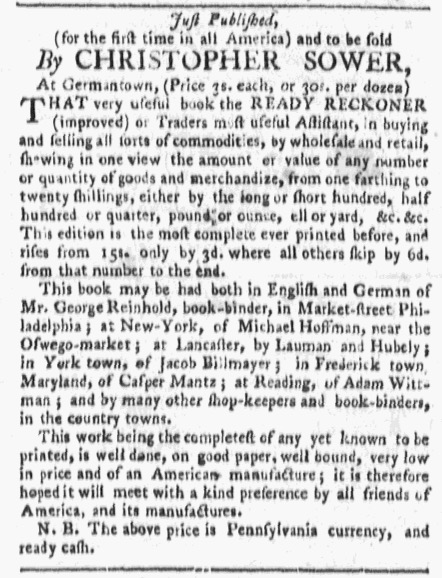
“It is therefore hoped that it will meet with a kind preference by all friends of America, and its manufactures.”

As the final days of 1774 approached, Christopher Sower, the printer of the Germantowner Zeitung, advertised an American edition of Daniel Fenning’s The Ready Reckoner; or Trader’s Most Useful Assistant, in Buying and Selling All Sorts of Commodities Either Wholesale or Retail.  The handy reference volume had been through several London editions, published it “for the first time in all America” and established a network of local agents to sell copies “both in English and German” in several cities and towns.  His advertisement in the December 8, 1774, edition of Rivington’s New-York Gazetteer listed his own printing office in Germantown, Pennsylvania, and named associates in Lancaster, Reading Philadelphia; New York City; Fredericktown, Maryland; and Yorktown, Virginia.  In addition, Sower claimed that “many other shop-keepers and book-binders, in the country towns” stocked the volume.  For those interested in selling copies at their shops, he offered a discount, thirty shilling for a dozen copies compared to three shillings for a single copy.  In other words, those who bought ten copies received two additional copies for free.

Sower declared that he issued an “improved” edition, “the most complete ever printed.”  The table it contained were supposed to save time and avoid errors in calculations, as the lengthy subtitle explained: “shewing at one view the amount or value of any number of quantity of goods from one farthing to twenty shillings … in so plain and easy a manner, that persons quite unacquainted with arithmetic may hereby ascertain the value of any number … at any price whatever.”  Sower considered it the “most complete” edition because it featured increments of three pence instead of six pence.  Yet that element alone did not recommend the book to prospective customers.  The publisher described it as “well done, on good paper, well bound and of an American manufacture.”  He did not specify whether “American manufacture” referred to the “good paper” as well as the labor undertaken in setting type, working the press, and binding the book.  Still, he expected that an American edition “will meet with a kind preference by all friends of America, and its manufactures” who might otherwise opt for a London edition published in 1773.  Sower’s call to purchase the American edition likely had even greater resonance given that the Continental Association, a nonimportation agreement adopted in response to the Coercive Acts, had recently gone into effect.

August 21

What was advertised in a colonial American newspaper 250 years ago this week?

Supplement to the New-York Journal (August 18, 1774).

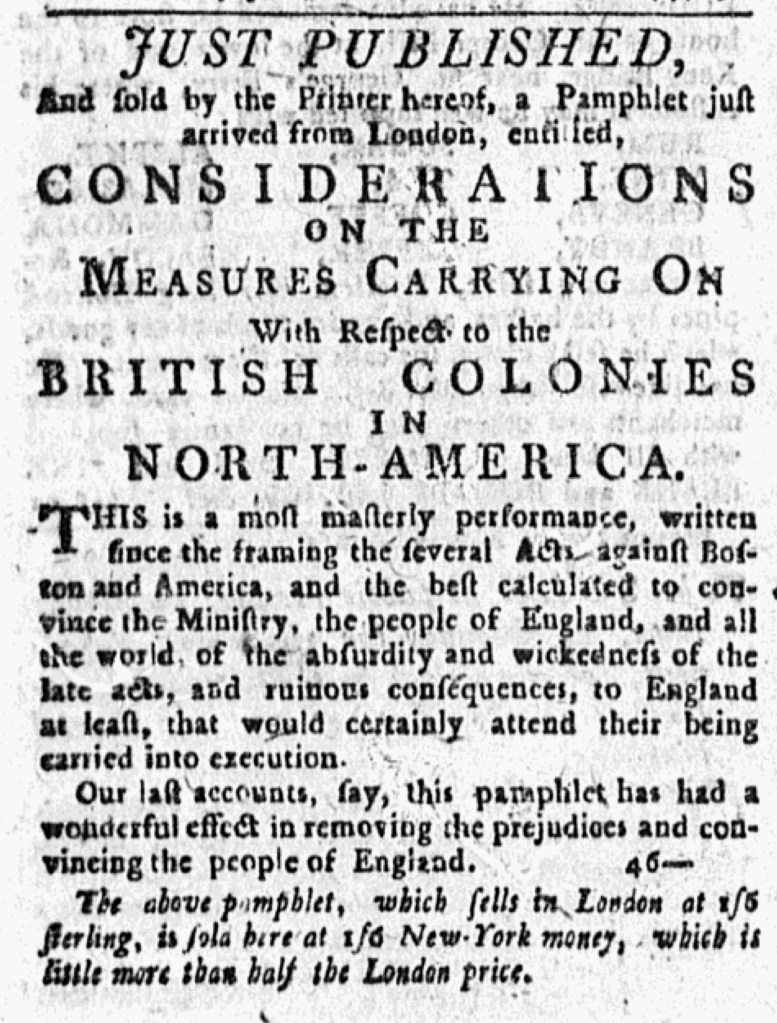
Sold here at 1s6 New-York money, which is little more than half the London price.”

The Adverts 250 Project previously examined an advertisement for a political tract, Considerations on the Measures Carrying On with Respect to the British Colonies in North-America, that appeared in a prominent place in the August 1, 1774, edition of the Boston-Gazette, attributing the copy to Benjamin Edes and John Gill, the printers of that newspaper and the Boston edition of the pamphlet.  Yet Edes and Gill were not the only printers to produce an American edition of Considerations, nor were they the first to advertise it.  When they did, they borrowed advertising copy that previously appeared when John Holt marketed his edition in the New-York Journal.

Holt first announced publication of a New York edition of this “Pamphlet just arrived from London” on July 21.  When Edes and Gill advertised the same pamphlet eleven days later, they used copy identical to Holt’s advertisement, embellishing it with a quotation from Phillippe de Commines that appeared on the title page of the pamphlet.  As was often the case with advertisements for books and pamphlets, the printers did not devise any of the copy on their own, except for “THIS DAY PUBLISHED, (Price 9d.) And sold by EDES and GILL, in Queen-Street.”  Holt may have written the copy that lauded the pamphlet as a “most masterly performance” against the Coercive Acts and reported on its reception in England when he first advertised the pamphlet, though he could have borrowed that overview from someone else, just as Edes and Gill appropriated it from him.  Either way, Holt did eventually make an addition to his advertisement. After it ran twice, he added a note that the pamphlet “sells in London at 1s5 sterling” yet “is sold here at 1s6 New-York money, which is little more than half the London price.”  That suggests that the initial appeals might not have been enough to convince readers to buy the tract, no matter how much they may have been interested in the arguments it made about current events.  The printer found it necessary to add an appeal to price in hopes of selling the pamphlet.  Holt and other patriot printers sought to spread the rhetoric of the American Revolution (and generate revenues for themselves in the process), but doing so required more than merely announcing political pamphlets for sale.  Their advertisements aimed to convince colonizers, even those already sympathetic to their cause, to purchase the books and pamphlets about politics and political philosophy they printed and sold.

June 30

What was advertised in a colonial American newspaper 250 years ago today?

Maryland Gazette (June 30, 1774).

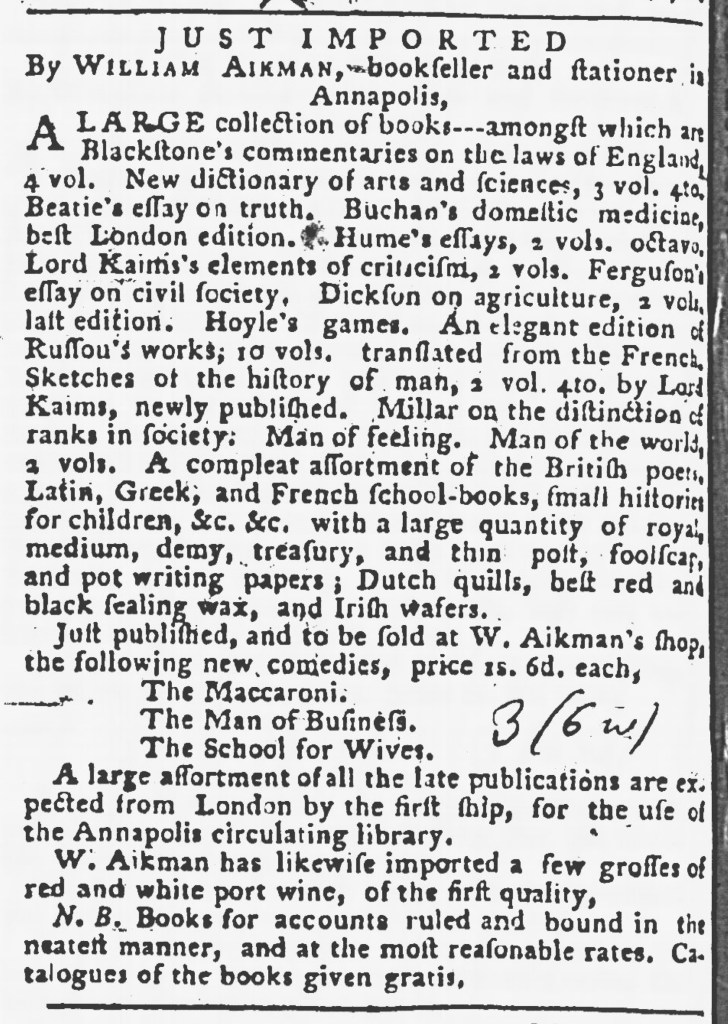
“Just published … the following new comedies.”

In the spring and summer of 1774, William Aikman, “bookseller and stationer in Annapolis,” advertised a “LARGE collection of books” in the Maryland Gazette.  He listed all sorts of titles, including “Blackstone’s commentaries on the laws of England” in four volumes, “Buchan’s domestic medicine, best London edition,” and “Russou’s works, … translated from the French.”  In addition, he stocked a variety of books from several genres, ranging from a “compleat assortment of the British poets” to “Latin, Greek, and French school-books” to “small histories for children.”  Aikman had something for every reader.

The bookseller also devoted a portion of his advertisement to three “new comedies” that sold for one shilling and six pence each.  These works, “Just published,” most likely were reprints that he acquired from John Dunlap in Philadelphia.  In 1774, Dunlap printed American editions of Robert Hitchcock’s The Macaroni: A Comedy, as It Is Performed at the Theatre Royal, George Coleman’s The Man of Business: A Comedy: As It is Acted at the Theatre-Royal in Covent-Garden, and Hugh Kelly’s The School for Wives: A Comedy: As It Is Performed at the Theatre-Royal in Drury Lane.  Perusing those works gave readers in the colonies, in Philadelphia or Annapolis or anywhere else that Dunlap distributed his reprinted editions, a taste of the theater scene in the cosmopolitan center of the empire.

In addition, Aikman announced that a “large assortment of all the late publications are expected from London by the first ship, for the use of the Annapolis circulating library.”  That was another venture that the enterprising bookseller and stationer oversaw.  A year earlier, he opened that library and advertised the subscription fees for joining for a month, a quarter, six months, or a year.  In the fall of 1773, he advertised that his Annapolis Circulating Library provided delivery service to Baltimore, both a convenience for members there and an attempt to undercut a competing library proposed by a competitor who did not manage to establish a library there.

Overall, Aikman’s advertisement revealed multiple trajectories for producing, distributing, and acquiring books on the eve of the American Revolution.  Booksellers received most of their inventory from English printers, though printers in the colonies published both American editions and original works.  Those printers worked with printers and booksellers in other towns to exchange, market, and sell books and pamphlets printed in the colonies.  For their part, readers could purchase books or join circulating libraries to increase their access to larger libraries than they could afford on their own.

October 25

What was advertised in a colonial American newspaper 250 years this week?

Supplement to the Massachusetts Gazette and Boston Weekly News-Letter (October 22, 1772).

“PROPOSALS For Re-Printing by Subscription … Baron de MONTESQUIEU’s celebrated Spirit of Laws”

On October 22, 1772, Richard Draper distributed a two-page supplement to accompany the standard issue of the Massachusetts Gazette and Boston Weekly News-Letter.  That supplement consisted almost entirely of advertising, though it did include brief news items from London and Quebec.  A subscription proposal for an “American Edition of … Baron de MONTESQUIEU’s celebrated Spirit of Laws” filled most of the second page of the supplement.  That subscription proposal would have looked familiar to colonizers who also read the Massachusetts Gazette and Boston Post-Boy since it appeared in that newspaper three days earlier.  It may have also looked familiar to those who had not perused the other publication.  As I argued when examining the first appearance of the subscription proposal in Boston’s newspapers, it likely circulated separately as a handbill or broadside.

Draper adopted the same method of making the subscription proposal fit on the page that John Green and Joseph Russell used in their newspaper.  Since it was wider than two standard columns, he created a narrower third column by rotating the type to run perpendicular to the rest of the page.  Draper also added a colophon, centered at the bottom of the subscription proposal.  This method of making the broadside fit on a newspaper page was not the only similarity between its appearance in two newspapers.  It looks as though the printing offices shared the type.  If that was the case, who produced the broadside?  Draper or Green and Russell?  Even if the subscription proposal did not circulate separately as a broadside or handbill, the printers almost certainly shared type between their offices.  That was not the first time in 1772 that Draper collaborated with other printers in that manner.  In May, Jolley Allen’s advertisements in the Boston-Gazette and the Massachusetts Gazette and Boston Weekly News-Letter had identical copy and format.  At the same time, Andrew Dexter’s advertisements in the Boston Evening-Post and the Massachusetts Gazette and Boston Weekly News-Letter also featured identical copy and format.  At various times, Draper apparently shared type already set with three other printing offices.  Yet he was not always involved in instances of sharing type.  Advertisements for a “Variety of Goods” that ran in the Boston Evening-Post and the Boston-Gazette on October 12, for instance, appear identical, with the exception of the last two lines either added to the notice in the Boston-Gazette or removed from the one in the Boston Evening-Post to make it fit the page.  Examining advertisements reveals several other examples of printers in Boston seemingly sharing type in the early 1770s.

As I have noted on other occasions that I have identified what appears to be type transferred from one printing office to another, these observations are drawn from digitized copies of eighteenth-century newspapers.  Examining the original editions, including taking measurements, may yield additional details that either demonstrate that Boston’s printers did not share type for newspaper advertisements or that further suggest that they did indeed do so.  This question merits further investigation to learn more about business practices in printing offices that competed for both newspaper subscribers and advertisers.

Supplement to the Massachusetts Gazette and Boston Weekly News-Letter (October 22, 1772).

October 19

What was advertised in a colonial American newspaper 250 years ago today?

Massachusetts Gazette and Boston Post-Boy (October 19, 1772).

“PROPOSALS For Re-Printing by Subscription … Baron de MONTESQUIEU’s celebrated Spirit of Laws.”

It would have been hard for readers to miss the subscription proposal that dominated the final page of the October 19, 1772, edition of the Massachusetts Gazette and Boston Post-Boy.  John Boyles announced his intention to publish an “American Edition” of the “Baron de MONTESQUIEU’s celebrated Sprit of the Laws,” a work of political philosophy “Which ought to be in EVERY MAN’s Hands.”  Boyles explained that the book had been “Translated from the French Original” as well as “translated and published in most of the civilized Nations of EUROPE.”  Colonizers who wished to participate in the transatlantic republic of letters needed to acquire copies of their own.  To make this particular edition even more attractive than imported alternatives, the publisher stated that it would include “a larger Account of the Life and Writings of the AUTHOR, than is in the European Editions.”

The format of the subscription proposal suggests that it may have been printed separately as a broadside or handbill, on paper of a different size, for distribution beyond subscribers to the Massachusetts Gazette and Boston Post-Boy.  If that was indeed the case, the compositor did not wish to set the type once again in order to insert the subscription proposal in the newspaper.  Its width exceeded two newspaper columns, causing the compositor to create a narrow third column by rotating the type for additional advertisements to run perpendicular to the page.  In the years immediately preceding the American Revolution, advertisers sometimes arranged to have book catalogues, broadsides, or handbills incorporated into newspapers, expanding the reach of their marketing efforts.  That being the case, I suspect that more advertising ephemera circulated in early America than has been identified and preserved in research libraries, historical societies, and private collections.  This subscription proposal in the Massachusetts Gazette and Boston Post-Boy hints at a hidden history of early American advertising impossible to recover in its entirety.  Although newspaper notices constituted, by the far, the most voluminous form of advertising in early America, other printed media likely circulated more frequently than previously realized.

Massachusetts Gazette and Boston Post-Boy (October 19, 1772).

August 22

What was advertised in a colonial American newspaper 250 years ago today?

Pennsylvania Chronicle (August 22, 1772).

“The APPENDIX is not in the London Edition.”

Henry Miller, printer of the Wöchentliche Pennsylvanische Staatsbote, published and advertised an American edition of A Complete German Grammar by John James Bachmair in 1772.  German-speaking colonizers constituted a significant portion of Pennsylvania’s population, prompting Miller, himself born in the principality of Waldeck on the Upper Rhine, to believe a local market existed for this book.  He informed prospective customers that he charged nine shillings for his edition, compared to fourteen shillings for the London edition.

In addition to declaring that he published the third edition, “greatly altered and improved,” Miller also promoted an Appendix that included “An Index of German Words similar in Sound, but of different Orthography and Signification,” “Names of the most common Occupations and Trades, as also the Names of the Materials and Implements, &c. thereto belonging,” and an “Explication of a German Proverb.”  In a nota bene, Miller underscored that all of those items were bonus materials not included in the London edition.  In addition to the lower price, the useful and entertaining supplemental materials likely made Miller’s American edition seem like an even better choice for colonizers interested in learning German.

Miller also deployed a blurb from the first edition in his efforts to market the book.  He quoted from the preface to the first edition, highlighting Bachmair’s assertion that “those who have a Mind to learn fundamentally the German Language, will find such plain and easy Instructions, that, even without a Master, they may at least attain to read and understand it.”  The blurb simultaneously offered encouragement and set expectations.  With some diligence, those who studied from the book could learn to read and understand German, even if they did not become fluent enough to speak and write the language.  They could achieve that level of proficiency studying on their own rather than working with tutors or schoolmasters.

Miller incorporated a variety of marketing strategies into advertisements for his American edition of Bachmair’s German Grammar.  He hawked supplementary materials that did not appear in the more expensive London edition, while also including a blurb in which the author gave encouragement and promised “plain and easy Instructions.”  In describing the contents of the appendix and inserting the blurb, Miller sought to help prospective customers imagine themselves learning German with greater ease than they previously anticipated.

March 8

What was advertised in a colonial American newspaper 250 years ago this week?

Pennsylvania Journal (March 5, 1772).

“There is another edition, JUST PUBLISHED.”

Get a copy while they are still available!  That was the message that William Bradford and Thomas Bradford delivered to prospective customers in Philadelphia when they advertised their own edition of A Dissertation on the Gout, and All Chronic Diseases by William Cadogan, a “Fellow of the College of PHYSICIANS.”  The Bradfords noted that “a number of Gentlemen were disappointed in the purchase of the first publication” so they set about producing “another edition” in order to meet demand.  Still, copies went so fast the first time around that the Bradfords warned consumers not to miss their opportunity to purchase the volume this time.

The printers underscored the popularity of the book on both sides of the Atlantic, stating that it was “so much esteemed in England, that it has already past through Eight Editions.”  This testified to the reputation it had earned.  Printers would not have published so many editions, the Bradfords implied, if the public did not clamor for them.  Furthermore, all sorts of people, not just physicians, found the “rational METHOD of CURE” helpful.  “The Doctrines advanced,” the Bradfords advised, “are delivered in a familiar style, which renders them intelligible to Gentlemen of all professions, as well as to Physicians.”

The Bradfords were not alone in publishing American editions of Cadogan’s Dissertation on the Gout in 1772.  Printers in two other cities produced their own editions.  Hugh Gaine did so in New York, while John Boyle, Benjamin Edes and John Gill, and Henry Knox published competing editions in Boston.  In Philadelphia, Robert Aitken appended the work to William Buchan’s Domestic Medicine or, The Family Physician, perhaps as a bonus intended to make the entire volume more attractive to perspective customers.  With a “first publication” that sold out in 1771, the Bradfords confirmed that Cadogan’s Dissertation on the Gout likely had as much potential in American markets as it did in England.

March 4

What was advertised in a colonial American newspaper 250 years ago this week?

Boston-Gazette (March 2, 1772).

“THE FRUGAL HOUSEWIFE … By SUSANNAH CARTER.”

In 1772, Benjamin Edes and John Gill, printers of the Boston-Gazette, published an American edition of The Frugal Housewife, or Complete Woman Cook by Susannah Carter of London.  The book included “Five Hundred approved Receipts” for everything from roasting and frying to sauces and soups to tarts and puddings to jellies and custards as well as instructions for preserving, pickling, and candying various foods.  In addition, Carter provided “Various BILLS of FARE, For DINNERS and SUPPERS in every Month of the Year” to guide readers in consulting the many recipes and choosing which items to prepare together.  The book also featured “a copious Index of the whole” to help readers find the recipes.  Edes and Gill promised that “Any Person, by attending to the Instructions given in this Book, may soon attain to a compleat Knowledge in the Art of Cookery.”

The printers marketed The Frugal Housewife in their own newspaper, but they also turned to other publications in their effort to create a larger market for what they believed had the potential to be a popular American edition of a cookbook first published in London in the 1760s.  On March 2, 1772, they ran advertisements in both the Boston Evening-Post and the Boston-Gazette.  Three days later, they placed an advertisement in the Massachusetts Spy.  The notices in the other newspapers were not as elaborate as the one that appeared in their own.  The version in the Boston-Evening Post, for instance, did not include the price nor the nota bene assuring prospective customers that they would acquire “a complete Knowledge” of cooking.  The version in the Massachusetts Spy, on the other hand, included both of those items as well as a note that the book “contains more in Quantity than most other Books of a much higher Price.”  It did not, however, feature the distinctive typography with only two items on each line that made the notices in the other newspapers occupy significantly more space.  Instead, a dense list of the contents comprised most of the content of the advertisement in the Massachusetts Spy.

Edes and Gill sought to expand their marketing and sales by placing advertisements in multiple newspapers.  Though they exercised control over the copy, they did not exert as much influence when it came to the format.  Compositors who labored in other printing offices made decisions about the appearance of Edes and Gill’s advertisements for The Frugal Housewife.