December 15

What was advertised in a revolutionary American newspaper 250 years ago today?
Essex Journal (December 15, 1775).

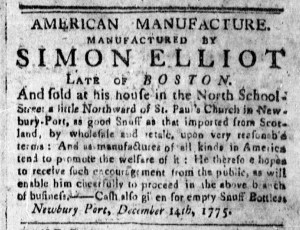
“Manufactures of all kinds in America tend to promote the welfare of it.”

In December 1775, Simon Elliott took to the pages of the Essex Journal, printed in Newburyport, Massachusetts, to promote the snuff that he made in that town.  He published his advertisement as the siege of Boston continued, much of the copy testifying to the imperial crisis that had become a war with the skirmishes at Lexington and Concord the previous April.

The advertisement featured an elaborate headline.  Indeed, it had a primary headline and a secondary headline, like many other newspaper advertisements.  Elliot’s name, centered and all in capital letters of a larger font than anything else in that issue of the Essex Journal except the name of the newspaper in the masthead, demanded attention.  It was the second line of three, the other two also centered and in capital letters but smaller fonts: “MANUFACTURED BY / SIMON ELLIOT / LATE OF BOSTON.”  A secondary headline, “AMERICAN MANUFACTURE,” appeared above the headline that made Elliot’s name so prominent.

Like so many other artisans when they moved to new towns and introduced themselves to prospective customers, Elliot mentioned his origins.  Usually, “OF BOSTON” sufficed, but in this instance “LATE OF BOSTON” likely indicated that he had been displaced from that city recently.  Many residents chose to leave following the outbreak of hostilities.  In the early days of the siege of Boston, the Sons of Liberty and General Gage negotiated an exchange that allowed Loyalists to enter and others to depart.  In the following months, newspapers throughout New England carried advertisements by entrepreneurs “from Boston,” a diaspora of refugees displaced at the beginning of the Revolutionary War.

In addition to signaling the hardships he recently faced, Elliot also promoted the quality of the snuff that he made in Newburyport, asserting it was “as good Snuff as that imported from Scotland.”  That was no small claim since tobacco processed into snuff in Scotland had a superior reputation at the time.  Yet Elliot had more to say about his “AMERICAN MANUFACTURE” and why consumers should favor it over others.  Echoing the Continental Association, a nonimportation agreement devised by the First Continental Congress, and popular discourses of the last decade, Elliot declared that “as manufactures of all kinds in America tend to promote the welfare of it: He therefore hopes to receive such encouragement from the public” to support his new enterprise.  Supporters of the American cause, he suggested, had a civic duty to purchase the snuff that he made in Newburyport as well as support other entrepreneurs who produced domestic manufactures.
December 12

What was advertised in a revolutionary American newspaper 250 years ago today?

Pennsylvania Evening Post (December 12, 1775).

“HARE’s and Co. best DRAUGHT and BOTTLED AMERICAN PORTER.”

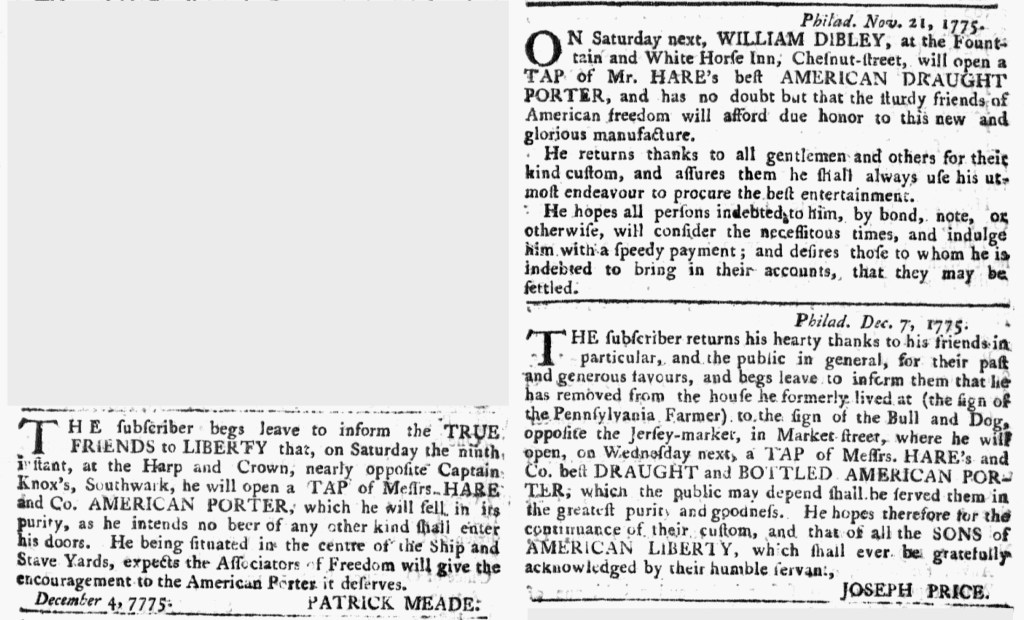
In December 1775, Philadelphia tavernkeeper Joseph Price ran an advertisement to express his gratitude to “his friends in particular, and the public in general,” while simultaneously alerting them that he had moved to a new location.  They could now find him at “the sign of the Bull and Dog” on Market Street rather than at “the sign of the Pennsylvania Farmer.”  To entice readers to visit his new location, he announced that “he will open … a TAP of Messrs. HARE’s and Co. best DRAUGHT and BOTTLED AMERICAN PORTER, which the public may depend shall be served them in the greatest purity and goodness.”

Price was not the only tavernkeeper promoting Hare and Company’s American porter, nor was he the only one associating that beer with support for the American cause.  He proclaimed that he “hopes … all the SONS of AMERICAN LIBERTY” would affirm their commitment by choosing Hare and Company’s American porter.  Price joined two other tavernkeepers who already promoted that brew.  All three of them placed advertisements in the December 12, 1775, edition of the Pennsylvania Evening Post.  William Dibley’s advertisement ran immediately above Price’s notice.  He confidently declared that he “has no doubt but that the sturdy friends of American freedom will afford due honor to this new and glorious manufacture.”  Immediately to the left of Price’s advertisement, Patrick Meade stated that he “expects the Associators of Freedom will give the encouragement to the American Porter it deserves.”  Readers who did not know much about Hare and Company’s American porter encountered endorsement after endorsement, encouraging them to take note of a beer that local tavernkeepers promoted over any others.  Tavernkeepers usually did not mention which brewers supplied their beer, making these advertisements even more noteworthy.  For their part, Hare and Company did not need to do any advertising of their own when they had such eager advocates for their American porter encouraging the public to demonstrate their political principles through the choices they made when they placed their orders at taverns in Philadelphia and nearby Southwark.

December 9

What was advertised in a revolutionary American newspaper 250 years ago today?

Pennsylvania Evening Post (December 9, 1775).

“He will open a TAP of Messrs. HARE’s and Co. AMERICAN PORTER.”

Patrick Meade aimed to create some anticipation among prospective patrons who might visit his tavern, the Harp and Crown, in Southwark on the outskirts of Philadelphia.  In an advertisement that first appeared in the Pennsylvania Evening Post on December 5, 1775, he announced that “on Saturday the ninth … he will open a TAP of Messrs. HARE and Co. AMERICAN PORTER.”  Hare and Company had been building a reputation for their brew.  Two weeks earlier, William Dibley, the proprietor of the Fountain and White Horse Inn in Philadelphia, advertised that he “will open a TAP of Mr. HARE’s best AMERICAN DRAUGHT PORTER.”  Meade’s advertisement ran again on December 9, the day he tapped the celebrated porter.

Meade and Dibley deployed similar marketing strategies to entice “gentlemen and others” to visit their establishments and drink Hare and Company’s porter.  Dibley proclaimed that he “has no doubt but that the sturdy friends of American freedom will afford due honor to this new and glorious manufacture.”  Meade addressed “the TRUE FRIENDS to LIBERTY” and emphasized his location, “situated in the center of the Ship and Stave Yards,” and declared that he “expects the Associators of Freedom will give the encouragement to the American Porter it deserves.”  Meade went all in on promoting Hare and Company’s porter, asserting that “he intends no beer of any other kind shall enter his doors,” especially not porters and other beers imported from England.  The tavernkeeper made a porter brewed in America the exclusive choice for his patron, likely expecting that the lack of other options mattered less to prospective patrons when they gather to drink, socialize, and discuss politics and current events than demonstrating their patriotism by consuming a porter brewed in America.  Meade stated that he would sell Hare and Company’s “AMERICAN PORTER … in its purity,” signaling the quality of the beverage.  Meade issued both an invitation and a challenge: who could desire any beer other than one brewed in America in support of the American cause?

November 25

What was advertised in a revolutionary American newspaper 250 years ago today?

Pennsylvania Evening Post (November 25, 1775).

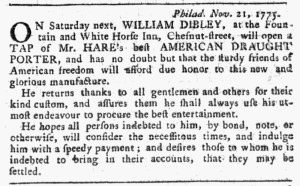
“WILLIAM DIBLEY … will open a TAP of Mr. HARE’s best AMERICAN DRAUGHT PORTER.”

William Dibley was no stranger to advertising his tavern in the public prints.  In February 1775, he announced that he “removed from the Cross Keys … to the Fountain and Three Tuns.”  Both were located on “Chesnut-street” in Philadelphia, so his regular patrons did not have to go far to continue enjoying Dibley’s hospitality, yet he made sure that both “his Friends in particular and the public in general” knew about the “considerably improved” amenities available at his new location.

Nine months later, Dibley ran an advertisement in which he “returns thanks to all gentlemen and others for their kind custom, and assures them he shall always use his utmost endeavour to procure the best entertainment.”  By that time, he updated the name of his establishment to the Fountain and White Horse Inn, perhaps an effort to retain some continuity with a device, the Fountain, that had marked the location while simultaneously distinguishing his business from the one that Anthony Fortune previously operated at the same location, exchanging the Three Tuns for the White Horse.  Dibley’s expression of gratitude suggested that patrons continued gathering at his tavern when he rebranded it.

He aimed to give them more reasons to gather at the Fountain beyond the amenities he highlighted in his earlier advertisement, proclaiming that on Saturday, November 25, he would “open a TAP of Mr. HARE’s best AMERICAN DRAUGHT PORTER.”  This porter was for patriots!  Dibley declared that he “has no doubt but that the sturdy friends of American freedom will afford due honor to this new and glorious manufacture.”  As George Washington and the American army continued the siege of Boston and the Second Continental Congress continued meeting in Philadelphia, Dibley offered an opportunity for supporters of the American cause to drink a porter brewed in the colonies as they gathered to socialize and discuss politics at his tavern.  The tavernkeeper made the porter, a new product, the highlight of a visit to the Fountain, announcing when he would “open a TAP” to create anticipation among prospective patrons.  They may have expected an informal ceremony and a round of toasts to mark the occasion, another enticing reason to visit the Fountain on that day.  Consumption certainly had political overtones at the time.  Dibley tapped into the discourses about purchasing American goods when he marketed a visit to his tavern,

November 13

What was advertised in a revolutionary American newspaper 250 years ago today?

Norwich Packet (November 13, 1775).

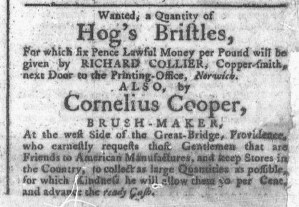
“Wanted, a Quantity of Hog’s Bristles [from] Friends to American Manufactures.”

Cornelius Cooper, a brushmaker who had relocated from Philadelphia to Providence, needed materials to continue operating his business in the fall of 1775.  He ran an advertisement to that effect in the Providence Gazette, but his efforts did not end there.  He also enlisted the help of Richard Collier, a coppersmith, in Norwich, Connecticut.  An advertisement in the November 13, 1775, edition of the Norwich Packet proclaimed, “Wanted, a Quantity of Hog’s Bristles, For which six Pence Lawful Money per Pound will be given.”  The notice listed Collier as the local agent who collected the bristles and paid the premium, yet it did not end there.

Instead, it also advised that “Cornelius Cooper,” his name in a font as large as “Hog’s Bristles,” offered the same price.  After giving directions to his shop on “the west Side of the Great-Bridge, Providence,” the “BRUSH-MAKER” declared that he “earnestly requests those Gentlemen that are Friends to American Manufactures, and keep Stores in the Country, to collect as large Quantities as possible.”  In his advertisement that simultaneously ran in the Providence Gazette, he indicated that he wished to acquire “Five Thousand Weight of Hog’s Bristles,” a considerable quantity.  In making an appeal to “Friends to American Manufactures,” he invoked the Continental Association and efforts to replace goods imported from England with items produced in the colonies.  That became more important than ever after the battles at Lexington and Concord.  Decisions in the marketplace, including collecting hog’s bristles and purchasing brushes made from them, had political implications.  Collier supported the cause by serving as a local agent for Cooper; the brushmaker presented an opportunity for others to do the same, especially shopkeepers in the countryside who collected bristles from their patrons.  In return for that “Kindness,” Cooper not only paid “ready Cash” but also “allow[ed] them 30 per Cent.”  It seems that he offered a discount to retailers who collected bristles if they purchased his brushes to stock in their stores.  That strategy meant acquiring supplies and making sales at the same time, a neat arrangement for a brushmaker seeking to establish himself in New England.

April 19

What was advertised in a revolutionary American newspaper 250 years ago today?

Pennsylvania Journal (April 19, 1775).

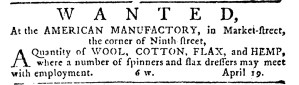
“WANTED, at the AMERICAN MANUFACTORY … A Quantity of WOOL, COTTON, FLAX, and HEMP.”

In the middle of March 1775, supporters of a “FUND for establishing and carrying on an AMERICAN MANUFACTORY, of LINEN, WOOLLEN,” and textiles made of other items met at Carpenters’ Hall in Philadelphia to learn more about the undertaking.  They pledged their support by signing their names to “Subscription Papers” or “general Proposals,” either at the meeting or at the London Coffee House in advance.  The organizers and the “Subscribers” sought to encourage “domestic manufactures” (products made in the colonies) as alternatives to imported goods.  Entrepreneurs had been pursuing that goal for more than a decade during the imperial crisis, though many devoted more effort during the times that colonizers adopted nonimportation agreements as political leverage.  In the spring of 1775, those involved with the “AMERICAN MANUFACTORY” did so as part of the Continental Association.  Its eighth article called for “encourage[ing] Frugality, Economy, and Industry; and promot[ing] Agriculture, Arts, and the Manufacturers of this Country.”

A month later, advertisements concerning the venture simultaneously appeared in the Pennsylvania Gazette and the Pennsylvania Journal on April 19.  “WANTED, At the AMERICAN MANUFACTORY,” the notices advised, “A Quantity of WOOL, COTTON, FLAX, and HEMP.”  Readers could demonstrate their commitment to the cause by supplying the resources necessary to produce textiles in the colony.  The advertisement also noted that “a number of spinners and flax dressers may meet with employment” at the manufactory, contributing to the success of the Continental Association while earning their livelihoods.

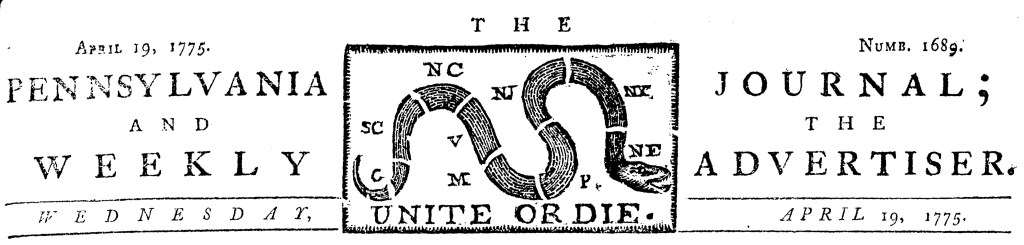
When the printers of the Pennsylvania Gazette and the Pennsylvania Journal distributed the weekly issue of their newspapers on April 19, they were not yet aware of the momentous events that happened at Lexington and Concord in Massachusetts that morning, though it would not take long for word to spread to Philadelphia and throughout the colonies.  Historians have long debated when the American Revolution began, echoing the question that John Adams posed to Thomas Jefferson in 1815: “What do We mean by the Revolution?  The War?  That was no part of the Revolution.  It was only an Effect and Consequence of it.  The Revolution was in the Minds of the People, and this was effected, from 1760 to 1775, in the course of fifteen Years before a drop of blood was drawn at Lexington.”  Establishing the “AMERICAN MANUFACTORY” in Philadelphia before the war, according to Adams, was part of the revolution.  Today, however, the 250th anniversary of the battles at Lexington and Concord offers a convenient moment for commemorating the American Revolution by aligning it with the Revolutionary War that secured independence for a new nation composed of thirteen former colonies.  For readers of the Pennsylvania Journal in 1775, the political cartoon depicting a severed snake with the motto “UNITE OR DIE” had already been spreading its message for many months.  The masthead, the articles and letters, and many of the advertisements had been part of a revolution that was already occurring “in the Minds of the People.”

Pennsylvania Journal (April 19, 1775).

March 14

What was advertised in a colonial American newspaper 250 years ago today?

Pennsylvania Evening Post (March 14, 1775).

“A FUND for establishing and carrying on an AMERICAN MANUFACTORY.”

The organizers of a “FUND for establishing and carrying on an AMERICAN MANUFACTORY, of LINEN, WOOLLEN,” and other textiles in Philadelphia and its hinterland called a meeting to rally support.  In an advertisement that first appeared in the March 11, 1775, edition of the Pennsylvania Evening Post, they announced that all “Subscribers” to that enterprise should meet “at the CARPENTERS HALL” on March 16 “to consider of a Plan for carrying the same into Execution.”  It was an especially appropriate place to meet considering that the organizers sought to put into effect one of the provisions of the Continental Association that the First Continental Congress had devised when the delegates held their meetings at Carpenters’ Hall in September and October 1774.  In addition to boycotting goods imported from Britain, the eighth article specified that colonizers should “encourage Frugality, Economy, and Industry; and promote Agriculture, Arts, and the Manufactures of this Country, especially that of Wool.”

Apparently, “general Proposals” had been printed and disseminated ahead of the meeting, perhaps by Benjamin Towne, the printer of the Pennsylvania Evening Post, or perhaps in the printing office operated by William Bradford and Thomas Bradford.  The notice stated that “one of the Subscription Papers [had been] left with WILLIAM BRADFORD, at the London Coffee-House.”  In addition, the Pennsylvania Journal, the newspaper printed by the Bradfords also carried the notice on the eve of the meeting.  No matter which printer produced the “Subscription Papers,” it was not too late for colonizers to sign their names and show their support for “this important and very interesting Undertaking” by becoming “Subscribers.”  They could visit the London Coffee House to add their names, but those who “may not have an Opportunity of Subscribing before the Day of meeting” could arrive early at Carpenters’ Hall to add their names.  For two hours before the meeting was scheduled to begin at three o’clock, some of the organizers would be present “for that Purpose.”  With subscription papers circulating, prospective supporters could examine who had already committed to the project.  That had the potential to inspire others to do so, provided colonizers actively engaged with printed materials that circulated in Philadelphia as the imperial crisis intensified.  Newspaper advertisements and subscription papers delivered news about the proposed “AMERICAN MANUFACTORY” that encouraged colonizers who encountered them to get involved by signing their names, attending meetings, and making donations.

March 13

What was advertised in a colonial American newspaper 250 years ago today?

Dunlap’s Pennsylvania Packet (March 13, 1775).

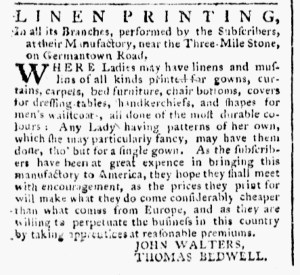
“LINEN PRINTING … at their Manufactory … on Germantown Road.”

When the Continental Association prohibited importing goods from Great Britain it called on colonizers “in our several Stations, [to] encourage Frugality, Economy, and Industry; and promote Agriculture, Arts, and the Manufactures of this Country.”  John Walters and Thomas Bedwell answered the call to give consumers alternatives to imported textiles.  In an advertisement in the March 13, 1775, edition of Dunlap’s Pennsylvania Packet, those entrepreneurs announced that they undertook “LINEN PRINTING, In all its Branches … at their Manufactory … on Germantown Road.”

Walters and Bedwell targeted “Ladies,” declaring that they “may have linens and muslins of all kinds printed for gowns, curtains, carpets, bed furniture, chair bottoms, covers for dressing-tables, handkerchiefs, and shapes for men’s waistcoats.”  Perhaps the men who would wear those vests were just as interested in how they would maintain appearances while the Continental Association remained in effect, but discourse in the public prints often associated women with consumption even though men participated in the marketplace just as actively.  No job was too small for Walters and Bedwell.  “Any Lady having patterns of her own, which she may particularly fancy” they declared, “may have them done, tho’ but for a single gown.”  They hoped such attention to even the smallest order would gain the approval of prospective customers.

In addition, Walters and Bedwell attempted to leverage their investment in their business to convince consumers that they had a responsibility to support their endeavor.  They “have been at great expence in bringing this manufactory to America” for domestic production as an alternative to importing printed linens.  Accordingly, they “hope they shall meet with encouragement” from customers who considered it their duty to put their political principles into practice in the marketplace.  They also sought to entice “Ladies” (and gentlemen as well) with promises that “the prices they print for will make what they do come considerably cheaper than what comes from Europe.”  Walters and Bedwell did their part for the American cause in establishing their “manufactory.”  Now they needed consumers to rise to the occasion “to perpetuate the business in this country.”  Adhering to the Continental Association created opportunities for both producers and consumers.

January 29

What was advertised in a colonial American newspaper 250 years ago this week?

Massachusetts Spy (January 26, 1775).

“American Manufacture.”

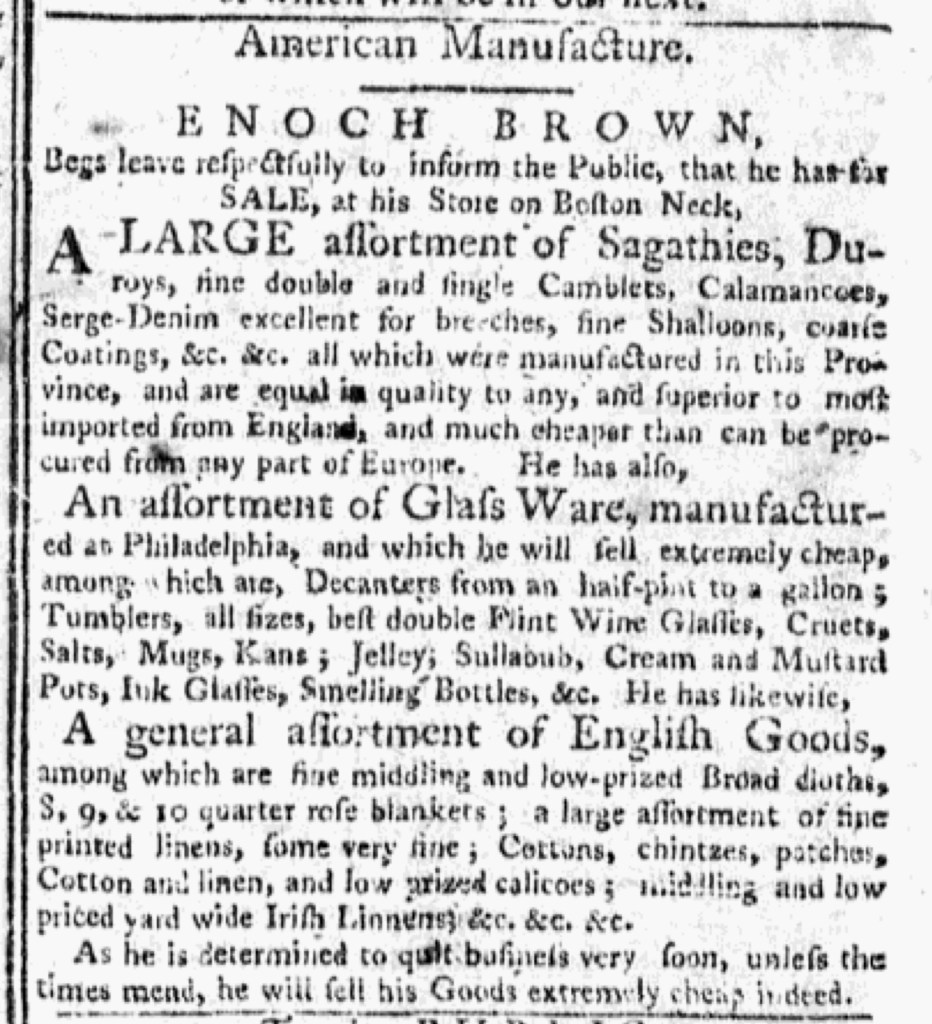
An advertisement in the January 26, 1775, edition of the Massachusetts Spy informed readers of “SUNDRY Goods, Wares and Merchandize Imported in the Brigantine Venus … from London” that would be “SOLD agreeable to The American Congress Association.”  That nonimportation agreement included provisions for selling goods imported between December 1, 1774, and February 1, 1775, yet it also called for encouraging “domestic manufactures” as alternatives to items acquired from Britain.

Enoch Brown emphasized such wares in his own advertisement in that same issue of the Massachusetts Spy.  The headline proclaimed, “American Manufacture.”  Brown reported that he stocked several kinds of textiles, a “LARGE assortment of Sagathies, Duroys, … Camblets, Calamancoes, Serge-Denim, [and] Shalloons … all which were manufactured in this Province.”  Like many other retailers who encouraged consumers to “Buy American” during the imperial crisis, Brown emphasized that his customers would not have to make sacrifices when it came to price or quality for the sake of abiding by their political principles.  These textiles, he insisted, “are equal in quality to any, and superior to most imported from England.”  In addition, customers could purchase them “much cheaper than can be procured from any part of Europe.”

Yet that was not the extent of Brown’s wares produced in the colonies.  He also stocked an “assortment of Glass Ware, manufactured at Philadelphia.”  Perhaps he stocked some of the “AMERICAN GLASS” advertised by John Elliott and Company in the Pennsylvania Journal just as the Continental Association went into effect at the beginning of December 1774.  Brown listed a variety of items, including decanters, wine glasses, and mustard pots, underscoring that “he will sell extremely cheap.”

Only after detailing products made in the colonies did Brown also mention a “general assortment of English Goods,” naming several textiles, such as “fine printed linens,” not included among those “manufactured in this Province.”  He likely attempted to liquidate inventory that had been on his shelves before the nonimportation agreement commenced, intending to “quite business very soon, unless the times mend.”  To that end, he vowed to “sell his Goods extremely cheap indeed.”  In the process, he gave priority to “American Manufacture” in his advertisement, directing readers to options that would allow them to be responsible consumers who did their part in support of the Continental Association and the American cause.

December 8

What was advertised in a colonial American newspaper 250 years ago today?

Rivington’s New-York Gazetteer (December 8, 1774).

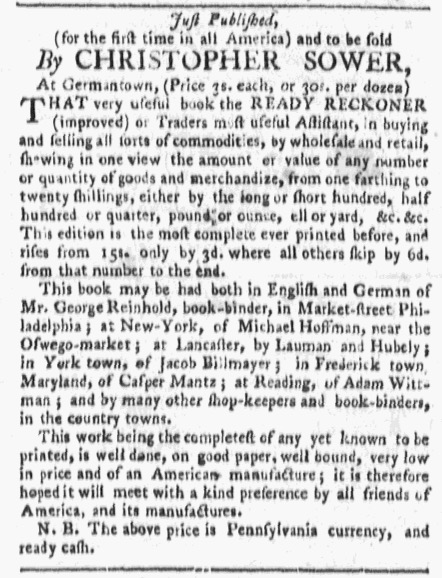
“It is therefore hoped that it will meet with a kind preference by all friends of America, and its manufactures.”

As the final days of 1774 approached, Christopher Sower, the printer of the Germantowner Zeitung, advertised an American edition of Daniel Fenning’s The Ready Reckoner; or Trader’s Most Useful Assistant, in Buying and Selling All Sorts of Commodities Either Wholesale or Retail.  The handy reference volume had been through several London editions, published it “for the first time in all America” and established a network of local agents to sell copies “both in English and German” in several cities and towns.  His advertisement in the December 8, 1774, edition of Rivington’s New-York Gazetteer listed his own printing office in Germantown, Pennsylvania, and named associates in Lancaster, Reading Philadelphia; New York City; Fredericktown, Maryland; and Yorktown, Virginia.  In addition, Sower claimed that “many other shop-keepers and book-binders, in the country towns” stocked the volume.  For those interested in selling copies at their shops, he offered a discount, thirty shilling for a dozen copies compared to three shillings for a single copy.  In other words, those who bought ten copies received two additional copies for free.

Sower declared that he issued an “improved” edition, “the most complete ever printed.”  The table it contained were supposed to save time and avoid errors in calculations, as the lengthy subtitle explained: “shewing at one view the amount or value of any number of quantity of goods from one farthing to twenty shillings … in so plain and easy a manner, that persons quite unacquainted with arithmetic may hereby ascertain the value of any number … at any price whatever.”  Sower considered it the “most complete” edition because it featured increments of three pence instead of six pence.  Yet that element alone did not recommend the book to prospective customers.  The publisher described it as “well done, on good paper, well bound and of an American manufacture.”  He did not specify whether “American manufacture” referred to the “good paper” as well as the labor undertaken in setting type, working the press, and binding the book.  Still, he expected that an American edition “will meet with a kind preference by all friends of America, and its manufactures” who might otherwise opt for a London edition published in 1773.  Sower’s call to purchase the American edition likely had even greater resonance given that the Continental Association, a nonimportation agreement adopted in response to the Coercive Acts, had recently gone into effect.