December 20

What was advertised in a revolutionary American newspaper 250 years ago today?

Pennsylvania Journal (December 20, 1775).

“Any person desirous of information concerning the character … of Mrs. Brodeau, may apply to … B. FRANKLIN.”

When she arrived in Philadelphia, “Mrs. BRODEAU, from England,” placed advertisements in the Pennsylvania Gazette and the Pennsylvania Journal as a means of “acquainting her friends and the public in general, that she has opened a boarding school in Walnut-street.”  She sought pupils of a certain status, pledging that “young ladies will be genteelly boarded, and taught to read and speak the French and English language; the tambour embroidery, and every kind of useful and ornamental needle work.”  In addition to the curriculum, Brodeau promoted her supervision of her charges, stating that she “hopes to prove by her assiduity and attention to the morals and behaviour of these ladies entrusted to her care, that she in some measure merits the recommendations she has been favoured with from her native country.”  Like many other schoolmasters and schoolmistresses who advertised in Philadelphia’s newspapers during the era of the American Revolution, Brodeau emphasized moral development as well as curriculum.[1]

The parents and guardians of prospective students did not have to take Brodeau’s word for it.  Instead, she inserted a testimonial from Robert Morris, the influential merchant, and Benjamin Franklin, the retired printer turned politician and diplomat.  “Any person desirous of information concerning the character and recommendations of Mrs. Brodeau,” they stated, “may apply to either of us.”  According to Claude-Anne Lopez, associated editor of the Papers of Benjamin Franklin, that was, “so far as we know, the only time that Franklin backed an enterprise of that kind with his name.”[2]  Lopez further explains that Anna Brodeau “suddenly and rather mysteriously appeared in Philadelphia with a baby daughter in her arms,”[3] yet “[n]othing is known about a Mr. Brodeau.”  If residents of Philadelphia had any concerns about Brodeau’s background, the endorsement from Franklin and Morris likely countered their concerns.  Still, the advertisement apparently did not garner as much response as Brodeau hoped when she placed it in the December 6 edition of the Pennsylvania Gazette, the newspaper that Franklin formerly printed.  Two weeks later she placed the same advertisement in the Pennsylvania Journal.  Those efforts helped launch her boarding school.  By the end of the Revolutionary War, Franklin’s daughter, Sarah Bache, wrote to her father that Brodeau “has made a handsome fortune.”  Despite the disruptions of the war, she established her boarding school and her reputation.  Lopez chronicles other accolades for Brodeau that appeared in print, including a poem by an anonymous contributor to the Columbian Magazine in 1786 and her obituary in the National Intelligencer in 1836.  With words of support from Franklin and Morris, Brodeau soon “attracted students from the best families in Philadelphia.”[4]  Her marketing incorporated the eighteenth-century version of a celebrity endorsement.

**********

[1] Carl Robert Keyes, “Selling Gentility and Pretending Morality: Education and Newspaper Advertisements in Philadelphia, 1765-1775,” Pennsylvania Magazine of History and Biography 141, no. 3 (October 2017): 245-274.

[2] Claude-Anne Lopez, “Benjamin Franklin and William Dodd: A New Look at an Old Vause Célèbre,” Proceedings of the American Philosophical Society 129, no. 3 (September 1985): 262.

[3] Lopez, “Benjamin Franklin and William Dodd,” 262, 263.

[4]Lopez, “Benjamin Franklin and William Dodd,” 263.
November 23

What was advertised in a revolutionary American newspaper 250 years ago today?

Rivington’s New-York Gazetteer (November 23, 1775).

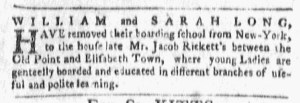
“WILLIAM and SARAH LONG, HAVE removed their boarding school from New-York.”

Late in November 1775, William and Sarah Long placed an advertisement for their boarding school “where young Ladies are genteelly boarded and educated in different branches of useful and polite learning” in the final edition of Rivington’s New-York Gazetteer, though they did not know that it would be the last issue.  They advised prospective students and their parents that they “removed … from New-York, to the house late Mr. Jacob Rickett’s between the Old Point and Elisabeth Town” in New Jersey.  What prompted the Longs to relocate outside the city?  With the siege of Boston continuing, the uncertainty of where and when British soldiers would attempt to assert their authority likely played a role in their decision.  A few months earlier, Andrew Wilson ran an advertisement for his grammar school in Morristown, New Jersey, emphasizing its distance from the coast.  He invoked the “dangerous and alarming times [for] the inhabitants of large cities” and suggested that they “may wish to have their children educated in the interior parts of the country, at a distance from probable, sudden danger and confusion.”  Similar thoughts may have inspired the Longs when they “removed” their school from New York.

On November 27, “sudden danger and confusion” did indeed occur at James Rivington’s printing office on Hanover Square.  Angry with the Tory perspective that Rivington often expressed in his newspaper, the Sons of Liberty attacked his printing office.  It was not the first time, but the damage was much more significant than the previous attack.  The Sons of Liberty destroyed Rivington’s press and type, preventing him from continuing to publish his newspaper or anything else.  The printer decided to leave the city, sailing for London.  He returned in 1777, during the British occupation of New York, and established Rivington’s New-York Gazette.  It continued the numbering of Rivington’s New-York Gazetteer.  That tile lasted for only two issues before he updated it to Rivington’s New York Loyal Gazette for several weeks and then the Royal Gazette throughout the remainder of the war.  Rivington’s newspaper changed names one more time, becoming Rivington’s New-York Gazette for just over a month before ceasing publication with the December 31, 1783, edition.  In his History of Printing in America (1810), patriot printer Isaiah Thomas noted that “for some time Rivington conducted his paper with as much impartiality as most of the editors of that period.”[1]  Adhering to that impartiality longer than other printers contributed to the perception that Rivington favored Tory sentiments when he claimed that he merely exercised freedom of the press.  Earlier in 1775, he advertised “Pamphlets published on both sides, in the unhappy dispute with Great-Britain.”  In addition to the Longs’ advertisement about their boarding school, the final issue of Rivington’s New-York Gazetteer also carried an advertisement for the Constitutional Post Office in New York.  The Second Continental Congress authorized the Constitutional Post as an alternative to the imperial system.

William and Sarah Long and their students “removed” from New York before “sudden danger and confusion” found them.  James Rivington, on the other hand, fled the city after repeated attacks on his printing office made it impossible for him to continue printing his newspaper.

**********

[1] Isaiah Thomas, The History of Printing in America: With a Biography of Printers and an Account of Newspapers (1810; New York: Weathervane Books, 1970), 511.

September 12

What was advertised in a revolutionary American newspaper 250 years ago today?

Dunlap’s Maryland Gazette (September 12, 1775).

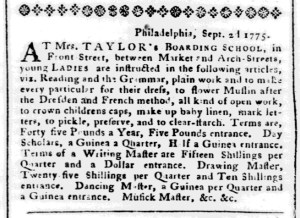
“Mrs. TAYLOR’s BOARDING SCHOOL … [for] young LADIES.”

The first advertisement in the September 12, 1775, edition of Dunlap’s Maryland Gazette, published in Baltimore, promoted “Mrs. TAYLOR’s BOARDING SCHOOL” for “young LADIES” on Philadelphia, apparently an elite institution based on the tuition.  The headmistress charged forty-five pounds per year along with an initial entrance fee of five pounds.  Taylor advised the parents and guardians of prospective pupils that they would be taught “Reading and the Grammar, plain work and to make every particular for their dress, to flower Muslin after the Dresden and French method, all kind of open work, to crown childrens caps, make up baby linen, mark letters, to pickle, preserve, and to clear-starch.”  The standard curriculum combined practical skills that prepared young women to run a household with some leisure activities that testified to their status.

Yet that was not the extent of the instruction that took place at Taylor’s boarding school.  For additional fees, her charges could opt for additional lessons taught by tutors that Taylor hired.  Students learned to form their letters from a “Writing Master” for fifteen shillings each quarter.  They learned their steps from a “Dancing Master” for a guinea (or twenty-one shillings) each quarter.  Although Taylor did not say so, those students presumably learned to dance with grace rather than focusing exclusively on the mechanics of minuets and other popular dances.  Lessons from a “Drawing Master” cost twenty-five shillings per quarter.  Taylor also listed a “Musick Mater &c. &c.” but did not note their rates.  Repeating the common abbreviation for et cetera twice suggested that other tutors taught painting, French, and other genteel pursuits in addition to singing and playing instruments.  Taylor operated her boarding school in the largest and most cosmopolitan city in the colonies.  For pupils aspiring to gentility, she could arrange for access to all sorts of instructors, allowing her students and their families to choose which kinds of lessons they needed or desired in addition to the standard curriculum.  For the gentry in Baltimore, a port growing in size and importance on the eve of the American Revolution, Taylor’s boarding school for young ladies may have looked very attractive indeed.

July 10

What was advertised in a revolutionary American newspaper 250 years ago today?

New-York Gazette and Weekly Mercury (July 10, 1775).

“Children educated … at a distance from probable, sudden danger and confusion.”

In July 1775, Andrew Wilson, a schoolmaster in Morristown, New Jersey, attempted to leverage current events to enroll students in his school “about twenty-seven miles from Powles-Hook, and eighteen miles from Elizabeth-Town.”  In the late spring and early summer, colonizers in New York followed the news about the battles at Lexington and Concord, the siege of Boston, and the Battle of Bunker Hill.  In addition to updates from Massachusetts, they read and discussed actions taken by the Second Continental Congress, meeting in Philadelphia, and provincial congresses throughout the colonies.  While the fighting had been confined to Massachusetts so far, colonizers anticipated that it would spread.

In such an environment, Wilson saw an opportunity to market his school to parents and guardians in New York City and other coastal towns.  “IN these dangerous and alarming times,” he declared, “the inhabitants of large cities, and other places on the sea coast, may wish to have their children educated in the interior parts of the country, at a distance from probably, sudden danger and confusion.”  He acknowledged that they likely weighed tuition and the quality of instruction against the prospects of danger, suggesting that they would send their children to such a school “if the expence was reasonable, and they could depend on the fitness of the teacher.”  Wilson confidently stated that he could alleviate both concerns.  He claimed that he “was recommended by Dr. Witherspoon, of New-Jersey College, and the Rev. Mr. Mason, in New-York.”  Furthermore, he had experience.  When he ran his advertisement in the July 10, 1775, edition of the New-York Gazette and Weekly Mercury, he had “taught [in Morristown] upwards of ten months, to the satisfaction of his employers.”  When it came to expenses, lodging and board amounted to “much less money than is generally given for the same in other places.”  His pupils did not reside at the school; instead, Wilson placed them in the homes of “good families.”  In addition, the schoolmaster described Morristown and a “healthy place” as well as an accessible one.  “[O]n three different days of the week,” he noted, “a stage goes from it to New-York.”

As resistance to imperial overreach became a revolution, the crafty schoolmaster portrayed Morristown, New Jersey, as a relatively safe place to send children to school.  Parents and guardians could remove their charges from danger while still attending to their education and development, alleviating at least some of the worry they experienced during uncertain times.

June 13

What was advertised in a revolutionary American newspaper 250 years ago today?

South-Carolina Gazette and Country Journal (June 13, 1775).

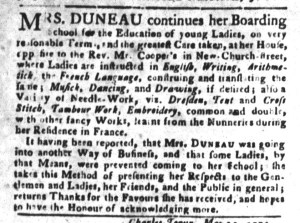
“MRS. DUNEAU continues her Boarding School for the Education of young Ladies.”

In an advertisement in the June 13, 1775, edition of the South-Carolina Gazette and Country Journal, Mrs. Duneau assured the public that she “continues her Boarding School for the Education of young Ladies … at her House, opposite to the Rev. Mr. Cooper’s in New-Church-street” in Charleston.  She may have intended to suggest that her proximity to the minister contributed to the “greatest Care” that she took of her pupils.  The schoolmistress also provided an overview of the curriculum at her school: “English, Writing, Arithmetic, the French Language, construing and translating the same; Musick, Dancing, and Drawing.”  The education they received from Duneau helped in forming her students into genteel young ladies.  In addition, they learned a “Variety of Needle-Work,” likely intended to demonstrate their devotion to leisurely pursuits rather prepare them occupations to support themselves.  Those included “Dresden, Tent and Cross Stitch, Tambour Work, [and] Embroidery, common and double,” along with “other fancy Works” that Duneau “learnt from the Nunneries during her Residence in France.”

Although advertisements for boarding schools regularly appeared in newspapers published in Charleston on the eve of the American Revolution, Duneau may have considered it especially necessary to insert this notice to attract students.  “It having been reported,” she stated, “that Mrs. DUNEAU was going into another Way of Business, … some Ladies, by that Means, were prevented coming to her School.”  What kinds of reports had circulated?  Who was responsible for suggesting that she planned to pursue another occupation, perhaps putting her skill with a needle to use in the marketplace?  Had a rival schoolmistress spread rumors as a means of undercutting Duneau and enrolling students who otherwise would have attended her school?  Duneau did not provide further details in her advertisement.  Instead, she focused on “presenting her Respects to the Gentlemen and Ladies, her Friends, and the Public in general,” expressing her gratitude for “the Favours she has received” when entrusted with students in the past and requesting “the Honour of acknowledging more.”  Whatever readers may have heard about whether Duneau continued to operate her school, she wanted the parents of prospective students to know that she was prepared to teach their daughters.

May 9

What was advertised in a revolutionary American newspaper 250 years ago today?

South-Carolina Gazette and Country Journal (May 9, 1775).

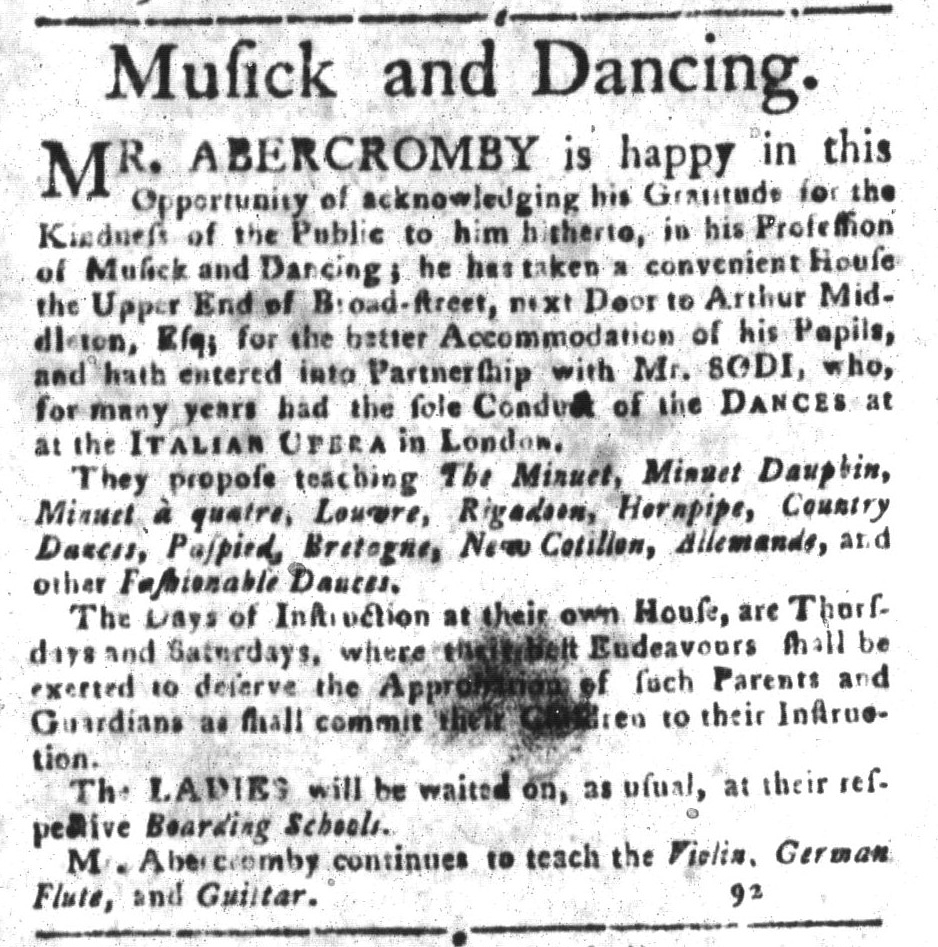
“Musick and Dancing.”

Among the advertisements for textiles, patent medicines, vessels preparing to depart for distant ports, and enslaved people for sale in the May 9, 1775, edition of the South-Carolina Gazette and Country Journal, Mr. Abercromby promoted lessons in “Musick and Dancing.”  He started by expressing his appreciation for the support he already received, stating that he was “happy in this Opportunity of acknowledging his Gratitude for the Kindness of the Public to him hitherto, in his Profession.”  Doing so bolstered his reputation; readers not previously familiar with Abercromby, especially genteel readers who knew that their social standing depended in part on their ability to demonstrate that they had mastered the steps of various dances or could play a musical instrument, may have asked themselves why they did not know Abercromby and whether they should make his acquaintance.

Abercromby next made two important announcements.  First, he moved to a new location, a “convenient House [in] the Upper End of Broad-street” in Charleston, that offered “better Accommodation of his Pupils.”  In addition, he “entered into Partnership with Mr. SODI, who, for many years had the sole Conduct of the DANCES at the ITALIAN OPERA in London.”  Signior Sodi, as he styled himself, previously advertised his services in the Pennsylvania Journal in the summer and fall of 1774, but by the spring of 1775 he had migrated from Philadelphia to Charleston.  Just as Sodi had done in his own advertisements, Abercromby emphasized the cachet of learning to dance from an instructor with connections to such an illustrious institution.

Abercromby listed nearly a dozen dances that he and Sodi taught, including “The Minuet, Minuet Dauphin, Minuet à quatre, Louvre, [and] Rigadoon,” as well as “other Fashionable Dances.”  Their pupils could learn new dances or refine their steps for those they already knew.  In addition to the lessons they gave at their “convenient House,” Abercromby and Sodi visited boarding schools in Charleston.  Parents and guardians could arrange to enhance the curriculum that their young “LADIES” studied, trusting that the schoolmistresses provided appropriate supervision of the dancing masters and their pupils.  Such services may have been especially attractive to the gentry in one of the largest and most cosmopolitan urban ports in the colonies.  Abercromby and Sodi did not merely teach dancing, after all, but instead sold status to those who succeeded at their lessons.

March 31

What was advertised in a colonial American newspaper 250 years ago today?

South-Carolina and American General Gazette (March 31, 1775).

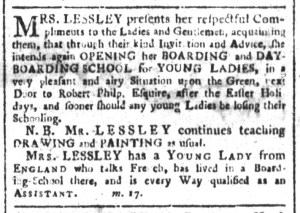
“She intends again OPENING her BOARDING and DAY-BOARDING SCHOOL.”

Mrs. Lessley ran a “BOARDING and DAY-BOARDING SCHOOL for YOUNG LADIES” in Charleston in the 1770s. She closed the school for a while, as schoolmasters and schoolmistresses often did for various reasons, but, as spring arrived in 1775, she took to the pages of the South-Carolina and American General Gazette to announce that she planned on “again OPENING” her school “after the Easter Holiday.”  She decided to do so, she stated, at the “kind Invitation and Advice” of “Ladies and Gentlemen” familiar with her school, offering an implicit endorsement she hoped would convince prospective pupils and their families.

Lessley also gave information about others who worked at her school.  “MR. LESSLEY continues teaching DRAWING and PAINTING as usual,” enriching the curriculum offered by his wife.  Readers, especially former students, may have assumed that was the case, but they did not necessarily know about a new employee.  The schoolmistress reported that she “has a YOUNG LADY from ENGLAND who talks French, has lived in a Boarding-School there, and is every Way qualified as an ASSISTANT.”  Those cosmopolitan skills and experiences enhanced the education that Lessley provided for her charges.  Her assistant aided in teaching a language considered a marker of gentility among the gentry and those who aspired to join their ranks.  Perhaps she even served as the primary instructor for that subject.  She may have consulted with Lessley on replicating an English boarding school without students having to cross the Atlantic while also serving as a role model for how “YOUNG LADIES” should comport themselves at such a school.

The schoolmistress gave less attention to the amenities at her school, though she did mention that it was located “in a very pleasant and airy Situation upon the Green.”  With classes slated to begin sometime after April 16, she assured prospective students and their families that they would live and learn in a comfortable environment.  She also indicated that she would commence lessons “sooner should any young Ladies be losing their Schooling.”  In other words, if other schoolmasters and schoolmistresses closed or suspended their schools, Lessley would gladly accept their students.  She hoped that these additional appeals in combination with her description of those who taught at her school would help in encouraging prospective pupils and their families to enroll.

March 22

What was advertised in a colonial American newspaper 250 years ago today?

Essex Journal (March 22, 1775).

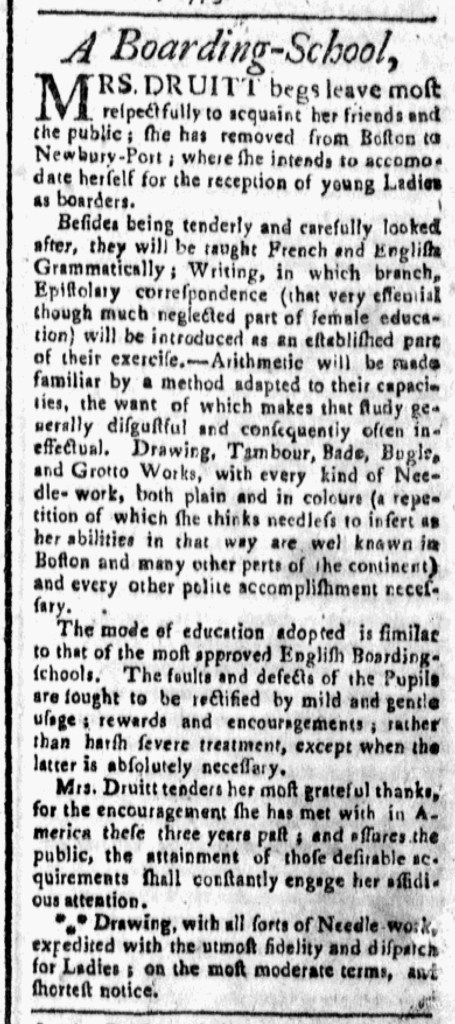
“The mode of education adopted is similar to that of the most approved English Boarding-schools.”

When Eleanor Druitt moved to Newburyport from Boston in the spring of 1775, she placed an advertisement in the local newspaper, the Essex Journal, to announce that she planned to open a boarding school for “young Ladies.”  According to her notice, she had been in the colonies for just three years, yet in that time she had established a reputation for educating young women that she hoped would serve her well in her new town.  Druitt provided a “mode of education … similar to that of the most approved English Boarding-schools,” offering pupils in Massachusetts the same benefits.

The schoolmistress gave an overview of the curriculum, emphasizing that students would learn “French and English Grammatically” and “Writing, in which branch, Epistolary correspondence (that very essential though much neglected part of female education) will be introduced as an established part of their exercise.”  In other words, she taught young women how to write polite letters that would serve them well in maintaining relationships with family and friends in other cities and towns.  Her students also learned arithmetic, “made familiar by a method adapted to their capacities, the want of which makes that study generally disgustful and consequently often ineffectual.”  Druitt had a much higher estimation of young women’s aptitude for drawing, embroidery, and other kinds of decorative “Needle-work,” asserting that she “thinks needless to insert” a longer description “as her abilities in that way are well known in Boston and many other parts of the continent.”  The families of prospective pupils may have seen some of the advertisements she ran in Boston’s newspapers over the past three years since those publications circulated in Newburyport and other towns in Massachusetts and New Hampshire.  In general, her curriculum focused on “polite accomplishment[s]” to distinguish the “young Ladies” that she “tenderly and carefully looked after.”

To that end, Druitt declared that the “faults and defects of the pupils [will] be rectified by mild and gentle usage.”  That meant “rewards and encouragement; rather than harsh severe treatment.”  Parents did not need to worry about the treatment their daughters would receive when boarding with Druitt, though she did state that she would adopt some of those stricter methods as a last resort when “absolutely necessary.”  The schoolmistress suggested that she established just the right balance of encouragement and discipline that allowed pupils at her boarding school to thrive.  Families had a variety of concerns as the imperial crisis intensified in the spring of 1775, but they need not worry about the “reception” their daughters would experience at Druitt’s boarding school.

September 17

What was advertised in a colonial American newspaper 250 years ago today?

Addition to the South-Carolina Gazette (September 17, 1774).

“MRS. WINDSOR … has declined being connected with Mrs. SAGE, in a Boarding-School.”

In an advertisement that ran in a midweek supplement to the South-Carolina Gazette, Ann Sage announced that she opened a “New Boarding-School, FOR YOUNG LADIES” on September 15, 1774.  The curriculum included “READING, TAMBOUR, EMBROIDERY, and all Kinds of NEEDLE-WORK.”  Sage presumably taught reading and those feminine arts herself.  For an additional price, students could learn “WRITING, ARITHMETIC, DANCING and MUSIC.”  Sage may have provided some of that instruction, but another advertisement suggests that she hired tutors to supplement the lessons she provided.

Immediately below Sage’s notice, Mrs. Windsor declared that she “declined being connected with Mrs. SAGE, in a Boarding-School; which is to be opened on the 15th.”  Dated September 1, Windsor’s advertisement previously appeared separately from Sage’s announcement, including in the September 13 edition of the South-Carolina Gazette and Country Journal.  She did not elaborate on her reasons for not joining Sage’s endeavor, instead advising “her FRIENDS in particular, and the PUBLIC in general” that she “continues, as usual, to instruct Young LADIES upon the HARPSICHORD.”  Windsor requested the “Continuance of the Patronage and Encouragement of her Friends and Acquaintances.”  She had her own enterprise to oversee.

What was Windsor’s purpose in even mentioning Sage’s school in her advertisement?  She could have sought pupils without commenting on her refusal to be affiliated with the boarding school.  Perhaps Sage had attempted to recruit Windsor as a partner in the endeavor rather than merely a tutor who occasionally gave lessons to students who paid additional fees.  In that case, Sage may not have had time to continue offering lessons to her existing clientele.  Her newspaper notice made it clear that she wished to continue those relationships as well as gain new students.  Yet the details she provided (and those she did not) hinted at an untold story, perhaps some interesting gossip, especially when Windsor’s advertisement appeared immediately below Sage’s notice.  The “Friends and Acquaintances” that Windsor thanked for the “Continuance of [their] Patronage and Encouragement” (and other readers as well) otherwise may not have thought anything about Windsor’s other prospects, but her intervention in the public prints could have prompted some to discreetly ask questions here and there to discover if they had missed out on something interesting.

April 7

GUEST CURATOR:  Maria Lepak

What was advertised in a colonial American newspaper 250 years ago today?

Rivington’s New-York Gazetteer (April 7, 1774).

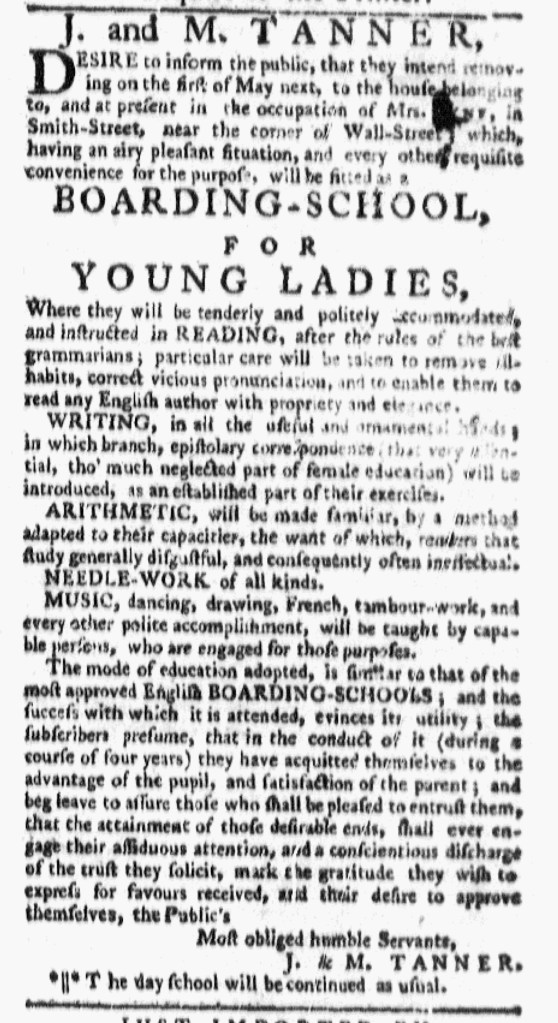
“BOARDING-SCHOOL, FOR YOUNG LADIES.”

J. & M. Tanner’s notice in Rivington’s New-York Gazetteer advertised an opportunity for young women to attend a boarding school “in Smith-Street, near the corner of Wall Street.” At this school, the “YOUNG LADIES” would improve in reading, writing, needlework, music, dancing, and other subjects considered appropriate for them. The Tanners include a comparison of their new school to what a British boarding school had to offer, stating that their curriculum “was similar to that of the most approved English BOARDING-SCHOOLS.” According to Mary Cathcart Borer in Willingly to School: A History of Women’s Education, boarding schools for young ladies popped up in England as early as 1711, with nearly the same curriculum at each.[1] However, arithmetic was a subject that the Tanners’ school in the colonies included that many British schools for girls and young women did not. While still expected to stay in the private sphere, Tanners’ boarding school allowed for young women’s opportunities in arithmetic, which was not always an option for many young women elsewhere. We cannot conclude exactly why the Tanners chose to incorporate arithmetic into their school’s curriculum. However, it indicates that while still using the British model, there were variations of the boarding school systems in the colonies.

 The Tanners’ boarding school seems to have been an effort to demonstrate that the colonies could also partake in the same developments that England did, particularly in women’s education and manners. Considering that this advertisement was published in 1774, a year before the first battles of the American Revolution, tensions increasingly inspired colonists to establish self-sufficiency in government and commerce and other aspects of life, such as education, without reliance on Britain. Even as that happened, it is critical to recognize that while the colonies were looking to have their own self-sufficient systems and government, they still included British ideals. Britain was still influential in colonial culture, which was especially shared through ideas of education and what made well-educated and well-mannered young ladies.

**********

ADDITIONAL COMMENTARY:  Carl Robert Keyes

Rather than expand on Maria’s interpretation of today’s advertisement, I am reflecting on pedagogy and my experiences integrating the Adverts 250 Project and the Slavery Adverts 250 Project into the courses I teach at Assumption University.  Throughout this academic year, including the time that Maria and her peers were enrolled in my Revolutionary America course last fall, faculty and staff have engaged in a series of programs about “awaken[ing] in students a sense of wonder” and how we seek to fulfill the University’s mission.  I have learned some valuable lessons along the way, from my colleagues at those events and from my students in the classroom.

Maria and her classmates commence their responsibilities as guest curators by compiling a mini-archive of newspapers published during a particular week in 1774.  I provide each of them with a list of extant newspapers that have been digitized and train them in using several databases.  Once they have created their mini-archives, each student examines the newspapers for their week to identify all of the advertisements about enslaved people for inclusion in the Slavery Adverts 250 Project and to select an advertisement about consumer goods or services to feature on the Adverts 250 Project.  I provide students with hard copies of their newspapers, encouraging them to work back and forth with the digitized ones.

One morning last fall, I arrived in class intending to discuss advertisements about enslaved people and what students learned from that portion of the project.  We had a robust discussion, but, to my initial frustration, students did not stick to the topic for the day!  Instead of focusing solely on advertisements about enslaved people, they started discussing other kinds of advertisements and asking about other aspects of the newspapers as well.  I had a lesson plan, an “agenda” of material that I “needed” to cover that day, and their “off-topic” questions did not facilitate the good order that I had envisioned.

Then I realized that I was witnessing authentic wonder in my classroom, that the conversation taking place was more important than anything I scripted in my mind in advance, and that students were learning more from the experience than by following my outline for that class.  I spend so much time working with (digitized) eighteenth-century newspapers that they are as familiar to me as modern media … but having a week’s worth of newspapers published in 1774 in front of them was completely new to my students.  The advertisements were new to them, but so were the conventions of eighteenth-century print culture!  They immersed themselves in their newspapers, learning as much as they could on their own and then asking questions about life in early America based on what they encountered in those newspapers.

When I finally understood what was happening, I jettisoned my outline so we could have a lengthy conversation about anything my students found interesting or confusing or strange in their newspapers.  However unintentional, my first instinct had been to stifle their sense of wonder by attempting to rigidly follow my outline for that class.  In the end, we all – professor and students – got so much more out of that class when I learned from my students that I could better facilitate how they learned about the past by giving them opportunities to express their wonder.  As the semester progressed, we circled back, repeatedly, to discussing advertisements about enslaved people as my students worked on the Slavery Adverts 250 Project.  At the same time, I allowed for more opportunities to “get off track” as we examined a variety of other primary sources.  My students learned more and I had a more fulfilling experience as an instructor, energized by the quality of the discussions we had in class on those occasions that my students deviated from what I planned for the day.

**********

[1]  Mary Cathcart Borer, Willingly to School: A History of Women’s Education (Cambridge, UK: Lutterworth Press, 1976).