April 13

What was advertised in a colonial American newspaper 250 years ago today?
Maryland Gazette (April 13, 1775).

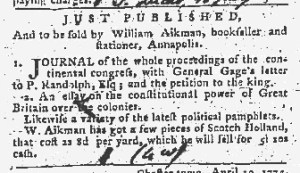
“JOURNAL of the whole proceedings of the continental congress.”

An advertisement by William Aikman, a bookseller and stationer in Annapolis, in the April 13, 1775, edition of the Maryland Gazette proclaimed, “JUST PUBLISHED, And to be sold … JOURNAL of the whole proceedings of the continental congress” and “An essay on the constitutional power of Great Britain over the colonies.”  While Aikman no doubt sold those items, they had not been “JUST PUBLISHED,” nor had he published them.

Readers understood that “JUST PUBLISHED” did not always mean that an item was hot off the presses; sometimes that phrase was a vestige of an advertisement originally composed and disseminated weeks or months earlier and printed once again without revisions.  Readers also understood that “JUST PUBLISHED, and to be sold by” did not necessarily mean that the retailer was also the publisher, merely that the retailer sold an item that had been published by someone, somewhere.  Keeping that in mind yields a better understanding of the production and dissemination of the items that Aikman advertised.

Although printers in many towns, including Anne Catharine Green and Son in Annapolis, produced and advertised local editions of the Extracts from the Votes and Proceedings of the American Continental Congress in the weeks after the First Continental Congress concluded its meetings in Philadelphia near the end of October 1774, only two printing offices published the complete Journal of the Proceedings of the Congress in the following months.  William Bradford and Thomas Bradford printed an edition in Philadelphia, as did Hugh Gaine in New York.  Aikman most likely stocked and advertised the Bradfords’ edition, especially considering that they also printed John Dickinson’s Essay on the Constitutional Power of Great-Britain over the Colonies in America in 1774.  Gaine did not publish a New York edition of that volume.

Aikman’s advertisement also stated that he carried “a variety of the latest political pamphlets,” but he did not list additional titles.  Perhaps he followed the lead of James Rivington in New York and tried to profit from selling pamphlets “on both sides, in the unhappy dispute with Great-Britain.”  As the imperial crisis reached its boiling point in April 1775, Aikman took to the pages of the Maryland Gazette to hawk two items published by the Bradfords in 1774 that became more timely and relevant as well as the “latest political pamphlets” that provided even more for colonizers to consider as they learned about and participated in current events.

April 10

What was advertised in a colonial American newspaper 250 years ago today?

New-York Gazette and Weekly Mercury (April 10, 1775).

“Turn them speedily into cash, before the trade opens with Great-Britain.”

In the spring of 1775, Samuel Loudon, a bookseller and stationer, took to the pages of the New-York Gazette and Weekly Mercury to promote his current inventory.  His advertisement included a catalog listing many of the titles currently in stock as well as “a Variety of Religious books too tedious to mention” and “a variety of History and Romance.”  He also carried writing supplies, including “Quills, Writing Paper, Blank Books, Wafers and Sealing Wax.”

Loudon hoped to make a deal with customers “who take a quantity,” whether for themselves or to retail at their own shops, offering to sell the books “nearly at prime cost” or just a small markup.  He stated that he wished to “turn them speedily into cash, before the trade opens with Great-Britain” because he wanted to be in a better position to “lay in a fresh assortment.”  Despite the volume of newspaper advertisements and subscription proposals for books and pamphlets published by American printers, most books purchased and read by colonizers were printed in England and imported to the colonies.  At that moment, however, Americans participated in a nonimportation agreement, the Continental Association, enacted in response to the Coercive Acts.  Loudon acknowledged that he did not currently have access to new books, yet he looked to the future with optimism and planned to place orders as soon as Parliament repealed the offensive legislation and trade returned to normal.

In that regard, his advertisement echoed the one that John Minshull placed for looking glasses and engravings in the New-York Journal a few days earlier, though Minshull, likely a Loyalist, may have adhered to the nonimportation agreement out of necessity rather than enthusiasm.  Loudon “was decidedly a whig,” according to Patriot printer Isaiah Thomas, so his support may the Continental Association could have been more genuine despite any frustration with the disruptions it caused for his business.  Not long after he placed his advertisement in the New-York Gazette and Weekly Mercury, he purchased “printing materials, and opened a printing house.”  He commenced publishing “a newspaper devoted to the cause of the country” in January 1776.[1]  Neither Loudon nor Minshull saw trade resume with Britain in the way they imagined.  They did not know when they submitted their advertisements to the printing offices that resistance would soon become revolution following the battles at Lexington and Concord in Massachusetts.

**********

[1] Isaiah Thomas, The History of Printing in America: With a Biography of Printers and an Account of Newspapers (1810; New York: Weathervane Books, 1970), 482.

June 30

What was advertised in a colonial American newspaper 250 years ago today?

Maryland Gazette (June 30, 1774).

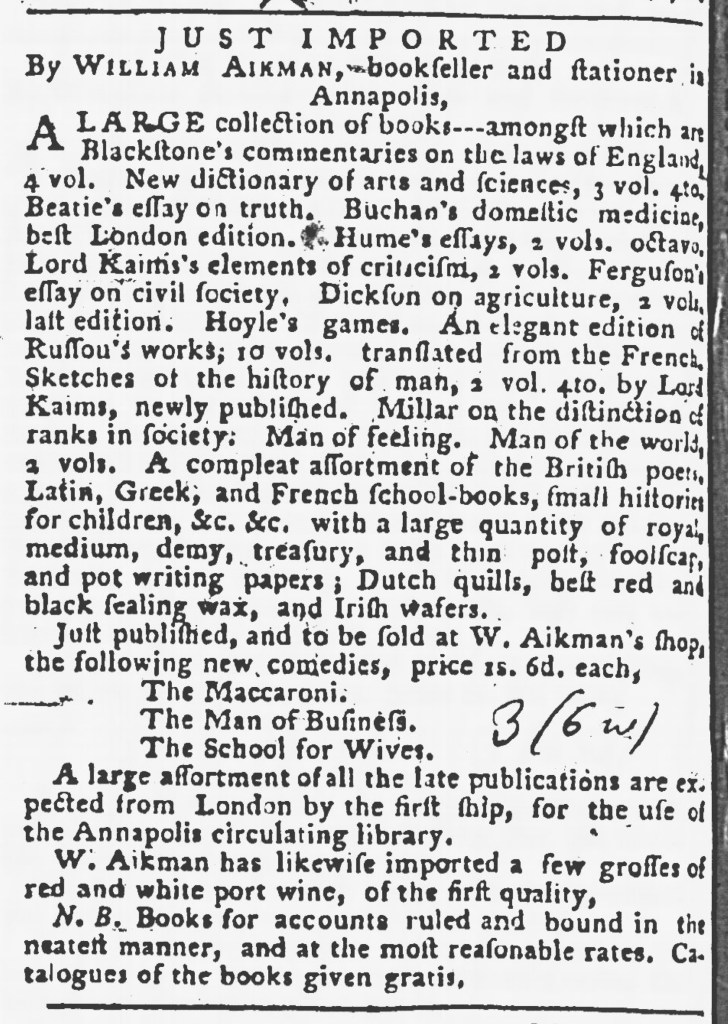
“Just published … the following new comedies.”

In the spring and summer of 1774, William Aikman, “bookseller and stationer in Annapolis,” advertised a “LARGE collection of books” in the Maryland Gazette.  He listed all sorts of titles, including “Blackstone’s commentaries on the laws of England” in four volumes, “Buchan’s domestic medicine, best London edition,” and “Russou’s works, … translated from the French.”  In addition, he stocked a variety of books from several genres, ranging from a “compleat assortment of the British poets” to “Latin, Greek, and French school-books” to “small histories for children.”  Aikman had something for every reader.

The bookseller also devoted a portion of his advertisement to three “new comedies” that sold for one shilling and six pence each.  These works, “Just published,” most likely were reprints that he acquired from John Dunlap in Philadelphia.  In 1774, Dunlap printed American editions of Robert Hitchcock’s The Macaroni: A Comedy, as It Is Performed at the Theatre Royal, George Coleman’s The Man of Business: A Comedy: As It is Acted at the Theatre-Royal in Covent-Garden, and Hugh Kelly’s The School for Wives: A Comedy: As It Is Performed at the Theatre-Royal in Drury Lane.  Perusing those works gave readers in the colonies, in Philadelphia or Annapolis or anywhere else that Dunlap distributed his reprinted editions, a taste of the theater scene in the cosmopolitan center of the empire.

In addition, Aikman announced that a “large assortment of all the late publications are expected from London by the first ship, for the use of the Annapolis circulating library.”  That was another venture that the enterprising bookseller and stationer oversaw.  A year earlier, he opened that library and advertised the subscription fees for joining for a month, a quarter, six months, or a year.  In the fall of 1773, he advertised that his Annapolis Circulating Library provided delivery service to Baltimore, both a convenience for members there and an attempt to undercut a competing library proposed by a competitor who did not manage to establish a library there.

Overall, Aikman’s advertisement revealed multiple trajectories for producing, distributing, and acquiring books on the eve of the American Revolution.  Booksellers received most of their inventory from English printers, though printers in the colonies published both American editions and original works.  Those printers worked with printers and booksellers in other towns to exchange, market, and sell books and pamphlets printed in the colonies.  For their part, readers could purchase books or join circulating libraries to increase their access to larger libraries than they could afford on their own.

May 22

What was advertised in a colonial American newspaper 250 years ago this week?

Supplement to the Massachusetts Gazette and Boston Weekly News-Letter (May 19, 1774).

“Exterminate Ignorance and Darkness, by the noble Medium of SOCIAL LIBRARIES.”

Today Henry Know is acclaimed as an American general during the Revolutionary War and the nation’s first Secretary of War, appointed when George Washington formed the first presidential cabinet.  In May 1774, however, he was a young bookseller in Boston.  Just a few months shy of his twenty-fourth birthday, he ran the “LONDON BOOK-STORE” and advertised an “ELEGANT, VALUABLE & LARGE ASSORTMENT of BOOKS” in the Massachusetts Gazette and Boston Weekly News-Letter.  He was a veteran advertiser by that time, having previously placed newspaper advertisements and distributed engraved trade cards.  He also passed out book catalogs, “which may be had gratis,” as part of his marketing efforts.  Like many other entrepreneurs, Knox did not rely on newspaper notices alone to generate interest and incite demand for his wares.

Knox stocked works by “the latest. Most learned, and most approved Authors, in all Branches f Literature,” from “ANATOMY” and “ARCHITECTURE” to “DIVINITY” and “HISTORY” to “PHILOSOPHY” and “SURGERY.”  He listed thirty genres, offering something to attract just about any reader.  He also carried “Magazines, Reviews, and other new Publications of Merit, by every Opportunity after they come out in London,” though he did not mention if he sold the Royal American Magazine, published by Isaiah Thomas in Boston.  Knox supplemented revenues from books by peddling patent medicines, a common practice among printers and booksellers at the time.

Knox sought various kinds of customers for the books that he imported.  While readers were always welcome to visit the London Book-Store to peruse and purchase the titles on hand and pick up a catalog, the bookseller also aimed to supply “Country Merchants, [and] Traders” with books and pamphlets for their retail operations, whether they were shopkeepers with fixed locations in towns beyond Boston or itinerant peddlers who hawked a variety of wares as they traveled from village to village.  Knox also hoped that members of social libraries would acquire books from him.  Public libraries did not yet exist, but clubs formed to open private libraries that gave members who paid subscriptions or other fees access to a greater number of books than they could afford to purchase on their own.  Knox lauded such initiatives, commending “Those Gentlemen in the Country who are actuated with the most genuine Principles of Benevolence in their Exertions to exterminate Ignorance and Darkness, by the noble Medium of SOCIAL LIBRARIES.”  Prospective customers purchasing on behalf of those institutions likely wished to collect from among many or even most of the genres that the bookseller highlighted in his advertisement.  Knox’s marketing strategy included diversifying the kinds of customers he served as well as stocking a wide selection of books, pamphlets, magazines, and other reading material.

December 21

What was advertised in a colonial American newspaper 250 years ago today?

Connecticut Courant (December 21, 1773).

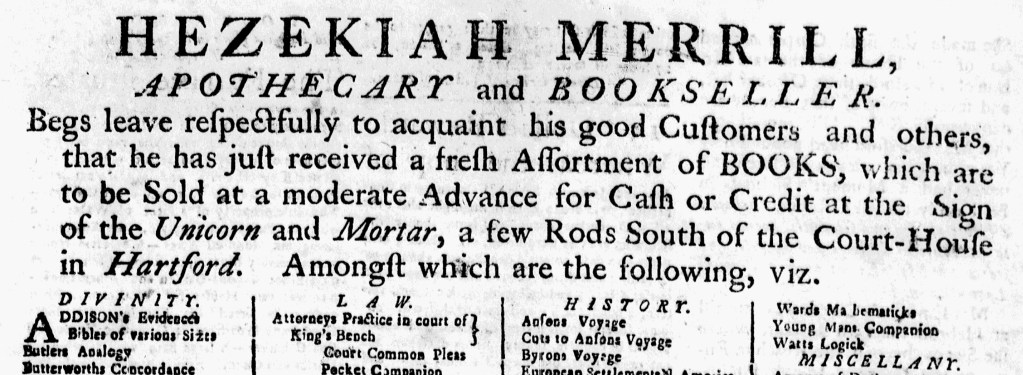
“He has just received a fresh Assortment of BOOKS.”

Hezekiah Merrill, “APOTHECARY and BOOKSELLER … at the Sign of the Unicorn and Mortar” in Hartford, ran a full-page advertisement in the December 21, 1773, edition of the Connecticut Courant.  His name and occupation served as headlines running across the top of the page, followed by an introduction that gave his location and announced that he “just received a fresh Assortment of BOOKS,” which also ran across the entire page.  To aid prospective customers in navigating the advertisement, Merrill divided the books by genre with headings that included “DIVINITY,” “LAW,” “PHYSIC & SURGERY,” “HISTORY,” “SCHOOL BOOKS,” and “MISCELLANY.”  In smaller type, four columns listed individual titles for sale, compared to three columns for news, editorials, advertising, and other contents on the other three pages of the newspaper.  A nota bene in the same size font as the list of titles, ran across the entire page at the bottom.  In it, Merrill promoted stationery, writing supplies, and a variety of items often sold by apothecaries.  In many ways, Merrill’s advertisement dominated that issue of the Connecticut Courant.  It accounted for one-quarter of the total space as well as more space than the other advertisements combined.  When readers perused the issue, Merrill’s advertisement became visible to others gathered nearby.

It was not the first time that the bookseller and apothecary published an oversized advertisement in his local newspaper.  On May 11, 1773, he ran an advertisement that filled two of the three columns on the second page.  He may have made arrangements with Ebenezer Watson, the printer, to produce the advertisement separately as handbills or broadside book catalogs, though no such items have been identified in research libraries, historical societies, or private collections.  Compared to newspapers, often preserved by printers or subscribers in complete or nearly complete runs, handbills and broadside book catalogs were much more ephemeral advertising media.  Still, in the case of Smith and Coit’s broadside book catalog that also ran as a full-page advertisement in the Connecticut Courant in July 1773, Watson had experience producing advertisements in more than one format for his clients.  For Smith and Coit, Watson reset the type, using five columns in the broadside but only four in the newspaper.  He could have done the same for Merrill or, even more easily, printed the newspaper advertisement as a separate handbill or broadside book catalog without making any adjustments to type already set.  Either way, Merrill, Smith and Coit, other booksellers, and other retailers likely distributed more advertisements in the eighteenth century than happen to survive today.

Connecticut Courant (December 21, 1773).

September 17

What was advertised in a colonial American newspaper 250 years ago today?

New-Hampshire Gazette (September 17, 1773).

It is hoped will induce all Book-buyers to look at those cheap Editions, before they lay out their Money elsewhere.”

Colonial newspapers circulated throughout entire regions rather than just the towns where they were published and nearby villages.  In the 1770s, many bore the names of a colony, such as the New-York Journal or the Pennsylvania Packet, as a testament to their dissemination far beyond the busy urban ports of New York and Philadelphia.  More elaborate titles, such as the South-Carolina Gazette and Country Journal and Rivington’s New-York Gazetteer; or the Connecticut, New-Jersey, Hudson’s-River, and Quebec Weekly Advertiser, also suggested the reach of those newspapers.  Accordingly, advertising in colonial newspapers was not exclusively local to the town of publication.  Instead, newspapers ran advertisements from purveyors of goods and services throughout the regions they served, though the vast majority did originate in the place of publication.  Readers would not have been surprised, for instance, to see an advertisement from Lancaster, Pennsylvania; Baltimore, Maryland; Wilmington, Delaware; or Trenton, New Jersey, in any of the several newspapers published in Philadelphia.

Advertisements that originated on the other side of the Atlantic, however, rarely appeared in colonial newspapers.  Merchants, shopkeepers, and artisans certainly hawked imported goods in the public prints, but they assumed responsibility for their own marketing.  The producers of those goods usually did not participate in advertising to American consumers.  That made J. Donaldson’s advertisement in the New-Hampshire Gazette and other newspapers published in New England all the more noteworthy.  Donaldson promoted “NEW BOOKS” that he sold at “the only Shop for cheap Books” in London.  To demonstrate the bargains, he devised columns for “Donaldson’s Prices,” the titles of books he sold, and “London Prices.”  An edition of “Mr. Pope’s Works, with all his Notes” in six volumes typically sold for eighteen shillings, but Donaldson charged only fourteen shillings.  Similarly, Milton’s Paradise Lostsold for three shillings and six pence, but Donaldson’s customers saved a shilling.  He charged only two shillings and six pence for the same book.

In total, the bookseller listed twenty-six titles that amounted to more than £27 if purchased at “London Prices” but just over £14 at “Donaldson’s Prices,” approximately half the price.  Donaldson prefaced his list with an explanation that “many People are not acquainted with the Prices Books are commonly sold for” so “by reading what follows, they will see it their Interest to buy at his Shop.”  Below the list, he further elaborated that “By the above Comparison of Prices, it is evidence that you can buy of J DONALDSON for Fourteen Pounds and Six Pence, the same Articles which the London Booksellers charge at Twenty-seven Pounds two Shillings and six Pence.”  Donaldson calculated the savings: “in this small Parcel, Thirteen Pounds and two shillings are saved.”  He considered that argument enough to “induce all Book-buyers to look at those cheap Editions, before they lay out their Money elsewhere.”  Although Donaldson may have welcomed orders from individual consumers in the colonies, he more likely hoped to attract the attention of printers and booksellers looking to import quantities of books.  American printers produced a limited number of titles; printers, booksellers, and others who stocked books in their shops imported the vast majority of books.  Donaldson offered them a means of acquiring their inventory at lower prices and increasing sales by passing along the savings to their own customers.

May 25

What was advertised in a colonial American newspaper 250 years ago today?

South-Carolina Gazette and Country Journal (May 25, 1773).

“Other curious Tracts worthy of high Rank in every Gentleman’s Literary Repository.”

Robert Bell, one of the most influential booksellers and publishers in eighteenth-century America, had a memorably flamboyant style.  He often packed his newspaper advertisements and book catalogs with florid prose to attract the attention of prospective customers.  Such was the case in an advertisement that ran in several newspapers in May 1773, commencing in the Pennsylvania Chronicle and the Pennsylvania Packet at the beginning of the month and appearing in the South-Carolina Gazette and Country Journal by the end of the month.

Bell often opened his advertisements with an extravagant salutation.  In this instance, he addressed “THE SONS OF SCIENCE IN AMERICA,” advising them that they played an important role in the publication of “a decent American Edition of the splendid Judge BLACKSTONE’S COMMENTARIES on the LAWS of ENGLAND, in four Volumes.”  For nearly two years, Bell had been promoting the project throughout the colonies, including in an advertisement in the Providence Gazette that addressed the “Gentlemen of Rhode-Island, and all those who are animated by the Wish of seeing NATIVE FABRICATIONS flourish in AMERICA.”  The bookseller now reported that under the “auspicious Influence” of his supporters, those “SONS OF SCIENCE” and gentlemen who supported an American publishing industry, the fourth and final volume of Blackstone’s Commentaries went to press and “is now ready to be delivered to the Subscribers.”  Those who placed advance orders could expect to receive their books soon.

The “humble Providore to the Sentimentalists, and Hand Servant to the Friends of Literature” took the opportunity to promote another book that he marketed as “a fifth Volume to range uniformly with said Commentaries.”  That “New Edition” included “much esteemed Letters of the very respectable dissenting Divine Dr. FURNEAUX to Judge BLACKSTONE, with PRIESTLEY’S Remarks on the Commentaries, and some other curious Tracts worthy of high Rank in every Gentleman’s Literary Repository.”  Yet Bell did not confine sales of that book solely to gentlemen who purchased all four volumes of Blackstone’s Commentaries and had extensive libraries.  He presented a single volume with so many entries as an “Accommodation [for] the un-opulent, among whom are many firm Friends to the Exploration and Investigation of every Truth, in which Humanity or Christianity are inserted, who ardently wish to see the Foundation of civil and religious Liberty fully displayed, asserted and established, above and beyond the Reach of all Human Tyranny.”  A prospective buyer’s ideals, not his status, justified acquiring so many essays “in one Volume.”  Bell encouraged readers to think of themselves as part of community devoted to the highest ideals, a community that extended from New England to South Carolina.

May 11

What was advertised in a colonial American newspaper 250 years ago today?

Connecticut Courant (May 11, 1773).

BOOKS.”

Hezekiah Merrill’s advertisement for books “JUST IMPORTED, FROM LONDON” filled most of the second page of the May 11, 1773, edition of the Connecticut Courant, filling the space allotted to two columns on other pages.  The compositor, however, did not abide by the usual column width.  Instead, the headline and introduction at the top of the advertisement and a nota bene giving more information at the bottom extended the entire width.  A list of books, one title per line, arranged in three columns accounted for most of the advertisement.  To direct prospective customers to items of interest, Merrill included headers for “DIVINITY,” “LAW,” “PHYSIC & SURGERY,” “HISTORY,” “SCHOOL BOOKS,” and “MISCELLANY.”

Merrill’s advertisement had the appearance of a broadside book catalog that just happened to appear in the pages of a newspaper … and the bookseller may very well have had it printed separately.  Ebenezer Watson, the printer of the Connecticut Courant, made similar arrangements with other advertisers.  In July 1773, for instance, Watson printed a broadside book catalog for Smith and Coit to distribute on their own and inserted it in the Connecticut Courant.  It filled an entire page.  I believe that this previously happened with a full-page advertisement that Smith and Coit placed on August 4, 1772, though no separate broadside book catalog has yet been located.  Similarly, no extant broadside version of Merrill’s advertisement has been identified.

Entrepreneurs created and distributed printed advertisements in a variety of formats in eighteenth-century America, from broadsides and handbills to trade cards and billheads to furniture labels and catalogs.  All of those formats were much more ephemeral than newspaper notices because printers and some subscribers saved their newspapers.  For many newspapers published in the 1700s, we have complete or nearly complete runs, granting access to an array of content that included extensive advertising.  Newspaper notices, in turn, provide evidence of other forms of advertising that have not been preserved by research libraries, historical societies, and private collectors.  Booksellers and auctioneers frequently mentioned catalogs in their newspaper advertisements, but few remain extant.  Merchants, shopkeepers, artisans, tavernkeepers, and others described the signs that marked their locations, sometimes including woodcuts that depicted them, though few of those signs survive today.  Similarly, printers and advertisers likely worked together in producing and distributing far more handbills and broadsides, including broadside book catalogs, than have been saved.  Given its size and unusual format, Merrill’s newspaper advertisement could have circulated separately as part of larger marketing campaign.

December 10

What was advertised in a colonial American newspaper 250 years ago today?

New-York Journal (December 10, 1772).

“Christmas pieces.”

In December 1772, John Holt, printer of the New-York Journal, ran an advertisement that listed a variety of stationery wares imported via the Lady Gage and other vessels recently arrived from London and now available for sale at his printing office.  Holt’s inventory included “ACCOUNT, and blank books of all sorts and sizes,” “Writing paper of all kinds from the lowest to the highest prices … with black, or gilt edges, or plain,” “Receipt books of all sorts and sizes, with and without clasps, some interleaved with blotting paper,” and “Very best red and black wax of all Sorts, and wafers in boxes.”

Given the time of the year, Holt stocked “Almanacks of several sorts for the Year 1773.”  In a nod to the holiday that would take place just a week before the new year, the printer also listed “Christmas pieces” among the pamphlets he carried.  He did not, however, suggest that any of his other merchandise, such as “Newberry’s children’s books of all sorts” and “Best Merry Andrew and Harry’s playing cards,” might make for good Christmas gifts.

That Holt even mentioned “Christmas pieces” in December did distinguish him from other merchants and shopkeepers.  In stark contrast to today’s association of Christmas with marketing and consumerism, colonizers did not make the same connections.  Only rarely did retailers attempt to make sale by encouraging consumers to purchase gifts.  The appropriately named Garrat Noel, a bookseller and stationer in New York, did so in December 1765 when he “offer[ed] to the Public, the following List of Books, as proper for Christmas Presents and New-Year’s Gifts.”  He confided that he set “extraordinary low Prices” as “an Encouragement to those who are willing to be generous on the Occasion.”  He described that holiday sale as “his annual Custom.”  Most other retailers did not adopt or expand that custom.  John Mein, a bookseller in Boston, marketed a “Large Assortment of entertaining and instructive Books for Children, very proper for Christmas and New Year’s Gifts,” the following year, but throughout the colonies such examples were rare.

Marketing and Christmas were not yet synonymous in eighteenth-century America, despite the efforts of a few booksellers to connect purchasing gifts, especially for children, and the holiday.  Holt’s “Christmas pieces” may very well have been devotional literature not intended as gifts.  The pages of colonial newspapers carried very different messages about Christmas and consumerism than newspapers, radios, televisions, and the internet would disseminate in December in later centurires.

November 23

What was advertised in a colonial American newspaper 250 years ago today?

Boston-Gazette (November 23, 1772).

“A General Supply of the most modern BOOKS.”

Like many modern booksellers, James Foster Condy sold books and more at his store on Union Street in Boston in the early 1770s.  In a lengthy advertisement that ran in the November 23, 1772, edition of the Boston-Gazette, he highlighted several aspects of his business, promoting his merchandise, his prices, and his customer service.

Condy began with an announcement about a new publication, “A POEM, Entitled, the GRAVE. By Robert Blair.”  That volume also included “An ELEGY written in a Country Church-Yard. By Mr. Gray.”  In addition to listing the price, just one shilling, Condy appealed to colonizers who considered themselves refined consumers of literature, assuring them that the “Pamphlet will fully recommend itself, to the best Judges and Lovers of Poetry.”  The bookseller had a particular interest in this pamphlet, having made arrangements with a local printer to produce a new edition.

The portion of Condy’s advertisement that hawked the poems could have stood on its own as a separate notice, but the bookseller determined that it served as a good introduction to an overview of his wares.  In addition to the poetry, printed in Boston, he also stocked a “General Supply of the most modern BOOKS” imported from London.  Rather than list any titles, Condy highlighted various genres, including “Law, Physick, History, Divinity, and every Branch of polite Literature” as well as bibles and other devotional materials.  He even had “Books for the Amusement and Instruction of Children.”

The bookseller also carried an assortment of stationery and writing supplies.  That portion of his advertisement occupied almost as much space as the portion about the poetry and more than the portion about other books.  Condy listed everything from “Writing Paper of every Sort” and “Account Books of every Size and Quality” to “various Sorts of Penknives” and “Quills,” to “Glass Ink Potts” and “red and black Sealing Wax.”  In yet another section of the advertisement, he called attention to other kinds of merchandise, some of it related to the books and stationery he sold.  Condy stocked “reading Glasses” and “Glasses for near-sighted Persons” as well as “Diagonal Machines for viewing of Prints” and “a Convex Glass for drawing Landscapes.”

The bookseller concluded with a pitch that extended beyond his merchandise.  He proclaimed that he offered the lowest prices that consumers would encounter not only in the city but anywhere in the colonies, asserting that “All those Persons who please to purchase at said Store, may depend on buying as cheap as at any Store in BOSTON or AMERICA.”  He was so confident in that claim that he declared its veracity “without Exception.”  In addition, his customers would be “used” or treated “in such a Manner as will leave no Room for Complaint, but give entire Satisfaction.”  In other words, Condy considered customer service an important aspect of his business.

With all of the books, stationery, writing supplies, glasses, and other merchandise, the inventory at Condy’s bookstore looked much the same to consumers in eighteenth-century America as modern bookstores appear to customers who browse an array of goods.  Condy did not rely on a single revenue stream.  Instead, he marketed and sold a variety of wares, using price and customer service to further entice prospective clients.