October 9

What was advertised in a colonial American newspaper 250 years ago today?

Oct 9 - 10:9:1767 South-Carolina and American General Gazette
South-Carolina and American General Gazette (October 9, 1767).

“ORDERS for BOOKS and STATIONARY WARES.”

Each issue of the South-Carolina and American General Gazette concluded with a colophon that ran across all three columns at the bottom of the final page. Most colonial newspapers included a colophon on the final page, though they differed in length and content. The colophon for the October 8, 1767, issue of the Massachusetts Gazette simply stated “Printed by Richard Draper.” On the same day, the New-York Gazette: Or, the Weekly Post-Boy included a longer colophon: “New-York: Printed by JAMES PARKER, at the NEW PRINTING-OFFICE in Beaver-Street where Subscriptions, and Advertisements, &c. for this Paper are taken in.” Parker used the colophon as an advertisement for his own newspaper. One of his local competitors did the same in a more elaborate colophon for the New-York Journal, but also promoted job printing and offered relatively rare information concerning prices for newspaper advertisements. “NEW-YORK: Printed by JOHN HOLT, at the Printing-Office near the Exchange, in Broad Street, where all Sorts of Printing Work is done in the neatest Manner, with Care and Expedition. Advertisements of a moderate Length are inserted for Five Shillings, four Weeks, and One Shilling for each Week after.”

Among this variation, Robert Wells devised one of the most elaborate colophons that graced the pages of colonial newspapers in the 1760s. Had the type been set in a single column and inserted among the advertisements in the South-Carolina and American General Gazette, the contents of the colophon would have been indistinguishable from the paid notices inserted by colonial entrepreneurs. It first indicated Wells’s location, “at the Old Printing-House, Bookseller’s and Stationer’s Shop on the BAY,” and then mentioned specific services related to the newspaper, “Subscriptions and ADVERTISEMENTS.” To entice potential advertisers to choose his newspaper rather than either of the other two printed in Charleston at the time, Wells underscored that the South-Carolina and American General Gazette “circulated through all the SOUTHERN COLONIES.” Advertisers could reach broad markets of prospective consumers.

Yet Wells did not conclude the colophon there. He inserted two more lines about his work as a bookseller and stationer, invoking common appeals to prices, quality, and choice found in advertisements placed by retailers of all sorts. He also hawked bookbinding services, making the “Old Printing-House, Bookseller’s and Stationer’s Shop on the BAY” a location for convenient one-stop shopping. Wells accepted “ORDERS for BOOKS and STATIONARY WARES,” but also promised that “a large Stock is constantly kept up.” He did “all Kinds PRINTING and BO[O]K-BINDING Work … executed with Accuracy and Expedition, at the most reasonable Rates.”

Robert Wells took advantage of the space allotted in his newspaper for a colophon by inserting what amounted to an advertisement for the goods and services he provided. Such was the privilege of operating the press that every issue of the South-Carolina and American General Gazette concluded with a message to colonial consumers.

October 5

What was advertised in a colonial American newspaper 250 years ago today?

Oct 5 - 10:5:1767 Boston-Gazette
Boston-Gazette (October 5, 1767).

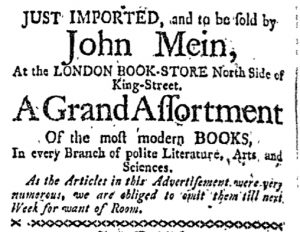
As the Articles in this Advertisement were very numerous, we are obliged to omit them till the next Week for want of Room.”

Bookseller John Mein frequently placed advertisements in Boston’s newspapers (and sometimes publications in other towns) in the 1760s. Even if they had never visited the “LONDON BOOK-STORE North Side of King-Street,” regular readers of the Boston-Gazette would have been familiar with Mein’s marketing efforts. On occasion his advertisements occupied even more space than those inserted by shopkeepers with the most extensive lists of imported merchandise, extending anywhere from an entire column to an entire page. Mein intended to publish another lengthy advertisement in the Boston-Gazette on the first Monday in October 1767, but had to settle for a shorter notice.

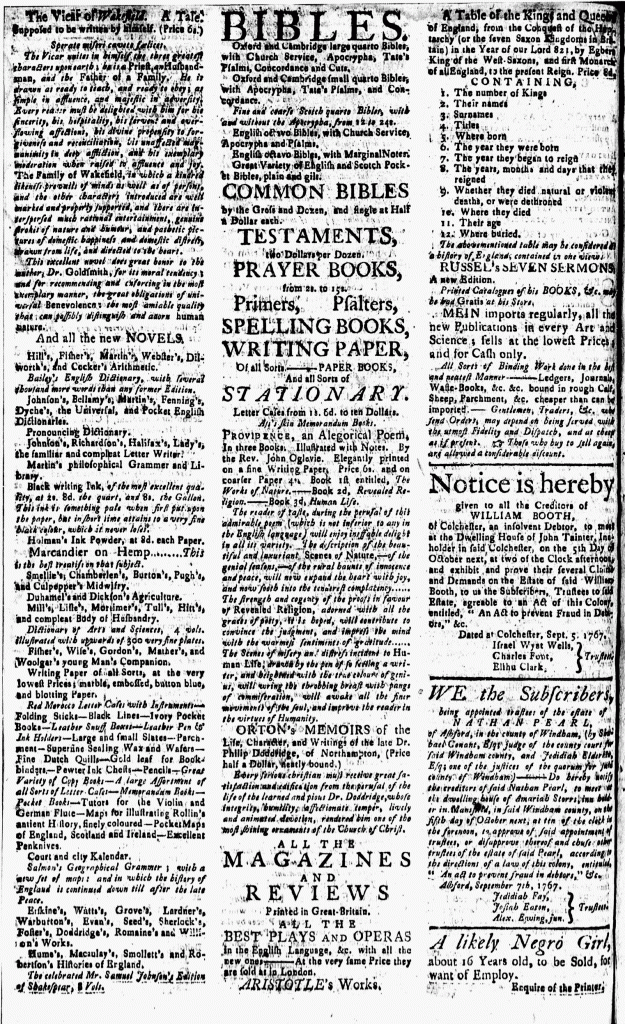
Actually, Mein placed two advertisements in the October 5 issue. One appeared at the top of the third column on the second page, to the right of an open letter “To The People of Boston and all other English Americans,” a letter that argued Parliament had renewed its attempts to reduce the colonies to “perfect slavery.” This relatively short advertisement amounted to a single square, the standard length for most paid notices in that issue. The second advertisement, approximately two squares, appeared in the middle of the third column on the third page, less easy to distinguish among the other notices on the page.

Both advertisements announced that Mein stocked “A Grand Assortment Of the most modern BOOKS, In every Branch of polite Literature, Arts and Sciences” (though the typography differed significantly). The shorter notice also indicated that since “the Articles in this Advertisement were very numerous, we are obliged to omit them till the next Week for want of Room.” The second notice focused primarily on a single volume, a new edition of “Dilworth’s Spelling Book” just published on “fine Paper” with new type. It concluded with a brief note that “Printed Catalogues may be had Gratis at the Store” on King Street. Surely Mein’s catalog included many of the books he meant to advertise in the Boston-Gazette that week had space permitted.

Given the placement of Mein’s advertisements within the newspaper, he may not have submitted two separate notices for publication. Instead, the printers may have created the shorter advertisement, with its announcement anticipating a lengthier list of Mein’s titles in the next issue, and given it a prominent place to compensate for not publishing all of the copy Mein submitted. When the advertisement did appear the following week, it filled an entire page. Given the expense that Mein incurred, the printers may have considered a second advertisement promising more information about Mein’s “Grand Assortment Of the most modern BOOKS” the least they could do when they ran out of space to publish the list in its entirety. After all, they wanted to encourage the bookseller to continue (to pay) to insert lengthy advertisements in their newspaper.

Mein intended to attract attention through the volume of his advertising, yet circumstances prompted the printers to deliver an alternate marketing strategy. They incited interest by temporarily withholding the complete advertisement while simultaneously giving the announcement a prominent place in the publication to increase the number of potential customers who would read it.

September 25

What was advertised in a colonial American newspaper 250 years ago today?

Sep 25 - 9:15:1767 Page 3 New-London Gazette
New-London Gazette (September 25, 1767).

“London BOOK-STORE, North Side of KING-STREET, BOSTON.”

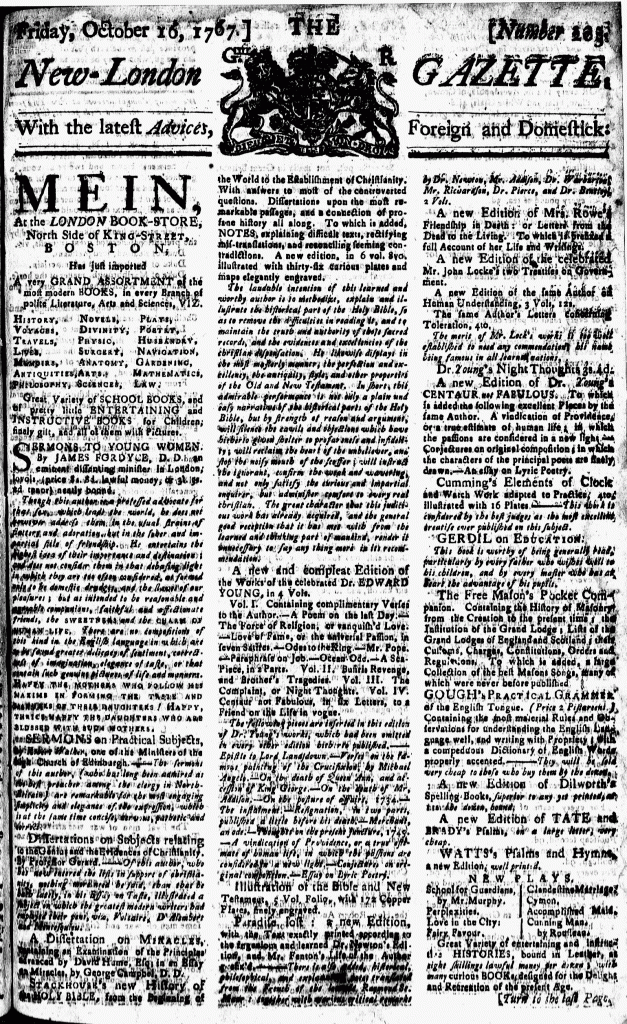
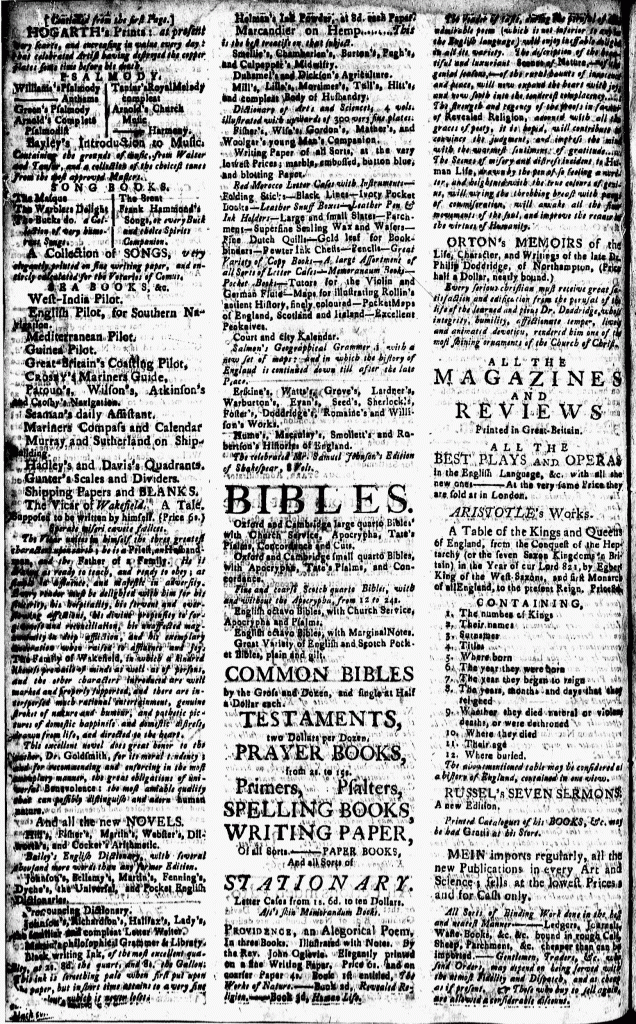
John Mein, prominent bookseller in Boston, placed an extraordinary advertisement in the September 25, 1767, edition of the New-London Gazette. A regular advertiser in Boston’s newspapers, Mein previously experimented with a full-page advertisement in the Massachusetts Gazette two months earlier. The length of his advertisement in the New-London Gazette, however, far exceeded that previous notice: it extended nearly two full pages and amounted to almost half of the entire issue. Mein’s advertisement for “A very GRAND ASSORTMENT of the most modern BOOKS, in every Branch of polite Literature, Arts and Sciences” filled the entire third page and all but the second half of the final column on the fourth page. It took up so much space that Timothy Green, the printer, inserted a notice at the bottom of the second page to assure readers (and advertisers whose notices had been squeezed out to make room for Mein) that “Advertisements omitted will be in our next.” Although not unknown, full-page newspaper advertisements were not common in the 1760s. When they did appear they merited special notice, yet they seemed restrained compared to Mein’s nearly-two-page advertisement.

Sep 25 - 9:15:1767 Page 4 New-London Gazette
New-London Gazette (September 25, 1767).

Mein’s extensive advertisement qualified as exceptional for another reason: he operated the “LONDON BOOK-STORE” on King Street in Boston, yet he supplemented his marketing efforts in local newspapers with a newspaper notice in faraway New London, Connecticut. Retailers frequently acknowledged that they served customers in the hinterlands that surrounded their own cities and towns, but they rarely placed advertisements in newspapers published in other colonies if they had local alternatives. Retailers in Boston, for instance, expected that when they advertised in any of the city’s four newspapers that they would attract customers from other parts of Massachusetts beyond the busy port. They typically did not, however, insert advertisements in newspapers printed in other towns, each with their own hinterlands in other colonies. Mein deviated from standard practices related to newspaper advertising, apparently considering the opportunity to enter new markets worth the investment. He had previously published book catalogs that may have been distributed far beyond Boston. Any customers they generated may have encouraged him to consider advertising in newspapers in distant cities. He acknowledged customers who resided outside Boston in the final paragraph of his advertisement: “Gentlemen, Traders, &c. who send Orders, may depend on being served with the utmost Fidelity and Dispatch, and as cheap as if present.” In his efforts to gain customers from markets beyond Boston, Mein anticipated and addressed potential obstacles that might prevent them from patronizing his business.

August 23

What was advertised in a colonial American newspaper 250 years ago this week?

Aug 23 - 8:17:1767 New York Gazette
New-York Gazette (August 17, 1767).

“They will be presented to the Publick in a Catalogue.”

Garret Noel continued to stock “A Very extensive Assortment of Books” nearly a month after his advertisement concerning a shipment that just arrived on the Amelia first appeared in the July 20, 1767, edition of the New-York Gazette. That the second line of his notice, proclaiming that he “Has this Day receiv’d” new inventory, was slightly outdated mattered little compared to two other aspects of the advertisement.

Noel, a prolific advertiser, informed potential customers that his “extensive Assortment of Books” covered a wide variety of topics, including “History, Divinity, Law, Physic, [and] Poetry.” In fact, he now carried so many new books that they were “too numerous” to list all the titles in newspaper advertisements. Instead, he resorted to another medium, a book catalog printed separately and often distributed free of charge as a means of inciting demand. Noel indicated that his catalog was “publishing with all the speed possible.” No extant copy exists, but that does not mean that Noel’s catalog never made it to press. According to the American Antiquarian Society’s online catalog, Noel previously published four other catalogs in 1754/55, 1755, 1759, and 1762. The partnership of Noel and Hazard later published a catalog in 1771. Perhaps Noel never printed the catalog promised in this advertisement but instead suggested that it existed as a means of luring potential customers to his shop, but the evidence suggests a fairly good chance that he did indeed publish this marketing tool to supplement his frequent newspaper advertisements. While fairly complete collections of many eighteenth-century newspapers have survived into the twenty-first century, other printed materials have not. Newspaper advertisements suggest that many more book catalogs likely circulated in the eighteenth century than can be found in archives today.

While awaiting publication of the catalog, Noel also informed existing customers who had placed orders that they could send for them. This announcement did matter more at the time the bookseller originally inserted the advertisement in the New-York Gazette. With a new shipment that had just arrived he likely had not yet had time to send notices to every customer awaiting an order. An announcement in the newspaper presented an opportunity for eager customers to obtain their purchases as quickly as possible (and potentially saved the bookseller time and energy in contacting customers individually). That this portion of Noel’s notice continued to run for so many weeks also served to inform potential customers that they could also submit special orders.

Garret Noel offered two forms of customer service intended to cater to consumers and convince them to purchase his merchandise. He distributed a catalog detailing his “Very extensive Assortment of Books,” introducing potential customers to titles they may not have previously considered. He also accepted orders and informed clients as soon as they arrived, exhibiting how eagerly he sought to serve his patrons.

July 16

What was advertised in a colonial American newspaper 250 years ago today?

Jul 16 - 7:16:1767 Massachusetts Gazette
Massachusetts Gazette (July 16, 1767).

“Just imported and to be Sold by John Mein At the LONDON BOOK-STORE.”

John Mein regularly advertised in the Massachusetts Gazette in 1767. He also advertised in the Boston Evening-Post, the Boston-Gazette, and the Boston Post-Boy. With so many local publications carrying news and advertising to local consumers, he increased the likelihood that potential customers would be exposed to his advertisements.

The length of Mein’s advertisements may have also drawn attention. Shopkeepers frequently placed advertisements that extended half a column or more, but rarely did they exceed a single column. Mein, however, inserted advertisements that overflowed into second and sometimes even third columns. The variable length of his advertisements suggests that he may have submitted extensive sample advertisements to newspaper offices with an understanding that they would include as much as possible but truncate them to fit the space available. In such cases, printers and compositors would have played a role in editing advertising copy even though they were not responsible for generating it.

This particular advertisement may have also drawn attention because it covered almost the entire front page of the July 16 edition of the Massachusetts Gazette, almost squeezing out a notice for a “Variety of Millenary Goods” at the lower right. Its placement may seem strange considering the importance associated with front-page news in the twentieth and twenty-first centuries, but it also demonstrates the evolution in journalism practices and consumption practices. Neither publishers nor readers engaged with newspapers and their content in quite the same way in the eighteenth century that they have in time since then.

Early Americans expected (or at least would not have been surprised) to encounter major news stories nestled within the inner pages of any given issue. Taking into consideration the production of the July 16 edition helps to demonstrate what that was the case. A four-page issue, it resulted from printing two pages on each side of a broadsheet and then folding it in half. The first and fourth pages, comprised entirely of the masthead and advertisements the printer received well in advance (and most of them already set in type for previous issues), were printed first. Only after they dried were the second and third pages printed on the other side. In this case, those pages included the news content for the issue, including items dated the date before and the day of publication.

To modern eyes, John Mein’s (nearly) full-page advertisement on the front page of a newspaper may seem extraordinary. Its lengthy certainly merited notice in the eighteenth-century, but contemporary readers may not have been especially surprised by its placement. That it appeared on the front page just would not have resonated as being all that significant for readers accustomed to seeing advertising, rather than news, immediately under the masthead.

July 13

What was advertised in a colonial American newspaper 250 years ago today?

Jul 13 - 7:13:1767 Connecticut Courant
Connecticut Courant (July 14, 1767).

“The following BOOKS.”

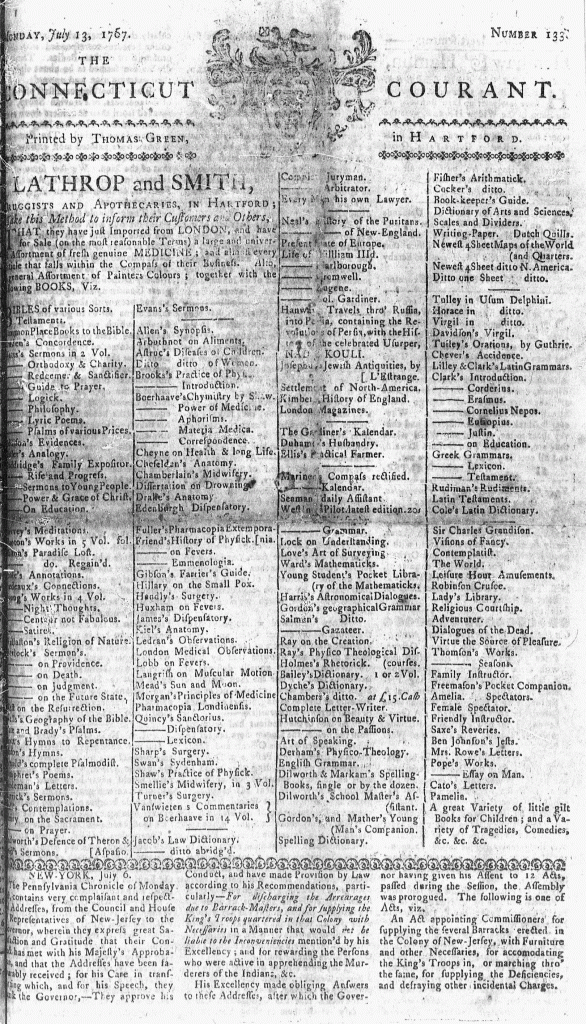
Compared to newspapers published in major port cities in the 1760s, Hartford’s Connecticut Courant included relatively little advertising. Even compared to other newspapers from smaller towns (such as Savannah’s Georgia Gazette, Portsmouth’s New-Hampshire Gazette, and the New-London Gazette) the amount of space the Connecticut Courant devoted to commercial notices and other sorts of paid advertisements was modest, usually limited to a few short items on the final page or scattered throughout an issue.

This aspect of Thomas Green’s newspaper made Lathrop and Smith’s advertisement particularly striking and unexpected. In addition to promoting the “large and universal Assortment of fresh genuine MEDICINE” they had just imported from London, the apothecaries also listed scores of books they sold. Their advertisement extended across the entire page, divided into four columns (rather than three columns throughout the rest of the newspaper) in order to squeeze in as many titles as possible.

Jul 13 - 7:13:1767 Front Page Connecticut Courant
Front Page of the Connecticut Courant (July 13, 1767).

In addition to its length, Lathrop and Smith’s advertisement dominated the front page of the Connecticut Courant; it hardly could have escaped the notice of subscribers and other readers. It also would have been readily visible to anyone who observed someone reading the newspaper, especially if it was held aloft while perusing the items in the center pages. Except for the masthead at the top and a snippet of news relayed from New York at the bottom, the apothecaries’ advertisement filled the entire first page.

Lathrop and Smith almost certainly were familiar with the standards and conventions of newspaper advertising in Hartford, yet they likely also read newspapers from Boston and New York, at least occasionally, since eighteenth-century newspapers tended to circulate far beyond their places of publication. Certain booksellers, especially John Mein in Boston and Garret Noel in New York, frequently placed lengthy advertisements listing the titles they stocked. With those notices and others as models of what was possible when it came to newspaper advertising, Lathrop and Smith devised their own marketing efforts accordingly. Their advertisement more closely replicated those placed by their counterparts in other cities than the usual notices for consumer goods and services in their local newspaper. They designed an advertisement considered appropriate and effective among others who pursued the same occupation.

July 6

What was advertised in a colonial American newspaper 250 years ago today?

Jul 6 - 7:6:1767 Boston-Gazette
Boston-Gazette (July 6, 1767).

“At the London BOOK-STORE.”

Bookseller John Mein regularly advertised in Boston’s newspapers in the 1760s, often inserting lengthy advertisements that extended over multiple columns or even filled an entire page. Yet newspaper notices were not the only marketing media utilized by Mein and other eighteenth-century booksellers. They also used broadsides and catalogs to inform potential customers of the titles they sold.

To promote the “Grand Assortment of the most MODERN BOOKS, In every Branch of Polite LITERATURE, ARTS, and SCIENCES” at his “LONDON BOOK-STORE,” Mein distributed a small broadside in 1766. Measuring 20 x 13 cm (8 x 5 in), it could have been posted around town or passed out as a handbill. Unlike his newspapers advertisements, the broadside did not include titles of many books. Instead, Mein listed more than two dozen genres that might interest readers, from Divinity and Philosophy to Travels and Voyages to Anatomy and Midwifery. Potential customers need to visit his shop to discover which titles he stocked.

Jul 6 - Mein Broadside
John Mein’s broadside advertisement (Boston: 1766). Courtesy American Antiquarian Society.

Mein adopted the opposite strategy in the fifty-two-page “CATALOGUE OF CURIOUS and VALUABLE BOOKS” he distributed the same year, listing (and numbering) 1741 different titles. For some, particularly bibles and prayer books, he also described the material aspects of the books, such as “Baskerville’s large Octavo Prayer-Book, bound in red Morocco, gilded” (#1734) and “Tate and Brady’s Psalms, fine Paper, bound in Morocco and Calf, gilded” (#1739). Mein used two different methods in categorizing his books. The first 367 were organized by size: octavo or folio. The remainder, however, fell under subject headings similar to those listed on the broadside. Under certain headings, some books were further demarcated by size. The bookseller aimed to help readers find books that corresponded to their interests, their budgets, their preferences for storing them, and their tastes for displaying them.

Mein’s newspaper advertisement melded aspects of his broadside and catalog, listing multiple titles under several categories. He also added a blurb to promote one book, Oliver Goldsmith’s The Vicar of Wakefield. Lest potential customers not see any books that interested them, Mein concluded by stating that he “has for Sale a grand Assortment of the best AUTHORS in evry Art and Science, and in every Branch of polite Literature.” Like other eighteenth-century booksellers, he experimented with media and organization in his efforts to market his wares. His advertising may have helped to fuel a reading revolution as colonists’ habits veered from intensive reading of devotional literature to extensive reading of many genres, including novels.

June 30

What was advertised in a colonial American newspaper 250 years ago today?

Jun 30 - 6:30:1767 South-Carolina Gazette and Country Journal
South-Carolina Gazette and Country Journal (June 30, 1767_.

“Compleat Assortment of Stationary Ware, consisting of almost every Article in that Branch.”

George Wood, “STATIONER and BOOKBINDER in Elliott-street” in Charleston, adopted many of the marketing appeals most frequently used by merchants and shopkeepers who sold dry goods and housewares in eighteenth-century America. In particular, he emphasized consumer choice when he noted that he stocked “a very large and compleat Assortment of Stationary Ware” and then listed dozens of specific items. His inventory included everything from the basics, like “Writing Paper of all Kinds” and “best London Ink Powder,” to specialty items, like “large Ink Pots for Compting-Houses” and Surveyors Pocket Cases of Instruments.” To guarantee that potential customers did not assume that he sold only the items listed in his advertisement, Wood concluded his list with “&c.” (the eighteenth-century abbreviation for et cetera), allowing readers to conjure up images of other stationery wares that might be in Wood’s shop.

He followed a similar strategy in listing books he had for sale, listing some of the most popular titles before making nods toward general categories, such as “a great Variety of small Picture Books for Children” and “a great Variety of Song Books.” Just in case readers did not notice particular titles they desired, Wood doubled down on his appeal to consumer choice: “He has likewise to dispose of, upwards of One Thousand Volumes of curious Books, consisting of Histories, Voyages, Travels, Lives, Memoirs, Novels, Plays, &c.” The bookseller had something for every taste and interest. Customers just needed to visit his shop and explore the shelves to find the books they wanted.

Wood realized schoolmasters in particular would likely be interested in the variety of titles he stocked, especially spelling and math books. He indicated that some volumes were intended “for the use of Schools.” To encourage instructors to choose from among his selection, Wood offered discounts if they would “take a Quantity” to distribute among their students.

By offering such a “large and compleat Assortment” of stationery, writing supplies, and books, Wood encouraged customers of all sorts to visit his shop. Providing a list of merchandise not only underscored consumer choice but also allowed him to identify specific types of customers with particular interests or specialized needs. His advertisement addressed the general interests of colonial readers, but also marketed certain wares to several occupational groups.

May 22

What was advertised in a colonial American newspaper 250 years ago today?

May 22 - 5:22:1767 New-Hampshire Gazette
New-Hampshire Gazette (May 22, 1767).

Fraught with Entertainment.”

Daniel Fowle and Robert Fowle, the printers of the New-Hampshire Gazette, also sold books that they imported from England or exchanged with other printers in the colonies. Their advertisement filled an entire column and nearly half of another on the final page of the May 22, 1767, issue of the New-Hampshire Gazette. Such lengthy advertisements were not uncommon for printers and booksellers, but the length of this one resulted from an innovative format not featured in most newspaper notices. Printers and booksellers usually followed one of two standard practices when advertising books. Either they provided a list of titles for sale, a catalog of sorts, or they marketed a single volume via lengthy explications of the contents and their practical usefulness for readers.

The Fowles did a little bit of each but more in this advertisement. They included a short list of additional titles at the conclusion, but first they described several books in chatty blurbs that took a very different tone than most advertisements for books inserted in newspapers in the 1760s. The Fowles aimed to entertain readers rather than strictly instruct them (though a heavy dose of instruction was still embedded in their marketing), offering an alternate rationale for why consumers should purchase their wares.

Consider, for example, the description of “The Clandestine Marriage, A COMEDY: As it is acted at the Theatre Royal in Drury Lane.” According to the blurb, the play was “fraught with Entertainment. Some of the Scenes are truly comic, others inculcate the strictest Morality.” It also included a description of the characters, including “the conceited, infirm, and antiquated yet generous Lord Ogleby – the vulgar, money loving Sterling – the sensible Lovewell – the sycophant Canton – the impudent Brush – Mrs. Heidelberg the Dutch Widow, an ignorant Pretender to Quality Mannersthe pert, spiteful Miss Sterling, displaying in reality the modern fine Lady, and the amiable, gentle, and delicate Miss Fanny – who altogether form a Group that must afford greta [sic] Entertainment to every Reader.” In addition, the Epilogue, in particular, was “very remarkable for its Singularity and Humour.”

This shift in tone, telling readers that they would be entertained as well as receive moral instruction, made sense as part of the reading revolution that took place in the eighteenth century. Reading habits experienced a transition from intensive reading of the bible and devotional literature to more extensive reading of works of all sorts for entertainment. The Fowles demonstrate that one mode of reading did not simply replace the other. Instead, they framed several of their books to appeal to whichever purpose their customers wished to achieve in their reading habits.

May 8

What was advertised in a colonial American newspaper 250 years ago today?

May 8 - 5:8:1767 New-Hampshire Gazette
New-Hampshire Gazette (May 8, 1767).

“As neat as any in Boston.”

John Edwards, a “BOOKBINDER and STATIONER from BOSTON,” sold a variety of books as well as writing supplies at his shop on Queen Street in Portsmouth, New Hampshire. Edwards did not describe himself as a bookseller, even though he devoted approximately half of his advertisement to listing some of the titles he carried. Throughout the eighteenth century members of the book trades often specialized in one trade yet supplemented their incomes by taking on some responsibilities more closely associated with other aspects of book production and distribution. Both printers and bookbinders, for instance, commonly sold books that they had not printed or bound.

By trade and training, Edwards may have considered himself first and foremost a bookbinder, taking pride in the unique skills mastered in that occupation. Yet the demand for bookbinding services in the town of Portsmouth likely made it impossible to earn his living solely from that trade. Considering that Edwards had relocated from Boston at some point, competition among bookbinders for the business of a finite number of potential customers, even in that bustling port, may have prompted him to seek out other opportunities in the neighboring colony. Fewer bookbinders resided in Portsmouth, but so did fewer potential customers. In the face of less demand for the services of bookbinders, Edwards sold consumer goods related to his trade – books and writing materials – to generate additional revenues. He likely bound some of his imported books to the taste and budget of those who purchased them.

Edwards attempted to mobilize his Boston origins to his advantage. He proclaimed that he bound “all sorts of Books” and made “Account Books of any size, as neat as any in Boston.” Having lived and worked in that city, Edwards was qualified to testify to the quality of the bookbinding done there and assess his own work in comparison. He pledged to potential customers that his work was comparable to what they would find in a larger and more distinguished market, assuring them that its quality was comparable to what they would find in the urban center that most immediately commanded their attention when making comparisons. Similarly, advertisers in Boston favorably compared their wares and workmanship to what was produced in London. Colonists looked to the next larger market for validation as they shaped their own practices of consumption.