March 8

What was advertised in a colonial American newspaper 250 years ago this week?

mar-8-381767-part-1-south-carolina-and-american-general-gazette

mar-8-381767-part-2-south-carolina-and-american-general-gazette
South-Carolina and American General Gazette (March 6, 1767).

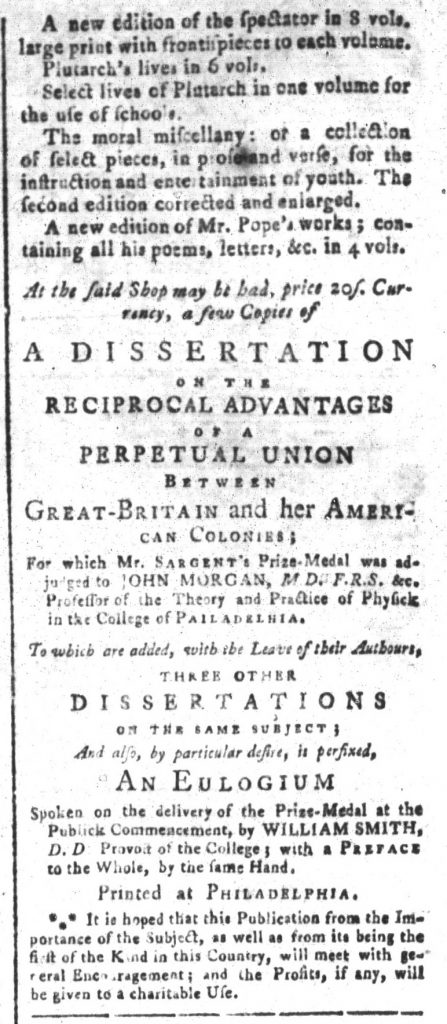
“A DISSERTATION ON THE RECIPROCAL ADVANTAGES OF A PERPETUAL UNION BETWEEN GREAT BRITAIN and her AMERICAN COLONIES.”


Robert Wells stocked a variety of items at “the great Stationary and Book Shop on the Bay” in Charleston. Among the wares he imported from England, he first listed “LARGE and elegant prints of Mr. PITT and LORD CAMDEN,” members of Parliament considered friendly to the American cause during the Stamp Act crisis. Wells concluded this advertisement by devoting significant space to a book printed in Philadelphia, a volume which included four “DISSERTATIONS” on the “RECIPROCAL ADVANTAGES OF A PERPETUAL UNION BETWEEN GREAT-BRITAIN and her AMERICAN COLONIES.” The first, authored by John Morgan, won “Mr. Sargent’s Prize Medal,” awarded at commencement exercises for the College of Philadelphia (now the University of Pennsylvania).

This advertisement provides valuable insight concerning how most colonists interpreted their relationship with Great Britain in the first months of 1767, still fairly early in the imperial crisis that eventually – over the course of more than a decade – led to the colonies declaring independence. One of the challenges of teaching about the American Revolution lies in helping students understand that it was not an instantaneous event but rather a long process that involved a transition from resistance to Parliamentary overreach while seeking redress of grievances to, eventually, revolutionary rhetoric and actions when Americans determined that they had exhausted all other options.

In early 1767 continued to underscore the “RECIPROCAL ADVANTAGES” of being part of the British Empire. In his “DISSERTATION,” Morgan ranked commerce and trade among some of the most significant advantages. By this time the Stamp Act had been passed and repealed, in large part due to the protests and petitions of the colonists but also thanks to advocacy by merchants and politicians, like Pitt and Camden, in England. The Americans had discovered means for having their grievances addressed, though they did not particularly care for the Declaratory Act that accompanied repeal of the Stamp Act. Still, the rupture in relations did not seem insurmountable. Indeed, most Americans believed it foolish not to attempt to make amends.

The “DISSERTATIONS” written and published in Philadelphia served to cement colonists’ understanding of their place and privileges within the British Empire, but they also reminded English observers of the benefits of amicable relations between parent country and colonies. This publication simultaneously shored up British identity among colonists while alerting those in England that it was not in anyone’s best interest to attempt to take advantage of the colonies, a warning that Parliament did not heed when it promulgated the Townshend Acts later in 1767.

Return once again to the prints of Pitt and Camden that led the list of goods Wells stocked. They set the tone for the rest of the advertisement, especially the “DISSERTATIONS” that appeared at the end. Colonists considered themselves Britons, so much so that Wells expected consumers would display images of English politicians – especially those who understood and advocated for the proper sort of relationship between Great Britain and the American colonies – in public and private spaces. Most Americans had not yet been radicalized in favor of independence in early 1767, at least not according to the merchandise Robert Wells expected to sell at his shop in Charleston.

February 16

What was advertised in a colonial American newspaper 250 years ago today?

feb-16-2161767-boston-evening-post
Boston Evening-Post (February 16, 1767).

Any of those with this Mark (*) may be had by the Dozen, at a small Advance.”

Like other colonial booksellers, M. Williams imported from London most of the “good Assortment of Books” he sold. His newspaper advertisements amounted to miniature catalogs that listed dozens of titles. In most regards, his notice looked little different from those published by his competitors. To make it easier for potential customers to read and identify items of interest, each title occupied its own line. To increase the number of titles that could be listed, the advertisement was divided into two columns, making it dense yet still readable. Williams also hawked a variety of other goods (“Stationary Wares,” including paper, inkpots, quills, penknives, and sealing wax) and services (blank books made and ruled and “old Books new bound”).

In one regard, however, Williams’ advertisement differed from most others. A printing ornament preceded the majority of titles. Williams explained its meaning in a nota bene that concluded his notice: “Any of those with this Mark (*) may be had by the Dozen, at a small Advance.” This reveals that the bookseller did not operate merely as a retailer of individual books one at a time but instead sold in volume to others that then retailed the books themselves.

Given that Williams’ shop was in Salem, he most likely did not intend his advertisement to address readers of the Boston Evening-Post who resided in Boston itself. After all, residents of Boston could conveniently purchase “Books and Stationary Wares” from several local printers and booksellers. Instead of soliciting their patronage, Williams depended on the dissemination of the Boston Evening-Post throughout the city’s hinterland, which included Salem as well as smaller towns and villages. While some of the books he stocked would have been appropriate for schoolmasters to purchase in volume, Williams likely anticipated that others might find their way into shops in surrounding villages, where they would supplement other sorts of merchandise. Stressing that he sold books by the dozen may have allowed him to capture some of the market among these shopkeepers that otherwise prominent printers and booksellers in Boston would have dominated.

February 1

What was advertised in a colonial American newspaper 250 years ago this week?

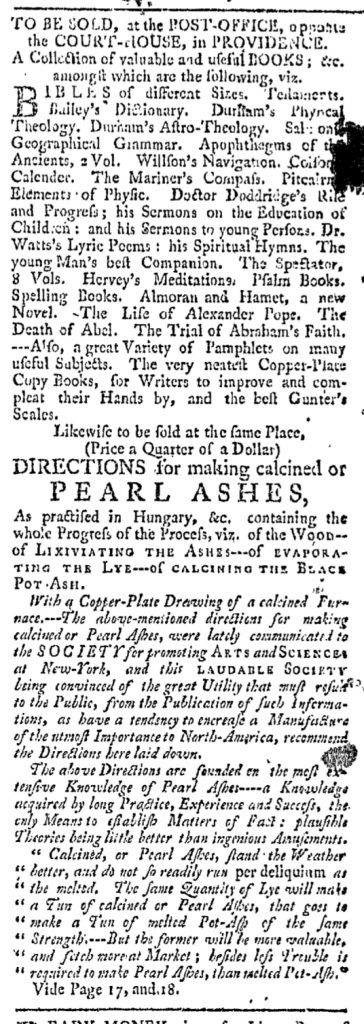
“TO BE SOLD, at the POST-OFFICE … A Collection of valuable and useful BOOKS.”

feb-1-1311767-providence-gazette
Providence Gazette (January 31, 1767).

The methodology that guides the Adverts 250 Project sometimes makes it difficult to choose which advertisement to feature on certain days. Each advertisement must have been published 250 years ago that day. If no newspapers were printed in colonial America on any particular date, then the advertisement should come from the most recently published newspaper available anywhere in the colonies. This means that there are days – Thursdays in 2017 (Mondays in 1767) and Sundays in 2017 (Thursdays in 1767) – for choosing among multiple newspapers from colonial America’s largest urban ports, many overflowing with advertisements to the point that they sometimes issued supplements to contain then all.

On other days, however, only one newspaper was published anywhere in the colonies. For Fridays (Mondays in 1767) the project draws from South-Carolina and American General Gazette, on Saturdays (Tuesdays in 1767) from the Georgia Gazette, and on Tuesdays (Saturdays in 1767) from the Providence Gazette.

Note that the Providence Gazette was the only colonial American newspaper published on Saturdays in 1767. Recall that no newspapers were printed on Sundays. That means that on Wednesdays in 2017 (Sundays in 1767), featured advertisements must come from the Providence Gazette. As a result, this methodology privileges the Providence Gazette, a newspaper from a smaller port, over its counterparts in larger and busier cities. The Providence Gazette did not include nearly as many advertisements as the four newspapers printed in Boston, four others in New York, three in Philadelphia, and three in Charleston. This greatly constrains the choices when selecting which advertisements to feature on the Adverts 250 Project.

It does not help that the methodology also asserts that advertisements should not be featured twice, though exceptions can be made to demonstrate significant aspects of marketing practices in eighteenth-century America. Such is the case today. The featured advertisement previously appeared in the Providence Gazette on multiple occasions, sometimes as a single advertisement and other times divided into two parts. The few advertisements in the January 31 issue all appeared in earlier editions.

jan-31-providence-gazette
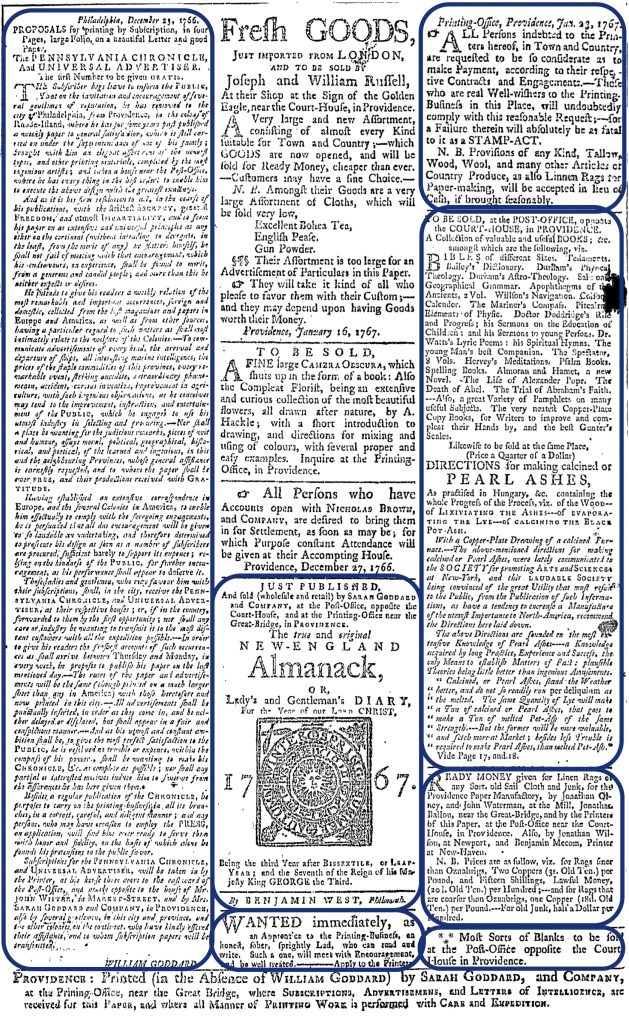
Advertisements inserted by the printers on the final page of the Providence Gazette (January 31, 1767).

Examining those advertisements to make that determination yields an interesting revelation: the printers of the Providence Gazette occupied most of the advertising space on the final page. This includes William Goddard. After all, the colophon indicates that the newspaper was “Printed (in the Absence of WILLIAM GODDARD) by SARAH GODDARD, and COMPANY.”

This gives that impression that the Providence Gazette may have been struggling to attract advertisers in 1767, unlike its counterparts in other larger port cities. Even the new Pennsylvania Chronicle, promoted in one of the advertisements inserted by the printers of the Providence Gazette in their own publication, ran copious advertisements within its first month. Sarah Goddard and Company made an editorial decision to fill the final page of their newspaper with advertisements, even if they were their own notices. In comparison, other printers in smaller towns opted to print news items almost exclusively and forego similar amounts of advertising. Such decisions merit additional investigation as the Adverts 250 Project continues.

January 8

What was advertised in a colonial American newspaper 250 years ago today?

jan-8-181767-massachusetts-gazette
Massachusetts Gazette (January 8, 1767).

“Books for Children, very proper for Christmas and New Year’s Gifts.”

John Mein made a fairly unique appeal to potential customers when he advertised “A Large Assortment of entertaining and instructive Books for Children, very proper for Christmas and New Year’s Gifts.” The bookseller tied consumerism to the holidays in a way that few other advertisers did in late 1766 and early 1767, which differs significantly from marketing practices in the twentieth and twenty-first centuries. Very few advertisers acknowledged Christmas as a holiday, much less used it to promote purchases from their shops. Recognition of the new year manifested itself in advertising mostly through calls for those who previously bought on credit to settle accounts. Indeed, only a handful of advertisers linked the holidays to making purchases and giving gifts.

As with many other aspects of marketing, members of the book trade seemed to be at the forefront of this innovation. Throughout all of the advertisements placed in newspapers during December 1766 and early January 1767, booksellers alone encouraged customers to think of their wares as gifts for others. In an advertisement in the January 8, 1767, issue of the New-York Journal bookseller Garrat Noel listed “A very large Parcel of Mr. Newberry’s beautiful gilt Picture Books, for the Entertainment of his old Friends the pretty Masters and Misses of New-York, at Christmas and New-York.” The appropriately named Noel was a veteran of promoting holiday gifts, having noted in his advertisements a year earlier that it was “his annual Custom … to offer to the Public, the following List of Books, as proper for Christmas Presents and New-Year’s Gifts.”

John Mein further advanced this innovation, anticipating marketing strategies of the late nineteenth century and beyond. He announced that potential customers could pick up free “Printed Catalogues” listing the books he considered especially suited to be given as gifts. Retailers of all sorts eventually resorted to catalogs, especially Christmas catalogs, to drive sales during a season increasingly associated with consumerism.

In the 1760s, however, the media – both printers and advertisers – took little notice of the Christmas season. On the same day that Mein’s advertisement appeared in Boston and Noel’s in New York, the first page of the Virginia Gazette featured “An ODE upon CHRISTMAS” on the front page. It was dated December 4, 1766, but the printers did not consider it pressing enough to make room for it in their newspaper until five weeks later. The Christmas holiday did not dominate December in the 1760s to the extent it does in modern America.

September 14

What was advertised in a colonial American newspaper 250 years ago this week?

sep-14-9131766-providence-gazette
Providence Gazette (September 13, 1744).

“Likewise to be sold at the same Place …”

Most readers of the Providence Gazette in 1766 probably would not have paused to question if this constituted one advertisement or two separate advertisements. For historians of printing and/or advertising interested in quantifying and analyzing the number of advertisements that appeared in colonial newspapers, on the other hand, it raises a conundrum.

At first glance, it appears to be a single advertisement, especially since the phrase “Likewise to be sold at the same place” functions as a transition from a list of books for sale to a more elaborate description of a particular book sold by the same advertiser. However, the two halves of this advertisement appeared separately, in different columns, in the previous issue. The list of books appeared at the bottom of a column and the advertisement for the pamphlet on making pearl ashes was at the top of the next column. This would have had the effect of presenting them sequentially to anybody who read the newspaper from first page to last, even through they were spatially separated. The printer likely intended them to be distinct, yet related advertisements. Still, the absence of a line separating them when they appeared one above the other (the same sort of line that defined the boundaries of other advertisements that appeared in the issue) serves as a visual cue indicating a single advertisement.

For the most part, it doesn’t much matter if this was one advertisement or two, though it does demonstrate that printers were able to leave some content (namely advertisements) in their forms and move them around to fit their needs from issue to issue.

Still, this presents a frustrating situation for certain research questions. For other projects I have attempted to count the number of advertisements placed by members of the book trade as a proportion of total advertisements. This example, if counted only once, downplays the influence of printers and booksellers on eighteenth-century advertising, especially considering its length relative to other advertisements in the same issue. This suggests that tabulating column inches would be a better method for making such assessments, but that method would be much more labor intensive (not necessarily a good justification for not doing it) as well as impossible to do with microfilmed and/or digitized sources that do not include measurements among the metadata (a better explanation for not measuring column inches). For researchers that do not have access to the original newspapers, tabulating column inches simply would not be possible. Counting how many advertisements appeared, while flawed, at least allows for some sort of metrics when working with surrogates rather than original sources.

June 30

What was advertised in a colonial newspaper 250 years ago today?

Jun 30 - 6:30:1766 New-York Mercury
New-York Mercury (June 30, 1766).

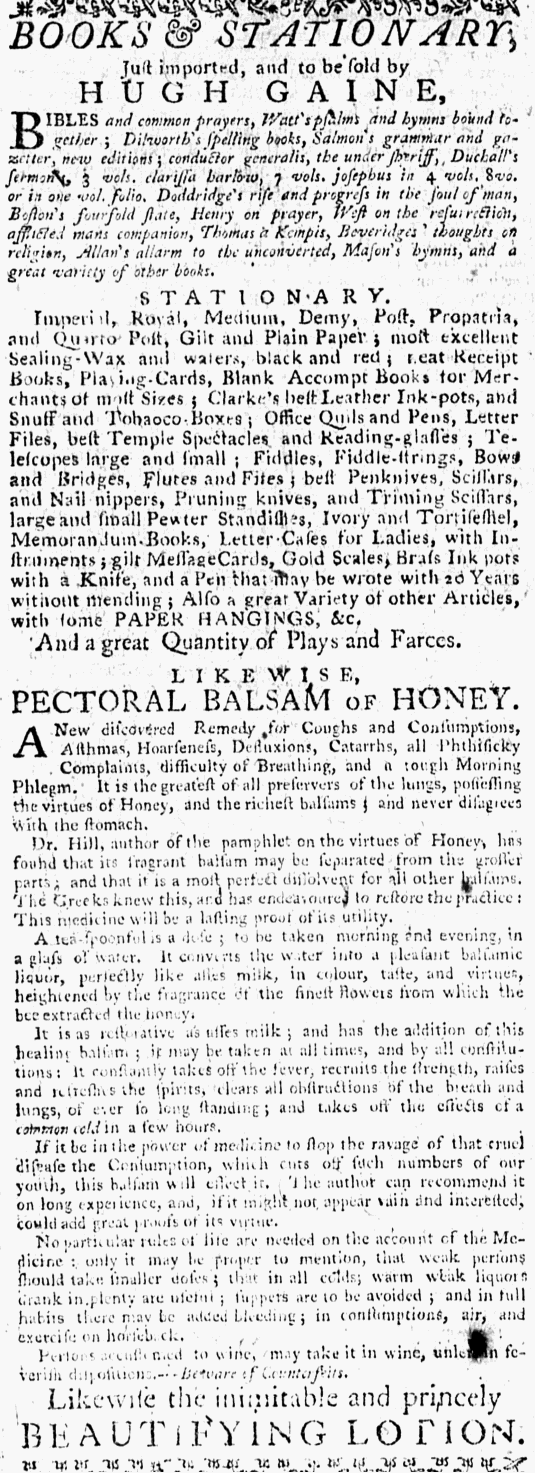
“BOOKS & STATIONARY, Just imported, and to be sold by HUGH GAINE.”

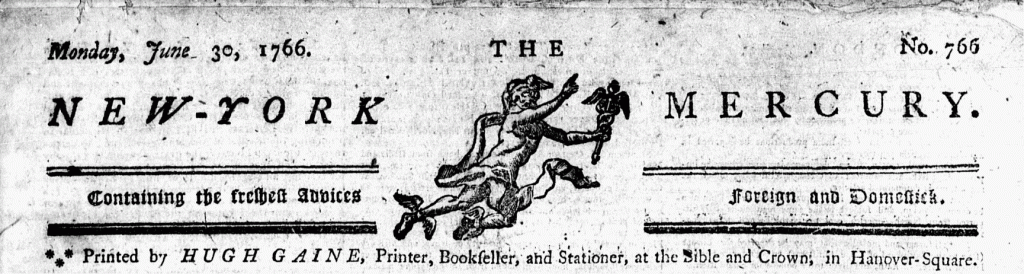
Hugh Gaine printed the New-York Mercury, though it is clear from the masthead that he considered himself more than just a printer. He listed his occupations as “Printer, Bookseller, and Stationer.” In that regard, Gaine was not much different from other printers who published newspapers in colonial America. They often supplemented the income from operating the newspaper by selling a variety of other products and services associated broadly with the book trades.

Gaine devised a headline for his advertisement, which was not a standard practice but also not unknown. He announced that he sold “BOOKS & STATIONARY,” merchandise associated with the book trades. Upon closer examination of his advertisement, however, potential customers would have discovered that in addition to books, stationery, and writing supplies (including “Leather Ink-pots,” “most excellent Sealing-Wax,” and “Office Quils and Pens”), he also sold “a great Variety of other Articles,” including musical instruments, telescopes, and paper hangings (what we would today call wallpaper). Gaine stocked a good deal of merchandise beyond the newspaper he printed.

Setting aside those items, half of his lengthy advertisement promoted a patent medicine, the pectoral balsam of honey, and concluded with a “BEAUTIFYING LOTION.” (One of the benefits of printing the newspaper must have been inserting his own advertisements of whatever length he wished.) Gaine may or may not have written the copy for this portion of the advertisement; he may have copied it directly from other promotional materials sent to him by the suppliers of this remedy. It may seem strange today that a “Printer, Bookseller, and Stationer” peddled patent medicines in the eighteenth century, but Gaine was certainly not the only one who did so. A variety of printers and booksellers included a few lines devoted to patent medicines in their book catalogues, demonstrating that they really diversified the merchandise they offered to customers.

Jun 30 - 6:30:1766 Masthead New-York Mercury
Masthead for the New-York Mercury (June 30, 1766).

May 20

What was advertised in a colonial newspaper 250 years ago this week?

May 20 - 5:19:1766 Boston Evening-Post
Boston Evening-Post (May 19, 1766).

“CATALOGUES to be had gratis at the London Book-Store.”

Bookseller John Mein published an advertisement that offered to deliver and distribute another advertising medium to potential customers: his book catalogue. Residents of Boston could pick up a free catalogue “at the London Book-Store, a few Days before the Sale.” While they were there, they could also examine the books, stoking their anticipation of the auction scheduled to take place at the end of the month. Mein also offered to send catalogues to potential customers who lived in the city’s hinterland. (Mein addressed them as “GENTLEMEN in the COUNTRY,” though women read books too.)

May 20 - Catalog Cover
John Mein, A Catalogue of Curious and Valuable Books, To Be Sold at the London Book-Store (Boston:  William McAlpine(?), 1766).  American Antiquarian Society.

Some early American bookseller’s catalogues have been lost over the years, but Robert B. Winans has compiled A Descriptive Checklist of Books Catalogues, Separately Printed in America, 1693-1800 that includes 278 catalogues still extant.[1] In addition, Winans identified eight others not extant but for which good evidence can be found that they were printed, 138 other unlocated catalogues, and 265 references to additional unlocated catalogues from another bibliographer’s American Book Auction Catalogues. Though less than half have survived, book catalogues were a common marketing medium in eighteenth-century America.

May 20 - Catalog Interior
John Mein, A Catalogue of Curious and Valuable Books, To Be Sold at the London Book-Store (Boston:  William McAlpine(?), 1766).  American Antiquarian Society.
May 20 - Catalog Final Page
John Mein, A Catalogue of Curious and Valuable Books, To Be Sold at the London Book-Store (Boston:  William McAlpine(?), 1766).  American Antiquarian Society.

Here’s the main body of Winan’s entry for the catalogue mentioned in today’s advertisement:

Bookseller’s catalogue: total of 1741 consecutively numbered short author entries, 367 in the first catalogue , arranged by format, and 1375 (numbers 368-1741) in the second, arrangement not consistent, partly by format and partly by subject. Subject headings: [miscellaneous]; classics; law; physic and surgery; books of entertainment (the largest group); divinity; tragedies; comedies and operas; pretty little books for children; magazines; political pamphlets, poems, &c.; maps; Bibles, prayerbooks, &c. Date: Mein advertised the catalogue in the Boston Evening-Post, May 19, 1766.

**********

[1] Robert B. Winans, A Descriptive Checklist of Book Catalogues Separately Printed in America, 1693-1800 (Worcester: American Antiquarian Society, 1981).

April 12

GUEST CURATOR:  Kathryn J. Severance

What was advertised in a colonial newspaper 250 years ago this week?

Apr 12 - 4:11:1766 New-Hampshire Gazette
New-Hampshire Gazette (April 11, 1766).

“TO BE SOLD … the following BOOKS.”

This advertisement sold different types of books, from Bibles (“royal Families Bibles”) to history books and geography (“Histories of the late War” and “History of Austria”), a science book (“Winkler’s natural Philosophy”), and sets of books about warfare (“Sieges and Battles”) to novels. (Skome also sold Stoughton’s Elixir, a patent medicine.)

The advertisement also mentions “Stackhouse’s Life of Christ, Folio.” In today’s world, “folio” refers to the page numbers that appear in books. However, in the eighteenth century, a folio was a type of book that was larger than average and also more expensive, made of a piece of paper that had been folded just once, resulting in two pages. Other book sizes included quartos, octavos, and duodecimals. Quartos are slightly smaller than folios due to the fact that the paper that was used to form them was folded four times instead of two. Octavos are even smaller, as the paper used to form them has been folded eight times. Duodecimals are even smaller than octavos since they have twelve pages per sheet. One famous example of a work that was distributed as a folio was a 1623 edition of Shakespeare’s works.

For more information on the history of books, check out this syllabus for an online course on “The Book: 1450 to the Present.”

**********

ADDITIONAL COMMENTARY: Carl Robert Keyes

The eighteenth century was an age of revolutions. This blog explores the consumer revolution every day, one advertisement at a time. In many instances, the guest curators and I have linked the appeals made in those advertisements to the political revolution brewing in England’s American colonies. Today’s advertisement, however, called attention to another revolution that occurred throughout the eighteenth century.

Note that Skome’s lists several kinds of reading material, starting with bibles and other devotional works and concluding with “A Number of curious and entertaining NOVELS.” A number of histories, geographies, and other reference works appeared in the middle of the list. In choosing to list his titles in this order, Skome created a hierarchy that reflected many colonists’ attitudes toward the reading materials available to them, including a suspicion and hostility toward novels.

So, what does this have to do with some kind of revolution? A revolution in reading took place during the eighteenth century. Colonists’ reading habits shifted from intensive reading of a small number of printed works – primarily bibles and other texts about religion – to extensive reading of a great number of genres, including histories, travelogues, economics, poetry and other literature, and novels. The consumer revolution and the reading revolution converged as colonists purchased and read a greater variety of books than bibles and almanacs.

This greater variety included “curious and entertaining NOVELS.” Some colonists were not happy with that development, even as they cultivated an appreciation for other printed works. Most books possessed at least some redeeming content, but critics believed that the fictional tales of romance and scandal in novels promoted salacious behavior in real life. Such critiques had a gendered component as well: in a patriarchal society, many men worried about what kinds of ideas women and girls might develop when left to their own devices to read possibly unsavory novels without appropriate supervision.

February 25

GUEST CURATOR:  Mary Aldrich

What was advertised in a colonial newspaper 250 years ago this week?

Feb 25 - 2:24:1766 New-York Gazette
New-York Gazette (February 24, 1766).

This Day has published … The CHILD’s best INSTRUCTOR. In SPELLING and READING.”

This advertisement for a child’s spelling and reading book consists of instruction in the “true and correct pronunciation of every word.” According to E. Jennifer Monaghan and Arlene L. Berry, children were mainly taught to read before they could even write because the majority of reading was done orally. This particular book caters to that method of teaching by including words that are broken up into syllables so that the child will learn to pronounce words correctly.

Within the book, there are lessons on morality. In a time when faith was very much a part of people’s lives, whether they went to church or not, teaching one’s children to be virtuous was encouraged. They also mention the presence of historical events from England. It is interesting that the history of Britain is mentioned as a selling point because of the colonies eroding relationship with Britain.

This book was not just aimed at children. At the end of the advertisement, foreigners are invited to use it as well in order to learn the proper pronunciation of words.

**********

ADDITIONAL COMMENTARY:  Carl Robert Keyes

Mary correctly notes that the relationship between Britain and the colonies was eroding in 1766. The Stamp Act was still in effect (and would not be repealed until March 20, 1766, almost simultaneously with passage of the Declaratory Act). I have previously featured several advertisements that reacted to the Stamp Act in one way or another, often encouraging consumers to purchase locally produced goods rather than imported wares.

In selecting this advertisement, Mary helps to provide balance in the narrative and interpretation. Colonists were engaged in resistance to what they considered abuses perpetrated by Parliament, but most were not yet prepared to advocate revolution and separation from Britain. Indeed, many objected to the Stamp Act and other measures because they believed they departed from traditional British liberties.

Even as political tensions rose, Americans continued to feel connected to Britain culturally. They believed that they shared a common past. As a result, it did not seem odd to colonists to oppose the Stamp Act imposed by Parliament while simultaneously celebrating the feats of William the Conqueror and other monarchs through seven centuries. Note that Noel also marketed this book by stating that it was used “by the most eminent Schoolmasters in and about London.” Noel likely believed that such connections to the metropolitan center of the empire imbued the book with greater cachet among potential readers.

(As an aside, Garrat Noel placed the first advertisement featured on the Adverts 250 Project when it started publication as a blog.)

January 1

What was advertised in a colonial newspaper 250 years ago this week?

Jan 1 - 12:30:1765 New-York Gazette
New-York Gazette (December 30, 1765)

“GARRAT NOEL, BOOKSELLER and STATIONER; According to his annual Custom, begs Leave to offer to the Public, the following List of Books, as proper for Christmas Presents and New-Year’s Gifts.”

At this time of the year we often hear laments that Christmas has become too secularized, evidenced in particular by the commercialization of the holiday.  The appropriately-named Noel, however, demonstrates that some advertisers developed a marketing strategy that linked consumption and Christmas in the eighteenth century.

And, since everyone loves a bargain at Christmas and New Year, Noel promised “extraordinray low Prices” to “those who are willing to be generous on the Occasion.”  For those who may not have considered giving gifts during the season, Noel planted the idea that they could confirm their benevolence and thoughtfulness by presenting books and stationery wares to family and friends.